Presentation of a new class of public key cryptosystems
K(XIII)SE(1)PKC along with K
p
(XIII)SE(1)PKC that realizes the
coding rate of exactly 1.0, constructed by modifying
K(XII)SE(1)PKC.
Masao KASAHARA
∗†Abstract
In this paper, we present a new class of public key cryptosystems by modifying K(XII)SE(1)PKC [1], referred to as K(XIII)SE(1)PKC, and a particular class of K(XIII)SE(1)PKC, Kp(XIII)SE(1)PKC. We show that
K(XIII)SE(1)PKC would improve both the coding rate and the security, compared with K(XII)SE(1)PKC. We also show that Kp(XIII)SE(1)PKC realizes the coding rate of exactly 1.0. In a sharp contrast with
the conventional code based PKC (CB·PKC) that uses Goppa code, in K(XII)SE(1)PKC, K(XIII)SE(1)PKC and Kp(XIII)SE(1)PKC, we do not care for the security of the primitive polynominal that generates the
Reed-Solomon code.
keyword
Public Key Cryptosystem, Error-Correcting Code, Reed-Solomon code, Code based PKC, McEliece PKC.
1
Introduction
Various studies have been made of the public key cryptosystem(PKC). The security of the PKC’s proposed so far, in most cases, depends on the difficulty of discrete logarithm problem or factoring problem. For this reason, it is desired to investigate another classes of PKC’s that do not rely on the difficulty of these two problems. The multivariate PKC is one of the very promising candidates of a member of such classes. However, most of the multivariate PKC’s are constructed by the simultaneous equations of degree larger than or equal to 2 [2] ∼[7]. Recently the author proposed a several classes of linear multivariate PKC’s that are constructed by many sets of linear equations [8]∼ [11] based on error-correcting codes. It should be noted that McEliece PKC [12], a class of code based PKC(CB·PKC), can be regarded as a class of the linear multivariate PKC. Excellent analyses and survey are given, for example, in Refs. [13] and [14].
In this paper, we present a new class of public key cryptosystems, by modifying K(XII)SE(1)PKC [1], referred to as K(XIII)SE(1)PKC, Kp(XIII)SE(1)PKC. We show that K(XIII)SE(1)PKC would improve both
the coding rate and the security, compared with K(XII)SE(1)PKC. We also show that Kp(XIII)SE(1)PKC
realizes the coding rate of exactly 1.0. In a sharp contrast with the conventional code based PKC (CB·PKC) that uses Goppa code, in K(XII)SE(1)PKC, K(XIII)SE(1)PKC and Kp(XIII)SE(1)PKC, we do not care for the
security of the primitive polynominal that generates the Reed-Solomon code.
Throughout this paper, when the variablevitakes on a value ˜vi, we shall denote the corresponding vector v= (v1, v2,· · ·, vn) as
˜
v= (˜v1,v˜2,· · · ,v˜n). (1)
The vectorv= (v1, v2,· · ·, vn) will be represented by polynomial as
v(x) =v1+v2x+· · ·+vnxn−1. (2)
The ˜u, ˜u(x) et al. will be defined in a similar manner. Let us define several symbols.
a: I·message added on the check symbols of code word as an error vector, (a1, a2,· · · , at)
overF2m, where we assume thatai= 0 ;̸ i= 1,2,· · · , t, for K(XIII)SE(1)PKC.
m: II·message, (m1, m2,· · · , mη) overF2m.
µi: carrier for II·message m; i= 1,2,· · ·, k.
vi: code word overF2mforµi;i= 1,2,· · ·, k.
ui: secret key overF2m;i= 1,2,· · ·, g.
G(x) : generator polynomial of degreeg, overF2m.
E: exponent to whichG(x) belongs, exponent ofG(x) for short.
{vi(x)}: Reed-Solomon code of lengthE, generated byG(x).
j
⃝: location of erasure error onµi ; j= 1,2,· · ·, η.
µi⃝j : coefficient ofx j⃝ ;i= 1,2,· · · , k;j= 1,2,· · · , η.
[i] : location of message symbolai on ciphertext.
(i) : location ofui randomly selected according to a random choice of [i] ;i= 1,2,· · · , k.
|C|: length of ciphertext.
Ps[ ˆAi] : probability that eventAi is successfully estimated by an exhaustive attack.
#S : order of setS.
2
K(XIII)SE(1)PKC
2.1
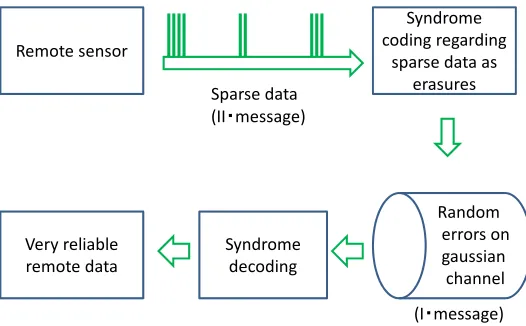
Theoretical background of present paper
Remote sensor
Syndrome coding regarding
sparse data as erasures
Random errors on gaussian
channel Syndrome
decoding Very reliable
remote data
Sparse data (II・message)
(I・message)
Fig. 1: Syndrome coding
In Feb.1986, the author presented a survey paper on cryptgraphy [17]. In Ref. [17], the author suggested the using of McEliece PKC on noisy channel and presented a very simple scheme of joint coding for encryption and error control coding, based on McEliece PKC.
The author recently proposed a new class of code based PKC, K(XII)SE(1)PKC [1], on the basis of syndrome coding. K(XIII)SE(1)PKC and Kp(XIII)SE(1)PKC presented in this paper are modified versions of
K(XII)SE(1)PKC.
2.2
Construction
Let the vectorµi overF2m be defined by
µi= (µi1, µi2,· · · , µiK) ; i= 1,2,· · ·, k ;
µi̸=µj for (i̸=j), (3)
where
K=E−g. (4)
Letµi(x) be
µi(x) =µi⃝1x⃝1 +µi⃝2 x⃝2 +· · ·+µi η⃝x⃝η ; i= 1,2,· · ·, k, (5)
where the exponent⃝i takes on a random value such that
0≤⃝ ≤i K−1 ; ⃝ ̸i =⃝j for i̸=j. (6)
We assume thatµi⃝j takes on a random value overF2m. From Eq.(6), we see that the Hamming weight ofµi is
w(µi)≤η ; i= 1,2,· · ·, k. (7) Let carrier µi(x) be transformed into
µi(x)xg≡ri(x) modG(x) ;i= 1,2,· · ·, k,
=ri1+ri2x+· · ·+rigxg−1.
(8)
We then have the code wordvi(x) as
Let the code words of{vi}be
v1= (µ11, µ12,· · · , µ1K, r11, r12,· · · , r1g), v2= (µ21, µ22,· · · , µ2K, r21, r22,· · · , r2g),
.. .
vk = (µk1, µk2,· · · , µkK, rk1, rk2,· · ·, rkg).
(10)
LetAr be
Ar=
r11, r12, · · · , r1g
r21, r22, · · · , r2g
..
. ... ...
rk1, rk2, · · · , rkg
, (11)
where we let
ri= (ri1, ri2,· · ·, rig). (12)
The matrixAris transformed into
Ar·PI =
u11, u12, · · ·, u1g
u21, u22, · · ·, u2g
..
. ... ...
uk1, uk2, · · ·, ukg
, (13)
wherePI is a random column permutation matrix overF2m. Letui be
ui= (ui1, ui2,· · ·, uig) ; i= 1,2,· · · , k. (14)
We assume that the elements of the set{ui}are ordered asu1,u2,· · ·,uk. The set{ui}will be publicized.
We shall refer to subscriptias locationi.
For I·messagea= (a1, a2,· · ·, at), Bob constructs the message polynomial :
at(x) = a1x[1]+a2x[2]+· · ·+atx[t];
0≤[i]≤g−1, (15)
where the exponents [1],[2],· · ·,[t] satisfies
1≤[1]<[2]<· · ·<[t−1]<[t]≤g−1. (16) Throughout this paper (except Kp(XIII)SE(1)PKC), we assume that Bob randomly selects a set of
expo-nents{[i]}, all over again, for every given I·message. Set of keys are :
Public key : {ui}
Secret key : {µi},{ri}, Ar, PI
After constructiong at(x) = a1x[1]+a2x[2] +· · ·+atx[t], Bob selects the location of the public key
(1),(2),· · · ,(η) based on the transformation :
φ({[i]}) ={(i)}, (17) where the order of{(i)} is chosen as
After performing this transformation, Bob selects public keysu(1),u(2),· · · ,u(η)from{ui}.
Let the wordwbe
w=m1u(1)+m2u(2)+· · ·+mηu(η). (19)
The ciphertextC is
C=w+at. (20)
It should be noted that, in accordance with a random choice of locations (i)’s, the carrier µ(i)’s are
selected.
Theorem 1: Erasure errorEη(x) due to II·messagemis
Eη(x) = η ∑
i=1
miµ(i) 1⃝x⃝1 + η ∑
i=1
miµ(i) 2⃝x⃝2
+· · ·+
η ∑
i=1
miµ(i)⃝ηx⃝η
(21)
Proof : Straightforward 2
We also see from Eq.(21) thatatresults in random errors. The minimum distance,D, of the Reed-Solomon
code generated byG(x) of degree gis
D=g+ 1. (22)
The following relation :
2t+η+ 1 =D, (23)
is required to hold so that the messagesmanda may be correctly decoded. LetBµ overF2mbe
Bµ=
µ(1) 1⃝, µ(1) 2⃝, · · · , µ(1)⃝η
µ(2) 1⃝, µ(2) 2⃝, · · · , µ(2)⃝η
.. .
µ(η) 1⃝, µ(η) 2⃝, · · · , µ(η)⃝η
. (24)
All the row vectors ofBµ are selected based on a set of randomly chosen locations {(i)}.
Let PBµ[NS] be the probability that Bµ over F2mproves non-singular under the condition that all the elements are randomly chosen. The probabilityPBµ[NS] can be bounded by
PBµ[NS]>(1−2
−m)η ∼
= 1−η2−m;m >∼88. (25) We see that, for m= 88, η = 64, t= 32, g = 128, k= 128, non-singular matrix Bµ can be generated
with sufficiently high probability of more than 1−2.07×10⁻²⁵.
Thus even if Bob sends N = 1012 ciphertexts of size 1.41KB, the probability that one of the randomly
chosenBµ’s proves singular takes on, from Chebyshev’s inequality∗, an extremely small value of less than
2.07×10⁻¹³.
We see thatEµcan be decoded by erasure and error decoding [19], as all the erasure locations⃝1,⃝2,· · ·⃝η
are known to Alice. LetSu andSue be
Su={u1,u2,· · · ,uk} (26) and
Sue ={ue(1),ue(2),· · · ,ue(η)}, (27)
∗ε=N−1−P
Bµ[NS] = 10−12−2.07×10⁻²⁵.
P[ε]≤PBµ[NS](1N ε−2PBµ[NS])∼=
2.07×10⁻²⁵
Let a subset ofSu beSisuch that
Seu⊂Si (28)
and
#Si=g−t−i. (29)
2.3
Security considerations
Remark 1: The using of the Reed-Solomon codes is very attractive because they meet the very nice property of maximum distance seprability. However, so far, the using of Reed-Solomon code has been supposed to be a little dangerous as the generator polynomial can be estimated without much difficulty compared with the Goppa code. However the author strongly feels that even if the generator polynomial is disclosed, K(XII)SE(1)PKC can be made sufficiently secure as we discussed in Ref [1]. Accordingly we do not regard G(x) as a secret key. However G(x) is not recommended to be publicized.
Attack 1: Attack on estimating carrier µi
Let the probability that carrierµi is estimated correctly be denotedPs[ ˆµi]. Then
Ps[ ˆµi] = (
K η
)−1
(2m)−η. (30)
In order to be secure against Attack 1, we recommend Ps[ ˆµi] be
Ps[ ˆµi]≤2−
80= 7.21×10⁻²⁵. (31)
In this paper, we let m be longer than 88 and η, larger than 8. As a result Ps[ ˆµi] can be made much
smaller than 2−80. We conclude that K(XIII)SE(1)PKC can be secure against Attack 1. Attack 2: Attack on II·message
Let us define the following steps of Attack 2:
Step 1 : Exhaustive attack for disclosing g−t−ierror free symbols among the symbols of a given ciphertext C.
The probability that Step 1 proves successful is
Ps[Step 1] = (
g−t g−t−i
) (
g g−t−i
)−1
= (g−t)!(t+i)!
i!g! .
(32)
Step 2 : Exhaustive attack for obtainingg−t−ielements from{ui}that includesug(1),ug(2),· · ·,ug(η).
The probability of successfully obtainingg−t−isymbols that includesue(1),ue(2),· · · ,ue(η)is
Ps[Step 2] = (
k−η g−t−η−i
) (
k g−t−i
)−1
= (k−η)!(g−t−i)!
k!(t−i)! ,
(33)
where we letg−t−η =t.
LetPs[Step 1]∗Ps[Step 2] =Ps[Attack 2] be
Ps[Attack 2] =AB, (34)
where
A= (g−t)!(k−η)!
B =(t+i)!(g−t−i)!
i!(t−i)! = 1
t!
(
t i
)
(t+i)!(g−t−i)!
< 1 t!
(
t i
)
t!(g−t)!.
(36)
As the following relation holds (
t i
)
<
(
t t/2
)
. (37)
We now have the upper bound ofB as
B <
(
t t/2
)
(g−t)!. (38)
The upper bound of probabilityPs[Attack 2] is
Ps[Attack 2]<
(k−η)!
g!k!
(
t t/2
)
{(g−t)!}2. (39)
Example 1 : m= 96,k= 312,g= 212,t= 64,η= 84. We see that the relation 2t+η =g holds.
The probabilities PBµ[NS], andPs[Attack 1] are
PBµ[NS]>1−η·2
−m= 1−1.06×10⁻²⁷, (40)
Ps[Attack 2]<
(k−η)!
g!k!
(
t t/2
)
{(g−t)!}2
= 1.78×10−72,
(41)
yielding an extremely small value.
2.4
Encryption and decryption processes.
[Encryption process]
Step 1 : Given I·messageae= (ea1,ea2,· · ·,eat), Bob randomly chooses the locations :
[1],[2],· · ·,[t].
Step 2 : Bob transforms I·message vector aintoeat(x) =ea1x[1]+ea2x[2]+· · ·+eatx[t].
Step 3 : Bob transforms{[i]}into{(i)}, yieldingu(1)e ,u(2)e ,· · · ,u(η)e . Step 4 : Given II·messagemf= (me1,me2,· · ·,meη), Bob calculates the word :
e
w=m1eu(1)+m2ue(2)+· · ·+mηue(η).
[Decryption process]
Step 1 : Receieving the ciphertextCe(=we +ate ) from Bob, Alice calculates the following : (we +eat)PI−1=er+αte , where αte =ate PI−1.
Leter+αte be denoteder+αet=Ce−T = (ec1−T,ec2−T,· · · ,ecg−T).
Step 2 : GivenCe−T, Alice decodes an erasure valueEη andαte ,
for example, with Euclidean erasure and error decoding algorithm [18], [19]. Step 3 : Alice decodesae= (ea1,ea2,· · ·,eat) by performingPI onαet.
Step 4 : Alice decodes{(fi)} from{[ei]}.
Step 5 : FromEeη(x), II·messagemis decoded by solving linear simultaneous equations given by Eq.(21).
3
A particular class of K(XIII)SE(1)PKC,
K
p(XIII)SE(1)PKC
In Kp(XIII)SE(1)PKC, the locations for II·message are not randomly chosen but are predetermined. Without
loss of generality, let these predetermined locations bex0, x1, x2,· · ·, xt−1. As a resulta
t(x) is now
at(x) =a1+a2x+· · ·+atxt−1. (42)
Bob selects the locations{(i)} based on
φ({ai}) ={(i)}. (43)
Considering thatatresults in an erasure error, the coding rate ρis
ρ=t+η
|c| = g
g = 1.0. (44)
We see that the coding rateρtakes on the value of exactly 1.0.
Attack 3: Exhaustive attack on disclosing the set of locations{(i)} The probability,Ps[{(i)}], that{(i)} is successfully disclosed by an attacker is
Ps[{(i)}] = (
k η
)−1
. (45)
In order to be secure against Attack 3, we letPs[{(i)}] be
Ps[{(i)}]<2−80= 8.27×10⁻²⁵. (46)
Example 2 : m= 88,k= 96,g= 64,t=η= 32
The probability Ps[{(i)}], coding rateρand the size of public keySPK are
Ps[{(i)}] = (
96 32
)−1
= 3.36×10⁻²⁶, (47)
ρ= η+t
|c| = 1.0, (48)
SPK=mgk= 67.6(KB). (49)
We see that the coding rateρtakes on exactly 1.0. We also see that the size of public key is smaller than that of Example 1, by a factor of about 12.
The probabilityPs[{(i)}] takes on a value less than 2−80. We thus conclude Kp(XIII)SE(1)PKC would
Besides Kp(XIII)SE(1)PKC realizes the coding rate of exactly 1.0, yeilding a simple digital signature scheme
compared with K(XIII)SE(1)PKC.
4
Conclusion
In this paper, we have presented a new class of public key cryptosystem by modifying K(XII)SE(1)PKC, referred to as K(XIII)SE(1)PKC and Kp(XIII)SE(1)PKC. We have clarified the followings :
(i) K(XIII)SE(1)PKC would improve both the coding rate and the security, compared with K(XII)SE(1)PKC.
(ii) In Kp(XIII)SE(1)PKC, the coding rateρtakes on the value of exactly 1.0, yielding a simple
signature scheme compared with K(XIII)SE(1)PKC.
(iii) In a sharp contrast with the conventional CB·PKC that uses Goppa code, in K(XII)SE(1)PKC, K(XIII)SE(1)PKC and Kp(XIII)SE(1)PKC, we do not care for the security of the primitive
polynominal that generates the Reed-Solomon code.
References
[1] M. Kasahara, “A New Class of Public Key Cryptosystems Constructed Based on Reed-Solomon Codes K(XII)SE(1)PKC.– Along with a presentation of K(XII)SE(1)PKC overF28, the field extensively used
for various storage and transmission systems –”, Cryptology ePrint Archive, 2013/363 (2013-06).
[2] M. Kasahara and R. Sakai “A Construction of Public Key Cryptosystem for Realizing Ciphertext of size 100 bit and Digital Signature Scheme”, IEICE Trans. Vol. E87-A, 1, pp.102-109 (2004-01).
[3] M. Kasahara and R. Sakai “A Construction of Public Key Cryptosystem Based on Singular Simultaneous Equations”, IEICE Trans. Vol. E88-A, 1, pp.74-79 (2005-01).
[4] N. Koblitz “Algebraic Aspect of Cryptography”, Springer Verlag, Berlin Heidelberg.
[5] T. Mastumoto and H. Imai “Public Quadratic Polynomial-Tuples for Efficient Signature - Verification and Message-Encryption”, Advances in Cryptology, Eurocrypt’88, Springer-Verlag, pp.419-453 (1988).
[6] J. C. Faugere and A. Joux “Algebraic cryptanalysis of hidden field equation (HFE) cryptosystems using Gr¨obner bases”, In Advances in Cryptoglogy-CRYPTO 2003 pp.44-60 (2003).
[7] C. Wolf: “Multivariate Quadratic Polynomials in Public Key Cryptography”, Dr. Thesis, Katholieke Universiteit Leuven, (2005-11).
[8] M. Kasahara “Construction of New class of Linear Multivariate Public Key Cryptosystem - Along With a Note on the Number 9999990 and its Application”, Technical Report of IEICE, ISEC 2009-44 (2009-09).
[9] M. Kasahara “A New Class of Public Key Cryptosystems Constructed Based on Perfect Error-Correcting Codes Realizing Coding Rate of exactly 1.0”, Cryptology ePrint Archive , Report 2010/139 (2010-03).
[10] M. Kasahara “A Construction of New Class of Linear Multivariate Public Key Cryptosystem Con-structed Based on Error Correcting Codes”, Technical Report of IEICE , ISEC 2009-135 (2010-03).
[12] R. J. McEliece: “A Public-key Cryptosystem Based on Algebraic Coding Theory”, DSN Progress Re-port, no.42-44, pp.114-116 (1978).
[13] J. C. Faugere and A. Otomoni, L. Perret, J. P. Tillich: “Algebraic Cryptanalysis of McElierce Variants with Compact Keys”, Eurocrypt’10.
[14] E. M. Gabidulin: “Public-key cryptosystems based on linear codes”, Report 95-30, TU Delft (1995).
[15] A. J. Viterbi: “Error-Bounds for Convolutional Codes and an Asymptotially Optimum Decoding Algo-rithm”, IEEE Trans. Inform. Theory, IT-13, 2, pp.260-269 (April 1967).
[16] H. Kumazawa, M. Kasahara, and T. Namekawa: “A Construction of Vector Quantizers for Noisy Channels”, Trans. of IEICE, Vol. J67-B, No.1 pp.1-8 (1984-01).
[17] M. Kasahara: “On Cryptography”, Proc. of Symposium on Information and Communication Network Security, pp.154-179 (Feb. 1986).
[18] Y. Sugiyama, M. Kasahara, S. Hirasawa and T. Namekawa: “A method for solving key equation for decoding Goppa codes”, Info. and Control, 27, pp.87-99 (1975).