IJISET - International Journal of Innovative Science, Engineering & Technology, Vol. 2 Issue 10, October 2015.
www.ijiset.com
ISSN 2348 – 7968
Design, Fabrication and Performance Evaluation of a
Low-Cost Portable Roasted Groundnut Seeds Dehuller
Ayelegun, T. A. and *Ajewole, P. O.
Department of Agricultural and Bio-Environmental Engineering, The Federal Polytechnic, Ado-Ekiti, Nigeria *Corresponding Author: 32TU[email protected]U32T, +2347068675165
Abstract
Traditionally, the manual dehulling (removal of peels) of roasted groundnut seeds has been a
time-consuming and tedious operation. A low cost roasted groundnut seeds dehuller was
therefore designed, fabricated and tested. The machine consists of a hopper made of stainless
steel, a dehulling unit consisting of a shaft with rubber spikes arranged on it and which rub the
groundnut seeds against a housing, a discharge unit for collection of dehulled seed, a fan for
blowing away the chaffs and a frame made of mild steel. The overall size of machine is 235mm
x 200mm x 250mm. The result obtained after testing the machine shows that at four testing trials,
the average dehulling efficiency obtained are 81.83% while cleaning efficiency and machine
throughput are 97.02% and 37.78kg/hr respectively. The machine total cost is SNS35,500.00.
Introduction
Groundnut (Arachis hypogaea L.) is an important grain legume that grows in wet conditions in
semi-arid regions of the world (Rao, 1980). As major crop in most of the tropical and subtropical
regions, groundnut ranks 12th in the world crop production. It is grown in all continents with a
total area of 24.6 million hectares, and a production of 41.3 million tons in 2012 (FAO, 2013).
There are two main types of groundnut: the America groundnut (Arachis hypogea), and the
Africa groundnut, the Bambara nut (Voandzeia subterranean). Both are grown in Western Africa
as a protein source. Groundnuts also contain sufficient quantity of carbohydrates and fats. The
America groundnut grow 30-40cm high and do not spread. The West Africa groundnut is shorter
and run along the ground from 30-60cm. Yields of kernels generally range from 0.5-4.0 tons/hec.
In the developing countries, where 80 % of the crop is produced, the average yields are around 1
tons/hec (Shankarappa et al, 2003; Hommons, 1994). Africa, with 11.7 million hectares of land
used for groundnut production and 10.9 million tons of annual production in 2012 is second only
to the American continent (FAO, 2013). De-hulling (removal of seed coat from a grain) after the
kernel has been roasted is vital in the final processing of such seed for human consumption. For
roasted groundnut, de-hulling also means de-chaffing. This is traditionally done manually by the
women and children by rubbing the groundnut kernels in between their palms. The cleaning is
achieved by using mouth to blow away the chaff from the kernels while the kernels are still in
their palms, while the de-hulling process for other legumes such as sorghum and millet is
accomplished either traditionally by hand pounding of tempered grain using pestle and mortar or
mechanically using abrasive de-hullers (Munck et al, 1982). There have been several attempts to
make machines that de-hull legumes and other seeds such as sorghum, cowpeas, maize etc.
Between 1972 and 1976, the then Nigeria’s Federal Ministry of Agriculture and Natural
Resources and the North-Eastern State Ministry of Agriculture and Natural Resources
established a complete processing plant consisting of de-huller, hammer mill and a diesel engine
to drive the equipment in Maiduguri (Dovlo et al, 1976). Most groundnut dehulling machines
fabricated in Nigeria are either too expensive or not efficient, and as a result of high demand for
groundnut and ground product in the world market today, the traditional method of using bare
hand to dehull and winnowing to separate groundnut seeds are time and labour consuming. Since
the local method of production could not match the demand there is the need to develop a
machine which will remove drudgeries, reduce the number of labour required and the time for
dehulling and winnowing kernel from the husk or skin of the groundnut. Hence, a portable
roasted groundnut seeds dehuller was designed and fabricated.
Methodology
Description of the machine
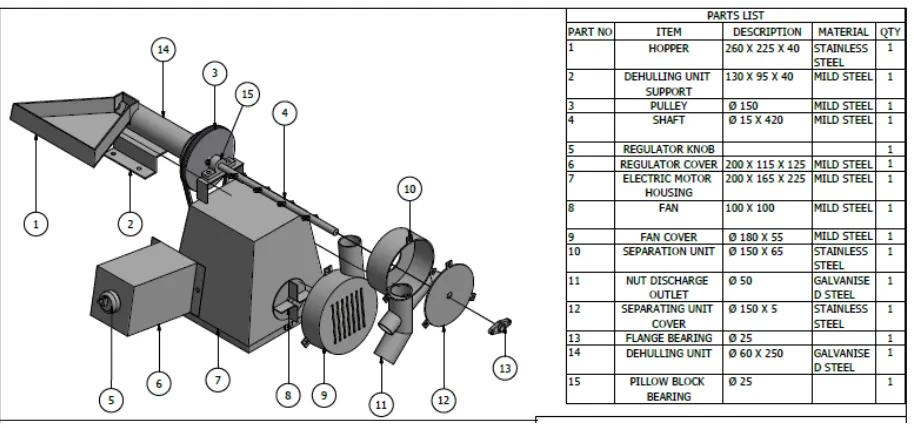
The isometric and exploded views of the machine are shown in Fig. 1 and Fig. 2 respectively.
The roasted groundnut dehulling machine consists of the following components:
i. The Hopper: The hopper is pyramidal in shape and suitable at the left to top hand side of
the machine. It is the inlet in which the roasted groundnut seeds were admitted into the
IJISET - International Journal of Innovative Science, Engineering & Technology, Vol. 2 Issue 10, October 2015.
www.ijiset.com
ISSN 2348 – 7968
dehulling chamber. The hopper is fabricated from stainless steel of dimension 200mm x
80mm x 260mm.
ii. The Dehulling Unit: This is the core of the machine; it houses the shaft which bears the
iii. spikes that rub the roasted groundnut seeds.
iv. Discharge Unit: This is the point where the kernel and chaff from the dehulling unit are
collected separately. The machine has two discharge outlets, one for the kernels and other
for the chaffs.
v.
Machine Frame: The frame is the mounting support of all the components of themachine. Therefore, while it is desirable to minimize the weight of the frame, it should be
sufficiently strong and rigid.
Fig 1: Isometric View of the Groundnut Seed Dehuller
IJISET - International Journal of Innovative Science, Engineering & Technology, Vol. 2 Issue 10, October 2015.
www.ijiset.com
ISSN 2348 – 7968
Design of Components
The key components of the machine such as drive shaft, hopper, dehulling unit, and length of
belt were designed and the results of design calculations are given as follows:
Diameter of the drive shaft = 20mm
Length of belt = 430mm
Power required to drive dehulling unit = 0.44hp
Mode of Operation of The Machine
The dehulling operation of the machine is achieving by rubbing and rotation forces. The main
function of the roasted groundnut seeds dehulling machine is to remove the husk (the thin coated
skin of the groundnut seed) from the seed and separated the kernel from the chaffs (husks of the
seeds). The hopper serves as the feeding mechanism through which the roasted groundnut seeds
are fed into the machine, after the feeding, the spikes coupled with impeller serves as conveyor
and the same time rub the seed with cylinder wall, and the roasted seeds to the outlet. As the
conveying and rubbing progress dehulling of the roasted groundnut seeds take place. Finally, the
dehulled seeds and the chaffs (skin) are collected through different outlets. The machine is
incorporated with a fan to separate the dehulled seeds and chaffs (skin) as the dehulled seeds are
dropping from the dehulling unit. The machine is made up of two units at the discharge point,
namely; the kernels discharge unit and chaffs discharge unit.
Test Procedure and Results
The machine was run with constant power of 1,1025kw (1.5hp) electric motor. Different sample
of roasting groundnut seeds were measured in grams using electronic weighing balance before
being taken to machine dehuller. The weights are; 110.1g, 107.1g, 110.7g and 107.4g. The total
weight of each sample was measured before dehulling and after dehulling. The discharge
obtained were separated into different five categories such as: (i) Fully dehulled (ii) Undehulled
IJISET - International Journal of Innovative Science, Engineering & Technology, Vol. 2 Issue 10, October 2015.
www.ijiset.com
ISSN 2348 – 7968
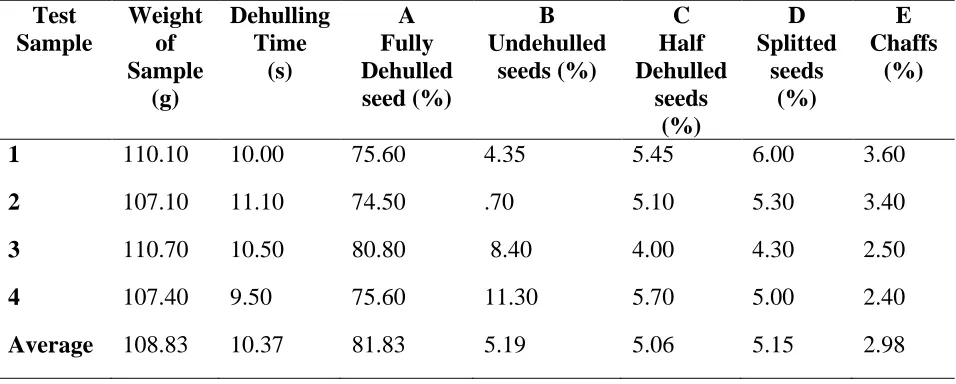
seeds (iii) Half dehulled seeds (iv) Splitted seeds (v) Chaffs. Each category was measured one
after the other using electric weighing balance. Table 1 shows the result obtained for the four test
samples
Table for the tester samples are:
Test Sample Weight of Sample (g) Dehulling Time (s) A Fully Dehulled seed (%) B Undehulled seeds (%) C Half Dehulled seeds (%) D Splitted seeds (%) E Chaffs (%)
1 110.10 10.00 75.60 4.35 5.45 6.00 3.60
2 107.10 11.10 74.50 .70 5.10 5.30 3.40
3 110.70 10.50 80.80 8.40 4.00 4.30 2.50
4 107.40 9.50 75.60 11.30 5.70 5.00 2.40
Average 108.83 10.37 81.83 5.19 5.06 5.15 2.98
Based on the result obtained in Table 1, the following parameters were calculated to give the
performance of the machine:
(a) Dehulling efficiency = Average of A = 81.83%
(b) Cleaning Efficiency = (1 – Average of E)% = (1 – 2.98)% = 97.02%
(c) Machine Throughput =
) ( ) ( hr Taken Time Average kg Samples of Weight Average = 3600 37 . 10 1000 84 . 108
= 37.78 kg/hr
Conclusion
A roasted groundnut dehulling machine was designed, fabricated and tested. Low cost available
materials were used in fabricating the machine. Initial test of the machine showed that it has a
dehulling efficiency and cleaning efficiency of 81.83% and 97.02% respectively. The throughput
of 37.78kg/hr showed that the machine is very efficient in saving the manual labour required in
dehulling roasted groundnuts.
References
FAO (2013). FAO Data Base. http://www.faostat.fao.org/ 4 July.
Rao VR (1980). Groundnut genetic resources at ICRISAT. In proceedings of the International
workshop on Groundnuts, pp. 65-71, ICRISAT, India.
Munck, L., Back Knudsen, K. E., Axtell, J. D. Industrial Milling for the 1980s. Proceedings of
the International Symposium on Sorghum. International Crops Research Institute for the
Semi-Arid Tropics. Patancheru, India. 1982.
Dovlo, F. E., Williams, C. E., Zoaka, L,. Cowpeas – home preparations and use in West Africa.
Ottawa Canada: International Research Centre. 1976 96pages.
Shankarappa T., Robert E. R. and Virginia N. (2003). World geography of groundnut:
distribution, production, use and trade.
[Hommons, R. O. (1994): The origin and History of groundnut, In: Smart, J. (Ed), The
Groundnut crop; A scientific Basis for Improvement. New York, U.S.A. Chapman and Hall, pp:
56-78.