Feedback Constraint for Validating Work
Efficiency in Spatial Crowdsourcing
Arivukkarasi.D1, Kavitha.B1, Mythily.R1,S.I.Santhana Lakshmi2
B.E Student, Dept. of C.S.E, GTEC, Vellore, Tamil Nadu, India1
Assistant Professor, Dept. of C.S.E, GTEC, Vellore, Tamil Nadu, India2
ABSTRACT : Currently there is a huge increase in smart devices usage and internet in common people and so it is possible for a crowd of people to easily participate in location-based tasks which lays the way for spatial (geo-location based) crowdsourcing process. So we are about to develop a spatial crowdsourcing platform for assigning spatial task to the worker considering the task’s required skills under specific time constraint and budget. Finding an optimal worker to assign a task is very essential which creates an important problem known as multi-skill spatial crowdsourcing. Many existing task assignment platform helps in assigning task automatically based on spatial information and skill constraints but they are not considering multi skill constraints of worker to assignment a task or process which produce an optimal solution to the hiring person or employer. To solve this problem we propose three effective heuristic approaches, including greedy, g-divide and-conquer,sentiment analysis algorithms and cost-model-based adaptive algorithms to get worker-and-task assignments without any computational overhead.
KEYWORDS: Spatial Crowdsourcing, Spatial Task Assignment, Multi Skill, greedy algorithm, g-divide and conquer algorithm cost-model-based algorithm,sentiment analysis algorithm.
I. INTRODUCTION
With the popularity of GPS-equipped smart devices and wireless mobile networks nowadays people can easily identify and participate in some location-based tasks that are close to their current positions, such as repairing houses,in technical field such as system repairing,electronics repair,at some spatial locations. Recently, a new framework, namely spatial crowdsourcing, for employing workers to conduct spatial tasks, has emerged in both academia and industry. A typical spatial crowdsourcing platform assigns a number of moving workers to do spatial tasks nearby, which requires workers to physically move to some specified locations and accomplish these tasks. In contrast, some spatial tasks can be rather complex, such as network installation, test job, software deployment and require demanding professional skills from workers. In other words, these complex tasks cannot be simply accomplished by normal workers, but require the skilled workers with specific expertise. Inspired by the phenomenon of complex spatial tasks, in this paper, we will consider an important problem in the spatial crowdsourcing system, namely multi-skill spatial crowdsourcing (MS-SC), which assigns multi-skilled workers to those complex tasks, with the matching skill sets and high scores of the worker-and-task assignments. In the sequel, we will illustrate the MS-SC problem by means of Crowdsourcing is effective in areas where the task can be easily described to humans than computers,e.g., perception task and task involving creativity. To explore our concept we implemented a crowdsourcing platform that integrates location as a parameter for distributing tasks to workers.
II.EXISTINGSYSTEM
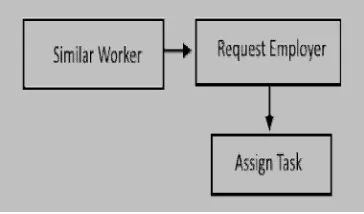
the multi skill workers. This accomplished by verifying the similarity of task list with each worker and assign more score to worker with more similarity values.
III.PROBLEMDEFINITION
In this section, we present the formal definition of the multi- skill spatial crowdsourcing, in which we assign multi-skilled workers with time-constrained complex spatial tasks our proposed system task assignment is based on value given by the worker so there no proof for validating the worker efficiency. So we provide a feedback based constraint to generate rating for each worker in the platform. After that only effective employees can get the task assigned and other wont. It also induce non effective worker to work effectively to get a good rank in the system. Feedback refers to Information about reaction to the product, a person’s preformation of the task which use as the basis for improvement of the effective employees.
IV.SYSTEMARCHITECTURE
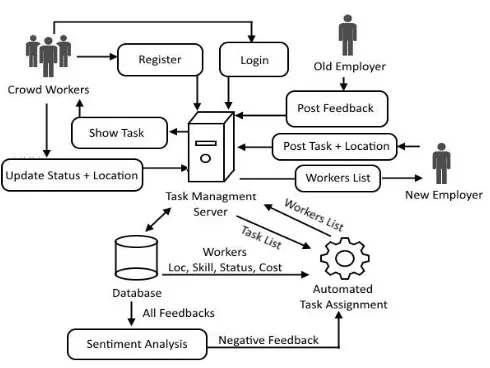
Fig 3 overall architecture
V.THE GREEDY ALGORITHM
According to the definition of the score increase and which iteratively assigns a worker to a spatial task that can always
achieve the highest score increase Ip . Initially, we set Ip to be empty, since no workers are assigned to any tasks .Next, we find out all valid worker-and-task pairs in the crowdsourcing system at timestamp p. Here, the validity of pair satisfies 4 conditions
(1) the distance between the current location, of worker wi and the location, lj of task tj is less than the maximum moving distance, di of worker wi,
(2) workerwi can arrive at the location, lj, of task tj before the arrival deadline ej; (3) workerwi have skills that task tj requires; and
Fig 4 greedy algorithm
VI.THE G-DIVIDE-AND-CONQUERAPPROACH
Although the greedy algorithm incrementally finds one worker-and-task assignment (with the highest score increase) at a time, it may incur the problem of only achieving local optimality. Therefore, in this section, we propose an efficient
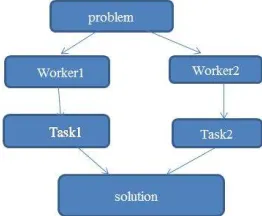
g-divide-and-conquer algorithm (g-D&C), which first divides the entire MS-SC problem into g subproblems, such that each subproblem involves a smaller subgroup of spatial tasks, and then conquers the subproblems recursively different numbers, g, of the divided subproblems may incur different time costs, in this paper, we will propose a novel cost-model-based method to estimate the best g value to divide the problem. Specifically, for each subproblem/subgroup ,
we will tackle the worker-and-task assignment problem via recursion ( the base case with the group size equal to 1 can be solved by the greedy algorithm which has an approximation ratio of where N is the total number of skills). During the recursive process, we combine/merge assignment results from subgroups, and obtain the assignment strategy for merged groups, by resolving the assignment conflicts among subgroups. Finally, we can return the task assignment
instance set Ip, with respect to the entire worker and task sets. In the sequel, we first discuss how to decompose the MS- SC problem into sub problems. Then, we will illustrate our g-divide-and-conquer approach in which utilizes the decomposing and merging algorithms. Finally, we will provide a cost model to determine the best number g of subproblems during the g-D&C process.
VII.COSTMODELBASEDALGORIHTM
The objective of our Cost model based model is to provide accurate estimate of the execution time of nearest neighbour queries including high dimensional data. It is a well known fact that simple queries ,including nearest neighbour queries are Input/0utput bound and only complex queries such as spatial join may be CPU –bound.Therefore,it is justified to take the number of page accesses as a measure for the query performance .Our cost model may be used for optimizing the parameters of the index structures such as the block size as well as for query optimization.
VIII. SENTIMENT ANALYSIS ALGORITHM
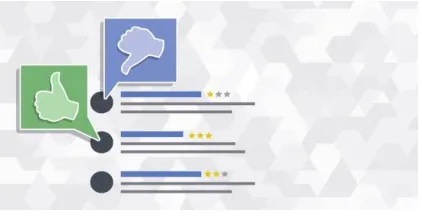
Identify and extract sentiment in given string. Sentiment analysis (also known as opinion mining) refers to the use of natural language processing, text analysis and computational linguistics to identify and extract subjective information in source materials. This algorithm takes an input string and assigns a sentiment rating in the range [-1 t0 1] (very negative to very positive). Sentiment Analysis is the use of natural language processing, statistics, and text analysis to extract, and identify the sentiment of text into positive, negative, or neutral categories. We often see sentiment analysis used to arrive at a binary decision: somebody is either for or against something, users like or dislike somethingor the product is good or bad. Sentiment analysis is also called opinion mining since it includes identifying consumer attitudes, emotions, and opinions of a company’s product, brand, or service.
Fig 6:sentiment analysis
IX. SENTIMENT ANALYSIS USE CASES
Analysis can be used to quickly analyze the text of research papers, news articles, social media posts like Tweets, and more.Social Sentiment Analysis is an algorithm that is tuned to analyze the sentiment of social media content, like tweets and status updates. The algorithm takes a string, and returns the sentiment rating for the “positive,” “negative,” and “neutral.” In addition, this algorithm provides a compound result, which is the general, overall sentiment of the string.
X. SIMILARITY MATRIX CONSTRUCTION
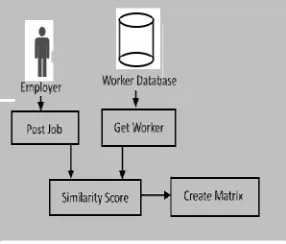
Each worker has a timeline, budget and set of skills and each employer will have a set of task, location, budget and timeline.A similarity score generated and given to each worker based on the employer’s requirement.Based on these details we construct a similarity matrix which hold these similarity value in a matrixform.
Fig 7: similaritymatrix construction
XI.G-DIVIDED-AND –CONQURE ALGORITHM
• To reduce the computation load and memory complexity we use divide and conquer algorithm.
• divide and conquer splits the datasets into small multiple parts process them separately to generate an intermediate results.
• These intermediate are combined and process till we get the end results for the process.
Fig 8:G-divided-and –conqure algorithm
XII.FINDING SIMILAR CROWDS
• This module finds the final worker group to whom the task need to assigned.
• Initially the system is provided with list of multiple worker satisfying the employer’s condition .
XIII.TASK ASSIGNMENT
• Reviewing the final list, employer approves the form to assign the task to the worker.
• Employer and the worker update the status of the task in the system so that the worker may get another. • After completion of job the employer pay the worker and provides a feedback in the system.
• If worker performance is poor the employee will give negative feedback which is drawback for the worker career.
Fig 9:Task Assignment
XIV.CONCLUSION
We had built an centralized web platform for managing the task assignment process thought which the employers and works can get benefited. We used divide and conquer technique to manage the memory complexity problem and greedy technique to select the most feasible worker for a task. And we also extracted the workers negative feedback to optimized the assignment process so that only genuine worker get their job
XV.FUTUREWORK
In future we are planning to provide addition security constrains based on user payments when the employer is willing to give a task to a worker he need to pay to the system first then the task is assigned to the worker if there is any dispute between the employer and the worker then the admin checks the problem and make payment to the worker in case they are wright else the payment will be rollback to the employers
REFERENCES
[1].(2016)PengCheng,Xiang Lei Chen,Member,IEEE,JinsongHan,Member,IEEE,andJizhongzhao,Member,IEE.Task Assignment on multi-skill oriented spatial crowdsourcing..
[2] (2016). Google street view [Online]. Available: https://www. google.com/maps/views/streetview. [3] (2016). Taskrabbit [Online]. Available: https://www.taskrabbit. Com.
[4] (2016). Waze [Online]. Available: https://www.waze.com.
[5] F. Alt, A. S. Shirazi, A. Schmidt, U. Kramer, and Z. Nawaz, “Location-based crowdsourcing: Extending crowdsourcing to the real world,” in Proc. 6th Nordic Conf. Human-Comput. Interaction: Extending Boundaries, 2010 pp. 13–22.
[6] R.Boim, O.Greenshpan,T. Milo,S. Novgorodov,N. Polyzotis, and W.-C. Tan, “Asking the right questions in crowd data sourcing,” in Proc.IEEE28thInt.Conf.DataEng.,2012pp.1261–1264.
[7] C. C. Cao, J. She, Y. Tong, and L. Chen, “Whom to ask?: Jury selec- tion for decision making tasks on micro-blog services,” in Proc. VLDB Endowment, 2012, vol. 5, no. 11, pp. 1495–1506.
[8] Z. Chen, R. Fu, Z. Zhao, Z. Liu, L. Xia, L. Chen, P. Cheng, C. C. Cao, and Y. Tong, “Gmission: A general spatial crowdsourcing platform,” in Proc. VLDB Endowment, 2014, vol. 7, no. 13, pp. 1629–1632.
[9] P. Cheng, X. Lian, Z. Chen, R. Fu, L. Chen, J. Han, and J. Zhao, “Reliable diversity-based spatial crowdsourcing by moving workers,” in Proc. VLDB Endowment, 2015, vol. 8, no. 10, pp. 1022– 1033.
[12] J. Fan, G. Li, B. C. Ooi, K.-l. Tan, and J. Feng, “iCrowd: An adap- tive crowdsourcing framework,” in Proc. ACM SIGMOD Int. Conf. Manage. Data ,2015, pp. 1015–1030.
[13] Z. B. G. L. J. F. Huiqi Hu, Y. Zheng, and R. Cheng, “Crowd- sourced poi labelling: Location-aware result inference and task assignment,” 32nd IEEE Int. Conf. Data Eng., May 2016.
[14] S. S. Kanhere, “Participatory sensing: Crowdsourcing data from mobile smartphones in urban spaces,” in Proc. 12th IEEE Int. Conf. Mobile Data Manage., 2011 pp. 3–6.