The Internet of Things in Education (IoTE):
An Overview
Sangeeta R. Singh
Lecturer, Department of Electronics and Telecommunication Engineering, Shah & Anchor Kutchhi Polytechnic,
Mumbai, India
ABSTRACT: Nowadays, learning is more and more taking place anywhere and anytime. This implies that e-learning environments are expanded from only virtual learning environments to both virtual and physical ones. Thanks to the evolution of Internet, Information and Communication Technology and Internet of Things, new learning scenarios could be experienced by learners either individually or collaboratively. Emerging technologies such as mobile computing, sensors and sensor networks, and augmented reality has led to innovations in the field of wearable computing. This paper discusses the various techniques used in e-learning mechanisms powered by IoT technology for better knowledge imparting and an immersive learning experience.
KEYWORDS: Energy efficient algorithm; Manets; total transmission energy; maximum number of hops; network lifetime
I. INTRODUCTION
Copyright to IJIRCCE DOI: 10.15680/IJIRCCE.2017. 0501161 1225
II. RELATED WORK
a. In 2014 mobile broadband subscriptions grew rapidly, almost five times faster than six years earlier (estimated to reach 2.3 billion worldwide) and the growth rates of developing countries are projected to be twice as high as in developed countries [1]. Rural areas of the developing world have increasing opportunities to use mobile devices and technologies. There are several reasons that a mobile device can empower the communication and interaction between teachers and learners in underdeveloped areas; for example, high rates of penetration, ownership, and portability and information deliverability [2]. Several researchers have explored the effectiveness of mobile devices as development tools to promote quality and equality of education in underdeveloped regions. Reference [3] stated that low-cost, mobile learning technology has the potential to facilitate personalized and exploratory learning through a child-centered model in an underdevelopment context. Consequently, researchers identified the successful use of mobile devices to improve educational outcomes in five developing countries in Asia including the Philippines, Mongolia, Thailand, India and Bangladesh. In particular, they found that mobile devices highly supported and increased accessibility, flexibility and that they reduced barriers to learning [2].
b. Through its Future City [4] program, the city of Glasgow is developing a school mapping project that will enable young people, parents, and teachers to map out which mode of transportation they use, the routes they take, and the distance they travel to school—and then combine the data to create a comprehensive visualization of the school’s travel network. Tools such as mobile apps, interactive games, and an online school travel planner will inform schools and communities on local changes in travel arrangements to encourage active modes of travel. The maps will be published online with the council’s open data manifesto, and will allow schools, local authorities, community councils, and transportation agencies to make smarter decisions on road safety and “active travel” [5] programs
c. In a joint research of Columbia and Paris University scientists, developed a system that allows students to interact with a set of physical objects in the surrounding. Each of these objects has associated one (or more) virtual object which provides information that allows the student to reach a learning achievement, as how they work, how it can be used, etc. This content is what we would add to the internet of objects. The purpose is to allow the students to manipulate the objects (both physically and virtually) in order to increase their understanding of the issue. In the experiments, the internal parts of the computer were tagged with NFC (Near Field Communication) and QRCODE (Quick Response CODE) allowing the association with virtual objects. [6]
d. The IoT is already present on most college and university campuses in the form of security cameras, temperature controls, and access to buildings, lights, power, etc. Ubiquitous access to computing power, high-quality online content, and social media and connections can be used to enhance the educational experience. Students can supplement their coursework with relevant video, activities, assessments, and conversations with students and faculty around the world. In addition, opportunities to do academic research on various aspects of the IoT are already under way in many higher education institutions like the "living lab" at Carnegie Mellon University. [7]
III. INTERNETOFEVERYTHING
billions, or even trillions, of connections create unprecedented opportunities and new risks. [10].
IV.IOEINEDUCATION
The four pillars of IoE create a need for an education system that empowers a new generation of digital citizens who understand the technologies that underpin IoE, the societal impact of widespread adoption, and the right application of the information that is captured.
Higher education programs must ensure that the next generation of engineers understands how to design and build
technological systems that reflect our altered expectations of openness and participation. In the area of computer science, the challenge is in developing new forms of scalable education that accommodate large numbers of students around the world, attract potential students with various interests, and deliver an innovative curriculum that reflects the radical changes in computing technology.
The model for applying wearable computing in e-education [9] was developed within the Laboratory for E-business (Elab), at the Faculty of Organizational Sciences, University of Belgrade. Cloud infrastructure is
a mediator between students and professor in the classroom. The infrastructure consists out of web services, storage/ontologies, a learning management system, and management interfaces. The main purpose of this part of the model is to gather data from the students and teachers, and to deliver specialized learning materials to individual devices. It also authenticates the users and authorizes them to access a learning session/course. This allows the teachers to directly control the experience of students taking their lectures.
The approach presented in (Anasol et al., 2012) proposes the creation then the use of a virtual laboratory by the combination of xReality, [11] virtual objects and learning activities in a mixed reality learning environment. The mixed reality activities that are structured as a sequence of learning activities based on IMS LD standard aim to help geographically dispersed learners to produce IoT projects. these activities are performed using Fortito’s Buzz Board educational toolkit (callaghan, 2012). this toolkit is composed by a variety of hardware components that form xReality objects and software modules and used to create IoT objects.
Copyright to IJIRCCE DOI: 10.15680/IJIRCCE.2017. 0501161 1227
V. RESEARCHFRAMEWORKOFSMARTEDUCATION
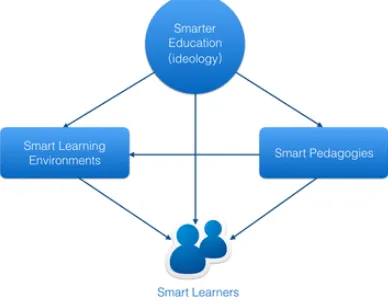
Based on the generalities of different countries’ smart education and the meaning of smart, the concept of smart education is proposed. Zhu and He (2012) stated that “the essence of smart education is to create intelligent environments by using smart technologies, so that smart pedagogies can be facilitated as to provide personalized learning services and empower learners, and thus talents of wisdom who have better value orientation, higher thinking quality, and stronger conduct ability could be fostered “ [12].
Figure 3 – Smart Learning Framework
And based on this definition of smart education, a research framework is proposed in Fig. 3. This framework describes three essential elements in smart education: smart environments, smart pedagogy, and smart learner. Smart education emphasizes the ideology for pursuing better education and thus had better to be renamed as smarter education, which address the needs for smart pedagogies as a methodological issue and smart learning environments as technological issue, and advances the educational goals to cultivate smart learners as results. Smart environments could be significant influenced by smart pedagogy.[13] Smart pedagogies and smart environments support the development of smart learners.
VI.CONCLUSION
The Internet of Things supported learning changes fundamentally the way in which knowledge is delivered to students. Using real objects and associating them as a learning resource through the IoT, brings tremendous benefits in engineering education, such as student-centered teaching approaches accompanied with enhanced student-to-student and faculty-to-student.
Communication. Therefore, the major impact of the IoT based learning environments is that the traditional teacher and student roles change significantly.
In our expectation on smart education, the smart learning environments could decrease learners’ cognitive load, and thus enable learners to focus on sense making and facilitate ontology construction. Also, students’ learning experience could be deepened and extended, and thus help students’ development in an all-round way (affectively, intellectually, and physically). Students can learn flexibly and working collaboratively in smart learning environments, and thus could foster the development of personal and collective intelligence of learners. Furthermore, better customize learning support could be provided for students to improve learners’ expectation.
REFERENCES
[1] International Telecommunication Union, "ITU releases 2014 ICT figures," vol. 2014, 2014.
[2] J. Valk, A.T. Rashid and L. Elder, "Using mobile phones to improve educational outcomes: An analysis of evidence from Asia," The International Review of Research in Open and Distance Learning, vol. 11, pp. 117-140, 2010.
[3] P. Kim, E. Buckner, H. Kim, T. Makany, N. Taleja and V. Parikh, "A comparative analysis of a game-based mobile learning model in low- socioeconomic communities of India," International Journal of Educational Development, vol. 32, pp. 329-340, 2012.
[4] http://futurecity.glasgow.gov.uk
[5] www.glasgow.gov.uk/index.aspx?articleid=4000
[6] J. Ǵomez, J. F. Huete “Interaction System Based on Internet of Things as Support for Education”, Science Direct, Procedia Computer Science 21 ( 2013 ) 132 – 139
[7] Byron Spice, "CMU Leads Google Expedition to Create Technology for 'Internet of Things,'" CMU News, July 9, 2015.
[8] M. Selinger, A. Sepulveda, J. Buchan “Education and the Internet of Everything” Cisco Consulting Services and Cisco EMEAR Education Team, October, 2013
[9] That ‘Internet of Things’ Thing: In the Real World, Things Matter More than Ideas,” Kevin Ashton, July 2009. [10] “Innovation Insight: The ‘Internet of Everything’ Innovation Will Transform Business,” Gartner; January 2012.
[11] A. Labus, “Wearable Computing In E-Education” Journal of Universal Excellence, March 2015, year 4, number 1, pp. A39–A51 [12] Anasol, P. R., Callaghan, V., Gardener, M., & Alhaddad, M. J. (2012), End-User Programming & Deconstrutionalism For Collaborative
Mixed Reality Laboratory Co-Creative Activities, 2nd European Immersive Education Summit, 26, 27.
[13] P. Dillenbourg, What do you mean by collaborative learning? Collaborative-learning: Cognitive and Computational Approaches, 1999, pp. 1–19