Expressive Properties of Internet Evolutionized Malay Words within the
Dimension of Malay Values and Attitudes
Mohd Zaidi Abd Rozan
1, Robin Nagano Lee
2, Yoshiki Mikami
11
Nagaoka University of Technology, Niigata, JAPAN
2
Miskolc University, Miskolc, HUNGARY
Abstract
Internet Evolutionized Malay (EM) is a newly formed language variety that has gained popularity within online text-based Malay communities. This paper discusses a study that utilized nine EM words and five of their corresponding Standard Malay (SM) words as word stimuli, with responses of 56 respon-dents towards 15 adjective pairs. The expressive properties or connotative meanings of the stimuli were then analyzed by means of Semantic Differential Analysis (SDA) to quantify the Type and Level of adjective-pairs. Based on the analysis, our investigation reveals two findings: 1) Different types of connotations of SM and EM words are observed, which are particularly common when the words per-tain to emotional description of human character, and 2) Level of connotation differs, where native Ma-lay speakers have a wider spectrum of perception for SM and EM words, showing higher sensitivity to the spelling changes on SM, while non-native Malay group shows less reaction to the change. It is important to note from this study that EM is not simply being exotically spelled as ‘eye-candy’ as al-ways argued, but also triggers different perceptual connotations.
Keywords: Internet Evolutionized Malay, Semantic Differential Analysis (SDA), Malay Values and Attitudes, Expressions, Connotations
Introduction
Due to its relatively low cost and ease of use, text-based communication on the Internet has become available to an increasingly large number of users. However, such a mode of communication pos-sesses several disadvantages, particularly in terms of the power of expression it can support when compared to a traditional face-to-face or even telephone conversation. Because of the absence of vis-ual signals and intonation cues, Internet users have developed some series of symbols to function as a representation of their expression. This has resulted in the enormous use of pictorial or
non-linguistic character based icons (emoticons), which produce richer dimensions within text-based communication (Wolf, 2000).
Even with the abundance of non-linguistic (or paralinguistic) elements offered in textual interaction, the need to mimic face-to-face conversation has pushed writers to inscribe words with the intention to bet-ter represent and further display their expression. This has resulted in the creation of various unusual spelling of words that are more colloquial in nature (Abd Rozan & Mikami, 2007). Here, the term ex-pression is defined as the representation of feelings or attitudes, which can be demonstrated by
pro-ducing or forming words that are in different spellings when compared to its standard variety. It is commonly accepted that such expression can be traditionally demonstrated within sound-mediated communication, which is universally capable of conveying someone’s thoughts or feelings (Scherer, 2003) by representing different prosody in voice, which is noticeable by ear. Our idea is to illustrate to
readers that a newly formed Evolutionized Malay (EM) may perform beyond its basic purpose as a
(SM) word, but also to bear a different representation of expression within the dimension of Malay val-ues and attitudes, when compared to its matching SM word.
Background of Study and Objectives
Spelling modifications in the virtual world SM are not occurring in isolation; some other languages are in fact facing this phenomenon such as English (Baron, 2003) and also Catalan and Spanish (Climent et al., 2003). As (Crystal, 2001, p.2) explains, ‘when broadcasting enabled selected voices to be heard by millions, there was an immediate debate over which norms to use as correct pronunciation, how to achieve clarity and intelligibility, and whether to permit local accents and dialects’. In Crystal’s view, the availability of online communication has provided even more creative and liberal ways of interac-tion. This has brought about the birth of own-standard rules in spellings, and still, surprisingly, the in-teraction is somehow understood by both the writers and readers.
The alteration of the established standard Malay (SM) into an evolutionized form of Malay language has prompted us to look deeply into the reasons behind this. Herring (2001) has identified several rea-sons for spelling changes on the web, particularly for non-standard English e-mails. The first reason is economization, the second is the representation of spoken style and the third is for creative expres-sions. Gani (2000) also suggested three features similar to those proposed by Herring but particularly for Malay evolution on the Web: the need to shorten words, to be similar to spoken style, and to repre-sent melodically driven utterances. In SM evolution, the melodically driven utterances suggested by Gani may have a similar function as the creative expressions mentioned by Herring. Two other find-ings on the evolution of Malay words are: a) visual attraction constructed by exotically spelled words
which serves as eye-candy and b) construction of a cross language environment, which demonstrated
the influence of the standard English language and non-standard text-based online English on the modification of standard Malay words (Abd Rozan & Mikami, 2007). The findings from these three au-thors are shown in Table 1.
Table 1: Brief information on the reasons of the spelling changes from three authors
•Spoken style
•Visual attraction (eye‐candy)
•Cross language environment
•Shortened Words
•Spoken style
•Melody
•Economization
•Spoken style
•Creative expressions
Abd Rozan & Mikami (2007) Gani (2000)
Herring (2001)
•Spoken style
•Visual attraction (eye‐candy)
•Cross language environment
•Shortened Words
•Spoken style
•Melody
•Economization
•Spoken style
•Creative expressions
Abd Rozan & Mikami (2007) Gani (2000)
Herring (2001)
Is the usage of such variety merely because of writing in spoken style, or rather its visual attraction, or does it have some other very special reasons that motivate people to use it? We continue to believe that there are some additional reasons behind the existence of this spelling variation. Based on that, in this paper, we would like to illustrate another feature EM has compared to SM that is to be more inter-actively expressive within text-based electronic communication. The main point is, although an EM word carries the same semantic meaning as its corresponding SM word, an EM word would be con-sidered special, since it is able to modify the SM expression just by a slight modification of letters in a word.
The focus of this paper is to argue that spelling variations do not occur merely for the purpose of eye-candying (Abd Rozan & Mikami, 2007) or creative expression, as suggested by Herring, but that such
Online Text-Based Communication and Connotations
Human communication is described as a means of exchanging symbols among people (Littlejohn, 1989). The transfer or exchange of symbols is mediated through an electronic medium by at least two agents as a form of dialog. In computer-mediated communication, such symbols can be described as a system of human written languages that are used in communication and may consist of letters, emoticons, fonts, colors, etc.
In this study we define that, within an electronic text-based medium, a symbol is a word, which is
de-termined by its Spelling that carries its literal meaning and a certain connotative meaning. This is
shown in Figure 1. Particularly in this figure, the literal meaning is written as Meaning and the connota-tive meaning is written as Feeling. We are mostly interested in the deepest component, that is, Feel-ing. As our investigation involved requesting respondents to register their feelings about a word by
providing feedback in order to measure the type and level of perceived connotative meanings, the term deepest component was found to be suitable for this. The observable words that are obvious and visible to our eye are termed as the superficial component which is transported via the electronic
me-dium.
ELECTRONIC MEDIUM
Feeling Meaning
Spelling
Feeling Meaning Spelling Superficial
Components
Deepest Components
ELECTRONIC MEDIUM
Feeling Meaning
Spelling
Feeling Meaning Spelling Superficial
Components
Deepest Components
Figure 1: Three Components of ‘-ING’: Spelling, Meaning & Feeling
According to Oxford Advanced Learners’ Dictionary on CD (sixth edition), a word or expression that has the same or nearly the same meaning as another in the same language is known as a synonym. And also, two words could have the same spelling but carry different meanings; these are known as homonyms.
Let us now consider the situation in which a particular word is, for example, spelled in a non-standard spelling but has been constructed or evolutionized from a corresponding standard spelling word. In this case, when compared to its corresponding standard word, both words certainly have different spellings but bear the same meaning. We can neither call them synonyms nor two different words. We have termed the non-standard type as evolutionized words, which we define as ‘a word that has a dif-ferent variety of spelling(s) and was originally derived from a corresponding word that has standard spelling’.
Here we would like to argue that connotative properties of similar words (words with the same literal meaning) are affected by the spelling (standard or evolutionized). Indeed, based on earlier interview sessions with 31 Malay speakers residing in Japan, we found that almost 70% agree with this hy-pothesis. We found that 45% (14 respondents) agreed strongly, 22% (7 respondents) agreed and 15% (5 respondents) neither agreed nor disagreed with the idea of a writer using a different spelling in order to express himself or herself. Five respondents (5%) disagreed with this idea and stuck to the point that words written in either EM or SM perform exactly the same function, that is, to carry only its respective literal meaning, but not in any way to represent or suggest any sort of connotative meaning. With such statement, we decided to further investigate the connotative properties of standard spelling and non-standard spelling usage, i.e. standard Malay (SM) and Evolutionized Malay (EM). We started out with a general assumption that EM words are used to represent milder and non-harsh expression.
Internet Evolutionized Malay (EM) and Malay Values and
At-titudes
language community, the more likely the language is to have more varieties (Nik, Farid, Hashim & Ab-dul, 2006) and to be vulnerable to evolutionization (Abd Rozan & Mikami, 2007).
Internet evolutionized Malay (EM) is a variation of standard Malay (SM) used online that involves
modifications of standard Malay spellings. EM spelling is highly influenced by traditional face-to-face spoken style, which is regularly utilized in written mode online communication such as web-forums or chat. According to (Bradner, Kellogg & Erickson, 1999), chat mode can be evaluated as being much like a conversation. Although there are various findings and views regarding this (Crystal, 2001; Her-ring, 2007; Muniandy, 2002), we agree upon the point that chat mode is more inclined towards con-versational style. Since the word morphology in EM is similar to words constructed in chat mode, we can assume that the spelling structures are very much similar to the phonetics of spoken words. In this case, the spoken words that have been typed in are meant to convey the aural effects that reflect bet-ter expression of a wribet-ter’s feelings, which may have similar expression via colloquial style. Here the ability to mimic the spoken element in written conversation may be one advantage of EM.
Generally, the nature of a language used in communication has correlations with the attitude and val-ues for any group of society (Asmah, 1986), to which Malay people are no exception. For such rea-sons, the characteristic properties of Malay people have been of interest to researchers for decades and many papers have described such values from the perspectives of business and management (Asma, 1996), entrepreneurship (Abd Rozan, 2001), marketing (Muthaly et al., 2005) and even from the patterns of apologies in verbal communication (Marlyna, 2006). According to Asmah, as cited in Marlyna (2006), ‘the rules of speaking in a society are always related to the cultural values of the soci-ety’. Here, the rules of ‘speaking’ cover mostly the verbal aspects of communication. This paper, which attempts to present a novel outcome, looks specifically at the written aspect of online communi-cation.
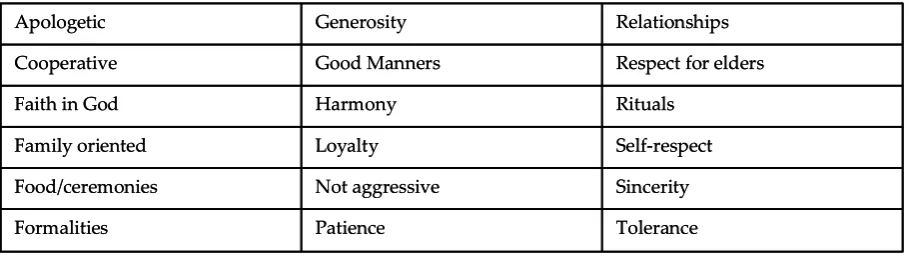
Table 2: Values and attitudes of ethnic Malays
Tolerance Patience
Formalities
Sincerity Not aggressive
Food/ceremonies
Self‐respect Loyalty
Family oriented
Rituals Harmony
Faith in God
Respect for elders Good Manners
Cooperative
Relationships Generosity
Apologetic
Tolerance Patience
Formalities
Sincerity Not aggressive
Food/ceremonies
Self‐respect Loyalty
Family oriented
Rituals Harmony
Faith in God
Respect for elders Good Manners
Cooperative
Relationships Generosity
Apologetic
In order to better understand the perceptual effect of EM (and SM) on the concept of Malay values and attitudes, we have chosen to start with terms that represent Malay values and attitudes from the list of terms provided by Dahlan (cited in Muthaly et al., 2005), as shown in Table 2. This functioned as our research framework and served as a basic description for the development of our tool. Generally, our tool is intended to measure the level of intensity from different type of connotative meanings that are represented conceptually by terms derived from Malay values and attitudes. More details on the use of this framework will be explained in subsection 5.2.
Questionnaire Design and Experimental Procedure
In this section, several subsections are introduced. This includes our experimental method based on Osgood Semantic Differential Analysis (SDA), information on respondents’ demography, selection of adjectives pair based on the concept of Malay values and attitudes and finally, selection of standard Malay (SM) and evolutionized Malay (EM) words that functioned as stimuli in the questionnaire
in-strument.
Experimental Method
scales with adjectives of opposite meaning anchoring ends of each scale. The main idea of this ap-proach is to quantify such meanings using SDA.
In our SDA study, all respondents were asked to rate each stimulus presented to them on the 15 sets of bipolar adjective scales. A five-step semantic differential scale was employed, where a response of ‘Mostly’ indicated that the stimulus was very closely related by the adjective anchoring to either one end of the semantic differential scale, while a response of ‘Slightly’ indicated that the stimulus was slightly associated to either one side but was not really neutral. Respondents were instructed to give a response of ‘Neutral’ if both of the scales equally associated with the concept, or neither of the an-choring adjectives characterized the stimulus.
Polite ______:______:______:______:______
Impolite
Mostly : Slightly : Neutral : Slightly : Mostly
‘sibuk’
Polite ______:______:______:______:______
Impolite
Mostly : Slightly : Neutral : Slightly : Mostly
‘sibuk’
Figure 2: Part of the 5-point bipolar adjective scale showing one adjective pair and a stimulus word.
In order to differentiate the given scales quantitatively, points were assigned for every scale from left to right, with ‘1’ point for the left-most scale. This is followed by ‘2’ points for the second scale, ‘3’, ‘4’ and ‘5’ points for the respective subsequent scales. Higher points (>3) reflect the inclination towards the ‘positive’ zone of Malay values and attitudes and lower points (<3) works towards the opposite direction.
Fourteen stimuli were presented in a random order for each of fifteen adjective pairs. Figure 2 shows the 5-bipolar adjective scale with the bipolar adjective pair ‘polite-impolite’ and a stimuli word sibuk
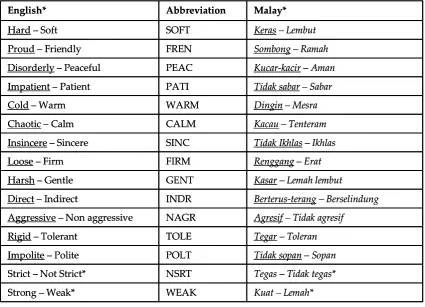
‘busy’ presented as an example. In the instrument, the bipolar adjectives were written in the Malay words. The lists of these adjectives with the positive zones (values) are shown in Table 4.
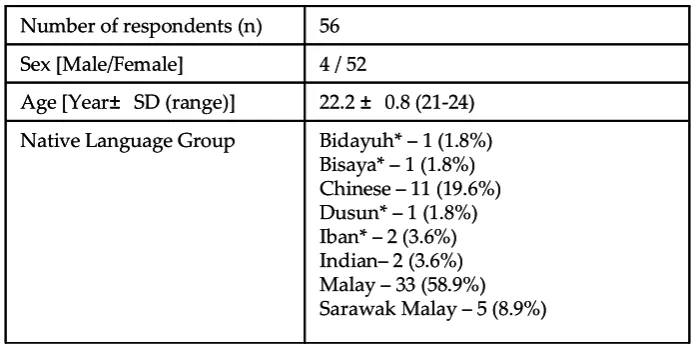
Table 3: Demographic information of the study population
Bidayuh* – 1 (1.8%) Bisaya* – 1 (1.8%) Chinese – 11 (19.6%) Dusun* – 1 (1.8%) Iban* – 2 (3.6%) Indian– 2 (3.6%) Malay – 33 (58.9%) Sarawak Malay – 5 (8.9%) Native Language Group
22.2 ± 0.8 (21‐24) Age [Year± SD (range)]
4 / 52 Sex [Male/Female]
56 Number of respondents (n)
Bidayuh* – 1 (1.8%) Bisaya* – 1 (1.8%) Chinese – 11 (19.6%) Dusun* – 1 (1.8%) Iban* – 2 (3.6%) Indian– 2 (3.6%) Malay – 33 (58.9%) Sarawak Malay – 5 (8.9%) Native Language Group
22.2 ± 0.8 (21‐24) Age [Year± SD (range)]
4 / 52 Sex [Male/Female]
56 Number of respondents (n)
SD: Statistical Deviation. *:Indigenous Group
From Concept words to Adjective-pair words
The reason for this experiment is to validate our claim that EM words can trigger a different impression when compared to SM words in online communication. Based on a discussion with three Malay native speakers prior to the development of our survey instrument, three concept words were chosen based on their close relationship with the notion of online communication. The selected concepts are good manners (sikap yang baik), tolerance (toleransi) and cooperation (kerjasama). The full concept words
are available in Table 2.
As we know from our experience, intonation patterns in voice or speech utterances can convey differ-ent expressions and create differdiffer-ent impressions in a hearer (Indirawati & Mardian, 2006). This is al-ways noticeable even for a single word uttered, which can spell out the emotions or feelings of the speaker. This also applies to the selection of words in text-based online communication. Therefore, it is important to choose words that can correctly describe the connotative meanings of stimuli words.
Table 4: Corresponding bipolar adjective pairs both in Malay and in English
Kuat – Lemah*
WEAK Strong – Weak*
Tegas – Tidak tegas*
NSRT Strict – Not Strict*
Tidak sopan – Sopan
POLT Impolite – Polite
Tegar – Toleran
TOLE Rigid – Tolerant
Agresif – Tidak agresif
NAGR Aggressive – Non aggressive
Berterus‐terang – Berselindung
INDR Direct – Indirect
Kasar – Lemah lembut
GENT Harsh – Gentle
Renggang – Erat
FIRM Loose – Firm
Tidak Ikhlas – Ikhlas
SINC Insincere – Sincere
Kacau – Tenteram
CALM Chaotic – Calm
Dingin – Mesra
WARM Cold – Warm
Tidak sabar – Sabar
PATI Impatient – Patient
Kucar‐kacir – Aman
PEAC Disorderly – Peaceful
Sombong – Ramah
FREN Proud – Friendly
Keras – Lembut
SOFT Hard – Soft
Malay* Abbreviation
English*
Kuat – Lemah*
WEAK Strong – Weak*
Tegas – Tidak tegas*
NSRT Strict – Not Strict*
Tidak sopan – Sopan
POLT Impolite – Polite
Tegar – Toleran
TOLE Rigid – Tolerant
Agresif – Tidak agresif
NAGR Aggressive – Non aggressive
Berterus‐terang – Berselindung
INDR Direct – Indirect
Kasar – Lemah lembut
GENT Harsh – Gentle
Renggang – Erat
FIRM Loose – Firm
Tidak Ikhlas – Ikhlas
SINC Insincere – Sincere
Kacau – Tenteram
CALM Chaotic – Calm
Dingin – Mesra
WARM Cold – Warm
Tidak sabar – Sabar
PATI Impatient – Patient
Kucar‐kacir – Aman
PEAC Disorderly – Peaceful
Sombong – Ramah
FREN Proud – Friendly
Keras – Lembut
SOFT Hard – Soft
Malay* Abbreviation
English*
Note: The adjective pairs as underlined represent negatives and non-underlined represent positives polarity of Malay values and attitudes.
*: These adjective pairs do not represent positive or negative values.
Taking into account the important role of such descriptive words, we have chosen the most appropri-ate descriptive words representing the three concept words. Good manners are represented by the values of indirectness, politeness, softness and gentleness. Tolerance is signified by the virtue of non-aggressiveness, patience, peace, tolerance and calm. Cooperation is denoted by sincerity, friendli-ness, firmness and warmth. Another two descriptive words, strict and weak are considered by the
The lists of words used as bipolar adjectives are shown in Table 4. Please note that in the process of producing concept words and its corresponding dimensions, only Malay words were utilized in the dis-cussion. The English adjective (or adverb) pairs that match Malay word pairs in Table 4 were later se-lected by translating Malay words into English using the Dewan Eja Pro v1.0 electronic dictionary.
Stimuli Words
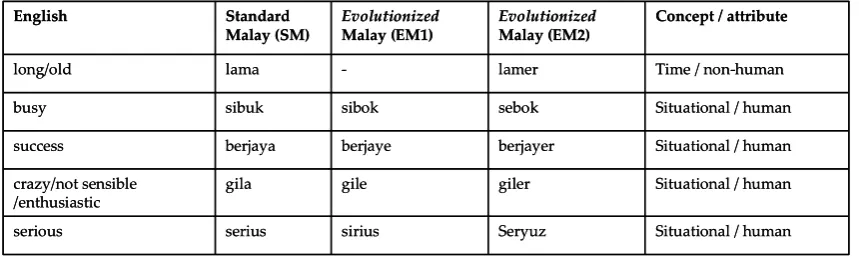
Stimuli were selected from EM words utilized in CMC. As numerous spoken-style words can be found either in asynchronous or synchronous discussion channels, we chose five groups of words as our stimuli selected from one web forum site, asamboi.org. This site provides many forum channels that are relatively informal, with large numbers of younger users and with the use of non-standard regis-ters. The site’s popularity is shown by the fact that it was ranked within the top 10 among web forums site within Malaysian cyberspace, awarded by Family Information Media, 2006 (E-keluarga.com, 2006). Table 5 gives the fourteen stimuli words with their English glosses. Note the slight differences in spelling between SM words and their EM varieties. Please also note that, since there is more than one word in EM corresponding to the same word in SM (except for ‘lama’), we have grouped EM words into two classes of EM1 and EM2. EM1 represents spoken-style spelling and EM2 corresponds to words, which have melodic utterances. More information on the differences of EM words in terms of groupings can be found in Abd Rozan & Mikami (2007).
Table 5: Standard Malay (SM) and evolutionized Malay (EM) words used in the experiment as stimuli
Situational / human Seryuz
sirius serius
serious
Situational / human giler
gile
gila crazy/not sensible
/enthusiastic
Situational / human berjayer
berjaye
berjaya success
Situational / human sebok
sibok
sibuk busy
Time / non‐human lamer
‐
lama long/old
Concept / attribute Evolutionized
Malay (EM2) Evolutionized
Malay (EM1) Standard
Malay (SM) English
Situational / human Seryuz
sirius serius
serious
Situational / human giler
gile
gila crazy/not sensible
/enthusiastic
Situational / human berjayer
berjaye
berjaya success
Situational / human sebok
sibok
sibuk busy
Time / non‐human lamer
‐
lama long/old
Concept / attribute Evolutionized
Malay (EM2) Evolutionized
Malay (EM1) Standard
Malay (SM) English
The literal meaning of lama ‘long/old’ is related to the concept of time, which is non-human in nature.
For example in English, the word lama is used in Malay as the same meaning of ‘an old street’ or ‘a long wait’. The words sibuk ‘busy’, berjaya ‘success’, gila ‘crazy/non sensible’ and serius ‘serious’ are
associated with the concept of situation and dominantly related with the subjective nature of human. The word gila has several literal meanings in Malay, which translates as being insane or not sensible,
extraordinary and enthusiastic. However, this word is not commonly used to represent the words ‘ex-traordinary’ and ‘enthusiastic’ because there are other preferable alternatives available. In addition, using the word gila is considered as rude, since it reflects negative connotations. Serius, while
origi-nally a loaned word, is now registered as a standard Malay lexical item.
Results and Discussion
In this section, three runs of analyses were performed. The first was on the perception of the whole sample of respondents (n=56). The second and third were on the perception among the native Malay (n=33) and non-native Malay (n=23) speakers, respectively. Cronbach’s Alpha reliability tests were conducted for every each of the investigation and the coefficient value computed was 0.906 for all the 56 respondents, and respectively 0.908 and 0.903 for the native Malay and non-native Malay respon-dents. With this value, it is considered that the instrument used in this study is highly reliable since all the coefficient values are greater than 0.7 (Fink, 1995).
Mean Values, Stimuli words Direction and the Magnitude of Shift
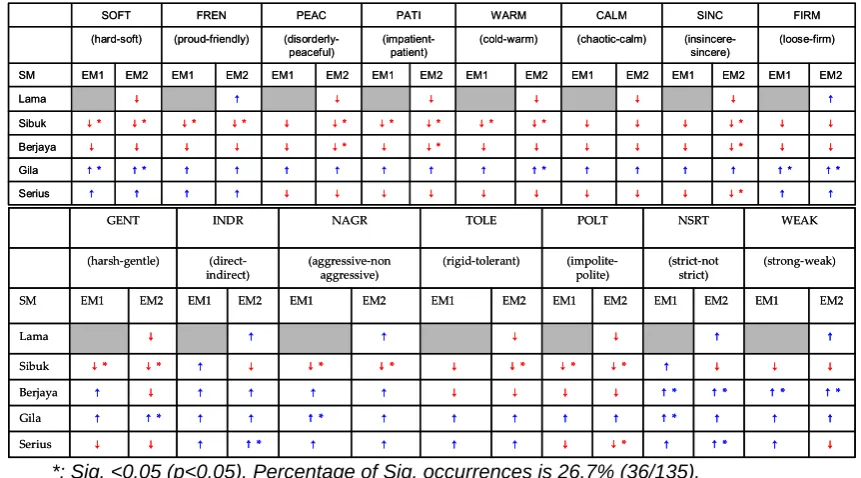
Mean value is important in order to display quantitatively a position, which may well describe the ad-jective type (within a bipolar adad-jectives) and to illustrate the level of intensity triggered by a specific stimulus. Moreover, such quantitative values can be used to gauge the shift of polarity within the ad-jective pairs by calculating the deviation of mean values between EM (1 or 2) and SM. For that rea-son, we introduced the use of arrow sign to represent the change of intensity within an adjective pairs.The directions of the arrow are vital here, which are determined by the relationships between mean values of stimulus pair SM – EM1 (60 cases, 4 stimulus pairs x 15 adjectives) and SM – EM2 (75 cases, 5 stimulus pairs x 15 adjectives).
When a mean value of EM1 is lower than SM, the deviation of EM1 – SM is negative and thus a downward arrow (↓) is produced which implies that the perception is directed into the negative region
of Malay values and attitudes. A downward pointed arrow occurred if EM1 is smaller than SM (
EM
1
<
SM
) or when EM2 is lesser than SM (EM
2
<
SM
).In the case of a positive deviation, an upward arrow (↑) is used which symbolizes the shift of percep-tion towards the positive region of Malay values and attitudes. For instance, upward pointed arrow
occurred for EM1 – SM pairs, if EM1 is greater than SM (
EM
1
>
SM
). This also applies for EM2 – SM pairs, if EM2 is of bigger value than SM (EM
2
>
SM
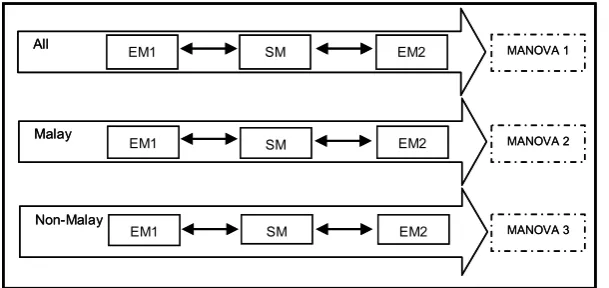
).Another important test was to measure the magnitude of shift in perception from SM into EM1 or EM2, these were done by utilizing Multivariate Analysis of Variance (MANOVA) statistical analysis. Three series of MANOVA were employed to compare the means between SM – EM1 and SM – EM2 stimuli words towards fifteen adjective pairs. These were MANOVA 1, 2 and 3, for the whole respondents, for native Malay and non-native Malay speakers correspondingly as shown in Figure 3.
Major differences between stimuli words occurred when the MANOVA results showed significant val-ues, which are represented by Sig. value that is less than 0.05 (p<0.05). These significant differences of mean and the direction of shift are shown as arrow with asterisk (↓*) or (↑*) in Table 6, 7 and 8.
All EM1 SM EM2
EM1 SM EM2
EM1 SM EM2
MANOVA 1
Malay
Non-Malay
MANOVA 2
MANOVA 3
All EM1 SM EM2
EM1 SM EM2
EM1 SM EM2
MANOVA 1
Malay
Non-Malay
MANOVA 2
MANOVA 3
Figure 3: Summary of statistical analyses which involved three series of MANOVA tests.
Perception by all respondents
In this first analysis, the calculation of mean values for SM, EM1 and EM2 stimuli of every adjective pairs were performed based on scales selected by all 56 respondents.
Based on Table 6, the highest occurrences for downward arrows were for stimulus word ‘sibuk’
(28/30=93%). This is followed by ‘berjaya’, ‘lama’ and ‘serius’, which recorded 70%, 60% and 50%,
respectively while ‘gila’ showed 100% for upward arrows.
Therefore we can see that words that have a strong association with human values, i.e. ‘sibuk’, ‘ ber-jaya’ and ‘serius’, were highly affected by their EM versions. Based on the nature of the stimuli word
‘gila’, which is considerably rude in nature, it is surprising to see that the modification of SM into EM
for this word is perceived to be positive with a 100% shift. The somehow negative impression for such a rude word is changed by means of EM style. For a non-human related stimulus like ‘lama’, the
The occurrences of significant values (26.7%) show that the jumps in perceived connotative meanings
are large from one adjective to the other within adjective-pairs. Here, not only are the types of conno-tative meanings affected, but also the level of intensity of such connoconno-tative meanings.
Table 6: The direction and magnitude of shifts produced by the deviation of stimuli pairs (EM1 – SM and EM2 – SM) for all 56 respondents
↑ ↑ ↓* ↓ ↓ ↓ ↓ ↓ ↓ ↓ ↓ ↓ ↑ ↑ ↑ ↑ Serius ↑* ↑* ↑ ↑ ↑ ↑ ↑* ↑ ↑ ↑ ↑ ↑ ↑ ↑ ↑* ↑* Gila ↓ ↓ ↓* ↓ ↓ ↓ ↓ ↓ ↓* ↓ ↓* ↓ ↓ ↓ ↓ ↓ Berjaya ↓ ↓ ↓* ↓ ↓ ↓ ↓* ↓* ↓* ↓* ↓* ↓ ↓* ↓* ↓* ↓* Sibuk ↑ ↓ ↓ ↓ ↓ ↓ ↑ ↓ Lama EM2 EM1 EM2 EM1 EM2 EM1 EM2 EM1 EM2 EM1 EM2 EM1 EM2 EM1 EM2 EM1 SM (loose-firm) (insincere-sincere) (chaotic-calm) (cold-warm) (impatient-patient) (disorderly-peaceful) (proud-friendly) (hard-soft) FIRM SINC CALM WARM PATI PEAC FREN SOFT ↑ ↑ ↓* ↓ ↓ ↓ ↓ ↓ ↓ ↓ ↓ ↓ ↑ ↑ ↑ ↑ Serius ↑* ↑* ↑ ↑ ↑ ↑ ↑* ↑ ↑ ↑ ↑ ↑ ↑ ↑ ↑* ↑* Gila ↓ ↓ ↓* ↓ ↓ ↓ ↓ ↓ ↓* ↓ ↓* ↓ ↓ ↓ ↓ ↓ Berjaya ↓ ↓ ↓* ↓ ↓ ↓ ↓* ↓* ↓* ↓* ↓* ↓ ↓* ↓* ↓* ↓* Sibuk ↑ ↓ ↓ ↓ ↓ ↓ ↑ ↓ Lama EM2 EM1 EM2 EM1 EM2 EM1 EM2 EM1 EM2 EM1 EM2 EM1 EM2 EM1 EM2 EM1 SM (loose-firm) (insincere-sincere) (chaotic-calm) (cold-warm) (impatient-patient) (disorderly-peaceful) (proud-friendly) (hard-soft) FIRM SINC CALM WARM PATI PEAC FREN SOFT ↓ ↑ ↑* ↑ ↓* ↓ ↑ ↑ ↑ ↑ ↑* ↑ ↓ ↓ Serius ↑ ↑ ↑ ↑* ↑ ↑ ↑ ↑ ↑ ↑* ↑ ↑ ↑* ↑ Gila ↑* ↑* ↑* ↑* ↓ ↓ ↓ ↓ ↑ ↑ ↑ ↑ ↓ ↑ Berjaya ↓ ↓ ↓ ↑ ↓* ↓* ↓* ↓ ↓* ↓* ↓ ↑ ↓* ↓* Sibuk ↑ ↑ ↓ ↓ ↑ ↑ ↓ Lama EM2 EM1 EM2 EM1 EM2 EM1 EM2 EM1 EM2 EM1 EM2 EM1 EM2 EM1 SM
(strong‐weak) (strict‐not
strict) (impolite‐
polite) (rigid‐tolerant)
(aggressive‐non
aggressive) (direct‐
indirect) (harsh‐gentle)
WEAK NSRT POLT TOLE NAGR INDR GENT ↓ ↑ ↑* ↑ ↓* ↓ ↑ ↑ ↑ ↑ ↑* ↑ ↓ ↓ Serius ↑ ↑ ↑ ↑* ↑ ↑ ↑ ↑ ↑ ↑* ↑ ↑ ↑* ↑ Gila ↑* ↑* ↑* ↑* ↓ ↓ ↓ ↓ ↑ ↑ ↑ ↑ ↓ ↑ Berjaya ↓ ↓ ↓ ↑ ↓* ↓* ↓* ↓ ↓* ↓* ↓ ↑ ↓* ↓* Sibuk ↑ ↑ ↓ ↓ ↑ ↑ ↓ Lama EM2 EM1 EM2 EM1 EM2 EM1 EM2 EM1 EM2 EM1 EM2 EM1 EM2 EM1 SM
(strong‐weak) (strict‐not
strict) (impolite‐
polite) (rigid‐tolerant)
(aggressive‐non
aggressive) (direct‐
indirect) (harsh‐gentle)
WEAK NSRT POLT TOLE NAGR INDR GENT
*: Sig. <0.05 (p<0.05). Percentage of Sig. occurrences is 26.7% (36/135).
Perception of native Malay language speakers
The second analysis involves the calculation of mean values for SM, EM1 and EM2 stimuli of every adjective pairs performed based on scales selected by 33 native Malay speakers.
Table 7: The direction and magnitude of shifts produced by the deviation of stimuli pairs (EM1 – SM and EM2 – SM) for native Malay speakers
↑ ↓ ↓ ↓ ↓ ↓ ↑ ↓ ↓ ↓ ↓ ↓ ↑ ↑ ↑ ↑ Serius ↑ ↑ ↑ ↑ ↑ ↑ ↑ ↑ ↓ ↑ ↑ ↑ ↑ ↑ ↑ ↑ Gila ↓ ↓ ↓* ↓ ↓ ↓ ↓ ↓ ↓ ↓ ↓ ↓ ↓ ↓ ↓ ↓ Berjaya ↓ ↓ ↓* ↓ ↓* ↓* ↓ ↓* ↓* ↓* ↓* ↓ ↓* ↓* ↓* ↓* Sibuk ↑ ↓ ↓ ↓ ↓ ↑ ↑ ↓ Lama EM2 EM1 EM2 EM1 EM2 EM1 EM2 EM1 EM2 EM1 EM2 EM1 EM2 EM1 EM2 EM1 SM
(loose‐firm) (insincere‐
sincere) (chaotic‐calm)
(cold‐warm) (impatient‐
patient) (disorderly‐
peaceful) (proud‐friendly)
(hard‐soft)
FIRM SINC CALM WARM PATI PEAC FREN SOFT ↑ ↓ ↓ ↓ ↓ ↓ ↑ ↓ ↓ ↓ ↓ ↓ ↑ ↑ ↑ ↑ Serius ↑ ↑ ↑ ↑ ↑ ↑ ↑ ↑ ↓ ↑ ↑ ↑ ↑ ↑ ↑ ↑ Gila ↓ ↓ ↓* ↓ ↓ ↓ ↓ ↓ ↓ ↓ ↓ ↓ ↓ ↓ ↓ ↓ Berjaya ↓ ↓ ↓* ↓ ↓* ↓* ↓ ↓* ↓* ↓* ↓* ↓ ↓* ↓* ↓* ↓* Sibuk ↑ ↓ ↓ ↓ ↓ ↑ ↑ ↓ Lama EM2 EM1 EM2 EM1 EM2 EM1 EM2 EM1 EM2 EM1 EM2 EM1 EM2 EM1 EM2 EM1 SM
(loose‐firm) (insincere‐
sincere) (chaotic‐calm)
(cold‐warm) (impatient‐
patient) (disorderly‐
peaceful) (proud‐friendly)
(hard‐soft)
FIRM SINC CALM WARM PATI PEAC FREN SOFT ↑ ↑ ↑* ↑ ↓ ↓ ↑ ↑ ↑ ↔ ↑* ↑ ↓ ↓ Serius ↑ ↑ ↑ ↑ ↑ ↑ ↑ ↑ ↑ ↑ ↓ ↑ ↑ ↑ Gila ↑* ↑ ↑* ↑ ↓ ↓ ↓ ↓ ↑ ↑ ↑ ↑ ↓ ↑ Berjaya ↓ ↓ ↓ ↓ ↓* ↓* ↓* ↓ ↓* ↓* ↓ ↑ ↓* ↓* Sibuk ↑ ↑ ↓ ↑ ↓ ↑ ↓ Lama EM2 EM1 EM2 EM1 EM2 EM1 EM2 EM1 EM2 EM1 EM2 EM1 EM2 EM1 SM
(strong‐weak) (strict‐not strict)
(impolite‐polite) (rigid‐tolerant)
(aggressive‐non aggressive) (direct‐indirect)
(harsh‐gentle)
WEAK NSRT POLT TOLE NAGR INDR GENT ↑ ↑ ↑* ↑ ↓ ↓ ↑ ↑ ↑ ↔ ↑* ↑ ↓ ↓ Serius ↑ ↑ ↑ ↑ ↑ ↑ ↑ ↑ ↑ ↑ ↓ ↑ ↑ ↑ Gila ↑* ↑ ↑* ↑ ↓ ↓ ↓ ↓ ↑ ↑ ↑ ↑ ↓ ↑ Berjaya ↓ ↓ ↓ ↓ ↓* ↓* ↓* ↓ ↓* ↓* ↓ ↑ ↓* ↓* Sibuk ↑ ↑ ↓ ↑ ↓ ↑ ↓ Lama EM2 EM1 EM2 EM1 EM2 EM1 EM2 EM1 EM2 EM1 EM2 EM1 EM2 EM1 SM
(strong‐weak) (strict‐not strict)
(impolite‐polite) (rigid‐tolerant)
(aggressive‐non aggressive) (direct‐indirect)
(harsh‐gentle)
WEAK NSRT POLT TOLE NAGR INDR GENT
*: Sig. <0.05 (p<0.05). Percentage of Sig. occurrences is 17.0% (23/135).
The dominant numbers of significant values found for the stimulus ‘sibuk’ (18/30), showed that all the jumps were associated with the shifts into the negative region of Malay values. This suggests that the EM form of the word ‘sibuk’ carries strong negative connotations.
The somewhat affected stimuli ‘lama’ and ‘serius’ showed some mixed directions. This is probably due to the fact that ‘lama’ is very objective and non-human, and ‘serius’ is not originally a native Malay word.
The amount of sensitivity regarding SM into EM shifts can be gauged by the number of occurrences in significant values. In Table 7, 17% of the values that occurred were significant.
Perception of non-native Malay language speakers
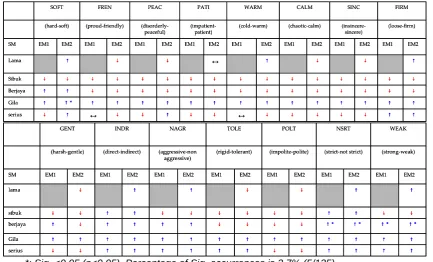
Here, the analysis involves the calculation of mean values for SM, EM1 and EM2 stimuli of every ad-jective pair performed based on scales selected by the 23 non-native Malay speakers. The respon-dents in this group represented the non-native speakers, whose native languages are Bidayuh, Bisaya, Chinese, Dusun, Iban, Indian and Sarawak Malay, as previously presented in Table 3. There are not many differences between the perception of native and non-native Malay speakers. However, the measure of sensitivity of changes from SM into EM is rather low in non-Malay group. In Table 8, the occurrences of significant values were recorded as only 3.7%.
Table 8: The direction and magnitude of shifts produced by the deviation of stimuli pairs (EM1 – SM and EM2 – SM) for non-native Malay speakers.
↑ ↑ ↓ ↓ ↓ ↓ ↓ ↔ ↓ ↓ ↑ ↓ ↓ ↔ ↑ ↓ serius ↑ ↑ ↑ ↑ ↑ ↑ ↑ ↑ ↑ ↑ ↑ ↑ ↑ ↑ ↑* ↑ Gila ↓ ↓ ↓ ↓ ↓ ↓ ↓ ↓ ↓ ↓ ↓ ↓ ↓ ↓ ↑ ↑ Berjaya ↓ ↓ ↓ ↓ ↓ ↓ ↓ ↓ ↓ ↓ ↓ ↓ ↓ ↓ ↓ ↓ Sibuk ↑ ↓ ↓ ↑ ↔ ↓ ↓ ↑ Lama EM2 EM1 EM2 EM1 EM2 EM1 EM2 EM1 EM2 EM1 EM2 EM1 EM2 EM1 EM2 EM1 SM
(loose‐firm) (insincere‐
sincere) (chaotic‐calm)
(cold‐warm) (impatient‐
patient) (disorderly‐
peaceful) (proud‐friendly)
(hard‐soft)
FIRM SINC CALM WARM PATI PEAC FREN SOFT ↑ ↑ ↓ ↓ ↓ ↓ ↓ ↔ ↓ ↓ ↑ ↓ ↓ ↔ ↑ ↓ serius ↑ ↑ ↑ ↑ ↑ ↑ ↑ ↑ ↑ ↑ ↑ ↑ ↑ ↑ ↑* ↑ Gila ↓ ↓ ↓ ↓ ↓ ↓ ↓ ↓ ↓ ↓ ↓ ↓ ↓ ↓ ↑ ↑ Berjaya ↓ ↓ ↓ ↓ ↓ ↓ ↓ ↓ ↓ ↓ ↓ ↓ ↓ ↓ ↓ ↓ Sibuk ↑ ↓ ↓ ↑ ↔ ↓ ↓ ↑ Lama EM2 EM1 EM2 EM1 EM2 EM1 EM2 EM1 EM2 EM1 EM2 EM1 EM2 EM1 EM2 EM1 SM
(loose‐firm) (insincere‐
sincere) (chaotic‐calm)
(cold‐warm) (impatient‐
patient) (disorderly‐
peaceful) (proud‐friendly)
(hard‐soft)
FIRM SINC CALM WARM PATI PEAC FREN SOFT ↑ ↑ ↑ ↑ ↓ ↓ ↑ ↑ ↑ ↑ ↑ ↑ ↓ ↓ serius ↑ ↑ ↑ ↑ ↑ ↑ ↑ ↑ ↑ ↑ ↑ ↑ ↑ ↑ Gila ↑* ↑* ↑* ↑* ↓ ↓ ↓ ↓ ↑ ↑ ↑ ↑ ↓ ↑ berjaya ↓ ↓ ↑ ↑ ↓ ↓ ↓ ↓ ↓ ↓ ↑ ↑ ↓ ↓ sibuk ↑ ↑ ↓ ↓ ↑ ↑ ↓ lama EM2 EM1 EM2 EM1 EM2 EM1 EM2 EM1 EM2 EM1 EM2 EM1 EM2 EM1 SM
(strong‐weak) (strict‐not strict)
(impolite‐polite) (rigid‐tolerant)
(aggressive‐non
aggressive) (direct‐indirect)
(harsh‐gentle)
WEAK NSRT POLT TOLE NAGR INDR GENT ↑ ↑ ↑ ↑ ↓ ↓ ↑ ↑ ↑ ↑ ↑ ↑ ↓ ↓ serius ↑ ↑ ↑ ↑ ↑ ↑ ↑ ↑ ↑ ↑ ↑ ↑ ↑ ↑ Gila ↑* ↑* ↑* ↑* ↓ ↓ ↓ ↓ ↑ ↑ ↑ ↑ ↓ ↑ berjaya ↓ ↓ ↑ ↑ ↓ ↓ ↓ ↓ ↓ ↓ ↑ ↑ ↓ ↓ sibuk ↑ ↑ ↓ ↓ ↑ ↑ ↓ lama EM2 EM1 EM2 EM1 EM2 EM1 EM2 EM1 EM2 EM1 EM2 EM1 EM2 EM1 SM
(strong‐weak) (strict‐not strict)
(impolite‐polite) (rigid‐tolerant)
(aggressive‐non
aggressive) (direct‐indirect)
(harsh‐gentle)
WEAK NSRT POLT TOLE NAGR INDR GENT
*: Sig. <0.05 (p<0.05). Percentage of Sig. occurrences is 3.7% (5/135).
Conclusion
The aim of our investigation is to answer the two research questions that were introduced earlier, i.e. ‘Do SM & EM words have the same type of perceived connotative meanings?’ and ‘What are the dif-ferences in the level of perceived connotative meanings for SM & EM words?’ We have performed an empirical test based on Semantic Differential Analysis (SDA) on the perception of the use of non-standard spelling over non-standard spelling online. No other studies, as far as we are aware, have em-pirically tested the perception of standard words and non-standard words in Malay.
which are visible from the direction of arrow signs (as in Table 6, 7 & 8). Moreover, the occurrences of significant values that represent the jumps of perceived connotative meanings are large, which sug-gests that both EM and SM have a different level of intensity of given connotative meanings. Prior to the experiment, our assumptions on EM words were that they are used for milder and non-harsh expression. Based on our experimental results, the perception of EM words showed mixed ten-dency. From the perception of all the 56 respondents, it is shown that EM could create larger shift in those human attributed SM words. Where, ‘sibuk’ is largely perceived as moving into the negative re-gion of Malay values and attitudes when compared to a rude word ‘gila’, which shows the opposite tendency (100% towards positive, fitting Malay values) if written in EM. We suggest that the changes in connotative meaning highly affect human-attributed words, i.e. those that are related to human feel-ing and emotions.
Another interesting finding is the results from the two language groupings of native Malay and non-native Malay. Malay speakers have a higher sensitivity to recognize the shift of connotative meanings for the SM words, which shows a somewhat higher significant value (17%) compared to only 3.7% by non-native Malay. This suggests that native Malay speakers have highly sensitive perceptions of the changes from SM to EM words, which implies that they hold a strong feeling of correctness and incor-rectness of use of their native language, Malay. This also implies that non-native Malay speakers are not as rigid and are more tolerant in their perception towards SM changes online. Since connotative meanings are related to speakers’ real-world experiences (Allan, 2007), perhaps it is not surprising that results vary between these two groups.
Having pointed out the differences between responses to SM and EM words, here we would like to suggest a few points. A word selection strategy for this special type of orthographic changes could be devised. For example, a speaker may be able to more effectively convey his intended feeling via the connotative meanings represented by EM. A few respondents raised this point after they had com-pleted the written questionnaire. For example, there was often difficulty in utilizing SM words instead of EM due to the mismatch of expression an SM word could provide. One respondent said, ‘SM words are not the best choice if we want to match the expressive properties with our intention or feeling to others. We find EM words to be largely appropriate and suitable for the situation and purpose of our message’. Here, the selection of word and change of spelling have a great deal of influence on the type of expression such word could possibly provide.
Although EM words are frequently found online, with our improved understanding of the effect an EM word can trigger, we would suggest users to be more selective and careful when utilizing EM words. We cannot openly assume that such words can be utilized liberally without having a good sense of their implications. However, having the ability to apply different words for different expressions can also promote a more natural style of interaction. We are not saying that this natural style of interaction is on a par with face-to-face interaction or voice communication over the telephone, but rather that such utilization of EM could act as a tool, which expresses the non-explicit and auditory properties that are not ordinarily found in text. The orthographic dissimilarities between SM and EM are important and serve to contribute to differences in perception. Our findings support the claim that EM is not only ex-otically spelled to possibly provide a greater level of attraction or eye-candy (Abd Rozan & Mikami, 2007) but that EM spellings also trigger different perceptual meanings.
It is true that there are several limitations involved in this study, which we believe should be dealt with in further research. This includes using more stimuli words, which would represent more evolutionized Malay words. Another research consideration is the dialectal influence, in this case, stimuli words that may reflect better on numerous dialect in Malaysia should be used in future experiments. A well-balanced proportion of gender among respondents should also be considered. A sample with a larger age-range would improve patterns of responses and could possible give different impact in the out-come of results and minimize bias in results. Finally, this study is capable of measuring only the type and intensity of connotative meanings of EM and SM words within a general situation or context. Per-ception within a specific context will also be our main research agenda in future.
References
Abd Rozan, M. Z. & Mikami, Y. (2007). Orthographic Reforms of Standard Malay Online: Towards Better Pronunciation and Construction of Cross Language Environment. Journal of Universal Language, Vol. 8, No.1, 129-159.
Allan, K. (2007). The pragmatics of connotation. Journal of Pragmatics, Vol 39. 1047-1057.
Asma, A. (1996). Going Glocal: Cultural Dimensions in Malaysian Management. Kuala Lumpur: Ma-laysian Institute of Management.
Asmah, H. O. (1986). Bahasa dan Alam Pemikiran Melayu. Kuala Lumpur: Dewan Bahasa dan Pustaka.
Baron, N. S. (2003). The Language of the Internet. In Ali Farghali (Ed.), The Stanford Handbook for Language Engineers (pp. 59-127). Stanford: CSLI Publications.
Bradner, E., Kellogg, W. A. & Erickson, T. (1999). The adoption and use of BABBLE: A field study of chat in the workplace. In Bødker, Susanne, Kyng, Morten, Schmidt, Kjeld (Eds.), Proceedings of the Sixth European Conference on Computer Supported Cooperative Work - ECSCW 99 (pp.139). Copenhagen, Denmark.
Climent, S., More, J., Oliver, A., Salvatierra, M., Sanchez, I., Taule, M. & Vallmanya, L. (2003, No-vember). Bilingual Newsgroup in Catalonia: A Challenge for Machine Translation. Journal of Computer-Mediated Communication, 9 (1). Retrieved January 8, 2007 from
http://jcmc.indiana.edu/vol9/issue1/climent.html
Crystal, D. (2001). Language and the Internet. Cambridge: Cambridge University Press.
E-keluarga.com, Malaysia. E-keluarga.com. Retrieved March 27, 2006 from http://e-keluarga.com Fink, A. (1995). The Survey Kit: How to Report on Surveys. California: Sage Publications.
Gani, M. P. (2000). Evolusi Standard Malay Internet [Standard Malay Internet Evolution]. Bahasawan. Retrieved January 24, 2005, from http://www.bahasawan.org/isian/SM-net.htm
Herring, S. C. (2001). Computer-mediated discourse. In D. Tannen, D. Schiffin & H. Hamilton (Eds.), Handbook of discourse analysis. (pp. 612-634). Oxford: Blackwell.
Herring, S. C. (2007). A Faceted Classification Scheme for Computer-Mediated Discourse. lan-guage@internet 1/2007. Retrieved February 15, 2007 from
http://www.languageatinternet.de/articles/761/index.html
Indirawati, Z. & Mardian, S. O. (2006). Fonetik dan Fonologi [Phonetics and Phonology]. Kuala Lum-pur: PTS Professional Publishing Sdn. Bhd.
Littlejohn, S. W. (1989). Theories of human communication (3rd ed.). Belmont: Wadsworth. Marlyna, M. (2006). Apologies in English by Adult Malay Speakers: Patterns and Competence. The
International Journal of Language, Society and Culture. Issue 19-2006. Retrieved March 15, 2007 from http://www.educ.utas.edu.au/users/tle/JOURNAL/ARTICLES/2006/19-2.htm Muthaly, S., Rugimbana, R., Sivagnanam, K. & Willis, M. (2005). Malaysia: ASEANS’s cultural gold
mine. Retrieved January 10, 2007 from
http://www.vuw.ac.nz/~caplabtb/m302w06/Malaysia_ASEAN.pdf
Muniandy, V. A. A. (2002). Electronic-discourse (E-discourse): Spoken, written or a new hybrid? PROSPECT, An Australian Journal of TESOL. Vol. 17, No. 3. Retrieved August 20, 2006 from http://www.nceltr.mq.edu.au/prospect/17/
pros17_3avam.asp
Nik S. K., Farid M. O., Hashim H. M. & Abdul H. M (2006). Tatabahasa Dewan Edisi Baharu [Dewan Grammar New Edition]. Kuala Lumpur: Dewan Bahasa dan Pustaka.
Osgood, C. E., Suci, G, J. & Tannenbaum, P. H. (1957). The measurement of meaning. Illinois: Uni-versity of Illinois Press.
Scherer, K., 2003. Vocal communication of emotion: A review of research paradigms. Speech Com-munication. Vol. 40, Issues 1-2: 227-256.