Performance Analysis of Distributed Storage
Cluster using Network Coding
Priyanka Ramesh Nanaware 1, Shreya Bokare2, Zia Saquib3
P.G. Student, Department of Electronics Engineering, PIIT New Panvel, Mumbai, India1
Technical Officer, Department of CNIE, CDAC Mumbai, India2
Executive Director, CDAC Mumbai, India3
ABSTRACT:Tremendous growth in the data generation using applications like networks, file, and video sharing is
demanding for the data availability and reliability. Distributed storage clusters performs an important role in this case by providing data redundancy over network storage node. This paper presents the performance analysis of ceph cluster: one of the distributed storage cluster freely available in the storage technology, by using different network coding techniques. Various network coding techniques and their significance in data distribution and regeneration during node failure are discussed in this paper. Here we used network codes such as ceph default crush algorithm, Erasure code, Regenerating code and Self-repairing code to evaluate the performance of ceph storage cluster. The experimental setup and procedure flow graph presents the insights of the testing carried over ceph cluster. Finally result analysis shows the comparison of different network codes.
KEYWORDS:Ceph cluster; Distributed Storage cluster; Network Coding; Performance Parameters
I. INTRODUCTION
With growth in variety of applications like networks, file and video sharing in recent years, the demand for large-scale data storage has increased significantly with the requirement of seamless secured storage access. Single node deployment may become unreliable in case of node failure. The redundancy in the storage node is required to improve the reliability. The simplest solution to improve the reliability is to use node replication by using RAID architecture [1]. However, RAID comes with its own set of issues, like increased in the amount of storage and bandwidth used, performance penalties. The industry has worked to overcome these issues by developing new techniques like distributed storage cluster using network coding [2]. For distributed storage, the idea of using network coding was introduced by, scenario.A. G. Dimakis, V. Prabhakaran, and K. Ramchandran, “Ubiquitous Access to Distributed Data in Large-Scale Sensor Networks through Decentralized Erasure Codes” is mentioned in Proc. IEEE/ACM Int. Symposium on Information Processing in Sensor Networks (IPSN), April 2005. The distributed storage cluster couples data distribution with replication of the dataset, which improves the data regeneration rate. In distributed storage cluster the data is distributed and stored onto multiple disks in the form of blocks or objects. In case of block data storage, file data is split in the form of block i.e chunk of bytes of fixed size and stored on disk using SCSI or related protocol [3]. However object data storage, file is treated as an object i.e actually divided into data, metadata and unique identifier which have flexibility on block size during data storage [4].
ISSN(Online): 2320-9801
ISSN (Print) : 2320-9798
I
nternational
J
ournal of
I
nnovative
R
esearch in
C
omputer
and
C
ommunication
E
ngineering
(An ISO 3297: 2007 Certified Organization)
Vol. 4, Issue 5, May 2016
experimental setup prepared in our lab for testing. The testing procedure is explained in section 5, testing results and analysis is provided in section 6, finally we conclude our paper in section 7.
II. NETWORK CODING ALGORITHMS
In the conventional routing, each intermediate node in the network simply stores and forwards the information received. Network coding is a generalization of the conventional routing (store-and-forwarding) method. The network coding allows the intermediate nodes to generate output data by encoding (i.e., computing certain functions) previously received input data. Fundamental idea of Network Coding is combining of packets instead of just routing which allows information to be “mixed” at intermediate nodes [9]. Thus network coding techniques can be used to improve a network's throughput, efficiency and scalability along with resilience to attacks and overhearing [10]. In general, network codes stores a file of size M bytes in the form of n fragments each of size M/k bytes; any k of which can be used to reconstruct the original file. There are different types of network coding namely Replication code, Erasure Code, Regenerating Code, Self-repairing code currently used in the storage networking etc.
Replication Code:
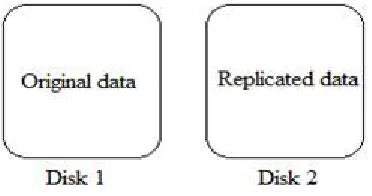
In replication code, as the name indicates it will stores the replicated copy of original data into another disk. In case of original disk failure, data recovery is possible with another disk which has the same copy of the original data. However due to the data replication, the bandwidth required is more. e.g bandwidth required to store Analysis.txt file using replication code is twice as of the normal case.
Fig. 1 Replication code strategy Erasure Code:
Fig. 2 Erasure code data recovery Regenerating Code:
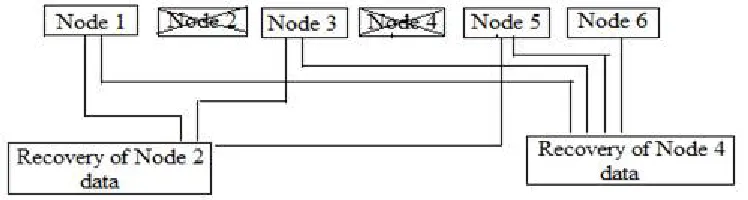
Regenerating code is the variation of erasure code. Original data k is divided into M fragments which are stored in n nodes. Each node stores M/k data fragments and less than n-1 nodes are required to recreate the original data [11][12]. The advantage of regenerating code over erasure code is there is no need to recreate the original data first by connecting with all remaining nodes. Therefor repair bandwidth and latency required is less than erasure code. Regenerating code is a priority based code thus all nodes are not treated equally. In case of data recovery the number of nodes required for recovery are depend on which specific node is missing. Consider 6 nodes, node 1 to node 6, and node 2 & node 4 are failed. One may require different number of nodes to recover the failed node data which eventually depends on the priority and data distribution pattern. Thus repair bandwidth and latency required to regenerate the data will not be same for all nodes. Regenerating code can handle concurrent multiple failures, but data regeneration takes place sequentially.
Fig. 3 Regenerating code data recovery Self-repairing Code:
ISSN(Online): 2320-9801
ISSN (Print) : 2320-9798
I
nternational
J
ournal of
I
nnovative
R
esearch in
C
omputer
and
C
ommunication
E
ngineering
(An ISO 3297: 2007 Certified Organization)
Vol. 4, Issue 5, May 2016
Fig. 4 Self-repairing code data recovery
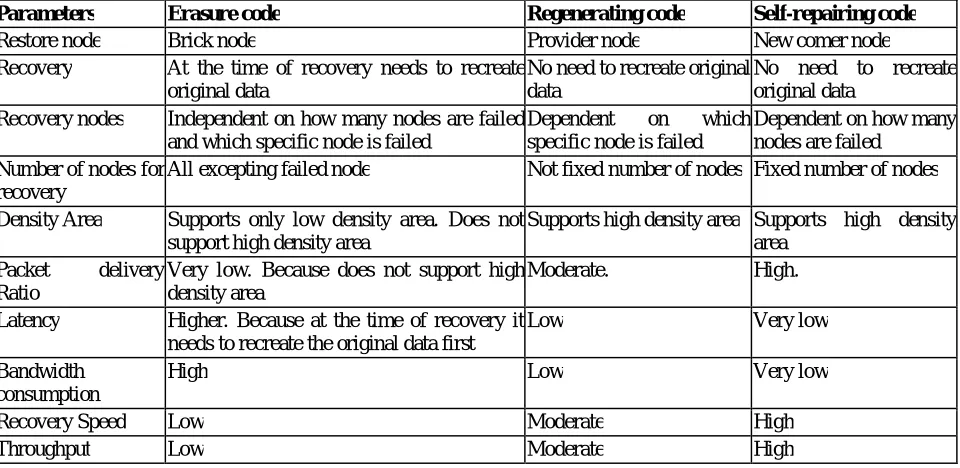
Table 1 Parameter Comparison of network codes
Parameters Erasure code Regenerating code Self-repairing code
Restore node Brick node Provider node New comer node
Recovery At the time of recovery needs to recreate original data
No need to recreate original data
No need to recreate original data
Recovery nodes Independent on how many nodes are failed and which specific node is failed
Dependent on which specific node is failed
Dependent on how many nodes are failed
Number of nodes for recovery
All excepting failed node Not fixed number of nodes Fixed number of nodes
Density Area Supports only low density area. Does not support high density area
Supports high density area Supports high density area
Packet delivery Ratio
Very low. Because does not support high density area
Moderate. High.
Latency Higher. Because at the time of recovery it needs to recreate the original data first
Low Very low
Bandwidth consumption
High Low Very low
Recovery Speed Low Moderate High
Throughput Low Moderate High
III. DISTRIBUTED STORAGE CLUSTER USING CEPH
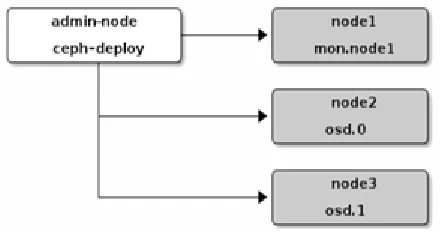
Fig. 5 Working components of Ceph cluster
There are three main components of ceph cluster:
1. Admin node: Original data is stored or put on an admin node. Admin node is responsible for the way how data should be distributed and also it is responsible for manual process of Ceph installation and Ceph deployment on remaining nodes.
2. Monitor node: It is responsible to keep track of active and failed cluster nodes. Mainly monitor node is responsible for detecting the failure node.
3. Object Storage Devices (OSD): This store the distributed content of files. Ideally, OSDs stores the data which is distributed by the admin node of the ceph cluster [16][17][18].
By default ceph cluster uses crush map algorithm for data distribution and recovery. The details of crush map algorithm are mentioned here:
Crush map Algorithm:
In ceph cluster the CRUSH (Controlled, Scalable and Decentralized Placement of Replicated Data) algorithm determines how to store and retrieve data on/from data storage locations by performing computation on it. CRUSH allows Ceph admin to communicate with OSDs. CRUSH requires a map of cluster, and uses the CRUSH map to store and retrieve data in OSDs with a distribution of data across the cluster. CRUSH maps algorithm uses rules to determine placement of data for a pool, where pools are the logical groups for storing data objects in ceph cluster. CRUSH rules defines placement and replication strategies or distribution policies that allow to specify exactly how CRUSH places object replicas.
IV. EXPERIMENTAL SETUP
ISSN(Online): 2320-9801
ISSN (Print) : 2320-9798
I
nternational
J
ournal of
I
nnovative
R
esearch in
C
omputer
and
C
ommunication
E
ngineering
(An ISO 3297: 2007 Certified Organization)
Vol. 4, Issue 5, May 2016
Fig. 6 Experimental Setup
Table 2. Ceph cluster component details
Node Number IP Address Ceph Component OS RAM storage volume
Node 1 10.X.X.135 Admin node and Object storage device (osd.2) Centos 6.5 2 GB 40 GB
Node 2 10.X.X.102 Monitor node and object storage device (osd.3) Centos 6.5 2 GB 40 GB
Node 3 10.X.X.103 Object storage device (osd.0) Centos 6.5 2 GB 40 GB
Node 4 10.X.X.101 Object storage device (osd.1) Centos 6.5 2 GB 40 GB
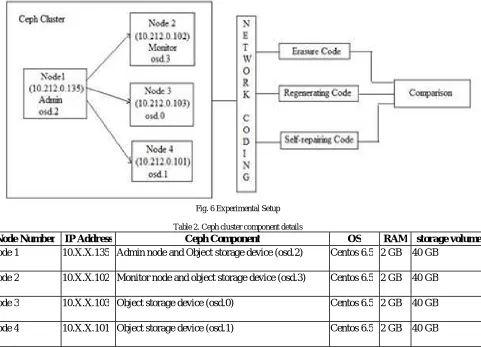
As shown in fig. 6, in the experimental setup we used four object storage devices (OSD) to store the distributed data. To form a ceph storage cluster, the deployment is initiated from node 1 having ip address 10.X.X.135 on which admin service is deployed. On node 2 Monitor component is deployed from admin node i.e node 1. On each node, the OSD directory structure is created at a particular location to use these nodes as data storage device. In this way ceph cluster is ready with admin, monitor and four osd’s for distributed data storage.
V. TESTING PROCEDURE
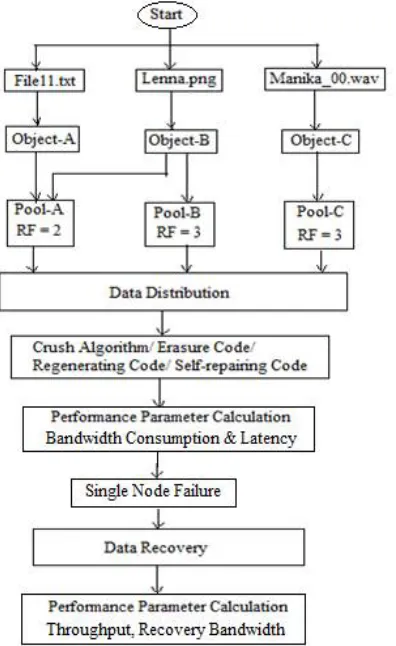
Fig. 7 Test procedure of data distribution and recovery
VI. RESULTS AND ANALYSIS
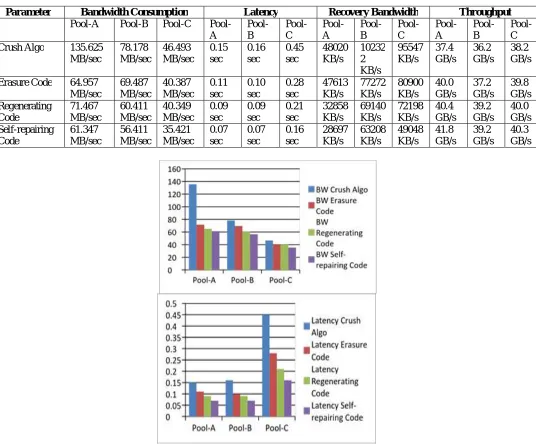
In this paper, we listed four performance parameters of distributed storage cluster and evaluated them using above discussed network coding techniques. The detailed structure of object data distribution pattern is presented in table 3. Table 4 provides the details of four parameters evaluated using four different network codes. The analysis of the performance parameters evaluated using four different network codes are depicted in the form of bar graph fig 8-11.
Table 3 Data Distribution Pattern in Ceph Cluster
Parameters Data Distribution Pattern
Name of pool Pool-A Pool-B Pool-C
Replication Factor 2 3 3
No of object 2 1 1
Name of object Object-A
Object-B
Object-B Object-C
ISSN(Online): 2320-9801
ISSN (Print) : 2320-9798
I
nternational
J
ournal of
I
nnovative
R
esearch in
C
omputer
and
C
ommunication
E
ngineering
(An ISO 3297: 2007 Certified Organization)
Vol. 4, Issue 5, May 2016
No of placement group 128 128 128
Pool id 8 9 10
Placement group id Object-A 8.68 Not Applicable Not Applicable
Object-B 8.7b 9.7b Not Applicable
Object-C Not Applicable Not Applicable 10.7f
Failed osd number Osd.0 (Node 3) Osd.0 (Node 3) Osd.0 (Node 3)
Osd number used for recovery Osd.2 (Node 1) Osd.3 (Node 2) Osd.1 (Node 4)
Table 4 Parameter Evaluation
Parameter Bandwidth Consumption Latency Recovery Bandwidth Throughput
Pool-A Pool-B Pool-C Pool-A Pool-B Pool-C Pool-A Pool-B Pool-C Pool-A Pool-B Pool-C Crush Algo 135.625
MB/sec 78.178 MB/sec 46.493 MB/sec 0.15 sec 0.16 sec 0.45 sec 48020 KB/s 10232 2 KB/s 95547 KB/s 37.4 GB/s 36.2 GB/s 38.2 GB/s
Fig. 8 and Fig. 9 shows that, Self-repairing code require less bandwidth and less time (latency) for data distribution as compared with other network codes.
Fig. 10 Comparison of Recovery Bandwidth of Crush Algorithm, Erasure Code, Regenerative code and Self-Repairing code Fig. 11 Comparison of Throughput of Crush Algorithm, Erasure Code, Regenerative code and Self-Repairing code
Fig. 10 and Fig. 11 shows that, after node failure the repair bandwidth required for node reconstruction using repairing code is the least one. We calculated the throughput values for all the network codes, it is observed that self-repairing code has the highest throughput values.
VII. CONCLUSION
In this paper, the performance of distributed storage cluster is evaluated using network coding techniques. We considered four performance parameters during data distribution and data restore to/from the object storage device. Crush Algorithm, erasure code, regenerating code, self-repairing code are the four different coding techniques used for data distribution and data recovery on ceph storage cluster. It was observed that the Self-repairing code is an optimized code for data distribution and data recovery(during node failure) as it provides less distribution bandwidth, low latency, fast recovery and better throughput than the other network codes. The experimental results shows that network coding techniques used instead of default distribution algorithm(crush algorithm), can improve the storage cluster performance.
ISSN(Online): 2320-9801
ISSN (Print) : 2320-9798
I
nternational
J
ournal of
I
nnovative
R
esearch in
C
omputer
and
C
ommunication
E
ngineering
(An ISO 3297: 2007 Certified Organization)
Vol. 4, Issue 5, May 2016
4. Data Direct Networks, “A Beginner’s Guide To Next Generation Object Storage”, White paper,2015.
5. Sage A. Weil Scott A. Brandt Ethan L. Miller Darrell D. E. Long, Carlos Maltzahn “Ceph: A Scalable, High-Performance Distributed File System”, OSDI ’06: 7th USENIX Symposium on Operating Systems Design and Implementation, Page no. 307-320.
6. Intel storage solutions reference architecture – fujitsu and ceph published in jan 2015.
7. Sage A. Weil Scott A. Brandt Ethan L. Miller Carlos Maltzahn, “CRUSH: Controlled, Scalable, Decentralized Placement of Replicated Data”, IEEE Tampa, Florida, USA, November 2006.
8. Benjamin Depardon, Gael Le Mahec, Cyril Seguin, “Analysis of Six Distributed File Systems”, hal-00789086, 15 Feb 2013.
9. Alexandros G. Dimakis, KannanRamchandran,YunnanWu,andChanghoSuh, “A Survey on Network Codes for Distributed Storage”, Proceedings of the IEEE Vol.99,No.3,March2011.
10. Frederique Oggier, AnwitamanDatta, “Self-repairing Homomorphic Codes for Distributed Storage Systems” arXiv:1008.0064v1[cs.DC] 31 Jul 2010.
11. Ming-Zhu Deng, Zhi-Guang Chen, Yi-Mo Du, Nong Xiao, and Fang Liu, “Erasure Codes in Big Data Era”, The 2014 International Conference on Control, Automation and Information Sciences (ICCAIS 2014) Gwangju, South Korea, Page No. 218-223, December 2-5, 2014.
12. K. V. Rashmi, Nihar B. Shah, KannanRamchandran and P. Vijay Kumar “Regenerating Codes for Errors and Erasures in Distributed Storage”, IEEE International Symposium on Information Theory Proceedings, 2012.
13. Christian Huebner, PawelStefanski, KostiantynDanilov, Igor Fedotov, “Ceph Best Practices Manual”, Version 1.0, 29-Feb-2016. 14. EMC white paper “EMC Unified Storage System Fundamentals for Performance and Availability”, August 30, 2011.
15. Michael Ratner, “Better Object Storage With Hitachi Content Platform” The Fundamentals of Hitachi Content Platform, white paper, November 2014.
16. Fujitsu Limited, Technical White Paper, FUJITSU Hyperscale Storage System ETERNUS CD10000, 2014.
17. Roman Talyansky, Bernd Scheuermann, Bj¨ornKolbeck, Jan Stender, “Trace-Driven Performance Evaluation of Distributed File Systems under Enterprise Application Workload”, arXiv:1001.2931v3 [cs.DC], 25 nov 2010.
18. EMC Corporation, White paper, “The Case For Tiered Storage In The Enterprise”, Feb 2016.
BIOGRAPHY
Priyanka Ramesh Nanaware is a P.G. Student in the Department of Electronics Engineering,PIITNew Panvel,
Mumbai. She received Diploma in Electronics and Telecommunication in 2010 and Bachelor’s Degree in Electronics and Telecommunication Engineering in 2013 in Pune University. Her research interests are in Distributed Storage Area Network, network coding.
Shreya Bokare is Technical Officer in Computer Networks & Internet Engineering Research group at C-DAC
Mumbai. She is working in the area of IPSAN and disaster recovery past 9 years and working as a team lead for projects in the area of IPSAN and Disaster Recovery.
ShreyaBokare is B.E and M.Tech in Electronics Engineering from Nagpur University and pursuing PhD in Electronics and Telecommunication Engineering from SNDT University. Her research interests are Storage area network, Disaster Recovery, I/O optimization, Network Coding.
Zia Saquib is Executive Director of C-DAC Mumbai and heads the Computer Networks & Internet Engineering
Research group. He is the Chief Investigator of the project 'Cyber-security of SCADA Systems' and is the Architect of e-Pramaan Authentication System for the National e-Governance Plan of Govt. of India.