Dynamic Channel Allocation for
Cluster-Based Mobile Ad Hoc Networks
1
M.Jothilakshmi, 2K.Ranjitha, 3N.Kohila., 4B.Nathiya
1,3
Assistant Professor, Department of Computer Science and Applications, Vivekanandha College of Arts and Sciences
for Women, Elayampalayam, Tiruchengode, Namakkal, India
2,4
Full Time M.Phil Scholar, Department of Computer Science, Vivekanandha College of Arts and Sciences for
Women, Elayampalayam, Tiruchengode, Namakkal, India
ABSTRACT: Mobile ad hoc networks (MANETs) are becoming increasingly common, and typical network loads
considered for MANETs are increasing as applications evolve. This, in turn, increases the importance of bandwidth efficiency while maintaining tight requirements on energy consumption delay and jitter. Coordinated channel access protocols have been shown to be well suited for highly loaded MANETs under uniform load distributions. However, these protocols are in general not as well suited for non-uniform load distributions as uncoordinated channel access protocols due to the lack of on-demand dynamic channel allocation mechanisms that exist in infrastructure based coordinated protocols. In this paper, we present a lightweight dynamic channel allocation mechanism and a cooperative load balancing strategy that are applicable to cluster based MANETs to address this problem. We present protocols that utilize these mechanisms to improve performance in terms of throughput, energy consumption and inter-packet delay variation (IPDV). Through extensive simulations we show that both dynamic channel allocation and cooperative load balancing improve the bandwidth efficiency under non-uniform load distributions compared to protocols that do not use these mechanisms as well as compared to the IEEE 802.15.4 protocol
KEYWORDS: MANET, Cluster, MAC, CDCA-TRACE, IPDV.
I. INTRODUCTION
MOBILE ad hoc networks (MANETs) have been an important class of networks, providing communication support in mission critical scenarios including battle- field and tactical missions, search and rescue operations, and disaster relief operations. Group communications has been essential for many applications in MANETs. The typical number of users of MANETs have continuously increased, and the applications supported by these net-works have become increasingly resource intensive. This, in turn, has increased the importance of bandwidth efficiency in MANETs. It is crucial for the medium access control (MAC) protocol of a MANET not only to adapt to the dynamic environment but also to efficiently manage band-width utilization. In general, MAC protocols for wireless networks can be classified as coordinated and uncoordinated MAC protocols based on the collaboration level [1]. In uncoordinated proto-cols such as IEEE 802:11, nodes contend with each other to share the common channel. For low network loads, these protocols are bandwidth efficient due to the lack of over-head. However, as the network load increases, their band-width efficiency decreases. Also, due to idle listening, these protocols are in general not energy efficient.
II. RELATED WORK
The responsibility of the MAC layer is to coordinate the nodes’ access to the shared radio channel, minimizing conflicts. In a multi-hop network, obtaining high bandwidth efficiency is only possible through exploiting channel reuse opportunities. Indeed, efficient utilization of the common radio channel has been the centres of attention since the
there are various game-theoretic approaches to the channel allocation problem in ad hoc wireless net-works. Gao and Wang model the channel allocation problem in multi-hop ad hoc wireless networks as a static cooperative game, in which some players collaborate to achieve a high data rate. However, these approaches are not scalable, as the complexity of the optimal dynamic channel allocation problem has been shown to be NP-hard.
In multi-hop wireless networks, CSMA techniques enable the same radio resources to be used in distinct locations, leading to increased bandwidth efficiencies at the cost of possible collisions due to the hidden terminal problem. Different channel reservation techniques are used to tackle the hidden terminal problem. Karn use an RTS/ CTS packet exchange mechanism before the transmission of the data packet. 802.11 distributed coordination function (DCF) uses a similar mechanism. Although this handshake reduces the hidden node problem, it is inefficient under heavy network loads due to the exposed terminal problem. Several modifications to the RTS/CTS mechanisms have been proposed to increase the bandwidth efficiency including use of multiple channels.
In coordinated MAC protocols, channel assignment is performed by channel coordinators. Spatially separated coordinators can simultaneously use the same channels with the channel reuse concept. The cellular concept that regulates channel access through fixed infrastructure called base stations also forms the basis of the widely deployed GSM systems.
The types of strategies for on-demand dynamic channel allocation used in cellular systems can be divided into two categories: centralized and distributed schemes. In centralized dynamic channel allocation schemes, the available channels are kept in a pool and distributed to various cells by a central coordinator. Although quite effective in maximizing channel usage, these systems have a high overhead and cannot be applied to MANETs due to the lack of high bandwidth and low latency links between the cluster heads for coordination.
Distributed dynamic channel allocation for cellular net-works has also been studied extensively. In distributed dynamic channel allocation, each cell is assigned a number of channels. These channels can be exchanged among adjacent cells through message exchange mechanisms between the channel regulators (cell towers) in an on demand basis. This approach, too, is not directly applicable to MANETs. Unlike in the cellular case, in MANETs, the message exchanges between the channel regulators also consume network resources. Due to node mobility and the dynamic behaviour of the network, the large overhead associated with the frequent message exchanges may overwhelm the network and decrease the bandwidth efficiency. we first introduced the preliminary concept of dynamic channel allocation for TRACE systems in. In this paper, we extend the concept and analyse the non-uniform load distribution problem from both the perspective of member nodes and the cluster heads. We also introduce a collaborative load balancing algorithm for TRACE. By combining the dynamic channel allocation and collaborative load balancing algorithms, we propose the CDCA-TRACE protocol that has the highest bandwidth efficiency among the TRACE family of protocols.
We investigate the performance of the dynamic channel allocation and collaborative load balancing algorithms, by comparing them to MH-TRACE[4], which implements the basic multi-hop MAC protocol of the TRACE system, as well as the beacon enabled IEEE 802.15.4 protocol in GTS mode of operation and the well known IEEE 802.11 [24] protocol. Thanks to the popularity of IEEE 802.11, the literature consists of many references comparing the performance of IEEE 802.11 with many other existing protocols.
III. BANDWIDTH EFFICIENCY TECHNIQUES FOR COORDINATED MAC PROTOCOLS:
In this section we describe the lightweight dynamic channel allocation mechanisms based on channel sensing and the cooperative load balancing algorithms. We begin with a discussion of our assumptions. The nodes in the network are equipped with a transceiver that can operate in one of two modes: transmission or reception. Nodes can-not simultaneously transmit and receive. Channel sensing. The receiver node is able to detect the presence of a carrier signal and measure its power even for messages that cannot be decoded into a valid packet.
In the case of simultaneous transmissions in the system, neither of the packets can be received unless one of the transmissions captures the receiver. The receiver can be captured if the power level of one of the transmissions is significantly larger than the power level of all other simultaneous transmissions. Such a capturing mechanism is the driving factor of the advantages gained through channel reuse. Channel coordinators. The channel resources are man-aged and distributed by channel coordinators. These coordinators can be ordinary nodes that are
where all the nodes comply with the channel access rules.
III.i Dynamic Channel Allocation Algorithm
The first mechanism that we propose is a dynamic channel allocation algorithm similar to the ones that exist in cellular systems. Under non-uniform loads, it is crucial for the MAC protocol to be flexible enough to let additional bandwidth be allocated to the controllers in the heavily loaded region(s).
Dynamic channel allocation systems in cellular systems depend on higher bandwidth back-link connections available to cell towers. The cell towers are coordinated using these back-link connections in order to provide dynamic channel allocation and spatial reuse simultaneously. On the other hand, in MANETs, the channel coordinators can only communicate by sharing common channel resources, reducing the resources available for data transmission. In addition to this, the interference relation-ships between channel coordinators are highly dynamic. Hence, implementing a tight coordination would be too costly for a MANET system. Instead, we adopt a dynamic channel borrowing scheme that utilizes spectrum sensing.
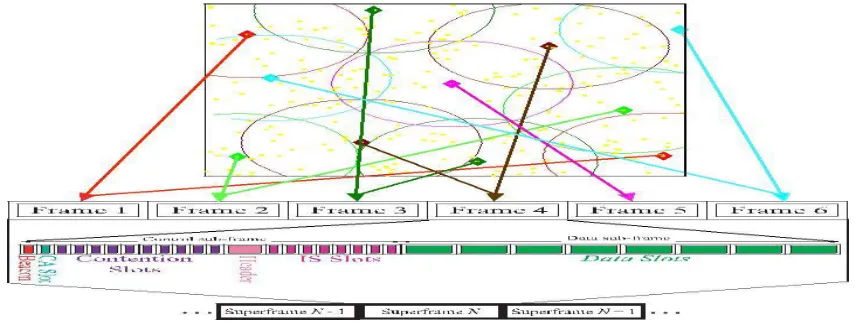
Fig. 1. A snapshot of MH-TRACE clustering and medium access. CHs are represented by diamonds. CH-frame matching, together with the contents of each frame, is depicted.
In this algorithm, the channel controllers continuously monitor the power level in all the available channels in the network and assess the availability of the channels by com-paring the measured power levels with a threshold. If the load on the channel controller increases beyond capacity, provided that the measured power level is low enough, the channel coordinator starts using an additional channel with the lowest power level measurement. Once the channel coordinator starts using the channel, its transmission increases the power level measurement of that channel for nearby controllers, which in turn prevents them from accessing the same channel. Similarly, as the local network load decreases, controllers that do not need some channels stop the transmissions in that channel, making it available for other controllers.
III.ii Cooperative Load Balancing
The DCA algorithm approaches the problem of non-uni-form load distribution from the perspective of the channel coordinators. The same problem can also be approached from the perspective of the other nodes in the network. Using cooperative nodes smooths out mild non-uniformities in the load distribution without the need for the adjust-mentis at the channel coordinator side.
the total number of nodes that access the channel and hence increases the service rate and the throughput.
IV. APPLYING DISTRIBUTED CHANNEL ALLOCATION AND COOPERATIVE LOAD BALANCING TO TRACE
IV.i Protocol Overview: MH-TRACE
This section briefly describes the MH-TRACE protocol. The complete protocol description is available in [4]. Also various protocol parameters are optimized. In MH-TRACE, certain nodes assume the roles of channel coordinators, here called cluster-heads. All CHs send out periodic Beacon packets to announce their presence to the nodes in their neighbourhood. When a node does not receive a Beacon packet from any CH for a predefined amount of time, it assumes the role of a CH. This scheme ensures the existence of at least one CH around every node in the network. In MH-TRACE, time is divided into super frames of equal length, as shown in Fig. 1, where the super frame is repeated in time and further divided into frames. Each cluster head operates using one of the frames in the super frame structure and provides channel access for the nodes in its communication range.
There are an equal number of IS slots and data slots in the remainder of the frame. During the IS slots, nodes send short packets summarizing the information that they are going to be sending in the corresponding data slot. By listening to the relatively shorter IS packets, receiver nodes become aware of the data that are going to be sent and may choose to sleep during the corresponding data slots. These slots contribute to the energy savings mechanism by letting nodes sleep during the relatively longer data slots whose corresponding IS packets cannot be decoded. IS packets can also carry routing information. However, for the purposes of this paper, we assume that all the nodes that can success-fully receive the IS packet listen to the corresponding data slot, since we are testing the performance of the MAC layer only. Routing considerations addressed in [45] are out of the scope of this paper.
IV.ii Dynamic Channel Allocation for TRACE
In MH-TRACE, each CH operates in one of the frames in the super frame. Since the number of data slots is fixed, the CH can only provide channel access to a limited number of nodes. Due to the dynamic structure of MANETs, one CH may be overloaded while others may not be using their data slots. In that case, although there are unused data slots in the super frame, the overloaded CH would provide channel access only to a limited number of nodes, which is equal to the number of data slots per frame, and the CH would deny the channel access requests of the others. Thus, the system needs a dynamic channel allocation scheme to provide access to a larger number of nodes.
DCA-TRACE includes two additional mechanisms on top of MH-TRACE: i) a mechanism to keep track of the interference level from the other CHs in each frame; and ii) a mechanism to sense the interference level from the transmitting nodes in each data slot in each frame. These mechanisms make use of existing messages and do not add complexity other than slightly increasing memory requirements to store the interference levels.
The MH-TRACE structure provides CHs the ability to measure the interference from other CHs in their own frame and in other frames through listening to the medium in the CA slot of their own frame and the Beacon slots of other frames. In MH-TRACE, CHs use this mechanism to choose the minimum interference frame for themselves. DCA-TRACE makes use of the same structure. However, in order to accommodate temporary changes in the interference levels that may occur due to CH resignation or unexpected packet drops, an exponential moving average update mechanism is used to determine the current interference levels in each frame. At the end of each frame, the interference level of the Beacon and CA slots are updated with the measured values in that frame using
In DCA-TRACE, CHs mark a frame as unavailable if there is another cluster that uses the frame and resides closer than a certain threshold, measured through the high interference value of that frame. Even under high local demand, CHs refrain from accessing these frames that have high interference measurements, in order to protect the stability of the clustering structure and the existing data transmissions. At the end of each super frame, CHs determine the number of frames that they need to access, m, based on the reservations in the previous frame. Depending on the interference level of each frame, they choose the least noisy m frames that have an interference value also below a common threshold, if the number of available frames is less than, the CHs operate only in the available frames. prevents excessive interference in between co-frame clusters that can potentially destabilize the clustering structure.
allocate another data slot that has a lower interference value. In order to do this, CHs keep track of the interference levels of each IS slot of each frame in the super frame. In order to accommodate temporary changes, the exponential moving average smoothing mechanism of (1) is also used for IS frames. Knowing the interference values of all IS slots; the CH opportunistically assigns the available data slots to the nodes that request channel access beginning with the slot that has the lowest interference value. This mechanism helps to reduce any possible collisions between the trans-missions sharing the same data slot.
Channel sensing and assignment in DCA-TRACE is similar to cognitive radio systems. However, since we do not distinguish between the primary CH of the frame and the CH that borrows a channel, we treat them equally in having access to the available data slots in any frame.
IV.iii Collaborative Load Balancing for TRACE
In the previous section, we described DCA-TRACE, which tackles non-uniform load distribution by allowing the CHs to access more than one frame in the super frame. The same problem can also be tackled from the member nodes’ perspective. In our previous work, we determined that the majority of the nodes in a TRACE network are in the vicinity of more than one CH (they are in the vicinity of two, three or four CHs with probabilities of 52, 19 and 1 percent). The nodes that are in the vicinity of more than one CH can ask for channel access from any of these CHs. Using a cooperative approach and a clever CH selection algorithm on the nodes, the load can be migrated from heavily loaded CHs to the CHs with more available resources.
In the TRACE protocols, nodes contend for channel access from one of the CHs that have available data slots around themselves. After successful contention, they do not monitor the available data slots of the CHs around them. Due to the dynamic nature of the network load, a cluster with lots of available data slots may become heavily loaded during a data stream. In order to tackle this issue, nodes should consider the load of the CH not only when they are first contend-ing for channel access but also after securing a reserved data slot during the entire duration of their data stream.
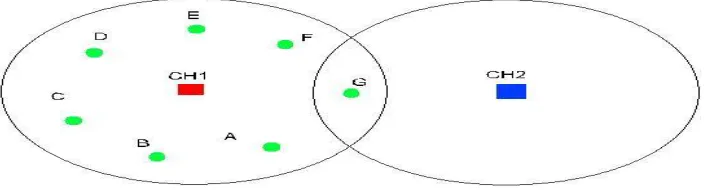
In order to further elaborate this, consider Fig. 2. Nodes A-G are source nodes and need to contend for data slots from one of the CHs. Each CH has six available data slots. In MH-TRACE, if their contentions go through in alphabeti-cal order, node G would mark CH1 as full and would ask for channel access from CH2. However, if node G secures a data slot from CH1 before any of the nodes A-F, one of the source nodes would not be able to access to the channel.
Fig. 2. Demonstration of a scenario for the collaborative load balancing algorithm.
In DCA-TRACE, once CH1 allocates all of its available slots, it triggers the algorithm to select an additional frame. However, accessing one additional frame might not always be possible, if the interference levels on all the other frames are too high. Moreover, accessing additional frames increases the interference in the Beacon and Header slots of these frames and may trigger CH resignations and reselections in the rest of the network that temporarily disturbs ongoing data streams on the resigned CHs. Finally, accessing additional frames increases interference on the IS and data slots of the new frame and decreases the potential extent these packets can reach.
V. PERFORMANCE EVALUATION
MANETs this information might not be available a priori, and some of these parameters may change over the course of the net-work lifetime. Thus, it is necessary for the protocols to dynamically adjust to changing conditions.
In uncoordinated MAC protocols such as IEEE 802.11 [46], the common channel resource is shared among the nodes in the network based on carrier sensing. This simple behaviour is well suited for handling any nu-uniformities in the load distribution. However, these protocols do not scale well as the load in the network increases due to the increasing number of collisions. On the other hand, coordinated MAC protocols such as the TRACE protocols and IEEE 802.15.4 (GTS mode) minimize or eliminate collisions by allocating dedicated channel resources to transmitters. Unlike MH-TRACE, the channel allocation for DCA-TRACE and CDCA-TRACE can be adjusted on the fly, making them more flexible protocols compared to their predecessor. By adjusting the channel access scheme, they are more capable of adapting to: i) shrinking network dimensions, and ii) non-uniformities in load distribution.
Due to the movement of the nodes in the network, the diameter of the network may shrink over the course of net-work operation. At one extreme, when the largest distance between any two nodes in the netnet-work is below the communication radius, nodes form a single hop connected net-work. The bandwidth efficiency of MH-TRACE sharply reduces for such an operation, as MH-TRACE cannot adjust the number of frames in each super frame dynamically, and each CH can only utilize a single frame per super frame. However, the dynamic channel allocation mechanism of
DCA-TRACE enables adaptation of the protocol to thisenvironment by letting the single CH access all the frames and
all the data slots. We investigate this scenario in Section 5.2. Cooperative load balancing is not effective in this simple scenario since there is only a single CH. Hence, CMH-TRACE and CDCA-TRACE perform similar to their predecessors, namely MH-TRACE and DCA-TRACE, respectively. Thus, we omit the CMH-TRACE and CDCA-TRACE results for this scenario.
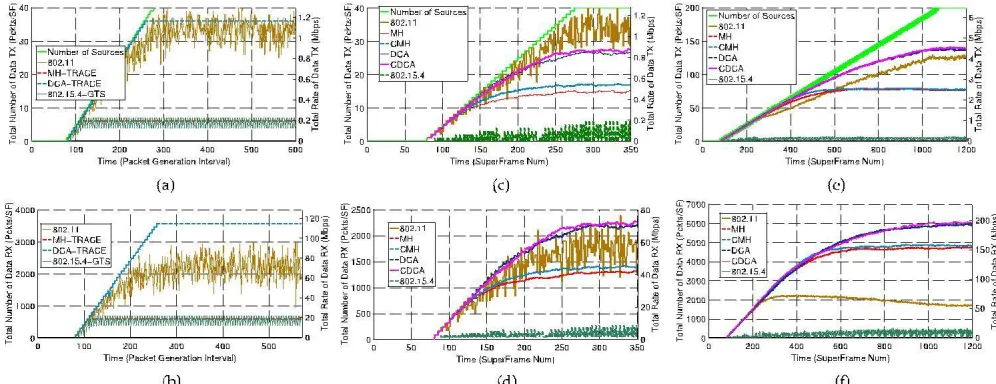
Fig. 3. Rate and number of data transmissions and receptions in each packet generation interval for (a,b) a single hop network (c,d) multi-hop net-work with localized load distribution, (e,f) multi-hop network with random load
distribution.
V.i System Model
For comparison purposes, we conduct ns-2 simulations of all of the protocols. The system model is discussed in this section. we addressed various routing layer considerations of TRACE systems in our previous work [45]. In this paper, we focus on the performance of the MAC layer only. Hence, we utilize simple network and transport layer protocols that provide local broadcasting. A connection-less transport layer model is assumed in which the transport layer directly connects the upper and lower layers. All data packets are assumed to be destined to the local neighbourhood (i.e., local broadcasting). All received data packets are passed to the application layer and are not relayed further.
Similarly, no ACK mechanism is used in the TRACE proto-cols either, and there are no packet retransmissions. For IEEE 802.15.4, beacon enabled mode of operation is used with guaranteed time slot (GTS) mechanism. The ACK mechanism is disabled for the data packets but is active for the control messages.
VI. CONCLUSION
In this paper, we studied the problem of non-uniform load distribution in mobile ad hoc networks. We proposed a light weight dynamic channel allocation algorithm and a cooperative load balancing algorithm. The dynamic channel allocation works through carrier sensing and does not increase the overhead. It has been shown to be very effective in increasing the service levels as well as the throughput in the system with minimal effect on energy consumption and packet delay variation. The cooperative load balancing algorithm has less impact on the performance compared to the dynamic channel allocation algorithm. We showed that these two algorithms can be used simultaneously, maximizing the improvements in the system. The combined system has been shown to perform at least as well as the systems with each algorithm alone and performs better for many scenarios. Both of the algorithms as well as the combined system also have a fast response time, which is on the order of a super frame duration of 25 ms, allowing the system to adjust under changing system load.
We proposed a novel MAC protocol, CDCA-TRACE, that combines dynamic channel allocation and cooperative load balancing algorithms into the TRACE framework. CDCA-TRACE, which controls channel utilization through the dynamically selected distributed channel coordinators, is compared to beacon enabled IEEE 802.15.4 in GTS mode of operation and IEEE 802.11, which controls channel utilization in a fully distributed manner. The carrier sensing mechanism enables CDCA-TRACE to select the channel coordinators more effectively compared to IEEE 802.15.4. CDCA-TRACE provides channel access to 20x more nodes and improves the number of receptions compared to IEEE 802.15.4.
REFERENCES
[1] B. Karaoglu, T. Numanoglu, and W. Heinzelman, “Analytical performance of soft clustering protocols,” Ad Hoc Netw., vol. 9, no. 4, pp. 635–651, Jun. 2011.
[2] Part 15.3: Wireless medium access control (MAC) and physical layer (PHY) specifications for high rate wireless personal area networks (WPAN), IEEE Draft Standard, Draft P802.15.3/D16, Feb. 2003.
[3] Wireless Medium Access Control (MAC) and Phys. Layer (PHY) Specifications for Low-Rate Wireless Personal Area Networks (WPANs), IEEE Standard 802.15.4-2006, Sep. 2006.
[4] B. Tavli, and W. B. Heinzelman, “MH-TRACE: Multi hop time reservation using adaptive control for energy efficiency,” IEEE J. Sel. Areas Commun., vol. 22, no. 5, pp. 942–953, Jun. 2004.
[5] T. Clausen, P. Jacquet, “Optimized Link State Routing Protocol”, Internet Draft, draft-ietf-manet-olsr-11.txt, July 2003.
[6] X. Hong, K. Xu, M. Gerla, “Scalable Routing Protocols for Mobile Ad Hoc Networks”, IEEE Network, 16(4), pp. 11-21, July-Aug 2002.
[7] F. Li, S. Z., X. Wang, X. Xue, H. Shen, “Vote-Based Clustering Algorithm in Mobile Ad Hoc Networks”, Proc. of International Conference on Networking Technologies for Broadband and Mobile Networks (ICOIN’2004), LNCS Vol. 3090, pp. 13 – 23, 2004.
[8] D. Shukla, L. Chandran-Wadia, and S. Iyer, “Mitigating the exposed node problem in IEEE 802.11 ad hoc networks,” in Proc. 12th Int. Conf. Comput. Commun. Netw., Oct. 2003, pp. 157–162.
[9] Y. Yi, M. Gerla, T. Kwon, “Efficient Flooding in Ad hoc Networks: a Comparative Performance Study”, Proceedings of the IEEE International Conference on Communications (ICC’2003), 2003.
[10] Y. Yi, M. Gerla, T. Kwon, “Passive Clustering (PC) in Ad Hoc Networks”, Internet Draft, draft-ietf-yi-manet-pac-00.txt, 2001. [12] J. Yu, P. Chong, “A Survey οf Clustering Schemes for Mobile Ad Hoc Networks”, IEEE Communications Survey
[11] L. Kleinrock, and F. Tobagi, “Packet switching in radio channels: Part I–carrier sense multiple-access modes and their throughput-delay characteristics,” IEEE Trans. Commun., vol. 23, no. 12,
[12] F. Tobagi, and L. Kleinrock, “Packet switching in radio channels: Part II–the hidden terminal problem in carrier sense multiple-access and the busy-tone solution,” IEEE Trans. Commun., vol. 23, no. 12, pp. 1417–1433, Dec. 1975.
[13] P. Karn, “Maca-a new channel access method for packet radio,” in Proc. ARRL/CRRL Amateur Radio 9th Comput. Netw. Conf., 1990, vol. 140, pp. 134–140.
[14] S. Toumpis, and A. Goldsmith, “New media access protocols for wireless ad hoc networks based on cross-layer principles,” IEEE Trans. Wireless Commun., vol. 5, no. 8, pp. 2228–2241, Aug. 2006.
[15] D. Shukla, L. Chandran-Wadia, and S. Iyer, “Mitigating the exposed node problem in IEEE 802.11 ad hoc networks,” in Proc. 12th Int. Conf. Comput. Commun. Netw., Oct. 2003, pp. 157–162.
[16] A. Nasipuri and S. Das, “Multichannel CSMA with signal power-based channel selection for multihop wireless networks,” in Proc. 52nd Veh. Technol. Conf., 2000, vol. 1, pp. 211–218.
[17] J. So and N. H. Vaidya, “Multi-channel MAC for ad hoc networks: Handling multi-channel hidden terminals using a single trans-ceiver,” in Proc. 5th ACM Int. Symp. Mobile Ad Hoc Netw. Comput., 2004, pp. 222–233.
[18] K. Tang and M. Gerla, “Mac layer broadcast support in 802.11 wireless networks,” in Proc. 21st Century Mil. Commun. Conf., 2000, vol. 1, pp. 544– 548.