A Novel Approach to Improve Performance of
DSR Algorithm in Mobile Ad hoc Network
Rachna Sharma 1, Neha Goyal2
M. Tech Student, Department of CSE, Shri Ram College of Engg. & Mgmt, Palwal, Haryana, India 1
Asst. Professor, Department of CSE, Shri Ram College of Engg. & Mgmt, Palwal, Haryana, India 2
ABSTRACT: The routing protocol is very helpful to transfer the data from source to destination node. The dynamic routing protocol is reactive on demand routing protocol which utilizes source routing and manage routes lively. It uses two phases: route discovery and route maintenance. DSR is the routing protocol in which correspondent find the right order of nodes of which a packet is transmitted. High overhead included in broadcasting while route generation is a restricting factor of Dynamic Source Routing (DSR) protocol used for mobile ad hoc networks (MANETs). During data delivery, it appears that we fully advantageous from DSR if the route is not long enough. In this paper, we introduce two modifications of DSR algorithm to improve its performance. In the changed DSR approach, to decrease flooding overhead, multicasting technique is utilized. Again, for decreasing packet length, in situation of longer route, the route is truncated after a predetermined no. of hops. Some simulations indicate that the novel modified algorithm (Improved DSR) performs better as compared to the DSR algorithm. In this paper, to examine the several routes among nodes in the network ant colony optimization algorithm is employed. The performance analysis of DSR routing protocol is examined by using ACO with various QoS parameters.
KEYWORDS: DSR, AODV, E-DSR, RREQ and RREP
I. INTRODUCTION
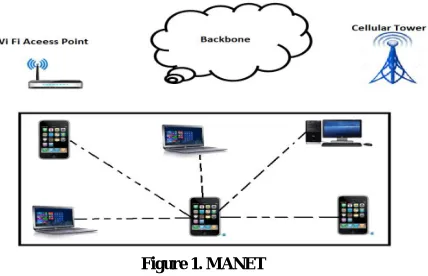
A Mobile Ad-hoc network (MANET) [1] is a type of wireless ad-hoc network, and is a self organizing network of mobile routers (and connected hosts) linked by wireless connections – the union of which make an arbitrary configuration [1]. Along with current growth of the ad hoc networks, their required size will become large. It is hence needed to ensure the management of the large ad hoc networks effectively. Some routing protocols have been introduced for the ad hoc networks. They are categorized into hierarchical routing protocols and plane routing protocols [2]. As illustrated in Figure 1, the plane routing protocols are consisted of source-initiated on-demand driven (Reactive) and table driven (Proactive) protocols [3].
Figure 1. MANET
DSR [4], when the destination obtains the request packet, it forwards back the route response packet consisting the complete route from the source node to the destination node along the back route to the source node.
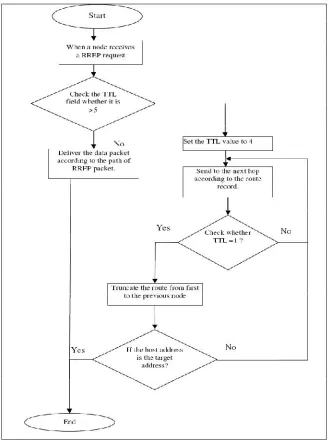
High overhead, included in broadcasting during route generation, is a restricting factor of Dynamic Source Routing (DSR) protocol when used for mobile ad hoc networks (MANETs). This paper examines through simulating an enhancement of basic DSR to improve its performance. In the Enhanced-DSR (E-DSR), to decrease Route Request Packet overhead, multicasting technique is utilized employing Route Record field of Route Request option. Again, in situation of longer route in the packet header, the route is truncated after a predetermined no. of hops to decrease the packet length. The Dynamic Source Routing protocol permits mobile sources to determine paths towards any required destination dynamically [4, 5]. Each data packet involves entire list of nodes, which the packet must pass before it arrives the destination node. Thus, all nodes that send or overhear these packets may record routing information for future usage. DSR can support fast network configuration modifications and service even asymmetric connections; it can successfully discover paths and send packets in unidirectional connection environments. Furthermore, like AODV [6], it has a technique for on-demand route management, so there are no periodic configuration update packets. When connection failures happen, only those nodes which send packets through those connections must obtain proper routing advertisements. Additionally, DSR permits source nodes to obtain and record more than one path towards a particular destination. Intermediary nodes have the chance to choose another cached route as soon as they are reported about a connection failure.
When a source that wants to forward data to a specific destination, first examines to whether it has a route in its cache for that destination node. If it does, it will utilize that route by placing (in the data packet header) the sequence of hops that the packet must adopt to arrive the destination. If there is no such route recorded in the local cache, then the source will start a new path discovery mechanism, by flooding a Route Request to its neighborhood. This message has the source and destination addresses, a request ID and an ordered intermediary node’s address list, via which this message has traversed. This node list blank initially when the message leaves the source node (it has not yet traversed any other node). After that, each other node that obtains this request message parses it to view if it is the targeted destination. Each node processes the request according to the below steps:
1. If the initiator’s address for this route request is detected in this host’s list of recently viewed requests, then drop the route request packet and do not process it further.
2. If this host’s address is already listed in the route record in the request, then drop the route request packet and do not process it further.
3. If the destination of the request matches this host’s own address, then the route record in the packet consist the route by which the request arrived this host from the route request initiator. Return a copy of this route in a route response packet to the initiator.
4. Else, add this host’s own address to the route record in the route request packet and re-broadcast the request.
II. LITERATURE REVIEW
Ammar Odeh et al.[1]:In this paper, authors analyze a MANET’s performance for two proactive protocols; Ad Hoc On-Demand Distance Vector (AODV) Protocol, and Dynamic Source Routing (DSR) Protocol. By using network simulator NS2, we setup and evaluate the performance of AODV and DSR protocols with respect to the packets’ size. The different performance metrics were investigated with respect to packets’ size. DSR has shown better performance in terms of efficiency for a packet size less than 700 bytes. In our simulation, we are studying the relation between different MANET performance parameters with respect to packets’ size.
Aarti et al.[2]: In this paper, authors explained the characteristics, challenge, application, security goal and different types of security attacks in mobile ad-hoc network. Ad-Hoc network routing protocols are commonly divided into three main classes; Proactive , reactive and hybrid protocols .In MANET, all networking functions such as routing and packet forwarding, are performed by nodes themselves in a self-organizing manner. MANET vulnerable to various kinds of security attacks like warm hole, black hole, rushing attack. Attacks are classified into two categories. Active attack and passive attacks.
performance matrices packet delivery fraction, normal routing load and packet drop. The main focus of the work is to reduce the routing overhead, congestion and increase the performance Cygurin and NS-allinane 2.34 simulation tool is used.
Dweepna Garg et al.[4]:In this paper, writers show a novel routing algorithm for multi-hop, mobile ad-hoc networks. The protocol depends on swarm intelligence. Ant colony Algorithms are a group of swarm intelligence and assume the capability of simple ants to resolve complicated issues by cooperation. The major challenge in this type of networks is to determine a path among the communication end points, what is critical through the node mobility. Data packets routing is only through optimum route which is created by route discovery stage as described by ACOR. Route maintenance is performed periodically to retain optimum route. The primary objective of the protocol design is to decrease the routing overhead and refer to the protocol as the Ant Colony Optimization Routing (ACOR).
Diya Naresh Vadhwani et al.[5]: In this Paper, writers analysis the DSR performance. Reactive Manet routing protocols is built for delay and throughput utilizing the OPNET simulation tool. The DSR protocol is examined based on HTTP traffic because currently the internet applications are more significant for secure interaction. DSR is reactive Manet routing protocol. Here the DSR routing protocol is examined with HTTP. The traffic parameters i.e. DSR routing traffic obtained and forwarded are examined for 50, 70 and 100 nodes. The HTTP traffic obtained and forwarded is also examined for 50, 70 and 100 nodes. From the above simulation the performance matrices i.e. delay and throughput are examined for 50, 70 and 100 mobile nodes for DSR routing protocol. From above it is realized analysis that throughput is more in 100 nodes as compared to 50 and 70.Also the delay is less for 70 nodes in comparison of 50.
III. ACO BASED TECHNIQUE
AntNet is an adaptive routing algorithm motivated by ant colonies to resolve routing issues in wired networks. An AntNet node manages probabilistic entries in the routing table, showing the path goodness. Every node periodically forwards a forward ant packet to determine routes to a arbitrary destination. Forward ants determine the network for a low cost and viable path, storing each node it visits. Once it reaches at the target node, it is translated into a backward ant. The backward ant backs to the source node adopting the reverse path. Every intermediary node maintains its routing tables from the backward ant information. Ants communicate and interact indirectly by maintaining the routing tables, hence collaboratively resolve the global network routing optimization issue.
Antnet Algorithm
At periodic intervals, from each network node, a forward ant is established with a arbitrarily chosen destination node. While going towards their target node.
The forward ants record their paths and the traffic situations. At every node, every forward ant selects the next node.
If all the neighbor nodes have not been visited, then the next neighbor is selected among the nodes that have not been visited.
If all the neighbor nodes have been visited previously, then the next node is selected in a uniform way among all the neighboring nodes. The forward ant is pushed to return to a prior visited node.
With a small possibility, the next node may be selected in a uniform way among all the neighbor nodes.
If a cycle is determined, i.e., if the ant is pushed to return to an already traversed node.
When the target node is arrived, the forward ant creates a backward ant. The backward ant uses the similar path as the corresponding forward ant, but in the reverse direction.
Reaching at a node coming from a neighboring node, the backward ant maintains the routing table Tr, for all the entries corresponding to the target node.
IV. ANT DYNAMIC SOURCE ROUTING (ADSR)
graph and they are imitating real ants, International Journal of Computer Science and Security, volume (2) issue (3) deposit artificial pheromone on the graph in such a manner that future artificial ants can make better solutions. ACO has been used successfully to an impressive no. of optimization issues. PSO is a global minimization method for dealing with issues in which a best solution can be shown as a surface or point in an n-dimensional space. ACO is application of ant’s nature to complicate computational optimization issues. ACO is motivated by the foraging nature of ant colonies, whereas they are capable to determine shortest path between two points through collective learning. Learning is obtained by deposition of a chemical known as pheromone. ACO depends on real ant’s nature in determining a route to food nest. It has been realized that of existed routes, ants determine shortest route to food nest. To obtain this, ant interacts through deposition of chemical substance known as pheromone along the route. Shortest path has greatest concentration yielding to more and more ants utilizing this route.
V. SIMULATION AND RESULT
In A-DSR, the basic issue of DSR has been enhanced by decreasing Route Request overhead and decreasing packet length which has been indicated by utilizing the extended version of OPNET[12] and . In the simulation, it has been indicated that the performance of A-DSR is much better as compared to DSR. Here it is considered that, the ad-hoc network contains 100 wireless nodes, moving about over 2500 X 2000 flat spaces for 300 s of simulated time. For enabling direct, fair comparisons between the DSR and the E-DSR, it was severe to challenge the protocols with similar loads and environmental situations. Each simulator run accepts a scenario file as input that explains the exact motion of every node and the exact packets sequence Generated by every node, together with the exact time at which every change takes place in motion or packet creation. However every protocol was changed in a same manner, the performance of these protocols can directly be compared.
4.1Route Request Packet Overhead
For the same network E-DSR decreases flooding of packets. Fig 2 shows this idea. From the graph, it can be concluded that, as the no. of nodes increases in a network, no. of flood packet is decreased in ESDR in comparison of DSR.
4.2 Control Packet Overhead
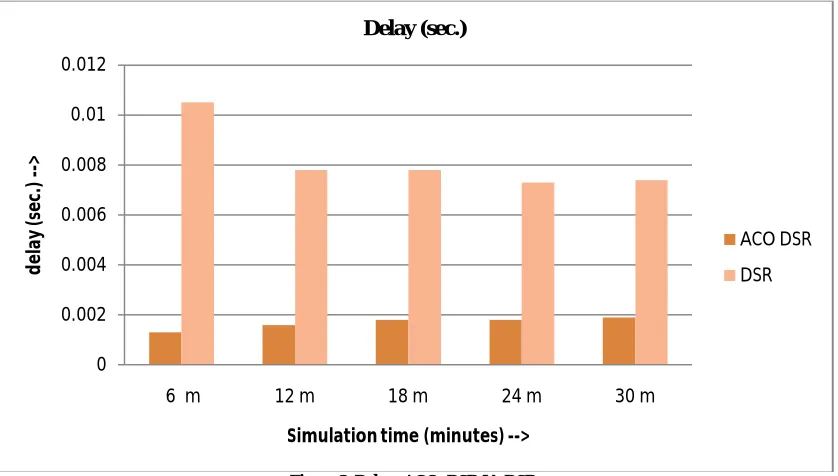
In DSR, broadcasting of every Route request packet includes various consecutive control packets i.e. MAC, RTR [4, 7]. So, decrement of Route Request packets in E-DSR also decreases control packet overhead. The measurement of DSR routing protocol and its optimization utilizing ant colony algorithm is explained in this. Fig 3 illustrates the delay of ACO_DSR and DSR. ACO_DSR generates better results as compared to other routing protocols. This is due to the Ant colony technique in this the shortest path once discovered then all the routing that is transfer of packets take place on that path which overcomes the route finding process. So here the ACO_DSR delay is less than DSR.
Figure 3. Delay: ACO_DSR Vs DSR
Fig 4 represents the routing load of DSR and ACO_DSR. ACO_DSR and DSR are pure reactive protocol with no zone concept. When the network size increases a vehicle has more choices for routes to destination node which proves the process to be multi path form. As there is using an ant colony procedure to optimize the protocol these initially represents a high result in comparison of other protocols which is indicated below. So the ACO_DSR has less routing load in comparison of DSR and same path searching takes place in reactive routing protocol.
0 0.002 0.004 0.006 0.008 0.01 0.012
6 m 12 m 18 m 24 m 30 m
d
el
ay
(s
e
c.
)
-->
Simulation time (minutes) -->
Delay (sec.)
ACO DSR
Figure 4. Routing Load: ACO_DSR Vs DSR
Fig 5 depicts the analysis of percentage of packet delivery ratio. As a result the packet delivery ratio increase as no. of nodes increases. The packet delivery ratio increases in the ant colony optimization mechanism.
Figure 5: Packet delivery ratio ACO_DSR vs DSR
VI. CONCLUSION
In this paper we introduce a swarm based optimization mechanism to enhance the DSR protocol performance for vehicular ad hoc network. DSR is appropriate for VANET due to its self organizing and maintenance characteristics. As explained in the results, ant colony optimization method works properly for vehicular ad hoc network and enhance the several quality of service parameters i.e. jitter, end to end delay, energy consumption in the network, packet delivery ratio and routing load. The DSR routing protocol provides excellent performance utilizing the ACO algorithm for multi hop wireless ad hoc network, so using ACO with DSR will be flexible and optimal for data packages routing
0 20000 40000 60000 80000 100000 120000 140000 160000
6 m 12 m 18 m 24 m 30 m
N
e
tw
o
rk
lo
ad
(b
it
s/
se
c.
)
Simulation time (minutes) --> Network load (bits/sec.)
ACO DSR
DSR
0 500000 1000000 1500000 2000000 2500000
6 m 12 m 18 m 24 m 30 m
T
h
ro
u
gh
p
u
t
(b
it
s/
se
c.
)
-->
Simulation time (minutes) --> PDR (bits/sec.)
ACO DSR
in vehicular ad-hoc networks (VANETs). This work concentrates and outline on the usage of ACO in the VANET routing algorithms.
REFERENCES
[1] Ammar Odeh,Eman Abdefattah and Muneer Alshokan,”Performance Evaluation Of Aodv And Dsr Routing Protocols in MANET Networks ,”International journal of Distributed and Parallel system (IIDPS), VOL.3, ISSUE.4, JULY 2012, pp.13-22.
[2] Aarti, Dr. S.S Tyagi,”Study of MANET: Characterstics, Challenges, Application and Security Attacks”, International Journal of advanced Research in computer science and software Engineering, vol. 3, Issue. 5, May 2015, pp.252-257.
[3] Chintan kavani, Amit Singla, “Ant colony optimization based modified AOMDV For multipath routing in MANET”, International Journal of Computer Application, vol. 82, issue-10, November 2013, pp. 14-19.
[4] DWEEPNA GARG & PARTH GOHIL,”ANT COLONY OPTIMIZED ROUTING FOR MOBILE ADHOC NETWORKS (MANET)”,International journal of smart sensor and ADHOC Networks (IISSAN), vol-2, issue-3,4 , 2012 ,pp. 8-13.
[5] Diya Naresh Vadhwani ,Deepak Kulhare , Megha Singh ,”Behaviour Analysis of DSR MANET PROTOCOL WITH HTTP TRAFFIC USING OPNET SIMULATOR”, International journal of innovative research in computer and communication engineers,vol.1, issue 3,MAY 2013,pp.680-682.
[6] Dr. S.S Dhenakaran,A.parvathavarthini,”An Overview of Routing Protocol in Mobile Ad hoc Network”,International Journal of Advanced Research in Computer Science and Software Engineering,vol. 3,Issue. 2, February 2013, pp.251-259.
[7] G.Vijaya Kumar, Y.Vasudeva Reddya, Dr. M Nagendra,”Current Research Work On routing protocol for MANET: A Literature Survey”, International Journal on Computer Science and Engineering (IJCSE), vol. 2, Issue.3, 2010, pp.706-713.
[8] Goel A., Ramakrishnan K. G., D. Kataria, and D. Logothetis, “Efficient computation of delay-sensitive routes from one source to all destinations,” in Proceedings of IEEE Conference on Computer Communications, 2001, pp. 854-858.
[9] Heissenbüttel M., T. Braun, M. Wälchli, and T. Bernoulli, “Optimized stateless
broadcasting in wireless multi-hop networks,” in proceeding of 4th IEEE international conference on Infocom Barcelona,2006,pp.234-250.
[10] H.P. Glathe, L. Karlsson, G.P. Brusaglino, L. Calandrino, “The PROMETHEUS Programme– Objectives, Concepts and Technology for Future Road Traffic”, in Proceedings of12th conference of networking, May 1990, pp. 477-484.
[11] H. Safa, H. Artail, and R. Shibli, “An interoperability model for supporting reliability and power-efficient routing in mobile ad hoc network,” International Journal of Ad Hoc and Ubiquitous Computing, Vol. 4, 2009, pp. 74-83.
[12] H. Wu, Fujimoto, R., Guensler, R., and Hunter, M, “MDDV: a mobility-centric data dissemination algorithm for Mobile network,” in Proceedings of the 1st ACM international Workshop on Mobile Ad Hoc Networks, October, 2004, pp. 47-56.
[13] Jaspreet Kaur, Vinod Kumar , “An Effectual Defense Method against Packet DroppingAttack in Wireless Sensor Networks” , International Journal of Computer Science and Information Technologies, Vol. 3 (3) , 2012, pp. 4523-4528.
[14] Jasvinder, Monika Sachdeva ,” Effects of Black Hole Attack on an AODV Routing Protocol Through the Using Opnet Simulator” International Journal of Advanced Research in Computer Science and Software Engineering, Volume 3, Issue 8, August 2013.
[15] Jaydip Sen, M. Girish Chandra, “ A Mechanism for Detection of Packet DroppingAttack in Mobile Ad Hov Networks”, in Proceeding of ICICS IEEE Conference, 2007.
[16] Jorjeta G. Jetcheva, Yih-Chun Hu, Amit Kumar Saha, and David B. Johnson. “Design and Evaluation of a Metropolitan Area Multitier Wireless Ad Hoc Network Architecture in MANET”. In Proceedings of the Fifth IEEE Workshop on Mobile Computing Systems & Applications, Monterey, CA, Oct. 2003,pp 32-37.
[17] Jerome Haerri “Performance Comparison of AODV and OLSR in MANETs Urban Environments under Realistic Mobility Patterns” Department of Mobile Communications, June 2005, pp. 123-134.
[18] Jahanzeb Farooq, Bilal Rauf “ Implementation and Evaluation of IEEE 902.11e Wireless LAN in GloMoSim” In Proceeding of the 1st ACM International Workshop on Mobile Ad Hoc Networks, NY, USA, 2004,pp. 76-85.
[19] Korkmaz G., E. Ekici, F. Ozgüner, and U. Ozgüner, "Urban multi-hop broadcast protocol for inter-vehicle communication systems in MANET," In Proceeding of the 1st ACM International Workshop on Mobile Ad Hoc Networks, NY, USA, 2004,pp. 76-85.
[20] Lovepreet Singh Shaheed Bhagat Singh Navdeep Kaur,l” Analysis the Performance of MANET Protocol under Black Hole Attack for E-Mail Application” International Journal of Computer Applications (0975 – 8887) Volume 103 – No.12, October 2014.
[21] Manoharan R., S. L. P. Thambidurai, “Energy efficient robust on-demand multicast routing protocol for mobile ad hoc network,” in Proceedings of International Journal of Ad Hoc and Ubiquitous Computing, Vol. 3, 2008, pp. 90-98.
[22] Manvi S., Kakkasageri M.S., Mahapurush , “Performance Analysis of AODV, DSR, Routing Protocols In Mobile Ad hoc Network Environment” In Proceedings of International conference on future Computer and Communication., April. 2009, pp. 21-26.
[23] Meenakshi Patel, Sanjay Sharma,”Detection of Malicious Attack in MANET A Behavioral Approach”, IEEE International Advance Computing Conference (IACC)Volume 3,2013,pp.388-393.
[24]Meenakshi Tripathi,M.S.Gaur,V.Laxmi,” Comparing the Impact of Black Hole and Packet DroppingAttack on LEACH in WSN”The 8th International Symposium on Intelligent Systems Techniques for Ad Hoc and Wireless Sensor Networks (IST-AWSN)Volume- 19 ,2013,pp1101 – 1107.
[25] Megha Arya, Yogendra Kumar Jain, “Packet Dropping Attack and Prevention in Mobile Adhoc Network”, in Proceeding of International Journal of Computer Applications, Vol.27, August 2011, pp.21-26.
[26] Megha Arya, Yogendra Kumar Jain, “Packet Dropping Attack and Prevention in Mobile Adhoc Network”, in Proceeding of International Journal of Computer Applications, Vol. 27, August 2011, pp.21-26.