Abnormal Moving Object Detection Using
Sparse Based Graph K Nearest
Neighbour(SGk-NN)
R. Kavitha1, Dr.N.Kavitha2
M.Phil Scholar, PG & Research Dept. of Computer Science, Nehru Arts and Science College, Coimbatore, India1
Professor & Head, PG & Research Dept. of Computer Science, Nehru Arts and Science College, Coimbatore, India2
ABSTRACT: The task of processing k-nearest neighbour queries is most important in moving object related applications. Mostly the previously available approaches to this problem handles the processing of k-nearest neighbor Queries in centralized setting only. It is difficult, if not impossible to handle the large amount of data and concurrent
queries that are increasingly common in those applications. The proposed method called “An Efficient Sparse Graph
Based KNN (SGk-NN) Processing of K Nearest Neighbor Queries over Moving Objects” shown that using nearest neighbor classification to approximate with real-time moving object detection, classification and tracking capabilities is given. This method can work well in both color and gray scale video imagery from a stationary camera. It can detect the Abnormal moving object in indoor and outdoor environments and under changing illumination conditions.
KEYWORDS: Clustering; Nearest Neighbor, Graph, Sparse Combining, Abnormal Event Detection
I. INTRODUCTION
Clustering is ubiquitous in science and engineering with numerous application domains ranging from bioinformatics and medicine to the social sciences and the web [1]. Perhaps the most well-known clustering algorithm is the so-called “k-means” algorithm or Lloyd’s method [2]. Lloyd’s method is an iterative expectation-maximization type approach that attempts to address the following objective: given a set of Euclidean points and a positive integer k corresponding to the number of clusters, split the points into k clusters so that the total sum of the squared Euclidean distances of each point to its nearest cluster center is minimized. Due to this intuitive objective as well as its effectiveness [3], the Lloyd’s method for k-means clustering has become enormously popular in applications [4].
A major challenge for processing k-NN queries lies in the sheer volume of data and concurrent queries. A recent
study [5] estimates that the global pool of generated personal location data was at least 1PB in 2009 and that it is growing by about 20 percent a year. The abundance of such data gives rise to a variety of location-based applications and services, which must be able to effectively handle a large quantity of user-initiated concurrent queries (many of which are k-NN queries) in addition to managing the vast volume of data. For example, the number of users of weChat, a free social networking app installed on smart phones, has exceeded 300 million as of January 2013 [6]. One of its functionalities is to allow the users to locate their nearest fellow users upon request. In the new era of big data, it is imperative to find solutions that can effectively support the processing of many concurrent k-NN queries over large volumes of moving objects data.
KNN(K-Nearest Neighbour) algorithm is a typical machine learning algorithm. It is one of the oldest, accurate and simplest method for pattern classification and regression. kNN algorithms have been identified as one of the top ten most influential data mining algorithms for their ability of producing simple but powerful classifiers. It has been studied at length over the past few decades and is widely applied in many fields.
Most existing solutions to the problem of k-NN over moving objects [7], [8], [9] are not designed to handle the large volume of data, Because they implicitly assume a centralized setting, where the maintenance of the object locations and query processing both take place at a central place .While this is a reasonable assumption for a small set of objects and a light update/query workload, such approaches are no longer viable when the volume of data and/or queries exceeds. It is therefore necessary to develop distributed solutions that are able to scale as demands increase. The distributed cluster framework with determining initial centroid and by using Euclidean distance method based object detection approach to get more accurate result.
To detect Abnormal moving objects in video, combination techniques such as background extraction and Sparse Graph mapping(SGK-NN) are combined for efficient object detection using Visible Gradient (Orientation Estimation), Luminance Map Detection (Image Intensity variation) and Background Extraction with sparse basis. The key objective of the SGK-NN work is to merge the clustering based Nearest Neighbor method for the video streaming data with frame feature prediction based approach.
The rest of the paper is organized as follows: Related work is detailed in Sect. 2. In Sect. 3, Proposed Methodology and Sect. 4, discussed experimental results are described. The conclusion is in Sect. 5.
II. RELATED WORK
In [5] authors proposed many location-based applications require constant monitoring of k-nearest neighbor (k-NN) queries over moving objects within a geographic area. Existing approaches to this problem have focused on predictive queries, and relied on the assumption that the trajectories of the objects are fully predictable at query processing time. Authors used an optimization function which considers nature of the packet, size of the packet and distance between the nodes, number of hops and transmission time are also considered for optimization. In [6] introduced a new index method, called the grid-partition index, to support NN search in both on-demand access and periodic broadcast modes of mobile computing. The grid-partition index is constructed based on the Voronoi diagram, i.e., the solution space of NN queries. However, it has two distinctive characteristics. First, it divides the solution space into grid cells such that a query point can be efficiently mapped into a grid cell around which the nearest object is located. In [7] authors proposed an air indexing framework that 1) outperforms the existing (i.e., snapshot) techniques in terms of energy consumption while achieving low access latency and 2) constitutes the first method supporting efficient processing of continuous spatial queries over moving objects. In [8] Authors had modified the Users specify the computation in terms of a map and a reduce function, and the underlying runtime system automatically parallelizes the computation across large-scale clusters of machines, handles machine failures, and schedules inter-machine communication to make efficient use of the network and disks. Programmers find the system easy to use: more than ten thousand distinct MapReduce programs have been implemented internally at Google over the past four years, and an average of one hundred thousand MapReduce jobs are executed on Google's clusters every day, processing a total of more than twenty petabytes of data per day. In [9] authors described a dynamic index structure called an R-tree which meets this need, and give algorithms for searching and updating it. This paper present the results of a series of tests which indicate that the structure performs well, and conclude that it is useful for current database systems in spatial applications.
III.PROPOSED ALGORITHM
Fig.1. Proposed Framework Architecture diagram
A. Image and Video Feature Extraction
Features of the image are extracted without considering the local decisions. This feature extraction process results as feature image. Here, Real world data may contain errors, & it doesn’t be complete and consistent. There is one image mining technique called image data preprocessing resolves this issue. This is a well known accepted method for data preprocessing. It transforms the raw data into understandable format.
The input images are first separated into amount of pixels, which are separated into non-overlapping pixels. The image pixel orientation and magnitude are computed for each pixel. An image vectors variation of these bin orientations is formed for each shape. The magnitude of the bin is used as a vote weight. The resulting mean shift grouping pixels are concatenated to form the image descriptor.
The process of video frame extraction can be done by converting .avi file into number of frames. Here there are two methods are implemented .JPG file and formatCdata (Character Data) conversion. Histogram difference between the frames are taken and the frames above the some average will be collected. Frames collected in this manner are known as key frames. Those folders kept in one folder. The Color image data array is converted into indexed array data (i.e., the corresponding data is converted into greyscale value (0 and 1)). The Converted Frames are in 4-Dimension array, so first reshape the matrix into 3D array. Conversion of 4-D array into 3-D array image data with help of image total pixels and number of frames is done in the Pre-Alignment process.
B. Gradient Field and Dynamic Background Extraction
The location that is different from its surrounding are indicated by visual saliency bottom-up, stimulus-driven signal. For example red object in a white field will be salient and will attract attention in a bottom-up manner. This bottom-up deployment of attention towards salient locations can be strongly modulated or even sometimes overturn by top-down, user-driven factors.
A Gradient Pyramid approach is obtained by applying a set of 4 directional gradient filters (horizontal, vertical and 2 diagonal) to the Gaussian Pyramid at each level. At each level, these 4 directional Gradient Pyramids are combined together to obtain a combined gradient pyramid that is similar to a Laplacian pyramid. The solution is same in both of approaches except replacing the Laplacian pyramid with the combined Gradient Pyramid.
C. Nearest Neighbor Clustering Algorithm
The Nearest Neighbour Clustering algorithm is designed to discover the clusters and the moving objects in a real world datasets according to equation (1). First, the appropriate parameters objective function, cluster label, and Centroid value of clusters and one core point of the neighbour partitions respective cluster are selected.
A correlation between low membership elements and outliers was also observed. A low-memberships score indicates that a point is on average far from the rest of the points and hence probably an background objects. In high-dimensional spaces, however, low data point elements are expected to occur by the very nature of these spaces and data resource. The Nearest Neighbor based kernel mapping can be applied using more general notions of similarity, and the similarities may be positive or negative. The output of the algorithm is unchanged if the similarities are scaled and/or offset by a constant (as long as the preferences are scaled and/or offset by the same constant). To compute fitness measure over the set of possible clusters and then chooses among the set of cluster candidates points (hubs) those that optimize the measure used. To identify the cluster of a specific vertex or to group all of the vertices into a set of clusters, and then present possible cluster fitness measures that serve for methods that produce the clustering by comparing different groupings and selecting one that meets or optimizes a certain criterion. The ratio of the cluster is to minimum sums of degrees either inside the cluster or outside it. A fitness function is evaluated for all neighbors and the outcome is used to choose to which neighbor the search will proceed.
d( , )
=1-a+b-2c
n eqn. (1)
D. The Sparse Graph Based KNN (Gk-NN) Algorithm
A robust and novel approach to automatically extract a set of projective transformations induced by these frame regions, detect the occlusion pixels over multiple consecutive frames, and segment the scene into several motion layers. First, after determining a number of seed regions using correspondences in two frames, to expand the seed regions and reject the outliers employing the graph cuts region merging method integrated with salient motion representation. Next, these initial regions are merged into several initial layers according to the motion similarity. Third, an occlusion order constraint on multiple frames is explored, which enforces that the occlusion area increases with the temporal order in a short period and effectively maintains segmentation consistency over multiple consecutive frames.
The SGK-NN learning moving object detection in video training 3D data location gradient features in all frames are
denoted as X = {x1, x2,…, xn} ∈Rp×n, collected temporally for training. The research goal is to find a nearest neighbor
combination set NN = {N1, N2, …, NK} with each Neighbouri∈Rp×k containing N over completed dictionary beginning
vectors, forming a unique combination, where Neighbour (N) ≪ query. Each Ni belongs to a closed, convex and
bounded set, which ensures column-wise unit standard to prevent over-fitting.
Algorithm : SPARSE GRAPH BASED KNN (GK-NN) Input: X, current training features Xc = X
repeat
Optimize {Si, β} with Eq. (4)
Optimize {γ} using Eq. (5)
until Eq. (4) distance converges Add Si to set S
Remove calculated features xj with γji = 0 from Xc
i = i + 1 until Xc = ∅ Output: S
IV. RESULTS AND DISCUSSIONS
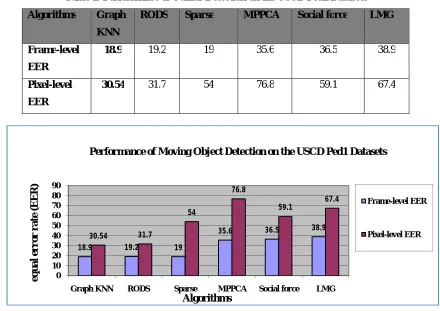
The performance of Sparse Graph based KNN classification method was compared with that of a number of state-of-the art moving object event detection algorithms. Since most of the previously mentioned moving object detection algorithms are offline (only batch versions), it was not appropriate to compare with them, as the dataset becomes very large and high-dimensional for streaming videos. Hence, for comparison of performance evaluation, the following algorithms which are widely used for anomaly detection in streaming videos have been used: RODS [10], Sparse [12], MPPCA [11], Social force [14] and LMH [13].
Table 1 shows the quantitative performance comparison of the Sparse Graph based KNN model with other existing models of RODS. It can be clearly seen that Sparse Graph based KNN outperforms other algorithms.
Table 1: Performance of Outlier Detection on the USCD Ped1 Datasets Algorithms Graph
KNN
RODS Sparse MPPCA Social force LMG
Frame-level EER
18.9 19.2 19 35.6 36.5 38.9
Pixel-level EER
30.54 31.7 54 76.8 59.1 67.4
18.9 19.2 19
35.6 36.5 38.9
30.54 31.7
54
76.8
59.1 67.4
0 10 20 30 40 50 60 70 80 90
Graph KNN RODS Sparse MPPCA Social force LMG
e
q
u
al
e
r
r
o
r
r
ate
(EER
)
Algorithms
Performance of Moving Object Detection on the USCD Ped1 Datasets
Frame-level EER
V. CONCLUSION AND FUTURE WORK
This paper presents an optimal Sparse Graph Based KNN (SGk-NN) Algorithm which combines moving objects and Real-world data's. The Nearest Neighbor Queries over Moving Objects detection using graph based algorithm with gradient method for classification has not previously been attempted. This proposed work shown that using nearest neighbor classification to approximate with real-time moving object detection, classification and tracking capabilities is presented. The system operates on both color and gray scale video imagery from a stationary camera. It can handle object detection in indoor and outdoor environments and under changing illumination conditions. Object detection in a video is usually performed by object detectors or background subtraction techniques. To apply to the moving objects we need to refine the adjacency matrix by move with reasonable velocities pursuing as future research.
REFERENCES
1. J. A. Hartigan, Clustering Algorithms. New York, NY, USA: Wiley, 1975.
2. S. Lloyd, “Least squares quantization in PCM,” IEEE Trans. Inf. Theory, vol. 28, no. 2, pp. 129–137, Mar. 1982.
3. R. Ostrovsky, Y. Rabani, L. J. Schulman, and C. Swamy, “The effectiveness of Lloyd-type methods for the k-means problem,” in Proc.47th Annu. IEEE Symp. Found. Comput. Sci. (FOCS), Oct. 2006, pp. 165–176.
4. X. Wu et al., “Top 10 algorithms in data mining,” Knowl. Inf. Syst., vol. 14, no. 1, pp. 1–37, 2008.
5. X. Yu, K. Pu, and N. Koudas, “Monitoring k-nearest neighbor queries over moving objects,” in Proc. 21st Int. Conf. Data Eng., 2005, pp. 631– 642.
6. B. Zheng, J. Xu, W.-C. Lee, and L. Lee, “Grid-partition index: A hybrid method for nearest-neighbor queries in wireless locationbased services,” VLDB J., vol. 15, no. 1, pp. 21–39, 2006.
7. K. Mouratidis, S. Bakiras, and D. Papadias, “Continuous monitoring of spatial queries in wireless broadcast environments,” IEEE Trans. Mobile Comput., vol. 8, no. 10, pp. 1297–1311, Oct. 2009.
8. J. Dean and S. Ghemawat, “MapReduce: Simplified data processing on large clusters,” Commun. ACM, vol. 51, no. 1, pp. 107–113, 2008. 9. A. Guttman, “R-trees: A dynamic index structure for spatial searching,” in Proc. ACM SIGMOD Int. Conf. Manage. Data, 1984, pp. 47–57.
10. Abe, N, Zadrozny, B, and Langford, J, “Outlier detection by active learning,” in Proc. 12th ACM SIGKDD Int. Conf. Knowl. Discovery Data
Mining, 2006, pp. 504–509.
11. Kim, J and Grauman, K, “Observe locally, infer globally: A spacetime MRF for detecting abnormal activities with incremental updates,” in
Proc. IEEE Conf. Comput. Vis. Pattern Recog., 2009, pp. 2921–2928.
12. Cong, Y, Yuan, J and Liu, J, “Abnormal event detection in crowded scenes using sparse representation,” Pattern Recog., vol. 46, no. 7, pp.
1851–1864, 2013.
13. Mehran, R, Oyama, A and Shah, M,“Abnormal crowd behavior detection using social force model,” in Proc. IEEE Conf. Comput. Vis. Pattern
Recog., 2009, pp. 935–942.
14. He, Z, Xu, X, Huang, J. Z and Deng, S, “Mining class outliers: concepts, algorithms and applications in CRM,” Expert Syst. Appl., vol. 27, no.