A Novel Finger Vein Network Enhancement
Technique Using SVM
Mudasir Ahmad1, Sahil Dalwal2
M. Tech Student, Dept. of CSE, Bells Institute of Management and Technology, Shimla, India1
Assistant Professor, Dept. of CSE, Bells Institute of Management and Technology, Shimla, India2
ABSTRACT: Finger vein is a special physiological biometric for identification of individuals based on the physical characteristics and parameters of the vein patterns in the human. The technology is at present in use or development for a wide range of applications, like credit card authentication, security in automobile, employee time and tracking attendance, computer and network authentication, security at end points and automated teller machines. The proposed work simultaneously acquires information of the finger vein and low resolution finger image and combines these two techniques using a better score level combination strategy. On analyzing the previously proposed finger-vein identification approaches in image processing, an approach is proposed that describes its superiority over previous published efforts. In this work we have developed and analyzed three new score-level combinations, i.e., Repeated Line Tracking , Gabor Filter and Segmentation and SVM to comparatively evaluate analysis with more popular technique of score-level fusion approaches to ascertain their effectiveness in the proposed system.
KEYWORDS: Finger Vein Recognition, Image Segmentation, Support Vector Machine (SVM)
I. INTRODUCTION
Finger vein is a unique physiological biometric for identifying individuals based on the physical characteristics and attributes of the vein patterns in the human finger [5]. It is a fairly recent technological advance in the field of biometrics that is being applied to many fields such as medical [5], financial, law enforcement facilities and other applications where high levels of security or privacy is very vital. And this technology is very impressive because it requires only small and relatively cheap single-chip design, and has an identification process that is contact-less and of higher accuracy as compared to other identification biometrics like fingerprinting, iris recognition, facial recognition and so on. The higher accuracy rate of finger vein is not unconnected with the fact that finger vein patterns are virtually impossible to forge thus it has become one of the fastest growing new biometric technology that is quickly leading its way from research labs to commercial development.
Traditional biometric authentication system is usually provided by passwords or Personal Identification Numbers PIN(s),which are simple to design and implement but there is more vulnerable to the risk analysis of exposure and being forgotten. Human physiological or behavioural features using biometrics for personal identification is very effective and is becoming one of the more interesting and popular for promising alternatives to the traditional password or PIN based authentication techniques. As we step forward into the new millennium techniques, identity thefts and Internet scams are comparatively increasing.
Many governments and institutions are working on these technologies to safeguard airports, hospitals, prisons and other sensitive areas. In this field, it is imperative analysis that we tend continuously upgrade our security systems, and the use of biometrics, a step towards the security upgrading that are required continuously.
There are two types of Finger Authentication:
i. Automatic Finger Image Authentication System (AFAS).
ii. Automatic Finger image Identification System (AFIS).
In AFIS the input is just a finger print and the output is a list of identities of persons that can have the given finger image and a score for each identity indicating similarity between the two finger image. It is possible to provide partial identity information to narrow the search space. The System compares the input image with many records in the database. Recognition is defined as a process involving perception and associating the resulting information with one or combination of more than one of its memory contents. Visual perception means deriving information from a particular scene.
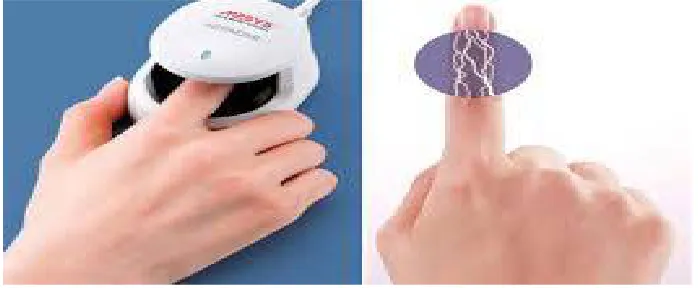
Figure 1: Finger Vein Recognition
Biometrics systems have been an important area of research in recent years. There is two important utilization of biometrics system:
a. Authentication or Verification of person’s identity.
b. Identification in which a person’s identity is sought using biometrics scene available.
The tremendous growth in the demand for more user friendly and secured biometrics systems has motivated researchers to explore new biometric features and traits. Biometric Authentication technology is the one that conduct a personal identification by using human physiological features and behavioral characteristics. Vein is free from the impact of any external contamination and minor injuries and information characteristic is insensitive to the changes in humidity and temperature. Additionally, it is easy to collect, readable and so on. Because of the above special advantages, the vein recognition is widely used in biometric identification. In recent years, vein recognition has become the most innovative and sophisticated biometric identification technology. In the area of biometric identification, security and convenience of the system are important. In particular, the systems require high accuracy and fast response times. Biometric methods include those based on the pattern of fingerprints, facial features, the iris, the voice, the hand geometry, or the veins on the back of the hand. However, these methods do not necessarily ensure confidentiality because the features used in the methods are exposed outside the human body. Therefore these methods can be susceptible to forgery.
IMAGE SEGMENTATION
finger-vein network extraction. Although the proposed MSMR can significantly improve the contrast between venous regions and non-venous regions, it is still difficult to obtain an integrated finger-vein network in practice. This is because a) the vein ridge information often varies greatly in intensity.
b) the vein ridges with great intensity variation always interlace.
To tackle these problems, we resort to image matting for finger-vein network segmentation.Image matting refers to the problem of softly and accurately extracting a foreground region of interest from a single input image with limited user inputs. However, the performance of the state-of-the-art image matting is usually undesirable without user guides that is, manually providing proper constraints (called tri-map, a pre-segmented image consisting of three regions of foreground, background and unknown) of the foreground and background in advance is essential for accurate matting-based image segmentation. Actually, manual intervention is impossible for finger-vein network segmentation. Thus, to make image matting suitable for finger-vein segmentation, a new scheme is proposed for automating the matting process in finger-vein network segmentation.
SUPPORT VECTOR MACHINE (SVM)
The Support Vector Machine (SVM) is a state-of-the-art classification method introduced in 1992 by Boser, Guyon, and Vapnik. The SVM classifier is widely used in bioinformatics and other disciplines due to its high accuracy, ability to calculate and process the high dimensional data such as gene expression and edibility in modeling diverse sources of data. SVM belong to the general category of kernel methods. A kernel method is an algorithm that depends on the data only through dot-products. When this is the case, the dot product can be replaced by a kernel function which computes a dot product in some possibly high dimensional feature of space.
The main advantages of SVM is its ability to generate non-linear decision boundaries using methods designed for linear classifiers. Secondly, the use of kernel functions allows the user to apply a classifier to data that have no obvious fixed-dimensional vector space representation. The example of such data in bioinformatics are sequences of either DNA or protein, and protein structure.
Support Vector Machines (SVM) have recently gained excellence in the field of machine learning and pattern classification. Classification is achieved by realizing a linear or non-linear separation surface in the input space.
It initializes the set with the closest pair of points from opposite classes like the Direct SVM algorithm. As soon as the algorithm finds a violating point in the dataset it greedily adds it to the candidate set. It may so happen that addition of the violating point as a Support Vector may be prevented by other candidate Support Vectors already present in the set.
These are some commonly used kernels include:-a)Linear Kernel is considered as follows: f(x, y) = x, y
b)Polynomial Kernel is considered as follows: f(x, y) = (x. y+1) d
SVM Algorithm is as;
1) Define an optimal hyper plane.
2) Extend the above definition for non linear separable problems.
Map data to high dimensional space for easier classification to find linear decision surfaces.
II. LITERATURE REVIEW
experiments.
Jinfeng Yang et al. [2] proposed Finger-vein network enhancement and segmentation. In this paper an emerging biometric recognition based on human finger-vein patterns has received considerable attention. Due to light attenuation in imaging finger tissues, the finger-vein imagery is often seriously degraded. This makes network -based finger-vein feature representation greatly difficult in practice. In order to obtain perfect finger-vein networks, in this paper, he proposes a novel scheme for venous region enhancement and finger-vein network segmentation. First, a method aimed at scattering removal, directional filtering and false vein information suppression is put forward to effectively enhance finger vein images. Then, to achieve the high-fidelity extraction of finger-vein networks in an automated manner, matting based segmentation approach is presented considering the variations of veins in intensity and diameter. Extensive experiments are finally conducted to validate the proposed method.
Pengfei Yu et al. [3] proposed a method Fingerprint Image Preprocessing Based on Whole-Hand Image Captured by Digital Camera. In this paper they present some fingerprint image pre-processing approaches based on a whole-hand image captured by digital camera. The pre-processing methods include key point location, finger image segmentation and fingerprint region extraction. Firstly, the key points including fingertips and valley points, which are called key points, are located from the hand contour image. Secondly, the middle finger is cropped from the hand image based on the information of the key points' positions and the knuckle's texture near the finger root. Finally, the fingerprint is extracted from the middle finger through the first knuckle's texture. Because of the low resolution of the fingerprint images, linear projection methods such as Principle Component Analysis (PCA) and Linear Discriminant Analysis (LDA) are used for fingerprint feature extraction. Experimental results on a database of 86 hands (10 impressions per hand) show that these approaches are effective.
Beining Huang et al. [4] proposed a method a finger posture change correction method for finger-vein recognition.They found that due to posture changes when acquiring finger images, the discrepancy between different images from the same finger greatly lowers the performance of the entire system. In this paper, they define 6 types of finger posture changes, and analysis how they influence imaging. They then proposed a method to reconstruct a 3D normalized finger model from 2D images, which can be used to map finger area in 2D image into a new 2D coordinate system, thus being able to eliminate the influence of these six types of posture changes. They choose three kinds of feature extraction method, with a test data set from a practical finger-vein recognition system including 50,700 finger-vein images. The experimental results well proved the effectiveness of this method.
Jinfeng Yan et al. [5] proposed a technique for an improved method for finger-vein image enhancement. They found an improved approach, incorporating directional decomposition and Frangi filtering, to enhance finger veins. First, background subtraction is processed to improve image contrast and eliminate uneven illumination. Then, the vein information as ridge-like directional characters in image is detected by directional filter bank and enhanced through Frangi filtering after noise removal. Finally, the enhanced images are obtained from enhanced directional images using a finer reconstruction rule. Experimental results show that the proposed approach is much more effective and robust in enhancing finger-vein images.
Dingrui Wan et al proposed a method Fingerprint Recognition Using Model-Based Density Map. They proposed a polynomial model to approximate the density map of fingerprints and used the model’s parameters as a novel kind of feature for fingerprint representation. Thus, the density information can be utilized into the matching stage with a low additional storage cost. A decision-level fusion scheme is further used to combine the density map matching with conventional minutiae- based matching and experimental results showed a much better performance than using single minutiae-based matching.
III.PROPOSED WORK
Finger Vein is a new biometric method which is leading its way day by day. As Finger vein identification uses the unique patterns of finger veins images to identify individuals are of high level of accuracy and security. The credibility of the finger vein authentication is higher. The higher accuracy rate of finger vein is not unconnected with the fact that finger vein patterns are virtually impossible to forge therefore, it has become one of the fastest growing new biometric technology and is quickly finding its way from research labs to commercial development.
proposed based on the Finger Vein Recognition using Segmentation and SVM algorithm.
Different Algorithms on Finger Vein Recognition has been proposed previously but there have been always a need for better results or Fusion of Images. The existing Image Fusion techniques uses algorithm which is poor in quality, more prone to noise and needs further enhancement. An enhanced Human Identification algorithm is developed Using Finger Vein which based on Automatic Trimap Generation, Repeated Line Tracking, Gabor and SVM. This algorithm is fast and more accurate with respect to other finger vein identification technique and also take less time as comparison to other technique. The proposed algorithm uses some new parameters like PSNR, FAR, GAR and Accuracy, thus it is good in quality.
Figure 2: Flow Chart of Proposed Work.
IV.RESULTS
The section presents the results of the proposed work. Thefigures show the result of the Enhancement of the Finger Vein recognition with segmentation and SVM. This technique gives better results as compared to previous techniques. After obtaining all the necessary terms Finger Vein Recognition , Segmentation and SVM for a number of images in our database; implemented the results in the final method. The proposed method is more accurate and assures quality of result. Human Identification algorithm Using Finger Vein which based on Automatic Trimap Generation, Repeated Line Tracking, Gabor and SVM is proposed. Algorithm which is fast and accurate and thus take less time as comparison to other technique. In proposed algorithm consider some new parameters like PSNR, FAR, GAR and Accuracy, thus it is good in quality.
Acquire Finger Image
Image Normalization
Result Analysis ROI Extraction
Image Enhancement
Image Segmentation
Feature Extraction
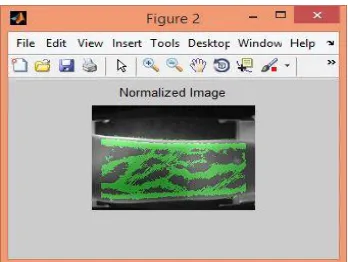
Figure 3: The output of acquired finger image Figure 4: The output of Image Normalization
Figure 5: The output image of ROI. Figure 6: Output of Image Enhancement
Figure 9: Image of Matched Vein. Figure 10: Graph showing results of PSNR of proposed algorithm
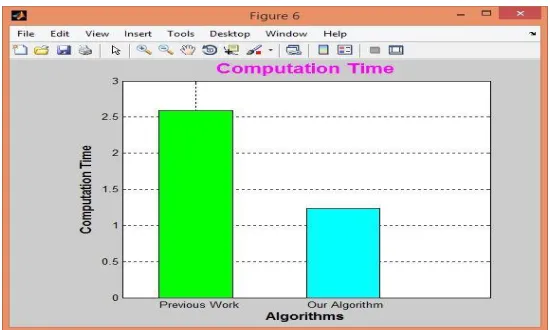
Figure 11: Graph showing results of CT of proposed algorithm
V. CONCLUSION
Finger Vein is a new biometric method which uses the unique patterns of finger veins images to identify individuals at a high level of accuracy and security. The credibility of the finger vein authentication is higher. In this work, systematically develop a new approach for the finger vein feature extraction using Repeated Line tracking, Gabor filters and SVM is developed. The result comes after the combinations of these three methods are more accurate than the results of the individual method. The result comes for GAR and the FAR after comparing with the individual technique is more accurate. The GAR and FAR output for individual Repeated Line Tracking approach, Gabor and Matched filter methods after many results is very low but the combination of these three method increase the results accuracy to very high, which shows that the combination of these two method gives much better results as compared to the individual use of these methods. Using this algorithm the PSNR values also increases as compared with literature which provide high quality of work. The time taken in Enhancement and segmentation also reduces as compared with literature.
REFERENCES
1. Anjum Asma and Gihan Nagib,’Energy Efficient Routing Algorithms for Mobile Ad Hoc Networks–A Survey’, International Journal of
Emerging Trends & Technology in computer Science, Vol.3, Issue 1, pp. 218-223, 2012.
2. Hong-ryeol Gil1, Joon Yoo1 and Jong-won Lee2 ,’An On-demand Energy-efficient Routing Algorithm for Wireless Ad hoc Networks’,
3. S.K. Dhurandher, S. Misra, M.S. Obaidat, V. Basal, P. Singh and V. Punia,’An Energy-Efficient OnDemand Routing algorithm for
Mobile Ad-Hoc Networks’, 15 th International conference on Electronics, Circuits and Systems, pp. 958-9618, 2008.
4. DilipKumar S. M. and Vijaya Kumar B. P. ,’Energy-Aware Multicast Routing in MANETs: A Genetic Algorithm Approach’, International Journal of Computer Science and Information Security (IJCSIS), Vol. 2, 2009.
5. AlGabri Malek, Chunlin LI, Z. Yang, Naji Hasan.A.H and X.Zhang ,’ Improved the Energy of Ad hoc On- Demand Distance Vector
Routing Protocol’, International Conference on Future Computer Supported Education, Published by Elsevier, IERI, pp. 355-361, 2012.
6. D.Shama and A.kush,’GPS Enabled E Energy Efficient Routing for Manet’, International Journal of Computer Networks (IJCN), Vol.3,
Issue 3, pp. 159-166, 2011.
7. Shilpa jain and Sourabh jain ,’Energy Efficient Maximum Lifetime Ad-Hoc Routing (EEMLAR)’, international Journal of Computer
Networks and Wireless Communications, Vol.2, Issue 4, pp. 450-455, 2012.
8. Vadivel, R and V. Murali Bhaskaran,’Energy Efficient with Secured Reliable Routing Protocol (EESRRP) for Mobile Ad-Hoc
Networks’, Procedia Technology 4,pp. 703- 707, 2012.
9. Haiyun Xu, Raymond N. J. Veldhuis, Tom A. M. Kevenaar, and Ton A. H. M. Akkermans; “A Fast Minutiae-Based Fingerprint
Recognition System”. IEEE Systems Journal, Volume 3, NO. 4, DECEMBER 2009.
10. Sharath Pankanti, Salil Prabhakar, Anil K. Jain; “On the Individuality of Fingerprints”. IEEE Transactions on Pattern Analysis and
Machine Intelligence, Volume 24, NO. 8, AUGUST 2002.
11. Jianjiang Feng, Anil K. Jain; “Fingerprint Reconstruction: From Minutiae to Phase”. IEEE Transactions on Pattern Analysis and Machine
Intelligence Volume 33, NO. 2, FEBRUARY 2011.
12. Jingxin Hong, Wu Lin, Hao Zhang, Lin Li; “Image Mosaic Based on SURF Feature Matching”. IEEE International Conference on
Information Science and Engineering, 2009.
13. Naoto Miura, Akio Nagasaka,Takafumi Miyatake; “Feature extraction of finger-vein patterns based on repeated line tracking and its
application to personal identification”. Springer-Verlag 2004
14. Pandillapalli Gowtham, Ch.Sindhu, C.Sudheer Kumar, Ch.Chandra Sekhar, M.s.Abdullah; “ Identification of Finger Images using
Score-Level Fusion”. International Journal of Engineering Science Invention, ISSN: 2319 – 6726, Volume 2, NO. 2 FEBRUARY 2013.
15. Elif Aybar; “Sobel Edge Detection Method for MATLAB”. Porsuk Vocational School, Anadolu University, Eskisehir, 2010.
16. Kefeng Li; “Biometric Person Identification Using Near-infrared Hand-dorsa Vein Images”. University of Central Lancashire in
collaboration with North China University of Technology, 2013.
17. Jinfeng Yang and Xu Li; “Efficient Finger Vein Localization and Recognition”. IEEE International Conference on Pattern Recognition,
2010.
18. Jayant V. Kulkarni, Bhushan D. Patil and Raghunath S. Holambe;“Orientation feature for fingerprint matching”. Pattern Recognition Society. MARCH 2006.
19. Mudasir Ahmad ,Sahil Dalwal,”Finger Vein Network Enhancement with SVM”, IJIRCCE, DOI: 10.15680/ijircce.2015. 0307017, Vol. 3,