University of Windsor University of Windsor
Scholarship at UWindsor
Scholarship at UWindsor
Electronic Theses and Dissertations Theses, Dissertations, and Major Papers
1-1-1973
Careers in modeling: A study in occupational socialization.
Careers in modeling: A study in occupational socialization.
Rose Marie Greve University of Windsor
Follow this and additional works at: https://scholar.uwindsor.ca/etd
Recommended Citation Recommended Citation
Greve, Rose Marie, "Careers in modeling: A study in occupational socialization." (1973). Electronic Theses and Dissertations. 6708.
https://scholar.uwindsor.ca/etd/6708
CAREERS IN MODELING:
A Study in Occupational Socialization.
BY
Rose Marie Greve
A Thesis
Submitted, to the Faculty of Graduate Studies through the Department of Sociology and
Anthropology in Partial Fulfillment of the Requirements for the Degree
of Master of Arts at the University of Windsor
Windsor, Ontario
1973
UMI Number: EC53118
INFORMATION TO USERS
The quality of this reproduction is dependent upon the quality of the copy
submitted. Broken or indistinct print, colored or poor quality illustrations and
photographs, print bleed-through, substandard margins, and improper
alignment can adversely affect reproduction.
In the unlikely event that the author did not send a complete manuscript
and there are missing pages, these will be noted. Also, if unauthorized
copyright material had to be removed, a note will indicate the deletion.
®
UMI
UMI Microform EC53118Copyright 2009 by ProQuest LLC.
All rights reserved. This microform edition is protected against
unauthorized copying under Title 17, United States Code.
ProQuest LLC
789 E. Eisenhower Parkway PO Box 1346
Rose Marie Greve 1973
&
'? 0 ,1 -*»V U* ei !i i
ii
Approved By:
-,/7
ACKNOWLEDGMENTS
% very grateful thanks to Dr Robert N. Whitehurst for his
guidance in writing this thesis and for the many hours of his time that
were made available to me; and to my committee members, Dr Mary Lou
Dietz and Dr Lawrence E. La'Fave for their interest and inspiration and
for their invaluable assistance in the planning of this study.
My thanks also to the models and staff of the agency for their
cooperation.
A special thankyou to my parents for their patience and
■understanding throughout my academic career.
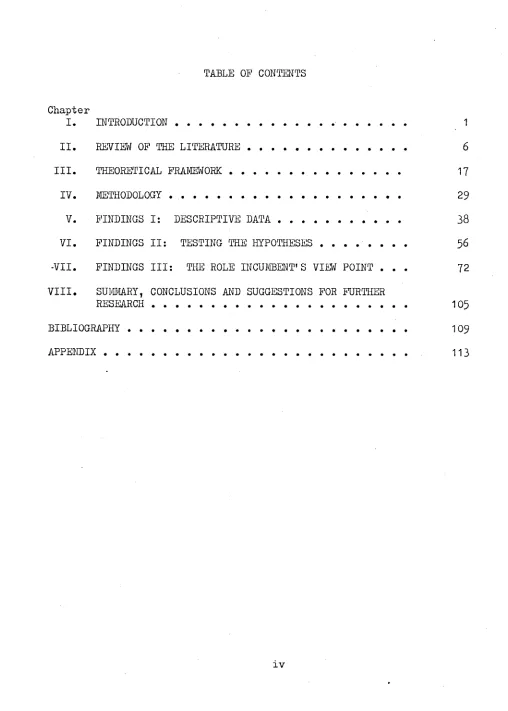
TABLE OP CONTENTS
Chapter
I. INTRODUCTION... ... 1
II. REVIEW OP THE LITERATURE... 6
III. THEORETICAL FRAMEWORK... 17
IV. METHODOLOGY ... 29
V. FINDINGS I: DESCRIPTIVE D A T A ... . 38
VI. FINDINGS II: TESTING THE HYPOTHESES . . . 56
-VII. FINDINGS III: THE ROLE INCUMBENT1 S VIEW POINT . . . 72
VIII. SUMMARY, CONCLUSIONS AND SUGGESTIONS FOR FURTHER R E S E A R C H ... 105
BIBLIOGRAPHY... 109
LIST OP TABLES IN TEXT
TaBle Page
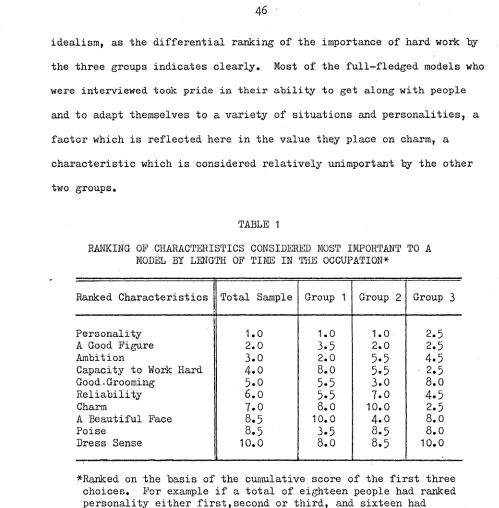
1. RANKING OP CHARACTERISTICS CONSIDERED MOST
IMPORTANT TO A MODEL BY LENGTH OP TIME IN THE
OCCUPATION... 4 6
2. MEAN SCORES FOR IDEAL CONCEPTION OP A MODEL
BY LENGTH OP TIME IN OCCUPATION... 50
3. MEAN SCORES FOR SELF-EVALUATION BY LENGTH OF
TIME IN OCCUPATION... 50
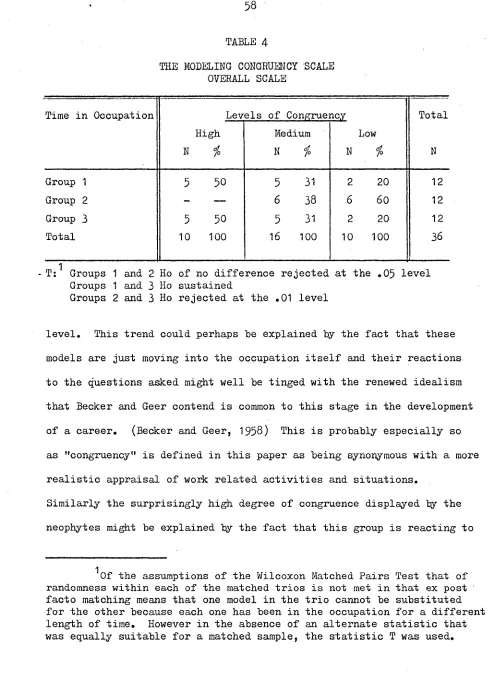
4. MODELING CONGRUENCY SCALE: OVERALL SCALE ... 59
5. MODELING CONGRUENCY SCALE BY LENGTH OP TIME IN
OCCUPATION CONTROLLING FOR ETHNICITY ... 63
6. MODELING CONGRUENCY SCALE: I. ATTITUDES TOWARD
WORK AND SUPPORTING OTHERS BY LENGTH OP TIME IN
OCCUPATION... 64
7. MODELING CONGRUENCY SCALE: I. a. ATTITUDES
TOWARD WORK BY LENGTH OP TIME IN OCCUPATION... 65
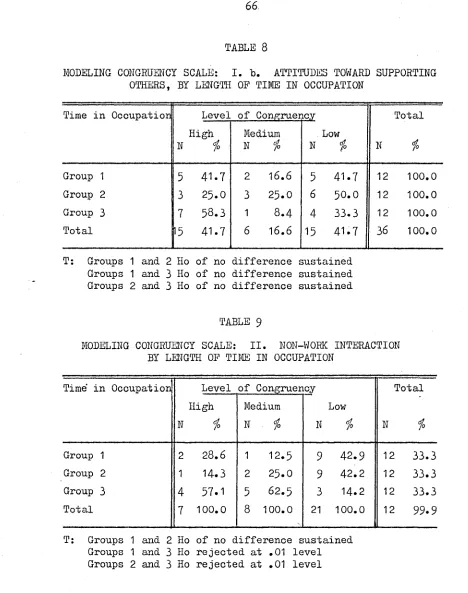
8. MODELING CONGRUENCY SCALE: I. b. ATTITUDES
TOWARD SUPPORTING OTHERS BY LENGTH OP TIME
IN OCCUPATION... 67
9. MODELING CONGRUENCY SCALE: II. NON-WORK
INTERACTION BY LENGTH OP TIME IN OCCUPATION... 67
10. MODELING CONGRUENCY SCALE: III. COMMITMENT TO
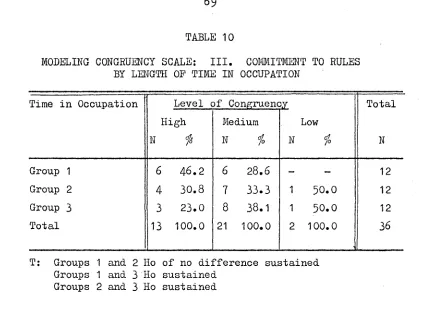
RULES BY LENGTH OP TIME IN OCCUPATION... 70
v
ABSTRACT
This study is designed to explore several sociological
variables with reference to changes in the self in the course of
adapting to an occupation. As such, the study is in the general area
of the sociology of occupations; its particular focus being fashion
modeling.
The study was conducted in two parts. In the first a sample of
thirty-six Montreal models at three different stages of their careers
were interviewed by questionnaire survey; and in the second, a further
refined sample of twelve experienced models were questioned in greater
depth using a focused interview technique. The sample was drawn from
a single modeling agency.
The major hypothesis entertained was that there was a rela
tionship between the length of time in the occupation and socialization
into the role as measured by changing attitudes toward work and
colleagues, increasing interaction with the occupational reference group
and an increasingly higher level of technical skill. Possibly due to
the inadequacies inherent in the use of three matched groups of models
to measure change, the first part of the study did not produce clear
evidence of the expected relationships. However, in-depth probing of
models' responses suggests that the process of socialization into the
occupation follows the lines entertained by the hypotheses.
Using some of the concepts of Becker^ Goffman and the other
discussed and the relationship between these and a model's career were
investigated.
In all, the study is reported in three phases. The first
describes the demographic backgrounds of models; the second concerns
itself with the statistical testing of the hypotheses; and the third
investigates the models' own perception of their occupation and the
process of socialization into it.
vii
CHAPTER I
INTRODUCTION
The purpose of -this paper is to present a study of a particular
occupational group— female fashion models— based on the postulate that
"a frame of reference for studying careers is at the same time a frame
of reference for studying personal identity." (Becker and Strauss, 1956:
259)
The study of careers in fashion modeling in these terms and in
the context of occupational socialization is useful because its points
of similarity and difference with other occupations serve, by and large,
to highlight some of the general problems involved in becoming a careerist
My interest in the field originally was created while in training
as a model in England. Starting the course armed with many of the usual
misconceptions about modeling, my class and I quickly learned that the
realities of modeling were very unlike our anticipations. To the uniniti
ated, the life of a model is glamorous and exciting; it means $500 dresses
instant success, admiring audiences, photographs in Vogue, exciting trips
around the world etcetera. The reality falls far short of this idealized
vision for, in actuality, modeling generally involves demanding work for
hard task masters, many disappointments and the sort of success enjoyed
by Twiggy, Jean Shrimpton and Verushka, and aspired to by all would-be
models, is relatively rare.
2
arrested by the finished product as it appears on television, in
advertisements, fashion magazines and fashion shows. Little thought is
given to the amount of work that went into the production of the
idealized image on the part of the model and her co-workers. As some
models complain, the public gaze is concentrated on the model and
people usually fail to recognize the existence of a person behind the
front presented.
Having been "back stage" so to speak, and having been initiated
into some of the "trade secrets" that go into the production of the
public image of a model, I became interested in finding out more about
-how this front was produced and the role of the model constructed, and
also how models perceived the role and related to it and how it effected
the rest of their role sets.
The sociological usefulness of this study lies largely with the
uniqueness of the choice of this particular occupational group as its
area of inquiry. The study of modeling in the contex of occupational
socialization represents relatively new territory, the more traditional
fields for these studies being the professional and semi-professional.
Further, the study attempts to trace the process of socialization into
one of the more unusual occupations which, while numerically small in
comparison with the more ordinary occupations, are nevertheless amongst
the highest paid in the world. (For example, those which come most readily
to mind are careers in show business and the film industry).
Modeling is also of interest to the study of occupational socializa
tion for its uniqueness which sets it apart from most other occupations.
As an occupation it is predominantly a women’s occupation in that male
models are usually people with other careers for whom modeling is merely
a secondary source of income. Its brevity, relative to other careers
also makes it unusual. Like the professional athlete, a girl embracing
a career in modeling faces the fact that it is not the occupation she
can pursue for the rest of her working life, as can an individual in a
professional or semi-professional occupation for example. As with the
athlete, the model's commodity is her body and the natural process of
aging which does not trouble persons in other occupations until much
later, looms large here. As an eighteen year old model said, "at
twenty-two you are middle-aged." This in turn, necessitates a greater
body-awareness on the part of models, analogous to that of athletes and profes
sional dancers, (a sign which is often interpreted as a manifestation of
vanity or narcissism by the general public). Again because of the short
ness of the career, the model must face the problem of retirement much
earlier than persons in other career lines and must plan for an alternate
career while she is still young. In short, the relative brevity of the
career of a model gives one a condensed view of a career, containing
within a time span of ten to fifteen years events common to many longer
careers, thereby casting them into sharper profile. In other words, while
the career contingencies in modeling do not necessarily produce an identical
pattern as those in other, longer occupations, they are sufficiently
similar to permit comparisons between types of work. In all, an analogy
could be drawn between the use of modeling to study occupations in general,
in the sociological arena and the use of short-lived insects to study
contingencies common to human lives in the biological.
4
body of occupations, part of the aim of this study is, nevertheless, to
consider the ways in which careers in modeling can he compared with careers
in other occupational fields.
The first similarity which suggests itself is the fact that— pop
ular ideas to the contrary— models see their occupation first and foremost
as a job. In spite of the fact that for the model, as for the executive
and the doctor, the work role is the central one and impinges to a large
extent on all other roles in her role set, most models stress the fact
that it is only work, and furthermore, well-paid work.
As with other occupations one can recognize three stages in a
model's career; the trainee, the new model and the full-fledged model
stages, which can be compared to the student, intern, doctor stages of the
medical profession. A model, like anyone else, has to learn the skills
necessary to her trade and to put them into practice both in a school
setting and outside it.
Again, as with other occupations, there are certain things which
models share in common and.which set them apart as a distinctive occupa
tional group. The model's tote is no less a part of her costume than the
doctor's bage and the lawyer's briefcase. The model's walk and the model's
smile are as cultivated and as recognizable as the doctor's bedside manner.
For the models of this study as for the automobile workers of
Chinoy's, autonomy is a highly valued commodity, the more so because for
the former it is not the unrealistic dream it is for the latter. (Chinoy,
1952) In common with many professionals, a model enjoys feeling that she
controls the behaviour that can make or break her.
In summary, the contribution of this study to the further
standing of occupations lies in the fact that, while modeling is
admittedly an unusual occupation its divergences from, as well as its
CHAPTER II
REVIEW OP THE LITERATURE
Despite the contemporary contention that the work life of the
individual is becoming increasingly more fragmented and insecure and
*
therefore of less importance to him, making thereby, less impact on his
total identity (Dubin, 1956) there still exist some occupations where
work is more than the means to the end of earning a living. (Morse and
Weiss, 1955: 191) Contraiy to Friedmann and Havinghurst's claim that
work has less meaning for workers of lower skill and socio-economic
statuses, (1954)> Morse and Weiss contend that for the vast majority of
employed men work provides "a feeling of being tied to the larger
society, -of having a purpose in life." (1 9 5 5s 1 9 1) For some individuals,
such as the nurses of Orzack's study Work as the Central Life Interest of
Professionals work has an even deeper meaning. For them it is the focal
point of self identification and, particularly in the early stages of
the career, it is necessary for the generation of a sense of personal
worth which is part of the emerging self concept. (Orzack, 1959) Thus,
while for some work may be a mere source of income as studies by Dubin
(1956), Chinoy (1952) and other industrial sociologists would indicate,
for others it is, as Weber and Tawney suggest, the most significant part
of a person’s sense of identity. (Dubin, 1956)
In his paper Sociological Perspectives on Occupations Solomon
defines work as "the generic term for activity leading to the production
6
7 '
of goods and services." In his subsequent discussion of occupations he
contends that though . . we seem to think of an occupation as a set
of skills or a set of persons who possess similar skills" the term is
something more than a label for a class or category of persons. An
occupational label presupposes a certain status or role and therefore,
"an occupation can be thought of as a role" or rather, since a career
usually implies movement from one stage to another, a sequence of roles.
Occupations are, in short, "roles people are paid to perform." (Solomon,
1968
:
5
/
7
)
To see an occupation in terms of a role and of role playing implies
also a process of learning that role; in other words, occupational
socialization.
One of the best known studies of occupational socialization is
Boys in White: Student Culture in Medical School by Becker and his coll
eagues. -This study shows the process of recruitment of the would-be
doctors into the occupation; follows their training in medical school;
considers the ways in which their perceptions of themselves and their
chosen occupation change during the course of training; explores the ways
in which these changes come about and the role others who influence the
changing perceptions of the students; and discusses their final emergence
from the training process with not only the appropriate skills, but also
a sense of identification with their profession. (Becker, et al, 1 9 6 1)
In the article The Fate of Idealism in Medical School Becker and
Geer elaborate on the theme of the changing perceptions of the medical
students and, in particular, on their swing from idealism to cynicism
meet the situation in which they find themselves. It would appear that
the student culture works to depress the initial idealism of the students
but that,
as school comes to an end, the cynicism specific to the school situation also comes to an end and their original and more general idealism about medcine comes to the fore again, though within a
framework of more realistic alternatives. (Becker and Geer, 1958s
55)
Mauksch in, Becoming a Nurse: A Selective View finds that the nurses of
his study also adjust to the work situation as it prevails in nursing
school, revising their idealized conceptions of the "ministering angel"
role of nurses to fit the realities of the training course. (Mauksch,
t983) As Becker and Geer recognize, this adjustment from the conceptual
ized or anticipated role to the realities of the actual role is common
to all occupations. Again refering to the medical students they state
that:
As in all other lines of work, he [the medical student] drops lay attitudes for those more relevant to the way the events affect someone in his position. (Becker and Geer, 1958: 54)
This concept of situational adjustment, in which individuals take
on the characteristics required by the situations they find themselves
participating in; and the concept of commitment to an occupation are
recurrent themes in the literature on occupations. In the article
Pers-sonal Change in Adult Life Becker claims that both situational adjustment
and commitment are essential to the process of occupational socialization
and to identification with an occupation. (Becker, 1 9 6 4) Geer in her
study of Occupational Commitment and the Teaching Profession elaborates
on the importance of the latter concept. She concludes that the teachers
of her study "can be said to lack commitment only insofar as women do not
9 ■
want to teach continuously and men want advancement "beyond the classroom."
(Geer, 196 8: 222)
In the same article the author goes on to discuss and apply Becker's
idea of the accumulation of occupational "valuables" which he sees as
affecting commitment. According to her, Becker in his Botes on the
Concept of Commitment (i9 6 0) states that:
commitment to any consistent line of activity occurs when an individ ual, confronted with an opportunity to depart from it, discovers that in the course of past activity he has, wittingly or not accum ulated valuables of a kind that would be lost to him if he makes a
change. (Geer, 196 8: 223)
Geer goes on to explain that these valuables are both difficult to abandon
and are not always usable outside the context of the occupation in which .
they were acquired. Valuables are, then, one of the end products of
socialization into an occupation for,
To work at any job, trade or profession is to acquire a body of
experience unique to it. One learns the culture of an occupational
group, the "ropes"— which rules must be followed, which can or must be broken, the quirks of people and things that ease everyday perform
ance. (Geer, 196 8: 22?)
The acquisition of such a body of knowledge comes only with time
in an occupational group and the literature on occupations acknowledges
the fact that the individual passes through several stages in the process
of socializing into his particular work culture. As Geer states, "one
aspect of the occupational structure is the familar division into appren
tice, journeyman and master"; (Geer, 196 8: 223) or into parallel categor
ies in other occupations.
Hall in his article on The Stages of a Medical Career restates
this idea of stages in occupational identification when he maintains that
institutions, formal organizations and informal relationships in which
the profession is practiced. (Hall, 1948) Simpson in her study
Patterns of Socialization into a Profession: The Case of Student Nurses
concludes that nurses must pass through "three analytically distinct
phases, each involving some learning of the cultural content of the role
and some self identification with it." (Simpson, 1987: 47) Becker and
Carper in Elements of Identification with an Occupation consider a similar
process on the part of three groups of graduate students in philosophy,
physiology and mechanical engineering. Their findings also indicate that
the Building up of a professional identity was a gradual process for,
"identifications are not so clearly defined in the first years as they
Become later . . . " (Becker and Carper, 1958: 341) They conclude that
the four major elements of work identification are; pride in occupational
title and associated ideology, commitment to the task, commitment to the
particular organizations or institutional positions and recognition of
the significance of one's position in the larger society. (Becker and
Carper, 1958) In their seven year long consideration of students in
dentistry Sherlock and his colleagues again stress the idea of stages in
the acquisition of an occupational identity. In the article The Evolution
of the Professional: A Paradigm Sherlock and Morris indicate that their
three majof foci of interest are recruitment, the socialization processes
and the professional outcomes. (Sherlock and Morris, 1 9 8 7)
In all, the importance of the idea of stages and of the gradual
evolution of the socialization process is acknowledged in many studies of
occupational socialization. Becker and Strauss in Careers, Personality
and Adult Socialization refer to this phenomenon as "career flow", which
encompasses recruitment, (when the candidates whose backgrounds are too
irregular are eliminated) training, (during the early stages of the career
when schooling has the task of getting people committed to the career as
well as prepared to fill the occupational positions) and finally,
"full-fledged participation" in the occupation. (Becker and Strauss, 1956)
While all three phases of an occupation have been considered in
most studies of occupational socialization, some writers have attached
much importance to the first stage— that is, recruitment. In Strategies
of Occupational Choice: Recruitment to Dentistry Sherlock and Cohen
consider the reasons for the choice of dentistry as a profession. (1 9 6 6)
Lortie in his study Laymen to Lawmen: Law School Careers and Professional
Socialization endorses the importance of the recruitment stage when the
first tentative identification with the occupational group is made by the
neophytes. According to him the first year in which the sorting out
process takes place is the most important phase of the socialization
process into the practice of law. (Lortie, 1959)
In his study, Processes of Socialization in American Graduate
Schools, Gottlieb considers not only the sorting out process but also
remarks on the part played by the graduate school system in the way in
which students are selected out or change their career preferences. His
paper is largely concerned with the part played by the graduate faculty
in this. Like Becker and Carper, he sees the graduate school as playing
an important role in the development of professional identification.
(Gottlieb, 1 9 6 1) Following a similar theme, Rosen and Bates in The
Structure of Socialization in Graduate Schools consider the ways in which
12
the students. While stressing the idea of "gateways" through which the
neophyte must pass in his pursuit of the career goal, the authors see
the graduate school faculty as agents and role models whose task it is
to convey all the essential information to the neophyte accurately and
completely and to he the embodiment, representation and dramatization
of the role toward which the neophyte is reaching. (Rosen and Bates,
1 9 6 7) Merton in The Student Physician: Introductory Studies in the Sociol
ogy of Medical Education also stresses the role of the faculty in the
socialization of medical students into their culture when he states that:
Socialization takes place primarily through social interaction with people who are significant for the individual— in medical school,
probably with faculty members above most others. (Merton, Reader and
Kendall, 1957: 2 8 7)
In a study of Faculty Influence and Professional Participation of Doctoral
Students based on this contention, Pease discovered that the professional
participation of doctoral students was indeed influenced by informal
contacts with faculty. In other words, the acquisition of professional
attitudes and behaviours on the part of the graduate students was directly
related to the degree of contact they had with their mentors and role
models. (Pease, 19^7) In ber previously cited study on nurses, Simpson
too stresses the influence of role models on the process of socialization
(Simpson, '1967), as does Mauksch in his study. (1963)
Altogether, the importance of role models, reference groups and
occupational communities has been stressed by many industrial sociologists.
Particularly in total institutions like the army and the navy the import
ance of the reference group is recognized and fostered by the leaders
of these communities. In his study The Haval Recruit Training Centre: A
13
Study in Role Assimilation in a Total Institution Zurcehr describes the
early training of the recruit as an attempt to destroy all previous
identity and to substitute for it the peer and reference groups of the
other boots and the navy itself. According to him, with increasing
decivilianization, the recruit turns to the occupational community for
reinforcement and conformation of his emerging identity. (Zurcher, 19^7)
Dornbusch in his study The Military Academy as an Assimilating Institution
points to a similar experience on the part of the recruits into the army.
He feel that the remarkable unity of the swab (recruit) class is a
consequence of undergoing a very unpleasant experience together. (Dornbusch,
1955) Stouffer's study The American Soldier: Adjustment During Army Life
confirms these findings and states, furthermore, that virtual isolation
from the outside world and the physical proximity of the places of work
and residence serve to build up a sense of community and a "we-feeling"
that reinforces the new self-image of the recruit. (Stouffer, et al,
1949)
The importance of the occupational community extends beyond
fulfilling a purely socializing function. It provides the individual
with a sense of identity and self-worth. In his paper Some Sociological
Determinants of Occupational Communities Salaman states that the
occupational community is a primary reference group, a source of values
and identification for someone whose occupational role is incorporated
into his self-image. According to the author, membership in an occupa-r
tional community is dependent on strong ties with an occupation and a
feeling of intrinsic satisfaction with work which must be viewed as
14
their work in this way will carry work-based, interests, activities and
relationships into their non-work lives, and.
men who are strongly involved in their work skills and tasks are likely to see themselves in terms of their occupational role, for work will be an activity they regard as emotionally important and valuable and the occupational role will therefore become a salient
element in their self image. (Salaman, 1971: 61)
Salaman also recognizes the pervasiveness of the value system of the
occupational community when he says that:
The value systems which are held by the members of occupational communities are frequently relevant not only to the world of work
but to many other aspects of members lives. (Salaman, 1971• 57)
In his study Two Occupational Communities: Examples of the Remarkable
Convergence of Work and Non-Work her found that such widely different
occupational groups as architects and railwaymen tended to have distinc
tive occupational cultures consisting of value systems, attitudes about
the work they did and their fellow workers, and beliefs about the
importance of their work. They also tended to have friends in the same
occupations who shared the same experiences and language. Like Becker's
dance musicians (Becker, 1963) they tended to view themselves as a group
apart from all others. (Salaman, 1967)
Like Salaman*s architects and railwaymen, the printers in the
studies by Blauner (1 9 6 4) an4 Lipset (Lipset, Trow and Coleman, 1956)
viewed their work with pride and considered the work itself both
interesting and important. They too tended to take their jobs into their
leisure time activities and to consider their work role an important part
of their total identity.
The same could be said of the musicians of Becker's study The
Culture of a Deviant Group: The Dance Musician. (Becker, 1963) For
15
these men their occupational community serves as a sub-culture.
According to Becker such a situation arises "whenever some group of
people have a bit of common life with a modicum of isolation from other
people, a common corner in society, common problems and perhaps a couple
of common enemies." (Becker, 1963: 79) Musicians too tend to associate
with colleagues out of hours and as with Salaman's railwaymen and arch
itects, there is no separation of work and non-work life. As Becker
states, ". . . to understand the behaviour of someone who is a member of
such a group is to understand that way of life." (Becker, 1963: 79)
Similarly, Janowitz in his study The Professional Soldier considers the
military profession a "complete style of life" since the officer is
". . . a member of a community whose claims over his daily existence
extend well beyond his official duties." (Janowitz, 1960: 175)
As a study which is interestingly dissimilar, -Weinberg and Arond's
The Occupational Culture of a Boxer deserves mention. For the boxer, as
for the musician and the soldier, the role of a professional fighter
permeates and governs the rest of his role set. Yet emphasis is placed
not on involvement with an occupational community or a "we-feeling" but
on the boxer as an individual, probably because boxing is a highly compet
itive sport and rarely involves team activity. Where such competition
exists. Where such competition exists, the development of a "we-feeling"
among professional rivals is effectively hindered. (Weinberg and Arond,
A
1 9 5 2) Interestingly enough, the same is true of fashion modeling.
In summary, a review of the literature on occupational
ation points up the fact that, while work can have different meanings
for different people when one considers the way in which the novice is
socialized into the group parallels can he drawn between many occupations.
The novice acquires his occupational image through the acquisition of
the relevant technical skills and the behaviours and attitudes that are
a prerequisite to identification with the role. He learns this mostly
through imitation of role models and through contact with the occupational
reference group and often through formal learning in an institutional
setting. In all, occupational socialization is the process by which the
recruit becomes a role incumbent, fitting into his allotted place in the
occupational structure. Occupational socialization is, therefore:
the process by which he develops his personal self, with its
characteristic values, attitudes, knowledge and skills, fusing these into a more or less consistent set of dispositions which govern his behaviour in a wide variety of professional (and extra-professional)
situations. (Merton, 1957: 28j)
CHAPTER III
THEORETICAL FRAMEWORK
This study is designed to explore the socialization of models
into their occupation and their adoption of the attitudes, beliefs and
behaviours which are more congruent with the occupational structure.
Together with the acquisition of the necessary skills, the adoption of
congruent reference groups, the influence of the new significant others
and the adoption of a new normative structure should, over a period of
time, tend to lead to the building up of a new self concept or identity.
One of the postulates of this study is that the longer an individ
ual remains within a career group, the more likely she is to adopt the
life style and behaviour of that group. The other is that the more
completely she accepts the behaviour of the group, the more likely it
is that she will have built up a new and more congruent self image.
Individuals who are not able to adapt to the demands— technical and
normative— of the group will either drop out early or will be only 1
marginally successful in their careers.
As the study is essentially one of a process of socialization
1
The factors necessary to success include, for example, attitudes that are more relevant to the situation in which the model finds herself, the accumulation of occupational "valuables" and of the necessary
18
into an occupation, its theoretical framework borrows heavily from the
work of the Symbolic Interactionists, notably Moreno, Linton and
Goffman. Also of relevance is the work of such occupational sociologists
as Becker, Geer, Hughes, Strauss and Weiss.
In the final analysis, occupational socialization is not very
different from any other kind of socialization process into cultures,
sub-cultures or groups. According to Merton it is:
the process by which people selectively acquire the values and attitudes, the interests, skills and knowledge— -in short, the
culture— current in the groups of which they are, or seek to become
a member. (Merton, Reader and Kendall, 1957: 287)
The model is, therefore, analogous to the child learning the ways of the
society in which he is going to operate; the major difference being that
models, like all other occupational recruits, build upon an already
existing normative structure. For the model, as for the child, the "end
point or major goal of socialization is the internalization of the values
and practices which define and direct [her] culture." (Landy and
Wechsler, 1966: 378)
As socialization "consists of those patterns of action or aspects
of action which inculcate in individuals the skills (including knowledge),
motives and attitudes necessary for the performance of present or anticip
ated roles" (Clausen, 1 96 8: 4) a study of these processes necessitates
also a study of roles and role behaviour.
The term role in its normative sense is defined in this paper
as "the set of complementary expectations regarding the actor in his
interaction with other individuals." (Getzel and Guba, 1956: 1 6 4)
According to Goffman, role in its normative sense must be
distinguished from role enactment or role performance "which is the
19
actual conduct of a particular individual while on duty in his position."
(Goffman, 19 6 6: 8 5) His concept of performance, and indeed a larger
part of his dramaturgical theory is of special relevance to this study.
He defines "performance" as "all the activity of a given participant on
a given occassion which serves to influence in any way any of the other
participants" in the interaction situation. (Goffman, 1959s 15) While
this seems to imply the theatrical and unreal playing of parts, Goffman
himself recognizes that role behaviour falls into a continuum between
the two extremes of sincerity, when the performer and his audience are
taken in by the expression of reality of the part; and cynicism, when
the performer is not taken in by his own routine. (Goffman, 1959s 18)
These two extremes are also represented by the two concepts Goffman calls
"role embracement" and "role distance". He states that:
To embrace a role is to disappear completely into the virtual self available in the situation, to be fully seen in terms of the image
and -to confirm expressively one's acceptance of it. (Goffman, 196 6:
106
)
Conversely, role distance is the "effectively expressed separateness
between the individual and the role." (Goffman, 1966: 106) Moreno's
interpretation of role playing and role taking is very similar to the
distinction between the two concepts discussed above, and will be used
throughout this paper. Moreno states that:
Role playing may be considered an experimental procedure, a method of learning to perform roles more adequately . . . In contrast with role playing, role taking is an attitude already frozen in the behaviour of the person. Role playing is an act, a spontaneous
playing; role taking is a finished product, a role conserve. (Biddle
and Thomas, 1 96 6: 7)
% contention is that the trainee model begins by making a
unreflecting and unconscious adoption of that role. She has, in short,
become frozen into the role in the manner described by Goffman and Moreno.
Through socialization her conception of the role and of the attached self
image have become second nature to her and an integral part of her
personality. Conformity to the group norms and to the various techincal
skills becomes automatic habit requiring little or no conscious thought
and role playing reaches the level where it gives way to role taking in
Moreno's definition of the term. In other words, role playing in a model
must progress beyond the point where the role remains an object to the
actor to be understood and interpreted but not implemented; just as a
child may play at an adult role, learning it and beginning to understand,
it, but not taking it completely, to the extent that it becomes one of
the full complement of his roles. The model must allow the inferred
attitudes and behaviours of her work role to become a part of her total
self and' must allow it to direct her behaviour. iy adopting for herself
the standpoint that she first saw as foreign to her and by playing it
until it becomes familiar to her and an integral part of her behaviour
pattern, she forms a new self image. As Goffman states; "Through social
discipline (ie. socialization), then, a mask of maimer can be held in
place from within." (Goffman, 1959: 57)
While some contemporary occupational sociologists have suggested
that the work role of the individual is no longer the dominant one in his
role set, this generalization does not often hold true for this particular
occupation. Even while models believe they can, and do, readily effect
1
For further discussion of role implementation in the context of modeling, see page twenty-six.
21
role distance, they still acknowledge the fact that their occupational
role governs much of their non-working hours. One frequently hears them
speak of "twenty-four hour models." In short, all other roles in their
role set must take suhbordinate positions and are coloured and shaped
r
by the dominant role. The role of model is, in Goffman's terms, one
which carries identifying implications for the performer when he is
off-duty and away from the immediate arena of his role." (Goffman, 1966:
150)
The stress laid on the dominant role makes it necessary that the
other roles in the role set should be congruent with the occupational
-role if serious role conflict is to be avoided. Role conflict would
undoubtedly reduce the functional effiency of the model and impair her
chances of success. Thus, the value orientations that models bring into
the sub-culture must undergo the revisions necessary to bring them into
line with the demands of its normative system. If their value
orientations are already too firmly entrenched, people reject certain
statuses which they find repugnant and select other prospective statuses
that they find congenial. (Merton, 1966: 7 6) The trainee model who
cannot adapt to the normative demands of her profession will reject
modeling in favour of an occupation she regards as less threatening.
The concept of role performance suggests the existence of role
1
22
others, or as Goffman terms them, audiences. For the model her audience 1
is the public at large and it is to and for them that she performs her
occupational role, both on and off duty. From them too she conceals those
aspects of her behaviour that are out of line with her dominant role.
For example, models will wait until they are in the privacy of their
homes before they will break or abandon role. Conversely, the model's
non-work audience (that is, her family and close friends) are the outsid
ers she generally attempts to keep away from those situations in which
she appears in her work role. In other words, models feel the need to
practice audience segregation.^
The process of role playing and role taking also implies the
existence of one or more role models. Through a positive identification
with significant others and reference groups the trainee model learns
the behaviour expected of her in her new role. As people who have
undergone the same or a similar process of socialization, the members
of the reference group stand ready to guide or advise the new recruits.
In fact they act as "coaches" to the neophyte. (Strauss, 1966: 23)
The reference group at once teaches and reinforces the normative struc
ture of the occupational group and as Sherif contends, "the values and
norms of his reference group constitute the major anchorages in relation
to which his [ie. the individual's] experience of self identity is
organized. (Sherif, 1968: 8 7) The term reference group is used here
in its normative and positive sense. It is, in other words, the group
The term public includes buyers, clients, acquaintances and the general public (that is, the person in the street) itself.
2
For elaboration see page 101 - 102»
23
that sets the standards for the person and the one in which the person
is motivated to he accepted and treated as a member. (Kelly, 1 9 6 8)
Shibutani's three-fold definition of reference groups is also of
particular value to this paper. According to him
. . . an examination of current usage discloses three distinct
referents for a single concept: (1 ) groups which serve as comparison
points, (2) groups to which men aspire and (3) groups whose perspec
tives are assumed by the actor. (Shibutani, 1968: 105)
For the novices in modeling the occupational reference group is the one
to which they aspire. It is a positive identification group but since
the neophytes are still too ignorant of the group norms to which the
other members conform, it does not constitute for the a group whose
perspective they share. With time in the occupation, the socialized
models who have internalized the norms can be said to have assumed the
perspective of the reference group. For them the group then becomes an
identification group with which they identify either positively— if they
view the occupation with enthusiasm and pride— or negatively— if they
have become disillusioned and cynical. For all models, except the
neophytes, the occupational reference group is also the membership group.
For models in particular, the reference group is an important factor in
the process of successful socialization because reference group
participation is compulsory in that contacts have to be made and cul
tivated. The model who makes the right contacts is more successful than
the model who relies solely on the agency for work. In the first place,
the contacts ensure more work and in the second, it is through these
contacts that the model learns the "correct" behaviour toward the
24
Hypotheses
Given the above and the presumption, that the study attempts to
describe the process of socialization into an occupation, the
hypotheses are:
The general hypothesis
There is a direct correlation between the length of time in an
occupation and the degree of socialization into it.
The sub-hypotheses
1. Models will, over a period of time, acquire a new set of
attitudes (with reference to their own roles and those of people in
supporting occupational groups) that are more congruent with their work.
2. Models will interact with greater frequency with people in
the fashion sub-culture in direct proportion to the length of time they
have spent in the occupation.
3. The degree to which a model abides by the rules governing the
technical aspects of her work will be directly correlated with the
length of time in the occupation.
As has been mentioned before, the socialization of a model into
the occupation takes place over a period of time. Therefore, as this
study attempts to test the degree of socialization into an occupation
at given points in time, length of time in the occupation will be
considered the independent variable.
Howecer, not all trainee models make the transition in the same
period of time. This points to the fact that there must be some forces
which intervene between the independent variable, time, and the dependent
25
variable, the new self concept, influencing the transitional process and f
shaping it. The crux of the study lies in the consideration of these
intervening variables and the part they play in the socialization process
and not in the postulate that length of time in the occupation is
reflected in the degree of socialization into it and in the construction
of a new self image. The aim is thus to describe the impact of these
variables on the outcome of the new self concept of the "professional
model".
On a general level the study directs its attention toward the
process of the construction of a new self image over a period of time,
through changes in attitudes. Changes in attitudes can be brought about
by reference group participation and interaction with the reference group
and with the significant others in supporting roles and through the
acquisition of technical skills. Reference group participation and
technical skills are therefore the intervening variables leading to
changes in attitudes upon which the ultimate dependent variable— the
redefined self concept— rests.
Because of their importance to this study, the three intervening
variables referred to briefly above will be discussed in greater detail
in the following pages.
By technical skills, I mean those occupational skills that are
taught by the school or the agency and the set of rules (of a technical
nature) that force a model into a pattern of behaviour that is congruent
with the occuaption. As an example of the first, one could cite the
motor habits that are taught the trainee model. For example, a model
26
occupants in the room to notice her, she will then close the door in
a way which precludes the necessity of turning her back on the room.
Ejy rules I mean adages such as, a model always smiles, no matter how
miserable she feel; or, a model is never seen ungroomed. The level of
technical skill will be used as an indicator or the extent of the move
ment from role playing to role taking. Until these activities are so
routinized as to be implemented almost unthinkingly, the individual is
playing at being a model and is not actually being one. It is also an
important variable because, unless she has acquired the necessary
technical skills a model will not be successful at her work; and is she
is unsuccessful her image of herself as a model will not be reinforced
and will, therefore, break down.
The second intervening variable— reference group participation—
has been discussed at some length earlier and need not, therefore, be
explained further at this point, beyond the reiteration of the conten
tion that the model who participates extensively in work-oriented
reference groups is more likely to experience the changes in attitude
that are crucial to the building up of a new self image.
The third intervening variable to be considered is that of
changes in attitudes. As this variable is dependent on reference group
participation and the progression from role playing to role taking as
indicated by the level of technical skill, it has been separated from
the former. However, it will not here be classed as a dependent variable
because the final dependent variable of this study— the changed self
concept— is in turn dependent on it.
The dependent variable of the study is, therefore, the new image
of the socialized model.
In summary, over a given period of time, models, by participating
in their occupational sub-culture and by acquiring the skills,behaviour,
attitudes and beliefs congruent with the occupational structure also
acquire a new image of themselves which, by virtue of its dominant posi
tion in their role set will, to some extent, shape and colour their
R ep ro du ced w ith pe rm is s io n of th e co py ri gh t o w ne r. Furth er re production p ro h ib it e d w it h ou t p e rm is s io n . Independent Variable
Length of Time in the Occupation
Independent Variable
Experienced Model
(Two or more years in the occupation)
I
FLOW CHARTS OF VARIABLES
The General Flow Chart
Intervening Variables Dependent Variable
1. Level of Technical Skill Required.
2. Degree of Reference Group Participation
Changes in Attitude
New Self Image
The Successful Model
Intervening Variables Dependent Variable
1. High Skill Level Congruent Successful Model
2. High Reference Attitudes
CHAPTER IV
METHODOLOGY
The research strategy of this study uses tow techniques common
to survey analysis— a mailed questionnaire and a series of in-depth
interviews. Its purpose is to generate a body of descriptive knowledge
about the female fashion models of a Montreal agency as they pursue their
careers.
The advantage of confining the study to the descriptive level
lies in the fact that this allows, especially in the case of the latter
technique, for a measure of flexibility, which in turn is invaluable to
a study of an exploratory nature, as this is. Its disadvantage lies in
the fact -that it is thereby "limited to an accurate portrayal of surface
factors in the situation investigated", concentrating its energies on
finding out what is happening, but glossing over the reasons for these
occurrences. (Jahoda; Deutsch and Cook, 1951: 77)
While it must be recognized that the most appropriate research
technique for the consideration of the occupational socialization of a
single group would be that of a longitudinal study which tests the same
group for the effects of the socialization process at predetermined
intervals, the exigencies of time and the resources available made it
necessary to substitute a different methodological form.
As is common with this type of study (that is, a descriptive
30
As the dual goals of the study imply, its methodology comprises two
distinct parts, each utilizing, as has been mentioned before, a different
technique of data gathering.
Using a structured questionnaire, Part I elicits information
dealing with the fact that models undergo attitude and behaviour changes
in response to the demands of their occupation. Part II is more
concerned with the models' own perception and description of the
socialization process and the occupation as a whole and is, therefore
oriented toward a more extensive consideration of the more significant
factors involved in the process as demonstrated by Part I. Given this
-orientation, the second part of the study uses a more flexible, modified
focused interview technique.
The nearest methodological approximation to a longitudinal study
was the use of three matched groups of twelve models each. The models
in each group were at three different stages in their careers. The stages
are:
1. The first stage which is during the early stages of training,
before the model has begun to feel the full impact of the socializing
effects of the training period. These models make up Group One of the
neophytes.
2. The second stage falls at the end of the training period and
up to six months in the occupation during which tiem the model was still
thought to be undergoing attitudinal and behavioural changes due to the
pressures of the occupation. This second group will be referred to as
the new models.
3. The third stage is thought to be after at least one and a half
31
years experience as a model. Given the relative brevity of the career i
span of a model it was felt that a model would be relatively well
socialized into her occupation by this time. The third group will be
referred to as the experienced or full fledged models.
The fact that each model in every group is expected to serve as
a parallel for a model in each of the other two groups necessitated the
use of precision matching. An attempt was made to equate the persons
within the groups in all aspects that were considered relevant to the
study. The factors chosen were ethnicity, (because it was felt that
initial differences in attitudes and behaviour might exist between
English and French models) ; type of school (the rationale being that
a girl who has been subjected to the tighter discipline of a religious
institution might find it harder to accede to some of the demands of her
occupation) ; marital status, (in that a married model might possibly be
less committed to the occupation than an unmarried one); and finally,
whether models worked part-time or full-time. The last factor did not
apply to the group in training. A further factor, religion, could not
be used in the matching because information was not always available in
the agency's files which were used to draw up the sample. The factors
The terms English and French are used in a broad sense so as to include people who are not of either ethnic background but who associate themselves with one or the other group. The distinction was made on the basis of the language used by the models in answering the questionnaire.
2
32
chosen were those that would appear most likely to affect the degree to
which models were receptive to the socializing effects of the occupation.
The greatest difficulty encountered in the matching of the groups
was due to the smallness of the population from which they had to he
constructed. As a single modeling agency constituted the overall
population for the study, the groups that comprise its sample had to he
drawn from the two hundred female models in the agency. Of the three
groups, the most limited in terms of size of population was the first
group, the trainee models. With the members of this group as the hase,
the other two groups were arrived at using the agency's files to do so.
Given these limitations, it cannot he said that the goal of precision
matching was completely met. However, it was felt that the confinement
of the study to a single agency was advantageous as it allowed for
better comparability of the socializing experiences undergone by the
models. •
As Part II is, by and large, an extension of Part I and as it is
concerned with the models' own perception of the socialization process,
its respondents are entirely drawn from Group Three, the experienced
models. The rationale for the choice of this group for further questioning
lies in the fact that, as experienced models, they are the most conversant
with the norms and values of the occupational group and have, therefore,
the most complete picture of the process in its entirety. Furthermore,
It is not met in that there are more full time models in the third group of the English sub-sample than there are in the second group. Additionally, there are two unmatched married models in the third group of the total sample. When controlled for, however, neither of these variables proved to have any significant influence on the predicted outcomes.
33
as they are the furthest removed from the initial impact of the active
socializing process, they are probably the best fitted to view it
objectively.
As has been mentioned earlier, the two instruments used for the
study were a structured questionnaire and a focused interview schedule.
The questionnaire is composed, for the most part, of questions
which allow the respondents a limited choice of answers. The advantage
of so structured an instrument is that its standardization "ensured some
degree of uniformity from one measurement situation to the next."
(Jahoda; Deutschand Cook, 1951s 156) Such uniformity is beneficial in
that it minimizes the dangers of the subjective interpretation of
questions, even though it imposes constraints in relation to the variab
ility of responses. Additionally, it has the second advantage of being
more open to statistical manipulation than the more flexible interview
schedule.
Among the measures included in the questionnaire were several
attitudinal measures set up as Likert type scales insofar as the
respondents were asked to indicate their attitudes on several subjects
by checking a category of a scale ranging from strong agreement to strong
disagreement. The adaptation differs from a true Likert Scale in that
no attempt was made to derive an overall scale from all of the attitudes
so measured.
The instrument also includes a modification of a Semantic
Differential Scale which is designed to explore and evaluate the model's
1