Smart Home Using Bluetooth Low Energy
Aayushi Kothari1, Anar Pandya2
Graduate, Dept. of ECE, Silver Oak College of Engineering & Technology, Ahmedabad, Gujarat, India1 Graduate, Dept. of ECE, Indus Institute of Technology & Engineering, Ahmedabad, Gujarat, India2
ABSTRACT: Bluetooth low energy, also referred to as Bluetooth smart, is a low power consuming wireless technology. It is a part of Bluetooth classic introduced under the segment of Nokia Wibree as Bluetooth 4.0 umbrella, functioning in personal area network providing plenty of wireless protocols with an ease of standard way to talk with any mobile platform such as windows, android, iOS, etc. In this paper, a smart system is being introduced using Bluetooth low energy, installed at home to control electrical appliances. This process is carried out by delivering necessary instructions to peripherals with the help of android application and observing output by witnessing functioning of electrical appliances.
KEYWORDS: Bluetooth Low Energy, Android app, Wireless communication, Home Automation, Home appliances
I.INTRODUCTION
In the progressive era of 21st century, technology is an essential part of living. Designing and creating a product by utilizing technologies will be advantageous and worthwhile as well. This system controls appliances through mobile application using Bluetooth Low Energy [1]. BLE is an upcoming and emerging technology used for short communication. It is favourable and useful as it consumes low power and communicates in the form of small packets [2]. BLE is comparatively more convenient, as, at time 128 peripherals can be operated through a single module. It also rules out the use of remotes and switches creating a new mode of operating and controlling electrical devices and appliances proposing a smart home system. It also provides a compatible level of security as it allows only authenticated users to be a member of android application and process of key distribution during communication is also encrypted. Moreover, this system also helps in controlling power consumption and reduces human labour, as you can turn on and turn off appliances with minimal physical efforts. In addition, this application is very useful in future as it provides a powerful means for helping and supporting special needs of the elderly and people with disabilities.
II.LITERATURE SURVEY
Previous Research work on Bluetooth Low Energy:
In the paper Facilitating positioning through Bluetooth Low Energy wireless messaging byMauri Juhana Honkanen, A system is providing positioning related information within wireless signals where an apparatus may receive advertising messageson the presence of other apparatus through Bluetooth Low Energy. The advertisement messages may further comprise information indicating the availability of positioning-related data from the target. The tracker device then determines the interaction with the target according to the data [3].
III. PROPOSED METHODOLOGY
A. Features:
a) Short range communication technology b) Low power consumption
c) Small size
d) Connectivity to mobile phones / Mobile access e) Robust and efficient
f) Secured and safe technique g) Smart approach
The functioning of the whole system starts with an Android application. The command is sent from an application by enabling Bluetooth feature in mobile. Bluetooth Low Energy (BLE) module connected to appliances like tube light, bulb, fan, etc which receives command from respective android application. The received command is transferred to controller unit via UART. In controller unit, microcontroller arm cortex M0 processes the command and respond accordingly. The final response is conveyed to the respective appliance through relay.
Figure 1: System Block Diagram
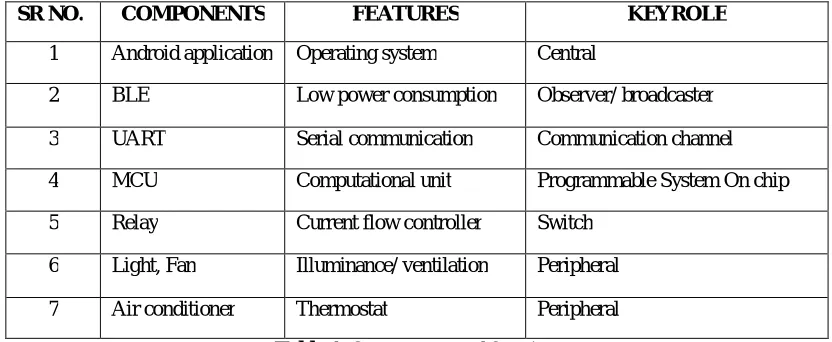
The functioning of each blocks is listed below.
SR NO. COMPONENTS FEATURES KEYROLE
1 Android application Operating system Central
2 BLE Low power consumption Observer/ broadcaster
3 UART Serial communication Communication channel
4 MCU Computational unit Programmable System On chip
5 Relay Current flow controller Switch
6 Light, Fan Illuminance/ ventilation Peripheral
7 Air conditioner Thermostat Peripheral
B. Connectivity:
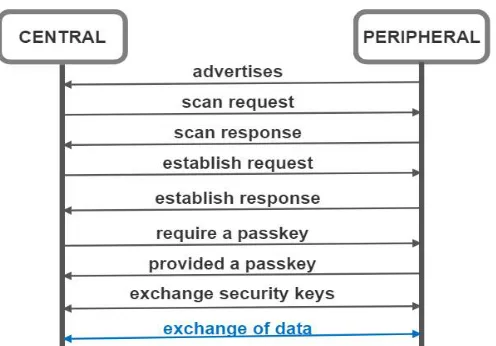
In this system, Bluetooth Low Energy is a fundamental unit that connects mobile android application which works as CENTRAL and electrical appliances working as PERIPHERALS[5]. Data can be exchanged by establishing connection between central and peripheral. For discovering a device, peripheral advertises packets after every interval. at the same time, scanning process is commenced in central device which send a request to peripheral and in response, device is discovered. After finding device, connection is established by a request from central and a response from peripheral. After connection, pairing and bonding of device is confirmed after an exchange of secured passkey, which further allows exchange of data.
For functioning of peripherals, a module of Bluetooth Low Energy is linked with appliances in two different ways. It is either mounted on hardware, replacing and modifying the conventional infrared framework, or connected with the switch board through controller, For proper transmission and reception of instructions. This process completes the cycle of operation [6].
Figure 2:Flow chart BLE Connectivity
Device discovery
Establishment of connection
C. Communication
After connectivity of central and peripheral, bidirectional serial communication between android application and Bluetooth low energy is being carried out. Instructions are transmitted from android application in the form small packets through Bluetooth, and are received by module of Bluetooth low energy via UART. UART processes the commands received according the instructions, in order to obtain necessary output. It also provides a necessary communication link along with handling interrupts of Bluetooth low energy.
IV. RESULT
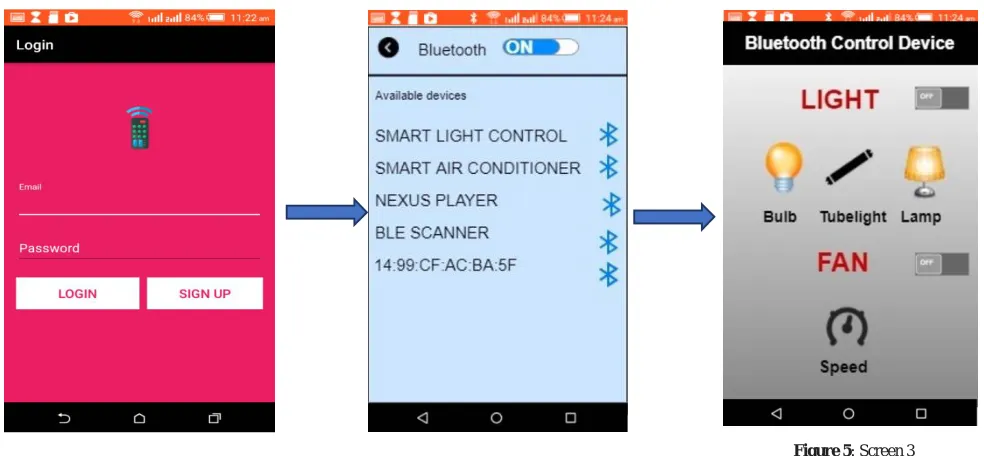
The user side application is built on android operating system [7]. The detailed implementation of system is mentioned below.
Step 1: Enable the Bluetooth feature of mobile.
Step 2: Start the SMART HOME application.
Step 3: For registered memberLogin with user email id and password.
Step 4: For new member sign up and provide necessary details.
Step 5: After successful login available devices are listed. On Selecting SMART LIGHT CONTROL pairing of device is confirmed.
Step 6: Turn on or off the appliance according to the need.
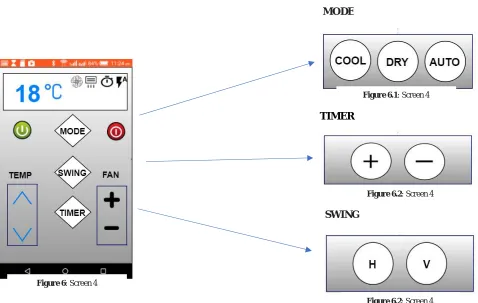
Step 7: On pairing with SMART AIR CONDITIONER device, controlling of various parameters of AC like temperature, Fan, Swing, Timer, Mode etc. can be operated.
Step 8: Select the additional option for mode, swing, timer.
Step 9: Similarly, any other electrical appliance can be controlled by selecting different devices from Screen 2.
The preceding procedure is demonstrated below.
Figure 3: Screen 1
Figure 4: Screen 2
V. CONCLUSION
The proposed system supports monitoring and controlling of the appliances where BLE module is installed.With the help of an android application selection of an appliance and controlling each parameter is carried out. This system makes the design of home smarter by transmitting the instructions and attaining successful results from appliances. This system provides advantages in terms of low power consumption, safety, time saving, user friendly, quick response etc. The system also assures the security feature by once registering into the application so that only authenticated users get accessibility.
VI. FUTURE WORK
In future, this framework can be expanded by controlling various appliances and machines using Bluetooth Low Energy.
The idea of monitoring Appliances like Television, Musicplayer, fridge etc can be procured using the same technology. Moreover, this approach is not only limited to Smart home but also be acquire in diverse field by implementing at Offices, Restaurants, Gym centres etc.
MODE
TIMER
SWING
Figure 6: Screen 4
Figure 6.1: Screen 4
Figure 6.2: Screen 4
REFERENCES
[1] Bluetooth Special Interest Group, "Bluetooth Developer portal," 2015.
https://developer.bluetooth.org/TechnologyOverview/Pages/Profiles.aspx. [2] The official Bluetooth website from Bluetooth SIG: http://www.bluetooth.com.
[3] Mauri Juhana Honkanen, “Facilitating positioning through Bluetooth Low Energy wireless messaging”, Feb 24, 2015, Google patents.
[4] Timothy J. Talty and Robert A. Hrabak“Bluetooth Low Energy detections through vehicle paired capable devices” , 7 Jan 2014,Google patents.
[5] Kevin Townsend, Carles Cufí, Akiba, And Robert Davidson, “Getting started with Bluetooth Low Energy”, O’reilly Publication, May 2014. [6] C. Gomez, J. Oller and J. Paradells, "Overview and Evaluation of Bluetooth Low Energy: An Emerging Low-Power Wireless Technology,"
Sensors (Basel), vol. 12, no. 9, pp. 11734-11753, 2012.