ISSN(Online): 2320-9801
ISSN (Print): 2320-9798
I
nternational
J
ournal of
I
nnovative
R
esearch in
C
omputer
and
C
ommunication
E
ngineering
(A High Impact Factor, Monthly, Peer Reviewed Journal) Website: www.ijircce.com
Vol. 5, Issue 10, October 2017
Enhancing Degraded Handwritten Document
Image using Morphological Operator
Sangeetha.R1, Rajkumar.T.C2
Research Scholar, Dept. of Computer Science, ST.Xavier’s College, Tirunelveli, Tamilnadu, India1
Assistant Professor, Dept. of Computer Science, ST.Xavier’s College, Tirunelveli, Tamilnadu, India2
ABSTRACT: Document image binarization is a prominent research area in computer science. Morphology operator is
a very important as well as essential method in digital image processing and computer vision. Morphology operators are widely used in image processing to detect the letters and characters for different gray scale and color image. In this paper, erode can be processed by areas of foreground pixels shrink in size and holes within those areas become larger. Dilation can be processed by areas of foreground pixels grow in size while holes within those regions become smaller. Image binarization is a process of converting a gray image into binary image. The gray image are not visible the clear output image so use the binarization method to get the clear output. It is also used to display the degraded the document image especially the handwritten document.
KEYWORDS: Document, morphology operator, Binarization
I. INTRODUCTION
Morphology is a branch of biology which deals with the form and structure of plants and animals. Here, it is used as a tool for extracting image components useful to describing image shape. Morphology is used to reconstruct the image. Morphology is a broad set of image processing operations that process images based on shapes. It applies a structuring element to an input image, creating to an input image, creating an output image of the same size. In many field they use the image such as in medical, document image, face recognition where it is a very challenging task to segment the text from background. In some place handwritten document are used, which can at times be faulty due to printing and manual error. That type of document can recover through the binarization method.
Dilation is a transformation that produces an image similar to the original by proportionally shrinking or stretching the image. Every dilation has a fixed point that is called the centre of dilation. Erosion is one of two fundamental operations in morphological operations are based. Erosion is the converse of dilation. The action of the erosion operator is equivalent to computing local minimum over the area of the kernel. The main purpose of erode and dilate operators is detect the characters and letters. These operators are also used to improve the contrast of gray and color image.
II. RELATED WORK
ISSN(Online): 2320-9801
ISSN (Print): 2320-9798
I
nternational
J
ournal of
I
nnovative
R
esearch in
C
omputer
and
C
ommunication
E
ngineering
(A High Impact Factor, Monthly, Peer Reviewed Journal) Website: www.ijircce.com
Vol. 5, Issue 10, October 2017
processing method is used to remove the noise. In [6] authors have proposed different types of images which have been tested in binarization method. They use the benchmark algorithm shows the test result for each case qualitative and quantitatively. The disadvantage is it supports only the textual component mostly. In [7] authors have proposed the wiener filter to binarize the degraded image. The main disadvantage is does not improve the quality of image but the content of image. In [8] authors have proposed the techniques to solve the degraded images. The method use various thresholding process to detect the degraded image but none of the method can solve the degraded images. In [9] authors have proposed the use of thresholding method that divide the text from degraded document and also they can apply the adaptive image contrast. It can implement the canny edge map to get a clear document. In [10] an author has proposed a degraded document image to improve the quality of the output image through the binarization method and also use the filtering method to avoid the noise. A new method has been proposed a morphology operator for get a better result. They use two thresholding methods to solve but it is not suitable for all images. The drawback of this method was unable to display the accurate output image. In [11] authors has proposed single thresholding algorithm. The main drawback of the method was foreground images suppress the background images. In [12] authors has proposed the different algorithm to test the ancient document but the most of the algorithm cannot gave the approximate solution. So they propose the Niblack algorithm in very detail. The disadvantage of the method is it can be low process.
III. PROPOSEDMETHODOLOGY A. Design Considerations:
Initiate a gray or color image. Resize the original image. Use the morphology operator. Calculate the MSE and PSNR value. Get the enhanced image.
B. Description of the Proposed Algorithm:
In proposed method, the RGB degraded images as an input image. It converts the RGB image into gray scale. Gray scale image have many shades of gray with blur in the boundary. So avoid this problem to convert the gray image into binary image. Filtering method is used to modifying or enhances the degraded image and also used to reduce the unwanted elements. Morphology operator is applied to enhance the image. In this operator, a structuring element as input as compared as degraded image until the process to get an accurate value. Finally, extract the clear image.
Start
Input color or gray image
Resize the image
Morphology operator
Use erosion and dilation operator
with gray image Use erosion and dilation operator with binary image
ISSN(Online): 2320-9801
ISSN (Print): 2320-9798
I
nternational
J
ournal of
I
nnovative
R
esearch in
C
omputer
and
C
ommunication
E
ngineering
(A High Impact Factor, Monthly, Peer Reviewed Journal) Website: www.ijircce.com
Vol. 5, Issue 10, October 2017
IV.PSEUDO CODE
Step -1 Convert RGB to Gray scale Image
i) Read the image from the specified location. ii) Display a RGB image in resized format. iii) Convert RGB image into Greyscale Image.
iv) Use filters to remove noises that are affecting the image. Step -2 Using morphology operators
A dilation of an image I by the structure element H is given by the set operation I ⊕ H = {(p + q)| p ∈ I, q ∈ H}
Take the union of copies of the structuring element, Hp, centred at every pixel location p in the foreground: I ⊕ H = U p∈I Hp
Uses equivalent formula I ⊕ H = S q∈H
Input: Image I, structuring element H
Output: Image I’ = I ⊕ H
(i) dilateImg = REPLICATE(MIN(img), dims[0]+2, dims[1]+2), dilateImg [1,1] = img (ii) dilateImg = DILATE(dilateImg, strucElem, /GRAY) , TVSCL, dilateImg, 2
Apply the dilate operations.
Only pixels p ∈ I such that Hp fits inside I I H = {p | Hp ⊆ I}
Uses dual, I H = (I ⊕ H∗)
Input: Image I, structuring element H
Output: Image I’ = I H
(i) erodeImg = REPLICATE(MAX(img), dims[0]+2, dims[1]+2) ,erodeImg [1,1] = img (ii) erodeImg = ERODE(erodeImg, strucElem, /GRAY) ,TVSCL, erodeImg, 1
Apply the erode operations.
Step -5 displaying the Enhanced image.
V. SIMULATIONRESULTS
MEAN SQUARE ERROR:
Two of the error metrics used to compare the various image compression techniques are the Mean Square Error (MSE) and the Peak Signal to Noise Ratio (PSNR). The MSE is the cumulative squared error between the compressed and the original image, whereas PSNR is a measure of the peak error.
General steps to calculate the mean squared error from a set of X and Y values: 1. Find the regression line.
2. Insert your X values into the linear regression equation to find the new Y values (Y'). 3. Subtract the new Y value from the original to get the error.
4. Square the errors. 5. Add up the errors.
6. Find the mean.
PSNR
Peak signal-to-noise ratio, often abbreviated PSNR, is an engineering term for the ratio between the maximum possible power of a signal and the power of corrupting noise that affects the fidelity of its representation. Because many signals have a very wide dynamic range, PSNR is usually expressed in terms of the logarithmic decibel scale.
ISSN(Online): 2320-9801
ISSN (Print): 2320-9798
I
nternational
J
ournal of
I
nnovative
R
esearch in
C
omputer
and
C
ommunication
E
ngineering
(A High Impact Factor, Monthly, Peer Reviewed Journal) Website: www.ijircce.com
Vol. 5, Issue 10, October 2017
PSNR is most easily defined via the mean squared error (MSE).The PSNR (in dB) is defined as:
= 10.
Here, MAXI is the maximum possible pixel value of the image. When the pixels are represented using 8 bits per sample,
this is 255. More generally, when samples are represented using linear PCM with B bits per sample, MAXI is 2B−1.
For color images with three RGB values per pixel, the definition of PSNR is the same except the MSE is the sum over
all squared value differences divided by image size and by three. Alternately, for color images the image is converted to
a different color space and PSNR is reported against each channel of that color space.
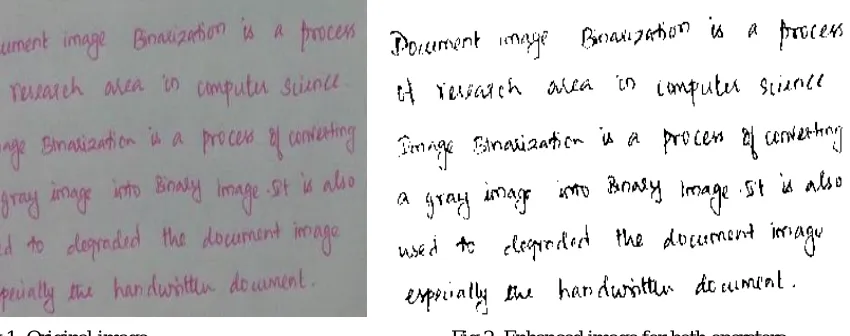
The output is:
Fig 1: Original image Fig 2: Enhanced image for both operators
The MSE value for the Doc-1original image is -2.405, and the PSNR for the original image is 0.00453.
The MSE value calculated for the enhanced image is 0.453, and the PSNR for the enhancement image is 8.2358.
VI.CONCLUSION
ISSN(Online): 2320-9801
ISSN (Print): 2320-9798
I
nternational
J
ournal of
I
nnovative
R
esearch in
C
omputer
and
C
ommunication
E
ngineering
(A High Impact Factor, Monthly, Peer Reviewed Journal) Website: www.ijircce.com
Vol. 5, Issue 10, October 2017
REFERENCES
[1] Su,Bolan,Shijian Lu, and chew Lim Tan. “Robust document image binarization technique for degraded document images.”Image processing, IEEE Transactions on 22.4(2013): 1408-1417.
[2] Prachi K.More ,D.D.Dighe. “A review on docment image binarization technique for degraded document images” Image processing,IRJET(2016) [3] Nikita Mote, Shital avhad, Sonali jangale. “Binarization technique used for recovering degraded document images” IJIR Vol 2 Issue-2, (2016) [4] Rekha chaudhari, Dinesh patil. “Document image binarization using threshold segmentation” IJIRCCE vol 3 Issue 3 march 2015
[5] D.D.Pukale ,aparna thorat,pooja bora,shruti barmecha,dipika suryawanshi. “Document image binarization for degraded document images along with OCR” IJIR Vol 2 Issue 6 2016
[6] J.sauvola and M.pietikainen, “Adaptive image binarization,” pattern recoginition, vol 33,no2,00.255-236,2000
[7] B.Gatos, i.pratikakis and s.perantonis, “Adaptive degraded document image binarizartion”pattern recognition, vol.39,no.3 2005 [8] Tarnjot kaur gill, “Document image binarization techniques –A review” ,IJCA vol 98-no 12 (2014)
[9] Prachi K.More,D.D.Dighe, “An improved hybrid binarization technique for degraded document digitization” IJESRT vol 5(8) 2016
[10] Divya jyoti, Bodh Raj, arun Sharma, Kapil kapoor, “ Document image binarization technique for degraded document image by using morphology operators” IJARIIT vol 2 issue 3 2016
[11]Ravinderkumar, Mohinder Malhotra, “Document image Binarization” IJERSTE vol 4 issue 12 December 2015
[12]Khurram Khurshid, ImranSiddiqi, Daudie Faure, Nicolevincent, “Comparision of niblack inspired binarization method for ancient document”2010.
[13] L. Eikvil, T. Taxt, and K. Moen, “A fast adaptive method for binarization of document images,” International Conference on Document Analysis and Recognition, pp. 435–443, September 1991.
[14] S. Lu and C. L. Tan, “Binarization of badly illuminated document images through shading estimation and compensation,” International Conference on Document Analysis and Recognition, vol. 1, pp. 312–316, September 2007.
[15] O. Trier and T. Taxt, \Evaluation of binarization methods for document images," IEEE Trans. Pattern Analysis and Machine Intelligence 17(3), pp. 312{315, 1995.
[16] Neelu Maheshwari, Pankaj Singh Parihar, and Anurag Maloo” A Review of Digital Image Enhancement Method of Degraded Indian Ancient Manuscripts”, International Journal for Scientific Research & Development, vol. 3, issue- 2015.
[17] Farzam Farbiz, Mohammad Bager Menhaj, Seyed A. Motamedi, and Martin T.Hagan " A New Fuzzy Logic Filter for Image Enahcement" IEEE Transections Systems, Man, and Cybernetics-part B: Cyberntics, Vol.30,NO.1, Feb 2000.
[18] Om Parkas Verma, Madasu Hanmandlu, Anil Singh Pariah and Vamp Krishna Madasu " Fuzzy Filter for Noise Reduction in Color Images" ICGST-GVIP Journal, Volume 9, September 2009, and ISSN:1687-398X.
[19] William K.Pratt PixelSoft,Inc. Los Altos, California " Digital image processing" Third Edition-2001.