DOCTRINE OF SEPARABILITY
IZZAH ZAHIN BINTI ALIMAN
A project report submitted in partial fulfillment of the requirements for the award of the degree of Master of Science (Construction Contract Management)
Faculty of Built Environment Universiti Teknologi Malaysia
Dedicated with deepest love and greatest affection to
Abah and Mak,
ACKNOWLEDGEMENT
In preparing this thesis, I am fortunate to have with me the pillars of support in providing the sheer willpower needed to see this through. Sincere and deepest gratitude are due to:
My family who stick by my side through everything and love me no matter what;
my supervisor, for her unrelenting efforts and encouragement throughout every stage of the research which were significant in the completion of this study;
my beloved lecturers for their guidance and invaluable inputs throughout this programme;
librarians at UTM and KLRCA for their kind assistance in supplying the relevant literatures; and
my friends for their help at various occasions.
ABSTRACT
ABSTRAK
TABLE OF CONTENTS
CHAPTER TITLE PAGE
DECLARATION ii
DEDICATION iii
ACKNOWLEDGEMENT iv
ABSTRACT v
ABSTRAK vi
TABLE OF CONTENTS vii
LIST OF CASES xii
LIST OF TABLES xv
LIST OF FIGURES xvi
LIST OF ABBREVIATIONS xvii
1 INTRODUCTION
1.1 Background 1
1.2 Problem Statement 4
1.3 Objective 6
1.4 Scope 6
1.5 Significance 6
1.6 Research Methodology 7
1.6.1 Stage 1: Initial Study 7
1.6.2 Stage 2: Data Collection 8
1.6.3 Stage 3: Data Analysis 8
1.6.4 Stage 4: Writing Up and Completion 8
2 ARBITRATION AGREEMENT
2.1 Introduction 10
2.2 Arbitration 12
2.3 Elements of the Arbitration Agreement 13 2.3.1 Source of Arbitrator‘s Power 14 2.3.1.1 The Arbitration Act 2005 14
2.3.1.2 The Arbitration Rules 14
2.3.2 Existence of a Dispute between the Parties 16
2.3.2.1 The Arbitration Clause 17
2.3.2.2 The Submission Agreement 17
2.4 Forms of the Arbitration Agreement 20
2.4.1 Made in Writing 20
2.4.2 Incorporation by Reference 22
2.5 Enforcement of the Arbitration Agreement 23 2.5.1 Multi-tiered Dispute Resolution Clause 24
2.5.2 Stay of Proceeding 27
2.6 Conclusion 30
3 DOCTRINE OF SEPARABILITY
3.1 Introduction 32
3.2 Party Autonomy 33
3.3 Arbitrability 34
3.4 Competence-competence 37
3.5 Separability and Competence-competence 38
3.6 Separability and Legal Fiction 40
3.7 Rationale for Separability 41
3.7.1 Theoretical Reason 41
3.7.2 Practical Reason 42
3.8 Effects of Separability 43
3.9 Position in England 44
4 RESEARCH METHODOLOGY
4.1 Introduction 52
4.2 Stage 1: Initial Study 53
4.3 Stage 2: Data Collection 54
4.4 Stage 3: Data Analysis 57
4.5 Stage 4: Writing-up and Completion 57
4.6 Conclusion 58
5 APPLICATION OF THE DOCTRINE OF SEPARABILITY IN MALAYSIA
5.1 Introduction 59
5.2 Summary of the Cases 59
5.2.1 Borneo Samudera Sdn Bhd v Siti Rahfizah binti Mihaldin & 820 Others
[2008] MLJU 293 (COA) 60 5.2.2 Chut Nyak Isham bin Nyak Ariff v
Malaysian Technology Development Corporation Sdn Bhd & Ors
[2009] 6 MLJ 729 (HC) 60 5.2.3 Cyber Business Solutions Sdn Bhd v
Elsag Datamat Spa [2010] MLJU 2079 (HC) 60 5.2.4 Assar Senari Holdings Sdn Bhd v
Teratai Sanjung Holdings (M) Sdn Bhd 10
[2011] MLJU 834 (HC) 61 5.2.5 Arul Balasingam v Ampang Puteri Specialist
Hospital Sdn Bhd (formerly known as Puteri Specialist Hospital Sdn Bhd)
[2012] 6 MLJ 104 (HC) 62 5.2.6 AV Asia Sdn Bhd v Pengarah Kuala Lumpur
Regional Centre For Arbitration & Anor
[2013] MLJU 183 (HC) 62 5.2.7 TNB Fuel Services Sdn Bhd v China National
5.2.8 Capping Corp Ltd & Ors v Aquawalk Sdn Bhd
& Ors [2013] 6 MLJ 579 (COA) 64 5.2.9 Masenang Sdn Bhd v Sabanilam Enterprise
Sdn. Bhd [2014] MLJU 1777 (HC) 64 5.2.10 Kukdong Engineering &Construction
Co. Ltd. v Bauer (M) Sdn. Bhd.
[2015] MLJU 455 (HC) 65 5.2.11 Juara Serata Sdn Bhd v Alpharich Sdn. Bhd.
[2015] 6 MLJ 773 (FC) 66
5.3 Analysis of the Cases 66
5.3.1 Borneo Samudera Sdn Bhd v Siti Rahfizah binti Mihaldin & 820 Others
[2008] MLJU 293 (COA) 66 5.3.2 Chut Nyak Isham bin Nyak Ariff v
Malaysian Technology Development Corporation Sdn Bhd & Ors
[2009] 6 MLJ 729 (HC) 67 5.3.3 Cyber Business Solutions Sdn Bhd v
Elsag Datamat Spa [2010] MLJU 2079 (HC) 68 5.3.4 Assar Senari Holdings Sdn Bhd v
Teratai Sanjung Holdings (M) Sdn Bhd
[2011] MLJU 834 (HC) 68 5.3.5 Arul Balasingam v Ampang Puteri Specialist
Hospital Sdn Bhd (formerly known as Puteri Specialist Hospital Sdn Bhd)
[2012] 6 MLJ 104 (HC) 69 5.3.6 AV Asia Sdn Bhd v Pengarah Kuala Lumpur
Regional Centre For Arbitration & Anor
[2013] MLJU 183 (HC) 69 5.3.7 TNB Fuel Services Sdn Bhd v China National
Coal Group Corp [2013] 4 MLJ 857(COA) 70 5.3.8 Capping Corp Ltd & Ors v Aquawalk Sdn Bhd
5.3.9 Masenang Sdn Bhd v Sabanilam Enterprise
Sdn. Bhd [2014] MLJU 1777 (HC) 72
5.3.10 Kukdong Engineering &Construction Co. Ltd. v Bauer (M) Sdn. Bhd. [2015] MLJU 455 (HC) 74
5.3.11 Juara Serata Sdn Bhd v Alpharich Sdn. Bhd. [2015] 6 MLJ 773 (FC) 75
5.4 Summary of the Analysis 77
5.5 Conclusion 84
6 CONCLUSION AND RECOMMENDATION 6.1 Introduction 85
6.2 Study Conclusion 85
6.2 Study Constraint 87
6.3.1 Duration of the Research 87
6.3.2 Resources 87
6.4 Future Research 88
LIST OF CASES
Albilt Resources Sdn Bhd v Casaria Construction Sdn Bhd [2010] 7 CLJ 785
Ajwa for Food Industries Co (MIGOP), Egypt v Pacific Inter-link Sdn Bhd [2013] 7
CLJ 18
Arul Balasingam v Ampang Puteri Specialist Hospital Sdn Bhd (formerlyknown as
Puteri Specialist Hospital Sdn Bhd) [2012] 6 MLJ 104
Assar Senari Holdings Sdn Bhd v Teratai Sanjung Holdings (M) Sdn Bhd [2011]
MLJU 834
AV Asia Sdn Bhd v Pengarah Kuala Lumpur Regional Centre For Arbitration &
Anor [2013] MLJU 183
Bauer (M) Sdn Bhd v Daewoo Corp [1999] 4 MLJ 545
Beijing Jianlong Heavy Industry Group v. Golden Ocean Group Limited and
others [2013] EWHC 1063 (Comm)
Bremer Vulkan Schiffbau Und Maschinenfabrik v South India Shipping Corp [1981]
1 All ER 289
Borneo Samudera Sdn Bhd v Siti Rahfizah binti Mihaldin & 820 Others [2008]
Cheng Keng Hong v. Government of the Federation of Malaya[1966] 2 MLJ 33
Capping Corp Ltd & Ors v Aquawalk Sdn Bhd & Ors [2013] 6 MLJ 579
Christopher Brown Ltd v Genossenschaft Osterreichischer [1954] 1 QB 8
Chut Nyak Isham bin Nyak Ariff v Malaysian Technology Development Corporation
Sdn Bhd & Ors [2009] 6 MLJ 729
Cyber Business Solutions Sdn Bhd v Elsag Datamat Spa [2010] MLJU 2079
Dallah Real Estate and Tourism Holding Co. v Ministry of Religious Affairs,
Government of Pakistan [2011] 1 All ER 485
Fiona Trust & Holding Corp v Privalov [2007] UKHL 40
Heyman v Darwins Ltd [1942] 1 All ER 337
Juara Serata Sdn Bhd v Alpharich Sdn. Bhd. [2015] 6 MLJ 773
Kukdong Engineering &Construction Co. Ltd. v Bauer (M) Sdn. Bhd. [2015] MLJU
455
Lim Su Sang v Teck Guan[1966] 2 MLJ 29
Masenang Sdn Bhd v Sabanilam Enterprise Sdn. Bhd [2014] MLJU 1777
Nolde Bros., Inc. v Bakery & Confectionary Workers Union (1977) 430 US 243
Premium Nafta Products Ltd Fili Shipping Co. Ltd. [2007] UKHL 40
Roy Hill Holdings Pty Ltd v. Samsung C&T Corporation [2015] WASC 458
Sri Kajang Rock Products Sdn Bhd v. Mayban Finance Bhd[1992] 1 CLJ 204
Susu Lembu Asli Marketing Sdn Bhd v Dutch Lady Milk Industries Bhd [2004] 2 MLJ
230
TNB Fuel Services Sdn Bhd v China National Coal Group Corp [2013] 4 MLJ 857
Westacre Invs. Inc. v Jugoimport-SDPR Holdings Co [1998] 4 All ER 570
Woh Hup v Property Development [1991] 3 MLJ 82
ZAQ Construction Sdn Bhd & Anor v Putrajaya Holdings Sdn Bhd [2014] 10 MLJ
LIST OF TABLES
TABLE NO. TITLE PAGE
Table 4.1 Search terms used to retrieve cases 71
Table 4.2 List of 11 cases retrieved from search terms no. 3-7 72
Table 5.1 Summary of Case Analysis 76
LIST OF FIGURES
FIGURE NO. TITLE PAGE
1.1 Flowchart of the research process 12
LIST OF ABBRIEVIATIONS
AIAJ Asian International Arbitration Journal
All ER All England Law Reports
AM. REV. INT'L ARB. American Review of International Arbitration
AMR All Malaysia Reports
Arb. Intl. Arbitration International Austl. B. Rev Australian Bar Review
CIDB Construction Industry Development Board
CLJ Current Law Journal
CLR Commonwealth Law Reports
COA Court of Appeal
Comm Commercial
Const LR Construction Law Reports
FC Federal Court
FIDIC Fédération Internationale Des Ingénieurs-Conseils or International Federation of Consulting Engineers
FMSLR Federated Malay States Law Reports
HC High Court
HKIAC Hong Kong International Arbitration Centre
HL House of Lords
ICC International Chamber of Commerce
KB King‘s Bench
KLRCA Kuala Lumpur Regional Centre for Arbitration J. Int'l Arb Journal of International Arbitration
LCIA London Court of International Arbitration
Lloyd‘s Rep Lloyd‘s List Reports
MLJA Malayan Law Journal Article
MLJ Malayan Law Journal Unreported
PAM Pertubuhan Arkitek Malaysia or Malaysian Institute of Architects
PC Privy Council
PWD Public Work Department or Jabatan Kerja Raya
QB Queen‘s Bench
S.Ac.L.J Singapore Academy of Law Journal
SCR Session Cases Report
SIAC Singapore International Arbitration Centre
SLR Singapore Law Report
WASC Supreme Court of Western Australia
WLR Weekly Law Report
Y.B. Arb. Inst. Stockholm Chamber Commerce
CHAPTER 1
INTRODUCTION
1.1 Background
Arbitration is one of the dispute resolution processes of obtaining a final and binding decision on a dispute, or series of disputes, without reference to the court. According to Stuyt, ―arbitration is the oldest method for the peaceful settlement of international disputes.‖1
Parties generally refuse to seek the solution for conflicts in the traditional judicial settlement which is the court because the legal procedure itself is complex and time-consuming. An arbitral award, is often enforceable in most part of the world by virtue of the New York Convention2. The enforceability aspect has to be considered when one of
1 A. Stuyt. (1990). Survey of International Arbitrations 1794-1989 vii 2
Convention on the Recognition and Enforcement of Foreign Arbitral Awards (the ‗New York Convention 1958‘) plays a major role in the international arbitration arena. Prior to it, there was a lack of a procedural mechanism for an award from one state to be registered and enforced by a court of another state.
See more The New York Convention. New York Arbitration Convention. Retrieved 22 July 2016, from
the disputing parties is, for example, is a foreign or multinational corporation and their assets are kept in their home country3. Besides that, arbitration stands out from the other dispute resolution process4 since party has the autonomy to agree on a prescribed arbitration process and procedure of their choice5. This is supported by a 2015 survey on arbitration practices and trends worldwide6.
For example, Malaysia is one of the states which have signed the Trans-Pacific Partnership Agreement (TPPA). The objective of the agreement is to establish a regional free trade agreement (FTA) across the Pacific Rim countries7. The investment chapter of TPPA provides that any disputes must be through investor-state dispute settlement (ISDS). Under that provision, disputes between investors and the host state would go before an international panel of arbitrators instead of before the domestic courts. 8 This mechanism is widely used in international commercial contracts, particularly international investment agreements as it offers legal protection and credible assurance by countries with domestic legal systems perceived as not meeting international standards for protecting foreign investors.9
3 Resolution of Construction Industry Disputes: Arbitration, Statutory Adjudication or Litigation in the
Construction Court? – Azman Davidson & Co. (2014). Azman Davidson & Co. Retrieved 5 August 2016, from http://www.azmandavidson.com.my/news-publications/resolution-of-construction-industry-disputes-arbitration-statutory-adjudication-or-litigation-in-the-construction-court/
4 For instance, conciliation, mediation, and dispute review board.
5 Pryles, M. (2008). Limits to Party Autonomy in Arbitral Procedure. International Council for
Commercial Arbitration (ICCA). Retrieved 21 April 2016, from
http://www.arbitration-icca.org/media/4/48108242525153/media012223895489410limits_to_party_autonomy_in_international_c ommercial_arbitration.pdf
6 2015 International Arbitration Survey: Improvements and Innovations in International Arbitration.
(2016). Queen Mary University of London. Retrieved 2 August 2016, from
http://www.arbitration.qmul.ac.uk/research/2015/
7 MITI FTA. (2016). Fta.miti.gov.my. Retrieved 20 April 2016, from http://fta.miti.gov.my/index.php/pages/view/246
8
Samra, H. & Juchawski, A. (2015). Investor-state dispute settlement in the newly signed Trans-Pacific Partnership | Insights | DLA Piper Global Law Firm. DLA Piper. Retrieved 20 April 2016, from
https://www.dlapiper.com/en/asiapacific/insights/publications/2015/12/international-arbitration-newsletter-q4-2015/investor-state-dispute-settlement/
9
The genesis of arbitration in Malaysia was the 1809‘s Arbitration Ordinance XIII. Later, Arbitration Act 1952 came into picture which followed closely the Arbitration Act 1950 of the United Kingdom10. Currently, the arbitration process in Malaysia is governed by the Arbitration Act 2005 based on the United Nations Commission on International Trade Law (UNCITRAL)11 Model Law.
The Court of Appeal case of Albilt Resources Sdn Bhd v Casaria Construction Sdn Bhd12 had this to say:
The Arbitration Act 2005 (Act 646) was enacted on 30.12.2005 and it brought about wholesale reform of the arbitral regime. It was based on the United Nations Commission on International Trade Law (UNCITRAL) Model Law on International Commercial Arbitration. The Arbitration Act 2005 (Act 646) repealed and replaced the Arbitration Act 1952 (Act 93) and the Convention on the Recognition and Enforcement of Foreign Arbitral Awards Act 1985 (Act 320) which enacts the New York Convention dealing with the recognition and enforcement of international awards.
In the Malaysian context, matters referred to arbitration including construction contract, maritime, insurance, finance and trade, aviation, oil and gas and commodity supply disputes13.
10 Bukhari, K. Arbitration and Mediation in Malaysia. Asean Law Association. Retrieved 2 August 2016,
from http://www.aseanlawassociation.org/docs/w4_malaysia.pdf 11
UNCITRAL is the abbreviation for United Nations Commission on International Trade Law. The Model Law complements the New York Convention 1958 for effective supervision of arbitral proceeding as well as registration and enforcement of an award. Unlike the New York Convention, adoption of the UNCITRAL Model Law is not a treaty obligation. Nevertheless, states are highly recommended to adopt it and they are at liberty to amend it to suit their own needs.
See more Davidson, W. & Rajoo, S. (2006). The Malaysian Bar - Arbitration Act 2005: Malaysia Joins the Model Law. The Malaysian Bar. Retrieved 2 August 2016, from
http://www.malaysianbar.org.my/adr_arbitration_mediation/arbitration_act_2005_malaysia_joins_the_mo del_law.html
The basis for parties to refer their disputes to arbitration is based on the arbitration agreement or arbitration clauses. These agreements or clauses are unique in a way that they are presumptively ‗separable‘ or ‗severable‘ from the ‗main‘ contract within which they are found (sometimes termed as the ‗underlying‘ or ‗principle‘ or ‗substantive‘ contract). The arbitration clauses are independent from the main contract in which it is contained.14
As such, the UNCITRAL Model Law cemented the separability doctrine and effectively grants arbitrators the authority (competence-competence) to consider their own jurisdiction as illustrated in its Article 16(1)15. The separability of arbitration agreements can also be found in section 7 of the United Kingdom‘s Arbitration Act 199616. In the Malaysia‘s Arbitration Act 2005, the doctrine of separability has been codified under section 18.
1.2 Problem Statement
As highlighted above, arbitration is unique in its own way whereby it can survive the death of the main contract regardless the validity of the main contract. Another example, in the case of Susu Lembu Asli Marketing Sdn Bhd v Dutch Lady Milk
13
Zakaria, A. (2013). Officiating Speech of the CIARB International Arbitration Conference 2013. Kehakiman. Retrieved 2 August 2016, from
http://www.kehakiman.gov.my/sites/default/files/document3/Teks%20Ucapan/speech%20tun%2022%20a ugust.pdf
14
Born, G. (2014). International commercial arbitration. Alphen aan den Rijn: Wolters Kluwer Law & Business.
15 Article 16, UNCITRAL Model Law. Retrieved 1 April 2016, from
http://www.uncitral.org/pdf/english/texts/arbitration/ml-arb/07-86998_Ebook.pdf
16
Section 7, United Kingdom‘s Arbitration Act 1996. Retrieved 1 April 2016, from
Industries Bhd17, the issue deliberated was whether the disputes between the Plaintiff and the Defendant would come within the terms of the arbitration clause as provided under the production agreement even though there was an allegation that the production agreement was affected by fraud or misrepresentation. The Court held that even if the production agreement was void ab initio for the various reasons alleged by the Plaintiff, the arbitration clause will survive and remain effective. The arbitration clause is an autonomous agreement independent from the production agreement.
Besides that, the case of Fiona Trust & Holding Corp v Privalov 18 has reaffirmed the principle of the doctrine of separability in English jurisdiction. In lower courts, the arbitration agreement was successfully challenged on the basis of defects relating to the contract. At appeal, the court overturned the lower court decision and decided that if a contract is alleged to be invalid for reasons such as bribery, unless that bribery relates specifically to the arbitration clause, the clause survives and the arbitrator should determine the validity of the contract as a whole, not the court.19
The question posed here is how does the doctrine of separability as applied or raised in those cases relate to the arbitrator‘s or the arbitral tribunal‘s competency to decide his or its own jurisdiction based on case laws? A party may not honor their part of the bargain and go to the court challenging the arbitral tribunal‘s jurisdiction by questioning the validity of the agreement they entered to on the very first place. A party may also attempt to question whether there is in existence a valid arrangement and agreement that provides the justification for the arbitral tribunal to act. At what point of time or upon what stage in the arbitration process does the doctrine of separability really applies?
17 [2004] 2 MLJ 230 18
[2007] UKHL 40. Also known as Premium Nafta Products Ltd Fili Shipping Co. Ltd. [2007] UKHL 40
19 Shore, L. & Maxwell, I. (2007). Fiona Trust v Privalov: English Court of Appeal all but ends
separability debate. Global Arbitration Review, 2(1). Retrieved 1 April 2016, from
1.3 Objective
The purpose of this study is to identify the application of the doctrine of separability in the arbitration process.
1.4 Scope
The approach that will be adopted in this study is to review the common law jurisdiction, which is of persuasive authority in Malaysia, is useful and indicative. Thereafter, a thorough analysis will be done to see how the Malaysian courts apply this doctrine of separability in determining the jurisdiction of the arbitrator or the arbitral tribunal. The selection of cases will not be restricted to construction law cases only. However, limit to the cases chosen in terms of time frame is set to be from the year 2005 onwards to reflect the adoption of section 18 of the Arbitration Act 2005.
1.5 Significance
in Malaysia. According to Samuel, separability is now largely a matter of historical interest20.
It is humbly submitted that it is still relevant to be studied as its development and theoretical underpinnings are relevant to an understanding of arbitration in Malaysia. This is important as in if an arbitrator or an arbitral tribunal decides that there is no a valid agreement to arbitrate, then the basis for his or its authority disappears.
1.6 Research Methodology
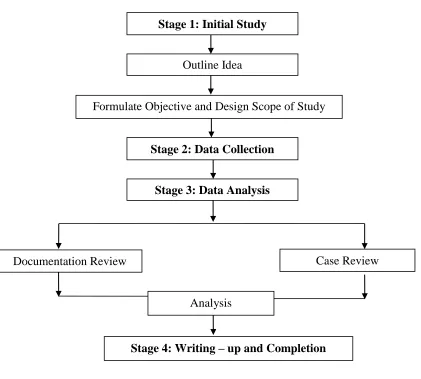
As a means to achieve the objective, a systematic research process has been drawn up and to be adhered to as illustrated in Figure 1.1. This is important to smoothen the process of the research.
.
1.6.1 Stage 1: Initial Study
Stage 1 is to identify the area of study and problem related to it. It involved reading on a myriad of materials. Discussions with potential supervisors are conducted simultaneously to obtain feedback and thoughts. The outline idea for the topic of this study is obtained and the next is formulating a suitable objective and designing the scope the study.
20
1.6.2 Stage 2: Data Collection
Stage 2 involves the collection of data and information. Data would be collected primarily through documentary analysis and browsing through the online databases. Relevant cases concerning the research topic would be sorted out from the databases. Additionally, secondary data is also collected from books, articles, and seminar reports.
1.6.3 Stage 3: Data Analysis
Stage 3 involves analysing and interpreting the data collected. ideas, Opinions and commentaries were also elicited. With regards to the case laws retrieved, after summarising facts and issues of each case, a thorough discussion was done in order to achieve the objective of this study.
1.6.4 Stage 4: Writing Up and Completion
1.7 Research Flow Chart
Figure 1.1 Flowchart of the research process Outline Idea
Formulate Objective and Design Scope of Study
Stage 2: Data Collection
Documentation Review Case Review
Analysis
Stage 1: Initial Study
Stage 3: Data Analysis
REFERENCES
2015 International Arbitration Survey: Improvements and Innovations in International
Arbitration. (2016). Queen Mary University of London. Retrieved 2 August 2016,
from http://www.arbitration.qmul.ac.uk/research/2015/
Stuyt, A. (1990). Survey of International Arbitrations 1794-1989 vii (3d ed.)
Abdul Aziz Hussin. (2009). Undang-undang timbang tara dalam industri pembinaan. Pulau Pinang: Penerbit Universiti Sains Malaysia.
Abdul Hak, N., Oseni, U., & Mohamed, N. (2016). Comparative Perspectives on Alternative Dispute Resolution with Reference to Malaysia. Gombak: IIUM Press.
Abu Backer, H. (2016). International Arbitration with Commentary to Malaysian Arbitration Act 2005. Kuala Lumpur: Janab (M) Sdn Bhd.
Aminuddin, F. (2014). Seat of Arbitration (Master). Universiti Teknologi Malaysia. Arbitration Act 2005.
Blackaby, N., Partasides, C., Hunter, M., & Redfern, A. (2014). Redfern and Hunter on international arbitration. Oxford: Oxford University Press.
Born, G. (2014). International commercial arbitration. (2nd ed.). Alphen aan den Rijn: Alphen aan den Rijn: Kluwer Law International.
Born, G. (2015). International Arbitration: Law and Practice. (2nd ed.). Alphen aan den Rijn: Kluwer Law International.
Born, G. (2015). International Arbitration-Cases and Materials. Alphen aan den Rijn: Kluwer Law International.
Brekoulakis, S. L. Lew , J. D. M., et al. (2016). The Evolution and Future of International Arbitration, International Arbitration Law Library, Vol. 37. The
Briggs, A. (2009) (2nd ed., p. 53). Oxford: Oxford University Press.
Browne, O. & Hyde, A. (2015). What Makes a Multi-tiered Dispute Resolution Clause Enforceable?. Latham & Watkins. Retrieved 1 August 2016, from
https://www.google.com/url?sa=t&rct=j&q=&esrc=s&source=web&cd=1&cad=rj
a&uact=8&ved=0ahUKEwiV1on7563OAhVEsI8KHU57CAEQFgggMAA&url=
https%3A%2F%2Fwww.lw.com%2FthoughtLeadership%2Flw-what-makes-a-
multi-tiered-dispute-resolution-clause-
enforceable&usg=AFQjCNEfxSjfsID51GNqAG5rF-9H209txA&sig2=e0jX3m69rM-3KRJNSRhDew
Bukhari, K. Arbitration and Mediation in Malaysia. Asean Law Association. Retrieved 2 August 2016, from
http://www.aseanlawassociation.org/docs/w4_malaysia.pdf
Cassese, A. (2011). Five Masters of International Law. Oxford: Hart Publishing Ltd. Chatterjee C. ―The Reality of Party Autonomy Rule in International Arbitration‖ (2003),
20(6) Journal of International Arbitration 539, 540.
Committee on International Commercial Arbitration, ILA, Final Report on Lis Pendens and Arbitration 4.11 (2006).
Contracts Act 1950 (Act 136).
Davidson, W. & Rajoo, S. (2006). The Malaysian Bar - Arbitration Act 2005: Malaysia Joins the Model Law. The Malaysian Bar. Retrieved 2 August 2016, from
http://www.malaysianbar.org.my/adr_arbitration_mediation/arbitration_act_2005
_malaysia_joins_the_model_law.html
Definition of RESEARCH. Merriam-webster.com. Retrieved 4 August 2016, from
http://www.merriam-webster.com/dictionary/research
Dimolitsa, A. (1999). Separability and Kompetenz-Kompetenz. In A. van den Berg, Improving the Efficiency of Arbitration Agreements and Awards: 40 Years of
Application of the New York Convention, ICCA Congress Series (1st ed., pp. 217 -
256). The Hague: Kluwer Law International.
HKIAC Model Clauses. Hong Kong International Arbitration Centre. Retrieved 4 August
2016, from http://www.hkiac.org/arbitration/model-clauses
Hornby, A. (2000). Jurisdiction. Oxford-Fajar Adanced Learner's English Dictionary. Shah Alam: Penerbit Fajar Bakti.
Irny, S. I. and Rose, A. A. (2005). Designing a Strategic Information Systems Planning Methodology for Malaysian Institutes of Higher Learning (isp-ipta), Issues in Information System. Volume VI, No. 1.
Jalil, M. (2015). Delay Tactic in Arbitration Proceeding (Master). Universiti Teknologi Malaysia.
Jalili, M. (1996). Kompetenz- Kompetenz: Recent U.S. and U.K. Developments. Journal of International Arbitration, 13(4), 169 - 178.
Jarvin, S. The sources and limits of the arbitrator's powers. 1986. 2 Arb. Intl. 140.
Jenkins, J. & Stebbings, S. (2006). International construction arbitration law. Alphen aan den Rijn: Kluwer Law International.
Jolles, ‗Consequences of multi-tier arbitration clauses: Issues of enforcement‘ (2006) 72 Arbitration 329.
KLRCA Arbitration Rules.
Landolt, P. The Inconvenience of Principle: Separability and Kompetenz-Kompetenz. 2013. 30(5). J. Int'l Arb.511-530.
LCIA Recommended Clauses. London Court of International Arbitration. Retrieved 4
August 2016, from
http://www.lcia.org/dispute_resolution_services/lcia_recommended_clauses.aspx
Lee, J. T. T. (1995). Separability, Competence-Competence and the Arbitrator's Jurisdiction in Singapore. S.Ac.L.J 7 421-437. Retrieved 23 July 2016, from http://ink.library.smu.edu.sg/cgi/viewcontent.cgi?article=1574&context=sol_resea
rch
Lew, J. D. M, Mistelis , L. A. and Kröll, S. (2003). Comparative International Commercial Arbitration. The Hague: Kluwer Law Arbitration. Malintoppi, L. (2015). Is there an "Asian Way" for Investor-State Dispute Resolution.
Mayer, P. (1999). The Limits of Severability of the Arbitration Clause. In A. van den Berg, Improving the Efficiency of Arbitration Agreements and Awards: 40 Years of Application of the New York Convention (1st ed., pp. 261 - 267). The Hague:
Kluwer Law International.
Michael Pryles,Multi-Tiered Dispute Resolution Clauses 18 J Int‘l Arb 159–176 (2001). MITI FTA. (2016). Fta.miti.gov.my. Retrieved 20 April 2016, from
http://fta.miti.gov.my/index.php/pages/view/246
Mohd Danuri, M., Mohd Ishan, Z., a Mustaffa, N., & Jaafar, M. (2012). A revisit on the current practice of dispute resolution and ADR in the Malaysian construction
industry. Universiti Malaya. Retrieved 27 July 2016, from http://repository.um.edu.my/27231/1/A%20revisit%20on%20the%20current%20p
ractice%20of%20dispute%20resolution%20and%20ADR%20in%20the%20Mala
ysian%20construction%20industry.pdf
Multi-Tiered Dispute Resolution Clauses. (2015). International Bar Association.
Retrieved 3 August 2016, from
http://www.ibanet.org/Document/Default.aspx?DocumentUid=9C6E21DE-043C-44C9-BE75-94CADECCF470
Nairn, K. & Heneghan, P. (2015). Arbitration World-International Series. London: Thomson Reuters.
Ong, C. K. Drafting Effective Dispute Resolution Clauses: Some Consideration. [2006] 3 MLJ l
Paulsson, J. (2005). Jurisdiction and Arbitrability. International Council for Commercial Arbitration. Retrieved 29 July 2016, from http://www.arbitration-
icca.org/media/0/12254599444060/jasp_article_-_jurisdiction_and_admissibility_-_liber_amicorum_robert_briner.pdf
Paulsson, J. (2010). Arbitration in Three Dimensions. SSRN Electronic Journal, 1-35. Retrieved 23 July 2016, from http://dx.doi.org/10.2139/ssrn.1536093
Pengelley, N. (2007). Separability Revisited: Arbitration Clauses and Bribery. Journal of International Arbitration, 24(5), 445 - 454.
http://www.arbitration-icca.org/media/4/48108242525153/media012223895489410limits_to_party_auto
nomy_in_international_commercial_arbitration.pdf
Rajoo, S. (2003). Law, practice, and procedure of arbitration. Kuala Lumpur: Malayan Law Journal Sdn. Bhd.
Rajoo, S. Drafting Effective Arbitration Agremeents. [2005] 1 MLJ vii
Rau, A. S. (2003). Everything You Really Need to Know about 'Separability' in Seventeen Simple Propositions. 14 Am. Rev. Int'l Arb. 84-92.
Report on the AALCO's Regional Arbitration Centres. (2016). Asian-African Legal
Consultative Organization. Retrieved 4 August 2016, from
http://www.aalco.int/Arbitration%202016.pdf
Resolution of Construction Industry Disputes: Arbitration, Statutory Adjudication or
Litigation in the Construction Court? – Azman Davidson & Co. (2014). Azman
Davidson & Co. Retrieved 5 August 2016, from
http://www.azmandavidson.com.my/news-publications/resolution-of-
construction-industry-disputes-arbitration-statutory-adjudication-or-litigation-in-the-construction-court/
Rules of Court 2012.
Samra, H. & Juchawski, A. (2015). Investor-state dispute settlement in the newly signed Trans-Pacific Partnership | Insights | DLA Piper Global Law Firm. DLA Piper. Retrieved 20 April 2016, from
https://www.dlapiper.com/en/asiapacific/insights/publications/2015/12/internation
al-arbitration-newsletter-q4-2015/investor-state-dispute-settlement
Samuel, A. (1986). Separability in English Law-Should an Arbitration Clause Be Regarded as an Agreement Separate and Collateral to a Contract in Which It Is Contained?. Journal Of International Arbitration, 3(3), 95 - 110.
Samuel. A. Book Review - International Arbitration: Three Salient Problems. 1988 5(1) J. Int'l Arb. 119-125.
Schwebel, S. M. (1987). The Severability of the Arbitration Agreement in International Arbitration: Three Salient Problems. Cambridge: Grotius Publications.
http://www.legislation.gov.uk/ukpga/1996/23/section/7
Sheridan, P. (1999). Construction and engineering arbitration. London: Sweet & Maxwell.
Shih, L. (2013). Federal Court Ajwa decision on the Arbitration Act 2005. Of Counsel. Retrieved 4 August 2016, from
https://leeshih.com/2013/08/05/federal-court-ajwa-decision/
Shih, L. (2016). Step by Step: Comply with Multi-tiered Dispute Resolution Clauses. Of Counsel. Retrieved 5 August 2016, from
https://leeshih.com/2016/07/04/step-by-step/
Shore, L. & Maxwell, I. (2007). Fiona Trust v Privalov: English Court of Appeal all but ends separability debate. Global Arbitration Review, 2(1). Retrieved 1 April 2016, from
http://globalarbitrationreview.com/journal/article/16437/fiona-trust-v-privalov-english-court-appeal-ends-separability-debate/
http://ssrn.com/abstract=648402
Shuttleworth, M. Definition of Research - How is Research Defined?. Explorable. Retrieved 4 August 2016, from https://explorable.com/definition-of-research Smit, R. (2003). Simpson Thacher. Separability and Competence-Competence in
International Arbitration: Ex Nihilo Nihil Fit? Or Can Something Indeed Come
From Nothing? Retrieved 2 August 2016, from
http://www.stblaw.com/docs/default-source/cold-fusion-existing-content/publications/publication22_0.pdf?sfvrsn=2
Standard ICC Arbitration Clauses. International Chamber of Commerce. Retrieved 2
August 2016, from
http://www.iccwbo.org/Products-and-Services/Arbitration-and-ADR/Arbitration/Standard-ICC-Arbitration-Clauses/
Tanya Melnyk,The Enforceability of Multi-Tiered Dispute Resolution Clauses: The English Position[2002] Int. ALR 113 – 118.
Tay, J. (2012). The Arbitrable Disputes in Malaysian Construction Industry (Master). Universiti Teknologi Malaysia.
Tham, Y. (2012). Judicial Interpretation of the High Court in Application of the Security for Costs (Master). Universiti Teknologi Malaysia.
THE ARBITRATION AND CONCILIATION ACT, 1996. Indiankanoon.org. Retrieved 4
August 2016, from https://indiankanoon.org/doc/1306164/
The New York Convention. New York Arbitration Convention. Retrieved 22 July 2016,
from http://www.newyorkconvention.org/
Ting, H. C. (2012). Conflict of Laws in Arbitration (Master). Universiti Teknologi Malaysia.
Travaini, G. (2014). Multi-tiered dispute resolution clauses, a friendly Miranda warning - Kluwer Arbitration Blog. Kluwer Arbitration Blog. Retrieved 1 August 2016,
from http://kluwerarbitrationblog.com/2014/09/30/multi-tiered-dispute-resolution-clauses-a-friendly-miranda-warning/#fn-10887-3
Tweeddale, A. & Tweeddale, K. (2005). Arbitration of commercial disputes. Oxford: Oxford University Press.
UNCITRAL Arbitration Rules (as revised in 2010). (2010). UNCITRAL. Retrieved 31
July 2016, from https://www.uncitral.org/pdf/english/texts/arbitration/arb-rules-revised/arb-rules-revised-2010-e.pdf
UNCITRAL Model Law (1994). Retrieved 1 April 2016, from
http://www.uncitral.org/pdf/english/texts/arbitration/ml-arb/07-86998_Ebook.pdf Usahasama SPNB-LTAT Sdn Bhd v ABI Construction Sdn Bhd. (2016). Kehakiman.
Retrieved 4 August 2016, from
http://kl.kehakiman.gov.my/sites/kl.kehakiman.gov.my/attachments/Usahasama_
SPNB-LTAT_Sdn_Bhd_v_Abi_Construction_Sdn_Bhd_.docx
Waincymer, J. (2012). Procedure and evidence in international arbitration. The Netherlands: Kluwer Law International.
What is JURISDICTION? definition of JURISDICTION (Black's Law Dictionary).
Thelawdictionary.org. Retrieved 24 July 2016, from
http://thelawdictionary.org/jurisdiction/
Williams, D. (2014). Defining the Role of the Court in Modern International Commercial Arbitration. Asian International Arbitration Journal, 10(2), 137-180.
Wong, K.H. (2010). Judicial Interpretations on Arbitrator's Misconduct (Master). Universiti Teknologi Malaysia.
Yaqin, A. (2007). Legal Research and Writing . Kelana Jaya: Lexisnexis.
Zakaria, A. (2013). Officiating Speech of the CIARB International Arbitration Conference 2013. Kehakiman. Retrieved 2 August 2016, from
http://www.kehakiman.gov.my/sites/default/files/document3/Teks%20Ucapan/sp
eech%20tun%2022%20august.pdf