Multimedia information retrieval for lecture
video using Automatic Speech Recognition
and Optical Character Recognition
Surabhi Pagar, Gorakshanath Gagare
M.E. Student, Department of Computer Engineering, SVIT, Nasik, India
Assistant Professor, Department of Computer Engineering, SVIT, Nasik, India
ABSTRACT: Now-a-days increased development in multimedia technology allows the capturing and storing of video
data with highly expensive computers. Users are not satisfied with video retrieval systems available because of analogue VCR functionality provided. This research represents an approach for automated audio ,video content retrieving over huge lecture video repositories. It apply/uses automated video segmentation and key-frame detection method .Subsequently, It extract/takes out textual meta-data by applying video Optical Character Recognition (OCR) technology algorithm on lecture video key-frames and Automatic Speech Recognition (ASR) on lecture audio tracks content of the video to retrieve audio from video and then convert that audio track into text details. Main purpose is to provide multimedia data such as image and video for extracted words. It provides relevant information i.e. text, audio, video to the user for more effectiveness.
KEYWORDS: Multimedia search, video segmentation, video retrieval OCR, ASR.
I. INTRODUCTION
II. RELATED WORK
In this section, an overview of existing multimedia retrieval techniques for e-lecture videos are provided. The objective of this survey is to understand the limitations/disadvantages of existing schemes. Haojin Yang and Christoph Meinel ,mentioned in their paper that in the last years e-lecturing has become very popular. The amount of lecture video data on the Internet is increasing rapidly. So ,a more efficient method for video retrieval on internet or within large lecture video repositories is essential. This paper represents an approach for automated video indexing and video search in large lecture video repositories. First of all, they apply automatic video segmentation(ASR)algorithm and key frame detection technique to offer a visual guideline for the video content navigation. Subsequently, they extract textual metadata by applying video Optical Character Recognition(OCR)technology on key-frames and Automatic Speech Recognition (ASR) on lecture audio tracks. The OCR and ASR transcript as well as detected slide text line types are adopted for keyword extraction, by which both video and segment level keywords are extracted for content-based video browsing and search. The performance and the effectiveness of proposed indexing functionalities is proven by evaluation[1].E.Leeuwis, M.Federico and M. Cettolo, presented a new system for automatic transcription of lectures. This system combines number of novel features, including deep neural network acoustic models using multi-level adaptive networks to incorporate out-of-domain information, and factored recurrent neural network language models. It demonstrate that the system achieves large improvements on the TED lecture transcription task from the 2012 IWSLT evaluation. Results are currently showing an relative Word Error Rate reduction of more than 16 percent compared to the closest competing system from the evaluation[2].D. Lee and G. G. Lee, introduced a Korean spoken document retrieval system for lecture search .It automatically build a general inverted index table from spoken document transcriptions and extract additional information from textbooks or slide notes related to the lecture .It integrate these two sources for a search process. The speech corpus used in that system is from a high school mathematics lecture videos. Experimental results showed that the contents information is slightly beneficial for the lecture spoken document retrieval[3].W.Heurst ,T .Kreuzer and M.Wiesen hutter,done research by Recording lectures and putting them on the WWW for to access by students has become a general trend at various universities. To take advantage of the knowledge data base that is built by these documents elaborate search functionality has to be provided that should goes beyond search on meta-data level but performs a detailed analysis of the corresponding multimedia documents. In this paper, presented some experiments towards setting up a Web based search engine for audio recordings of presentations. Authors evaluate standard, state-of-the-art speech recognition software as well as achievable retrieval performance.In addition, They also compare the speech retrieval results with traditional ,text-based approach for searching to evaluate the value of speech processing for lecture retrieval[4].A. Haubold and J. R. Kender ,presented that there is also investigation of methods of segmenting, visualizing, and indexing presentation videos by separately considering audio and visual data.The audio track is segmented by speaker and augmented with key phrases which are extracted using an Automatic Speech Recognizer. The video clip is segmented by visual dissimilarities and augmented by representative key frames. An interactive user interface combines a visual representation of audio, video, text, and key frames, and allows the user to navigate a presentation video. Authors also explore clustering and labeling of speaker data and present preliminary results[5].James Glass, Timothy J. Hazen, Lee Hetherington and Chao Wang, presented in their paper are port on recent efforts to collect a corpus of spoken lecture material that will enable research directed towards fast, accurate and easy access to lecture content .Thus far, collected a corpus of 270 hours of speech from a variety of undergraduate courses and seminars. Authors report on an initial analysis of the spontaneous speech phenomena presenting these data and the vocabulary usage patterns across three courses. Finally, examine language model perplexities trained from written and spoken materials, and describe an initial recognition experiment on one course[6].G. Salton and C. Buckley describes the Term weighting approaches which we can use in automatic retrieval of text data[7].
III.PROPOSEDALGORITHM
A. ARCHITECTURE:
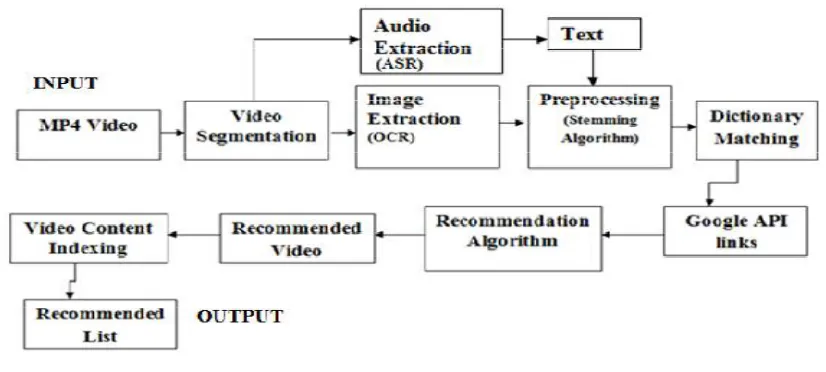
Following gives the description of blocks used in system architecture.
Slide Video Segmentation: Video browsing can be achieved by segmenting video into representative key frames.
video OCR, visual concept detection, etc.In the next step, the entire slide video is analysed.It will try to capture every knowledge change between adjacent frames,for which it established an analysis interval of three seconds by taking both accuracy and efficiency into account.It means that segments with duration less than three seconds maybe discarded in this system. Since there are every few topic segments shorter than three seconds,this setting is therefore not critical. In next step each slides stores as image in the backend database for OCR algorithm processing.Where we can extract text from each and every image which is considered as key segment.
OCR Algorithm: Text content given in thelecture slides are closely related to the lecture content ,which can thus
provide important information for the retrieval task of information .In the proposed framework, we developed a novel video OCR system for gathering video text. This Propose system uses OCR algorithm to extract text from images and store extracted text in database which we can use further.
Information Pre-Processing: From extracted text irrelevant keywords are remove by comparing predefine
keyword list and stop words can also remove by using Stemming algorithm .These extracted keywords are used for multimedia query search process for matching.
_ Multimedia Query Search _ Query Analysis
Query analysis helps to find the informative keyword for searching corresponding media data using multimedia search engines. The main objective of this process is to find the stem word which is considered as the informative keyword. System using an algorithm called stemming algorithm which removes stop-words make data efficient to use. Stemming algorithm is generally used to remove the stopwords which can be applied as follows:The first step is to consider the given query and initialize the empty variable of string data type.Split the query based on the space between them and pass them into array list of string type. Initialize for loop and remove the stop-words i.e., a, and, an, in, be, for and soon by passing the words in the array list. continue the process until length of the array list.Pass the remaining words into empty string variable initialized in step 1.Finally use the obtained words as informative keyword for search and vertically collect the media data.
Recommendation and Indexing: The next component of our model is Recommendation and Indexing. In this
module the given question is judged whether it requires any media data or it requires only textual answer. Here system will categorize mainly into four types such as text, text and image, text and video, text and image and video based on the given query. For those question which require media data such images and videos.
Figure 1. Overall Architecture of System
IV.EXPERIMENTALSETUP
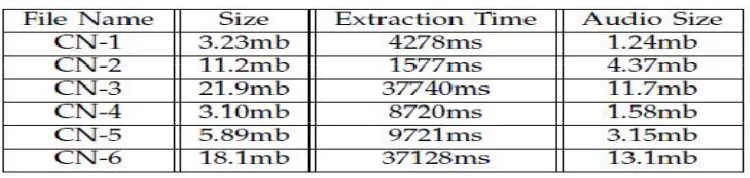
This section gives the results of Video To Audio Details.
Experimental Setup:For the experiment, we take computer network(CN) videos as a input initially.We are considering
this computer network videos for dataset.This dataset are freely available.All experimentation is performed using Pentium Dual Core processor and 1 GB RAM. The operating system is windows XP.We are using Java for programming.This will give the results of multimedia retrieval as follows.
TABLE 1 Video to Audio
Table 1 presents video files along with their size in MB and then give us the extracted audio files along with size in MB. It is done with the help of OCR algorithm.
TABLE 2 Audio to Text
Table 2 presents audio files along with their size in MB and then it convert that audio files to text using ASR algorithm. And gives the total time for audio to text conversion and also the total extracted words.
TABLE 3 Precision And Recall values
V. SIMULATIONRESULTS
Figure 2. Preprocessing of video file
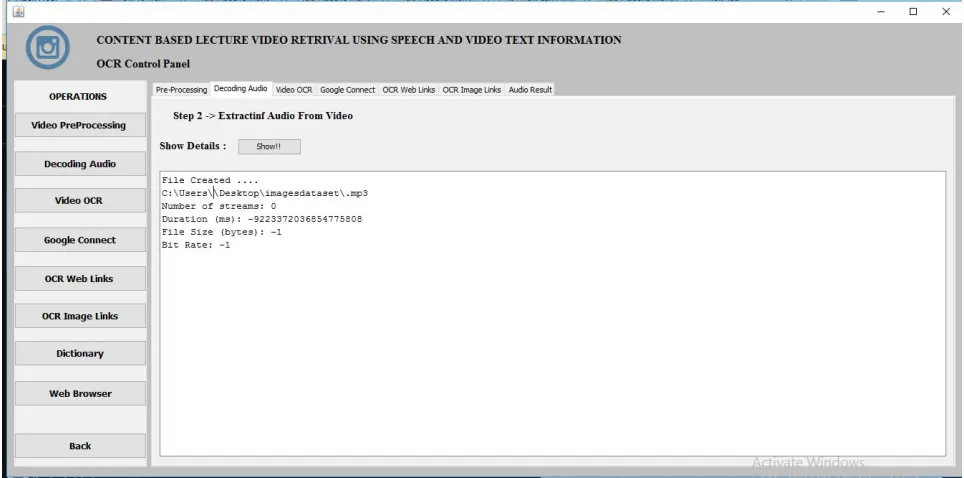
In the execution of system first we decode the video using Xuggler api.Then after interval of every 50 sec we save images from video and provide it to OCR algorithm.
Figure 3. Audio extraction from video file.
Figure 4. Extraction of text from images
Now we will extract text from images using OCR technique.we also removed duplicate words from the content and used porter stemming algorithm to remove stopwords .we maintained a dictionary of unique words.
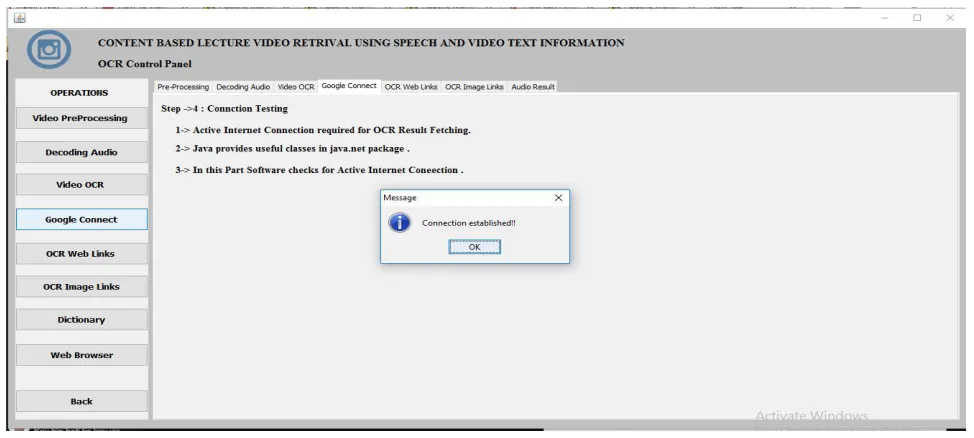
Figure 5. Connect google to get OCR web and images links.
We require google connection to get OCR web links and OCR image links.also system will can recommend different other videos and links and images related to intended video which are rated by other users of system which can be useful to current user to fulfil information requirement.
VI.CONCLUSIONANDFUTUREWORK
to OCR algorithm for text extraction. Both of these algorithms give highly accurate results within less computation time .In future we plan to make use of more efficient and usable algorithms to separate audio from video ,to extract text from audio and video segments and to divide video in multiple segments to choose key-frames among them.We can increase the number of nodes and analyze the performance.
REFERENCES
1. Haojin Yang and Christoph Meinel, “Content Based Lecture Video Retrieval Using Speech and Video Text Information”,IEEE Transactions On Learning Technologies,Vol.7,No.2 April-June.
2. E. Leeuwis, M. Federico and M. Cettolo, “Language modeling and transcription of the ted corpus lectures”,in Proc. IEEE Int.Conf. Acoust.,Speech Signal Process ,pp. 232235,2003.
3. D. Lee and G. G. Lee, “A korean spoken document retrieval system for lecture search”,in Proc. ACM Special Interest Group Inf. Retrieval Searching Spontaneous Conversational Speech Workshop,2008.
4. W.Heurst,T.Kreuzer,and M.Wiesenhutter, “A qualitative study towards using large vocabulary automatic speech recognition to index recorded presentations for search and access over the web”,in Proc. IADIS Int. Conf.WWW/Internet,pp.135143,2002.
5. A. Haubold and J. R. Kender, “Augmented segmentation and visualization for presentation videos”,in Proc. 13th Annu. ACM Int. Conf. Multimedia,pp. 5160,2005.
6. James Glass,Timothy J. Hazen,Lee Hetherington and Chao Wang, “Analysis and Processing of Lecture Audio Data: Preliminary Investigations”,in Proc. HLT-NAACL Workshop Interdisciplinary Approaches Speech Indexing Retrieval,pp.912,2004.
7. G. Salton and C. Buckley, “Term-weighting approaches in automatic text retrieval”,Inf. Process. Manage., vol. 24, no. 5,pp. 513 523,1988. 8. B. Epshtein, E. Ofek, and Y. Wexler, “Detecting text in natural scenes with stroke width transform”,in Proc. Int. Conf. Comput. Vis. Pattern
Recog.,pp. 29632970,2010.
9. C. Meinel, F. Moritz, and M. Siebert, “Community tagging in tele-teaching environments”, in Proc. 2nd Int. Conf.e-Educ.,e- Bus.,e-Manage and E-Learn,2011.
10. M. Grcar, D. Mladenic, and P. Kese, “Semi-automatic categorization of videos on videolectures.net”, in Proc. Eur. Conf. Mach. Learn. Knowl. Discovery Databases ,pp.730733,2009.
11. H. Yang, B. Quehl, and H. Sack, “A framework for improved video text detection and recognition” ,Multimedia Tools Appl.,pp.129,2012. 12. J. Eisenstein, R. Barzilay, and R. Davis, “Turning lectures into comic books using linguistically salient gestures” ,in Proc. 22nd
Nat.Conf.Artif.Intell.,1,pp.877882,2007.
BIOGRAPHY
Miss. Surabhi Dilip Pagar has received B.E degree in Information Technology from NDMVP COE, Nasik. She is
currently pursuing Master Degree in Computer Engineering at SVIT, Chincholi ,Nasik, India .Her research interest includes Data Mining ,DBMS.
Prof. Gorakshnath J. Gagare presently working as assistant professor in the Department of Computer Engineering at