University of Windsor University of Windsor
Scholarship at UWindsor
Scholarship at UWindsor
Electronic Theses and Dissertations Theses, Dissertations, and Major Papers
2012
Mining Multiple Web Sources Using Non-Deterministic Finite State
Mining Multiple Web Sources Using Non-Deterministic Finite State
Automata
Automata
Mohammad Harun-Or-Rashid University of Windsor
Follow this and additional works at: https://scholar.uwindsor.ca/etd
Recommended Citation Recommended Citation
Harun-Or-Rashid, Mohammad, "Mining Multiple Web Sources Using Non-Deterministic Finite State Automata " (2012). Electronic Theses and Dissertations. 4814.
https://scholar.uwindsor.ca/etd/4814
This online database contains the full-text of PhD dissertations and Masters’ theses of University of Windsor students from 1954 forward. These documents are made available for personal study and research purposes only, in accordance with the Canadian Copyright Act and the Creative Commons license—CC BY-NC-ND (Attribution, Non-Commercial, No Derivative Works). Under this license, works must always be attributed to the copyright holder (original author), cannot be used for any commercial purposes, and may not be altered. Any other use would require the permission of the copyright holder. Students may inquire about withdrawing their dissertation and/or thesis from this database. For additional inquiries, please contact the repository administrator via email
Mining Multiple Web Sources Using Non-Deterministic
Finite State Automata
By
Mohammad Harun-Or-rashid
A Thesis
Submitted to the Faculty of Graduate Studies Through Computer Science
in Partial Fulfillment of the Requirements for the Degree of Master of Science
at the University of Windsor
Windsor, Ontario, Canada
2012
Mining Multiple Web Sources Using Non-Deterministic
Finite State Automata
by
Mohammad Harun-Or-Rashid
APPROVED BY:
______________________________________________ Dr. Ronald Barron
Department of Mathematics and Statistics
______________________________________________ Dr. Subir Bandyopadyhay
School of Computer Science
______________________________________________ Dr. Christie Ezeife, Advisor
School of Computer Science
______________________________________________ Dr. Ziad Kobti, Chair of Defense
School of Computer Science
iii
DECLARATION OF ORIGINALITY
I hereby certify that I am the sole author of this thesis and that no part of this thesis has been published or submitted for publication.
I certify that, to the best of my knowledge, my thesis does not infringe upon anyone’s copyright nor violate any proprietary rights and that any ideas, techniques, quotations, or any other material from the work of other people included in my thesis, published or otherwise, are fully acknowledged in accordance with the standard referencing practices. Furthermore, to the extent that I have included copyrighted material that surpasses the bounds of fair dealing within the meaning of the Canada Copyright Act, I certify that I have obtained a written permission from the copyright owner(s) to include such material(s) in my thesis and have included copies of such copyright clearances to my appendix.
iv
ABSTRACT
Existing web content extracting systems use unsupervised, supervised, and
semi-supervised approaches. The WebOMiner system is an automatic web content data
extraction system which models a specific Business to Customer (B2C) web site such as
“bestbuy.com” using object oriented database schema. WebOMiner system extracts
different web page content types like product, list, text using non deterministic finite
automaton (NFA) generated manually.
This thesis extends the automatic web content data extraction techniques proposed in the
WebOMiner system to handle multiple web sites and generate integrated data warehouse
automatically. We develop the WebOMiner-2 which generates NFA of specific domain
classes from regular expressions extracted from web page DOM trees’ frequent patterns.
Our algorithm can also handle NFA epsilon() transition and convert it to deterministic finite automata (DFA) to identify different content tuples from list of tuples. Experimental
results show that our system is highly effective and performs the content extraction task
with 100% precision and 98.35% recall value.
Keywords: Web mining, regular expression, non deterministic finite automata, B2C,
frequent pattern, deterministic finite automata, regular expression, DOM tree, Web
v
DEDICATION
This thesis is dedicated to my parents and family, for their support and encouragement
throughout my graduate studies.
This work also desiccated to Dr. C.I. Ezeife for her support, appreciation and generosity
vi
ACKNOWLEDGEMENTS
I would like to thank all those people who made this thesis possible and an unforgettable
experience for me. First of all, I would like to express my deepest sense of gratitude to my
supervisor Dr. Christie Ezeife who offered her continuous advice and encouragement
throughout the course of this thesis. I thank her for the systematic guidance and great
effort she put into my thesis. I am thankful to Dr. Christie Ezeife also for research
assistantship support and encouragement whenever I was in need.
I would like to express my very sincere gratitude to my internal reader Dr. Subir
Bandyopadyhay and external reader Dr. Ronald Barron for the support to make this thesis
possible. I acknowledge my gratitude to my committee chairman Dr. Ziad Kobti for the
absolute support for the thesis.
I am thankful to my colleagues Sabbir Ahmed, Yanal Ahmed, Tamanna Mumu and
vii
TABLE OF CONTENTS
DECLARATION OF ORIGINALITY ... iii
ABSTRACT ... iv
DEDICATION ... v
LIST OF TABLES ... x
LIST OF FIGURES ... xi
CHAPTER 1 - Introduction ...1
1.1 Information Extraction...3
1.1.1 Types of web page ...3
1.1.1.1 Unstructured pages ...3
1.1.1.2 Structured/semi-structured web page ...4
1.1.1.3 List page: ...5
1.2 Data types in data warehouse ...7
1.2.1 Historical data: ...7
1.2.2 Derived Data: ...7
1.2.3 Metadata: ...8
1.3 Application of Information Extraction ...8
1.3.1 Wrapper...8
1.3.2 Traditional Information Extraction versus Web Information Extraction ...9
1.3.3 Applications of web information extraction ... 10
1.3.3.1 Manually-Constructed IE Systems ... 11
1.3.3.2 Supervised IE System ... 12
1.3.3.3 Semi-supervised IE systems ... 13
1.3.3.4 Unsupervised IE Systems ... 14
1.4 Document Object Model ... 15
1.5 Finite Automata ... 17
1.5.1 Deterministic finite automata ... 17
viii
1.5.3 Regular Expression ... 20
1.6 Modeling Web Documents As Objects For Automatic Web Content Extraction ... 20
1.7 Mining Web Document Objects with Non-deterministic Finite Automata ... 22
1.8 Thesis problem statement ... 25
1.9 Thesis Contribution ... 25
1.10 Outline of thesis proposal ... 26
CHAPTER 2- Related work ... 28
2.1 Comparison Based Approaches ... 28
2.1.1 MDR: Mining web records from web page ... 29
2.1.2 DEPTA: Web data extraction based on partial tree alignment ... 33
2.1.3 Net: A system for extracting web data from flat and nested data records ... 38
2.2 Separator-based approach ... 42
2.2.1 BYU-Tool: Conceptual-Model-based data extraction from multiple-record pages ... 42
2.2.2 OMINI: A fully automated extraction system for the world wide web ... 44
2.2.3 ViNTs: Fully automatic wrapper generation for search engine ... 47
2.2.4 OWebMiner: Modeling web documents as objects for automatic web content extraction ... 52
2.2.5 WebOMiner: Towards Comparative Web Content Mining using Object Oriented Model. ... 57
2.3 Grammar-based approach ... 59
2.3.1 RoadRunner: Towards Automatic Data Extraction From Data-Intensive Web Site. ... 59
2.3.2 DeLa: Data extraction and label assignment for Web database. ... 63
CHAPTER 3 - Web content mining using non-deterministic finite state automata ... 68
3.1 Problem Addressed ... 68
3.2 Web content objects ... 70
3.2.1 Image content ... 70
3.2.2 Text content ... 70
3.2.3 Form content ... 71
3.2.4 Plug-in content ... 71
3.3 Challenges to solve the problem ... 71
3.4Problem domain ... 71
3.4.1 Extract pattern of content ... 74
3.4.2 Regular expression (RE) generation ... 76
ix
3.4.4 DFA generation ... 78
3.5 Proposed “WebOMiner-2” Architecture and Algorithm ... 79
3.5.1 PatternExtractor Module ... 82
3.5.2 Regular Expression Generator ... 87
3.5.3 NFAGenerator Module ... 95
3.5.4 DFA generator ... 99
3.5.5 DatabaseSchema generator ... 103
CHAPTER- 4 Evaluation of WebOMiner-2 System ... 105
4.1 Strength of WebOMiner-2 ... 105
4.2 Empirical evaluation: ... 109
4.3 Experimental Results ... 110
CHAPTER 5 - Conclusion and Future Work ... 111
5.1 Future Work ... 112
REFERENCES ... 113
x
LIST OF TABLES
Table 1: Generated regular expression from different B2C Website... 93
Table 2:Transition table of DFA ... 101
xi
LIST OF FIGURES
Figure 1: An unstructured web page (wikipedia.com) ... 4
Figure 2: A structured web page (bestbuy.com) ... 5
Figure 3:Result page generated by google search engine(google.com) ... 6
Figure 4: A general view of Information extraction System ... 10
Figure 5 : Labeled training example ... 12
Figure 6: SRV rule. ... 12
Figure 7: (a) Sample HTML file and (b) Graphical representation of sample HTML file ... 16
Figure 8: Graphical representation of parent-child relation of the DOM tree ... 16
Figure 9: Deterministic finite automata ... 18
Figure 10 : Non deterministic finite automata ... 19
Figure 11: Architecture of WebOMiner ... 24
Figure 12: A tag tree representation of a HTML page ... 30
Figure 13: Artificial tag tree ... 30
Figure 14: Comparison and combination of node ... 31
Figure 15: A HTML code segment and boundary coordinates... 34
Figure 16: Tag tree for HTML code in Figure 15 ... 35
Figure 17: Artificial tag tree ... 35
Figure 18: Iterative tree alignment with two iterations ... 36
Figure 19: (X) Tree matching and aligning and (Y) Aligned data nodes under in N1 ... 39
Figure 20: Data table for N4 and N5 ... 40
Figure 21: Data table for N2 and N3 ... 41
Figure 22: Tag path extracted from web document ... 48
Figure 23: OWebMiner() algorithm (Annoni and Ezeife, 2009) ... 54
Figure 24: DOM tree representation of positive page from "bestbuy.com" ... 56
xii
Figure 26: C-repeated pattern ... 65
Figure 27: An example of a pattern tree ... 66
Figure 28: Architecture of FA generator ... 73
Figure 29: (a) List web page from "bestbuy.com" and (b) List web page from "acm.com" ... 74
Figure 30: Product pattern encoded by HTML tag ... 75
Figure 31: RE generated from extracted pattern ... 76
Figure 32: RE generated from "futureshop.ca" ... 76
Figure 33: Unified RE ... 76
Figure 34: RE generated from "acm.com" ... 77
Figure 35: Generated RE is converted to NFA ... 78
Figure 36: Generated NFA is converted to DFA ... 78
Figure 37: Architecture of WebOMiner-2 ... 79
Figure 38: Main algorithm of WebOMiner-2 ... 80
Figure 39: Main algorithm of FA generator ... 82
Figure 40: Algorithm PatternExtractor ... 83
Figure 41: Algorithm parseHTML ... 83
Figure 42: Snapshot of “temp.xml” file ... 84
Figure 43: Algorithm tagOccurence() ... 85
Figure 44: Snapshot of “occurrence.data” ... 86
Figure 45 : Algorithm OccurenceCount() ... 87
Figure 46 : “<img>” tag in product block. ... 90
Figure 47: Source code of product header ... 91
Figure 48: “price” information in product block source code... 92
Figure 49: “brand” attribute in product block source code ... 92
Figure 50: “ProdNum” attribute in Product block source code ... 93
Figure 51: Algorithm generateRE() ... 94
Figure 52: Algorithm NFAGnerator() ... 95
xiii
Figure 54:Snapshot of generated NFA of each attribute ... 98
Figure 55: Structural view of alternation NFA of “(title|image)” ... 99
Figure 56 : Generated NFA ... 99
Figure 57: Algorithm Subset construction ... 100
Figure 58: Generated DFA ... 102
Figure 59: Algorithm DFA simulation ... 103
1
CHAPTER 1 - Introduction
The World-wide-web has become the source of a huge amount of information on the
internet due to explosive growth and popularity (Embley et al., 1999). Day by day
internet users are also increasing. There are different kinds of users including customers,
retailers, service companies, etc. They use the web for gathering detailed information.
And these are displayed by different web sites which are in heterogeneous formats. By
collecting and organizing this information, it is possible to produce metadata for many
applications. It is beneficial to create a huge collection of historical and derived data on
the products from different domains (business to Customer, research, library, etc.). These
historical and derived data could be used for different purposes such as shopping
comparisons, detecting user intention and further knowledge discovery. For example,
there is a huge number of online stores (B2C) selling their products through internet. It is
hard for customers to retrieve, analyze and compare products or their prices from online
stores. In order to get a product with the special attribute (for example: 56” LCD TV) and
lowest cost compared to other similar products, a user has to go through all the online
stores, which takes a lot of time. Annoni and Ezeife (2009) proposed an approach called
OWebMiner that represents web content as objects. They identified six object types
which include text, list, image, form, separator and structure. Mutsuddy and Ezeife
(2010), Ezeife and Mutsuddy (2013) proposed an approach called WebOMiner that is an
automatic web content data extraction technique which models web sites of a specific
domain as object oriented database schemas. For Business to Customer (B2C) web sites
such as "Bestbuy.com”, “Futureshop.com” ,"CompUSA.com", the WebOMiner system
2
advertisement information from multiple sources using content non-deterministic finite
automaton (NFA) it generated.
In this thesis, we study the problem of extracting information from web pages of different
domains (B2C, research, library etc.). The WebOMiner (Mutsuddy and Ezeife, 2010;
Ezeife and Mutsuddy, 2013) extracts web contents from B2C web sites. It uses NFA to
identify tuple from list of tuple that extracted from web pages DOM tree. There is still
need for automatic NFA generation for the object oriented schema for each web site or
data sources. Other shortcoming of their work is that they didn’t handle ambiguity and
epsilon () transition of NFA. This thesis extends the automatic web content data
extraction techniques proposed in the WebOMiner system. Our proposed approach is able
to generate automatic source database schema NFA of domain classes from frequent
patterns extracted from web pages DOM trees. By converting NFA into deterministic
finite automata (DFA), our algorithm handles ambiguity and epsilon () transition and
able to identify different tuples from list of tuples. Our proposed approach is also able to
generate integrated data warehouse schema automatically by using regular expression
generated from frequent pattern extracted.
In the following sections of this chapter, we introduce the problem of information
extraction from the web. The information extraction problem is discussed in detail in
section 1.1, section 1.2 describes data type, section 1.3 explains the information
extraction problem in the context of e-commerce, section 1.4 describes document object
model, section 1.5 explains finite automata, section 1.6 explains the idea of
3
The contributions of this thesis are briefly explained in section 1.8. We conclude the
chapter with the organization of this thesis in section 1.9.
1.1 Information Extraction
Information extraction (IE) is defined by Peshkin and Preffer (2003) as the task of filling
in template information from previously unseen text which belongs to a pre-defined
domain. Lerman et al. (2004) identify that IE task is defined by its input and its extraction
target whereas input can be categorized into two types, namely unstructured document
and semi-structured document. The main goal of information extraction is to extract
information automatically from data source such as entities, relationships between
entities and attributes describing entities from structured and semi-structured documents.
This information can be stored into the database for further knowledge discovery,
shopping comparisons and detecting user intentions. In this thesis, we consider
information extraction from semi-structured documents that are present on the web.
1.1.1 Types of web page
The World-wide-web can be called a vast repository of information. Data stored on the
web can be accessible by the user through search form or dynamically generated web
page. The World-wide-web consists of huge amounts of web pages which represent
different products (Buttler et al., 2001). Two different types of web pages can be
distinguished.
4
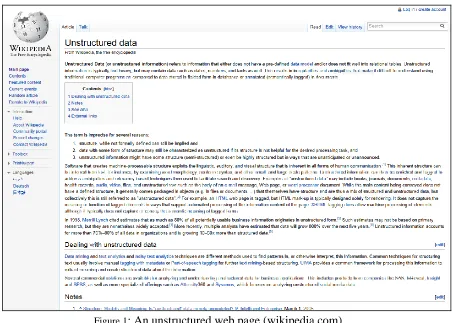
information extraction (IE) techniques can be applied with a certain degree of confidence.
For example, figure 1 represents an unstructured web page from “Wikipedia.org” which
contains only text and there is no template.
Figure 1: An unstructured web page (wikipedia.com)
1.1.1.2 Structured/semi-structured web page: Structured/Semi-structured pages are normally obtained from a structured data source, e.g., a database, and data are published
together with information on structure. The extraction of information is accomplished
using techniques based on wrapper generation, rule generation and automatic approaches.
Most of the web document formed by structured data such as text, image, hyperlink,
structured record such as list, table, and database generated content. This type of web
5
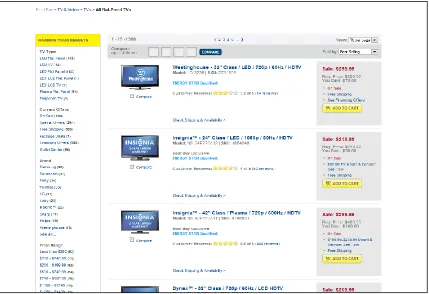
them in a HTML template. For example, Figure 2 represents a structured/semi-structured
web page which is a product list page from “Bestbuy.com”.
Figure 2: A structured web page (bestbuy.com)
1.1.1.3 List page: List pages are web pages that contain several structured records.
Generally, online stores display their different products with list pages. The data record
of list pages is important to create a historical and derived data warehouse with the
extracted data from it. For example, Figure 2 represents a list page from “Bestbuy.com”.
There are two types of list pages, vertically labeled list page and horizontally labeled list
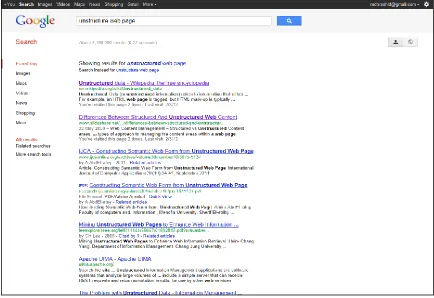
pages. Another type of list pages called result page produced by search engines with a
user query which is presented as a list or a table on an automatically generated page. For
example, Figure 3 represents a web result page which is generated by google search
6
using their own template. The template is generated using html tag. There is a query
working in the backend to fill the template and display data in the browser.
Figure 3:Result page generated by google search engine(google.com)
When a page is generated using a template, a common structure which is created with
html tag can be found in the source code of the page. For example, on a page displaying
10 laptops from different brands and prices, their presentation structures are the same
through the entire page. This structure can be assumed as a schema of the product.
Different domain specific web sites use different structures to display their products. For
example, the structure of a B2C web site is different from the structure of a library web
site. So, it is a big challenge to create a historical and derived data warehouse with
7
1.2 Data types in data warehouse
1.2.1 Historical data:Historical data is the data from previous time periods, in contrast
to current data (Singhal and Seborg, 2001). It is used for comparisons to previous periods
and trend analysis. The past information about a company can be extracted using
historical data, and it can
be used
to help forecast the company’s future, for example,“Given a product type and business name, output all promotion price offered by the
business within last 10 years”. This query extracts all the information about the product
until today’s date. And from it user can get idea about the promotional trend of this
product. Using historical data, we are able to extract information about a specific trend
about the sale price of a product which is sold by a B2C company. For example,
“Bestbuy.com” offers promotion on their product once a month. If we have a database
with historical database we are able to find the trend of the promotional price of any
particular product. The advantage is that user can decide about the right time to buy a
product.
1.2.2 Derived Data: Derived data types are those that are defined in terms of other data types, called base types (Botzer and Etzion, 1996). Derived data types contain attributes,
element or mixed content. They exist in data warehouse as built-in or user-derived. Base
types can be derived data types or primitive types. Restriction facets and extension are
used to create derived data types. A table exists in database can have derived columns,
which values are computed, based on the values of other table columns. It is called
a derived table, if all columns are derived. Derived data exists in the database as
aggregates such as count, sum, average, minimum, maximum which can be computed
8
month or how many times a company offer promotion on their product each year”. By
getting these two results user can get the idea about the promotional trend of a business to
a particular product.
1.2.3 Metadata: Metadata is structured information that describes an information resource and makes it easier to retrieve, use, or manage an information resource (Mize
and Habermann, 2010). Metadata is often known as information about information or
data about data. How the data is formatted and how and when and by whom a particular
set of data was collected, is described by metadata. Metadata helps to understanding
information stored in data warehouses. The telephone book is an example of metadata
that we are very familiar with, where we search for a telephone number using name or
location. Another example of metadata is the catalogue in a library, where we search for
information using "Subject", "Title" and "Author".
1.3 Application of Information Extraction
In recent years, a large number of architecture has been proposed for extracting
information from web pages. Three approaches are used, which are unsupervised
(automatic), supervised (manual) and semi-supervised. In this section we describe
different applications used in information extraction from web pages.
1.3.1 Wrapper
The process of information extraction uses a program which is called extractor or
wrapper (Adleberg, 1998). The information integration system considers a wrapper as a
9
sources. An information source (e.g., database server, web server) is wrapped by a
program and the integration system able to access that source without changing its core
mechanism. When the web server is considered as information source, then, the wrapper
uses HTTP protocols to query the web server to collect the resulting pages, extract
content from HTML documents, and after that integrates with other data sources.
Wrappers are used in information extraction from web sites and consist of a series of
rules and some codes to apply those rules and are specific to a source. Some examples of
existing wrappers are WIEN (Kushmerick et al., 1997), SOFTMEALY (Hsu and Dung
1998) STALKER Muslea et al., 1999) etc.
1.3.2 Traditional Information Extraction versus Web Information Extraction
Information extraction from web is different from traditional information extraction (IE)
(Appelt and Israel, 1999). In traditional IE, data are extracted from totally unstructured
free texts that are written in natural language. But information extraction from web
processes structured data which are online documents and the server-side application
program generates it automatically. Usually, Web IE task is performed by machine
learning approach (Soderland, 1999), pattern or rule mining techniques (Chang and Lui,
2001; Wang and Lochovsky, 2002; Chang et al., 2003) to extract the data from different
10
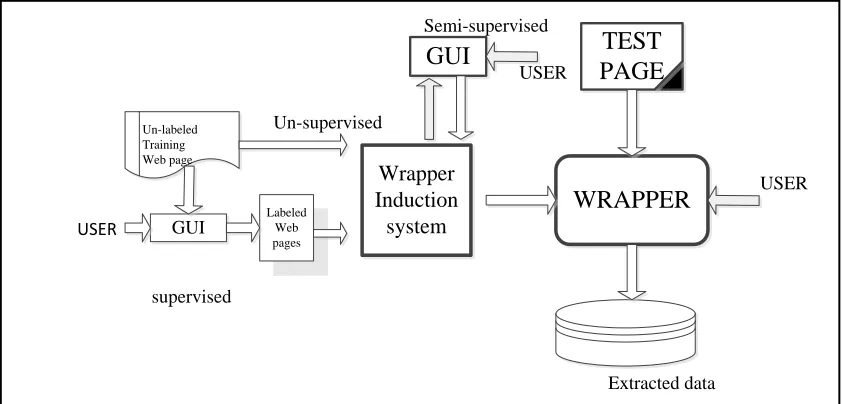
Figure 4: A general view of Information extraction System
1.3.3 Applications of web information extraction
The wrapper Induction (WI) generates wrapper (Wang and Lochovsky, 2002) or
information extraction (IE) systems (Kushmerick et al., 1997). Wrapper works as pattern
matching procedure (e.g., a form of finite-state machine) which depends on a set of
extraction rules. A wrapper generated by wrapper induction is used to extract the
information from target resources. In the earlier system, wrapper generation was manual
process where programmer was involved in writing extraction rule whereas later systems
are automatic rule generalization process based on machine learning. In wrapper
induction process, user writes extraction rules manually to labeling target extraction data.
Current wrapper induction systems are created with unlabeled training example. The
wrapper induction system can be categorized into four groups, include
manually-constructed IE system (Hammer et al.,1997;Crescenzi and Mecca,1998; Arocena and
Mendelzon, 1999; Liu et al.,2000; Saiiuguet and Azavant, 2001), supervised IE Systems
(kushmerick et al., 1997;Califf and Mooney.,1998; Muslea et al., 1999; Soderland, 1999),
Wrapper Induction
system
WRAPPER TEST PAGE GUI
Un-labeled Training Web page
GUI LabeledWeb pages
Extracted data
USER
USER
Un-supervised
Semi-supervised
supervised
11
Semi-supervised IE Systems(Chang and Lui.,2001; Chang and Kuo,2004; Hogue and
Karger, 2005), and unsupervised IE Systems (Arasu and Gracis-Molina,2003; Wang and
Lochovsky 2003; Zhai and Liu, 2005).
1.3.3.1 Manually-Constructed IE Systems
In manually-constructed IE system, user creates wrapper program using general
programming language like Perl or special-designed language for each web site. This
approach is considered as time consuming and labor intensive procedure because it
requires the user to have strong computer and programming background. Some existing
systems are TSIMMIS (Hammer et al., 1997), Minerva (Crescenzi and Meca, 1998),
WEBOQL (Arocena and Mendelzon, 1998), W4F (Saiiuguet and Azavant, 2001) and
XWRAP (Liu et al., 2000). Methods in this approach simplify the construction of data
extraction system by using some languages. In this approach the user are involved with
manually construct data records pattern for the extraction target. For example, TSIMMIS
is one of the first approaches that build web wrappers manually (Hammer et al., 1997). In
this approach, a wrapper takes a specification file as input that declaratively states by
programmers, where the data to extract is located on the pages and how the data should
be grouped into objects. Since manual approaches are not scope of this thesis, we do not
discuss more details. Reader interested may refer to Minerva (Crescenzi and Meca,
1998), WEBOQL (Arocena and Mendelzon, 1998), W4F ( Saiiuguet and Azavant, 2001)
12
1.3.3.2 Supervised IE System
Supervised systems extract data by using a set of web pages labeled with examples and
generate wrapper. As an example, the extraction rule for the book title is shown in Figure
5, which contains words “Book”, “Name”, and “</b>”, and immediately followed by the
word “<b>”. The title consists of at most two words that were labeled as “nn” or “nns” by
the POS tagger is specified by the “Filler pattern”. User provides an initial set of labeled
examples and the system may require additional pages for the user to label. Instead of
programmers, the user can be trained the system to reduce the cost of wrapper generation,
Figure 5 : Labeled training example
Such systems are RAPIER (Califf et al., 1998), WHISK (Soderland, 1999), SRV
(Kushmerick et al., 1997) and STALKER (Muslea et al., 1999). The methods of this
approach use machine learning techniques to learn and construct wrappers from human
labeled examples.
Figure 6: SRV rule.
Extraction rule of Book Title:
Pre-filter pattern Filter pattern Post-filter pattern
(1) Word: Book list: len: 2 Word:<b>
(2)Word: Name Tag: [nn, nns]
(3) Word: </b>
Extraction rule of rating
Length(=1)
13
The supervised system SRV (Kushmerick et al., 1997). is a top-down relational
algorithm that generates single-slot extraction rules. It considers IE as a kind of
classification problem. First, it tokens the input documents and all substrings of
continuous tokens such as text fragments are labeled as either positive examples or
negative examples. SRV generates rule which are logic rules that based on a set of
token-oriented features or predicates. These features are two types: simple and relational. A
simple feature describes a function that maps a token with some discrete value such as
length, character type (e.g., numeric), orthography (e.g., capitalized) and part of speech
(e.g., verb). A relational feature maps a token to another token, for example, the
contextual tokens of the input tokens. The learning algorithm works as FOIL, starting
with entire set of examples and adds predicates greedily to cover as many positive
examples and as few negative examples as possible. Supervised approaches are not scope
of this thesis. Reader interested refer to RAPIER (Califf et al., 1998), WHISK
(Soderland, 1999) and STALKER (Muslea et al., 1999).
1.3.3.3 Semi-supervised IE systems
Semi-supervised system accepts a rough example from users to generate extraction rule.
Semi-supervised IE systems include IEPAD (Chang et al., 2001), OLERA (Chang et al.,
2004) and THRESHER (Hogue and Karger, 200). In this approach, the user uses GUI to
specify the extraction targets because no extraction targets are specified for such systems
after the learning phase. User’s supervision is involved in this approach. The IEPAD
(Chang et al., 2001) is one of the first semi-supervised IE systems that generalize
extraction patterns using unlabeled web. It does not require any labeled training page and
14
to be extracted. This method developed based on the observation is that if a web page
contains multiple data records to be extracted, they are often rendered regularly using the
same template for good visualization. IEPAD generate wrappers by discovering repetitive
patterns. IEPAD discovers repetitive patterns in a web page using a data structure called
PAT tree which is a binary suffix tree. The suffix tree only records the exact match for
suffixes, IEPAD aligns multiple strings which start from each occurrence of a repeat and
end before the start of next occurrence by applying center star algorithm.
Semi-supervised approaches are not scope of this project. Reader interested refer to IEPAD
(Chang et al., 2001), OLERA (Chang et al., 2004) and THRESHER (Hogue and karger,
2005).
1.3.3.4 Unsupervised IE Systems
The labeled training examples are not required in unsupervised IE systems. It extracts
information from the web by training the system with example. It also does not have any
user interactions to generate a wrapper. Unsupervised IE systems include RoadRunner
(Crescenzi et al., 2001), EXALG (Arasu and Garcis-Molina, 2003), DeLa ( Wang and
Lochovsky, 2003) and DEPTA (Zhai and Liu, 2005). The RoadRunner and EXALG
solve page-level extraction task, while DeLa and DEPTA are related to record-level
extraction task. The difference between supervised and unsupervised system is that the
extraction targets are specified by the users in supervised system and the data that is used
to generate the page or non-tag texts in data-rich regions of the input page is defined as
extraction target. In this approach the schema is choose by the users. Since all data are
not needed, the user needs to do the post-processing work to select relevant data and give
15
pattern discovery. The main advantages of these methods include methods do not require
separate training, validation and application phases (Breuel, 2003). And these methods
can be divided into two categories including based on string matching and based on
HTML tree matching. It has been shown that automatic pattern discovery methods based
on HTML tree matching are outer perform than the string matching approaches
(Yeonjung, 2007). We describe technical details of the above approaches in section 2.
1.4 Document Object Model
The Document Object Model (DOM) is an application programming interface (API) for
well-formed XML documents and valid HTML documents (Marini, 2002). The logical
structure of XML or HTML documents is described by DOM and also defines the way a
document is accessed and manipulated. XML represents many different kinds of
information that may be stored in diverse systems and presents this data as documents,
and the DOM may be used to manage this data. With the Document Object Model, it is
possible to represent a HTML file as documents, navigate their structure, and add,
modify, or delete elements and content. The elements of an HTML or XML document
can be accessed, changed, deleted, or added using the Document Object Model. The
HTML DOM represents an HTML document as a tree-structure. The tree structure is
viewed as a node-tree and all nodes can be accessed through the tree. The contents of
node tree can be modified or deleted, and new elements can be created. The node tree is
shown in figure 7, the set of nodes, and the connections between them. The root node is
the starting point and branches out to the text nodes at the lowest level of the tree. The
16
<html> <head> <title>My Title</title> </head> <body><a href =” “>My link</a> <h1>My header</h1> </body> < /html> Document Root Element: <html> Element: <head> Element: <title> Text: “My title” Text: “My header” Text: “My Link” Attribute: “href” Element: <a> Element: <h1> Element: <body>
Figure 7: (a) Sample HTML file and (b) Graphical representation of sample HTML file
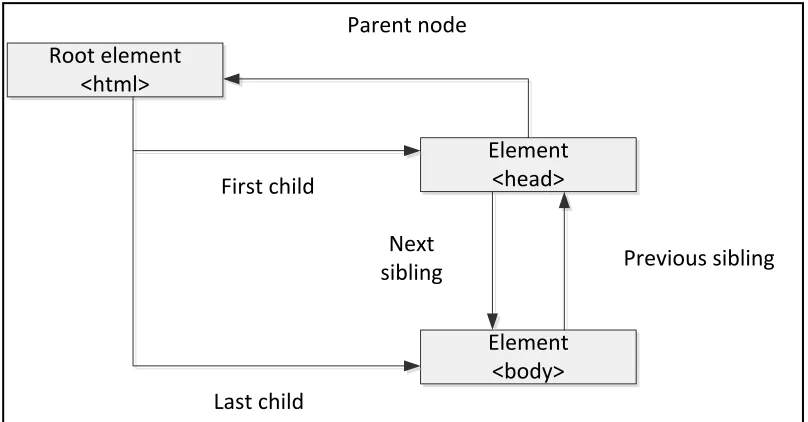
is described using the terms parent, child, and sibling. Parent nodes have children node
and Children on the same level are called siblings. The top node of node tree is called the
root. Every node has exactly one parent node except the root node. A node can be
contained any number of children. A leaf node does not have children. Siblings are nodes
which reside under the same parent. Figure 8 is shown the parent-child relationship.
Figure 8: Graphical representation of parent-child relation of the DOM tree
Root element <html> Element <head> Element <body> Parent node First child Last child Next
17
1.5 Finite Automata
Finite automata is a mathematical model which is a combination of 5 tuples (Q, q0, A, ∑,
) (Cormen, 2009), where Q represents a finite set of states, the start state is q0 Q, A
Q is a distinguished set of accepting states, ∑ is a finite input alphabet, represents a
function from Q x ∑ into Q, called the transition function. The finite automaton starts
with state q0 and it visits to the next state by reading input string one at a time. For
example, if the location of the automata is in state q and reads input character “a”, it
moves from state q to state (q, a) by making a transition. The generated finite state
machine M accepts an input string if it reached at final state. Otherwise input is rejected.
A finite automata M defines a function called (finite state function) from ∑ to Q such
that (w) is reached at the state M after reading the string “w”. Thus, the finite automata
M accepts a string w if and only if (w) A. The function scan input string recursively
by using transition function. Finite automata are two types include deterministic finite
automata (DFA) and non-deterministic finite automata (NFA). These are described below
1.5.1 Deterministic finite automata
A deterministic finite state automaton (DFA), also known as deterministic finite state
machine that accepts or rejects finite strings of symbols (Cormen, 2009). It produces a
unique computation of the automaton for each input string. The word 'Deterministic'
refers to the uniqueness of the computation. The states of DFA are fixed and state can be
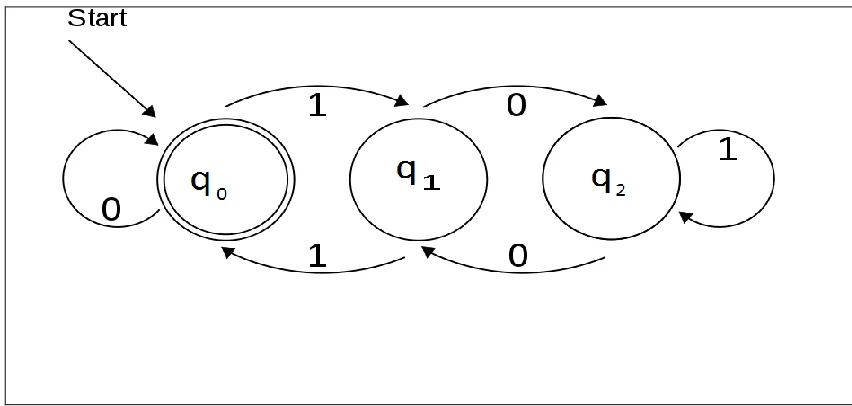
visited one state at a time. An example of deterministic finite state automata is shown in
18
Figure 9: Deterministic finite automata
Figure 9 illustrates a deterministic finite automaton using state diagram. In the
automaton, there are three states: q0, q1, and q2 denoted by circles. The automaton takes
0s and 1s as input. For each state, there is a transition arrow leading out to a next state for
both 0 and 1. A DFA jumps deterministically from a state to another by following the
transition arrow by reading input symbol. For example, if the automaton is currently in
state q0 and current input symbol is 1 then it deterministically jumps to state q1. A DFA
has a start state which is denoted graphically by an arrow coming in from nowhere where
computations begin, and a set of accept states which is denoted graphically by a double
19
1.5.2 Non-deterministic finite Automata
A non-deterministic finite automaton (NFA) is a finite state machine where from each
state using a input symbol the automaton may jump into several possible next states
(Cormen, 2009). The difference between deterministic finite automaton (DFA) and
non-deterministic finite automata is that next possible state is uniquely determined in DFA but
not in NFA. Although the DFA and NFA are not similar by definition, a NFA can be
translated to equivalent DFA using power set construction, which means that the
constructed DFA and the NFA recognize the same formal language. Both of them
recognize only regular languages.
Figure 10 : Non deterministic finite automata
A non-deterministic finite automaton is shown in Figure 10 using state diagram. Here q0
is the initial state and q1 is the final sate. It is non-deterministic because the state q0 has
more than one state to move. For every NFA, there is a deterministic finite
automaton (DFA) can be found that accepts the same language. Therefore it is possible to
20
1.5.3 Regular Expression
A regular expression provides a concise and flexible means to specify and
recognize strings of text, such as particular characters, words, or patterns of characters.
The regular expression can be considered as compact notation for describing string. The
regular expression follows some rules, which are given below:
• (Epsilon) is a regular expression that denotes {}, the set containing empty
string.
• If 'a' is a symbol in , then 'a' is a regular expression that denotes {a}, the set
containing the string a.
• Suppose q and r are regular expressions denoting the language L(q) and L(r), then
– (q) | (r) is a regular expression denoting L (q) L(r).
– (q)(r) is regular expression denoting L (q) L(r).
– (q) * is a regular expression denoting (L (q) )*.
– (q) is a regular expression denoting L (q).
1.6 Modeling Web Documents As Objects For Automatic Web Content
Extraction
Annoni and Ezeife (2009) proposed a framework called OWebMiner which presents web
document as object-oriented web data model to represent web data as web content and
web presentation objects. The proposed framework is able to mine complex and
21
three main zones of a web document as instances of specialized classes include
HeaderZone, BodyZone and FooterZone. They state that two types of objects exist in
these zone including web content objects and web presentation objects. They classified
the web content into six categories among them four have sub-content type including text
element, image element, form element, plug-in element, separator element and structure
element. Text element has two sub content-types including raw text and list text. Raw
text has three sub content types including title, label, and paragraph. List text has two
content types including ordered list and definition list. Image element has two
sub-contents like image and map. Form element has three sub content types which are form
select, form input and form text area. The authors classified the web presentation object
into six categories which are banner, menu, interaction, legal information, record and
bulk. Their proposed algorithm takes a set of HTML files as input. The algorithm works
in two sub algorithms. In the first part, it extracts web presentation object and web
content object sequentially. And in the second part, it stores the extracted objects into the
database. The first part of this algorithm is divided into three steps. In the first step, a
DOM tree is generated from the HTML file using DOM parser. In the second step, web
zones are identified on the web document from the DOM tree. In the third step, web
content object and web presentation objects are extracted. In this algorithm, block level
tag include table, division, heading, list, form, block quotation, paragraph and address
and non block level tag include anchor, citation, image, object, span, script are
considered to extracted object. Two search approaches used in OWebMiner to explore
22
block level tag. Breadth-first search is executed to parse non block level tag. We discuss
technical details of their approach in section 2.
1.7 Mining Web Document Objects with Non-deterministic Finite
Automata
Mutsuddy and Ezeife (2010), Ezeife and Mutsuddy (2013) proposed a system for
extraction and mining of structured web contents based on object-oriented data model.
Their work extended the work of Annoni and Ezeife (2009). They developed the
architecture called WebOMiner using object oriented model for extraction and mining of
web contents. They introduced an approach of generating and using non deterministic
finite state automata for mining web content objects. They defined data block and data
regions to ensure consistency between related data. They addressed to relate HTML tag
attribute information with related contents to ensure identification of contents, to assign
objects and other information together. They defined schema matching to unify similar
contents from different web site. They identified noise contents in data blocks and
prevent them entering into database table. They also implemented and materialize
object-oriented data model for web content and extract heterogeneous related web content
together. They defined a mining algorithm that identifies data block and generates
non-deterministic finite state automata based wrapper for extraction of related contents. They
classified all data blocks of a web page according to their type and check minimum
occurrence count based on observed pattern to ensure data consistency before entering
them into database. For example, minimum occurrence count for a ‘list’ content can be 3,
which means that to be accepted as list tuple record in the DOM tree it should have at
23
automatic object oriented web content extraction and mining system for integrating,
mining heterogeneous contents that are also derived, historical and complex for deeper
knowledge discovery. The WebOMiner extracts information from a given web page
including data records (e.g. product image, product brand, product id, short description
and price of the product), navigation information (e.g. link URL, link id or name),
advertisement (e.g. product advertised, image, URL links to related website). After
extraction, WebOMiner stores this information into database for comparative mining and
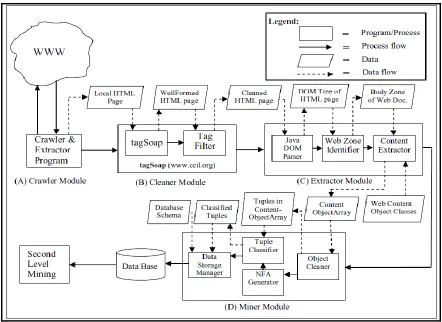
querying. Their proposed approach contains four modules include Crawler Module,
Cleaner Module, Content Extractor Module and Miner Module. The proposed crawler
module crawls the WWW to find targeted web page given as input. This module creates a
mirror of original web document after streaming the entire web document including tags,
texts and image contents. The comments are discarded from the HTML document by this
module. The cleaner module converts the generated HTML file to well formed by
inserting the missing tag, removing inline tag ( e.g. <br/>, <ht/>), insert missing “/” at the
end of unclosed <image> tag, clean up unnecessary decorative tags. The content extractor
module creates DOM tree from HTML page and contents are extracted from the DOM
tree in this module. This module assigns respective class object type as per pre-defined
object class to the content. It also puts objects into Array List after setting information
into objects. Data regions and data blocks are identified by this module and it segments
the respective data of a data block from other data blocks by using separator objects. This
module also generates Seed NFA pattern for data blocks. It stores identical tuples after
extracting objects of all tuples by matching with the refined NFA. It stores the objects
24
categories (e.g., for list, form, product, text etc. tuples). We describe technical details of
this approach in section 2.
Figure 11: Architecture of WebOMiner
The shortcoming of this approach is that although this method uses an NFA algorithm for
identifying tuples of web objects, the mechanism for using NFA algorithm for automatic
identification of different content types is not fully integrated in the current system. Also,
their NFA is built based on manual observation of ten different B2C web pages for
identifying content types from content list. They use manually generated database schema
for storing content into database. The authors didn’t mention how the “ɛ” transition or
25
for identifying tuple without convert it to DFA. In this approach, the database schema
generation is manual process which is labor intensive and not efficient. The authors
didn’t define schema integration for different domain specific website.
1.8 Thesis problem statement
This thesis addresses the limitation of WebOMiner (Mutsuddy and Ezeife, 2010; Ezeife
and Mutsuddy, 2013) which are given below:
1. The mechanism for using NFA algorithm for automatic identification of different
content types is not fully integrated in the current system.
2. Existing NFA is built for identifying content types based on manual observation
of ten different B2C web pages.
3. The “ɛ” transition or ambiguity of NFA was not handled.
4. In the current system, the database schema generation is manual process which is
labor intensive and not efficient.
5. Current system does not define schema integration for different domain specific
website.
1.9 Thesis Contribution
In this research we developed an algorithm that extends the WebOMiner (Mutsuddy and
Ezeife, 2010; Ezeife and Mutsuddy, 2013).
1. Our proposed algorithm finds the frequent pattern matching structure from DOM
26
matching structure to discover repeated objects (list, product, text etc.) in the
page. Finally, RE (regular expression) is formed from the discovered pattern
structure and NFA wrappers are generalized from RE. Our proposed framework
handles the “ɛ” transition by converting NFA to DFA (deterministic finite
automata) and produces DFA to the miner module of the WebOMiner to identify
objects tuple from the list of objects.
2. Our proposed algorithm also generates database schema automatically to store
different types of web content objects (list, text, product etc.) into the database.
Database schema is generated using generated regular expression based on the
frequent pattern matching structure exists on the DOM tree of the list web page.
3. Since different B2C web source follows different sequence pattern to represent
content object. Our algorithm generalizes DFA from different web sources.
1.10 Outline of thesis proposal
The remainder of the thesis is organized as follows:
Chapter 2: Related literature in the area is presented. We have identified problems which
are related to the problem studied in this thesis. We categorized these problems in three
sections and each section explains the related work done in these problems and surveys
the various solutions proposed. Different works are compared in this section and we tried
27
Chapter 3: Detailed discussion of the problem addressed and new algorithms are
proposed
Chapter 4: Explain performance analysis and the experiments conducted in detail.
Chapter 5: Concludes this thesis by explaining the work done. The contribution of this
28
CHAPTER 2- Related work
In this chapter, we survey the literature related to the shortcoming addressed in this thesis
include web content mining and how to bring web content from different web sites into a
unique format. There are several studies has been made on web content mining. They are
categorized into four categories: manual approach, supervised approach, semi-supervised
and unsupervised approach. Supervised or manual approach uses wrapper which is
generated using a set of web pages labeled with examples of the data to be extracted.
Wrapper generation requires a set of data extraction rules which are generated manually
from labeled pages. Manual labeling of pages is labor intensive and time consuming
because different templates exist in different sources. Semi-supervised approach accepts
a rough training example from user and generates extraction rule. Unsupervised or
automatic approach generates wrapper without much user interaction. Since unsupervised
approach performs better than other three, we only consider unsupervised approaches in
this section. And our thesis extends the work of Mutsuddy and Ezeife (2010), Ezeife and
Mutsuddy (2013) which is an unsupervised approach. We present previous studies which
are broadly related to unsupervised or automatic web content mining. We categorized
these techniques based on the techniques for data area identification and record
segmentation including comparison-based, grammar-based and separator-based.
2.1 Comparison Based Approaches
These approaches find commonalities and identify records by comparing page fragments.
29
Another comparison based approach called DEPTA (Zhai and Liu, 2005; Zhai and Liu,
2006) which uses a tree edit distance. NET (Liu and Zhai, 2005) uses a tree edit distance
as well but collapses shared subtrees. We describe technical details of these approaches in
the following section.
2.1.1 MDR: Mining web records from web page
Liu et al. (2003) addressed the problem of mining data records in web page using the
existing approaches. They identified three types of existing approaches include manual,
supervised learning and automatic techniques. They mentioned that manual approach is
not useful for large number of pages, supervised techniques need training data which are
prepared manually and for that reason it requires substantial human effort. They also
mentioned that existing automatic approach provides unsatisfactory result due to their
poor performance. The authors propose a new approach called MDR which is based on
two observations. Firstly, a group of data records form a contiguous region of a page and
within the data region the data records have similar tag tree structure. Secondly, the data
records of a data region have the same parent node. The proposed technique works on
three steps. In the first step, it builds a tag tree with HTML tag of the source page. For
example, a tag tree of HTML page is shown in Figure 12. In the second step, it mines
every data region that contains data records. In this step, first it mines generalized nodes
which form a data region based on two properties include the nodes all have the same
parent and the nodes are adjacent. For example, Figure 12 presents two generalized nodes
where the first 5 TR nodes of the TBODY consist by the first data region and second the
30
region by string comparison between generalized nodes. For example, Figure 13
represents an artificial tag tree to explain different kinds of generalize nodes and data
region. The generalized node is represented by the shaded area. The nodes 5 and 6
HTML HEAD BODY TABLE TABLE P TBODY TR
TR TR TR TR TR
TR TR TR TR TR TD
TD TD TD TD
TD TD TD TD TD
TD TD TD TD TD TDTD
TD
DATA RECORD 1
DATA RECORD 2
Figure 12: A tag tree representation of a HTML page
formed the data region labeled 1 and their length is 1. The nodes 8, 9 and 10 formed the
data region labeled 2 and their length is 1. The pairs of nodes (14, 15), (16, 17) and
(18,19) formed the data region labeled 3 and their length is 2. These generalized nodes
formed the data region based on the edit distance properties which is that the normalized
edit distance between adjacent generalized nodes is less than fixed thresholds.
1 9 3 4 2 9 8 7 6 5 10 11 12
13 14 15 16 17 18 19 20
Region 1 Region 2
Region 3
31
To identify the data region, the proposed mining algorithm finds the first generalized
node of a data region and it is possible when starting from each node sequentially. For
example, node 8 is the first node of data region 2 in Figure 13. It also needs to find the
number of components that a generalized node contains. For example, each generalized
node of data region 2 has one component in Figure 13. The algorithm finds the tag nodes
or components does a generalized node in each data region have by doing one node, two
node combination, ….., K node combination. It starts from each node and perform all
1-node string comparisons, all 2-1-node string comparisons and so on. Then the comparisons
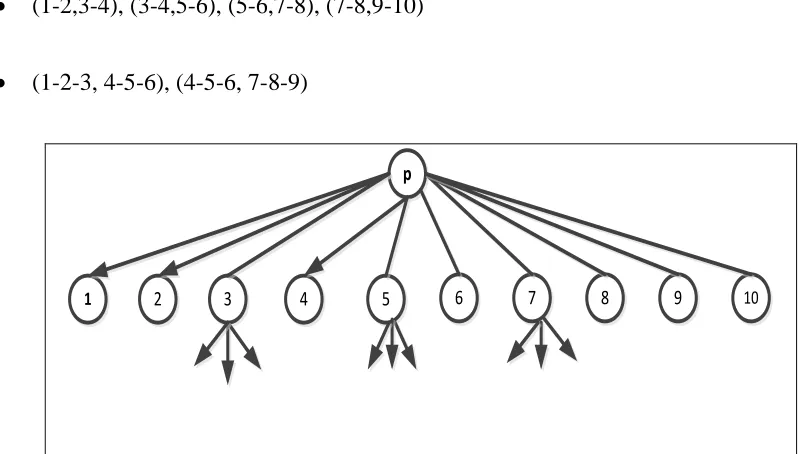
result is used to identify each data region. The comparison process is shown in Figure 14,
where it contains 10 nodes with the parent node p. The algorithm starts from each node
and continues with all possible combinations of component nodes. The following string
comparisons are computed:
(1,2), (3,4), (4,5), (5,6), (6,7), (7,8), (8,9), (9,10)
(1-2,3-4), (3-4,5-6), (5-6,7-8), (7-8,9-10)
(1-2-3, 4-5-6), (4-5-6, 7-8-9)
p
5 6 7 8 9 10
4 3
2
1
32
The pair node (1, 2) describes that tag string of node 1 is compared with tag string of
node 2. The tag string includes all the tags of the sub-tree of the node. For example, the
tag string for the second TR node (Figure 12) of TBODY is <TR TD TD………..TD
TD>. Here, the substring of sub-tree below the second TD nodes is denoted by “….”. The
pair node (1-2, 3-4) describes the comparison between the combined tag string of node 1,
2 and combined tag string node 3, 4. After doing all the string comparisons, the MDR
algorithm identifies each data region by finding its generalized node. Basically, the
algorithm finds similar children node combinations to identify candidate generalized
nodes and data region of the patent node by using the string comparison results at each
parent node. After that MDR identifies the data records in each region. MDR identifies
data records based on the assumption is that if a generalized node is the combination of
two or more data records then these data records contain similar tag strings. The authors
claim that the proposed method which is able to extract web data automatically. Also
their proposed method able to discover non-contiguous data records which didn’t handle
with existing system because the proposed method is developed based on nested structure
and presentation feature of web pages. The authors conducted an experiment of their
proposed approach with 18 pages from OMNI’s web site and a large number of other
pages from different domain like books, travel, software, auctions, jobs, shopping and
search engine result. They also used a number of training pages to build their system and
identify their default edit distance threshold. The authors obtained the result from their
experiment is that MDR has 99.88% recall and 100% precision where other system
OMINI and IEPAD only have a recall of 39%. They also mentioned that some data
33
as correct then the recall of OMINI and IPEAD reduce to 38.3% and 29% respectively. In
that case the precision value they obtain is that 56% for OMINI and 67% for IEPAD. The
authors claim that their approach doesn’t need any human effort and it mines data records
in a page automatically. They also claim that their algorithm able to extract
non-contiguous data records. The shortcoming of this approach is that MDR is designed to
handle tables tag only. It failed to extract data from web page which contains records that
have complex and nested structure. Reis et al. (2004) described that the limitation of this
approach is that the proposed algorithm works each time in a single page, so it does not
compare the page trees. Although achieving good results, the algorithm only works with
multi-record pages and therefore cannot be applied to on-line news page, that are almost
exclusively single-record pages. Miao et al. (2009) identified the limitation of this
approach is that it does not handle nested data objects.
2.1.2 DEPTA: Web data extraction based on partial tree alignment
Zhai and Liu (2005) addressed the problem of data record extraction from web page.
They state that the machine learning approach is time consuming and needs human effort
because it requires manually labeling of many examples from each web site for data
extraction and this approach is not able to expand to cope with large number of pages.
They also found that existing automatic approaches related to pattern discovery are
developed based on many assumptions and provide inaccurate results. The authors
propose a new architecture for automatic data extraction from web pages. The proposed
architecture is called DEPTA. It has three steps to extract data automatically. In the first
step, the method builds a HTML tag tree using visual information. The observation
34
optional embedded HTML content and an end tag, is rendered as a rectangle in a web
browser. The DEPTA builds tag tree based on the nested rectangle. For doing this, it uses
embedded parsing and rendering engine of a browser to find the 4 boundaries of the
rectangle of each HTML element and then it checks whether one rectangle is contained
inside another rectangle by detect the containment relationship within the rectangles. For
example, Figure 15 represents the HTML code on the left which is a table with two rows
and right side represents the boundary coordinated produced by the browser for each
HTML element shown in the right side.
Figure 15: A HTML code segment and boundary coordinates
The tag tree is shown in Figure 16 is build based on the visual information which is the
sequence of opening tag and also done by the containment check. After building the tag
tree DEPTA mines data region in a page that contain similar data records. The DEPTA
identifies the data region using string comparison between generalized nodes. For
example, Figure 17 represents an artificial tag tree to explain different kinds of generalize
nodes and data region. The generalized node represents by the shaded area. The Nodes 5
and 6 formed data region labeled 1 and their length is 1. The nodes 8, 9 and 10 formed
35
(18, 19) from the data region labeled 3 and their length is 2. These generalized node
formed the data region based on the edit distance properties which is that the normalized
table
tr tr
td td td td
Figure 16: Tag tree for HTML code in Figure 15
edit distance between adjacent generalized nodes is less than fixed thresholds. To identify
the data region, the mining algorithm finds the first generalized node of a data region.
And it is possible when starting from each node sequentially. For example node 8 is the
first node of data region 2 in figure 17.
1
9
3 4
2
9 8 7 6
5 10
11 12
13 14 15 16 17 18 19 20 Region 1 Region 2
Region 3