University of Windsor University of Windsor
Scholarship at UWindsor
Scholarship at UWindsor
Electronic Theses and Dissertations Theses, Dissertations, and Major Papers
2015
FUNCTION AND EVOLUTION OF PLUMAGE TRAITS IN TROGONS
FUNCTION AND EVOLUTION OF PLUMAGE TRAITS IN TROGONS
(AVES TROGONIFORMES), AND THE IMPORTANCE OF
(AVES TROGONIFORMES), AND THE IMPORTANCE OF
PARAMETERIZATION IN VISUAL MODELS
PARAMETERIZATION IN VISUAL MODELS
Pierre-Paul Bitton University of Windsor
Follow this and additional works at: https://scholar.uwindsor.ca/etd
Part of the Biology Commons
Recommended Citation Recommended Citation
Bitton, Pierre-Paul, "FUNCTION AND EVOLUTION OF PLUMAGE TRAITS IN TROGONS (AVES TROGONIFORMES), AND THE IMPORTANCE OF PARAMETERIZATION IN VISUAL MODELS" (2015). Electronic Theses and Dissertations. 5714.
https://scholar.uwindsor.ca/etd/5714
This online database contains the full-text of PhD dissertations and Masters’ theses of University of Windsor students from 1954 forward. These documents are made available for personal study and research purposes only, in accordance with the Canadian Copyright Act and the Creative Commons license—CC BY-NC-ND (Attribution, Non-Commercial, No Derivative Works). Under this license, works must always be attributed to the copyright holder (original author), cannot be used for any commercial purposes, and may not be altered. Any other use would require the permission of the copyright holder. Students may inquire about withdrawing their dissertation and/or thesis from this database. For additional inquiries, please contact the repository administrator via email
FUNCTION AND EVOLUTION OF PLUMAGE TRAITS IN TROGONS (AVES
TROGONIFORMES), AND THE IMPORTANCE OF PARAMETERIZATION IN
VISUAL MODELS
by
PIERRE-PAUL BITTON
A Dissertation
submitted to the Faculty of Graduate Studies
through the Department of Biological Sciences
in Partial Fulfillment of the Requirements for
the Degree of Doctor of Philosophy at the
University of Windsor
Windsor, Ontario, Canada
Function and evolution of plumage traits in Trogons (Aves Trogoniformes), and the importance of parameterization in visual models
by
Pierre-Paul Bitton
APPROVED BY:
______________________________________________
Dr. Robert Montgomerie, External Examiner Department of Biology, Queen’s University
______________________________________________
Dr. Melania Cristescu, External Departmental Reader Department of Biology, McGill University
Adjunct to the Great Lakes Institute of Environmental Research, University of Windsor
______________________________________________
Dr. Trevor Pitcher, Internal Departmental Reader Department of Biological Sciences, University of Windsor
______________________________________________
Dr. Daniel Mennill, Internal Departmental Reader Department of Biological Sciences, University of Windsor
______________________________________________
Dr. Stéphanie Doucet, Advisor
Department of Biological Sciences, University of Windsor
iii
Declaration of Co-Authorship / Previous Publication
I. Co-Authorship Declaration
I declare that this thesis incorporates material that is the result of joint research, as follows: I am
the sole author of the General Introduction, Chapter 1, and the General Discussion, Chapter 6. I
am the principal author of the manuscripts that comprise the four data chapters: Chapters 2
through 5. All six data chapters are co-authored with my supervisor, Dr. Stéphanie M. Doucet.
Chapter 4 was co-authored by collaborators Drs. Jeffrey DaCosta and John Klicka, and Chapter 5
was co-authored with Kevyn Janisse who also provided the spectral data for the analyses. For all
four data chapters, I conceptualized the research projects and experimental designs, and I am
primarily responsible for the experimental execution, data analysis, interpretation, and writing.
Dr. Stéphanie Doucet contributed to experimental design, interpretation, and the editing of the
manuscripts, as well as providing financial and logistical support. My others collaborators
provided data, contributed to the analyses, data interpretation, and/or writing and editing of
the manuscripts.
I am aware of the University of Windsor Senate Policy on Authorship and I certify that I
have properly acknowledged the contribution of other researchers to my thesis, and have
obtained written permission from my co-authors to include the above material in my thesis.
I certify that, with the above qualification, this thesis, and the research to which it
refers, is the product of my own work.
Chapter 2 is published in Behavioral Ecology, and is formatted for that journal. Chapters
3, 4, and 5 have been formatted for future submission to Journal of Evolutionary Biology,
iv II. Declaration of Previous Publication
This thesis includes one original paper that has been published in a peer reviewed journal, as
follows:
Thesis Chapter Publication title/full citation Publication status
Chapter 2
A multifunctional visual display in elegant trogons targets conspecifics and heterospecifics
Published in Behavioral Ecology
Chapter 2 is a pre-copyedited, author-produced copy of an article published in
Behavioral Ecology following peer review. The version of record “Bitton P-P., and S. M. Doucet.
2014. A multifunctional visual signal in the Elegant trogon Trogon elegans targets conspecifics
and heterospecifics. Behavioral Ecology 25: 27-34.” is available online at:
http://beheco.oxfordjournals.org/content/25/1/27.short
I certify that the above material describes work completed during my registration as
graduate student at the University of Windsor.
I declare that, to the best of my knowledge, my thesis does not infringe upon anyone’s
copyright nor violate any proprietary rights and that any ideas, techniques, quotations, or any
other material from the work of other people included in my thesis, published or otherwise, are
fully acknowledged in accordance with the standard referencing practices. Furthermore, to the
extent that I have included copyrighted material that surpasses the bounds of fair dealing within
the meaning of the Canada Copyright Act, I certify that I have obtained a written permission
from the copyright owner(s) to include such material(s) in my thesis.
I declare that this is a true copy of my thesis, including any final revisions, as approved
by my thesis committee and the Graduate Studies office, and that this thesis has not been
v
Abstract
In this dissertation, I investigated the function and evolution of plumage-based visual signals in
trogons (Trogoniformes), and assessed the influence of individual parameters in the
receptor-noise model of colour discriminability. In Chapter 2, I investigated the function of tail raising in
the elegant trogon. For this purpose, I used observational and experimental data collected in
Costa Rica. Results demonstrated that tail raising in the elegant trogon is a multifunctional signal
that targets both conspecifics and heterospecifics. Specifically, trogons used this behaviour
during intra and intersexual interactions, and the experiment confirmed that tail raising is a
pursuit-deterrent signal. In Chapter 3, I experimentally tested which plumage patches are used
in species recognition in two species of trogons: the black-headed trogon, which is sympatric
with a looking congener, and the elegant trogon, which is not sympatric with a
similar-looking congener. The results suggested that while both species use the back and belly colour as
specie- recognition traits, the black-headed trogon but not the elegant trogon also assessed the
tail banding pattern. In Chapter 4, I investigated the relationship between sympatry and
plumage divergence in the genus Trogon. My results demonstrated that Trogon taxa diversified
more rapidly, and that plumage trait divergence increased with sympatric overlap in South
American but not Central American taxa. Together, my findings suggested that the rapid
colonization of South America following the Great American Interchange resulted in
reinforcement through character displacement or trait sorting. In Chapter 5, I investigated how
dichromatism scores are influenced by individual parameters of the receptor-noise model of
chromatic contrast threshold, using an avian-based tetrachromatic approach. I systematically
tested parameter values for ambient light environment, photoreceptor sensitivities and
vi
sensory experience of species for which the visual system has been fully characterized. My
results demonstrated that oil droplet characteristics, photoreceptor densities, and the sensitivity
of the SWS1 photoreceptor (ultraviolet sensitive or not) had the most influence on
dichromatism scores. I encourage the complete characterization of visual systems when
possible, and my results will inform researchers when making inferences about tetrachromatic
vii
Acknowledgements
The research presented in this dissertation would not have been possible without the help and
support of amazing people. I have met and developed strong relationships with many individuals
who will always be remembered.
I’d like to thank my supervisor Stéphanie M. Doucet for all her guidance, financial
support, comments on manuscripts and grant applications, and giving me a great opportunity to
work in the tropics and in museums. Drs. Daniel Mennill, Trevor Pitcher, and Melania Cristescu
provided valuable advice throughout my doctoral studies.
Much of the data included in this dissertation was obtained by visiting several museums.
Janet Hinshaw at the University of Michigan Museum of Zoology was always very friendly,
helpful, and handled several loans. I also thank everyone who helped me at the Field Museum of
Natural History, the American Museum of Natural History, the National Museum of Natural
History, and the Louisiana State University Museum of Natural Science.
I thank the staff of the Department of Biological Sciences for the great support and
guidance throughout my five-year stay. Work in Costa Rica was facilitated by employees at the
Área de Conservación Guanacaste including Roger Blanco, and conversations with Daniel Janzen
and Frank Joyce. Several volunteers have helped me with this research. Specifically, for all their
hard work, I thank Stephanie Ly and Kenneth Sarpong. Others who have been missed are
thanked by name at the end of each chapter.
Of course, this research would not have been possible without support from several
funding agencies and institutions. Financial support came in the form of a Tuition Waiver
viii
Foreign Study Supplement from the Natural Sciences and Engineering Research Council of
Canada, an Ontario Graduate Scholarship from the Province of Ontario, a Field Museum Visiting
Scholar Award, an American Ornithological Union Research Award, and a Journal of
Experimental Biology Travelling Fellowship. Financial support was also provided by my
supervisor Stéphanie Doucet who received a Discovery Grant and Equipment Grant from the
Natural Sciences and Engineering Research Council of Canada, a Canada Foundation for
Innovation grant, an Early Researcher Award from the Government of Ontario, and from the
University of Windsor.
Life is so much better with good friends to share it with! I thank all who have put a smile
on my face throughout these years. I am thankful to the students, past and present, of the
Doucet, Mennill, and Love labs, particularly Daniel Hanley, Kara-Anne Ward, Katrina Lukianchuk,
Kevyn Janisse (née Gammie), Luis Sandoval, Roberto Sosa, David Wilson, Brendan Graham, and
Meghan Vankosky (adjunct to all three labs!).
I would never have gotten where I am without the lifelong support of my parents and
other important family members. My love for the natural world started at a very early age. My
paternal grandmother Laurette Bitton would take me out to pick flowers and poke at minnows
in the St-Lawrence river; my maternal grandfather Joffre Patenaude taught me about bees (but
not the birds!). Throughout my childhood both my parents would take me out camping and
encouraged outdoor play. I climbed Appalachian mountains with my dad Guy Bitton, and it was
on a hike with my mom Marie-France Patenaude that I realized I wanted a career in biology.
Their love and care have allowed me to chase my goals even if I chose the long and winding
road. I thank Françoise Entrialgo who has always been there for us, and Carmine Romano who
constantly radiates positive energy. I also thank Karen Ochs and Cameron Beck for accepting me
ix
Finally, my most heartfelt thanks go to my wonderful wife Courtney Ochs and my goof
of a son Sawyer. Going home and spending time with both of you makes my day, every day.
Cory, you have been there for me since the beginning and sacrificed much to be by my side all
this time. You have tolerated me leaving for several months every year for three years, dropped
work to help me in the field, spent sleepless nights comforting our little guy, and stayed home
with him when I could not. Thank you for all you have done. I would not have been able to
complete this work without you. Sawyer, I didn’t know I was missing something in my life until
x
Table of Contents
Declaration of Co-Authorship / Previous Publication ... iii
I. Co-Authorship Declaration ... iii
II. Declaration of Previous Publication ... iv
Abstract ... v
Acknowledgements ... vii
List of Tables ... xii
List of Figures ... xiv
Chapter 1 - General Introduction ... 1
Animal Communication... 2
Function and evolution of plumage colouration in birds ... 3
Quantification of colour ... 5
Study group: the Trogons... 8
Dissertation overview ... 9
References ... 13
Chapter 2 - A multifunctional visual display in elegant trogon targets conspecifics and heterospecifics ... 18
Summary ... 19
Introduction ... 20
Methods ... 22
Observation of natural tail raising occurrences ... 23
Model presentation experiment ... 25
Results ... 28
Observation of natural tail raising occurrences ... 28
Model presentation experiment ... 29
Discussion ... 30
Acknowledgements ... 34
References ... 35
Chapter 3 - Sympatric black-headed and elegant trogons (Aves: Trogoniformes) focus on different plumage characteristics for species recognition ... 47
Summary ... 48
Introduction ... 49
Methods ... 51
Models ... 52
Field experiment ... 55
Analyses ... 58
Results ... 58
xi
Acknowledgements ... 64
References ... 65
Chapter 4 - Increased plumage divergence with sympatry in a rapid and recent diversification of the avian genus Trogon ... 75
Summary ... 76
Introduction ... 77
Methods ... 80
Phylogenetic analyses ... 81
Comparative analyses ... 82
Plumage characteristics and visual model ... 83
Measurement of genetic distances and sympatry among subspecies ... 85
Statistical analyses ... 85
Results ... 88
Discussion ... 90
Acknowledgments ... 95
References ... 96
Chapter 5 - The importance of proper parameterization in tetrachromatic visual models when assessing sexual dichromatism ... 109
Summary ... 110
Introduction ... 111
Materials and Methods ... 115
Spectral measurements ... 115
General procedures ... 115
Model parameterization ... 117
Results ... 120
Discussion ... 123
Acknowledgements ... 129
References ... 130
Chapter 6 - General Discussion ... 144
Function of visual signals in Trogons ... 145
Species recognition ... 147
Evolution of plumage in Trogons ... 150
Parameters and visual models ... 152
Conclusion ... 154
References ... 155
APPENDICES ... 158
References ... 185
xii
List of Tables
Table 2. 1 Summary of evidence for visual pursuit-deterrence behaviors in vertebrate animals. 40
Table 2. 2 Elegant trogons (Trogon elegans) were observed performing tail raising displays in various contexts ... 43
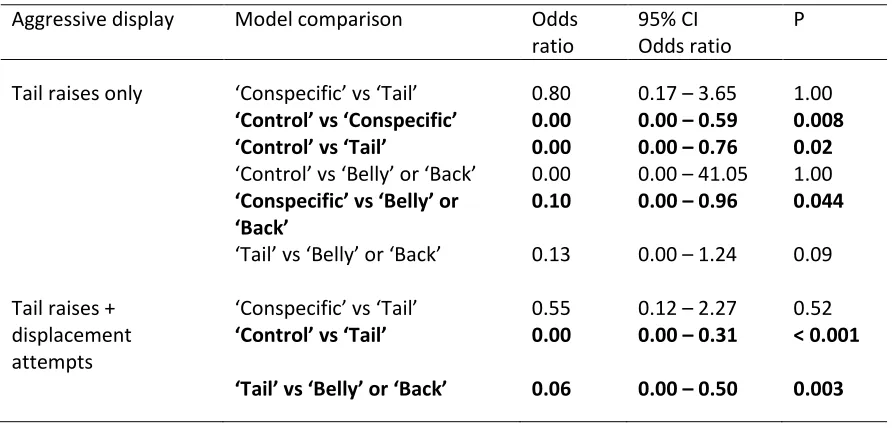
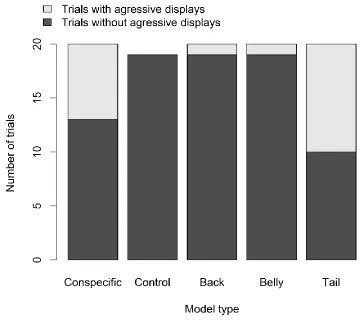
Table 3. 1 Elegant trogons performed more aggressive displays when presented with a
‘Conspecific’ and ‘Tail’ model than when presented with ‘Control’, ‘Belly’, and ‘Back’ models (see methods for model type definitions) ... 70
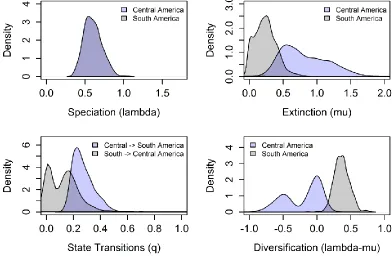
Table 4. 1 Summary statistics of 1000 binary state speciation and extinction (BiSSE) analyses comparing speciation, extinction, diversification, and state transition rates in South and Central American trogon subspecies ... 102
Table 4. 2 Summary of the top three best fitting generalized linear mixed models investigating the predictors of plumage color divergence among subspecies of the genus Trogon. ... 103
Table 5. 1 Summary of the visual system comparisons that generated the largest differences, based on the lowest Pearson’s r value, in the total dichromatism scores of 70 species of the Order Galliformes. ... 137
Table 5. 2 Summary of the changes in dichromatism score of the species most affected by changes in the sensory exprience, based on the absolute largest difference in total dichromatism score among 70 species of Galliformes ... 138
Table 5. 3 Summary of the changes in dichromatism score of the species most affected by changes in the sensory exprience, based on the largest difference in rank among 70 species of Galliformes ... 139
Table S4. 1 Sample identification number and GenBank NADH dehydrogenase subunit 2 accession numbers of the 41 species/subspecies included in the phylogenetic estimation,
diversification analyses, and ancestral state reconstruction. ... 161
Table S4. 2 Accession numbers for all museum skins from which plumage characteristics were measured ... 163
Table S4. 3 Parameters and AICc scores of all GLMM model ordered with decreasing number of parameters. ... 165
Table S5. 1 Catalogue numbers for all specimens measured. ... 167
xiii
Table S5. 3 Spectral absorption parameters for oil droplets and ocular media in avian eyes. See Methods for meaning of λcut, λmid and T50. ... 171
Table S5. 4 Ratio of photoreceptor densities in avian retinas. Photoreceptor with lowest
proportion was always given 1.00. ... 173
Table S5. 5 Parameters used to reproduce the average VIS and average UV avian visual systems presented in Endler and Mielke (2005) ... 175
Table S5. 6 Summary of photoreceptor sensitivities of the four avian cone classes separated by eye type ... 176
Table S5. 7 Summary of oil droplet cut-off parameters of three avian cone classes and T50 of the ocular media, separated by eye type ... 177
Table S5. 8 Photoreceptor density ratios values selected for comparisons from all known ratios with the justification for including these in our analyses ... 178
Table S5. 9 Summary of total dichromatism score changes of 70 species of the Order Galliformes when comparing the influence of changing light environments ... 179
Table S5. 10 Summary of total dichromatism score changes of 70 species of the Order Galliformes when comparing the influence of changing maximum photoreceptor sensitivity values ... 180
Table S5. 11 Summary of total dichromatism score changes of 70 species of the Order
Galliformes when comparing the influence of changing oil droplet cut-off values ... 181
Table S5. 12 Summary of total dichromatism score changes of 70 species of the Order
Galliformes when comparing the influence of changing ocular media absorbance curves. ... 182
Table S5. 13 Summary of total dichromatism score changes of 70 species of the Order
Galliformes when comparing the influence of changing photoreceptor densities. ... 183
Table S5. 14 Summary of total dichromatism score changes of 70 species of the Order
xiv
List of Figures
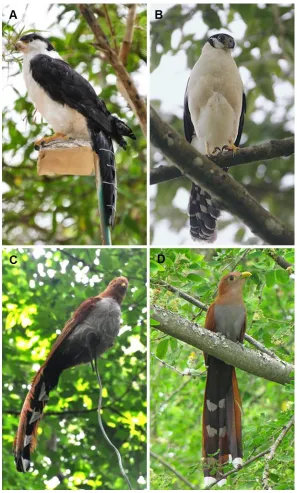
Figure 2. 1 Examples of the models (A and C) used during experimental trials and photographs of live specimens (B and D) for comparison. A and B collared forest-falcon (Micrastur
semitorquatus; Mike Dazenbaker); C and D squirrel cuckoo (Piyana cayana; Fransisco
Piedrahita). ... 44
Figure 2. 2 A) Elegant trogons were more likely to raise their tail in the presence of a predator model than in the presence of a control model, but B) the presence or absence of conspecifics did not influence tail raising behavior of elegant trogons presented with a predator model ... 45
Figure 2. 3 The influence of first perch distance from a predator model on tail raising rate in the elegant trogon was best described by an exponential decay curve (dashed line). ... 46
Figure 3. 1 Our experimental trials were conducted on the elegant trogon (Trogon elegans), which does not have a similar-looking congener in our study area, and the black-headed trogon (T. melanocephalus), which is sympatric with the violaceous trogon (T. violaceus). ... 71
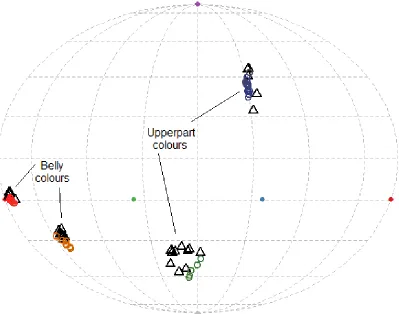
Figure 3. 2 The hue of the dyed feathers (coloured circles) on the models closely matched the hue of museum specimens (black triangles) in avian colourspace.. ... 72
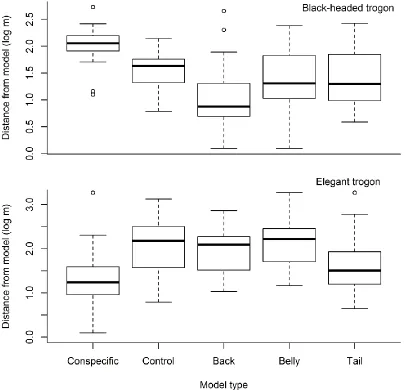
Figure 3. 3 Black-headed trogons approached ‘Conspecific’ models less than any other model type, and elegant trogons approached ‘Conspecific’ models more than all but the ‘Tail’ models ... 73
Figure 3. 4 Elegant trogons performed more tail raises when presented with models resembling conspecifics and models for which only the tail was modified, than when presented with other model types... 74
Figure 4. 1 Areas of high trogon diversity in Central America where five species coexist, and in South America where six species coexist (shaded in tan color). ... 104
Figure 4. 2 Posterior probability density distributions of speciation (lambda), extinction (mu), transition (q) and diversification (r) rates of South (SA) and Central American (CA) trogon subspecies using a binary state speciation and extinction (BiSSE) model with constrained
speciation rates ... 105
Figure 4. 3 Plumage characteristic differences among subspecies of Trogon are related to the degree of sympatry in South American (solid symbols, solid line) but not in Central America (hollow symbols, dashed line)... 106
xv
Figure 4. 5 The functional richness of colors in Trogon-rich areas (the smallest possible convex hull volume in colorspace used by the community) is not greater than expected by chance in Central America or South America. ... 108
Figure 5. 1 A) Molleweide projection of the 2100 color patches used in this study when
perceived by an average UV visual system under ideal illumination ... 140
Figure 5. 2 Comparison of the A) total sexual dichromatism scores (in just-noticeable
differences), and B) total dichromatism ranks of 70 species in the Order Galliformes contrasting two visual systems differing only in their oil droplet cut-off values ... 141
Figure 5. 3 Comparison of A) the total sexual dichromatism scores (in just-noticeable
differences), and B) total dichromatism ranks of 70 species in the Order Galliformes contrasting UV eye type visual systems differing only in their photoreceptor densities ... 142
Figure 5. 4 Comparison of A) the total sexual dichromatism scores (in just-noticeable
differences), and B) total dichromatism ranks of 70 species in the Order Galliformes contrasting the two most commonly used bird visual systems ... 143
Figure S4. 1 Molecular phylogeny of 41 Trogon species/subspecies and ancestral state
Chapter 1
2 Animal Communication
The study of animal communication has greatly contributed to our understanding of natural and
sexual selection (Bradbury and Vehrencamp 2011), the fundamental tenets of biology. This field
of research is particularly rich because of the various modalities by which animals can convey
information to one another. Indeed, animals can communicate by acoustic (Kroodsma and Miller
1982, Gerhardt and Huber 2002), visual (Hill and McGraw 2006a, Matthews and Matthews
2009), chemical (Bell and Cardé 1984, Vandenbergh 2012), electrical (Kramer 1990), and
vibrational (Markl 1983, Lewis and Narins 1985, Hill 2008) means. Because of this diversity of
signalling and sensory modalities, studies in animal communication cover a broad range of
proximate and ultimate questions including physical, physiological, anatomical, and behavioural
topics. Indeed, the study of animal communication is one of the most integrated fields in
biology. From a sender’s perceptive, investigations have focussed on how a signal is produced
(e.g., Bennet-Clark 1970, Aroyan et al. 2000, Elemans et al. 2004), how it propagates (e.g.,
Naguib and Wiley 2001, Boncoraglio and Saino 2007), its cost (Olson and Owens 1998, Gil and
Gahr 2002), how it is learned and/or developed (Beecher and Brenowitz 2005, Shawkey et al.
2014), and its physical and/or chemical attributes (Wyatt 2003, McGraw 2006a, b). Studies
concerned with understanding the receiver’s perspective have focused on sensory organs (Land
and Nilsson 2012), the neuroscience of perception (Guilford and Dawkins 1991), cognition (Hunt
1996, Prior et al. 2008), and thresholds of detection (Vorobyev and Osorio 1998). The
importance of signals in the interactions between senders and receivers has also generated
much research. Major topics of interest include the reliability of signalling (Searcy and Nowicki
2005), the function and evolution of signals (Searcy and Nowicki 2005), and communication
3 Function and evolution of plumage colouration in birds
Visual communication can take place through active signals (body movements) or passive signals
(colour of plumage patch). In many circumstances, such as during ritualized courtship displays,
behaviours are used to present and emphasize passive signals. Birds in particular have a long
and rich history in studies of visual signals (Hill and McGraw 2006a, b). For example, Darwin
(1871) discussed how plumage dichromatism was unlikely to have evolved through the process
of natural selection, developing the hypothesis that sexual selection was probably responsible
for differences between the sexes. Since then, bird models have been central in the
development of several hypotheses formulated to explain the evolution of conspicuous
secondary sexual ornaments, the maintenance of honest signals, and the benefits of mate
choice. Bird examples have been used to advance Fisher’s runaway selection (Fisher 1915,
Andersson 1994) and sexy son hypotheses (Fisher 1930, Weatherhead and Robertson 1979),
Zahavi’s handicap model (Zahavi 1975, 1977), Hamilton and Zuk’s hypothesis (Hamilton and Zuk
1982), the good genes hypothesis (Møller and Alatalo 1999, Griffith et al. 2002), and the
compatible genes hypothesis (Kempenaers et al. 1999, Neff and Pitcher 2005, Akçay and
Roughgarden 2007).
Visual communication can involve conspecifics or heterospecifics, but most visual signals
have been studied in the context of intraspecific communication. In birds, for example, the
colours of plumage patches and behaviours that display these patches have been thoroughly
documented in intraand intersexual interactions (Hill and McGraw 2006a). In contrast, visual
behaviours targeting heterospecifics are poorly documented. Stotting is one of a few
well-studied examples. Several species of ungulates, especially gazelles, propel themselves high in
the air with stiff legs in the presence of a potential predator. The pursuit-deterrent hypothesis,
4
honest signals of condition and convey unprofitability to predators. Behaviours with the same
function have been observed in birds. For example, common moorhens (Gallinula chloropus)
flash white under-tail coverts and turquoise-browed motmots (Eumomota superciliosa) wag
their tails in the presence of potential predators (Alvarez 1993, Murphy 2006, 2007). Tail
displays seem to be generally common in birds but whether they functions as conspecific signals
or heterospecific signals has rarely been investigated.
The function of animal colours such as those found on the plumage of birds has often
been studied in the context of mate choice, but rarely investigated for use in species recognition
(Ord and Stamps 2009). This is surprising since closely related species often look similar, and
there is evidence for character displacement of sexually selected visual traits (Sætre et al. 1997).
Because the proper recognition of heterospecifics can prevent hybridization between incipient
species (Price 2007), divergence in plumage traits could mediate pre-zygotic isolation through
reinforcement. Therefore, evaluating which visual traits are used for species recognition can
inform our understanding of interspecific communication and the ultimate mechanism of
speciation. Furthermore, it is important to understand which conditions lead to differences in
these traits. Evidence from pairs of closely related species has demonstrated that rapid
sympatry can drive trait divergence (Martin et al. 2010), especially at intermediate levels of
geographic overlap (Martin et al. 2015). However, the divergence of sexually selected colours
has rarely been investigated in large groups of closely related species, which would be
particularly informative to understand the evolution of visual signals. In all cases, to properly
5 Quantification of colour
It has long been understood that animals do not all share the same visual sensory experience.
Early experimental evidence demonstrated that while some animals perceive fewer colours than
humans (Allen 1879), others could detect wavelengths outside the normal human range of
vision, particularly in the ultraviolet (Kühn 1924). Nevertheless, the description of animal colours
remained subjective to human perception until recently (Burtt 1986, Burkhardt 1989, Bennett et
al. 1994). For example, feathers were described by matching their colour to that of a standard in
the Munsell book of colours (Munsell Color Company 1976, Zuk and Decruyenaere 1994), or by
calculating colour values based on the standard observer (Wyszecki and Stiles 1982, Burtt 1986,
Andersson and Praguer 2006). Discussions regarding the pitfalls of relying on the subjective
human visual experience to quantify colours (Burkhardt 1989, Bennett et al. 1994) prompted the
widespread use of spectrophotometry as the most objective method to quantify the reflective
properties of animal colours (Andersson and Prager 2006). Spectrophotometers collect spectral
data across any range of wavelengths, which is particularly useful in the study of ultraviolet
perception in animals such as birds (Bennett and Cuthill 1994).
Several methods can be used to extract quantitative information and compare colours
from reflectance spectra; each one has advantages and disadvantages, and is applied in
different contexts. From a descriptive approach, tristimulus variables have been developed to
interpret spectral curves, of which measures of hue, saturation, and brightness are the most
commonly used (Montgomerie 2006). Hue is generally defined as the wavelength which
contributes the most to the total reflectance, saturation is a measure of a colour’s purity, and
brightness is a measure of the total amount of light reflected by a surface (Montgomerie 2006).
Together, hue and saturation describe the chromatic component of a colour, whereas
6
spectral curves, colour metrics are comparable across studies and intuitive measures. However,
because they do not incorporate the ambient light or the receiver’s psychophysiology, and
therefore do not quantify the discriminability between colours, tristimulus scores have been
criticised when used to infer how visual signals may be perceived (Delhey et al. 2014).
The comparison of several colours can be achieved by applying principal component
analysis directly to multiple spectra (Endler 1990, Grill and Rush 2000), with the resulting
components representing the wavelengths that contribute most to among-colour differences.
This method has the benefit of simultaneously comparing several colours, but the multivariate
assumptions of multivariate normality, sphericity, and independence of spectral measurements
are often violated (Endler and Mielke 2005). Furthermore, the principal components are loaded
differently for every data set, even from the same species, preventing direct comparison of
results among studies. As a consequence, analysis of colours by principal component analysis is
now uncommon.
To incorporate some element of psychophysiology in the measurement of colours,
Endler (1990) proposed analyzing spectral curves using segment classification. This method
incorporates the ambient light environment, and generates unitless colour coordinates by
breaking down spectral data into equally-spaced regions, and comparing the relative stimulation
of the short wavelength cone to the medium cone, and the long wavelength cone to the short
wavelength cone. Segment classification is based on an opponency mechanism of colour vision
(Wyszecki and Stiles 1982, Endler 1990), and as such, it is a receiver-independent classification
scheme of colours, and captures common properties of many trichromatic vertebrate visual
systems. This method has rarely been implemented (Endler and Théry 1996), perhaps because it
7
trichromatic, and because a large number of spectral curves can generate the same colour
coordinates (like the RGB colourspace, Wyszecki and Stiles 1982).
With the understanding that birds and other animals are tetrachromatic, Goldsmith
(1990) proposed a tetrahedral colourspace model that could encompass all the colours
perceived by birds. Further developed by Endler and Mielke (2005) and then by Stoddard and
Prum (2008), colours are positioned in a three-dimensional space using coordinates
representing the stimulation of the four cones, based on photoreceptor sensitivity functions.
Several methods have been developed to compare the position in space of two or more points,
their spread, volume, and the volume overlap of two or more clouds of colour points (Endler
and Mielke 2005, Stoddard and Prum 2008, Maia et al. 2013). These methods of comparing
colours have been very popular because they are likely a good approximation of the visual
sensory experience of birds, require at a minimum only spectral and cone sensitivity data, but
can also accommodate several other characteristics of the visual system that can influence the
sensory experience.
To date, the most comprehensive model of animal vision is that proposed by Vorobyev
and Osorio (1998). Their model, which uses receptor-noise as a determinant of colour
thresholds, quantifies the chromatic contrast between two colours while considering the
ambient light environment, the light transmission properties of the ocular media, the
photoreceptor sensitivities and densities, the threshold sensitivity of the photoreceptors (Weber
fraction), and in several taxa, the transmission properties of oil droplets found anteriorly to the
photoreceptor (Vorobyev and Osorio 1998). Recently, methods have been developed to include
photoreceptor density in calculations of colourspace distances (Pike 2012, Delhey et al. 2014),
allowing the distances between points to be measured in just-noticeable-differences (Vorobyev
8
because it provides the best approximation of an animal’s visual sensory experience and the
units of measurements, just-noticeable-differences, are intuitive. However, the visual systems of
very few animals have been completely characterized and researchers almost always have to
make assumptions regarding one or many of the parameters listed above. The potential
consequences of wrongful parameterization have been pointed out (Renoult et al. 2010), but
the influence of individual parameters has never been systematically investigated.
Study group: the Trogons
The trogons and quetzals family (Trogonidae) comprise a pantropical group of approximately 40
species (Collar 2001), which arguably include some of the most beautiful birds in the world.
Systematic classification of the group has been hampered by a highly conserved body plan
throughout the order and a unique heterodactyl toe arrangement that is found in no other
family of birds. An ancient lineage, their closest living relatives are considered to be the
Coraciiformes (kingfishers, rollers, bee-eaters, Hackett et al. 2008), but they have been placed as
sister clade to the Coliiformes (mousebirds) of Africa (Espinosa de los Monteros 2000). Their
plumage is characterized by vibrant colours on most parts of their body. While the males of
Neotropical and African species bear bright iridescent feathers on their upperparts and
carotenoid based colours on their underparts, the Asian trogons seem largely coloured by
carotenoids and melanins (Collar 2001). All species have a relatively long tail that displays
barring patterns that vary across species. The phylogeny of trogons is well established at the
genus level, but studies of the arrangements of clade groupings are equivocal (Hosner et al.
2010, Quinteros and Espinosa de los Monteros 2011). The two main phylogenetic hypotheses
place either the African trogons (Hosner et al. 2010) or the New World trogons (Quintero and
9
Trogons of the Neotropical genus Trogon, the focus of this dissertation, comprise of a
group of 16 species for which 55 subspecies have been described (DaCosta and Klicka 2008,
Forshaw 2009, Remsen et al. 2014). As with all other trogons, members of this genus have a
highly conserved body plan and plumage patterns. Males bear iridescent feathers on their head,
mantle, rump and upper-tail (ranging from deep purple to copper) and carotenoid-based colours
on their belly and breast (red, orange, or yellow, Thomas et al. 2014). All species possess a long
tail that ranges in barring pattern from all white to all black, and many have a white band
separating the upper breast from the belly. The plumage colour of specific patches can vary
considerably within species. For example, the rump of T. rufus varies from copper-green in the
sulphurous subspecies to a purple-blue in the rufus subspecies. The genus Trogon is distributed
from southern Arizona to southern Brazil, and is found across a broad range of habitats (Collar
2001, Forshaw 2009). Ancestral area reconstruction has demonstrated that the genus originated
in Central America, and colonized South America through multiple migration events during and
after the completion of the Isthmus of Panama (DaCosta and Klicka, 2008). Areas of tropical
lowland can harbour many sympatric trogon species and/or subspecies. In general, trogons have
been poorly studied. The natural history of very few species has been described in detail, and
little is known about their biology and ecology.
Dissertation overview
In this dissertation, I investigate the signalling function and evolution of
a tail raising
behaviour in the elegant trogon (
Trogon elegans
)
using observational data and a modelpresentation experiment. Also using a model experiment, I assess which plumage patches are
10
colouration at the genus level, I investigate the relationship between geographic overlap
(sympatry) and plumage divergence across all subspecies of the genus Trogon. Finally, to clarify
the potential consequences of parameterization error in receptor-noise models of avian vision, I
systematically test the influence of individual parameters on the avian perception of sexual
dichromatism for 70 species of Galliformes.
In chapter 2, I investigated the function of tail raising in the elegant trogon, a behaviour
whereby the tail which normally rests vertically is rapidly lifted horizontally and slowly brought
back down. The first goal of the project was to characterize the contexts in which elegant
trogons perform tail raising displays. For this purpose, I conducted over 450 hours of
behavioural observations of free living birds in Costa Rica. The second goal of the project was to
determine the function of tail raising in the presence of heterospecifics. For this purpose, I
presented elegant trogons with models of a potential predator, and models of a
non-threatening control, to test the predictions of three competing hypotheses: the
pursuit-deterrent hypothesis, the conspecific warning signal hypothesis, and the self-preservation
hypothesis. This chapter was published in Behavioral Ecology.
In chapter 3, I experimentally tested whether the black-headed trogon (Trogon
melanocephalus) and elegant trogons use plumage traits for species recognition and if so, which
characteristics are used. I presented the two focal species with conspecific models, control
models, and modified models that differed in the colour of the back or belly, or the pattern of
banding on the tail. Furthermore, because the black-headed trogon is sympatric to the
similar-looking violaceous trogon (Trogon violaceus) but the elegant trogon does not have a
similar-looking sympatric congener in Costa Rica, I evaluated whether the presence of a similar-similar-looking
11
In chapter 4, I investigated the influence of the colonization of Trogon into South
America on plumage trait divergence and taxa diversification. The first objective was to compare
diversification rates in Central and South American taxa by modelling continent-specific
speciation and extinction rates. The second objective was to test whether character
displacement and/or phenotype sorting were responsible for trait divergence. This was
determined by collecting over 3500 spectral measurements of plumage characteristics from
almost 150 museum specimens and testing whether the proportion of sympatric overlap
explained plumage disparity among subspecies. The third objective evaluated whether the
presence in sympatry of several species of trogons influenced the range of plumage colour
values found in particular communities.
In chapter 5, I systematically evaluated the influence of individual parameters on the
quantification of chromatic sexual dichromatic in tetrachromatic visual models. I used the
receptor-noise model for colour discrimination developed by Vorobyev and Osorio (1998) to
calculate the chromatic contrast (in just-noticeable-differences) of 15 colour patches for each of
70 species of Galliformes. I investigated the influence of light environments, photoreceptor
sensitivities, oil droplet characteristics, ocular transmission, and photoreceptor densities on the
total dichromatism scores, the dichromatism rank of species in relation to one another, and the
dichromatism scores of individual patches. The main objective of the study was to determine
the relative influence of each parameter and to guide researchers when implementing visual
models for their study species.
Overall my dissertation uses a diversity of methods to understand visual communication
in the genus Trogon, and the influence of proper parameterization in avian visual models. I
incorporate observational and experimental field methods, as well as museum-based data
12
I also use modelling to understand how our assumptions regarding visual systems can influence
our quantification of avian sensory experiences. My research contributes to the understanding
of multifunctional visual signals, the use of visual traits in species recognition, the mechanisms
that influence visual character diversification, and the importance of proper parameterization in
avian visual models. Furthermore, this dissertation provides an important contribution to our
knowledge of trogons, a tropical group of birds that is poorly studied. Together, my
contributions should be of significant value to behavioural ecologists and evolutionary biologists
13 References
Akçay, E., and Roughgarden, J. 2007. Extra-pair paternity in birds: review of the genetic benefits. Evol Ecol Res 9: 855-868.
Allen, G. 1879. The colour-sense: Its origin and development: An essay in comparative psychology. Boston, Houghton.
Alvarez, F. 1993. Alertness signaling in two rail species. Anim Behav 46: 1229-1231.
Andersson, M. B. 1994. Sexual selection. Princeton University Press. Chicago.
Andersson, S., and Prager, M. 2006. Quantifying colors. In: Hill, G.E. & McGraw, K.J. (Eds.), Bird coloration. Volume 1: Mechanisms and measurements. Harvard University Press, Cambridge, pp. 41–89.
Aroyan, J. L., M. A. McDonald, J. C. Webb, J. A. Hildebrand, D. Clark, and J. S. Reidenbert. 2000. Acoustic models of sound production and propagation. In Hearing in Whales and Dolphins (W. W. L. Au, A. N. Popper, and R. R. Fay, eds.), pp. 409–469. New York: Springer Verlag.
Beecher, M. D., and Brenowitz, E. A. 2005. Functional aspects of song learning in songbirds. Trends Ecol Evol 20: 143-149.
Bell, W. J., and Cardé, R. T. 1984. Chemical ecology of insects. Chapman and Hall, London.
Bennet-Clark, H. C. 1970. The mechanism and efficiency of sound production in mole crickets. J Exp Biol 52: 619-652.
Bennett, A. T. D., and Cuthill, I. C. 1994. Ultraviolet vision in birds: what is its function? Vis Res 34: 1471-1478.
Bennett, A. T. D., Cuthill, I. C., and Norris, K. J. 1994. Sexual selection and the mismeasure of color. Am Nat 144: 848-860.
Boncoraglio, G., and Saino, N. 2007. Habitat structure and the evolution of bird song: a meta‐analysis of the evidence for the acoustic adaptation hypothesis. Funct Ecol 21: 134-142.
Bradbury, J.W., and Vehrencamp, S.L. 2011. Principles of animal communication, 2nd edn. Sinauer, Sunderland, MA.
Burkhardt, D. 1989. UV vision: a bird's eye view of feathers. J Comp Phys A 164: 787-796.
Burtt, Jr, E. H. 1986. An analysis of physical, physiological, and optical aspects of avian coloration with emphasis on wood-warblers. Ornithol Monogr iii-126.
14
Collar, N. J. 2001. Family Trogonidae (Trogons). In: Handbook of the birds of the world, Vol. 6. Mousebirds to Hornbills (J. del Hoyo, A. Elliott, and J. Sargatal, eds.), pp 80-129. Lynx Editions, Barcelona, Spain.
Darwin, C. 1871. The Descent of Man and Selection in Relation to Sex. John Murray, London.
Delhey, K., Delhey, V., Kempenaers, B., and Peters, A. 2014. A practical framework to analyze variation in animal colors using visual models. Behav Ecol aru198.
Endler, J. A. 1990. On the measurement and classification of colour in studies of animal colour patterns. Biol J Linnean Soc 41: 315-352.
Endler, J. A., and Mielke, P. W. 2005. Comparing entire colour patterns as birds see them. Biol J Linnean Soc 86: 405-431.
Endler, J. A., and Thery, M. 1996. Interacting effects of lek placement, display behavior, ambient light, and color patterns in three neotropical forest-dwelling birds. Am Nat 148: 421-452.
Elemans, C. P.H., Spierts, I. L.Y., Muller, U. K. , van Leeuwen, J. L., and Goller, F. 2004. Superfast muscles control dove's trill. Nature 431: 146-146.
Espinosa de los Monteros, A. 2000. Higher-level phylogeny of Trogoniformes. Mol Phyl Evol 14: 20-34.
Fisher, R. A. 1915. The evolution of sexual preference. Eugen Rev 7: 184-192.
Gerhardt, H. C., and Huber, F. 2002. Acoustic communication in insects and anurans: common problems and diverse solutions. University of Chicago Press, Chicago, Illinois.
Gil, D., and Gahr, M. 2002. The honesty of bird song: multiple constraints for multiple traits. Trends Ecol Evol 17: 133-141.
Griffith, S. C., Owens, I. P., and Thuman, K. A. 2002. Extra pair paternity in birds: a review of interspecific variation and adaptive function. Mol Ecol 11: 2195-2212.
Grill, C. P., and Rush, V. N. 2000. Analysing spectral data: comparison and application of two techniques. Biol J Linnean Soc 69: 121-138.
Goldsmith, T. H. 1990. Optimization, constraint, and history in the evolution of eyes. Q Rev Biol 65: 281-322.
15
Hamilton, W. D., and Zuk, M. 1982. Heritable true fitness and bright birds: a role for parasites? Science 218: 384-387.
Guilford, T., and Dawkins, M. S. 1991. Receiver psychology and the evolution of animal signals. Anim Behav 42: 1-14.
Hill, G. E., and McGraw, K. J. (Eds.). 2006a. Bird coloration: function and evolution (Vol. 2). Harvard University Press.
Hill, G. E., and McGraw, K. J. (Eds.). 2006b. Bird coloration: mechanisms and measurements (Vol. 1). Harvard University Press.
Hill, P. S. M. 2008. Vibrational Communication in Animals. Harvard, Cambridge, London.
Hosner, P. A., Sheldon, F. H., Lim, H. C., and Moyle, R. G. 2010. Phylogeny and biogeography of the Asian trogons (Aves: Trogoniformes) inferred from nuclear and mitochondrial DNA
sequences. Mol Phyl Evol 57: 1219-1225.
Hunt, G. R. 1996. Manufacture and use of hook-tools by New Caledonian crows. Nature 379: 249-251.
Kempenaers, B., Congdon, B., Boag, P., and Robertson, R. J. 1999. Extrapair paternity and egg hatchability in tree swallows: evidence for the genetic compatibility hypothesis? Behav Ecol 10: 304-311.
Kramer, B. 1990. Electrocommunication in teleost fishes. Behavior and experiments (Vol. 29). Springer, Berlin, Germany.
Kroodsma, D. E., and Miller, E. H. (Eds.). 1982. Acoustic communication in birds. Academic press, New York, USA.
Kühn, A. 1924. Versuche über das unterscheidungsvermögen der bienen und fische für spektrallichter. Nachrichten der Gesellschaft für Wissenschaften 1: 66-71.
Land, M. F., and Nilsson, D. E. 2012. Animal eyes. Oxford University Press, Oxford, UK.
Lewis, E.R., and Narins, P.M. 1985. Do frogs communicate with seismic signals? Science 227: 187-189.
Maia, R., Eliason, C. M., Bitton, P-P., Doucet, S. M., and Shawkey, M. D. 2013. pavo: an R package for the analysis, visualization and organization of spectral data. Methods Ecol Evol 4: 906-913.
Markl, H. 1983. Vibrational communication. In: Neuroethology and Behavioral Physiology, edited by Huber, F. and Markl, H. Springer-Verlag, Berlin Germany. pp. 332–353.
16
Martin, P. R., Montgomerie, R., and Lougheed S. C. 2015. Color patterns of closely related bird species are more divergent at intermediate levels of breeding-range sympatry. Am Nat In Press.
Matthews, R. W., and Matthews, J. R. 2009. Insect behavior. Springer Science & Business Media, Berlin, Germany.
McGraw, K. J. 2006a. Mechanics of carotenoid-based coloration. In Hill, G.E, and McGraw, K.J., eds. Bird Coloration. Volume 1 Mechanisms and measuremements. Harvard University Press, Cambridge, Massachusetts.
McGraw, K. J. 2006b. Mechanics of melanin-based coloration. In Hill, G.E, and McGraw, K.J., eds. Bird Coloration. Volume 1 Mechanisms and measuremements. Harvard University Press,
Cambridge, Massachusetts.
McGregor, P. K. (Ed.). 2005. Animal communication networks. Cambridge University Press, Cambridge, UK.
Møller, A. P., and Alatalo, R. V. 1999. Good-genes effects in sexual selection. Proc Roy Soc Lond B 266: 85-91.
Montgomerie, R. 2006. Analyzing colors. In Hill, G.E, and McGraw, K.J., eds. Bird Coloration. Volume 1 Mechanisms and measuremements. Harvard University Press, Cambridge, Massachusetts.
Munsell Color Company (Baltimore, Md.). 1976. Munsell Book of Color: Glossy Finish Collection.
Murphy, T. G. 2006. Predator-elicited visual signal: why the turquoise-browed motmot wag-displays its racketed tail. Behav Ecol 17: 547-553.
Murphy, T. G. 2007. Dishonest 'preemptive' pursuit-deterrent signal? Why the turquoise-browed motmot wags its tail before feeding nestlings. Anim Behav 73: 965-970.
Naguib, M., and Wiley, R. H. 2001. Estimating the distance to a source of sound: mechanisms and adaptations for long-range communication. Anim Behav 62: 825-837.
Neff, B. D., and Pitcher, T. E. 2005. Genetic quality and sexual selection: an integrated framework for good genes and compatible genes. Mol Ecol 14: 19-38.
Olson, V. A., and Owens, I. P. 1998. Costly sexual signals: are carotenoids rare, risky or required? Trends Ecol Evol 13: 510-514.
Ord, T. J., and Stamps, J.A. 2009. Species identity cues in animal communication. Am Nat 174: 585-593.
17
Prior, H., Schwarz, A., and Güntürkün, O. 2008. Mirror-induced behavior in the magpie (Pica pica): evidence of self-recognition. PLoS Biol 6: e202.
Quintero, E., Espinosa de los Monteros, A. 2011. Microanatomy and evolution of the
nanostructures responsible for iridescent coloration in Trogoniformes (Aves). Org Divers Evol 11: 237-248.
Renoult, J. P., Courtiol, A., and Kjellberg, F. 2010. When assumptions on visual system evolution matter: nestling colouration and parental visual performance in birds. J Evol Biol 23: 220-225.
Searcy, W. A., and Nowicki, S. 2005. The evolution of animal communication: reliability and deception in signaling systems. Princeton University Press, New Jersey, USA.
Sætre, G-P., T. Moum, S. Bureš, M. Král, M. Adamjan, and J. Moreno. 1997. A sexually selected character displacement in flycatchers reinforces premating isolation. Nature 387: 589-592.
Shawkey, M. D., D'Alba, L., Xiao, M., Schutte, M., and Buchholz, R. 2014. Ontogeny of an iridescent nanostructure composed of hollow melanosomes. J Morphol 276: 378-384.
Stoddard, M. C., and Prum, R. O. 2008. Evolution of avian plumage color in a tetrahedral color space: a phylogenetic analysis of new world buntings. Am Nat 171: 755-776.
Thomas, D. B., McGraw, K. J., Butler, M. W., Carrano, M. T., Madden, O., and James, H. F. 2014. Ancient origins and multiple appearances of carotenoid-pigmented feathers in birds. Proc Roy Soc Lond B 281: 20140806.
Vandenbergh, J. (Ed.). 2012. Pheromones and reproduction in mammals. Elsevier, Amsterdam, Netherlands.
Vorobyev, M., and Osorio, D. 1998. Receptor noise as a determinant of colour thresholds. Proc Roy Soc Lond B 265: 351-358.
Weatherhead, P. J., and Robertson, R. J. 1979. Offspring quality and the polygyny threshold: "the sexy son hypothesis". Am Nat 113: 201-208.
Wyatt, T. D. 2003. Pheromones and animal behaviour: communication by smell and taste. Cambridge University Press, Cambridge, UK.
Wyszecki, G., and Stiles, W. S. 1982. Color science. Second Edition, Wiley, New York, USA.
Zahavi, A. 1975. Mate selection—a selection for a handicap. J Theor Biol 53: 205-214.
Zahavi, A. 1977. The cost of honesty: further remarks on the handicap principle. J Theor Biol 67: 603-605.
Chapter 2
19 Summary
Avian visual displays often target either conspecifics or heterospecifics, but few visual displays
have been described where both conspecific and heterospecifics are the intended receivers. In
this study combining observational and experimental approaches, we present evidence that a
tail raising display performed by the elegant trogon (Trogon elegans) is used in multiple contexts
and is directed at conspecifics and heterospecifics. We observed tail raising displays towards
conspecifics in both inter- and intrasexual contexts, as well as towards heterospecifics. Displays
performed towards heterospecifics were directed at humans, monkeys, or birds of prey, all of
which could have been perceived as potential predators. We experimentally tested the possible
functions of tail raising behavior in the presence of a predator by presenting elegant trogons
with models of a natural predator and a non-threatening control. Tail raising displays were much
more likely to occur when trogons were in the presence of a predator model (48% of trials) than
a control model (6% of trials). The presence of conspecifics did not influence tail raising
propensity (conspecifics present: 44% of trials, conspecifics absent: 50% of trials). Our results
suggest that tail raising in trogons is a multifunctional visual display that may function as an
inter- and intrasexual conspecific signal as well as a pursuit-deterrent signal directed at
20 Introduction
Visual displays in animals can take many different forms, and are often directed at specific
receivers. In the presence of other males during agonistic encounters, for example, cuttlefish
display specific body patterns (Adamo and Hanlon 1996), hermit crabs wave enlarged chelipeds
(Arnott and Elwood 2010), and many birds perform ritualized threat displays (Hurd and Enquist
2001). These displays can prevent the escalation of aggression between individuals and reduce
the probability of harmful interactions. In the presence of females during mate attraction and
courtship, male fireflies use bioluminescent flashes (Branham and Wenzel 2003, Lewis and
Cratsley 2008), anoles bob their heads while presenting an extended colorful dewlap (Tokarz
1995), and many birds perform stereotyped dances (Gill 2007). In many species, the same
displays can be used in both intra- and intersexual contexts. For example, male ruby-crowned
kinglets (Regulus calendula) will raise their conspicuous red crest when confronting territorial
intruders or when displaying to a female during courtship (Martens and Päckert 2006).
Not all visual displays are directed towards conspecifics; a number of behaviors appear
to be targeted at heterospecifics. In birds for example, the turquoise-browed motmot
(Eumomotus superciliosa) wags its tail from side to side in the presence of potential predators, a
behavior identified as a pursuit-deterrent signal (Murphy 2006, 2007). This display warns
potential predators that they have been detected and that a capture attempt would be
unprofitable. The sunbittern (Eurypyga helias) also displays towards heterospecifics. It spreads
out its wings, exposing large “eyespots”, to scare away predators or individuals of other species
with which they compete for food resources (Frith 1978). The tail wagging in the
turquoise-browed motmot and wing spreading of the sunbittern are used in the presence of
heterospecifics, but do not seem to be used for signaling to conspecifics. In fact, relatively few
21
interspecific contexts, especially in birds (Table 2.1). One exception is the crest raising display of
the royal flycatcher (Onychorhynchus coronatus). In this species, male and females raise their
crests during courtship, aggressive intrasexual encounters, and when confronting
heterospecifics near their nests (Rieveley 2010).
Elegant trogons (Trogon elegans), perform a conspicuous visual display whereby the tail
is rapidly lifted above the horizontal and returned to its normal vertical position in a slow,
controlled manner. When performing this display, birds can usually be heard producing a
clucking sound (described in Taylor 1994). When positioned with their green back facing the
observer, elegant trogons appear generally inconspicuous against the background vegetation;
this display increases an individual’s detectability because of the movement involved, and
because it exposes the bright red belly and undertail coverts. This behavioral display has been
mentioned twice in the literature. Cully (1986) was the first to note that elegant trogons
produced this display in the presence of a live, tethered, great horned-owl (Bubo virgianus) near
their nest, and Hall and Karubian (1996) described this behavior in the context of a mating
display. The production of tail raising displays in the presence of heterospecifics and conspecifics
raises questions regarding the general function of this display and the evolution of
multifunctional displays in general. The first objective of our study was to characterize the
contexts in which elegant trogons perform tail raising displays. For this purpose, we conducted
behavioral observations of free living birds. The second objective of our study was to determine
the function of tail raising in the presence of heterospecifics. For this purpose, we conducted an
experiment testing the predictions of three competing hypotheses.
The conspecific warning signal hypothesis was developed in the kin selection framework
(Maynard Smith 1965, Sherman 1977) and presumes that displays in the presence of a potential
22
that have not yet detected the predator of the potential threat. A specific prediction of this
hypothesis is that birds should not display in the presence of a potential threat if conspecifics,
specifically kin, are not in visual range of the individual producing the displays.
The self-preservation alarm signal hypothesis states that signals target conspecifics with
the intent to trigger a reaction to deter or reduce the chance of a predator being successful by
mobbing or confusing the predator (Sherman 1985). A specific prediction of this hypothesis is
that on detecting a predator and after a display, conspecifics should approach the individual
displaying (to form a larger and threatening group), mob the predator, or scurry in all directions
to confuse the predator. The pursuit-deterrence hypothesis states that signals in the presence of
predators target the potential predator, not conspecifics, and informs that predator it has been
detected and an attempt at capture would be unprofitable (Woodland et al. 1980, Caro 2005).A
specific prediction of this hypothesis is that individuals should display in the presence of
potential predators regardless of the presence or absence of kin within visual range.
Methods
The elegant trogon is a member of the Trogoniformes and ranges from the southern United
States to northern Costa Rica (Collar 2001; Forshaw 2009). The species is sexually dimorphic:
males have bright iridescent green upperparts while females have coffee-brown upperparts.
Females display white feathers on their breast and faded red feathers on their undertail coverts;
males display brightly colored red feathers on their breast and undertail coverts. Immature
males, which exhibit delayed plumage maturation, have patchy brown and red breast feathers
(Kunzmann et al. 1998). They can be easily discriminated from mature males for more than one
23
but the two can be discriminated by tail feather wear: immature females leave the nest with
well frayed feathers which are first molted at least a year after fledging (personal observation).
Furthermore, immature females have a white tip on the tertials, which is lacking in older
females (Pyle 1997). Both the male and female contribute to modifying nest cavities by taking
turns to enlarge the opening. Males and females share responsibilities when incubating the eggs
and feeding the nestlings (Kunzmann et al. 1998).
We conducted our research in Sector Santa Rosa, Guanacaste Conservation Area, Costa
Rica (10˚ 40’N, 85˚ 30W). Our study site of nearly 9 km2 is characterized by a mix of secondary
dry deciduous forest, which has been in a regeneration state since the 1980’s, and older forest
stands of evergreen tree species (Janzen 1988). Elegant trogon breeding density at this location
is high; surveys during 2010 and 2011 estimated 20 to 30 breeding pairs per square kilometer
across the entire study area.
Observation of natural tail raising occurrences
We recorded observations of trogons raising their tails during two 2 ½ -month periods: April 18
to June 28 2010, and April 30 to July 12 2011. Trogon observations were conducted in three
different contexts: 1) opportunistically during trail surveys, 2) when following individuals located
on a previous day to document their behaviors and find their nests, 3) during focal nest watches.
We estimate that approximately 300 hours were dedicated to observing elegant trogons to
quantify tail raising behaviors in 2010, and 150 hours in 2011. Nest initiation and the start of the
breeding season in Santa Rosa is triggered by the arrival of the seasonal rains which usually start
early to mid- May. Therefore, in both field seasons, we collected behavioral data both before
24
When tail raising behaviors were observed, we noted the sex and age (immature or
adult) of the individual raising its tail and of any conspecifics in the area. Individuals were
considered in the area when they could be seen or heard within visual range of the displaying
individual. We noted the location of each observation to the nearest 5m by GPS and locations
were geo-referenced on ArcGIS (ESRI 2013). We inferred the context of the display based on the
interactions of the individuals and species present. The elegant trogons in our population are
not banded; therefore, we could not determine the exact identity of individuals we observed
displaying. However, based on local breeding density and time spent following individuals on
foraging bouts, we estimated that territory size extend 100m from the nest site at most.
Therefore, we considered any locations separated by more than 200m of each other to be
observations of different individuals. On several occasions, we observed trogons raising their
tails when we, the observers, were most likely the cause of the behavioral displays. This most
often occurred when flushing an unsuspecting bird, immediately triggering a tail raising
response. On other occasions we were certain that the displaying individuals were unaware of
our presence because 1) we first heard the trogons displaying and crept-up to observe the
displays without the birds ever looking in our direction, or 2) we observed the display when
conducting nest watches under camouflaging textile from at least 20m away. None of the tail
raising responses reported here were triggered on purpose by approaching birds or by making
our presence obvious.
To avoid including the same individual in the same group context more than once in our
analyses, we randomly selected a single observation in each year from those made in any given
area (separated by at least 200m). While an individual from a specific location could have been
included twice (from two different years) in our observations, the group context would always
25
Model presentation experiment
We conducted our experiment between May 1 and July 15 2011. To simulate the presence of a
potential aerial predator, we fabricated models closely resembling the collared forest-falcon
(Micrastur semitorquatus, Figure 2.1a, b). This species is known to consume trogons on
occasions (L. Sandoval, personal communication) and regularly consumes birds of similar size
(Thorstrom 2000). As a non-threatening avian control, we fabricated models closely resembling
the squirrel cuckoo (Piaya cayana, Figure 2.1c, d). This species is an appropriate control to the
collared forest-falcon for the following three reasons: 1) it is very similar in total length
(forest-falcon 51-57 cm; cuckoo 45-50 cm), 2) it has a long narrow tail, 3) it often perches relatively
upright. Therefore, the general silhouette of the squirrel cuckoo is similar to that of the collared
forest-falcon. The squirrel cuckoo is not a parasitic species and its main diet is similar to that of
trogons and does not include any birds (Payne 1997). Both the forest-falcon and cuckoo are
common in Sector Santa Rosa.
Experimental designs that involve model presentation often rely on stuffed specimens
(e.g. Götmark 1992, Götmark 1997). However, we elected to produce realistic looking models
from craft materials rather than risk damaging valuable museum specimens, or collecting
animals for the purpose of this experiment (Caro and Melville 2012). We constructed our
collared forest-falcon model (Figure 2.1a) using peregrine falcon (Falco pelegrinus) polyresin
decoys to which we glued two layers of commercially available black and white feathers in the
color patterns found on the forest-falcon (Figure 2.1b). The first layer consisted of downy
material, and produced a lofty, wind-sensitive layer. The second layer consisted of contour
feathers that were positioned on the model to reflect the natural arrangement of feathers on
live birds. The long tail was produced with commercially available black turkey (Meleagris