Electronic Theses and Dissertations Theses, Dissertations, and Major Papers
1-1-1981
Encoding specificity with multiple cues for movement extent: The
Encoding specificity with multiple cues for movement extent: The
nature of the memory trace.
nature of the memory trace.
Beverly-Mae Knight
University of Windsor
Follow this and additional works at: https://scholar.uwindsor.ca/etd
Recommended Citation Recommended Citation
Knight, Beverly-Mae, "Encoding specificity with multiple cues for movement extent: The nature of the memory trace." (1981). Electronic Theses and Dissertations. 6762.
https://scholar.uwindsor.ca/etd/6762
This online database contains the full-text of PhD dissertations and Masters’ theses of University of Windsor students from 1954 forward. These documents are made available for personal study and research purposes only, in accordance with the Canadian Copyright Act and the Creative Commons license—CC BY-NC-ND (Attribution, Non-Commercial, No Derivative Works). Under this license, works must always be attributed to the copyright holder (original author), cannot be used for any commercial purposes, and may not be altered. Any other use would require the permission of the copyright holder. Students may inquire about withdrawing their dissertation and/or thesis from this database. For additional inquiries, please contact the repository administrator via email
ENCODING SPECIFICITY WITH MULTIPLE CUES FOR MOVEMENT EXTENT
THE NATURE OF THE MEMORY TRACE
by
BEVERLY-MAE KNIGHT
B.P.H.E. U n i v e r s i t y of Toronto, 1954 B.A. U n i v e r s i t y of Windsor, 1979
A Thesis
submitted to the Faculty of Graduate Studies through the Department of Psychology
in Partial Fulfillment of the Requirements for the Degree
of Master of Arts at the University of Windsor
Windsor, Ontario, Canada
INFORMATION TO USERS
The quality of this reproduction is dependent upon the quality of the copy submitted. Broken or indistinct print, colored or poor quality illustrations and photographs, print bleed-through, substandard margins, and improper alignment can adversely affect reproduction.
In the unlikely event that the author did not send a complete manuscript and there are missing pages, these will be noted. Also, if unauthorized copyright material had to be removed, a note will indicate the deletion.
UMI Microform E C 5 4 7 4 5 Copyright 2010 by ProQuest LLC
All rights reserved. This microform edition is protected against unauthorized copying under Title 17, United States Code.
ProQuest LLC
789 East Eisenhower Parkway P.O. Box 1346
Ann Arbor, Ml 48106-1346
*
f
The present experiment examined the encoding speci
ficity principle for movement extent using the multiple
cues of mode, direction, and speed in a linear positioning
task. A n attempt was made to generate a quantitative d e
scription of the memory trace using a percentage correct
measure based on the difference limen for each subject (PCDL).
Thirty-two right-handed female volunteers were ran
domly divided into two groups, one using active slow c r i
terion movements to the left, and the other using passive
slow criterion movements to the left. Reproduction m o v e
ments for both groups contained all possible combinations
of mode, direction, and speed cues presented singly, in
pairs, in total, or completely lacking.
The results supported Lee and Hirota's (1980) finding that
the encoding specificity principle does apply for motor
reproduction of extent, at least under some conditions.
Speed cues had the most powerful effect, and interacted with
many other cues. The direction of reproduction was a
relatively independent cue, interacting only with speed of re
production. There was a strong encoding specificity
prin-ii
ciple effect for direction and speed but only a wea k one for
mode, more so at fast speeds than at slow.
The proposed PCDL measure was found to be too insen
sitive for use in quantitatively describing the memory trace.
A n alternative measure is proposed, and further research in
this direction is suggested.
Some previous research which showed m ixed results from
the point of vie w of the encoding specificity principle is
discussed, along with implications for caution in designing
and interpreting experiments applying the encoding specificity
Particular appreciation is extended to Dr. T.T. Hirota
for his understanding, ready availability, willingness to
discuss issues, attention to detail, and his m a n y helpful
suggestions in supervising this manuscript.
I would like to express my gratitude to Dr. G.A. Namikas
for his expert opinions and for his willingness to answer
questions and share his library.
I am also grateful to Dr. J.L. Leavitt for his provoca
tive questions, stimulating conversation, and expert guidance.
I am indebted as well to a colleague, Timothy D. Lee,
whose continuing interest, suggestions, and comments have
been very encouraging.
Finally, m y enduring gratitude is extended to m y h u s
band, Frederick, and m y children, Eric and Kathryn, for
their patience, support, and total cooperation.
TABLE OF CONTENTS
A B S T R A C T ... ii
A C K N O W L E D G E M E N T S ... '... iv
LIST OF T A B L E S ... viii
LIST OF F I G U R E S ... X CHAPTER I - INT R O D U C T I O N ... 1
The Encoding Specificity P r i n c i p l e ... 5
Active and Passive Movement C o n d i t i o n s ... 6
Probing the Memory Trace with Multiple C u e s ... 7
The Structure of the Memory T r a c e ... 9
M easurement of R e t r i e v a l ... 10
Describing the Motor Memory T r a c e ... 12
The P r o b l e m ... 15
H y p o t h e s e s ... 17
CHAPTER II - M E T H O D O L O G Y ... 19
S u b j e c t s ... 19
Apparatus and M a t e r i a l s ... 19
Experimental D e s i g n ... 21
P r o c e d u r e ... 23
Data A n a l y s i s ... ... 25
CHAPTER III - R E S U L T S ... 27
Variable Error (VE)... 38
Percentage Correct Based on Difference
Limen (PCDL)... 41
Three-Cue vs. Zero-Cue Comparisons and
Condition M e a n s ... 44
Description of the Memory Trace for the
i
Active G r o u p ... 47
.Description of the Memory Trace for the
Passive G r o u p ... 47
CHAPTER IV - D I S C U S S I O N ... 50
Information from Traditional Measures of
AE, CE, and V E ... 50
PCDL as a Dependent M e a s u r e ... 54
Generating a Quantitative Description of
the Memory T r a c e ... 56
Encoding Specificity Difficulties as
y Revealed by Other S t u d i e s ... 57
Suggestions for Further R e s e a r c h ... 61
S u m m a r y ... 62
A PPENDIX A - Presentation order of experimental
c o n d i t i o n s ... 64
vi
APPENDIX B - Instructions to subjects ... 66
APPENDIX C - Data analysis based on post hoc PCAE m e a s u r e m e n t ... 73
APPENDIX D - Raw data— signed e r r o r s ... 82
APPENDIX E - Raw data— dependent v a r i a b l e s ... 91
REFER E N C E S ... 100
VIT A A U C T O R I S ... 104
\
1 Corrected Probability Coefficients for
Gross Valences of the Memory T r a c e ... 13
2 Valences of the Memory T r a c e ... 16
3 Analysis of Variance Summary Table
for Absolute E r r o r ... 30
4 Duncan's Analysis of Significant Effects
for Absolute E r r o r ... 32
5 Analysis of Variance Summary Table
for Constant E r r o r ... 34
6 Duncan's Analysis of Significant Effects
for Constant E r r o r ... 36
7 Analysis of Variance Summary Table
for Variable E r r o r ... 39
8 Duncan's Analysis of Significant Effects
for Variable E r r o r ... 40
9 Analysis of Variance Summary Table for
Percentage Correct Based on Difference L i m e n . . 42
10 Duncan's Analysis of Significant Effects for
Percentage Correct Based on Difference L i m e n . . 43
11 Duncan'' s Analysis of the AE and PCDL Means
for the Zero-Cue vs. Three-Cue Conditions... 45
12 AEy and PCDL Means of Reproduction Movement
Conditions for Active and Passive G r o u p s ... 46
13 Corrected Probability Coefficients for Gross
Valences of the Memory Trace for the Passive
Group Based on PCDL. ... ,v.>. ... 48
14 Analysis of Variance Summary Table for
Percentage Correct Based on Absolute Error.... 74
TABLE PAGE
15 Duncan's Analysis of Signficant Effects for
Percentage Correct Based on Absolute Error.... 75
16 AE Converted to Percentage Correct for
the Passive G r o u p ... 76
17 Duncan's Analysis of the PCAE Means for the
Zero-Cue vs. Three-Cue C o n d i t i o n s ... ... 77
18 PCAE Means of Reproduction Movement
Conditions for Active and Passive G r o u p s ... 78
19 . Corrected Probability Coefficients for Gross
Valences of the Memory Trace for the Passive
Group Based on P C A E ... 79
20 Valences of the Memory Trace Based on PCAE
1 Elements of the m e m o r y t r a c e ... 14
2 M e a n constant error of each trial for all
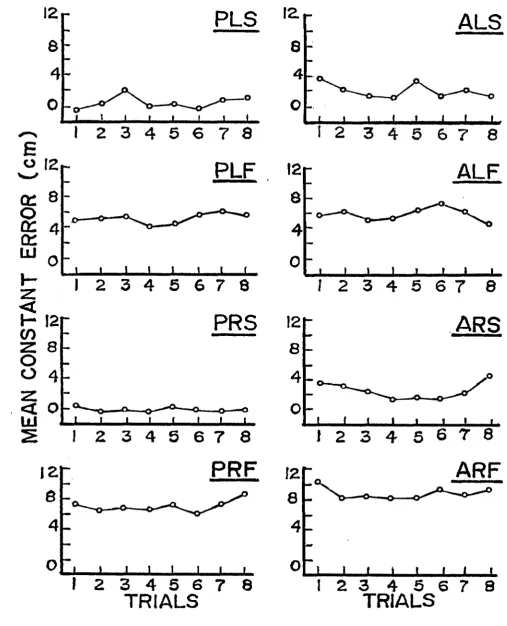
conditions of the active g r o u p . . . ... 28
3 Mean constant error of each trial for all
conditions of the passive g r o u p ... 29
4 Passive (P) , left (L), and slow (S)
components of the memory trace for the
passive g r o u p ... 80
x
CHAPTER I
INTRODUCTION
The characteristics of memory for kinesthetic infor
mation has been a topic of great interest to contemporary
researchers. During the past decade, much effort has been
devoted to determining the retention characteristics of
various sensory components of movement in an effort to
gain some insight into the form in which these variables
are encoded. Movement information that has been studied
includes torque, direction, velocity, and the variables
receiving the most attention from researchers, end-location
(the position in space a limb occupies) and extent (the
distance through w h i c h a limb is m o v e d ) . The accuracy and
precision of a reproduced movement is an indication of h o w
well that movement has been remembered over time.
A typical motor short-term memory paradigm has been
used to isolate and study the variables of end-location and
extent. Visual cues are removed by preventing the subject
from seeing either the apparatus or his arm, and white noise
is used to mask auditory cues. A criterion movement (CM)
is presented by having the subject move a slide wit h his
constrained (examiner-determined) and can be performed either
actively (the subject moves the slide) or passively (the e x
aminer moves the slide while the subject holds the carriage
w i t h a relaxed hand and a r m ) . The subject is required to
remember either the extent or the end-location of the CM so
that, after a variable retention interval (RI), he can pe r
form a reproduction movement (RM) in an effort to reproduce
the required extent or location. Extent and end-location cues
can be isolated by changing the starting position of the RM
from1 that of the CM. Thus, if location is being reproduced
the extent of movement is not reliable as a cue, and the
end-location of movement is not reliable as a cue if extent is
b eing reproduced. The RI can be manipulated to investigate
the phenomena of encoding, interference, storage, retrieval
time, and forgetting. The duration of the RI can be changed
to determine the relative stability of the memory for extent
or end-location over time. The RI can either be filled w ith
an interpolated activity to prevent rehearsal or to study the
effects of interference, o r unfilled so that rehearsal of the
information is possible. Errors due to overestimating or un
derestimating the criterion extent or location are measured.
Three measures are typically used (Roy, 1976; Schutz and Roy,
1973) : constant error (CE) is the mea n algebraic error or r e
sponse bias, variable error (VE) is the within-subject v a r i
ance, and absolute error (AE) is the average error or mean
deviation.
3
Posner (1967), using a short-term memory paradigm,
claimed that retention of information depends on central
processing. If information is capable of being coded for
storage, rehearsal of that information should prevent decay
over time. Keele and Ells (1972), finding that location
information was rehearsable while other movement information
was not, concluded that different movement variables have
different retention characteristics.
Marteniuk and Roy (1972) isolated distance and
end-location variables. Since the m ean AE was significantly
larger for distance reproduction than for end-location r e
production, they concluded that distance provides less
precise information about arm displacement than does lo
cation. Subsequent researchers indicated that primacy of
location information over extent exists for all types
(active, passive, constrained, preselected) of movement
reproduction (Marteniuk, 1973; Roy, 1977; Stelmach, Kelso,
and Wallace, 19 75).
Laabs (1973) found that over an unfilled RI, distance
information showed spontaneous decay while location infor
mation showed little forgetting. However, wit h interpo
lated mental activity (filled R I ) , a severe loss of location
information was found over that w hich was ascribed to decay.
Laabs (1973) interpreted this to mean that location infor
ting when rehearsal is blocked, whereas extent information
is not codable and so is subject to spontaneous forgetting.
Conflicting results were obtained by Marteniuk (1973):
Both extent and location information were forgotten over a
filled RI but neither were forgotten over an unfilled RI.
Both extent and location information appeared to be c e n
trally codable. A difference in methodology accounted for
the contradictory findings. Marteniuk (1973), by employing
a preselected CM rather than a constrained CM as was used »
in the Laabs (1973) study, obtained improved accuracy for
extent.
Subsequent researchers held that preselected movements
are more precisely encoded than constrained movements for
end-location and extent combined (Jones, 1974; Marteniuk,
1977), for end-location (Stelmach et al, 1975), and also
for extent (Roy, 1978; Roy and Diewart, 1975, 1978) unless
a strategy is provided by prior information about the ter
m inal position of the constrained CM (Roy and Diewart, 1975,
1978).
Using a similar paradigm, Carlton (1978) investigated
the retention characteristics of speed for preselected m o v e
ment. Both fast and slow preselected movement rates were
retained as well over an unfilled RI as over an immediate R I .
Reproduction errors increased wit h interpolated activity.
This was interpreted to mean that speed was centrally codable.
5
The retention characteristics of direction for passive
constrained and active preselected movements were studied by
Hall and Leavitt (1977) using directions radiating from the
subject's midline, one perpendicular to the frontal plane
and two others situated 45 degrees to either side. Mental
rehearsal improved performance relative to immediate r epro
duction, and interpolated activity removed the advantage.
Direction information, then, was thought to be centrally
processed.
Motor short-term memory research that is discussed
henceforth will be limited to experiments employing c o n
strained CMs in which extent of movement is reproduced.
The Encoding Specificity Principle
Bower (1967) and Tulving and Thomson (1973) have sug
gested that an episodic memory trace is composed of the
m ental storage of a set of interrelated components. The
encoding specificity principle, which comes from the verbal
literature (Thomson and Tulving, 1970; Tulving and Thomson,
1973), is a scheme for interpreting the relations between
encoded memory traces and retrieval cues. The encoding
specificity principle maintains that "specific encoding
operations performed on what is perceived determine what
is stored, and w hat is stored determines w h a t retrieval
(Tulving and Thomson, 1973, p. 353). Tulving contends that
the more precisely the conditions during output m a t c h the
conditions during encoding of the episodic me m o r y trace, the
better the retrieval. This v i e w has been supported by n u
merous investigators in the verbal field (Fisher and Craik,
1977; Pellegrino and Salzberg, 1975; Tulving and Watkins,
1975) .
An analogy can be drawn between the processes of motor
short-term memory as exhibited by a linear positioning task
%
and the encoding specificity principle in verbal short-term
memory. The memory trace is created by the encoding of the
perception of the CM. The RM, with its continuous sensory
feedback, contains the retrieval cue. Remembering the event
requires that information in the trace sufficiently matches
the information in the RM. The closer the conditons of the
RM resemble the conditions of the CM, the more accurate the
r e t r i e v a l .
Active and Passive Movement Conditions
Several researchers have found that there is a su
periority in accuracy for the reproduction of the extent
of active constrained CMs over the reproduction of the
extent of passive constrained CMs (Hall and Leavitt, 1977;
Marteniuk, 1973; Roy, 1978; Roy and Diewart, 1978). R e
cently, Lee and Hirota (19 80) cast doubt on the supposed
7
superiority of active movements when they recognized a
methodological flaw in the aforementioned studies: Re
gardless of whether the CM was in the active or the passive
mode, the RM was always in the active mode. The results
of these experiments, they argued, were confounded because
the encoding specificity principle was not taken into c o n
sideration.
Lee and Hirota (1980) correctly predicted that r e
production of extent would be more accurate when input
and output modes match than whe n they differ. They found
that active-active and passive-passive movements, while
not significantly different from each other, were sig
nificantly more accurate than either active-passive or
passive-active movements which had, themselves, equivalent
reproduction accuracies. The RI (immediate, 20 sec. filled,
and 20 sec. unfilled) had no effect. The findings suggest
that w h e n retrieval conditions m atch the conditions of e n
coding, there is no advantage to the memory trace provided
by an active as opposed to a passive movement.
Probing the Me m o r y Trace with Multiple Cues
Bower (1967) and Tulving and Watkins (1975) assume that
the me m o r y trace is multidimensional consisting of a mixture
of encoded trace elements. According to Tulving and Thomson
overlap between the memory trace and the cue in keeping with
the encoding specificity principle. Given these assumptions,
it follows that the trace can most completely and accurately
be described in terms of the pattern of effectiveness of
different types of retrieval cues in recalling target words
in a memorized list of words (Anderson, 1972; Light, 1972;
Nelson and Brooks, 1974). Although these studies provided
additional information about the nature of memory traces,
the wor k was done on a composite of m a n y different items,
and the experimenters could not determine to what extent
different cues m ight contain the same information.
Tulving and Bower (1974) and Tulving and Watkins (1975)
sought to improve the description of the memory trace. They
advocated a successive probing of a given trace with two or
more cues, taking into account the amount of information
overlap, if any, between the retrieval cues. Using p e r
centage of recall as a dependent measure, they were able,
by their complicated reduction method, to describe and
quantify the structure of the memory trace.
The basic prediction was that if the information c o n
tained in one cue is completely included in the information
contained in a second cue, then the first cue will be in
effective as a supplement to the second cue. If the in
formational contents of the two cues do not overlap, they
should exert separate additive effects on recall probability.
9
and the extent to which this is not so determines the amount
of the overlap. Two cues that overlap completely would be
redundant. Thus relations among the retrieval cues with
respect to the trace may be observed and recorded as a de
scription of the memory trace.
In the reduction method/ the successive probing, in
original and reverse order, of two cues, was necessary b e
cause the verbal memory trace, by its nature, is changed by
the act of probing with the retrieval cue. Such is not the
«
case in a linear movement paradigm, since a new trace is
provideid for every attempt of retrieval. Probing a m otor
me m o r y trace, then, should be a simpler process.
The Structure of the Memory Trace
Tulving and Bower (1974) and Tulving and Watkins (19 75)
quantitatively described the properties of a memory trace by
determining the recall probabilities of the gross, common,
and reduced valences of two or more retrieval cues. The
valence of a cue is its effectiveness with respect to a de
fined trace of a certain event which occurred under certain
conditions. The elements of the memory trace are defined
in terms of the valences of the retrieval cues.
Using Tulving and Watkins' (1975) notation, the gross
valence of a cue (X, for cue X) refers to the probability
pre-sence of that cue, and assumes a value between zero and
unity. Reduced valence refers to a cue valence that has
been reduced by some other cue. The valence of cue X
reduced by cue Y (XY) is the probability that the trace
can be retrieved by cue X and cannot be retrieved by cue Y.
The common valence or intersect of two cues such as cue X
and cue Y (XY) refers to the probability that the target
can be recalled to cue X as well as cue Y. A certain amount
of trace information overlaps with neither X nor Y (XY).
■ By determining the valences of various cues, a trace
can be depicted as consisting of its various elements in
specified percentages. If a trace is being probed by two
cues, X and Y, then XY + XY + XY + XY = 100% where XY is
the intersect of X and Y.
Measurement of Retrieval
Verbal short-term memory research typically employs
percentage correct as a measure of the subject's ability
to recall or recognize a previously encoded item. Motor
short-term memory experiments, on the other hand, tradi
tionally measure the subject's recall performance throught
the use of three error measures. According to Ho and Shea
(1978), retrieval accuracy, as measured by AE, can be more
clearly interpreted when CE, an indication of response bias,
and VE, a measure of the consistency or variability of
11
within-subject performance, are considered.
The motor short-term memory model assumes that the
reproduced movement (RM) should be equal to the
to-be-remembered item (CM) when retrieval is perfect. But is
this a valid assumption? Perhaps the reproduced m o v e
m e n t represents not only the replication of the
to-be-remembered item, but also the effects of context, s y
stematic bias, and individual sensitivity to stimuli.
If so, researchers may be attempting to precisely measure
an entity which, by its very nature, is subject to error
in measurement.
Another wa y of approaching the measurement of re
trieval of motor short-term memory information w ould be
to acknowledge the imprecise nature of the measurement s'
of retrieval items as well as individual differences in
subjects' retrieval capabilities. The
just-noticeable-difference or just-noticeable-difference limen (DL) could be estimated for
each subject by using the psychophysical method of average
error, adjustment, or reproduction. This is a procedure
that is designed to measure the amount of error that occurs
w h e n the subject adjusts one stimulus until he judges it
to be equal to another. Since a variation of the technique
is typically used in the m o t o r shcrt-term memory paradigm,
the DL can easily be determined by calculating half the
using identical CMs and RMs with immediate RIs. If resear
chers could agree that the DL, by determining each subject's
sensitivity, could be used to reasonably allow for errors
in measurement, then, on an individual basis, that much
flexibility could be allowed in determining a correct re
sponse. For example, for a subject with a DL of 2 cm for a
20 cm linear movement, a RM measuring within ±2 cm of the
CM could be counted as correct, and any measurement outside
of these limits would be counted as incorrect. Thus d e
pendent measures of reproduction accuracy w o u l d be in terms
of percentage correct based on the difference limen (PCDL).
Describing the Motor Memory Trace
A quantitative description of a motor memory trace
could be generated using a percentage correct measurement
in much the same way as Tulving and Watkins (1975) were
able to do for verbal material. The memory trace of the
movement could be constructed from its reproductions,
using cues X, Y, and Z, in the following way:
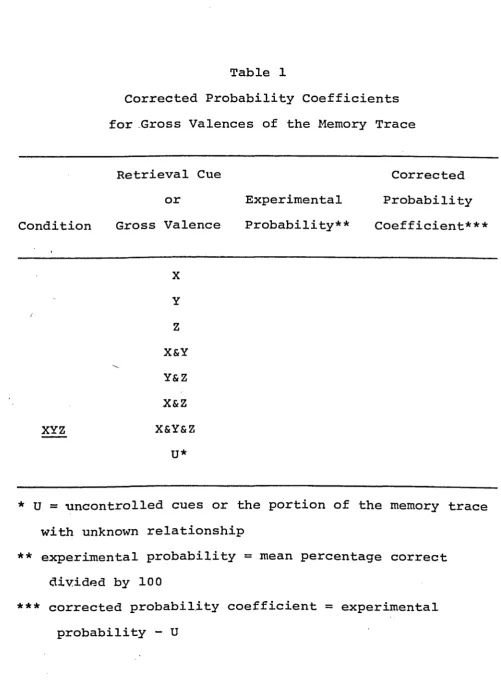
1. A table w o u l d be constructed listing the conditions, the
retrieval cues or gross valences, the experimental
probabilities, and the corrected probability coefficients
(see Table 1).
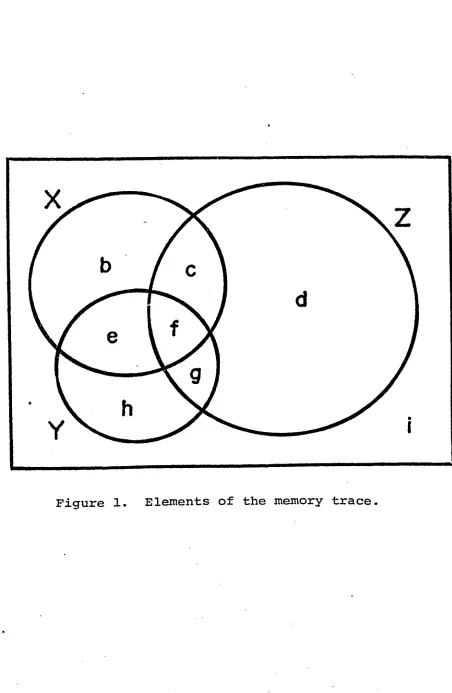
2. The elements of the memory trace are drawn and lettered
to explain the computations (see Figure 1).
13
Table 1
Corrected Probability Coefficients
for Gross Valences of the Memory Trace
Retrieval Cue Corrected
or Experimental Probability
Condition Gross Valence Probability** Coefficient***
X
J
Y
Z
X&Y
Y&Z
X&Z
XYZ X&Y&Z
U*
* U = -uncontrolled cues or the portion of the memory trace
wit h unknown relationship
** experimental probability = m e a n percentage correct
divided by 100
*** corrected probability coefficient = experimental
Figure 1. Elements of the memory trace.
15
The following equation would be used:
X&Y&Z= (b+c+e+f) + (e+f+g+h) + (c+f+g+d) - (e+f) - (c+f) - (g+f) +f
where, using corrected probability coefficients,
b+c+e+f=X e+f= (X)+ (Y)- (X&Y)
e+f+g+h=Y c+f=(X)+(Z)-(X&Z)
c+f+g+d=Z g+f=(Y)+ ( Z ) - (Y&Z)
where X&Y&Z is the union of X,Y, and Z, X&Y is the union
of X and Y, X&Z is the union of X and Z, and Y&Z is the
union of Y and Z .
Solve for f and substitute to find b,c,d,e,g,h.
i=100-(X&Y&Z)-XYZ=unmeasured variables of the trace
e.g. location
where XYZ is the union of X, Y, and Z.
3. The relationship of U to the rest of the memory trace
is unknown, but its value is an indication of the
completeness of the measured portion of the memory
trace: the lower the coefficient of U, the more
*
complete the measured portion of the trace.
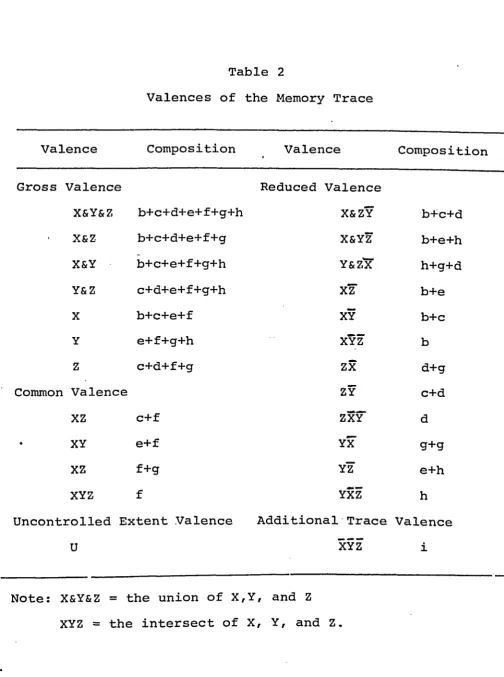
4. The coefficients of the elements can be added to
quantitatively describe the memory trace in terms
of its c o m p o n e n t s , and these values can be entered
in a table for purposes of comparison (see Table 2).
The Problem
Table 2
Valences of the Memory Trace
Valence Composition Valence
» Composition
Gross Valence Reduced Valence
X&Y&Z b+c+d+e+f+g+h X & Z Y b+c+d
X&Z b+c+d+e+f+g X&YZ b+e+h
X&Y b+c+e+f+g+h Y&z'x h+g+d
Y&Z c+d+e+f+g+h xz" b+e
X b+c+e+f XY b+c
Y e+f+g+h XYZ b
Z c+d+f+g ZX d+g
Common Valence ZY c+d
XZ c+f ZXY* d
XY e+f YX g+g
XZ f+g YZ e+h
XYZ f YXZ h
Uncontrolled Extent Valence
U
Additional Trace Valence
XYZ i
Note: X&Y&Z = the union of X,Y, and Z
XYZ = the intersect of X, Y, and Z.
17
being applicable to motor short-term memory (Lee and
Hirota, 1980). Verbal researchers (Tulving and Bower,
1974; Tulving and Watkins, 1975) have extended the ap
plication of the encoding specificity principle to in
clude a method of probing a specific memory trace with
multiple cues in order to provide a quantitative descrip-i
tion of the structure of the memory trace in terms of
its elements.
The proposed research is designed to:
1. replicate the results of Lee and Hirota (1980);
2 . apply the encoding specificity principle to the r e
trieval cues of speed and direction as they relate
to reproduction of movement extent;
3. extend the encoding specificity principle to the re
lationship of multiple cues for reproduction of m o v e
ment extent;
4. provide a quantitative analysis of the memory trace
for a specific movement with emphasis on the encoded
extent information.
Hypotheses
The following hypotheses are related to the purposes
stated above:
1 (a) The accuracy of retrieval will be significantly
same than when they are different.
2 (a) The accuracy of retrieval will be significantly
better when the speeds of the CM and the RM are the
same than when they are different.
(b) The accuracy of retrieval will be significantly
better when the directions of the CM and the RM i
are the same then when they are different.
3 (a) Reproduction accuracy for conditions in which the
CM and the RM are made in the same m o d e , at the same
speed, in the same direction will be significantly
better than the accuracy of the reproduction of
movements in which the RM is made in a different mode,
at a different speed, and in a different direction
than the CM.
(b) Conditions in which the RM contains one or two of
the retrieval cues of mode, speed, or direction that
duplicate information contained in the C M will re
sult in reproductions between the two extremes of
accuracy referred to in the above hypothesis.
4 (a) It will be possible to use the PCDL results of hy
pothesis 3 to quantitatively describe the memory
trace for an active slow movement to the left.
(b) It will be possible to use the PCDL results of h y
pothesis 3 to quantitatively describe the memory
trace for a passive slow movement to the left.
CHAPTER II
METHODOLOGY
Subjects
Thirty-two right-handed females who were randomly
chosen from a pool of volunteers enrolled in undergraduate
psychology courses at the University of Windsor received
credit towards their grade in one course. All subjects
were naive as to the purposes of the experiment.
Apparatus and Materials
The subject and the experimenter were seated on
opposite sides of a table approximately 122 cm long x
46 cm wide x 88 cm high. Attached to the top of the table
along the edge closest to the subject was a linear slide
apparatus consisting of an Ealing Optical Bench (cat.
# 22-6894), one meter, in length, and an Ealing Optical
carrier (cat. # 22-4170) w h i c h served as a slide carriage
with dimensions of 10 cm across the bench and 9 cm along
the bench. A horizontal pointer attached by a set screw
at the mid-point of the experimenter's side of the carriage
jutted out 2 m m above a meter rule (in mm) which was at
slide, permitting the experimenter to make accurate m e a s u r e
ments. Passive movements could be controlled by the e x
perimenter by moving the carriage wit h one hand while
placing a finger from the other hand along the leading
edge of the pointer. A quick stop of the carriage was
ensured by dropping the finger the short distance to the
ruler effectively blocking th e ’ movement of the carriage
at the pointer. The contact surfaces of the bench were
coated with Lubriplate to allow for near noisless and
frictionless movements of the carriage. An adjustable
stool served as the subject's seat.
On the subject's side of the slide and 109 cm above
the floor, a 122 cm x 33 cm horizontal shelf could be
adjusted towards or away from the subject. An adjustable
chin-rest was mounted midway along the length of the
shelf about 8 cm from the edge closest to the subject.
A t the edge of the shelf furthest from the subject, a
122 cm x 50 cm black visual shield tilted away from the
subject at a 135 degree angle from the shelf, effectively
blocking visual cues. A contrasting coloured dot 8 m m
in diameter, affixed to the shield midway along the
length and 13 cm below the top edge of the shield, d e
fined the visual fixation point. The subject was provided
with a set of Selfix stereo headphones, Model 6120, which
was connected to equipment on the experimenter's side of
21
the apparatus.
The limits within which the subject was able to move
the carriage were defined on the experimenter's side of
the bench by the use of plastic stops which could be ro
tated around a metal rod running parallel to the bench
in such a way that the stops could be propped against the
»
bench and rotated away. Silicone cement covered contact
surfaces of the stops to minimize auditory cues. A small
microphone and the earphones were connected to a no n
commercial white noise generator with an output set at
82 dB so that either instructions or white noise could
be relayed to the subject.
Experimental Design
The experiment consisted of 16 conditions arranged
i n a 2 x 2 x 2 x 2 design. There were two presentation
(CM) conditions: active left slow (A L S ) and passive left
slow (PLS); two modes of retrieval: active (A) and
passive (P); two directions of retrieval: to the left
(L) and to the right (R); and two speeds of retrieval:
slow (£) and fast (F); with repeated measures on the mode,
speed, and direction of retrieval factors and independent
groups on the presentation condition factor. Subjects
were randomly assigned to groups so that half the subjects
because she neglected to use the chin-rest for some of
the conditions, and one because an electrical storm
caused the lights to flicker erratically during the
testing session. Replacement subjects were randomly
selected from the original pool of volunteers.
A trial was defined as the presentation of a CM and
its reproduction. Each subject received 6 4 trials broken
down into two blocks of 32 trials, one under passive
and one under active modes of retrieval. Each of these
blocks was further broken down into two 16 trial blocks
so that right and left directions were used in an ABBA
order across the four 16 trial blocks. Each of these
blocks was in turn broken down into two 8 trial b l o c k s ,
so that retrieval involved slow and fast movements in
an ABBABAAB order across the eight 8 trial blocks. Each
of these blocks represented one condition. All blocks
were completely counterbalanced across subjects in each
group (see Appendix A ) .
The CMs were all 20 cm long and started 10 cm to
the right of the subject's midline and terminated 10 cm
to the left of the subject's midline. Within conditions,
starting positions of the RM were randomly presented so
that each of four starting positions (±5 and ±10 cm from
the beginning or end of the CM) appeared two times.
23
Procedure
The subject began the experimental session in a
room adjacent to the test room where a brief written ex
planation of the task requirements was read (see Appen
dix B ) . After answering any questions raised by the
subject, the experimenter led the subject into the test
room. The subject was seated so that the saggital plane
of the body was opposite the chin-rest and the mi d
point of the slide, and the subject's stool was adjusted
up or down so that the forearm was parallel to the floor
when the carriage handle was grasped. The chin-rest ap
paratus was adjusted so that the subject felt comfortable
with the head secured in the chin-rest. The shelf was
adjusted so that when the carriage handle was grasped the
subject would not feel cramped yet there would be freedom
to complete the required lateral movements across the
.body. The subject wore the earphones through which the
instructions and the white noise were presented.
Prior to the experiment, the rates at which fast and
slow movements occurred had been practised by the ex
perimenter until they were judged to be relatively con
sistent as well as clearly discriminable from each other.
The fast movement, when conducted over a distance of 20 cm,
feedback (Chernikoff and Taylor, 1952).
The experimental session consisted of two phases:
a pretest and a test phase. During the pretest phase
(see Appendix B) the examiner asked the subject to keep
the chin secured on the chin-rest and to fixate on the
coloured dot on the visual shield whenever a movement
was made (as suggested by Marteniuk, 1978). The subject
was given three 40 cm passive slow movements to the left
and three to the right, during which she was instructed
to totally relax the arm. This was followed by three
active slow movements to the left and three to the right
during which the subject was encouraged to move at the
same speed as the passive movements. The same procedure
was repeated using fast movements. A 30 cm CM was p r a c
tised twice, followed by two practise trials of 30 cm with
the RM in the same mode, direction, and speed as the CM
^ and with random start positions ±5 and ±10 cm from the
start of the CM, followed b y two similar trials with the
mode of the RM changed. The first time the subject used
a passive RM, he was instructed to say "stop" when the
required distance had been reached. The pretest con
cluded wit h a brief explanation of the test and assurances
that there would be a practice before each condition.
The test phase consisted of eight blocks of eight
trials, each with instructions (see Appendix B) and p rac
25
tice before each. There was a 5 min. break before the
first condition and another between conditions four and
five, at which time the subject was encouraged to leave
the room and move around. All practise trials had ex
tents of 30 cm, and starting positions of the RM were
randomly selected. There were two practise trials b e
fore each^condition. More practise trials w e r e used if
necessary to mee t the criterion of speed as judged by
the experimenter or if, in passive reproduction condi
tions, the subject was dissatisfied w ith the place that
the carriage was stopped. The experimental trials,
wit h extents of 20 cm and random RM start positions of
±5 and ±10 cm from those of the CM so that each occurred
twice, were aborted and restarted if they were not p r o
perly carried out.
The entire experiment, including the reading of
instructions and the two 5 min. breaks, took about 80 min.
Data Analysis
The mean CE was computed for each group across sub
jects for each of the eight successive trials of each of
the eight conditions. These means were plotted on a
graph to provide a visual check for possible confounding
due to repetition effects.
three dependent measures were used: AE, CE, and VE.
A fourth dependent measure was also used: PCDL. A
RM was deemed to be correct when its extent was +DL (in cm)
from the extent of the CM. The DL was estimated by cal
culating half the range across the eight trials of the
condition in which the CM and RM were ide n t i c a l .
Each dependent measure was analyzed using a four-way
analysis of variance (ANOVA) with repeated measures on
the last three factors. Post-hoc comparisons were per
formed using Duncan's new multiple range procedure (Duncan,
1955; Edwards, 19 72) to assess hypotheses 1 and 2. Post
hoc comparisons of the zero-cue and three-cue conditions of
each group were made to assess hypothesis 3 using Duncan's
new multiple range procedure using the means for all 16
conditions of both groups. The means for the 8 conditions
of each group were used to generate a qualitative description
of the memory trace for both the ALS and the PLS groups to
assess hypothesis 4.
CHAPTER III
RESULTS
Repetition Effects
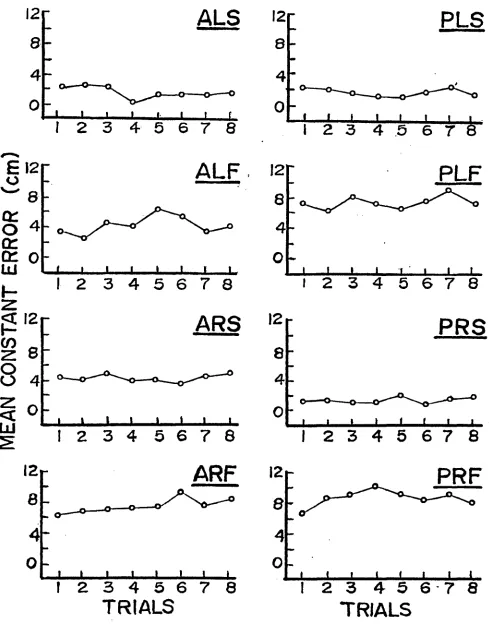
The mean CE, averaged across subjects in each group,
was plotted for each of eight successive trials on graphs
representing each of the eight conditions (see Figures 2-3).
A visual check of the graphs did not reveal any systematic
repetition effects.
Absolute Error (AE)
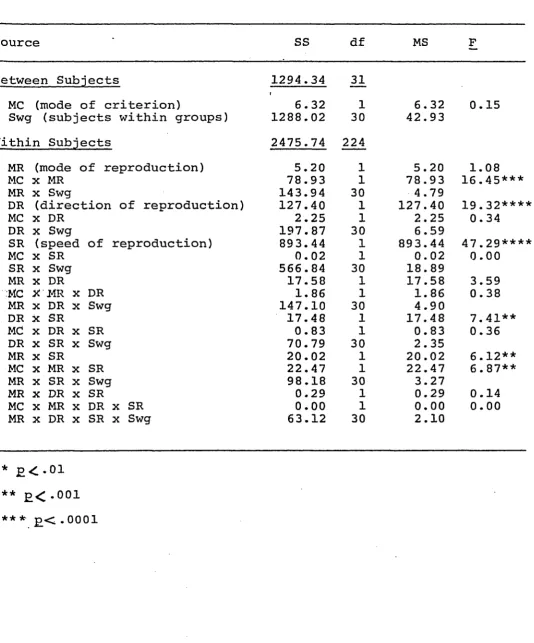
Analysis of variance for AE is summarized in Table 3.
The m a i n effects for the direction of reproduction, F(l,30)
= 19.32, £ < . 0 0 0 1 , and speed of reproduction, F(l,30) =
47.29, £ < . 0 0 0 1 , were significant. No other main effects
reached significant levels. Interactions of mode of cr i
terion by mode of reproduction, F(l,30) = 16.45, £ < . 0 0 1 ,
direction of reproduction by speed of reproduction, F(l,30)
= 7.41, £<*.01, mode of reproduction by speed of reproduc
tion, F(l,30) = 6.12, £ < . 0 1 , and mode of criterion by mode
of reproduction by speed of reproduction, F(l,30) = 6.87,
£ < • 0 1 , were significant. No other interactions were sig
M
EA
N
C
O
N
S
T
A
N
T
E
R
R
O
R
(c
m
)
1 2 3 4 5 6 7 8
1 2 3 4 5 6 7 8
ARS
1 2 3 4 5 6 7 8
PRS
o
-I
2 3 4 5 6 7 8
ARF
!
2 3 4 5 6 7 8
1 2 3 4 5 6 7 8
t r ia l s
t r ia l s
Figure 2. Mean constant error of each trial for all
conditions of the active group.
M
EA
N
C
O
N
S
T
A
N
T
E
R
R
O
R
(c
m
)
29
12
t
1 2
3 4 5 6
8
PLS
1
2 3
5 €8
12
8
4
O
I
2 3 4 5 6 7 Q
I2r
o-
■o-I
2 3 4 S 6 7 8
-O-6 T 8
~o-I
2 3 4 5 6
8
f2
8
4
0
1 2 3 4 5 6 7 8
TRIALS
TRIALS
Table 3
Analysis of Variance Summary Table for Absolute Error
Source SS df MS F
Between Subjects 1294.34 31
MC (mode of criterion)
t
6.32 1 6.32 0.15
Swg (subjects within groups) 1288.02 30 42.93
Within Subjects 2475.74 224
M R (mode of reproduction) 5.20 1 5.20 1.08
MC x MR 78.93 1 78.93 16.45***
M R x Swg 143.94 30 4.79
DR (direction of reproduction) 127.40 1 127.40 19.32***’
MC x DR 2.25 1 2.25 0.34
DR x Swg 197.87 30 6.59
SR (speed of reproduction) 893.44 1 893.44 47.29***’
MC x SR 0.02 1 0.02 0.00
SR x Swg 566.84 30 18.89
MR x DR 17.58 1 17.58 3.59
MC X M R x DR 1.86 1 1.86 0.38
MR x DR x Swg 147.10 30 4.90
DR X SR 17.48 1 17.48 7.41**
MC x DR x SR 0.83 1 0.83 0.36
DR x SR x Swg 70.79 30 2.35
MR x SR 20.02 1 20.02 6 .12**
MC X M R x SR 22.47 1 22.47 6.87**
MR x SR x Swg 98.18 30 3.27
MR X DR x SR 0.29 1 0.29 0.14
MC x MR x DR x SR 0.00 1 0.00 0.00
MR x DR x SR x Swg 63.12 30 2.10
** £ < *01
*** £ < .001
* * * * £ < .0001
31
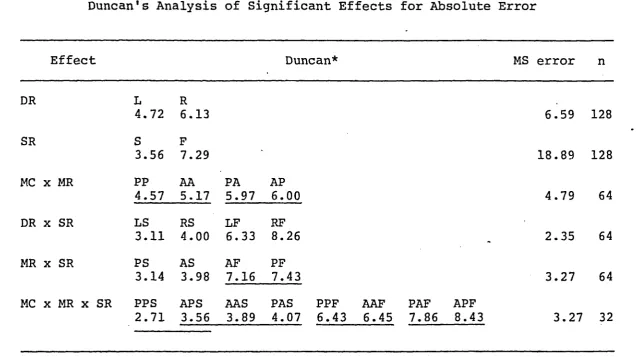
Post hoc comparisons are shown in Table 4. Analysis
of the main effects showed that RMs to the left (x = 4.72 cm)
were significantly more accurate than RMs to the right
(x = 6.13 cm). Slow RMs (x = 3.56 cm) were performed with
significantly better accuracy than fast RMs (x = 7.29 cm).
Duncan's analysis of the mode of criterion by mode of
reproduction interaction revealed that when the modes of
execution were the same there was significantly more
accuracy (passive-passive x = 4.5 7 cm, active-active x =
5.17 cm) than when the modes of execution were different
(passive-active 3T = 5.97 cm, active-passive x = 6.00 cm).
The active-active and passive-passive conditons were not
significantly different, nor were the passive-active and
active-passive c o nditions.
Analysis of the direction of reproduction by speed of
reproduction interaction indicated that left-slow (x =
3.11 cm) was significantly more accurate than right-slow
(x = 4.00 cm) which was significantly more accurate than
left-fast (5c = 6.33 cm) which was significantly more ac
curate than right-fast ( x = 8.26 cm).
Analysis of the interaction of mode by speed of the
RMs showed that passive-slow (x = 3.14 cm) were signi~
ficantly more accurate than active-slow (3c = 3.9 8 cm) m o v e
active-w ith p e rm is s io n of th e co pyr ig ht o w ne r. Fu rthe r rep roduction p ro h ib it e d wi th ou t p e rm is s io n .
Duncan's Analysis of Significant Effects for Absolute Error
Effect Duncan* MS error n
DR L R
4.72 6.13 6.59 128
SR S F
3.56 7.29 18.89 128
MC x MR PP AA PA AP
4.57 5.17 5.97 6.00 4.79 64
DR x SR LS RS LF RF
3.11 4.00 6.33 8.26 - 2.35 64
MR x SR PS AS AF PF
3.14 3.98 7.16 7.43 3.27 64
MC x MR X SR PPS APS AAS PAS PPF AAF PAF APF
2.71 3.56 3.89 4.07 6.43 6.45 7.86 8.43 3.27 32
* All pairs of means not connected by a horizontal line are significantly different,
df=30, p < .05
Note: MC = mode of criterion, MR = mode of reproduction, DR = direction of re production, SR = speed of reproduction, A = active, P = passive, L = left,
33
fast (x = 7.16 cm) or passive-fast (x = 7.43 cm) movements
w hich were not significantly different from each other.
Analysis of the interaction of mode of criterion by
mod e of reproduction by speed of reproduction revealed that
all the slow components of the interaction were signifi
cantly more accurate than all the fast components.
Passive-passive-slow (x = 2.71 cm) movements were not significantly
different from active-passive-slow (x = 3.56 c m ) , but were
significantly mor e accurate than active-active-slow (x =
3.89 cm) and passive-active-slow (x = 4.07 cm). The latter
three components were not different from each other.
Passive-passive-fast (x = 6.43 cm) movements were not
different from active-active-fast (x = 6.45 cm), but they
were significantly better than both passive-active-fast
(x = 7.86 cm) and active-passive-fast (x = 8.43 cm) m o v e
ments which were not different from each other.
Constant Error (CE)
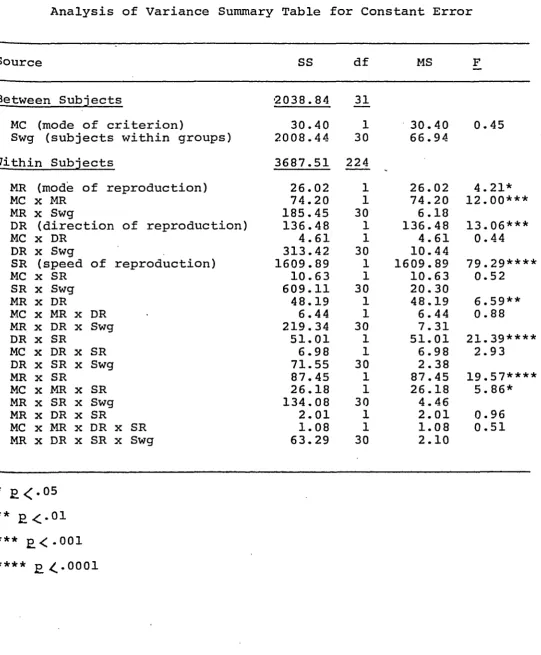
Analysis of variance for CE is summarized in Table 5.
M a i n effects for mode of reproduction, F(l,30) = 4.21,
£ < • 0 5 , direction of reproduction, F(l,30) = 13.06, £ < . 0 0 1 ,
and speed of reproduction, F(l,30) = 79.29, £<..0001, were
significant. There were no other main effects. Inter
Table 5
Analysis of Variance Summary Table for Constant Error
Source SS df MS F
Between Subjects ■2038.84 31
MC (mode of criterion) 30.40 1 30.40 0.45
Swg (subjects within groups) 2008.44 30 66.94
Within Subjects 3687.51 224
MR (mode of reproduction) 26.02 1 26.02 4.21*
MC x MR 74.20 1 74.20 1 2 .00***
M R x Swg 185.45 30 6.18
DR (direction of reproduction) 136.48 1 136.48 13.06***
MC x DR 4.61 1 4.61 0.44
DR x Swg 313.42 30 10.44
SR (speed of reproduction) 1609.89 1 1609.89 79.29***'
MC x SR 10.63 1 10.63 0.52
SR x Swg 609.11 30 20. 30
M R x DR 48.19 1 48.19 6.59**
MC X M R x DR 6.44 1 6.44 0.88
M R x DR x Swg 219.34 30 7.31
DR x SR 51.01 1 51.01 21.39***'
MC x DR x SR 6.98 1 6.98 2.93
DR x SR x Swg 71.55 30 2.38
M R x SR 87.45 1 87.45 19.57***'
MC x M R x SR 26.18 1 26.18 5. 86*
M R x SR x Swg 134.08 30 4.46
M R x DR x SR 2.01 1 2.01 0.96
MC x M R x D R x SR 1.08 1 1.08 0.51
M R x DR x SR x Swg 63.29 30 2.10
* £ < . 0 5
** £ . 01
*** £ < .001
**** £ < .0001
♦
35
F(l,30) = 12.00, £ < . 0 0 1 , mode of reproduction by direction
of reproduction, F(l,30) = 6.59, £ < . 0 1 , direction of re
production by speed of reproduction, F(l,30) = 21.39,
£ < . 0 0 0 1 , mode by speed of reproduction, F(l,30) = 19.57,
£ < . 0 0 0 1 , and mode of criterion by mode of reproduction by
speed of reproduction, F(l,30) = 5. 8 6 , £ < . 0 5 , were all t
significant. No other interactions reached significant
levels.
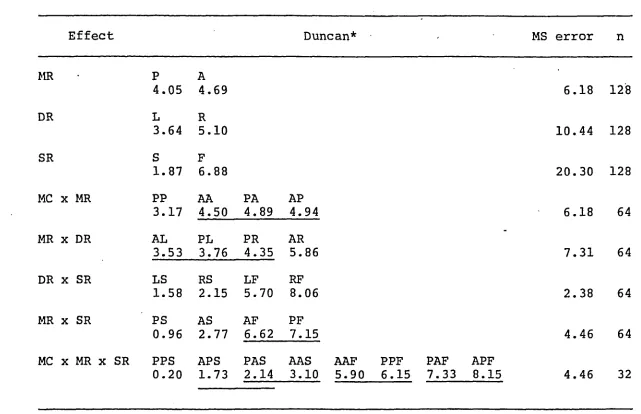
Post hoc comparisons are shown in Table 6 . All means
indicated that all types of movements tended to be overshot.
For the RM, active movements (x = 4.69 cm) were overshot to
a greater extent than passive movements (x = 4.05 cm), m ove
ments to the right (x = 5.10 cm) were overshot more than
movements to the left (x = 3.64 cm), and the overshooting
of fast movements (x = 6.8 8 cm) exceeded the overshooting
of slow movements (x = 1.87 cm).
A Duncan's post hoc analysis revealed that in the mode
of criterion by mode of reproduction interaction,
active-active (x = 4.50 cm), passive-active-active (x = 4.89 cm), and
passive-passive (x = 4.94 cm) movements, while not signi
ficantly different from each other, all overshot
passive-passive movements (x = 3.17 cm).
The .node of reproduction by direction of reproduction
interaction indicated that active-left (x = 3.5 3 cm),
w ith pe rm is s io n of th e co py ri gh t o w ne r. Furth er re production p ro h ib it e d w it h ou t p e rm is s io n .
Duncan's Analysis of Significant Effects for Constant Error
Effect Duncan* - MS error n
MR .
P A
4.05 4.69 6.18 128
DR L R
3.64 5.10 10.44 128
SR S F
1.87 6.88 20.30 128
MC x MR PP AA PA AP
3.17 4.50 4.89 4.94 6.18 64
MR x DR AL PL PR AR
3.53 3.76 4.35 5.86 7.31 64
DR x SR LS RS LF RF
1.58 2.15 5.70 8.06 2.38 64
MR x SR PS AS AF PF
0.96 2.77 6.62 7.15 4.46 64
MC x MR x SR PPS APS PAS AAS AAF PPF PAF APF
0.20 1.73 2.14 3.10 5.90 6.15 7.33 8.15 4.46 32
--- oj
<T> * All pairs of means not connected by a horizontal line are significantly different,
df=30, J3< . 05
Note: MC = mode of criterion, MR = mode of reproduction, DR = direction of re production, SR = speed of reproduction, A = active, P = passive, L = left,