11
Journal of Advanced Research in
Occupational Safety and Health
Journal homepage: www.akademiabaru.com/arosh.html ISSN: 2637-0255
Hazard Control Management on Optimization Layout of Vent
Stack at Offshore Platform
Asyraf Zaman1, Mohd Nabil Muhtazaruddin1,∗, Sallehuddin Muhamad1, Nurul Aini Bani1, Siti Armiza Mohd Aris1, Abdul Yasser Abd Fatah1
1 UTM Razak School of Engineering and Advanced Technology, Universiti Teknologi Malaysia, 54100 Jalan Sultan Yahya Petra, Kuala Lumpur,
Malaysia
ARTICLE INFO ABSTRACT
Article history:
Received 5 February 2018
Received in revised form 4 April 2018 Accepted 2 May 2018
Available online 1 July 2018
The flaring is a normal practice in the oil and gas industry to achieve a safe and reliable process during the emergency situation. This situation is a routine practice for oil and gas production by controlled burning of natural gas. The burning process can cause hazards by explosion or at the very least surrounding environment will be affected by heat radiation during vent stack burning operation. Hence, investigation of the gas flaring produced by the vent stack is needed to tackle these problems. This paper presents designing a safe vent stack position in the limited space of oil and gas platform with considered the heat radiation produced by the vent stack. The simulation will be done by using flaresim software to predict the heat contour, heat radiation, and gas dispersion. The results proved that the optimal position of vent stack with water sheild gives a better heat radiation.
Keywords:
Vent stack, heat radiation, gas flaring, gas dispersion, gas simulation, safe
design Copyright © 2018 PENERBIT AKADEMIA BARU - All rights reserved
1. Introduction
Gas flaring is the controlled burning of natural gas in the course of routine oil and gas production operations. This burning occurs at the end of a flare stack or boom and cause hot to surrounding environment. Oil production at upstream and downstream phases can’t avoid the gas flaring as for example, in 2010 the total of oil produced in the world was 87.2 million barrel per day and estimation of gas flaring 137.3 billion cubic meters for the same year, the average emission factor was 4.3 cubic meter per barrel of oil produced as shown in Table 1 [1].
Gas flaring will cause inconvenient environment to workers. The surrounding area will become noise and hot because of heat distribution by gas flaring. Very hot environments can be dangerous to health. Workers will exposure to heat in workplace and can cause source to occupational illness especially to oil and gas operator where to operate and maintenance work. Gas flaring can cause heat stress to oil and gas worker. The environment temperature will rise and workers need to
∗Corresponding author.
E-mail address: [email protected] (Mohd Nabil Muhtazaruddin)
Penerbit
Akademia Baru
12
maintain his body temperature to normal. Heat stress can occurs when body is overheated and losses its ability to cool itself by sweating. This situation can cause heat stroke, heat exhaustion and even death. It also can affect the worker performance job, risk the health of workers that can cause injuries and accident because of dizziness. More than that, the effect of heat stress by gas flaring will decrease mentally and physically operator’s work execution and dangerous to them if they work with machine or at height. [2] Acute health impact. Heat Stroke, Heat Syncope, Other heat illness, chronic health impact. Possible link to kidney, liver, heart, digestive system, central nervous system & skin problems. Gas flaring by vent stack or burner boom will cause different of temperature contour, emit thermal radiation and spread of gas dispersion. All of these effect are hazards to oil and gas operators who work on the production platform especially near to vent stack and risk to helicopter to landing in helideck area. Thermal radiation effect will warm the skin then becomes painful. After that, effect of 2degree burn will affect the skin depth of burn increasingly with time at stable of radiation level. Eventually, all the skin thickness will burn and underlying flesh will start to damaged and at 3degree burn will start. The gas flaring will give HSE and hazard issue on work in hot conditions and explosion. It also will effect offshore equipment if not organized well. The vent stack must place at suitable place with safety and health aspect must be considered.
Table 1
13
The study from Diaz et al., [3] trying to solved problem of toxic gas dispersion affecting humans in control room. Two methods have been used in this research, the first method is deterministic and stochastic, the random effect of meteorological conditions and reported to database on the toxic dispersion. The second method is Monte Carlo where to estimate the directional risk distribution for a given release scenario. The deterministic approach is based on the worst scenario where the stochastic meteorological condition is reduced to calm conditions.
Researchers [4] have developed new approach to optimizing the facility sitting and layout for fire and explosion. The structure collapse one of disaster that need to be avoided, structure collapse can be started from property damages by fire or explosion accidents that source from flammable material in the structure or the structure itself is flammable material. Study from [5] produce method designing safe layout with various safety distance measure using risk index that produce MILP approach. In additional, the author proposed modified individual risk index when a person work or near to dangerous equipment in the facilities.
Researchers [6] have produced a set of piecewise differentiable equation from graphical description and converted into complete formulation to produce optimization layout with some variables consideration to affecting the index. Result from the formula is mixed integer non-linear program (MINLP), the result can be solved by GAMS code. This research is continuity from the domino hazards index used that introduced by Tugnoli, Khan, Amyotte, and Cozzani [7], to produce domino effects based on hazards caused by a unit in a given layout. The study from [8] a stochastic approach for risk analysis in vapour cloud explosion. The method used in this study is stochastic approach to evaluate the risk vapor cloud explosion. Stochastic factor that is liable to vary or change are used calculate the chance of vapour cloud to explosion where the frequency of the release, probability of immediate ignition, probability of delayed ignition, probability of vapour cloud explosion given a delayed ignition, and meteorological factor also has be considered.
Researcher [9] used bow tie analysis method for fire and explosion risk developed for hazardous unit instead of predetermined worst-case scenario. In the chemical plant safety is very important especially in designing stage and operation of the plant. MINLP model have used in this study to optimization plan layout with safety consideration problem with GAMS to solve the MINLP problem.
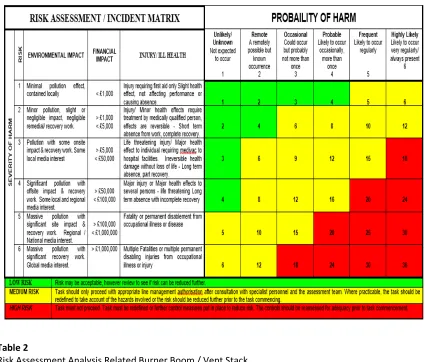
2. Risk Assessment Analysis
14
Table 1
Risk Assessment Analysis Matrix
Table 2
Risk Assessment Analysis Related Burner Boom / Vent Stack
3. Results and Discussion
15
burned to make sure the gas will not cause other problem such as methane cloud that is very dangerous to atmosphere. The engineering solution can be applied to study the heat radiation produce from flaring, and make some contour of the heat radiation. The heat radiation can be reduced by water shield and mostly reduced the risk of flaring operation. The engineering method is very important to make sure the heat radiation can be reduced.
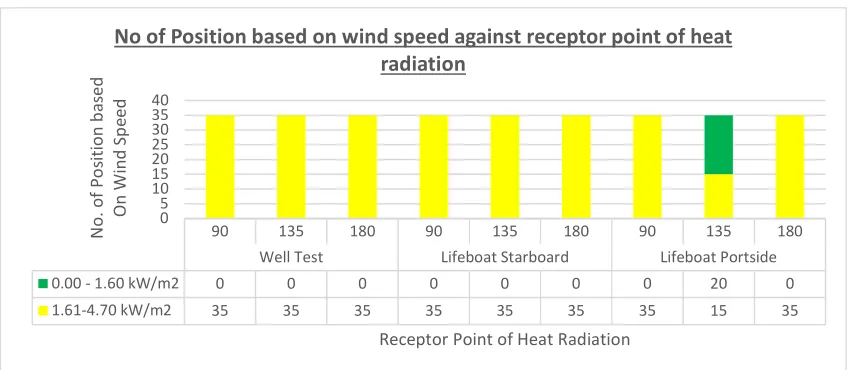
Fig. 2. Number of Position Based On Wind Speed against Receptor Point of Heat Radiation
Figure 2 shows number of position based on wind speed againt receptor point of heat radiation. The best place for burner boom position is where all the result of receptor point in green zone. The high result of receptor point in green zone will cause less place of receptor point to focus in reduce the heat radiation. Based on the results obtained, the best position for burner boom is at 1350.
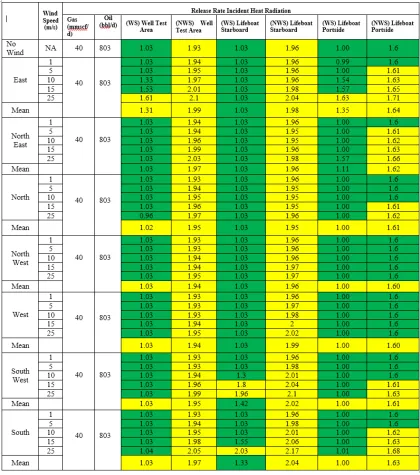
Table 3 shows result of heat radiation with and without water shield at burner boom at 1350 Position. Result without water shield is only 85 places in yellow zone (81%) and 20 places already in green zone (19%). Result with water shield is 5 (4.76%) places in yellow zone and 100 (95.24%) places in green zone.
Figure 4 shows position of burner boom at the MODU aft. As we can see the burner boom can be at 900,1350, and 1800 angle and the best angle is at 1350 as discussed in Figure 2. From the figure, the red line is equipment layout area for well test area where all equipment and operator will work in this area. The area approximate is 400m2 and all equipment must be in this area. The arrangement of equipment depend on the hazardous and non-hazardous area, process flow, piping, weight, equipment dimension, ventilation, utility system, and many more to obtain optimization layout. The flaring operation as described in risk assessment analysis can be dangerous to equipment and worker. This optimization equipment layout can’t be achieved if all the area in yellow zone where it can harm operator and equipment. The best position of burner boom is at MODU aft where it outside from MODU and far from MODU receptor point, and the burner boom can be rested at 00 when the MODU move from one place to another place. More than that, we can see position of crane cabin, lifeboat station 1 and 2 at portside and starboard of the MODU.
90 135 180 90 135 180 90 135 180
Well Test Lifeboat Starboard Lifeboat Portside
0.00 - 1.60 kW/m2 0 0 0 0 0 0 0 20 0
1.61-4.70 kW/m2 35 35 35 35 35 35 35 15 35
0 5 10 15 20 25 30 35 40 N o . o f P o si ti o n b a se d O n W in d S p e e d
Receptor Point of Heat Radiation
16
Table 3
Result of Heat Radiation at Burner Boom 1350 Position with and Without Water shield
17
Fig. 4. Positioning of Burner Boom at 90,1350, and 180 with receptor point at MODU aft
4. Conclusion
This paper presents an inclusive review of optimization layout of well test or LPS on offshore platform through Autocad and Flaresim simulation software to discover heat radiation on MODU. The vast number of heat radiation area with variation of wind speed and direction give the result more precise based on real situation. This research project can improve the occupational safety and health for operator working at oil and gas platform by reducing hazard of heat radiation with the implementation of optimization layout safe design and decreasing of surrounding heat radiation by engineering control method. The optimization layout also increase operator work time in work area while the burner boom burn gas or oil at once it will increase quality and productivity of operator and management also can minimized budget to buy special personal protective equipment for heat radiation. The future recommendation of this study is to obtain the real record of heat radiation produced by burner boom and heat radiation detector can be installed at work area to give warning alarm when radiation is more than 1.6kW/m2.
References
[1] Soltanieh, Mohammad, Angineh Zohrabian, Mohammad Javad Gholipour, and Eugenia Kalnay. "A review of global gas flaring and venting and impact on the environment: Case study of Iran." International Journal of Greenhouse Gas Control 49 (2016): 488-509.
[2] Al Ali, Mohamad Abdulla, and Prabir Kumar Sarkar. "Rising Heat, Rising Threat-Hydrate Before It's Late." In Abu Dhabi International Petroleum Exhibition and Conference. Society of Petroleum Engineers, 2014.
[3] Diaz, Christian O., Richart Vázquez-Román, Seungho Jung, and M. Sam Mannan. "A comparison of deterministic and stochastic approaches to solve the facility layout problem with toxic releases." In Computer Aided Chemical Engineering, vol. 26, pp. 93-98. Elsevier, 2009.
18
[5] Han, Kyusang, Inhyuck Choi, and En Sup Yoon. "Optimal layout of chemical process using risk index approach to minimize risk to human." In Computer Aided Chemical Engineering, vol. 31, pp. 1276-1280. Elsevier, 2012. [6] de Lira-Flores, Julio, Richart Vázquez-Román, Antioco López-Molina, and M. Sam Mannan. "A MINLP approach for
layout designs based on the domino hazard index." Journal of Loss Prevention in the Process Industries 30 (2014): 219-227.
[7] Tugnoli, Alessandro, Faisal Khan, Paul Amyotte, and Valerio Cozzani. "Safety assessment in plant layout design using indexing approach: Implementing inherent safety perspective: Part 2—Domino Hazard Index and case study." Journal of Hazardous Materials 160, no. 1 (2008): 110-121.
[8] Ramírez-Marengo, Clementina, Christian Diaz-Ovalle, Richart Vázquez-Román, and M. Sam Mannan. "A stochastic approach for risk analysis in vapor cloud explosion." Journal of Loss Prevention in the Process Industries 35 (2015): 249-256.