78: 5–8 (2016) 85–90 | www.jurnalteknologi.utm.my | eISSN 2180–3722 |
Jurnal
Teknologi
Full Paper
CONCEPT STUDY OF MICROGRID DISPATCH STRATEGY
FOR SOLAR THERMAL POWER PLANT WITH THERMAL
STORAGE
Noor Bazila Sharifmuddin
a*, Tohru Suwa
a, Sheikh Ahmad Zaki
Shaikh Salim
ba
TAKASAGO
Thermal/Environmental
Systems
Laboratory,
Malaysia-Japanese International Institute of Technology, Universiti
Teknologi Malaysia, Kuala Lumpur, Malaysia
b
Wind Engineering for (Urban, Artificial, Man-Made) Environment
Laboratory, Malaysia-Japanese International Institute of
Technology, Universiti Teknologi Malaysia, Kuala Lumpur, Malaysia
Article history Received 15 September 2015 Received in revised form
19 December 2015 Accepted 21 January 2016
*Corresponding author
[email protected]
Graphical abstract
Abstract
Complex grid systems have been gradually replaced by smaller and simpler grid systems called Microgrids. Integration of a solar thermal power generation systems into Microgrids open a new horizon of renewable energy power generation to achieve the supply and demand balance of electricity. Microgrid dispatch strategy is a control method of energy balance between power generation and electricity consumption. A thermal storage integrated into the system buffers the intermittency of solar radiation used as the heat source of the power generation system. The daily starting time for the power generation is determined by the dispatch strategy in search of minimum power from the conventional grid and maximum electricity generation from the solar thermal power generation system. In the simulation stage, the heat energy available for power generation and amount of thermal energy saved in the thermal storage is calculated at each time step using measured solar radiation data as the heat source and load profile data as the consumption required. Based on the simulation result, the power generation starting time for the next day is determined. The effectiveness of the proposed dispatch strategy is demonstrated by obtaining the best starting time and identifying minimum power requiredfrom the conventional grid. The power supply from the conventional grid is reduced by 10% by applying the proposed methodology.
Keywords: Solar radiation; solar thermal power plant; thermal energy storage; dispatch strategy; microgrid
© 2016 Penerbit UTM Press. All rights reserved
1.0 INTRODUCTION
Throughout these centuries, fossil fuels have been used for the electricity generation as the main source of energy. By burning the fossil fuels, the greenhouse gases which cause global warming are released. Thus penetration of renewable energy in electricity generation has gathered worldwide interest as an alternative for providing clean and environmentally friendly energy to the earth. On the contrary, the
intermittency of some of the renewable energies such as wind or solar energy requires an energy management system or an integration of storage system in order to provide continuous electricity to the consumer.
conventional grid imposed low system reliability as a small failure of the system might cause the entire system to shut down. Microgrid concept that eliminates the complexity of the current grid provides an alternative to the conventional system. Microgrid, which acts as a single controllable unit is a localized system consists of distributed generation, load consumption and control system positioned at distribution level usually near to the load [1]. As the Microgrid is a low voltage distribution system, the stochastic nature of renewable energy is managed more efficiently than integrating directly into the conventional grid. The smaller scale system enables its real time data controller to balance electricity generation with consumption. It is difficult for the centralized and interconnected systems of the conventional grids to manage the system stability and reliability of generation and consumption.
Solar thermal power generation systems are usually built in a high solar radiation and deserted locations. Therefore renewable energy generation has been operated without considering the balance of demand and supply. Since the systems have been built away from the cities, power generation control based on the varying demand has not been possible. Microgrid provides a platform for solar thermal power generation to be implemented and operated closer to the consumers. This will be an emerging technology where electricity is generated based on the solar radiation availability and consumption demand.
Despite the fact that various Microgrid technologies have been reported, most of them were related to Micro grid dispatch strategies for cost reduction. Operations of Micro grid integrated with various distributed generation and objective functions have been summarized and reviewed [2]. An operation
strategy approach called expert energy
management system (EEMS) was proposed [3]. In this system, optimal set points of distributed generation and storage devices were used to minimize the total operation cost and the net carbon dioxide emission. A dispatch schedule using hyper heuristics algorithms where the discharge schedule is planned based on the capacity and the performance (charge and discharge rate) of the battery to meet the consumption demand and to reduce the consumption from the conventional grid was presented[4].A forward looking dispatch strategy is proposed for future energy storage planning [5]. With the objective to minimize the cost of implementation and operation of a Microgrid, this study carried out nonlinear component submodules by using moving time horizon to solve the optimal dispatch approach. A global optimization method aimed to minimize daily energy rates cost for the day ahead is presented [6]. Three types of approaches were developed to retrieve an optimal power dispatch from conventional grid. Despite the fact that various renewable energy sources were used for distributed generation, solar thermal power generation with thermal energy storage remained an unexplored energy source to be
integrated into Microgrid. By replacing expensive batteries with thermal storage, it is possible to generate electricity without solar radiation for hours. The thermal storage compensates the fluctuation of the solar radiation and extends the operation time of the solar power generation system during the nighttime. By controlling the operation period during the nighttime, the electricity supply from the conventional grid can be reduced.
In this paper, a solar thermal power generation system is integrated into a Microgrid system. Thermal storage is used to generate electricity when solar radiation is not available by saving the excess heat energy during the daytime. In the proposed system, the thermal storage replaces the battery. In order for the grid system to work efficiently and to compensate the fluctuation of solar energy, the conventional grid is connected to the system. Demand and supply
management operation requires managing
intermittency of solar energy and solar thermal storage rate for effective energy supply to the consumers. Therefore, a concept study of Microgrid dispatch strategy by optimizing starting time of power generation from thermal storage, which impacts on the minimization of supply energy imported from the conventional grid is formulated.
The rest of the paper is organized as follows;
section2 presents the Microgrid component
implementation. The Microgrid dispatch strategy is proposed in Section 3. The report is concluded in Section 4.
2.0 MICROGRID COMPONENTS
2.1 Parabolic Trough Solar Collector
Solar parabolic trough collector is a mature technology to convert solar thermal energy into electrical energy. The solar radiation is collected by the parabolic trough mirror that acts as a sunlight concentrator. An absorber tube or a receiver tube is placed in the focal axis of the parabolic trough concentrator. Heat transfer fluid, which can be water or thermal oil, flows in the receiver tube acts as a heat absorbing material. The collected heat is used to generate steam, which rotates turbines to create electricity.
The solar radiation heat flux is multiplied by the parabolic solar collector. As the direct solar radiation is required by the parabolic trough as the input, the direct solar radiation is estimated from the measured global solar radiation data by the next steps. The energy absorbed by the collector tube, Pco lis
calculated by following equations [7]:
𝑃𝐶𝑜𝑙= 𝐺𝐻𝐼 ∗ cos 𝜃 ∗ɳ𝑜𝑝𝑡 ∗ 𝐼𝐴𝑀 ∗ 𝑅𝑆∗ 𝐸𝐿∗ 𝑆𝐹𝐴𝑣𝑎𝑖𝑙 (1)
Brief descriptions of the parameters are depicted as below:
GHI represents the total solar radiation reaching the earth in horizontal plane of direct normal irradiance and diffuse horizontal irradiance. GHI is measured by an instrument called pyrano meter in Watts per square meter (Wm-2).
b) Angle of incidence, θ
Angle of incidence is the angle between sun beam radiation and normal plane line to the parabolic trough collector aperture. The calculation of the angle of incidence involves declination angle,𝛿 , hour angle, 𝜔, and zenith angle, 𝜃𝑧. The equation is as below:
cos 𝜃 = √𝑐𝑜𝑠2𝜃
𝑧+ 𝑐𝑜𝑠2𝛿 𝑠𝑖𝑛2𝜔 (2)
c) Optical efficiency,ɳ𝑜𝑝𝑡
Optical efficiency takes account of the losses that occur while solar radiation reached to the collector mirror surface and heats up the thermal fluid inside the collector tube. The equation is a function of mirror reflectivity, 𝜌 andinterception factor, 𝛾of the mirror in addition to transmissivity of the glass tube enclosing the absorber tube,𝜏 and absorptivity,∝of the absorber tube surface:
ɳ𝑜𝑝𝑡 = 𝜌 ∗ 𝛾 ∗ 𝜏 ∗∝ (3)
d) Incidence angle modifier, IAM
As angle of incidence increases, incidence angle modifier is introduced to take account of this effect. In the equation below, K is characteristic coefficient that obtained experimentally.
IAM= 𝐾
cos 𝜃(4)
e) Row shadow, 𝑅S
This parameter reflects the effect of collectors shading as sun changes altitudes throughout a day. The range of the value is from 0 for collector row fully shaded to maximum value of 1where there is no shadow effect. Row shadow, Rs is a ratio of effective
mirror width, Wef, which is a function of spacing
between parabolic trough, Lspacing and zenith angle, θz
to the mirror width, W as shown below:
𝑅
𝑠=
𝑊𝑒𝑓𝑊
=
𝐿𝑠𝑝𝑎𝑐𝑖𝑛𝑔
𝑊
cos 𝜃𝑧
cos 𝜃 (5)
f) End losses,𝐸𝐿
This parameter represents the inoperable area of absorber tube, where focal length of collector, f, and length of collector tube, Lcol and incident angle is
taken into account as below:
EL= 1- ftan 𝜃
𝐿𝑐𝑜𝑙 (6)
g) Solar field available,𝑆𝐹𝐴𝑣𝑎𝑖𝑙
This is the solar field land area size measured in meters where the collector to be located.
2.2 Thermal Storage
Thermal energy storage is one of the most important components to support the solar thermal power generation system. There are three different concepts of thermal storage: sensible heat storage, latent heat storage and thermo-chemical storage [8]. Sensible heat storage stores thermal energy by increasing the temperature of solid or liquid without changing its phases while latent heat storage utilizes the phase change materials (PCM) to store heat. Thermo-chemical storage is an approach using thermo-chemical reactions such as endothermic reaction to store thermal energy.
Despite the difference in thermal storage forms, the storage behaviour for any thermal storage is characterized by state-of-charge (SOC) conditions [9]. The charging and discharging scheme determine the efficiency of thermal storage. The state-of-charge, SOC, can be obtained using the following equation:
𝑆𝑂𝐶𝑡= 𝑆𝑂𝐶𝑡−1+ 𝑃
𝑐𝑜𝑙𝑡− 𝑃𝑙𝑜𝑎𝑑𝑡(7)
Where Pcol indicates solar energy collected while Pl
indicates thermal energy used for electrical demand at specified time step, t.
The storage will be charged if the collected heat energy exceeds the load demand while the discharge mode will take over if collected energy is lesser than the load demand. Simplified function showed as below:
Charging state if Pcolt>Ploadtand
Discharging state if Ploadt>Pcolt
Charging and discharging states continue until the thermal storage is fully charged for charging state, or thermal storage is fully discharged for discharging state.
2.3 Solar Thermal Power Plant Integrated with Microgrid
Figure 1 shows the configuration of the solar thermal power generation system with the thermal storage. The heat energy concentrated by the parabolic trough solar collector is used to generate steam, which rotates a turbine. The excess heat energy is saved at the thermal storage for later use.
economic dispatch. Unit commitment control typically deals with the balance between supply and demand of energy, while economic dispatch is a control concept to minimize the cost of energy produced [10].
Figure 1 Schematic diagram of solar thermal power plant
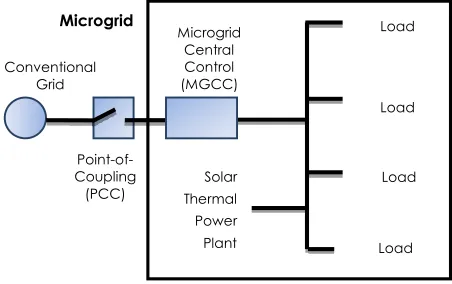
Figure 2 Solar thermal power plant integrated into microgrid structure
3.0 MICROGRID DISPATCH STRATEGY
3.1 Methodology
The objective of this study for a Microgrid dispatch strategy is to reduce the supplywattage required from the conventional grid while maximize the energy generated from the solar thermal power plant. Figure 3 shows the energy flow configuration used in this study.
To demonstrate the capability of the proposed methodology, one week record of hourly electricity consumption is used as a demand example. Solar radiation data measured at Kuala Lumpur is used as the heat energy input to the parabolic trough solar collector. The capacity of the thermal storage is assumed to be 500KWh and heat energy stored at the end of the day for power generation is 20% of its capacity.
Figure 3 Microgrid energy flow configuration
The Microgrid system is operated with ON/OFF control of constant power generation; solar thermal power generation will be in ON condition when
Pgen>PLand conventional grid will be disconnected
from Microgrid system. Thermal storage is charging if the solar collectors are receiving more solar energy than the heat energy required for power generation. During the absence of solar radiation, solar thermal power generation will turn ON if the thermal storage is discharging. Mode characterization for each component of the Microgrid system is simplified below:
a) Conventional grid power, Pg=
Connected, 1: Disconnected, 0 b) Solar thermal power generation, Pgen=
On, 1: Off, 0
c) Thermal energy storage, Pchar / Pdisch =
Charging: Discharging
The proposed dispatch strategy is to determine the optimal starting time to discharge energy from thermal energy storage. On each time step, when the heat energy concentrated at the solar collector is not enough to generate electricity, the required heat is discharged from the thermal storage.The total supply energy from the conventional grid is calculated at each iteration.The next equationsindicate the power balance in the Microgrid where ɳ is the efficiency of thermal storage energy conversion:
𝑃𝑔𝑒𝑛𝑡 = 𝑃𝑐𝑜𝑙𝑡 + (𝐸𝑑𝑖𝑠𝑐ℎ𝑡*ɳ)(8)
𝑃𝑔𝑟𝑖𝑑𝑡 = 𝑃𝑔𝑒𝑛𝑡 - 𝑃𝑙𝑜𝑎𝑑𝑡(9)
3.2 Results and Discussions
Three cases have taken into account for this research using the one week period data of solar radiation and load profile. These three cases are: (1) solar thermal power generation without thermal energy storage
Microgrid
Point-of- Coupling
(PCC) Conventional
Grid
Load Solar
Thermal Power
Plant
Load Load Load Microgrid
Central Control (MGCC)
Pchar
Pdisch Pcol
Pgen
Pload
Pg
Conventional Grid, Pg
Microgrid Dispatch
Strategy Load, Pl
Solar Thermal Collector, Pcol
Thermal Storage,
Pchar /Pdisch
(TES), (2) with thermal storage but without dispatch strategy and (3) with thermal storage and dispatch strategy.
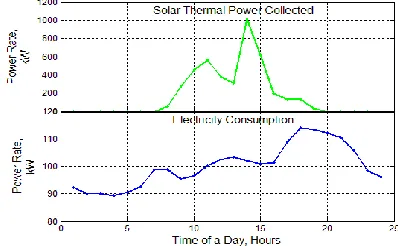
Figure 4 shows the solar radiation and the load profile while Figure 5 shows the comparison of the three cases with taking account of the power generation and power from the conventional grid on a typical day as an example. The power generation without thermal storage case is able to supply power to consumer from 9am to 6pm. Due to the lack of thermal storage, the excessive solar energy is dumped out to the environment. As for the second case, the integration of the thermal storage into the system prolongs the solar thermal power generation operation time by 3 hours: from 9am to 9pm. The supply energy from the conventional grid is also reduced visibly. With the implementation of dispatch strategy, the optimum power generation starting time is identified as 8am. Figure 6 shows the thermal energy stored in the thermal storage with taking account of the dispatch strategy. With this optimized starting time, the average energy imported in this one week operation and the power supplies from conventional grid are minimized simultaneously.
Table 1 summarizes the results for average electric power imported in one week period and the maximum value of electric power imported from the conventional grid. When the dispatch strategy is introduced, the power supply from the conventional grid is reduced by 10% compared to Case 2.
Since the solar radiation fluctuates during the daytime, the thermal storage provides thermal energy to the system when solar radiation is not temporary available. Also, the stored heat is used for power generation during morning and afternoon when there is not enough solar radiation. By using the proposed dispatch strategy the thermal energy saved in the thermal storage is utilized efficiently.
Table 1 Supply energy from conventional grid
CASE
Average Electricity Imported in
One Week (kW)
Maximum Electric Power
Imported (kW)
Case 1: Solar Thermal
Power Plant without TES 12251 144
Case 2: Solar Thermal Power Plant with TES and without Dispatch
Strategy
9661 137
Case 3: Solar Thermal Power Plant with TES and
with Dispatch Strategy at starting time, t=8am
8590 (Reduction of
10% from case 2)
137
Figure 4 Input data for three cases (solar thermal power collected and electricity consumption)
a) No TES
b) With TES without dispatch strategy
c) With TES with dispatch strategy starting at t=8am
Figure 6 Heat energy stored at Thermal storage with dispatch strategy
4.0 CONCLUSION
In this paper, a Microgrid dispatch strategy for solar thermal power generation plant is proposed. Since the power generation system has a thermal storage, batteries are not required for the Microgrid to compensate the solar radiation fluctuations. This dispatch strategy is implemented so that the total electricity and highest power imported from conventional grid are minimized at the same time. The effectiveness of the proposed dispatch strategy is demonstrated using one week solar radiation and power consumption data. The proposed methodology is being improved further by applying to a longer period of data.
Acknowledgement
The authors would like to thank for the support given to this research by Universiti Teknologi Malaysia (UTM), under PY/2014/03749 grant, Design and Optimization of Solar Thermal Co-Generation System to Overcome Shortcomings of Existing Solar Thermal Technology scheme code.
References
[1] Chaouachi, A., et al. 2013. Multiobjective Intelligent Energy Management For A Microgrid. Industrial Electronics. 60(4): 1688-1699.
[2] Rahman, H.A., et al. 2015. Operation And Control Strategies Of Integrated Distributed Energy Resources: A Review. Renewable and Sustainable Energy Reviews. 51: 1412-1420.
[3] Motevasel, M. and A.R. Seifi. 2014. Expert Energy Management Of A Micro-Grid Considering Wind Energy Uncertainty. Energy Conversion and Management. 83: 58-72.
[4] Mallol-Poyato, R., et al. 2015.Optimal Discharge Scheduling Of Energy Storage Systems In Microgrids Based On Hyper-Heuristics. Renewable Energy. 83: 13-24.
[5] Whitefoot, J.W., et al., 2011,Optimal Component Sizing And Forward-Looking Dispatch Of An Electrical Microgrid For Energy Storage Planning. International Design Engineering Technical Conferences And Computers And Information. 60: 1-7.
[6] Rigo-Mariani, R., et al., 2014, Optimal Power Dispatching Strategies In Smart-Microgrids With Storage. Renewable and Sustainable Energy Reviews. 40: 649-658.
[7] Jacobson, E., et al., 2006, Solar Parabolic Trough Simulation And Application For A Hybrid Power Plant In Thailand. Science Asia. 32(2): 187-199.
[8] Gil, A., et al. 2010.State Of The Art On High Temperature Thermal Energy Storage For Power Generation. Part 1— Concepts, Materials And Modellization. Renewable and Sustainable Energy Reviews. 14(1): 31-55.
[9] Li, J., W. Wei, and J. Xiang. 2012. A Simple Sizing Algorithm For Stand-Alone PV/Wind/Battery Hybrid Microgrids. Energies. 5(12): 5307-5323.
[10] Ahn, S.-J., et al. 2013. Power Scheduling Of Distributed Generators For Economic And Stable Operation Of A Microgrid. Smart Grid. 4(1): 398-405.