ABSTRACT
WINKLER, JONAH. Development of an Instrument to Measure the Relationship Between Community College Developmental Math Instructors’ Perceptions of Student Success and Instructional Practice (Under the direction of committee chair Dr. Susan Barcinas).
Community college developmental math instructors possess extremely important roles for many students’ initial college and higher education experience. Current research does not reflect the importance of these instructors in promoting the success of college students (Grubb & Worthen, 1999; Caffarella, 2014). The research purpose is to develop and validate an instrument that quantitatively measures the relationship between North Carolina’s community college instructors’ perceptions of student success and their instructional practice. Instrument creation includes multiple recognized survey development and validation methods used with intentions to answer specific research questions. Methods include a factor analysis and Cronbach’s alpha tests. After a pilot and validation study are conducted with an initial survey instrument, a final more valid survey instrument is created. Results from this research are measures of how
Development of an Instrument to Measure the Relationship Between Community College Developmental Math Instructors’ Perceptions of Student Success
and Instructional Practice
by Jonah Winkler
A dissertation submitted to the Graduate Faculty of North Carolina State University
in partial fulfillment of the requirements for the degree of
Doctor of Philosophy
Educational Research and Policy Analysis
Raleigh, North Carolina 2018
APPROVED BY:
_______________________________ _________________________________
Dr. Susan Barcinas Dr. Michelle Bartlett
Committee Chair
_______________________________ _________________________________
BIOGRAPHY
The basics of whom I am paint a portrait of my physical position in the educational research I wish to conduct. My name is Jonah Daniel Winkler, I am 32 years old, and I am a male graduate student working on the degree of Education Research Evaluation and Policy Analysis PhD at North Carolina State University. I have an undergraduate and graduate degree in mathematics from Appalachian State University. I am currently employed as a graduate assistant doing online instructional design in masters’ students’ course sites.
In addition, the process by which I attained my educational status and degrees impacts my views and interpretation of college experiences and institutions. I attended community college directly after high school for four years to attain my associate’s degree in science. My enrollment while in community college was considered part and full-time during the four years. I attended Appalachian State University immediately after finishing community college for 5 years to attain both my undergraduate and graduate degrees in mathematics and adult education. I am currently in my fifth year of doctoral studies at North Carolina State University, so I have a large amount of experience with college educational processes. The experiences I have
ACKNOWLEDGMENTS
I would like acknowledgements to center on my family and their support provided during the pursuit of my education. I would like to personally thank my mother, Paula Winkler, and father, Doug Winkler for their continuous commitment and support during my 13-year college education. My parents are the most ideal, loving, supportive, and proud parents that I could ever ask for, and I feel not only lucky, but proud to still have them in my life.
An additional acknowledgement I would like to make concerns my graduate school advisor and committee chair, Dr. Susan Barcinas. Dr. Barcinas substantially influenced my entrance into my doctoral program by advising me on how to improve my application before I was a student, rather than simply saying that my application was denied. I would like to thank Dr. Barcinas for her commitment and support not only during my entrance into the program, but throughout my five-year experience in the College of Education here at North Carolina State University.
TABLE OF CONTENTS
LIST OF TABLES ... vii
LIST OF FIGURES ... viii
CHAPTER 1: INTRODUCTION Introduction ... 1
Focus on North Carolina Community College Context ... 3
North Carolina Community Colleges and Developmental Math ... 4
Student Placement into Developmental Courses ... 5
Statement of Problem ... 6
Negative Influence of Developmental Math Curricula ... 6
Low Developmental Math Student Success ... 8
Background Information ... 9
First-Year Community College Students ... 10
Students Avoid Math Based Programs ... 10
Definition of Student Success in Developmental Math Research ... 11
Inconsistent Definitions’ Influence... 12
Available Research on Instructors ... 13
Instructors’ Knowledge and Experience ... 13
Literature Search Results ... 14
Problem Conclusion ... 14
Research Purpose ... 15
Research Questions ... 16
Conceptual Framework ... 17
Perceptions of Student Success Variables ... 18
Instructional Practice Variables ... 19
Significance of Research ... 20
Definitions of Terms ... 21
Assumptions ... 23
Limitations ... 24
Chapter Summary ... 26
CHAPTER 2: LITERATURE REVIEW Introduction ... 28
Demographic Overview of Community Colleges in United States ... 28
Definition of Student Success ... 31
Community Colleges and Student Success ... 32
Developmental Education ... 35
Developmental Math Programs ... 39
Results of Developmental Math Programs ... 40
Developmental Math Students ... 42
Developmental Math Student Abilities ... 45
Demographics of North Carolina Community Colleges ... 48
North Carolina Developmental Math Education ... 51
Influence on College Student Experience ... 55
Student Success in Developmental Math ... 59
Developmental Course Completion ... 60
Developmental Course Sequence Completion... 61
Requisite College Course Completion ... 63
College Degree of Certificate Completion ... 64
Student Acquires Required Skills and Knowledge ... 66
Goal Completion ... 68
Instructional Practices in Developmental Math Environments ... 70
Summary of Effective Instructional Practices Literature ... 72
Personal Qualitative Research on Instructional Practice ... 74
Available Research on Community College Developmental Math Instructors ... 77
Relevant Research on Developmental Math Instructors’ Perceptions ... 79
Discussion ... 81
CHAPTER 3: METHODS Introduction ... 84
Summary of Methods ... 84
Research Questions ... 85
Research Procedures ... 86
Instructors’ Perceptions of Student Success ... 86
Instructors’ Personal Instructional Practice ... 88
Survey Creation ... 93
Content Validity ... 93
Pilot Survey/Gather and Prepare Data ... 95
Data Analysis ... 96
Revise Instrument ... 97
Participants and Precautions ... 98
Initial Response ... 100
Missing Data ... 100
Survey Response and Demographic Characteristics of Participants ... 102
Chapter Summary ... 103
CHAPTER 4: RESULTS Introduction ... 105
Results for Research Question 1a ... 105
Results for Research Question 1b ... 107
Instructional Practice Construct ... 108
Factor Analysis Results ... 115
Results for Research Question 1c ... 123
Correlation of New Instructional Practice Constructs and Perception Variables ... 124
Overall Results ... 127
CHAPTER 5: INTERPRETATIONS, DISCUSSIONS, AND IMPLICATIONS Introduction ... 128
Interpret and Discuss Survey Question 1 ... 128
Interpret and Discuss Survey Questions 2 ... 130
Compare and Contrast Survey Questions 1 and 2 ... 132
Question 1b Interpretations and Discussions ... 134
Interpret and Discuss Factor Analysis ... 137
Interpret and Discuss Instructional Practice Constructs ... 138
Instructor Actions ... 138
Student Actions ... 138
Course Components ... 140
Question 1c Interpretations and Discussions... 142
Perception Variable’s Rank and Instructional Practice Correlations ... 143
Perception Variable’s Time Spent and Instructional Practice Correlations ... 144
Instructional Practice Construct Correlation to Self ... 146
Main Research Question 1 ... 147
Interpretations of and Recommendations to Instrument Design ... 147
Implications ... 151
Implications for Research ... 152
Implications for Theory ... 154
Implications for Practice ... 157
Conclusion ... 160
REFERENCES ... 162
APPENDICES Appendix I: Basic Skills as a Foundation for Student Success ... 173
Appendix II: Survey Instrument ... 175
Appendix III: Approved IRB Form ... 190
Appendix IV: Email to Community College Developmental Professionals ... 203
LIST OF TABLES
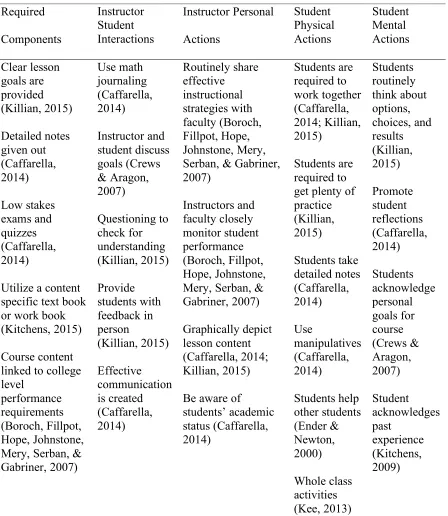
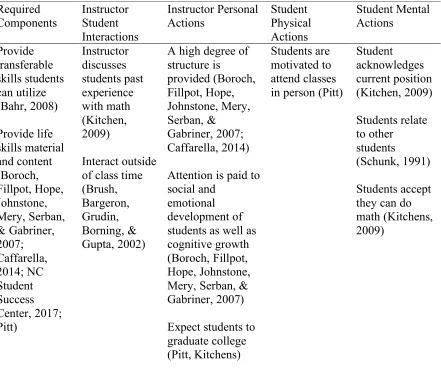
Table 3.1. Five Categories of Instructional Practice ... 90
Table 3.2. Participant Descriptive Statistics ... 102
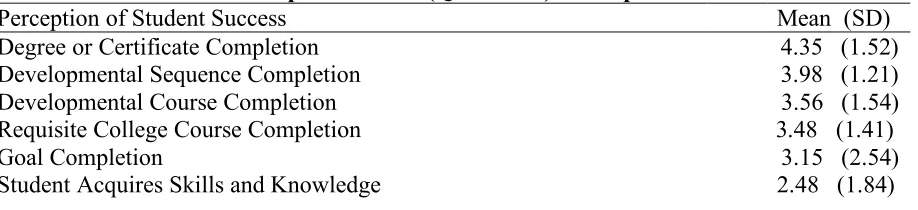
Table 4.1. Perceptions’ Rank (Question 1) Descriptive Statistics ... 106
Table 4.2. Perceptions’ Percentage of Time Spent (Question 2) Descriptive Statistics 107 Table 4.3. Course Components Variable and Statement Statistics ... 109
Table 4.4. Student and Instructors’ Interactions Variable and Statement Statistics ... 110
Table 4.5. Instructors’ Personal Actions and Statement Statistics... 111
Table 4.6. Student Participation Variable and Statement Statistics ... 112
Table 4.7. Students’ Mental Actions Variable and Statement Statistics ... 113
Table 4.8. Instructional Practice Variable Value Summary Statistics ... 114
Table 4.9. Eigenvalue Factor Analysis Results ... 115
Table 4.10. Factor Analysis Loading Results of Statements ... 117
Table 4.11. Factor Analysis Construct 1 Statistics ... 119
Table 4.12. Factor Analysis Construct 2 Statistics ... 121
Table 4.13. Factor Analysis Construct 3 Statistics ... 122
Table 4.14. Summary Statistics of New Instructional Practice Constructs ... 123
Table 4.15. Perception Rank and New I.P. Constructs’ Correlation Matrix ... 125
Table 4.16. Perception Percentage Time Spent and New I.P. Constructs’ Correlation ... 125
Table 4.17. Correlation Matrix of New Instructional Practice Constructs Themselves .. 126
LIST OF FIGURES
CHAPTER 1: INTRODUCTION
Instructors have more important roles in promoting success of college students than current research acknowledges (Grubb & Worthen, 1999; Caffarella, 2014). In particular, community college developmental math instructors perform critical roles for many college students’ experience. Developmental math programs are important avenues to higher education, and are proven to be effective at preparing students for college level material. The appropriate implementation and content of developmental math programs are highly scrutinized and debated. Therefore, institutional reform and program changes highly influence developmental math environments and processes. Many first-year college students personally experience these changes (Hodara, Jaggers, & Karp, 2012). For example, approximately 41 percent of all community college students require some form of developmental course work, and developmental course work typically takes place during students’ first year of enrollment. (McCabe, 2000).
focused upon issues of community college student demographics, student completion, student success, and identifying ways to support underprepared college students through the use of specific programs or strategies (Bailey, Jeong, & Cho, 2010; Aycaster, 2001; Fike & Fike, 2008). Therefore, efforts to improve developmental math curriculum and structure are a large part of the reform process in community colleges (Fike & Fike, 2008).
Substantial amounts of money and time are spent to improve and reinforce the current state of developmental math programs. However, implementation of developmental math programs creates unintended outcomes that current research highlights and discusses in detail. Unfortunately, developmental math curricula negatively affects many students’ college
experience (Aycaster, 2001; Bailey, Jeong, & Cho, 2010; Fike & Fike, 2008; Jenkins, Jaggers, & Roksa, 2009; Perin 2002). Direct results of developmental math course work on community college students are reduced student retention, prolonged college experiences, and diverted college careers. A large portion of the negative influence from developmental math programs originates from three key issues. The three key issues are that developmental math students historically possess low success rates, there are inconsistent definitions of developmental math program student success within research and practice, and there is a small amount of research currently utilizing community college developmental math instructors. Therefore, an overall result is that developmental math courses are known as “gatekeeper” courses in higher education, and are especially gatekeeper courses at community colleges (Jenkins, Jaggers, & Roksa, 2009).
alongside a conceptual framework. The conceptual framework assist in answering research questions to fulfill this research’s purpose and create a valid measurement instrument. Discussion about the conceptual framework includes descriptions and originations of all variables researched, and also includes justification for their use and consideration in my research. This introduction concludes with an explanation of this dissertation’s significance, research assumptions, and limitations associated with all methods taken.
Focus on North Carolina Community College Context
This dissertation is focused on the North Carolina developmental math program context. Therefore, this dissertation quantitatively researched North Carolina community college
developmental math instructors with the use of a mixed-mode survey in order to analyze student success in critical gatekeeper courses to higher education. A mixed-mode survey is chosen to be most appropriate for this research due to researchers’ ability to conform mixed-mode surveys to complex multi-faceted situations while maintaining overall survey quality (Dillman, Smyth, & Christian, 2014). As part of this research, a pilot study of developmental math instructors is conducted with the use of an internet/online survey that quantitatively records variables that depict instructors’ perceptions of student success and their instructional practice. The creation and validation of a mixed-mode survey answers questions about how to measure perceptions of student success, how to measure instructional practice, and relationships between the measures of instructors’ perceptions of student success and practices in developmental math environments. Therefore, this dissertation creates and develops a survey instrument that captures desired
survey reduce the four most common types of survey error, coverage, sampling, nonresponse, and measurement (Dillman, Smyth, & Christian, 2014).
A mixed-mode survey instrument was administered to gather and analyze data about North Carolina community college developmental math instructors. However, the main focus of implementing the survey instrument into a pilot study was to test variable constructs and
instrument design. Therefore, coverage, sampling, and nonresponse error of the final survey are not as critical in this research as is the process of creating accurate and valid measurements of desired variable constructs. The mixed-mode survey and methods used to gather data were piloted and highly analyzed for survey accuracy and reliability related to quantifying instructors’ perceptions of student success and instructional practices. All information gathered during my research and particularly from the pilot study directly relates to student success in North Carolina community college developmental math courses as perceived by instructors that personally observe and experience student success. Therefore, this dissertation produced a mixed-mode survey and process that provides a valuable avenue to important information about student success in North Carolina community college developmental math courses.
North Carolina Community Colleges and Developmental Math
2017). All of North Carolina community colleges provided developmental course work, and recently, the system endorsed open enrollment for all community colleges (NC Community College Final Report, 2013). Open enrollment increases the number of first-year students, and does not turn away students that need high levels of developmental course work before official college enrollment begins (Boggs, 2004). Therefore, current reforms in North Carolina
community colleges focus on large-scale institutional structures and curriculum modifications to support developmental math programs (Santikian, 2015).
The current developmental math course policy put in place by North Carolina’s community college system was implemented in 2013 (Santikian, 2015). The policy reform requires all North Carolina community colleges to implement a standard modularized curriculum for their developmental math courses (Developmental, 2011). In addition, the design allows developmental math courses to count as financial aid credit hours demonstrating students’ need for financial aid, however the courses do not count as college credit hours earned for students’ time spent.
Student Placement into Developmental Courses
All first-year community college students in North Carolinas are evaluated for their college readiness in mathematics with a two-prong strategy. The first strategy is via a placement exam with cut-scores to assess their readiness for college level course enrollment (NCCCS, 2017). The second strategy is via an exemption scheme that is based on student attributes.
placement exam created by a company titled College Board (Kalbaugh, personal conversation, September, 2017). Recently, the Accuplacer has been replaced with the North Carolina
Diagnostic Assessment and Placement, NCDAP, as of 2015 for all North Carolina community colleges.
Placement exams and the process of appropriately placing incoming students into math courses they can succeed in is a large part of current reform. Therefore, I elaborate on important attributes of the North Carolina Diagnostic Assessment and Placement exam, NCDAP, that determine students’ placement. The NCDAP contains eight modules of twelve questions (Kalbaugh, personal conversation, September, 2017). To pass a module, students must
successfully answer 7 out of the 12 questions for that particular module’s material. For modules students do not successfully answer seven questions, students are required to take corresponding developmental math course modules. Students are allowed to take the placement exam two times per year for free at all North Carolina community colleges. To assist incoming students with completing the placement exam, many high-school students are sent in groups during planned field trips to community colleges to take the placement exams. Some high-schools even allow students to take the placement exam on site, so potential community college students do not have to leave their school to take the NCDAP. Therefore, there is substantial interest, support, and dedication for accurately placing incoming college students into North Carolina’s developmental math curricula.
Statement of Problem Negative Influence of Developmental Math Curricula
college level courses (Jenkins, Jaggers, & Roksa, 2009). Literally, developmental math courses within community colleges are physical barriers for students to overcome in order to achieve higher education. In North Carolina community colleges, if students are required to take but do not pass developmental math’s curricula, they cannot enroll in college level requisite math courses. Nearly all college programs require at least one college level math course. Thus many community college students are sidetracked or delayed from pursuit of educational credentials in their first-year by their remedial courses. Given that these courses do not award college credit, many college students are sidetracked by their developmental math courses (Jenkins & Cho, 2012). As a result, developmental math curriculum in North Carolina’s community colleges have simultaneously become a necessary support and a costly barrier that prolongs and extends many college students’ experiences.
Three main factors significantly contribute to the negative college level developmental math outcome discussion. The first contributing factor is that generally speaking, community college developmental math courses have low student success rates (Bailey, Jeong, & Cho, 2010). There are multiple explanations within current literature and research that describe why critical foundational courses have such low success rates. In particular, student background and information about community college developmental math environments create a large portion of the explanations for low student success in developmental math course work. Therefore, substantial amounts of background information concerning developmental math students, developmental curricula, and developmental environments are highlighted for discussion.
research and professional practice arenas have produced vastly different methods and measures to conclude student success in developmental math environments. Therefore, inconsistent conceptualizations of student success are substantially influencing practice, policy, and pedagogical implications for both students and institutions.
The fact that there exists minimal research on college level developmental math
instructors is the third contributing factor to developmental math courses’ negative influence on student experience. Developmental math instructors manage, promote, and explore
developmental math student success as a chosen profession, and they often have many years of experience doing so. However, current research underutilizes the knowledge and experience that instructors possess about student success and developmental math environments. The
experiential knowledge that instructors possess can provide information about how and why developmental math courses significantly influence many students. Therefore, developmental math instructors possess a large amount of information that has not been studied or shared with recent educational research pursuits. I elaborate further on each of the three contributing factors in the following sections.
Low Developmental Math Student Success
To understand the problem of low success rates from students in developmental math courses and the influence developmental math curricula has on student experiences, background information about developmental math’s position in community college environments is
Background Information
Developmental math’s position in community college curriculum influences many students’ experience enrolling in and completing higher educational programs. Most colleges are experiencing increasingly diverse students with diverse needs associated with acquiring college ready math skills (Perin, 2002). Dr. Pitt, a community college math department chair, states that a majority of students enrolling in developmental math course work are either high-school graduates who have decided to go to community college at the last minute, or they are older students returning to school from the work force (D. Pitt, personal conversation, March 2017). A major roadblock many of these new college students immediately encounter is their low level of math competency. In fact, in 2011 69 percent of all recent high school graduates placed into a developmental course during their application process to North Carolina community colleges (NC Community Colleges Final Report, 2013). This staggering number translates to
approximately 10 percent of North Carolina’s community college budget dedicated to
facilitating supporting developmental coursework. However, previous strategies implemented and maintained meant to promote student success in what are critical developmental college courses are known to be inconsistent at best (Aycaster, 2001). Therefore, the growing number of first-year college students that possess low mathematical abilities created a substantial
investment into college level developmental math programs.
community college students enroll in what are critical developmental math courses. For positive college experiences to take place, the completion of these very important courses is essential. If students do not complete developmental courses they are referred to, students must re-enroll in them again before attempting college requisite courses. Therefore, background information and the impact of developmental math courses’ position in college curricula highly contributes to the negative influence developmental math curricula has on community college student experiences. First-Year Community College Students
Developmental math courses primarily enroll first-year college students (Puaa, 2011). A majority of first-year student enrollment is because basic advising standards/guidelines suggest that students enroll in a math and English course each semester until they no longer need those subjects to graduate (Pitt, personal conversation, March 2017). Since developmental math courses are prerequisites for all college level math courses, first-year students that cannot place out of them, find themselves starting in developmental programs.
Students Avoid Math Based Programs
Compounding the issue of delayed graduation dates, some first-year students are able to control and manipulate their schedules online with or without the presence of an advisor (Pitt, personal conversation, March 2017). For example, at a North Carolina community college, first-year students are required to enroll in courses their first semester with advisors present and assisting them. However, after an initial enrollment session, most students are in control of changing and making their course choices online. Note that this is not the case for other
exams and requiring/referring developmental education before requisite college courses are enrolled, does not automatically ensure students enroll/stay enrolled in developmental course work. Students in this unfortunate situation either make enrollment mistakes, or have other priorities influencing their enrollment decisions, which highly prolongs their community college experience.
Further compounding the negative influence of developmental math programs is that any increase in time to graduation caused by enrollment in developmental courses is highly
influential on student decisions (Choy, 2002). Students’ low level of performance in mathematics influences their choice of program, and often deters students away from fields that involve math or science knowledge requirements. Students are deterred away from or discouraged during higher education because of potential delays to important college curricula caused by required developmental programs. In addition, students’ expected graduation dates weighs heavily on their choice of program and desired college course work. Therefore, current issues of low mathematical ability from first-year college students appears in college developmental math courses that prolong college enrollment and ultimately deter students away from curricula related to math.
Definition of Student Success in Developmental Math Research
The definition of student success for community college developmental math students takes multiple forms within current literature, research, and practice. The definition of student success is very important in college level developmental math environments because different perceptions and uses of student success produce different instructional practices. Personal
outcomes. The literature review provides six different examples of how research defines student success in developmental environments, and how definition inconsistencies influence
developmental math environments and practice. Inconsistent Definitions’ Influence
In addition to current literature’s views and research strategies, current policy and curriculum modifications reflect the problem of inconsistent definitions with student success. The issue appears within political debates and efforts to solve community college student skill deficiencies. Policy and curriculum modifications define student success for college level developmental math courses numerous ways in efforts to understand positive outcomes of their programs. The choice of which definition of success to follow highly influences modifications made to the school systems and curricula (Bahr, 2008; Bailey, Jeong, & Cho, 2010; Aycaster, 2011). The definition of what student success is, and how to evaluate successful experiences from students highly influence how developmental math programs accomplish objectives and interact with students. When considering the fact that instructors of developmental math courses instruct cognitive math skills as well as influence affective learning components related to math and college, measuring student success becomes vague. Determining what student success for developmental math is has been researched and elaborated on by authors such as Aycaster, Bahr, and Bailey (Aycaster, 2001; Bahr, 2008; Bailey, 2009). However, clear demarcations of success are not established, implemented, or recognized in literature about community college
Available Research on Instructors Instructors’ Knowledge and Experience
Available research about developmental math topics routinely omits instructors’
information, demographics, perceptions, and overall importance related to the subject or student. Developmental math instructors experience student failure as well as student success, and
everything between. However, college level developmental math’s current literature provides very little substance about developmental math instructors. Previous college level developmental math research focuses on student knowledge, student demographics, institutional changes, particular developmental math programs, and developmental math strategies (Bailey, Jeong, & Cho, 2010; Caffarella, 2014; Edgecombe, 2011; Hodara, Jaggers, & Karp, 2012; Kee, 2013; Sivley, 2013). Instructors of developmental math courses possess first-hand knowledge and realistic perceptions of what student success is, what successful student experiences are, and what successful strategies are appropriate for students that enroll in these courses (Caffarella, 2014). Therefore, developmental math instructors experience and know about a large portion of what current literature and research are omitting in their attempts to understand student success. Therefore, instructors’ perceptions and knowledge of success provide vital information about creating and implementing community college developmental math courses that promote student success.
Research on developmental math course success focuses on students’ program
progression and individual course completion as means of defining success (Karp, 2011; Bailey, Jeong, & Cho, 2010; Aycaster, 2001). Developmental math instructors experience success, know what success is, and routinely promote success of students in developmental math course
instructors rarely mention course completion as a measure of success in their developmental environments, while others highly rely on this measure, as well as others. The qualitative pilot study I conducted focuses on understanding developmental math instructors’ perceptions of successful student experiences and how they think successful experiences for students are accomplished in their practice. This previous research and the importance of its findings are discussed and elaborated on in the up-coming conceptual framework section.
Literature Search Results
Multiple databases search results for information about developmental math instructors in current literature are carried out during preliminary research for this dissertation. Results from database research supports the fact that little information on college level developmental math instructors exists. In addition, information about developmental math instructors’ demographics for systems, states, and colleges is not obtainable through online searches due to how they are not available. For example, a 2015 system wide statistical report for North Carolina’s
universities and colleges does not disaggregate developmental instructors from college instructors, or math instructors from other subject instructors (University of North Carolina, 2015). The 2015 example report provides gender, level of education of professors, number of associate professors, number of assistant professors, and number of instructors for each college, but does not include any other relevant information about college level developmental math instructors.
Problem Conclusion
factor is low developmental math student success rates. Reasons behind low success rates in developmental math curricula are related to high school students’ exiting public education with low math skills, the fact that developmental education is intended for first-year college students, and the fact that developmental education increases students’ time spent in college before degree obtainment. The second contributing factor is that research and literature about developmental math student success references multiple definitions or perceptions of student success in developmental math environments. Inconsistencies within the definition of student success influence developmental math curricula and practice. The third contributing factor to developmental math’s negative influence on students’ college experience is that very little research utilizes developmental math instructors’ knowledge about student success. Previous research focuses on student demographics, course completion, college completion, and instructional strategies associated with student success in developmental environments. However, current literature does not focus on what student success actually is. In addition, multiple data base search results produce very little material and literature appropriate for use or discussion within my research about college level developmental math instructors. The problem of developmental math curricula’s negative influence on college students’ experience is known to the research community, however solutions and routes to understanding student success are not yet available.
Research Purpose
The purpose of this research is to develop and validate an instrument that quantitatively measures the relationship between North Carolina’s community college instructors’ perceptions of student success and their instructional practice. Instrument creation includes multiple
conducted after an initial survey is developed, and a final survey is created after analysis of all pilot study data.
Research Questions
The creation and validation of a quantitative survey instrument that measures the relationship between instructors’ perceptions of student success and their instructional practice answers the following research questions. The questions this dissertation and the creation of the survey instrument answer are directly related to instrument development, perceptions of student success, and instructional practices within North Carolina’s community college developmental math courses. The following main question and three sub-questions guide this dissertation’s research. The three sub-questions are intentionally used to completely explore and answer the main question about survey instrument development.
1. What instrument can be created to measure the relationship between community college developmental math instructors’ perceptions of student success and their instructional practice in classrooms?
a. What is the reliability and validity of the survey’s measure for instructors’ perceptions of community college developmental math student success? b. What is the reliability and validity of the survey’s measure for instructors’
personal instructional practice in community college developmental math environments?
Conceptual Framework
There currently is a need to research, understand, and promote student success in North Carolina’s community college level developmental math courses. Many instructors in
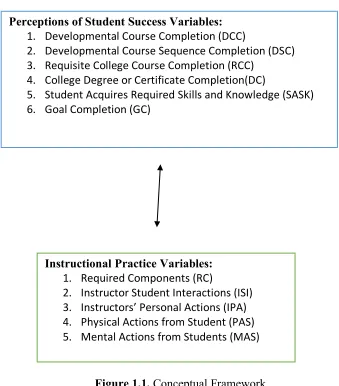
developmental math environments have experience with and possess extensive knowledge about student success. Therefore, the following conceptual framework in Figure 1.1 represents a way to quantitatively research variables that represent instructors’ perceptions of student success and instructional practice in community college developmental math courses. Past research acknowledges that instructors’ beliefs and values about teaching and learning influence educational environments and practices (Clark & Peterson, 1986; Fang, 1996; Kagan 1992; Stipek, Givvin, Salmon, & MacGyvers, 2001; Thompson, 1992). Therefore, all variables directly relate to perceptions of student success and instructors’ personal instructional practice in this conceptual framework. The six perceptions of student success variables originate from a review of the literature.
Figure 1.1. Conceptual Framework Perception of Student Success Variables
For the purposes of this research, instructors’ perceptions of student success are defined as how community college developmental math instructors express or define student success. In general, community college developmental math instructors’ perceptions of student success are not utilized in current research, literature, or practice. Therefore, variables of instructor’s
perceptions of student success are researched and analyzed in depth for potential use. A literature review produces six perception variables that represent six particular perceptions of student success. The six perceptions of student success are Developmental Course Completion (DCC), Developmental Course Sequence Completion (DSC), Requisite College Course Completion
Perceptions of Student Success Variables:
1. Developmental Course Completion (DCC)
2. Developmental Course Sequence Completion (DSC)
3. Requisite College Course Completion (RCC)
4. College Degree or Certificate Completion(DC)
5. Student Acquires Required Skills and Knowledge (SASK)
6. Goal Completion (GC)
Instructional Practice Variables:
1. Required Components (RC)
2. Instructor Student Interactions (ISI)
3. Instructors’ Personal Actions (IPA)
4. Physical Actions from Student (PAS)
(RCC), College Degree or Certificate Completion (DC), Student Acquires Required Skills and Knowledge (SASK), and Goal Completion (GC). This dissertation demonstrates that community college instructors’ perceptions are important and have a place in research, especially about community college student success.
Instructional Practice Variables
Instructional practices are all aspects of an educational environment that instructors perform in their profession. More particularly, my research only considers instructional practices to be aspects of developmental math course environments that instructors have control over. Aspects of their instructional practice that instructors have control over are what instructors are thinking, what instructors expect students to do, and what instructors are doing in their
profession. Current literature and research provides multiple explanations, discussions, and justifications for instructional practices in community college developmental educational environments. In order to further understand developmental math instructors’ practice beyond what literature has to offer, I conducted a qualitative study in 2015. The study is titled
Developmental Math Instructors’ Impressions of a Successful Student’s Experience. My primary
focus is to understand successful student experiences and how instructors think success in
environments serve as my research’s five instructional practice variables. The combination of perception and instructional practice variables allows this research to explore potential
relationships between instructors’ perceptions of student success and their personal instructional practice.
Significance of Research
The research uniquely contributes to the existing information about successful student outcomes in college level developmental math environments. My dissertation fills the gap between the large amount of literature concerning college level developmental math student success and developmental math instructional practice. A focus on developmental math instructors’ perceptions of student success and personal instructional practice together links literature related to successful developmental student outcomes and best instructional practices for developmental environments. In addition, the source of data used in this research adds to the significance of all results. The source of the data taps into the under-utilized knowledge of developmental math instructors. Instructors experience situations that promote student success, and their experience is valued, utilized, and explored in my research.
This research produced a survey instrument and used method of gathering data that any future research can utilize. I provide valuable information about how to measure perceptions of student success, how to measure instructional practices, and how to explore the relationship between the two measures. Also, the development of the survey itself provides a better understanding of instructors’ perceptions and personal definitions of student success. This dissertation produced further knowledge on the current yet evolving developmental math course environment to explore any and all perceptions of student success that lead to successful
math programs, and especially North Carolina community colleges will highly appreciate information provided in this research.
Definition of Terms
For the purposes of this research, the following definitions of terms are utilized:
The Accuplacer exam is an exam that new non-exempt community college students took
as part of their enrollment process into a North Carolina community college (NC Community College Creating Success, 2015). The Accuplacer exam includes sections of reading
comprehension, English use, and math skills assessment. A software company named College Board creates and sponsors the use of their Accuplacer exam. College Board states that their exams allow accurate placement of students based on multiple customized variables and modularized tests that align with government regulations and expectations (College Board, 2017).
A cut-score is defined by Boston College to be the point on a score scale that separates
one performance standard from another (Horn, Ramos, Blumer, & Madaus, 2000). In North Carolina community colleges, cut-scores are the scores that determine if college students are required to enroll in developmental curricula, and which courses they should enroll in.
Developmental math curricula also known as developmental math courses, is defined as:
curricula, consider North Carolina community colleges developmental math curricula. There are eight developmental math, DMA, courses students can be referred to enroll in in the NC
community college system. They are titled DMA1-DMA8, and must be completed in order from 1 to 8.
Developmental math instructors are any person with experience teaching developmental
math material at community colleges. To elaborate, any instructor of a community college who currently or has previously taught at least one developmental math course at a community college.
Instructional practice is defined here as any and all activities related to facilitating
developmental math courses at community colleges that instructors have control over. Aspects of instructional practices such as college environments and system wide policies are not consider instructional practices that instructors have control over. Other the other hand, instructional practice do include course preparation, student interactions, teaching style, and choice of course materials.
Mixed-mode survey designs allow researchers to reduce potential errors associated with
asking multifaceted questions and analyzing responses from target audiences (Dillman, Smyth, & Christian, 2014). Mixed-mode surveys are used in situations that gather two types of data through two different means. More appropriate for this research, mixed mode surveys methods reach out to target audiences in more than once in efforts to complete a single survey instrument.
Open Enrollment is the when an institution or organization removes all requirements or
Therefore, any North Carolina resident can go to a local community college and expect to be accepted and allowed to enroll in course work.
Perceptions are defined as ways an individual understands, frames or interprets an
experience. This dissertation’s research focuses on how instructors understand and interpret student success in developmental math environments, and gathers instructors’ perceptions for analysis with the use of a mixed-mode survey.
A current definition of success comes from Oxford’s dictionary, which states that success is defined as “The accomplishment of an aim or purpose” (Oxford, 2017). In connection to developmental math students, success is the accomplishment of whatever the students’ aim or purpose is.
Survey is defined as a means to investigate the opinions or experience of a group of
people by asking them questions (Oxford, 2017). A survey is the tool this research creates and uses to investigate instructions’ perceptions of student success and experiences promoting student success. Questions asked within the survey align with the variables and constructs of interest researched.
Assumptions
Assumptions play a role at many points during this research. The most obvious
My dissertation assumes that instructors in practice have highly valuable, significant, and useful information that is promoting student success in college level developmental math
courses. Going further, the most valuable information available for increasing student success in developmental math courses is known by developmental math instructors themselves, and not by data analyst or school administrators attempting to study student success. Therefore, a high level of value and significance is placed on instructors’ knowledge, and obtaining their knowledge substantially guides this research proposal’s methods.
Another assumption that guides my research is that to promote developmental math student success is to understand what student success actually is. The assumption provides justification for methodological avenues chosen throughout, and explains why instructors’
perceptions of student success are important variables within this research. Therefore, the content of this dissertation focuses on understanding student success’ definition. After understanding the definition of student success, a relationship to instructional practices and instructional
experiences is analyzed.
Limitations
preconceived ideas or notions of what participants mean, or why they answer the way they do can be unintentionally be implemented into the findings.
In addition, the ethnical position I maintain can be considered an extreme source of biasness in my research. I am a white, male, American. Not only am I of the majority ethnic group, but I am participating in a society that caters to the success of white males. In reference to my topic of interest, this fact becomes substantial as I strive to understand a continuously diversifying community college student population.
Another limitation to the proposed research is how applicable measures and constructs created are to studying specifically North Carolina community colleges. Quantitative measures take many forms and specific measures created during this research are intuitive constructs rather than predefined methods of measurement. To be clear, current literature supports all content used to create quantitative measures related to student success and instructional practice, and all measures specifically relate to North Carolina community colleges in current literature. However, this research’s measures of student success and instructional practice are intuitive constructs that are being quantified for the first time. Therefore, different interpretations of appropriate ways to quantify student success and instructional practice could potentially create different results and overall implications.
findings that provide information behind new constructs and new relationships. While the results do not possess statistical power, they do provide a foundation for understanding and improving the usefulness of the instrument created.
Chapter 1 Summary
There is a large and diverse investment into facilitating and promoting developmental math curricula in community colleges. Developmental math programs have proven effective at preparing college students for college level requisite material. Unfortunately, large portions of students are experiencing unintended outcomes of implementing large scale developmental math programs. The result is that developmental curricula negatively influences many students’ college experiences. The negative influence appears as poor student performance, low student retention, inconsistent definitions of success in developmental environment, and the omission of instructors’ input within current research. In particular, I research North Carolina’s community college developmental math curricula to focus on a certain developmental math context. The purpose of this dissertation’s research is to create a quantitative survey instrument that can reliably quantify and understand relationships between instructors’ perceptions of student success and their instructional practice. The conceptual framework provides a graphical
improvements to the instrument, measures, and survey are made. Therefore, this research
CHAPTER 2: LITERATURE REVIEW Introduction
A demographic overview of community colleges in United States starts the foundation for this literature review. Definitions of student success, developmental education,
developmental math, and developmental math students are discussed in detail. Also, North Carolina’s community college system and developmental math curriculum are described and explained to provide information about a particular community college developmental math context. Community college developmental math and student success are strongly connected within current research and literature. This connection presents itself through the variety of perceptions of developmental math student success that appear within many research projects. In addition, I discuss a previous summary of literature about best instructional practices in
community college developmental math environments is also provided. I conclude this literature review with a description of relevant available research on community college developmental math instructors, and recent similar research that merits discussion in my research.
Demographic Overview of Community Colleges in United States
improvement, and much more. National student enrollment among community colleges
increased 21.8 percent since 2007 (Mullin & Phillippe, 2011). Over 95 percent of 2-year college enrollment are at publicly funded institutions, and in 2015 nearly 8 million students enrolled in 2-year institutions (NC Community College Creating Success, 2017). Of the 1,200 current community colleges, 90.8 percent have no application criteria or restrictions for college acceptance, and 99 percent offer developmental services for college students that enter underprepared. Institutional statistics also include the fact that 61.2 percent of students are retained by 2-year colleges in comparison to 80.8 percent at 4-year colleges. Therefore,
community colleges have cemented their position in United States’ higher education system by becoming more popular and expanding options of higher educational pursuits available to many students.
students are unique and represent a diverse student body in United States higher education system.
In addition to student demographics, particular educational skills and knowledge levels associated with community college students are also unique. Students that enroll in community colleges are either high-school graduates, or are older students that return to school from the work force (Pitt, personal conversation, March 2017). For example, in 2015, 85.8 percent of students that enrolled in community colleges previously completed high-school, 24.2 percent had less than basic algebra math skills, 44.4 percent had less than algebra 2 skills, and 31.5 percent had taken a pre-calculus math course or higher (National Center Education Statistics, 2016). These statistics correspond to the important fact that 32.2 percent of incoming students are required to take a developmental courses in order to prepare for them college level material. Going further, 8.8 percent of community college students’ grade point average exiting high school is below 2.0, 41.2 percent are between 2.0 and 3.0, and 50 percent are over 3.0. These developmental courses combined with students’ poor performance in high school contribute to the fact that in 2012 at 2-year institutions students were 29.1 percent likely to graduate within 150 percent of the expected time required to complete their degree of choice. Therefore, students that enter community colleges are not necessarily ready for college course environments, and do not successfully complete college course work without an extended timeline to graduation.
faculty. In addition, instructors at community colleges in 2015 were approximately 79 percent Caucasian, 10 percent African American, 7 percent Hispanic, and 5 percent Asian. Average full-time salary for 2015-2016 2-year college staff is $67,300. In particular, assistant professors make on average $49,618, instructors make $21,405, and lecturers make $4,541 annually at 2-year colleges. In addition, approximately 65 percent of 2-year institutions faculty members are full time equivalent staff with 35 percent being part-time staff. Therefore, instructor demographics in United States’ community colleges are not as diverse as the students they provide services to, most of the community college faculty are instructors, and instructors expect to make well below the average community college staff member.
Definition of Student Success
money, and effort into all parts of this particular definition of student success. The definition of student success is extremely important, because how student success is perceived or defined leads, guides, and manipulates research that strives to understand it.
Community Colleges and Student Success
To start, open admissions are standard practice for over 90 percent of the nation’s
community colleges (National Center Education Statistics, 2016). In addition, between 35 and 40 percent of freshmen entering college at any college enroll in developmental course work
(Bettinger & Long, 2009). Sixty percent of students that enroll in community colleges are required to take developmental courses, and in low-income or racially diverse student populations, up to 90 percent of students are required to take developmental course work (Achieving the Dream, 2017). Therefore, a large need to ensure the success of underprepared students has been established and put in place for United States’ community colleges (Bryant, 2001). This is in part due to the reduction in admissions’ requirements. Community colleges react to underprepared college students by providing various academic support programs. Examples of such support programs include, summer bridge programs, learning communities, co-curricular support, academic counseling, financial aid, child care, and subject specific tutoring. College developmental courses, also known as college remediation, is the most
common approach to prepare students without the college skills needed to succeed (Martorell & McFarlin, 2012). This intense focus on developmental course work nationally cost freshmen that enter college over one billion dollars annually. In addition, seven billion dollars are spent
The substantial importance of developmental education combined with administrations’ intentions to help students succeed has created many types of developmental curricula within the United States. In particular, the American Association of Community Colleges has recently shown particular interest in developmental math student success in college. The AACC initiative is to award five million more students degrees or certificates by 2020 than previously predicted (AACC, 2017). The American Association of Community Colleges created benchmarks and desirable student outcomes developmental math programs in United States community colleges are to be measured by (American Association of Community Colleges, 2012). These measurable outcomes are students’ college readiness, developmental course progression, course completion, credit accumulation, and student persistence. The current public educational landscape is focused upon issues of community college student demographics, student completion, student success, and identifying ways to support underprepared college students through the use of specific programs or strategies (Bailey, Jeong, & Cho, 2010; Aycaster, 2001; Fike & Fike, 2008). Efforts to improve developmental math and reading curriculum structure are a large part of the reform process at community colleges (Fike & Fike, 2008). Analysis of data on over 28,000 students demonstrates that students enrolled in developmental course work are more likely to persist in college when compared to students with similar backgrounds that did not take developmental course work (Bettinger, Long, 2009). Therefore, remediation and developmental course work continues to be a large part of community college student success strategies and tactics.
Student success in community college environments is supported by many large
collaborative organizations that are highly invested and interested in higher education. To name a few, organizations that support research and programs for student success particularly in
Colleges, the Association of Community College Trustees, Completion by Design, Coalition on Adult Basic Skills, and the Aspen Institute College Excellence Program.
Achieving the Dream focuses on closing achievement gaps for diverse and low-income students (Achieving the Dream, 2017). Current student success initiatives for Achieving the Dream include programs such as the Community Colleges Count. The Community College Count is a national student success initiative to increase the number of degrees and certificates awarded to community college students. Achieving the Dream continues to be a large contributor to community college representation and research, and is discussed further later in this review. The American Association of Community Colleges dedicates themselves to being the national “voice of community colleges” (AACC, 2017). This association of trustees represent the 1,200 national community colleges in discussions with administration such as the United States congress, the Department of Education, and the Department of Labor. Therefore, community colleges have large organizations that represent and support their interest and voice. In a
three-year initiative to understand policies, practices, and resources community colleges successfully implement to assist students in need of developmental education (Achieving the Dream, 2017). The Coalition on Adult Basic Education, COABE, is a group of educators, administrators, and mentors that advocate to create new opportunities for adult students and provide educational faculty support (COABE, 2017). COABE is dedicated to adult education and providing adult students means to obtain better jobs and better ways to support their family. In addition, the Aspen Institute College Excellence Program aims to advance college practices and significantly improve student outcomes (The Aspen Institute, 2017). The accumulation of effort from these organizations as well as many others creates an avenue for community college staff and administration to voice concerns and opinions about community college practice or policies. Results of these organizations forming and following initiatives of student success include more informed policy decisions, more informed practice, and better overall student outcomes.
Therefore, programs and initiatives for student success in community college environments possess high levels of national support and interest from a variety of well-established organizations.
Developmental Education
By 1890, 80 percent of colleges possess college-prep course work (Dotzler, 2003). College-prep course work, or developmental course work, prepares students to enroll and
work. The idea that students’ skills for college courses need to be developed in order for them to succeed produced the name developmental education. Typical developmental education courses include three main topics of interest, reading, English, and math. These three main topics of student development where introduced in 1849 at the University of Wisconsin as reading, writing, and arithmetic, and was housed in designated college preparation departments.
Remarkably, subject headings of college level developmental courses remain relatively the same since that time. Today’s college developmental course work includes subjects of reading,
English, and math, and currently excludes any further subject specific pre-course work. Therefore, college level developmental education has existed for many years and particularly refers to pre-college course work in the three subject areas of reading, English, and math.
Consider the statement that, quality education that meets all students’ needs must acknowledge that not all students can be placed on the same educational assembly line and expect equal educational obtainment (Herring, 1992). Developmental education is a means of building students’ college ready skills so that they obtain educational goals equal to that of students that are not in need of development. Therefore, developmental education serves an important role in higher education by providing more than one pathway to success for many students. Currently, there are two avenues for colleges to implement developmental programs. These options are mainstreaming (stand-alone courses) and centralization (all remedial course in one developmental department) (Perin, 2002). Colleges that mainstream developmental courses offer course in their corresponding English and math departments. Here, reading and writing developmental courses are in the English department, and developmental math courses are offered through the math department. Colleges that practice centralization house all
developmental courses in a separate developmental department that is focused only on student development and preparing students for college. Therefore, community colleges have two options to provide developmental subjects for students.
For an idea of what kind of content development education includes, consider Levinson’s book, The Seasons of a Man’s Life, where four psychological development stages are determined and explicitly explained in order to research adult psychological development (Levinson, 1978). Levinson’s perspectives on psychological development demonstrate that important aspects of life and development are found within individuals’ sociocultural world, aspects of self, and
participation with the available world or community. Also consider, The Seasons of a Woman’s Life, where Levinson states that development is definitely extended into adulthood (Levinson,
contexts. In particular, developmental education’s material and instructional methods
intentionally appeal to students’ previous learning experiences as much as possible (Belenky, 1986). Implications and conclusions discussed by adult development research are applicable to the psychological development of students anticipated to take place in community college developmental courses. A student’s beliefs and values concerning topics such as mathematics often indicate their psychological stance toward accepting success. For example, in order to raise student self-efficacy and actually develop students enrolled in developmental courses,
individual’s sociocultural worlds, aspects of self, and participation with available resources are considered very important aspects of the curriculum that encourage development. With this in mind, developmental courses’ content ranges from subject specific research and content, to standard homework, to college-life skill development, to financial literacy (Pitt, personal conversation, March, 2017). Therefore, developmental math education in community colleges provide students with more than just math skills (Kalbaugh, personal conversation, September, 2017). Reasons behind the wide range of material presented in developmental education relate to a statement about life after college made by Dallas Herring in his book titled “What has
Happened to the Golden Door?” (Herring, 1992).
“A system of study that emphasizes applied basic educational experiences and relates them to occupational education … so that students that desire 1. To become aware of 2. To explore in a general way 3. To become skilled in a certain occupation, may acquire a better understanding of the importance of basic education to their occupational goals and may be motivated to increase their understanding of basic education in preparation for adult life.”
Developmental Math Programs
Community college developmental math education and programs are particularly elaborated on in this section. A large responsibility of community colleges is to accept students into a college environment and determine a program of study. In addition, developmental math programs have become an integral part of students’ acceptance and overall college success (Perin, 2002). So, what is developmental math? Developmental math, in community college contexts is post-secondary remedial education with special attention being given to remedial mathematics course work (Bahr, 2008). College developmental math content is also referred to as high-school algebra. So why is developmental math important? The importance of
mathematical material found in developmental math courses to college success and advancement is substantially researched (Horn, 2000). A study that researched over 85,000 first year
community college students in 107 colleges with intentions to understand the influence of remediation, concluded there is a direct relationship with successful remediation and long-term college attainment (Bahr, 2008). Therefore, research concludes a strong correlation between eighth-grade algebra skills possessed by college students and enrollment success in advanced mathematics courses at four-year colleges.
student success at community colleges in recent years (Jackson, 2014). Developmental math programs thought to be “highly effective at resolving skill deficiencies”, but the process of implementing programs and identifying which skills are deficient is debatable (Bahr, 2008). Different developmental programs provide a variety of different developmental courses that are presented in multiple formats. For example, in a study on developmental math courses, colleges use a lecture format, an individualized format with tutors assisting teachers, computer aided instruction, and both lecture and computer aided instruction in developmental math course formats (Aycaster, 2001). All of these formats were used at a single community college. In addition, typical developmental math programs have sequenced courses associated with student completion before college course enrollment is allowed (Pitt, 2017; Kalbaugh, personal
conversation, March, 2017; NC Community College Creating Success, 2017). Sequenced courses in developmental math education consists of taking multiple, smaller, modularized, condensed, and more detailed mini-courses. These mini-course cumulatively build students’ skill set one mini-course or module at a time in order to complete a total sequence of courses.
Therefore, developmental math course content and format vary according to policies, resources, and individual college environments.
Results of Developmental Programs
To start, a direct result of implementing developmental programs into community colleges is the assumed need for an initial student knowledge assessment. Initial student knowledge assessments take the form of placement tests within community college
used the SAT, ACT, or other tests to determine student placement. Community colleges typically require a placement exam prior to student enrollment and acceptance to determine how many, if any, developmental courses students are required to enroll in. Recent 2014 policy adjustments allow states to create state specific placement exams mandated for all community colleges in a particular state (Kalbuagh, personal conversation, September, 2017). Therefore, Accuplacer and Compass are slowly being replaced with population specific and state specific placement exams.
More importantly, student outcomes from developmental course programs have mixed reviews with varying performance levels associated with student success and the appropriateness of developmental course work in colleges. For example, within recent reforms, students can be referred to eight different levels of developmental course work. This requires students to navigate through multiple semesters of courses before being considered prepared for college course work to begin (Baily & Cho, 2010; College Board, 2017; NC Community College Creating Success, 2017). In addition, research on developmental math reform questions the existence of positive outcomes for students that enroll in developmental math courses (Martorell & McFarlin, 2012). Researchers state that the key to appropriately assisting a student in need of remediation is to identify those in need well in advance (Clayton, Crosta, & Belfield, 2012). However, this may not be taking place for many community college students. Therefore,
community college students may be hindered rather than assisted by developmental curricula that is intended to help them succeed (Bahr, 2008).
Currently, student success in community college developmental math courses is a direct avenue to the improvement of graduation rates for a large number of community college