ISSN(Online): 2320-9801
ISSN (Print): 2320-9798
I
nternational
J
ournal of
I
nnovative
R
esearch in
C
omputer
and
C
ommunication
E
ngineering
(An ISO 3297: 2007 Certified Organization)
Vol. 4, Issue 7, July 2016
Fog Image Enhancement Using DWT
Ravikiran J S, Gowtham M
Dept.of Computer Science and Engineering, Rajeev Institute of Technology, Hassan, India
Assistant Professor, Dept.of Computer Science and Engineering, Rajeev Institute of Technology, Hassan, India
ABSTRACT: this paper Proposes for fog image enhancement using DWT, Discrete Wavelet Transform (DWT) is applied to the image to divide the image into low frequency and high frequency components. The low frequency components are considered to improve the contrast of foggy image. In LUM filter the image is divided into windows and sub-windows. The sharpening techniques are applied to sub-windowed image resulting in the foggy image enhancement. In super resolution algorithm the intensity of the image is improved by adjusting the higher limits of the individual elements of the image. Finally all the techniques are compared by using entropy, peak signal to noise ratio, mean square error and standard deviation. The principal idea of enhancement is to process an image so that the result is more appropriate than the original image for an exact function. Image enhancement is one of the most interesting and visually pleasing areas of image processing. Image enhancement approaches drop into two broad categories: spatial domain methods and frequency domain methods. The term spatial domain refers to the image plane itself, and approaches in this class are based on direct manipulation of pixels in an image. Frequency domain processing techniques are based on modifying the Fourier transform of an image. Enhancement techniques based on various combinations of methods from these two categories are not remarkable. There is no general theory of image enhancement. When an image is processed for visual analysis, the viewer is the decisive judge of how fine a particular technique works.
KEYWORDS: Adaptive Histogram Equalization (AHE), Discrete Wavelet Transform (DWT) Singular Value Decomposition (SVD) and Color Space Conversion (CSC)
I.INTRODUCTION
The transformation is a process that translates one object from a given domain to another in order to have some important implicit information, which can be used for its recognition. One of the conventional transformations is the Fourier transform which usually transforms the signal from its time domain to the frequency domain. The next form of the Fourier transform developed to an efficient transform is called the Wavelet Transform (WT). Wavelet can be regarded as the most efficient transform that deals with image, sound, or any other pattern since it provides a powerful time-space (time-frequency).The objective of the paper is to improve the quality of image such as Medical or Satellite image. In this paper a technique has been proposed based on Discrete Wavelet Transform with Singular Value Decomposition. In this transform decompose the image into four sub bands, out of four bands one is low frequency and remaining are high frequency. Then the modified image is reconstructed by using inverse DWT. To improve the quality, the first step is Adaptive Histogram Equalization (AHE).Adaptive histogram equalization method for enhancing the contrast of digital is divided into regions of pixels. Images captured in foggy weather conditions get highly degraded due to suffering from poor contrast and loss of color characteristics .By using color space conversion method, to enhance the colored foggy images. The results of the SVD-DWT method clearly indicates increased efficiency and flexibility over the exiting methods such as Linear Contrast Stretching technique, GHE technique, De-correlation Stretching technique, Gamma Correction method based techniques.
ISSN(Online): 2320-9801
ISSN (Print): 2320-9798
I
nternational
J
ournal of
I
nnovative
R
esearch in
C
omputer
and
C
ommunication
E
ngineering
(An ISO 3297: 2007 Certified Organization)
Vol. 4, Issue 7, July 2016
II.LITERATURESURVEY
Kirandeep Kaur et al [1] this paper has focused on the different image enhancement techniques. Image enhancement has found to be one of the most important vision applications because it has ability to enhance the visibility of images. It enhances the quality of poor pictures. Distinctive procedures have been proposed so far for improving the quality of the digital images. To enhance picture quality image enhancement can specifically improve and limit some data presented in the input picture. It is a kind of vision system which reductions picture commotion, kill antiquities, and keep up the informative parts. Its object is to open up certain picture characteristics for investigation, conclusion and further use.
K. Tejasri et al [2] this paper proposes for a method the Image processing is used in different areas like face recognition, gaming and medical fields. Image enhancement is a technique used to improve the quality of the image which suffers from poor contrast in bad weather conditions as fog whitens the captured image and decreases the visibility leading to the decline of image contrast, providing a foggy look to the images. Therefore, it is necessary to enhance the image captured in a bad weather or the foggy image. And different techniques for enhancing the image quality like Wavelet transforms, LUM Filters and Super resolution algorithms are applied. Discrete Wavelet Transform (DWT) is applied to the image to divide the image into low frequency and high frequency components. The low frequency components are considered to improve the contrast of foggy image. In LUM filter the image is divided into windows and sub-windows. The sharpening techniques are applied to sub-windowed image resulting in the foggy image enhancement. In super resolution algorithm the intensity of the image is improved by adjusting the higher limits of the individual elements of the image.
Supreet Kaur Sohal et al [3] Described Image enhancement performs a significant part in digital image handling programs for both human and computer perspective. The major problems that increases in image improvement is quantifying the way of improvement and indicates that a variety of image improvement methods are scientific and thus needs entertaining techniques and methods to obtain pleased outcomes. In this document, originally a study on various image improvement methods has been done. From the study it has been found that none of the strategy is effective in every part. Therefore this paper has suggested a new particle swarm optimization based image improvement to improve the outcomes further. The trial outcomes have clearly proven that the suggested methods outperforms over the available methods.
Jyoti Rani et al [4] this paper proposes Image enhancement is used to improve the quality of an image for visual perception of human beings. It is also used for low level vision applications. It is a task in which the set of pixel values of one image is transformed to a new set of pixel values so that the new image formed is visually pleasing and is also more suitable for analysis. The main techniques for image enhancement such as contrast stretching, slicing, histogram equalization, for grey scale images are discussed in many books. The generalization of these techniques to color images is not straight forward. The input image must be a color image. Every image is on the basis of color, contrast and brightness. These three primary elements are altered in order to obtain enhanced image. Thus direct observation and recorded color images of the same scenes are often strikingly different because human visual perception computes the conscious representation with vivid color. In this research work, a novel method for color image enhancement has been proposed.
III.PROPOSEDSYSTEM
ISSN(Online): 2320-9801
ISSN (Print): 2320-9798
I
nternational
J
ournal of
I
nnovative
R
esearch in
C
omputer
and
C
ommunication
E
ngineering
(An ISO 3297: 2007 Certified Organization)
Vol. 4, Issue 7, July 2016
Figure 1: Architecture of Proposed System
a. Discrete Wavelet Transform (DWT)
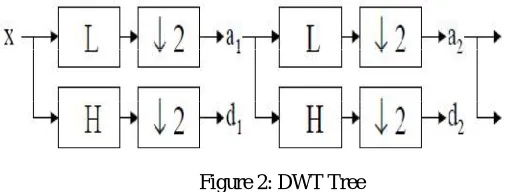
The discrete wavelet transform (DWT) is a linear transformation that operates on a data vector whose length is an integer power of two, transforming it into a numerically different vector of the same length. It is a tool that separates data into different frequency components, and then studies each component with resolution matched to its scale. DWT [3] is computed with a cascade of filtering followed by a factor 2 sub sampling (Fig2).
Figure 2: DWT Tree
H and L denotes high and low-pass filters respectively, ↓2 denotes sub sampling, Outputs of this filters are given by equation (1) and (2)
[ ] = −2 [ ]
∞
∞
(1)
[ ] = ℎ[ −2
∞
∞
] [ ] (2)
ISSN(Online): 2320-9801
ISSN (Print): 2320-9798
I
nternational
J
ournal of
I
nnovative
R
esearch in
C
omputer
and
C
ommunication
E
ngineering
(An ISO 3297: 2007 Certified Organization)
Vol. 4, Issue 7, July 2016
( ) = ^
Here γ is a constant a gamma value γ< 1 is sometimes called an encoding gamma, and the process of encoding
with this compressive power-law nonlinearity is called gamma compression; conversely a gamma value γ> 1 is called a
decoding gamma and the application of the expansive power-law nonlinearity is called gamma expansion. The effect of gamma correction on an image: The original image was taken to varying powers, showing that powers larger than one make the shadows darker, while powers smaller than one make dark regions lighter. The main disadvantage of this method is low signal to noise ratio.
c. Transmission Ratio of atmosphere light computes
The first step of image restoration consists in inferring the atmospheric veil V (x, y). Due to its physical properties, the atmospheric veil is subject to two constraints when the observed image is known: it is positive 0 ≤ V (x, y) and being pure white, for each pixel, it cannot be higher than the min of the components of I(x, y). We thus compute the image W(x, y) = min (I(x, y)) defined as the image of the minimal component of I(x, y) for each pixel (gray level or RGB). W is the image of the whiteness within the observed image I. For a gray level image, we obviously have W = I. The second constraint can thus be written as V (x, y) ≤ W(x, y). Following [12], visibility restoration is an ill-posed problem and a regularized solution can be obtained by maximizing the contrast of the resulting image assuming that the depth-map must be smooth except along edges with large depth jumps. The problem can thus be reformulated as maximizing V (x, y) assuming than V (x, y) is smooth most of the time, and formalized as the following optimization problem:
( , ) ( , )−⋋ ∅((‖∇ ( , )‖ ) (3)
With constraints 0 ≤ ( , ) ≤ ( , ). Parameter controls the smoothness of the solution, is an increasing concave function allowing large jumps.
d. White Balance
It assumes that the white balance is performed prior to the visibility restoration algorithm. When the white balance is correctly performed, the fog being pure white, this implies that Is can be set to (1, 1, 1), also assuming that the input image I(x, y) is normalized between 0 and 1. Thanks to the presence of fog in the image, most of time the white x I(x)
The amount of white color W is the black continuous curve and its local average is the black dash line. The result V estimated by optimizing (3) for a large value of it is shown as red dot-dash. The result V obtained with the proposed approach is shown as green dash. Balance can be performed simply by biasing the image average color towards pure white. For difficult images where light color changes along the image, such as in Fig. 8, it is better to perform a local white balance by biasing towards local image averages.
IV.RESULTS
ISSN(Online): 2320-9801
ISSN (Print): 2320-9798
I
nternational
J
ournal of
I
nnovative
R
esearch in
C
omputer
and
C
ommunication
E
ngineering
(An ISO 3297: 2007 Certified Organization)
Vol. 4, Issue 7, July 2016
(a) (b)
(c) (d)
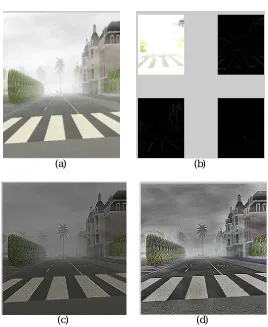
Figure 3: (a) Original Image; (b) Sub bands of Image; (c) Fog Removal Image; (d) Final Enhanced Image
V.CONCLUSION
In this Paper Concluded Wavelet can be regarded as the most efficient transform that deals with image, sound, or any other pattern since it provides a powerful time-space (time-frequency).The objective of the paper is to improve the quality of image such as Medical or Satellite image. In this paper a technique has been proposed based on Discrete Wavelet Transform with Singular Value Decomposition. In this transform decompose the image into four sub bands, out of four bands one is low frequency and remaining are high frequency. Then the modified image is reconstructed by using inverse DWT. To improve the quality, the first step is Adaptive Histogram Equalization (AHE)
REFERENCES
[1] Kirandeep Kaur, Asst.Prof.Neetu Gupta, “Performance Evaluation Of Dbla, Hsv-Clahe & Rgb-Clahe Based Image Enhancement”, International
Journal of Emerging Trends & Technology in Computer Science (IJETTCS), Vol 3, Issue 4, July, 2014.
[2] K. Tejasri, Mrs. K. Rani Rudrama ,”Image Enhancement Using Wavelet Decomposition, Super Resolution Algorithm & Lum Filters”,
International Research Journal of Engineering and Technology (IRJET), Vol 02, Issue: 05, 2015.
[3] Supreet Kaur Sohal, Er. Samandeep Singh, “Improved Particle Swarm Optimization Based Image Enhancement Using Fuzzy Logic”,
International Journal of Engineering and Innovative Technology (IJEIT), Vol 4, Issue 12, 2015.
ISSN(Online): 2320-9801
ISSN (Print): 2320-9798
I
nternational
J
ournal of
I
nnovative
R
esearch in
C
omputer
and
C
ommunication
E
ngineering
(An ISO 3297: 2007 Certified Organization)
Vol. 4, Issue 7, July 2016
[8] S.Palaneeswari, K.Fathima Begam, “Image Enhancement Using Colour Space Conversion and Discrete Wavelet Transform”, International
Journal of Innovative Research in Science,Engineering and Technology, Vol. 3 , Issue 4, 2014.
[9] Marcin Kociołek, Andrzej Materka, Michał Strzelecki, Piotr Szczypiński, “Discrete Wavelet Transform – Derived Features for Digital Image Texture Analysis”.
[10] Roshin Roy R.Dharmalingam, “Adaptive Contrast Image Enhancement for Foggy Images”, Transactions on Engineering and Sciences, Vol.3,
Issue 4, 2015.
[11] Neetu Gupta, Kirandeep Kaur, “Evaluating the Performancne of DBLA Using Clahe & Dark Channel Prior”, International Journal of Advanced