University of Windsor University of Windsor
Scholarship at UWindsor
Scholarship at UWindsor
Electronic Theses and Dissertations Theses, Dissertations, and Major Papers
2009
Extending Scojo-PECT by migration based on system-level
Extending Scojo-PECT by migration based on system-level
checkpointing
checkpointing
Peiyu Cai
University of Windsor
Follow this and additional works at: https://scholar.uwindsor.ca/etd
Recommended Citation Recommended Citation
Cai, Peiyu, "Extending Scojo-PECT by migration based on system-level checkpointing" (2009). Electronic Theses and Dissertations. 7922.
https://scholar.uwindsor.ca/etd/7922
This online database contains the full-text of PhD dissertations and Masters’ theses of University of Windsor students from 1954 forward. These documents are made available for personal study and research purposes only, in accordance with the Canadian Copyright Act and the Creative Commons license—CC BY-NC-ND (Attribution, Non-Commercial, No Derivative Works). Under this license, works must always be attributed to the copyright holder (original author), cannot be used for any commercial purposes, and may not be altered. Any other use would require the permission of the copyright holder. Students may inquire about withdrawing their dissertation and/or thesis from this database. For additional inquiries, please contact the repository administrator via email
NOTE TO USERS
This reproduction is the best copy available.
Extending Scojo-PECT by Migration Based on
System-level Checkpointing
By
Peiyu Cai
A Thesis
Submitted to the Faculty of Graduate Studies through the School of Computer Science in Partial Fulfillment of the Requirements for
the Degree of Master of Science at the University of Windsor
Windsor, Ontario, Canada 2009
1*1
Library and Archives CanadaPublished Heritage Branch
395 Wellington Street OttawaONK1A0N4 Canada
Bibliotheque et Archives Canada
Direction du
Patrimoine de I'edition
395, rue Wellington Ottawa ON K1A 0N4 Canada
Your file Votre reference ISBN: 978-0-494-57631-1 Our file Notre r6f6rence ISBN: 978-0-494-57631-1
NOTICE: AVIS:
The author has granted a
non-exclusive license allowing Library and Archives Canada to reproduce, publish, archive, preserve, conserve, communicate to the public by
telecommunication or on the Internet, loan, distribute and sell theses
worldwide, for commercial or non-commercial purposes, in microform, paper, electronic and/or any other formats.
L'auteur a accorde une licence non exclusive permettant a la Bibliotheque et Archives Canada de reproduire, publier, archiver, sauvegarder, conserver, transmettre au public par telecommunication ou par Nnternet, preter, distribuer et vendre des theses partout dans le monde, a des fins commerciales ou autres, sur support microforme, papier, electronique et/ou autres formats.
The author retains copyright ownership and moral rights in this thesis. Neither the thesis nor substantial extracts from it may be printed or otherwise reproduced without the author's permission.
L'auteur conserve la propriete du droit d'auteur et des droits moraux qui protege cette these. Ni la these ni des extraits substantiels de celle-ci ne doivent etre imprimes ou autrement
reproduits sans son autorisation.
In compliance with the Canadian Privacy Act some supporting forms may have been removed from this thesis.
Conformement a la loi canadienne sur la protection de la vie privee, quelques
formulaires secondaires ont ete enleves de cette these.
While these forms may be included in the document page count, their removal does not represent any loss of content from the thesis.
Bien que ces formulaires aient inclus dans la pagination, il n'y aura aucun contenu manquant.
1*1
Author's Declaration of Originality
I hereby certify that I am the sole author of this thesis and that no part of this thesis has been published or submitted for publication.
I certify that, to the best of my knowledge, my thesis does not infringe upon anyone's copyright nor violate any proprietary rights and that any ideas, techniques, quotations, or any other material from the work of other people included in my thesis, published or otherwise, are fully acknowledged in accordance with the standard referencing practices. Furthermore, to the extent that I have included copyrighted material that surpasses the bounds of fair dealing within the meaning of the Canada Copyright Act, I certify that I have obtained a written permission from the copyright owner(s) to include such material(s) in my thesis and have included copies of such copyright clearances to my appendix.
Abstract
In recent years, a significant amount of research has been done on job scheduling in high
performance computing area. Parallel jobs have different running time and require a different
number of processors, thus jobs need to be scheduled and packed to improve system
utilization. Scojo-PECT is a job scheduler which provides service guarantees by using
coarse-grain time sharing. However, Scojo-PECT does not provide process migration. We
extend the Scojo-PECT by migrating parallel jobs based on system-level checkpointing. We
investigate different cases in the Scojo-PECT scheduling algorithm where migration based on
system-level checkpointing can be used to improve resource utilization and reduce job
response time. Our experimental results show reduction of relative response times on
medium jobs over the results of the original Scojo-PECT scheduler and the long jobs do not
Dedication
To my parents, my aunts
and
Acknowledgements
I would like to take this opportunity to thank my thesis supervisor, Dr. Angela Sodan for her caring, guidance and cooperation throughout my graduate studies. This work presented here would not be impossible without her help and support.
Secondly, I would like to thank Dr. Xiaobu Yuan and Dr. Muscedere for being the committee and spending their valuable time and to Dr. Dan Wu for serving as the chair of the defenses.
Table of Contents
Author's Declaration of Originality iii
Abstract iv Dedication v Acknowledgements vi
List of Tables ix List of Figures x 1. Introduction 1 2. Background Issues 4 3. The Scojo-PECT scheduler 10
4. Checkpointing and Migration 12 4.1 Checkpointing mechanism 12 4.2 Checkpointing costs 15 4.3 Migration and restart mechanism and cost 17
5. Extending Scojo-PECT by migration based on system-level checkpointing 19
5.1 Our assumptions 19 5.2 Selected Metrics 20 5.3 Extended Cases 20
5.3.1 Case one: Move job to continue in next non-type slice 20 5.3.2 Case two: Move job to make space for non-type backfill job 23 5.3.3 Case three: New job non-type backfill with migration at the end of slice to
avoid conflictions 25 5.3.4 Case four: Remove non-type backfilled job if new job of own type arrives....27
5.4 Sub Cases of Extended Cases 28 5.4.1 Move one job which can stay on same resources 29
5.4.2 Move one job which can not stay on same resources .29 5.4.3 Move multiple jobs to use resources in next slice 30
5.5 Utilization Gain Calculation 32 5.6 Making decisions among checkpointing candidates 33
6. Experiments and Results 35 6.1 Experimental Set-up 35 6.2 Experimental Results 36 7. Summary and Conclusion 44
List of Tables
List of Figures
Figure 2.1: Conservative backfilling and EASY backfilling 5
Figure 3.1: Job Type slices and backfilling 10 Figure 3.2: Scojo-PECTjobs and backfilled jobs 11 Figure 4.1: A checkpoint-restart system [32] 13 Figure 5.1: Move job to continue in next non-type slice(before) 21
Figure 5.2: Move job to continue in next non-type slice(after) 22 Figure 5.3: Move job to make space for non-type backfill job(before) 23
Figure 5.4: Move job to make space for non-type backfill job(after) 24
Figure 5.5: Newjob non-type backfill conflicts (before) 25 Figure 5.6: New job non-type backfill with migration at the end of slice to avoid
conflicts(after) 26 Figure 5.7: Remove non-type backfilled job if new job of own type arrives(before) 27
Figure 5.8: Remove non-type backfilled job if new job of own type arrives (after) 28
Figure 5.9: Move one job which can stay on same resource 29 Figure 5.10: Move one job which cannot stay on same resources 30 Figure 5.11: Move multiple jobs to use resources in next slice 30
Figure 5.12: Move multiple jobs to avoid conflict 31 Figure 6.1: Seed 7 Long jobs relative response time comparison 37
Figure 6.2: Seed 7 Medium jobs relative response time comparison 37 Figure 6.3: Seed 13 Long jobs relative response time comparison 38 Figure 6.4: Seed 13 Medium jobs relative response time comparison 38 Figure 6.5: Seed 23 Long jobs relative response time comparison 39 Figure 6.6: Seed 23 Medium jobs relative response time comparison 39 Figure 6.7: Seed 31 Long jobs relative response time comparison 40 Figure 6.8: Seed 31 Medium jobs relative response time comparison 40 Figure 6.9: Seed 71 Long jobs relative response time comparison 41 Figure 6.10: Seed 71 Medium jobs relative response time comparison 41
1. Introduction
In recent years, much research has been done in the High Performance Computing field. A
computer cluster system is a group of individual computer nodes usually linked by networks
and work as a super computer. Each node in the cluster has one or multiple processors.
Nodes also have local memories, local disks, and network devices to communicate and
collaborate with other nodes in the cluster system.
In cluster systems, a job can run parallel using multiple processors for a certain period of
time, so this makes it important to schedule the jobs of "when" and "where" to run in order to
obtain better utilization of the system and better response time for the jobs. The scheduler for
the cluster should be designed to obtain high system utilization and reduce the response time
of the jobs.
One scheduling category is space sharing. Space sharing [17] partitions processors into
groups and each group of processors is assigned exclusively to a single job. The job will run
on the assigned processors until finished. This approach is easy to implement but creates
fragmentations and the performance is not promising. Another scheduling category is time
sharing. The basic idea of time sharing is that multiple jobs share the same resources. Gang
scheduling [17] is one of the time sharing approaches which schedules all threads/processes
at the same time performs better, but it also suffers from expensive context switches. Jobs are
Another possibility to switch running job out to accomplish time sharing is to do
checkpointing. In computer systems checkpointing is usually implemented to support
rollback-recovery, which aims to recover the system from potential failure. Checkpointing
meanwhile allows job schedulers to move jobs or processes, so that the job or the processes
of jobs can be re-located and restart at another node. System-level checkpointing requires
support from the operating system. It writes the entire image of the running job into storage
device. Hence the overhead is high. But system-level checkpointing can be done at any
moment by the system. Application-level checkpointing needs the programmer to code
checkpoints into their program and only checkpoint part of their data, hence the overhead is
reduced. However application-level checkpoints can only be initialized by the user.
The Scojo-PECT [7] scheduler is an existing coarse-grain time sharing scheduler framework,
each slice running one type of job and allowing backfilling. At the end of slice, all jobs are
preempted and swapped out, then let the next slice type of jobs running.
Scojo-PECT, however, does not support checkpointing and migration. In our thesis we
extend Scojo-PECT by adding support of system-level checkpointing and migration, and
keep the preemption swaps. This will give our scheduler the flexibility to migrate jobs to
different nodes other than those where they were started, hence they can be better packed.
We explored the possible cases when and where checkpoints can be done in each
coarse-grain time slice. By extending these cases, we expect improvements for the average
The thesis is organized in the following order: Chapter 2 introduced some important
backgrounds; Chapter 3 briefly introduced the Scojo-PECT scheduler; Chapter 4 introduced a
review of Checkpoint and Migration; Chapter5 we presented our extension algorithms on the
Scojo-PECT scheduler; Chapter 6 presented our experiments and results and Chapter 7 gives
2. Background Issues
In space sharing, introduced in the previous chapter, the simplest strategy is to schedule jobs
in a First Come First Serve order. That means jobs are scheduled to run on the corresponding
resources in their submission order. However, the problem for this approach is that jobs are
scheduled on the processor dimension only. This will potentially cause fragmentation in the
system, which means some processor groups are left idle in a period of time. Because jobs
are scheduled in First Come First Serve order, even if the system has enough resources to let
a later job run, this job will have to wait for the current running job to complete. As a
consequence, average job waiting time and response time are increased. This will hurt the
performance.
To address the fragmentation problem, backfilling is studied to fill the system fragmentation
and improve system utilization [8][14]. In parallel computing, backfilling means jobs are
scheduled to run ahead of their original FCFS order to fill the free resources (fragmentation).
There are mainly two types of Backfilling strategies conservative backfilling and EASY
backfilling. [34]
If the backfilled job does not delay any of the successive jobs, the approach is called
conservative backfilling. Some other aggressive backfilling approaches abandon the no-delay
rule. For example: 'EASY' backfilling. This approach relaxes constrains of conservative
Accordingly, later on jobs might be delayed and hence the response time is affected. As a
consequence, this approach could not guarantee good response time. The result varies on
different workloads.
JOB 3
Figure 2.1: Conservative backfilling and EASY backfilling
This figure shows an example of EASY backfilling, Job 1 is an EASY backfilled job, it does
not delay Job2 to run, but it conflicts with Job 3, which means Job3 will have to wait until
Job 1 is finished. Accordingly, in conservative backfilling, Job 1 will not be backfilled into
the space.
Both conservative backfilling and EASY backfilling can improve system utilization
significantly. Conservative backfilling improves about 70% system utilization, and still
leaves possibility to improve [49]. More over, the average response time is greatly reduced,
comparing to the basic First Come First Serve strategy. However, the pitfall of these two
approaches are, users have to estimate the jobs' running time accurately, otherwise, the
system can not guarantee fairness and correctness of the backfilling. This is also a hotly
studied topic of modern high performance computing research area.
Allowing preemption of jobs is another solution to improve space sharing approaches.
Preemption can be used to support priorities, if a job with higher priority comes, low priority
jobs may preempt. Preemption can also be used to support long term time sharing. For
example, preempt long jobs and run them at night or other non-busy time. The pitfall is that
the cost is high and almost all preemptions need support from the operating system.
Preemption can be implemented by suspend/resume in memory or page/swap on disk.
However, suspension and resumption in memory may cause memory contention because it
requires sufficient system memory to store the currently running job and the preempted jobs
as well. Paging and swapping also needs support from the system, which is not always
supported. Moreover, preemption requires the preempted job to restart at the same resources.
This makes it impossible to re-pack jobs to obtain better response time and utilization.
A more flexible method to switch jobs out is checkpointing. After checkpointing, jobs are
able to be migrated; hence it will be possible for jobs to run on different resources. This
makes is possible for the scheduler to re-pack jobs better. We will explain checkpointing and
migration more in detail.
Checkpointing means to write an image file of the job out including all the information
opened files and network. Checkpointing is more expensive to do, but it is more flexible than
page/swapping.
Once checkpointing is done by the system, migration becomes possible. Migration means to
restart checkpointed jobs on different processors. Mere migration keeps the original allocated
number of processors. Migration is also implemented by halting the whole job and check
pointing. Note that to do migration the job should be in a migration-safe state for example
not to be in the middle of updating data or holding a lock. Both checkpointing and migration
should not involve system objects, and it is going to be complicated to do on heterogeneous
systems. However, static resource allocation courses fragmentation. If the jobs are moldable
or malleable, we can apply adaptive resource allocation.
Time sharing is the other general category of scheduling approaches in parallel computing
systems. The basic idea of time sharing is to run parallel jobs on
time-shared/multi-processing mode.
Combinations of space sharing and time sharing are also introduced such as gang scheduling
[21]. Gang scheduling schedules all threads/processes on different processors of a job at the
same time. All the processors of the system are time partitioned coordinately, and each time
partition can be viewed as a virtual system. Then, all the processes and threads are
synchronized into these virtual systems. It also includes more than one job sharing a same
response time and has better results comparing to Space sharing.
Gang scheduling time slices are set globally and equal. Similar to some other approaches,
gang scheduling also suffers from high memory pressure, because it keeps jobs in memory to
reduce overhead.
Time sharing without coordination may leads to too many expensive switches or waste of
computing resources according to busy waiting. In other words a process of a parallel job
may have to wait for other processes of the job. Accordingly, the processor will stay idle for a
period of time. Another problem is basic time sharing entails too many expensive system
contexts switching. Other strategies have also been investigated such as Scojo-PECT.
The Scojo-PECT [7] scheduler is a coarse-grain time sharing preemptive scheduler
framework. It is also globally coordinated like gang scheduling. Scojo-PECT allocates
resource shares automatically. More specifically, it explicitly set the resource share
distribution per job class dynamically according to the workload, job mix and the
administrator's policy. By limiting time slice length into tens of minutes, the
preemption/swapping over head is acceptable. Scojo-PECT classifies jobs into job classes
according to their running time (currently supports short, medium and long type). Each job
type gets an individual slice of time to run. Scojo-PECT preempts jobs at the end of each
slice type to free memory space in the system so other jobs can run. We will introduce
The original Scojo-PECT does not support checkpointing; so as a consequence, jobs that
were preempted have to restart on the same resources. It is not flexible enough, so we try to
extend its flexibility by allowing jobs to migrate based on system-level checkpointing.
Checkpointing technology is a field which has been hotly studied but is still developing.
There are no perfect implementations in this area. Our goal is to use checkpointing as a tool
3. The Scojo-PECT scheduler
In each Scojo-PECT job type slices [7], jobs are scheduled in a first come first serve (FCFS)
order. Short jobs and long jobs are found to obtain good response times by employing this
approach. Scojo-PECT maintains waiting queues and preemption queues for short, medium
and long jobs separately. When a new job comes, the scheduler will classify it by its running
time, artd then this job will be put in to the waiting queue of its own type, and wait for its
time to run. When a time slice runs to its end, all the running jobs will be preempted into
their own type preemption queue logically, and the jobs of next time slice will then restart.
This approach will reduce memory usage because the jobs can be preempted into disk. Figure
3.1 shows that the time slice intervals changes as time changes.
m
l
I n t e r v a l X I n t e r v a l "X
Figure 3.1: Job Type slices and backfilling. [7]
Scojo-PECT reduces fragmentation by applying backfilling. Currently, in our work we are
using conservative backfilling policy.
Scojo-PECT additionally supports non-type backfilling to reduce potential fragmentation.
Non-type backfilling means that a preempted or waiting job of a different type may get
backfilled if it will not delay other jobs. The backfilled jobs will run in the non-type slice
node I
Short Medium Long t i m e
jobs jobs jobs
Figure 3.2: Scojo-PECT jobs and backfilled jobs
Scojo-PECT provides dramatically better relative response times than a non-preemptive
priority scheduler.
In brief the Scojo-PECT scheduler includes such characters:
1) Classify jobs by job type according to their runtimes (short, medium, long). The three
types of jobs are scheduled in separate time slices.
2) Each type of job is scheduled in a FCFS order.
3) Predict job's start time based on conservative backfilling.
4) For each time slice, the PECT scheduler will first resume preempted jobs of the same job
type.
5) Then allocate waiting jobs of the same type.
4. Checkpointing and Migration
Checkpointing is widely used in many kinds of computer systems. In distributed systems
checkpointing is normally implemented to support rollback-recovery, which aims to recover
the system from potential failure. Checkpointing meanwhile allows job schedulers to move
jobs or processes, so that the job or the processes of jobs can be re-located and restart at
another node. Hence, by implementing checkpointing, many goals can be accomplished, for
example system load balancing, which means when a node of the cluster become overloaded
and too "busy", the jobs running on this node can be migrated to other nodes. So
checkpointing combined with migration can be used to improve system performance
including response time and system utilization.
4.1 Checkpointing mechanism
In this thesis, we use system-level checkpointing and migration as a tool to extend the
flexibility of the Scojo-PECT scheduler. System-level checkpointing is a direct and also the
most widely implemented checkpointing mechanism is to save the entire state of the job,
which is usually called full checkpointing. Because this approach needs support from the
computer system, this is also called system-level checkpointing. To implement checkpointing,
all the processes must be in a globally consistent state. According to previous research a
globally consistent state can be defined as the following: "More precisely, a consistent
the corresponding sender reflects sending that message."[43] Once all the processes of the
job are at a consistent state, the processes will then write the state out, on local disk or any
kinds of stable storage system e.g. NFS (Network File Systems).
Figure 4.1 shows a typical cluster system with checkpointing supported. A, B and C are
nodes of a cluster system, parallel programs run parallel and communicate among the nodes.
The application coordinator send signals to the nodes and coordinate the target job that is to
be checkpointed to a consistent state, then the checkpoint file will be stored in to the storage
system. Accordingly, to restart the job, checkpoint files will be sent to the target nodes and
again the coordinator send signals and restart the job at a consistent stage.
n
/
XZ3
Control signals " for checkpointing and restart
Application \ ' Coordinator
- o - - • - • •
Locate an ndividual Storage Service Location of
checkpoints
Federation of Storage Services
In some systems that need high reliability, checkpointing has to be done frequently, thus
writing the checkpoint file frequently to the storage. This may cost a significant amount of
system I/O resource and communication bandwidth. Incremental checkpointing is employed
to reduce the checkpoint file size. The system can save only the part that has been modified
since the last checkpointing to reduce the file size need to be written out. Then checkpointing
can be done frequently and the latency can be hidden. However, incremental checkpointing
checkpoint file size is at least as big as the operating system page size. Because of this
character, incremental checkpointing can not guarantee that the reduction of the checkpoint
files to be significant for every job.
In recent years, computer memory (RAM) price is getting less expensive. This makes it
possible to upgrade the memory size of each node of the cluster to a high capacity. As we
described above, the major drawback and bottleneck of checkpoint approaches are the system
I/O and bandwidth, so saving the checkpoint files in the local memory of each nodes can
greatly reduce the system resource cost of checkpointing and restart of jobs.
Another approach is called application-level checkpointing. [44] Application level
checkpointing can be supported by external library or supported by compiler. But both need
the programmer's effort to initialize checkpointing. The user (programmer) typically needs to
define the data set to checkpoint and also define the time interval between checkpoints. In
application-level checkpoint file is normally smaller than that of the system-level
checkpointing hence the overhead to write the checkpoint file to the storage is lower.
However, this approach needs the programmer to know checkpointing structures well and
also with this approach it is impossible for the system to initialize a global checkpoint for the
entire system.
In our thesis we explored and extended Scojo-PECT scheduler by migration based on
system-level checkpointing.
4.2 Checkpointing costs
As we presented above, the cost of checkpointing of a parallel job in a cluster system
typically contains two parts:
1) To reach the consistent state, the system needs to coordinate all the processes, this takes a
certain period of time. We denote it Coord.
2) Once all the processes of the job are in a consistent state, the state image of each process
will be written out on local disk or in the memory or on a NFS server. At system level the
image size is equal to the memory footprint size.
We define the image file size that needs to write out as IS and the bandwidth to write out
Cp cost = Coord + IS/bandwidth
The coordinating time of processes is not dependent on the number of nodes and it is not the
main latency. By comparing the cost of in-memory and on-disk checkpointing, the cost of in
memory checkpointing is under 1 second, this includes coordination of processes and write
into memory. Hence Coord is less than 1 second roughly 0.4 sec or even less. [47][50]
The bandwidth to write the process image depends on the implementation. According to [49]
the bandwidth to write on the local disk is around 55-98MB /s to local disk in 2005, so it is
reasonable to believe that it can commonly be 70MB/s in 2009. If write into the memory it
can be as fast as lG/s. If store to a remote NFS server, the bandwidth will depends on the
network connection. A grid computing system in Canada called Sharcnet [www.sharcnet.org]
has lOGbps/IGbps dedicated connection between all clusters within the grid computing
system itself. So 70Mb/s is also reasonable for remote NFS server storage.
From the above information, the formula of the checkpointing cost we use in this thesis
would be:
CP Cost = IS/70 + 0.4
Accordingly, the in memory checkpointing cost would be
4.3 Migration and restart mechanism and cost
Since checkpointing stores a consistent state of a job, by transporting the state of process and
restarting it in a different node, we can achieve process migration.
Migration time is linear with the checkpointing image size. Mainly it costs the system to
write the image to the target nodes. And it is independent of the number of the processes in
the job [47]. Process restart itself costs a very short time. In some existing unix/linux system,
the system use mmap() function in Unix system instead of writing all the data into the
memory to restart the process.[48]
The cost to migrate and restart the job can be defined as follow:
MR cost = restart cost + IS/bandwidth
As we discussed above, the restart cost is very small [47] it is reasonable to believe it is
within 0.4 second. IS is the checkpoint file image size. Bandwidth is the achievable
transportation bandwidth to transport the image file to the target nodes. In [51] the bandwidth
is 22Mb/s in year 2005, it is reasonable to believe that the bandwidth now can be 30Mb/s. So
the formula to do process migration and restart is:
MR cost = IS/30 + 0.4.
Then we can obtain the total Checkpointing and Migration restart cost:
Accordingly, in memory checkpoint restart would be:
MR cost = IS/1024 + 0.4
Then the total Checkpointing and Migration restart cost would be:
5. Extending Scojo-PECT by migration based on
system-level checkpointing
The Scojo-PECT scheduler is a coarse-grain time sharing preemptive. It combines time
sharing and space sharing approaches to reduce response time and increase system
utilization.
5.1 Our assumptions
Our extension on Scojo-PECT scheduler is based several assumptions as follows.
• Each node contains only one processor, local memory, operating system and sufficient
local disk space.
• All jobs are neither moldable nor malleable. That means once submitted the number of
processors they need are fixed and can not change. In parallel computing, Moldable job
means the number of processors the job needs can be modified before starting to run.
Malleable job means the number of processors the job needs can be modified both
before starting to run and while it is running. [31]
• Users will have full knowledge of their job and are able to provide the number of
processors their jobs need. Also, the users will provide to the system with their estimated
running time of their jobs. This assumption used to be hard to accomplish. However,
recently, more and more commercial scientific computing softwares are released. More
and more researchers chose to use softwares to run tests on clusters instead of
automatically or offer such interfaces to the user based on the input of the user's problem
e.g. "Gaussian 09", "Amber".
5.2 Selected Metrics
The following are the metrics we employed:
• Average Relative Response time: The time period from the moment the job submitted to
the cluster system to the moment that the job completed its running is called response
time of the job. Relative Response time is defined as: "response time /pure running time
without time slicing". This metric represents more on behalf of the user.
• Another metrics is P75, it denotes the highest bound of 75% jobs' relative response
times.
• Similarly P95 denotes the highest bound of 95% jobs' relative response times.
5.3 Extended Cases
Our efforts and work to extend Scojo-PECT by adding migration based on system-level checkpointing can be categorized into the following four basic cases:
5.3.1 Case one: Move job to continue in next non-type slice
In Scojo-PECT scheduler, if a job can not finish at the end of it's own type slice, it will be
preempted and store into the preemption queue and wait for its own type of slice again then
resources in the next slice for this job to run, because this job was preempted, it has to start
on the same processors, the free resource will be wasted and stay idle.
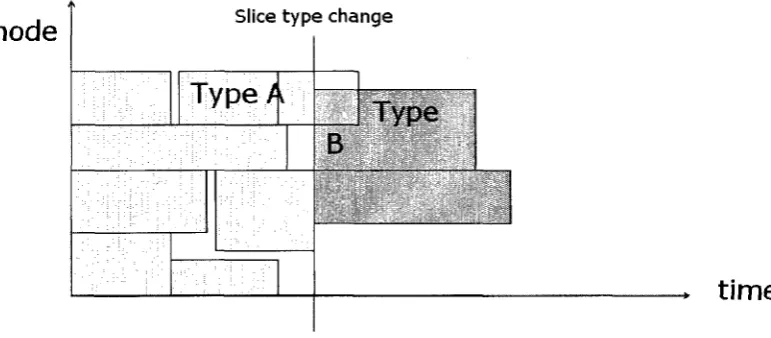
As illustrated in Figure 5.1 below, A job of Job Type A can not finish within its own slice
type, it need some more time to finish, but at the end of Slice Type A, this job must be
preempted and wait for Type B slice before it gets a chance to run again. However, we can
discover that in job Type B slice, there are enough free nodes (processors) to run this job,
because the original Scojo-PECT does not support checkpointing, these resources will be
wasted.
node
* Slice
Type/
typ
i
a cha
B
nge
Type
* time
Figure 5.1: Move job to continue in next non-type slice(before)
To make use of the free processors in the next slice, we can apply a checkpoint on the job and
then we restart the job to the free processors in the next slice. In Figure 5.2 the Type A job is
checkpointed. The deeper color part is the overhead to do the checkpoint. Then the
checkpointed job is migrated to Type B slice, the deeper colored part represents the overhead
node
Slice type changeType
Type
time
Figure 5.2: Move job to continue in next non-type slice(after)
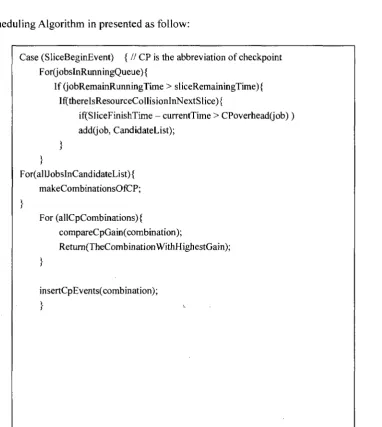
The scheduling Algorithm in presented as follow:
Case (SliceBeginEvent) {// CP is the abbreviation of checkpoint For(jobsInRunningQueue){
If (jobRemainRunningTime > sliceRemainingTime){ If(therelsResourceCollisionInNextSlice){
if(SliceFinishTime - currentTime > CPoverhead(job)) add(job, CandidateList);
} }
For(allJobsInCandidateList) { makeCombinationsOfCP;
}
For (allCpCombinations){
compareCpGain(combination);
Rerurn(TheCombinationWithHighestGain);
}
insertCpEvents(combination);
5.3.2 Case two: Move job to make space for non-type backfill job
This case addresses another situation. While a time slice is running, a job is finished, then the
processors allocated to it will be set free and ready for other jobs to run. At this point, the
Scojo-PECT scheduler will first try to run own type waiting jobs and then try to backfill jobs
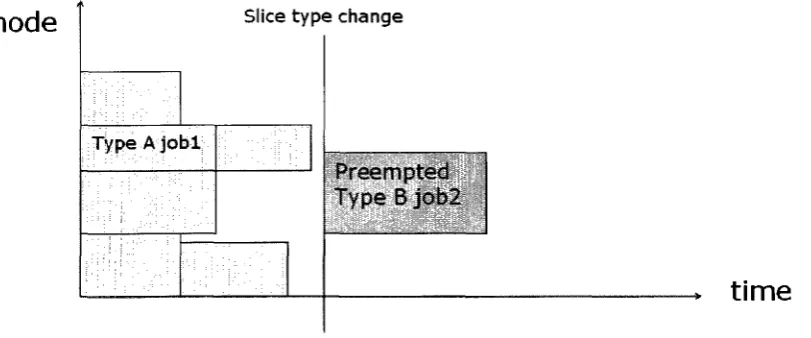
from other types. However, after all the checking, there is still a situation that the number of
free processors is enough for a preempted job of another type, but only because the job is a
preempted job it has to restart on the same processors it was running, and some of these
processors are occupied by another running job, hence this preempted job can not be
backfilled and run in current slice. In Figure 5.3 we can see in job Type A, a job finished in
the middle of this current slice, accordingly its processors are set free. A preempted Job 2 of
Type B can use these processors but it is blocked by Job 1.
node
Slice type changeType A j o b l :
Preempted
Type B job2
time
Figure 5.3: Move job to make space for non-type backfill job(before)
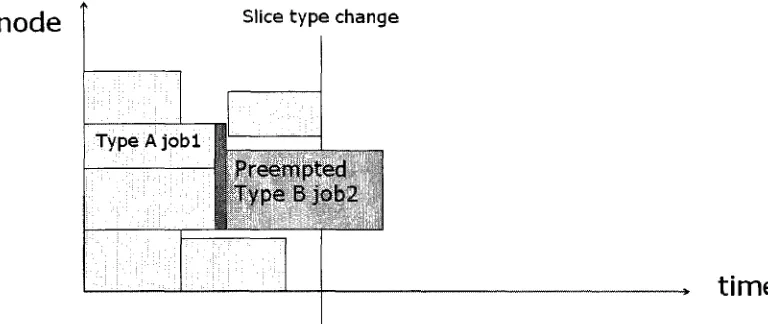
To make use of these system resources, we can apply a checkpoint on the job that is blocking
the preempted job, and migrate it to some other processors that will not block the preempted
processors and the preempted Type B Job 2 is non-backfilled and run in slice Type A. Hence
this will improve the response time of Job 2.
node
Slice type changeT y p e A j o b l
Preempted Type B job2
- time
Figure 5.4: Move job to make space for non-type backfill job(after)
The scheduling algorithm is presented as follow:
Case(j obFinishEvent) {
Schedule() // try schedule jobs using the existing scheduler
for (alljobsInPreemptionQ){
if (currentFreeNodes>jobNodes){
getJobsThatAreBlockingBackfill(); II jobs that blocks the preempted job if(backFillGain > CheckpointMigrationCost){
Migrate(blockingJobs);
Non-typeBackfill(preemptedJob); }
5.3.3 Case three: New job non-type backfill with migration at the end
of slice to avoid conflictions
In the original Scojo-PECT scheduler, when a job finishes, the scheduler will try to non-type
backfill jobs from other types. If a non-type job can fit into the free processors in the current
slice, but this job can not finish within the slice and needs to run on its own slice type, then,
the scheduler will check again if this job will conflict with the preempted jobs in next slice, if
it will, the job will normally not be backfilled. In Figure 5.5 in Type A slice, we can see there
are enough free processors for a new Type B job 1, however, this job can not finish within
slice Type A, and moreover, this job conflicts with a preempted Type B job 2, so hence this
Job 1 will not be non-type backfilled in the original Scojo-PECT scheduler without
checkpointing and migration.
node
Slice type changeType A
Preempted.tyce,Bjob2 Backfilled
new non-type B joblj
time
Figure 5.5: New job non-type backfill conflicts (before)
To extend the original scheduler, we allow the non-type waiting job backfill, then at the end
j o b to processors that are free in its own slice type and let it continue to run. In Figure 5.6,
the Type B j o b 1 is non-type backfilled and checkpointed at the end of slice Type A then in its
own type slice B, it is migrated to the free processors that will not conflict with the
preempted job 2.
node
Type A
Slice type change
Backfilled ns/j
non--J type B j o b l __
Preempted
type B job2
i
time
Figure 5.6: New job non-type backfill with migration at the end of slice to avoid conflicts(after)
The algorithm to handle this case is as follows:
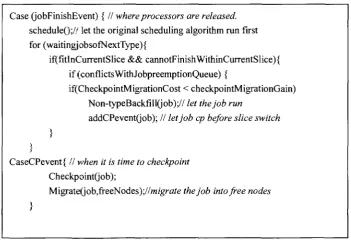
Case (jobFinishEvent) {// where processors are released. schedule();// let the original scheduling algorithm run first for (waitingjobsofNextType){
if(fitInCurrentSlice && cannotFinishWithinCurrentSlice){ if (conflicts With JobpreemptionQueue) {
if(CheckpointMigrationCost < checkpointMigrationGain) Non-typeBackfill(job);// let the job run
addCPevent(job); // let job cp before slice switch
} }
CaseCPevent{ II when it is time to checkpoint Checkpoint(job);
Migrate(job,freeNodes);//7w/grafe the job into free nodes
5.3.4 Case four: Remove non-type backfilled job if new job of own
type arrives
In the original Scojo-PECT scheduler, if a job is non-type backfilled into another type Slice,
this job will continue to run till the end of this slice. This makes a problem, if a new job of
the current slice type arrives and at this moment there are not enough free processors in the
system to run this job, it will be delayed and keep waiting till its own slice come again. This
will hurt the response time of this job when improving the response time of the non-type
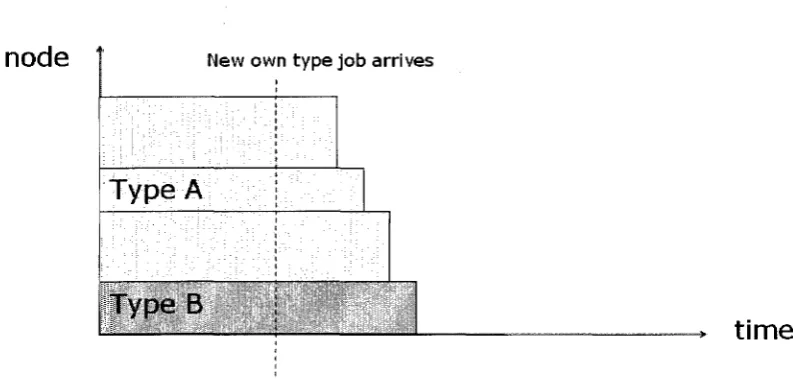
backfilled job. Figure5.7 shows at Type A slice a Type B job was non-type backfilled and
running, a new job of type A arrives when the backfilled job hasn't finish yet.
node
New own type j o b arrivesType A
Type B
-» time
Figure 5.7: Remove non-type backfilled job if new job of own type arrives(before)
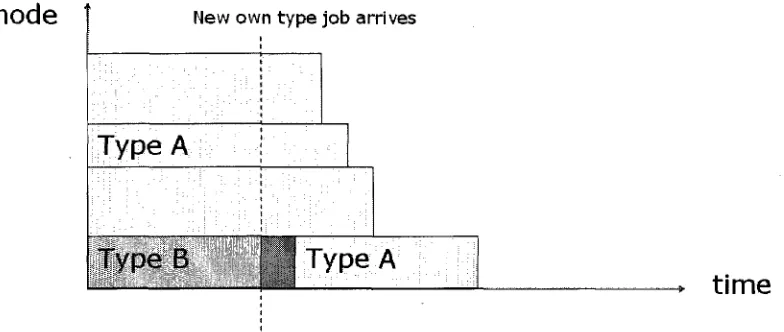
We extend this case by giving the non-type backfilled job a checkpoint and put it into the
preemption queue of its own type. Then the new arrived job can get a chance to run. In
Figure 5.7 we can see that the non-type backfilled Type B job is checkpointed and a newly
node
New own type job arrivesType A
Type B *Bl Type.A
1:••
time
Figure 5.8: Remove non-type backfilled job if new job of own type arrives (after)
The following is the algorithm of this case.
Case (jobSubmitEvent){
Schedule(WaitingJobs);//7r); to schedule with the
For (jobsInRunningQueue){ if (jobType != currentSliceType
&& enoughSpaceInNextSliceFor(job) && currentFreeNodes + jobNodes >=
Checkpoint(job); Start(waitingJob);
} } }
original scheduler
waitingJobNodes) {
5.4 Sub Cases of Extended Cases
Although we extended the original Scojo-PECT scheduler with the four basic cases, as we
implement we have to face more sub-cases that may occur. The following are the sub-cases
5.4.1 Move one job which can stay on same resources
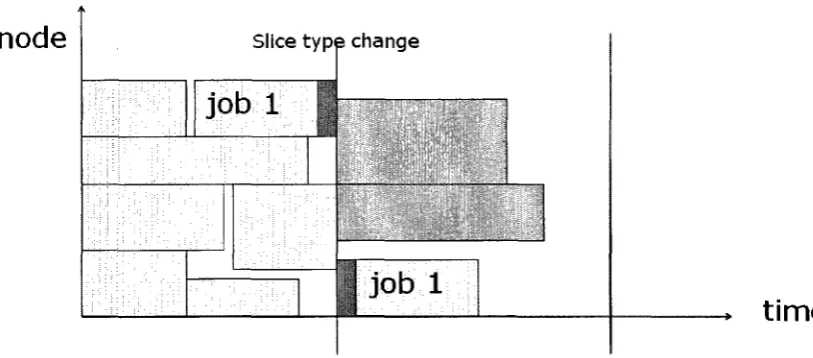
This is the most straight forward case in our basic case one. Job 1 is checkpointed and
migrated to another slice, then run and finish with in the next slice type. In Figure 5.9 job 1 is
checkpointed in its own type slice and migrated into the next type slice, then it ends before
the next slice is over.
node
Slice type changejob 1
| j o b l
- time
Figure 5.9: Move one job which can stay on same resource
5.4.2 Move one job which can not stay on same resources
In this case a job is checkpointed and migrated to another type slice as the pervious case, but
the migrated job is too long to finish within the next type slice. This may cause processor
conflicts if there are preempted jobs of its own type occupied the processors. So we have to
checkpoint the job again and migrate back to its own position when its own type slice comes.
Accordingly the overhead is again increased and have to be recalculated. In Figure 5.10 job 1
slice ends, so it is checkpointed again and migrated back to its own position after Type C
slice when Type A slice comes again.
node
Slice t y p e changejob 1
job 1
Preempted
job
time
Figure 5.10: Move one job which cannot stay on same resources
5.4.3 Move multiple jobs to use resources in next slice
node
Slice type changej o b 1
Job 2
j o b 1
Job 2
t i m e
Figure 5.11: Move multiple jobs to use resources in next slice
Another sub-case that may occur is that when we try to move job to continue in next
continue to run, we will have to evaluate the gain and cost of all the combinations of the
fixable jobs and make the decision which job or combination of the jobs should be
checkpointed and migrated. In Figure 5.11 jobl and job 2 can be checkpointed migrate
together into next type slice and continue to run.
5.4.4 Move multiple jobs to avoid conflict
node
TyjDe A
Slice type change
j o b l
job:
Backfilled;
j o b l I ! A preempted job i that has to restart
here Backfilled
job2
time
Figure 5.12: Move multiple jobs to avoid conflict
Similarly if there are multiple jobs that can be backfilled into a non-type slice and then can
avoid conflict with preempted jobs of its own type, we will make the decision which job or
which combination of jobs we should checkpoint and migrate. In Figure 5.12 job 1 and job 2
are both non-type backfilled into type A then at the end of slice Type A they are both
checkpointed then migrated in their own slice type to avoid conflicts with an existing
5.5 Utilization Gain Calculation
The Utilization Gain Calculation module is an important part of our extension on the
Scojo-PECT scheduler. Whenever we want to checkpoint and migrate a job for any of the
cases we introduced above, we need to first calculate the cost and the gain of the checkpoint
and migration, only if the gain is larger than cost we can continue to checkpoint and migrate
jobs.
We select which job(s) based on extra executed time during non-type slice minus overhead
for the procedure of checkpointing and migration of the job(s).
If using disk storage systems, the cost of checkpoint and migration can be simulated to be:
Checkpoint cost = Coordinate cost + ImageSize/bandwidthi
= 0.4 + (job memory footprint size) / 70 (Mb/s)
Migration cost = restart cost + ImageSize/bandwidthO
= 0.4 + (job memory footprint size) / 30 (Mb/s)
If the job(s) can finish within next non-type slice its Gain can be calculated as:
Gain = JobRemainningRuntime - (CheckpointCost + MigrationCost)
If the job(s) cannot finish within next non-type slice, that means this job will be first migrate
migrated back to its own type slice to avoid potential conflicts .
Hence the gain would be: extra executed time in next non-type slice minus the overhead to
do the checkpoint and migration twice including migrating back:
Gain = LengthOfNextNon-typeSlice - 2*(CheckpointCost + MigrationCost)
5.6 Making decisions among checkpointing candidates
Although we calculate the gain and cost before making the decision which job or
combination of jobs should be checkpoint and migrated to obtain the maximum gain, this is
not enough for a real cluster system. Modern cluster systems contain hundreds even
thousands of processors, this allows many jobs to run simultaneously. As a result, there can
be a large number of jobs that can be checkpointed and migrate. Then, calculating the gain
and cost of all possible job combinations could be very costly and became unaffordable. To
solve the problem we apply heuristics to reduce the computation load.
In our extension Case 1, if we have more than one job that can fit into the free processors in
the next non-type slice, we first calculate the cost and extra running time of individual jobs, if
the extra running time is larger than the cost, this job will be added to a candidate list. Then
we check possible job combinations with a maximum of 4 elements of all the candidates in
the list. And then we perform checkpointing and migration for the combination of jobs with
In our Case 2 once a job finishes in current slice, if the processors freed can fit more than one
preempted job to be non-type backfilled, we first calculate the extra running time of each
preempted job and then calculate the cost to migrate corresponding jobs need to be
checkpoint and migrated. Then we non-type backfill the job with the highest gain, checkpoint
migrate corresponding jobs and then see if the rest of processors can fit the job with the
second largest Gain and then repeat until all the candidates are checked or no more free
processor left in next non-type slice.
In our Case 3, it is very similar to case one. If the free processors in the current type slice are
enough for multiple non-type waiting jobs we select the one with the highest gain and then
try to fit more jobs with the same procedure.
In our Case 4, because the newly arrived job of own type has a higher priority, so it is fair
that we chose the first newly arrived job, checkpoint the corresponding non-type job(s) and
let the new job run. If there are multiple non-type backfilled jobs running, we checkpoint the
job(s) using less processors if it does not delay own type jobs.
By merging our extension and heuristics into the original Scojo-PECT scheduling algorithms,
our extension does not increase the algorithm complexity of the Scojo-PECT scheduler. In
our simulation, the running time of our extension for 10,000 jobs is increased about 15% than
6. Experiments and Results
6.1 Experimental Set-up
Our experiments and evaluation are based on a discrete event simulator. The simulation input
data is generated by an external library in the Lublin-Feitelson [17] model. This model
simulates and generates workloads based on tens of thousands real jobs of real cluster traces
from the following three systems [17].
• "San-Diego Supercomputer Center Intel Paragon machine. This system has 416 nodes
and the log covers all 1995 and 1996."
• "1024-node Connection Machine CM-5 installed at Los-Alamos National Lab. The log is
from January through September 1996"
• "100-node IBM SP2 machine at the Swedish Royal Institute of Technology in
Stockholm. In the Period of October 1996 to August 1997"
Based on Lublin-Feitelson model, we generated workloads with the following randomization
seeds: 7,31,73,13,71. Each set of workload has 10,000 jobs and these jobs are simulated to
run on a cluster system which has 128 nodes. Different workload will have different impacts
on the result of our approach. The following Table 6.1 describes the most important
characteristics of the workloads with different seeds.
SEED 7 13 23 31 71
Percentage of Job
types Short 64.31 63.57 64.77 63.09 64.03 Med 19.68 19.18 19.17 20.18 19.39 Long 16.01 17.25 16.06 16.73 16.58
Average Job size
Short 8.63 8.53 8.70 8.72 8.68 Med 17.35 16.98 16.60 16.67 16.65 Long 20.87 19.70 20.38 20.43 19.02 Average Inter-Arrival Time(sec) 840.0 832.0 1038.0 860.0 810.0 Overall Utilization 0.8037 0.7944 0.6215 0.7688 0.7643
6.2 Experimental Results
The following figures are the comparison of relative response times between the original
Scojo-PECT running workloads with different seeds and the result of extended Scojo-PECT
scheduler with our Checkpoint and Migration extension.
Avg denotes the average relative response time for all the jobs. P75 represents the average
relative response time for 75% of all the jobs. Similarly P95 is the average relative response
Seed 7 Long 35.00 30.00 25.00 20.00 15.00 10.00 5.00 0. 00 H Orig ffl Extend ~/<>;V-i> ..IS||i|i , ' ^^^^^^S
Avg 9.44 9.34
-• . Illlili
n- M
• • • • ^ . • ^
P7513. 18 13.06
" ~ ^ ~
-' . ••__
HSSH
•''
^8-'•'• 'WKt
'
P95 28.63 26.41
Orig
Extend
Figure 6.1: Seed 7 Long jobs relative response time comparison
Figure 6.1 show the comparison of relative response times for Seed 7 Long jobs between the
Original result and our Extension.
Seed 7 Medium
25.00 20.00 15.00 10.00 5.00 0. 00 • Orig 9 Extend
:
fr
;"lfijj|
'"" BBIIi
Avg 8.40 7.63
t-, , , , „ v'rijm
- 'i iiiiiilB
,.u_
P7511.30 10.32
K 'i
4
L* / 'J'i
? / ; •••• P95 21.41 21.27 I Orig I Extend
Figure 6.2: Seed 7 Medium jobs relative response time comparison
the Original result and our Extension.
Seed 13 Long
20.00 15.00 10.00 5.00 0. 00 fflOrig 9 Extend
p r r " r ~ ^
: ; «
Avg 6.90 6.67
iiM
/.- ;- j|J§jllj
"-••
P75 9. 16 8.76 ^ P95 17.82 17.73 • Orig 9 ExtendFigure 6.3: Seed 13 Long jobs relative response time comparison
Figure 6.3 shows the comparison of relative response times for Seed 13 Long jobs between
the Original result and our Extension.
Seed 13 Medium
Orig Extend
Figure 6.4 shows the comparison of relative response times for Seed 13 Medium jobs
between the Original result and our Extension.
Seed 23 Long
12.00 10.00 8.00 6.00 4. 00 2.00 0.00 HOrig B Extend
§1:1
. ~
,;
WM
Avg 4. 26 4. 13
- pm
-
-'HI
- Ill
P75 5.68 5.37
' - " —
>•• H i
m
P95 11. 10 11.00
H O r i g 9 Extend
Figure 6.5: Seed 23 Long jobs relative response time comparison
Figure 6.5 shows the comparison of relative response times for Seed 23 Long jobs between
the Original result and our Extension.
20.00 15.00 10.00 5.00 0.00 I Prig Extend Avg 6.05 5.28
Seed 23 Medium
P75 7.70 6.41 17.81 16.15 lOrig I Extend
Figure 6.6 shows the comparison of relative response times for Seed 23 Medium jobs
between the Original result and our Extension.
Seed 31 Long
25.00 20.00 15.00 10.00 5.00 0. 00 HOrig • Extend
n
-Avg 8.25 8. 12-. ~ M
• . 1
• ' ' ••••, A
P75 11.45 11.23
M
rMU
£m
P95 20.21 20.21 Orig ExtendFigure 6.7: Seed 31 Long jobs relative response time comparison
Seed 31 Medium
25.00 20.00 15.00 10. 00 5.00 0.00 HOrig B Extend
''•"
'
^Hl—
:
'":^Wtt
Avg 8.00 7. 16 v> -K.1BBMJIL^MT
P75 10.73 9.05 ; • • • - . • P95 22.59 21.82 Orig ExtendFigure 6.8: Seed 31 Medium jobs relative response time comparison
jobs between the Original result and our Extension.
Seed 71 Long
I Orig I Extend
Figure 6.9: Seed 71 Long jobs relative response time comparison
30.00 25.00 20.00 15.00 10.00 5.00 0.00
O r i g
Extend
Seed 71 Medium
Avg 8.61 7.25 iamsi
am
}
•*
i - • • :
K : r-«
i
-* -*
: , i
L* ' « •'!
P75 11.61 9. 19 P95 26. 15 22.72 Orig Extend
Figure 6.10: Seed 71 Medium jobs relative response time comparison
Figure 6.10 shows the comparison of relative response times for Seed 31 Long and Medium
In summary, for all the five seeds we tested, the average response time for Long jobs are
improved by 2.9%, the average response time for Medium jobs are improved by 13.1%. The
result of P75 for Long jobs is improved by 1.9%, Medium jobs 20.0%. For P95 Long jobs,
the improvement is 2.0% and for Medium jobs 9.0%. Our approach achieves improvements
on medium job relative response times, and long job relative response times do not suffer any
reduction.
As an explanation why long jobs do not benefit much: Scojo-PECT is a coarse-grain time
sharing scheduler, jobs are classified by running time. Medium jobs are those runs from 10
minutes to 3 hours and Long jobs are now classified from 3 hours to up to over 50 hours.
Approximately M slice interval is 18 minutes and L slice runs 42 minutes. When a long job
migrates into M slice, it runs 18 extra minutes minus costs. When a medium job checkpoint
and migrated into L slice it runs 42 extra minutes minus costs. So the extra run time for long
migrated to medium could be relatively small. And it is very likely that the migrated M job
will finish within the L slice. Moreover, the average job size of M jobs is smaller than L jobs
node Slice type change
tab!
Long slice 42 minutes
Medium 18m
J o b i
Long slice; 42 minutes
bob 1
time
Figure 6.11: Long job migrate into M and migrate back to L
node
Job 2
Slice type change
Long slice 42minute
fefeas1"1
Job 2
Job 2
time
7. Summary and Conclusion
We have presented our approach of extending the Scojo-PECT scheduler by Migration based
on system-level checkpointing. The focus of our presented approach is to obtain
improvement in average response times comparing to the original Scojo-PECT scheduler
which is a coarse-grain time sharing framework.
We explored possible situations where checkpoint and migration can be applied and
categorized them into four basic cases.
• We checkpoint job or multiple jobs and migrate them so that they can continue to run
in next non-type slice.
• We checkpoint and migrate job or multiple jobs to make space in a time slice to make
space for another job to perform non-type backfill.
• We let new arrived jobs to perform non-type backfill by checkpointing this job at the
end of the slice and migrate it to avoid conflicts with next slice.
• We halt and remove non-type backfilled job(s) if new job of own type arrives.
• Checkpoint and migration cost and gain are calculated and evaluated to support
decision making on which job or combination of jobs should be checkpoint and
migrated.
• Heuristics are applied when making the decision which job or combination of jobs
Our extension as expected is able to reduce average relative response time of jobs. The
experimental result shows that our approach improves average relative response time of
Medium jobs by about 13.1% and improves about 2.9 % for Long jobs compared to the
References
[I] S. Agarwal, G.S. Choi, C.R. Das, A.B. Yoo, S. Nagar, Co-ordinated coscheduling in time-sharing clusters through a generic framework, Proc. of the IEEE Intl. Conf. on Cluster Comp., 2003, pp. 84-91. [2] A.C. Arpaci-Dusseau, D. Culler, Implicit Co-Scheduling: Coordinated Scheduling with Implicit Information in Distributed Systems. ACM Trans. Compu. Sys., Aug. 2001,pp. 283-331.
[3] N. Bansal, M.H. Baiter, Analysis of SRPT Scheduling: Investigating Unfairness, ACM S1GMETRICS Performance Evaluation Review, 2001, pp. 279-290.
[4] R. Brightwell, K.D. Underwood, C. Vaughan, An Evaluation of the Impacts of Network Bandwidth and Dual-Core Processors on Scalability, Proc. Internat. Supercomputing Conference, Dresden, Germany, Jun. 2007.
[5] L. Chai, Q. Gao, D. K. Panda, Understanding the Impact of Multi-Core Architecture in Cluster Computing: A Case Study with Intel Dual-Core System, CCGRID, IEEE Inter. Symp. 2007, pp. 471-478 [6] S.P. Dandamudi, T.K. Thyagaraj, A Hierarchical Processor Scheduling Policy for Distributed-Memory Multicomputer Systems, High Performance Comp. Proc. 4th Intl. Conf., 1997, pp. 218-223.
[7] B. Esbaugh, A.C. Sodan, Coarse-Grain Time Slicing with Resource-Share Control in Parallel-Job Scheduling, High Performance Computing and Communication (HPCC), Houston, LNCS 4782, Springer Verlag, Sept. 2007.
[8] D.G. Feitelson, A Survey of Scheduling in Multiprogrammed Parallel Systems. Research Report RC 19790 (87657), IBM T. J. Watson Research Center, Oct 1994.
[9] D.G. Feitelson, L. Rudolph, Gang Scheduling Performance Benefits for Fine-Grain Synchronization. Journal of Parallel and Distributed Computing, Dec 1992, pp. 306-318.
[10] E. Frachtenberg, D. G. Feitelson, F. Petrini, J. Fernandez, Adaptive Parallel Job Scheduling with Flexible Coscheduling, Parallel & Distributed Systems, IEEE Trans., 2005, pp. 1066-1077.
[II] F. Gine, F. Solsona, P. Hernandea, E. Luque, Adjusting Time Slices to Apply Coscheduling Techniques in a Non-dedicated NOW, Euro-Par 2002 Parallel Proc, 2002, pp. 234-239.
[12] F. Gine, F. Solsona, P. Hernandez, E. Luque, Cooperating Coscheduling in a Non-dedicated Cluster, Euro-Par 2003 Parallel Proc, 2003, pp. 212-217.
[13] F. Gine, F. Solsona, M. Hanzich, P. Hernandez, E. Luque, Cooperating Coscheduling: A Coscheduling Proposal Aimed at Non-Dedicated Heterogeneous NOWs, Journal of Computer Science and Technology, Vol. 22, Sep. 2007.
[14] D. G. Feitelson and M. A. Jette, "Improved utilization and responsiveness with gang scheduling". In Job Scheduling Strategies for Parallel Processing, D. G. Feitelson and L. Rudolph (Eds.), pp. 238-261, Springer-Verlag, 1997. Lecture Notes in Computer Science Vol. 1291
[15] M. Hanzich, F. Gine, P. Hernandez, F. Solsona, E. Luque, A Space and Time Sharing Scheduling Approach for PVM Non-dedicated Clusters, Recent Advances in Parallel Virtual Machine and Message Passing Interface, 2005, pp. 379-387.
[16] M. Hanzich, F. Gine, P. Hernandez, F. Solsona, E. Luque, CISNE: A New Integral Approach for Scheduling Parallel Applications on Non-dedicated Clusters, Euro-Par 2005 Parallel Processing, 2005, pp. 220-230.
Scheduling Strategies for Parallel Processing(JSSPP), 1995, pp. 92-105.
[18] U. Lublin, D.G. Feitelson, The Workload on Parallel Supercomputers: Modeling the Characteristics of Rigid Jobs, Journal of Parallel and Distributed Computing, 2003, pp. 1105-1122.
[19] A. Moursy, R. Garg, D.H. Albonesi, S. Dwarkadas, Compatible Phase Co-Scheduling on A CMP of Multi-Threaded Processors, Parallel & Distributed Proc. Sys., 20th IEEE Intl., 2006.
[20] T. Moscibroda, O. Mutlu, Memory Performance Attacks: Denial of Memory Service in Multi-core Systems. Proc. Of 16 th USENIX Security Symp., Boston, 2007.
[21] J.K. Ousterhout, Scheduling Techniques for Concurrent Systems, In 3rd Intl. Conf. Distributed Corhput. Syst. (ICDCS), Oct 1982, pp. 22-30.
[22] F. Petrini, W. Feng, Buffered coscheduling: A New Methodology for Multitasking Parallel Jobs on Distributed Systems, Parallel & Distributed Proc. Sys., 14th IEEE Intl., May 2000, pp. 439-444.
[23] G. Sabin, G. Kochhar, P. Sadayappan, Job Fairness in Non-Preemptive Job Scheduling, Proc. Intern. Conf. on Parallel Proc. IEEE, 2004.
[24] G. Sabin, V. Sahasrabudhe, On Fairness in Distributed Job Scheduling Across Multiple Sites, CLUSTER IEEE, 2004.
[25] G. Sabin, P. Sadayappan, Unfairness Metrics for Space-Sharing Parallel Job Schedulers, Job Scheduling Strategies for Parallel Processing, Springer, Vol. 3834, 2005.
[26] A. Snavely, D.M. Tullsen, G. Voelker, Symbiotic Jobscheduling with Priorities for a Simultaneous Multithreading Processor, Proc. of the 2002 ACM SIGMETRICS Intl. Conf. on Measurement & Modeling of Computer Systems, Jun. 2002.
[27] A.C. Sodan, L. Lan, LOMARC — Lookahead Matchmaking for Multi-resource Coscheduling, Job Scheduling Strategies for Parallel Processing (JSSPP), 2005, pp. 288-315.
[28] A.C. Sodan, G. Gupta, A. Deshmeh, X. Zeng, Benefits of Semi Time Sharing and Trading Space vs. Time in Computational Grids, Technical Report 08-020, University of Windsor, Computer Science, May 2008.
[29] A.C. Sodan, L. Lan, LOMARC Lookahead Matchmaking for Multiresource Coscheduling on Hyperthreaded processors, Parallel and Distributed Systems, IEEE Trans., 2006, pp. 1360-13 75.
[30] A.C. Sodan, Adaptive Scheduling for QoS Virtual-Machines under Different Resource Availability—First Experiences, Job Scheduling Strategies for Parallel Processing (JSSPP), 2009.
[31] A.C. Sodan, Loosely Coordinated Coscheduling in the Context of Other Dynamic Approaches for Job Scheduling—A Survey, Concurrency & Computation: Practice & Experience, 17(15), Dec. 2005, pp.
1725-1781.
[32] Sriram Krishnan, Dennis Gannon: Checkpoint and Restart for Distributed Components in XCAT3. GRID 2004: 281-288. 10, Electronic Edition
[33] D.M. Tullsen, A. Snavely, Symbiotic Jobscheduling for a Simultaneous Multithreading Processor, Internat. Conf. on Architectural Support for Programming Languages and Operating Systems (ASPLOS), 2000.
[34] D. Lifka. The ANL/IBM SP scheduling system. In JSSPP, pages 295-303, 1995.
[35] J. Weinberg, A. Snavely, Symbiotic Space-Sharing on SDSC's DataStar System, Job Scheduling Strategies for Parallel Processing (JSSPP), 2007, Vol. 4376. pages 295-303,1995.
[38] X. Zeng, J. Shi, X. Cao, A.C. Sodan, Grid Scheduling with ATOP-Grid under Time Sharing, CoreGrid Workshop on Grid Middleware (in conjunction with ISC), Dresden, Springer, Jun. 2007.
[39] Y. Zhang, A. Sivasubramaniam, Scheduling Best-effort and Real-time Pipelined Applications , on Time-Shared Clusters, Proc. of the 13th annual ACM Sys. on parallel algorithms and architectures (SPAA), July 2001.
[40] B.B Zhou, R.P. Brent, On the Development of an Efficient Coscheduling System, Job Scheduling Strategies for Parallel Procesing (JSSPP), Springer, 2001, pp. 103-115.
[41] Jones JP, Nitzberg B. Scheduling for parallel Supercomputing: A historical perspective on achievable utilization.
[42] Proceedings of the Workshop on Job Scheduling Strategies for Parallel Processing (JSSPP) (Lecture Notes in Computer Science, vol. 1659). Springer: Berlin, 1999.
[43] E. N. (Mootaz) Elnozahy, Lorenzo Alvisi , Yi-Min Wang, David B. Johnson A survey of rollback-recovery protocols in message-passing systems.ACM Computing Surveys (CSUR) Volume 34, Issue 3, Pages: 375 - 408, 2002
[44] Luis Moura Silva, Joao Gabriel Silva: An Experimental Evaluation of Coordinated Checkpointing in a Parallel Machine. EDCC 1999: 124-142
[45] Sankaran S, Squyres J M, Barrett B, Lumsdaine A, Duell J, Hargrove P and Roman E 2003 The LAM/MPI checkpoint/restart framework: system-initiated checkpointing Proc. Los Alamos Computer Science Institute (LACSI) Symp. (Santa Fe, New Mexico, USA, October 2003)
[46] Gengbin Zheng, Lixia Shi, and Laxmikant V. Kal' e. Ftc-charm++: An in-memory checkpoint-based fault tolerant runtime for charm++ and mpi. In 2004 IEEE International Conference onCluster Computing, pages 93-103, San Dieago, CA, September 2004Gengbin
[47] G. Stellner. CoCheck: Checkpointing and Process Migration for MPI. Proceedings of the 10th
International Parallel Processing Symposium, p. 526-531,
[48] Hua Zhong and Jason Nieh http://www.ncl.cs.columbia.edu/research/migrate/crak.html
[49] Gioiosa, R. Sancho, J.C. Jiang, S. Petrini, F. Transparent, Incremental Checkpointing at Kernel Level: a Foundation for Fault Tolerance for Parallel Computers. Supercomputing, 2005. Proceedings of the ACM/IEEE SC 2005 Conference Publication Date: 12-18 Nov. 2005
[50] U.Lublin, D.G. Feitelson, "The Workload on parallel Super computers: Modeling the Characteristics of Rigid Jobs", Journal of Parallel and Dis tributed Computing, Vol. 63, No.l 1, Nov 2003, pp.1105-1122
[51] Jose Carlos Sancho, Fabrizio Petrini, Greg Johnson, Juan Fernandez, Eitan Frachtenberg: On the Feasibility of Incremental Checkpointing for Scientific Computing. 1PDPS 2004

![Figure 4.1: A checkpoint-restart system [32]](https://thumb-us.123doks.com/thumbv2/123dok_us/1459431.1178810/27.598.182.487.358.689/figure-a-checkpoint-restart-system.webp)