Augmented Virtual Reality: A Step towards
Next Vision
Vighnesh Bheed, Prathamesh Bhide, Wasim Tamboli, Akib Momin
B.E. Student, Dept. of Computer Engineering, Trinity College of Engineering and Research, Pune University, Pune,
India
ABSTRACT: In today's world we have ubiquitous presence of Internet. With Internet we have mobile devices which have good processing power and provides almost all resources such as Camera, GPS, Gyroscope, Accelerometer, etc. With both of them, Internet and mobile, combined, we could transcend their usability rather than considering them individually. Augmented reality is new technology used now-a-days, it can improve the camera scene which user sees at real time exceeding the contents displayed in it by overlaying digital object on the scene viewed by the device. It is used in many different areas such as education, entertainment, marketing, etc. Augmented reality also provides flexible, reliable and engaging environment to the user where the digital and real objects co-exist.
In this paper we will discuss our efforts taken to develop applications one will be using web services and other will be a standalone application for android device with camera.
KEYWORDS: Augment, Augmented Reality, Virtual Reality, 3D Model, Marker, Marker Detection, Image Tracking, Camera Feed, Scaling, Web, Web Based, Android.
I. INTRODUCTION
Augmented Reality (AR) witnesses as a way to "augment" the real world with virtual objects. At the same time, the goal of Virtual Reality (VR) is to create unified virtual world, in an AR system virtual objects are provoke in such a way which appear to coincide with the real ones. Despite AR may comprise all the senses, virtual objects are intermittently illustrated by computer generated essence that needs to be conferred to the user. Augmented Reality is rising technology which combines our physical world and virtual world through an interface. It augments the physical world by overlying virtual worlds to provide required or expected information. Hence physical world is intensified by additional virtual information. AR has enhanced and shown the effective progress in hand-held devices and in web applications. As AR is available in mobile devices it's gaining popularity, And has considerable benefit as it is easily accessible to user. Mobile devices are ubiquitous and provide flexibility.
The AR technology growth outlines how the observed suitability and the tranquility of purpose are at the primitives for the acceptance and adoption of new technology. The culmination has been represented by the improvement in the field of mobile technology, for the spread and acceptance of AR systems; And it is now well fortified and a number of applications for smart-phones support the users in a wide range of applications. An new applications and devices emerges the cost of developing and maintenance also increases, thus AR proved to be capable of bringing significant benefits to market.AR proved to be capable of bringing significant benefits to web applications also. Beside from new openings and opportunities, maintenance, repair and assembly are still classified as application field.
The basic idea behind this article is to provide experience of the virtual world with the learning perspective. Although the wide use of hand-held mobile AR for learning is not that new in our era, but with some exceptional facilities and remarkable attributes we develop a next step towards AR. The Application study includes the understanding of AR Framework, how AR can be used for learning purpose and developing AR.
II. RELATED WORK
Virtual Reality: The Virtual Reality is combination of both Virtual World and Real World. In more industrial terms we say, 3-D Computer generated environment which collaborates whit users. Virtual Reality pledge with the human sensibilities and creates the virtual environment where the user experiences the various reduplication of the physical world and collaborates with it as same like real world. Till the date the virtual environment has been Augmented only on the computer screens and on display gadgets.
Classification of Augmented Reality?
We use two approaches in Augmented Reality,
Marker based: In Marker based Augmented Reality Systems, Markers are the actual dormant data of the real world on which the superimposition of virtual data takes place. These markers can be developed on the fly or compiled into the systems itself , however later it offers immense increase in performance of the mobile device.
Marker less: In Marker less Augmented Reality Systems, any object in the environment of the vision can be treated as an Marker needed for augmenting the perspective.
Augmented Reality in Web Application: The AR application runs as a web application through a web browser. The Web application contains server side and client side, for the transmission between the Android applications, the recent application is A.R.-browser which is fully custom-made framework to implement augmented reality.
Client Side: The client side is an Android application which scans the objects in the real world environment and also gathers all the data through the Camera and sends required data to the server side where server does its assigned task and return the output to Client; That is, Android application and then Output is displayed.
Server Side: The Server side will be computer machine with the better processing speed, which would process the input data given by the Client side. The exact process of server side is to distinguish the marker and keep record of it, As well as find its corresponding 3D module and pass the co-ordinates for the model. All the processed data would be send to the Client and the output would be displayed to user.
III.A.R.FRAMEWORK
AR is a technique to generate model or information related to current situation. When developing augmented reality Various technical parameters are provided for evolution of the system. Framework is an open source technology which can be executed on any platform or any device which may be either position based or marker based AR on android. This theory give us a framework to develop AR application through an environment which provide us various interaction technique which are user friendly. The AR Framework provide platform to develop model with virtual worlds, provide a set of brief concepts from featured scene image or graph execution and virtually align object which recognized by a camera.AR Framework is used to execute the standard frame of an application for special platform. Augmented Reality SDK provide us platform with various libraries and tools to develop Augmented Reality very easily.
IV.A.R.FOR LEARNING
AR refers to a live and real-world image intensify by computer provoked virtual contents. It is interactive, mesmerizing and information sensitive [2]. It is single out as top 10 emerging technology for 2008 to 2012, and the advances in AR have been significant [2]. Mobile AR has an effective impact on the user for teaching and learning process. It can help learners to practice virtual worlds, to get a better understanding, to dynamically collaborate with physical and virtual reality, to augment their obligation and to boost imagination.
The best way of learning AR is through mobile AR application or games, which supports the learning factor and also helps in understanding of different virtual worlds. Mobile AR has been used for learning difficult maths and geometric concepts through the 3D display. Mobile AR for the expertise training is another field that feature the benefit of mobile AR. It is especially useful in a fatal, hazardous, costly but a needed area such as military and mechanical examples.
V. DEVELOPING A.R.
Developing Augmented Reality application will be divided in two major approaches which are standalone approach for android platform as an application without data connection i.e. Internet, and web-based application which will work over all platforms through a WebRTC compliant browser i.e. Google chrome.
We considered these two approaches because there are cases where a user may have a powerful device wherein using a web-based app would sabotage the efficiency of the device's capability where user will have to wait for response from server, on the other hand there are users who have a utilitarian phone with limited resources where using a web-based app would be more efficient than using a native app.
The advantages of web-based app are that it will have no special requirement because it will be accessible through a browser and can provide any number of services, but its downside is that it will require a high bandwidth data connection to use it.
The advantages of a standalone application are that it will not require high bandwidth data connection, the response of the application will be fast, whereas the downsides are that it will require a device with high processing speed and some space for its installation.
VI.DESIGN FACTORS
Our project is divided into different modules, therefore, different design factors were to be followed for proper implementation of each module. The design factors will be discussed in the sections below:
A. Hardware
1. Web-Based :-
For Web Based Application there are some approaches which may require special Hardware. The different approaches are detailed below.
HTTPs file Server :-
Here a HTTPS Server using Node.js and OpenSSL is created to make the application secure and use deprecated APIs'.We have developed a small HTTPS file server using node.js and OpenSSL as the certificate provider. This server is scalable up to approximate 50 users (Results of prototype) and does not require the server to restart while or during a change in the application. Only Clients need to reset the page.
Augmented Reality as a Service:-
Here The Device sends the captured frames to the Server and the Server Processes the Frames Overlays Data and Saves it as a Video file Stream.it is Simultaneously sent to the Device using mp4 format. As the Processing is offloaded from the Client the Bandwidth and Processing power requirement is reduced to a bare minimum. However, this cannot be tested on a standard home PC as it overheats the System rapidly causing Damage to hardware.
2. Stand-Alone
Standalone application will not require high bandwidth like web-based application requires. Standalone application will require an android device with camera, and RAM of minimum 1GB because all the processing will be done on the mobile device itself, if a nice GPU is present in mobile device, that will make perfect environment for the application to run.
B. Software
1. Web-Based
For web-based application the server will be running on server machine, the client will require a web browser to access the services from the server. The browser we have used is Google chrome.
2. Stand-Alone
There is no special software requirement for standalone application except for the Cardboard. Once it is installed, it can work on its own.
C. Contains
Web-based application consists of sub-modules, which are, contact sharing (in this, markers are defined which will display the respective contact information when camera is viewed over it), model viewing (in this, markers are defined which will display a 3D model when camera is viewed over it) and data representation (in this, whenever the camera is viewed over a marker, it shows the different data representation such as pie chart or a histogram or a 3d Model as a whole.).
2. Stand-Alone
In standalone application, we have used cardboard approach to provide real-like experience to the user. There is only one application with pre-defined markers which will show 3D models with animation and sound effects with appropriate surroundings.
VII. A.RMETHODS
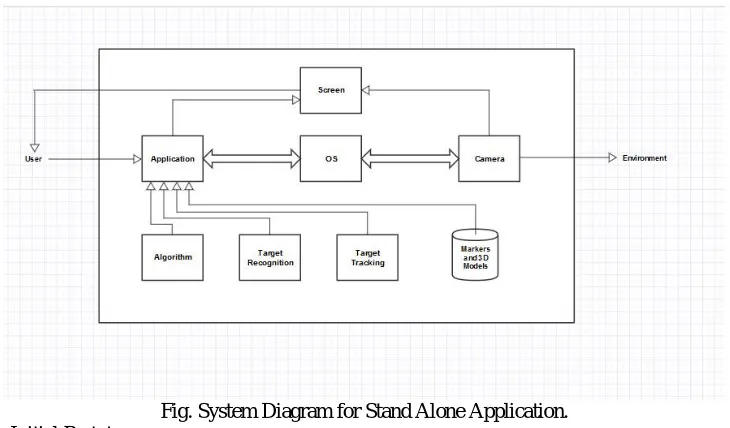
This particular section describes the System Architecture of the various approaches we used to handle Augmented Reality for handheld Devices. System Architecture provides a great insight of the complete system and depicts how it works. A System Architecture basically gives the overall general description of the system and shows the main blocks of working with a user level abstraction.
As we have 2 different approaches for augmented Reality for handheld devices we have two System Architectures as well. The First On Depicts the System Architecture of the standalone Application and the second one depicts the system architecture of Augmented Web.
A. STAND-ALONE APPLICATION
Fig. System Diagram for Stand Alone Application. 1) Initial Prototype
Initially, we only prepared an application which can open the camera and detect the marker.
On successful detection of marker, a 3D model would be displayed on top of it.
a) Marker for standalone application
b) Displaying 3D model on top of the marker
c) Displaying 3D model from different angle.
In fig. a, the image of box of Parker ink bottle is the marker.
On successful detection of marker, a 3D model is displayed on top of it. Show in fig. b.
In fig. c. it is shown that the marker is being tracked and the 3D model follows with the marker and scales accordingly.
2) Current Prototype:
In our current prototype, we have taken our application to a next level, where we used a cardboard approach
In this application, when there is a successful detection of marker, the scene is augmented on top of the marker and respected model as well.
In this application, the models are not static.
The models are given animations to do different sort of things such as walking around, gazing, etc.
With these animations we have attached a c# script to these models so that they can move around within the scene.
There are also sound effects for different models.
As this application uses a cardboard approach, this would give a more realistic effect to the user.
c) Lion Marker d) Lion Augment
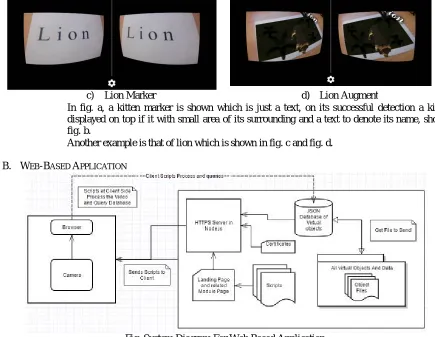
In fig. a, a kitten marker is shown which is just a text, on its successful detection a kitten is displayed on top if it with small area of its surrounding and a text to denote its name, shown in fig. b.
Another example is that of lion which is shown in fig. c and fig. d.
B. WEB-BASED APPLICATION
Fig. System Diagram For Web Based Application.
1) JavaScript Processing Library :-
The Backbone of the Web Based Application is the JavaScript Processing Library. It consists of all the methods and functions required to get Video from User and Process it and display the Data as mentioned in the Server.
2) Technologies Involved :-
Following List of Technology are involved for the web based application to work without lag:
WebRTC allows to throw a large amount of data on any normal bandwidth. It also allows to get audio and video data from user in a compatible and compressed form to be sent to server if Required.
Node.js and OpenSSL. HTTPS server is created using these 2 important Technologies. They are the Backbone of the Application.
JavaScript and AngularJS. JavaScript is the Scripting Language preferred and also the Google V8 Execution Engine runs JavaScript extremely fast hence we preferred it.
Html5 Canvas. This allows Us to Draw over the Video Elements and is extremely Popular with many online Gaming nooks.
3) Singular Vector Decomposition :-
Singular value decomposition takes a rectangular matrix of gene expression data (defined as A, where A is a n x p matrix) in which the n rows represents the genes, and the p columns represents the experimental conditions. The SVD theorem states:
Anxp = Unxn Snxp VTpxp
Where, UT U = Inxn
VT V = Ipxp
4) Adaptive thresholding :-
Adaptive thresholding typically takes a grayscale or color image as input and, in the simplest implementation, outputs a binary image representing the segmentation.
An approach to finding the local threshold is to statistically examine the intensity values of the local neighborhood of each pixel. The statistic which is most appropriate depends largely on the input image. Simple and fast functions include the mean of the local intensity distribution,
T = mean T = median
T
=
The size of the neighbourhood has to be large enough to cover sufficient foreground and background pixels, otherwise a poor threshold is chosen. On the other hand, choosing regions which are too large can violate the assumption of approximately uniform illumination. This method is less computationally intensive than the Chow and Kaneko approach and produces good results for some applications.
a) No Marker Found
This figure shows a marker for a web application. Currently, any 3D model is not displayed on top of it.
b) Marker Found
In this figure, there is a 3D model displayed on top of the marker.
Whole processing part is done on the server side, only the displaying part is on the client side.
c) Marker Found Top View
This figure shows the same model as above, from a different angle.
VIII. CONCLUSION
With the help of our applications mentioned above, it can be very useful for the users in various fields such as construction (for viewing finished product to the customer), medical (to operate on virtual organ), and many more. With the proposed standalone application for learning we can provide a ground breaking impact of knowledge to kids and also provide architectural model displaying and other 3d model viewing via internet with less cost of disk space. These applications are compatible for the users with and without internet connection so any user can use the application. The applications are easy to use, therefore, the user can enjoy and start exploring the world through the digital eyes. The challenges that might be faced while developing this type of application was detailed in [3] and [4]. the idea to make a head-gear for the masses was referred in [5].
REFERENCES
1. Rakhi Bhardwaj, Vighnesh Bheed, Prathamesh Bhide, Wasim Tamboli& Akib Momin “Vision of Future: Augmented Reality Vision via
2. V.T. Phan, and S. Choo, “Interior Design inAugmented Reality in Environment”, International Journalof Computer Applications, 2010, 5(5), 16-21.
3. Mehdi Mekni and Andre Lemieux, AugmentedReality:Applications,ChallengesandFutureT rends, ISBN: 978-960-474-368-1.
4. FABRIZIO LAMBERTI , FEDERICO MANURI , ANDREA SANNA , GIANLUCA PARAVATI , PIETRO PEZZOLLA AND PAOLO
MONTUSCHI, Challenges, Opportunities, and Future Trends of Emerging Techniques for Augmented Reality-Based Maintenance,IEEE TRANSACTIONS ON EMERGING TOPICS IN COMPUTING ,IEEE VOLUME 2, NO. 4, DECEMBER 2014.
5. Ahmed Amer and Phillip Peralez,Affordable Altered Perspectives,IEEE 2014 Global Humanitarian Technology Conference.