New Physics at 1TeV?
S.I.Godunov1,2,
1Institute for Theoretical and Experimental Physics, 117218, Moscow, Russia 2Novosibirsk State University, 630090, Novosibirsk, Russia
Abstract.We consider the extension of the Standard Model with an extra scalarSwhich decays can be responsible for the diphoton excess with invariant mass∼750 GeV ob-served at the 13 TeV LHC run. Two scenarios ofS production are considered: gluon fusion through a loop of heavy isosinglet quark(s) and photon fusion through a loop of heavy isosinglet leptons. In the second case many heavy leptons are needed or/ and they should have large electric charges in order to reproduce experimental data on
σpp→S X·Br(S →γγ).
1 Introduction
ATLAS and CMS collaborations recently announced a small enhancement over smooth background of two photon events with invariant mass 750 GeV [1, 2]. Though statistical significance of this enhancement is not large (within 3 standard deviations), it induced a whole bunch of theoretical papers devoted to its interpretation. The reason for this explosive activity is clear: maybe the Standard Model is changed at one TeV scale, and we are witnessing the first sign of New Physics.
Let us suppose that the observed enhancement is due to theγγdecay of a new particle. Then it should be a boson with spin different from one: the simplest possibility is a scalar particleS with mS =750 GeV. Since it decays to photons, it should be neutral and colorless, therefore inpp-collisions
it can be produced in gluon-gluon fusion through the loop of colored particles and in photon-photon fusion through the loop of charged particles. Let us suppose thatS decays to these particles are kinematically forbidden, otherwise Br(S → γγ) reduces significantly which makesS → γγdecays unobservable at the LHC.
We suppose that the particles propagating in the loop are Dirac fermions, so they have tree level masses, and that they areS U(2)L singlets. Nonzero hypercharges provide couplings of these parti-cles with photon andZ-boson. These particles can be quark(s) (color triplets)Tior lepton(s) (color
singlets)Li. They couple withS by Yukawa interactions with coupling constantsλiT andλiL
corre-spondingly.
This talk is based on the paper [3] written in collaboration with A.N. Rozanov, M.I. Vysotsky, and E.V. Zhemchugov.
2 Quarkophilic
S
In the case of one heavy quarkT the following terms should be added to the Standard Model la-grangian:
ΔL=1 2(∂μS)
2−1 2m
2
SS2+T¯γμ(∂μ−2igsAiμλi−ig
YT
2 Bμ)T+mTT T¯ +λTT T S¯ , (1)
whereAiμand Bμare gluon and U(1) gauge fields respectively, andλi are Gell-Mann matrices. S
coupling with gluons is generated by theT-quark loop:
Mgg= αs
6π
λT mTF
(β)G(1)μνG(2)μνS, (2)
β=
2mT mS
2
, F(β)=3 2β
⎡ ⎢⎢⎢⎢⎢
⎣1−(β−1) arctan2 1
β−1
⎤ ⎥⎥⎥⎥⎥
⎦. (3)
Inclusive cross section ofS production inppcollision at the LHC through gluon fusion is given by:
σpp→S X= α2s
576π
λ
T mT
2
|F(β)|2m2S dLgg
dsˆ
ˆs=m2
S
, (4)
where the so-called gluon-gluon luminosity is given by the integral over gluon distributions:
dLgg dsˆ =
1 s
−ln√τ0
ln√τ0
g(√τ0ey,Q2)g(√τ0e−y,Q2)dy, (5)
τ0 = sˆ/s,s = (13 TeV)2, and we useQ2 = m2S. Integrating gluon distributions from [4] for
√
ˆ
s =
750 GeV, √s=13 TeV, we getdLgg/dsˆ≈4.0 nb,m2
S dLgg/dsˆ≈(1/0.69 nb)·4.0 nb≈5.8. In order
to take into account gluon loop corrections, (4) should be multiplied by the so-calledK-factor which is close to 2 for √s=13 TeV, according to [5] (see also Fig. 2 in [6]).
In this way formT =mS andλT =1, substitutingαs(mS) =0.090, we obtainσpp→S X ≈41 fb,
which should be multiplied by Br(S →γγ) in order to be compared with experimental observations [1, 2]. Total width ofS is dominated by theS →ggdecay, and from (2) we get:
ΓS→gg=
α
s
6π
2
·8 m 3
Sλ2T
16πm2
T
|F(β)|2≈3.1 MeV. (6)
Thus for the models we consider, the width ofS should be much smaller than 45 GeV which is preferred by the ATLAS data. Let us note that CMS data prefer narrowS; see also [7].
T-quark loop contributes toS →γγdecay as well. The corresponding matrix element equals
Mγγ= α
3π
λT mTF
(β)F(1)
μνFμν(2)·3cQ2T, (7)
where the factor 3c corresponds to the three colors, andQT is theT-quark electric charge. Forγγ
width we get:
ΓS→γγ=
α
3π
2
(3cQ2T)2
m3
Sλ2T
16πm2
T
1 1.5 2 2.5 3
350 400 450 500 550 600 650 700 750 800
1 fb 2 fb 3 fb
4 fb 5 fb 7 fb 10 fb 15 fb
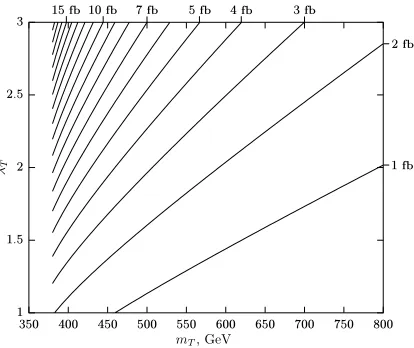
Figure 1.Contour plot ofσpp→S X·Br(S →γγ).
Br(S →γγ)≈
α
αs
2 (3
cQ2T)2
2 ≈0.0070, (9)
where we substitutedQT =2/3 andα=1/125.1Finally, we obtain:
σpp→S X·Br(S →γγ)≈0.28 fb. (10)
Experimental data provides a value approximately 36 times larger:
[σpp→S X·Br(S →γγ)]exp≈10 fb. (11)
This value follows from the the fact that both collaborations see about 15 events with 3 fb−1luminosity collected by at 13 TeV and effectivity ofγγregistrationε≈0.5 [1].
In order to reproduce experimental result (11) we should suppose that sixT-quarks exist. In this case Br(S →γγ) remains the same, while the cross section ofS production should be multiplied by the same factor 36, and (11) is reproduced.2
However, unappealing multiplication of the number ofT-quarks can be avoided by diminishingT -quark mass and increasing the value ofλT. The experimental result is reproduced formT =400 GeV
andλT =2.5.3Curves of constantσpp→S X·Br(S →γγ) are shown in Figure 1 on (λT,mT) plot.
In the rest of this section we consider the model with one additional quark T and mT =
400 GeV, λT = 2.5. As it was shown above, this model can explain the diphoton excess but let
us check that other existing bounds are not violated.
It is natural to suppose thatT-quark mixes withu-,c-, andt-quark which makes it unstable. To avoid LHC Run 1 bounds onmT following from the search of the decaysT → Wb,T → Zt and T → Ht[8–10] which excludeT-quark with mass below 700 GeV, we suppose thatT−tmixture is
1Fine structure constant is substituted by its running value at q2=m2S.
2The experimental result (11) will be reproduced if at 1 TeV scale we have a “mirror image” of the Standard Model with
three vector-like generations.
3As far asλ2
T/4πis a parameter of perturbation theory, this value ofλTis close to the maximum allowed value in order for
small, andT-quark mixing withu- andc-quarks dominates [11]. Though since we want the mass of T-quark to be just above the threshold ofS → T T decay the mixing with the first two generations should not be too large in order to prevent the diminishing of Br(S →γγ) due toS →T T∗→T Wq decays.
Since at √s= 8 TeV the gluon-gluon luminosity is 4.6 times smaller that at √s= 13 TeV, the CMS bound from Run 1 [σpp→S XBr(S →γγ)]8 TeV<1.5 fb [12] is (almost) not violated.
ConcerningS decays, let us note that the dominantS → gg decay is hidden by the two jets background produced by strong interactions. At 8 TeV LHC energy the following upper bound was obtained [13]:
[σpp→S X·Br(S →gg)]exp8 TeV<30 pb. (12)
while in the considered model [σpp→S X]theor
8 TeV≈0.39pb.
Three modes of S decays to neutral vector bosons do exist and have the following hierarchy
ΓS→γγ : ΓS→Zγ : ΓS→ZZ = 1 : 2(sW/cW)2 : (sW/cW)4, where sW(cW) is the sine (cosine) of
elec-troweak mixing angle (here we suppose that mixing ofS with Higgs doublet is negligible). Thus if the existence ofS will be confirmed by new data,S →γZandS →ZZdecays should be also looked for.
ScalarS can mix with the Standard Model Higgs boson due to renormalizable interaction term
μΦ†ΦS, whereΦis the Higgs isodoublet. Such an extension of the Standard Model was studied in our
recent paper [14]. Due to doublet admixture there are tree level decaysS →WW,ZZ,tt¯andhh, where his the 125 GeV Higgs boson. According to Eqs. (16)–(20) from [14], the sum of these widths equals approximately sin2α·m3
S/8πv2Φ≈sin
2α·300 GeV, whereαis the mixing angle, andv
Φ=246 GeV
is the Higgs vev. Ratio of partial widths at smallαisΓS→WW :ΓS→ZZ:ΓS→hh≈2 : 1 : 1. As a result, S width grows and Br(S →γγ) diminishes correspondingly.
To reproduce experimental result (11) and in order not to violate bounds from searches in these modes, the mixing angleαshould be small enough. For example, for sinα <1/150 we obtain at most 12 MeV (or 11%) increase of the width ofS, which is acceptable. It corresponds|μ|<15 GeV which is not unnaturally small.
Let us check if for such mixing angleS → ZZdecays (due to doublet admixture) do not exceed experimental bounds obtained at the LHC. In the considered model
[σpp→S X·Br(S →ZZ)]13 TeV<33 fb, (13)
well below experimental upper bound which, according to Fig. 11 from [15], equals 4 fb/(Br(Z → 4))2 =400 fb at 2σ(see also [16]).
For 8 TeV (taking into account energy dependence of theK-factor)
[σpp→S X·Br(S →ZZ)]8 TeV<9.0 fb, (14)
while the experimental upper bound is 60 fb (Fig. 12 from [17]).
More stringent upper bound comes from the search ofS →hhdecays [18] and equals 40 fb, while in our case the cross section does not exceed 10 fb.
Let us say a few words about future prospects. If the existence ofS will be confirmed with larger statistics at the LHC, then it can be studied ate+e−-colliders as well. For the cross section ofS production in photon fusion, according to [19, Eq. (48.47)], [20], we have:
σee→eeS(s)=8α 2
m3
S
ΓS→γγ ⎡ ⎢⎢⎢⎢⎢
⎢⎣f
⎛
⎜⎜⎜⎜⎝m2
S s
⎞
⎟⎟⎟⎟⎠⎛⎜⎜⎜⎜⎝ln
⎛
⎜⎜⎜⎜⎝ m2
Ts m2
em2S ⎞
⎟⎟⎟⎟⎠−1
⎞
⎟⎟⎟⎟⎠2
−1
3ln 3
⎛
⎜⎜⎜⎜⎝ s
m2
S ⎞
f(z)=1+1 2z 2 ln1 z − 1
2(1−z)(3+z), (16) andΓS→γγ is given in Eq. (8). Ate+e−collider CLIC with s = (3 TeV)2 for λT = 2.5 andmT =
400 GeV we obtain
σCLIC
ee→eeS ≈0.46 fb. (17)
With projected CLIC luminosityL = 6·1034/(cm2 ·sec) [19, p. 393], during one accelerator year (t=107sec) about 300S resonances should be produced.
3 Leptophilic
S
S production inγγfusion will be analyzed in this section (see also [21–23]).
Let us suppose that heavy leptonsLiwhich couple toS have electric chargesQL, and there areN
such degenerate leptons. The lagrangian is similar to that of the heavy quarks case (1):
ΔL= 1 2(∂μS)
2−1 2m
2
SS2+L¯iγμ(∂μ−igY2LBμ)Li+mLL¯iLi+λLL¯iLiS, (18)
where we assume equal lepton masses andS couplings. ForS →γγwidth we obtain:
ΓS→γγ=
α
3π
2
(NQ2L)2 m3
Sλ
2
L
16πm2
L
|F(β)|2, β=
2mL mS
2
. (19)
Production ofS at the LHC occurs through fusion of two virtual photons emitted by quarks which reside in the colliding protons. Let us estimate the production cross section. For the partonic cross section we get:
σ(γγ)
q1q2→q1q2S( ˆs)=
8α2
m3
S e21e
2 2ΓS→γγ
⎡ ⎢⎢⎢⎢⎢
⎢⎣f
⎛
⎜⎜⎜⎜⎝m2
S
ˆ s
⎞ ⎟⎟⎟⎟⎠⎛⎜⎜⎜⎜⎜⎝ln
⎛ ⎜⎜⎜⎜⎜
⎝ m
2
Lsˆ
Λ2 QCDm 2 S ⎞ ⎟⎟⎟⎟⎟
⎠−1
⎞ ⎟⎟⎟⎟⎟ ⎠ 2 −1 3ln 3 ⎛
⎜⎜⎜⎜⎝ sˆ
m2
S ⎞
⎟⎟⎟⎟⎠⎤⎥⎥⎥⎥⎥⎥⎦, (20)
wheree1, e2 are charges of the quarks, ˆs = x1x2s ≡ τs, and f(z) is given by (16). We should multiply (20) by PDFs and integrate overx1andx2:
σ(γγ)
pp→S X(s)= q1,q2 1 m2 S/s σ(γγ)
q1q2→q1q2S(τs)dτ·s· dLq1q2
dsˆ (Q
2, τ). (21)
dLq1q2 dsˆ (Q
2, τ)= 1
s −ln√τ
ln√τ
q1(x1,Q2)q2(x2,Q2)dy, (22)
x1=
√τ
ey,x2=
√τ
e−y. We takeQ2=m2
S and use PDFs from [4].
Cross sections in the case of one heavy lepton with chargeQL = 1, Yukawa coupling constant λL = 2 and massmL =400 GeV are shown in Table 1. ForΛQCD =300 MeV and
√
s =13 TeV we getσ(pp→S Xγγ) ≈11 ab,4 while the experimental result (11) is three orders of magnitude larger. We come to the conclusion thatNQ2
L≈30 is needed: we need either 30 leptons with unit charges, or
one lepton with charge 6, or several multicharged leptons.5
4According to Eq. (12) from the recent paper [24], this cross section equals 25 ab.
5Ifσ(γγ)
Table 1.Cross sections (in ab) for double photon production in the leptophilic model for different values of
ΛQCDand proton collision energies.
ΛQCD, GeV 0.1 0.3 1.0
√ s,T
eV 7 2.5 1.9 1.3 8 3.8 2.9 2.0 13 15 11 7.8
It is natural to suppose that leptons with charge one mix with the Standard Model leptons and become unstable. Search for such particles was performed at the LHC, and the lower boundmL >
170 GeV was obtained [25]. See also [26], where bounds on masses and mixings ofLare discussed. For masses above 200 GeV the existence ofLis still relatively unconstrained.
Cross section for quasielasticS production can be estimated with the help of the following equa-tion:
σpp→ppS =8α2
m3
S
ΓS→γγ ⎡ ⎢⎢⎢⎢⎢
⎣f
⎛
⎜⎜⎜⎜⎝m2
S s
⎞
⎟⎟⎟⎟⎠⎛⎜⎜⎜⎜⎝ln
⎛
⎜⎜⎜⎜⎝ s
m2
S ⎞
⎟⎟⎟⎟⎠−1
⎞
⎟⎟⎟⎟⎠2
−1
3ln 3
⎛
⎜⎜⎜⎜⎝ s
m2
S ⎞
⎟⎟⎟⎟⎠⎤⎥⎥⎥⎥⎥⎦. (23)
For√s=13 TeV,λL=2 andmL=400 GeV it equals 4.1 ab.6
4 Conclusions
We analyze the possibility that the enhancement at 750 GeV diphoton invariant mass observed by ATLAS and CMS is due to decays of a new scalarS. We found that production ofS in gluon fusion in a minimal model with one additional heavy Dirac quarkT can have value ofσpp→S X·Br(S →γγ) compatible with data. An upper bound on the mixing ofS withh(125) is obtained. If heavy leptons Lare introduced instead ofT, thenS can be produced at LHC in photon fusion, however, in order to reproduce experimental data many leptonsLiare needed and/or they should be multicharged.
S. G. is partially supported by MK-4234.2015.2 and by RFBR under grants 16-32-60115, 14-02-00995, and 16-02-00342. S. G. is also grateful to Dynasty Foundation for the support.
References
[1] The ATLAS collaboration, ATLAS-CONF-2015-081 (2015)
[2] The CMS collaboration, CMS-PAS-EXO-15-004 (2015)
[3] Godunov S.I., Rozanov A.N., Vysotsky M.I., Zhemchugov E.V., JETP Lett.103, 635 (2016) [4] Harland-Lang L. A., Martin A. D., Motylinkski P., Thorne R. S., Eur. Phys. J. C75, 204 (2015) [5] Baglio J., Djouadi A., JHEP1103, 055 (2011)
[6] Harlander R. V., Kilgol W., Phys. Rev. Lett.88, 201801 (2002) [7] Buckley M. R., Eur. Phys. J. C76, 345 (2016)
[8] The ATLAS collaboration, JHEP1510, 150 (2015)
[9] The ATLAS collaboration, JHEP1508, 105 (2015)
[10] The CMS collaboration, Phys. Rev. D93, 012003 (2016)
[11] Buchkremer M., Proc. of 49th Rencontres de Moriond on Electroweak Interactions and Unified Theories, 519 (2014)
[12] The CMS collaboration, Phys. Lett. B750, 494 (2015)
[13] The ATLAS collaboration, Phys. Rev. D91, 052007 (2015)
[14] Godunov S. I., Rozanov A. N., Vysotsky M. I., Zhemchugov E. V., Eur. Phys. J. C 76, 1 (2016)
[15] The ATLAS collaboration, ATLAS-CONF-2015-59.
[16] Franceschini R. et. al., JHEP1603, 144 (2016)
[17] The ATLAS collaboration, Eur. Phys. J. C76, 45 (2016)
[18] The ATLAS collaboration, Phys. Rev. D92, 092004 (2015)
[19] Olive K. A. et al. (Particle Data Group), Chin. Phys. C38, 090001 (2014)
[20] Budnev V. M., Ginzburg I. F., Meledin G. V., Serbo V. G., Phys. Reports15, 181 (1975) [21] Fichet S., vob GersdorffG., and Royon C., Phys. Rev. D93, 075031 (2016)
[22] Csaki C., Hubisz J., and Terning J., Phys. Rev. D93, 035002 (2016) [23] Pilaftis A., Phys. Rev. D93, 015017 (2016)
[24] Harland-Lang L. A., Khoze V. A., Ryskin M. G., JHEP1603, 182 (2016)
[25] The ATLAS collaboration, JHEP1509, 108 (2015)