AN APPROACH TO THE EVALUATION OF CHILDREN'S NARRATIVE WRITING
by
HELEN ALEXANDER COWtE
2
ABSTRACT
Research in the field of children's narrative writing is reviewed and the development of children as tellers and writers of stories is described within a framework which encompasses fantasy play, drawing and social role-taking abilities. An enpirical study is reported which was carried out in one London junior school. Stories written by 113 children who
were between 7- and 11 years of age were evaluated by focusing on specific attributes of the characters in narratives. Stories were scored for
characteristics of the self or hero/heroine, attributes of other characters, details of social and physical environment and the sense of awareness of the reader's needs. The results provided evidence of age-related increases in the numbers of references' to internal psychological states which
children make in their stories. The narratives were also analysed for structure,and develo mental trends in the complexity of the structure* which c ildren use were observed. Each child was interviewed in order to elicit his/her concept of story. It is suggested that the analysis
provides a useful method for evaluating the development of children's imaginative writing. The method is quantifiable and it also retains the quality of meaning which the child is trying to express, and gives insights into the groing capacity of children to understand the psychological
ACKNO 'LEDGE!IENTS
I would like to thank my supervisor, Dr Phil Salmon,for her guidance and inspiration throughout the course of this thesis.
I am grateful to Dr Isabel Finlayson and to Dr Dylis Davies for checking the reliability of the scoring procedures; Rev James Y. Finlayson is
thanked for his helpful cor1znents on the analysis of structure in children's stories.
I am indebted to Dr Peter K. Smith for his encouragement and support, and to my children, Julian, Anna and Ben, for their patience.
k2
11.3
53
60
65
k
TABLE OF CONTENTS
page
ABSTRACT
ACKNOWLEDGEMENTS
CHAPTER I: THE VALUE OF THE IMAGINATION.
Introduction.
Examples of children's writing.
Children's views on imaginative writing.
The imaginary and the real
The inner world of imagination.
Taking the spectator role in imagination.
The relevance of research in social role-taking.
Conclusion.
CHAPTER 2: CHILDREN' S DEVELOPMENT AS WRITERS OF SIORIES.
Introduction.
Early stages in iting development: drawing, play and
story-telling a precursors of narrative writing.
The mastery of writing skills.
The analysis of narrative structure.
Conolusion.
CHAPTER
3:
A REVIFd OF WRITING RESEARCH.
Introductioti.
What the authors tell us.
Case-studies of children's writing.
Samplea of young writers.
Studies of child control of the writing process.
Structure in chLldren'a narratives.
CHAPTER
k:
THE
PRESENT SThDY.Implications of writing research for the present study.
The present study.
page
CHAPTER
5:
THEIIES, CONTEXTS AVD
CHARACTERS.120
Themes.
120
Contexts.
122
Characters.
127
CHAPTER 6: THE !JRITTEN EXPRESSION OF SOCIAL SENSITIVITY.
13k
Introduction.
13k
Quantitative analysis.
137Qualitative analysis.
ik8
CHAPTER
7:
RLSPONSES ¶10 rç INTERVIE'1.
156
Introduction.
i6
Narrative writing as a means of understanding self
and others.
157
The children's concepts of a good story.
167
The children's concepts of a bad story.
177
CHAPTER
8:
THE Sr1RIJCTUREOF CHILDREN' S STORIES.
185
introauction.
185
Setting.
189
Development of episodes.
193
Endings.
195
Overall structure.
199
CHAPTER
9:
CON CLUSION.
209
Findings in the present study.
209
The value of narrative writing for children.
211
Relevance to the teacher.
216
Further research.
221
Conclusion.
222
REFEREiCES.
223
APPENDIX 1.
232
APPENDIX 2.
233
page 82
85
87
91
110 116 117 121 122 123 123 124 125 128 129 129 129 131 132 132 133133
138
I 43
147
147
6
TABLESTable 1: Types of outline accompanying 109 expository themes written by 25 eleventh grade students.
Table 2: Sense of audience by subject. Table
3:
Functions of writing by subject.Table
k:
Wilkinson's affective model of writing. Table5:
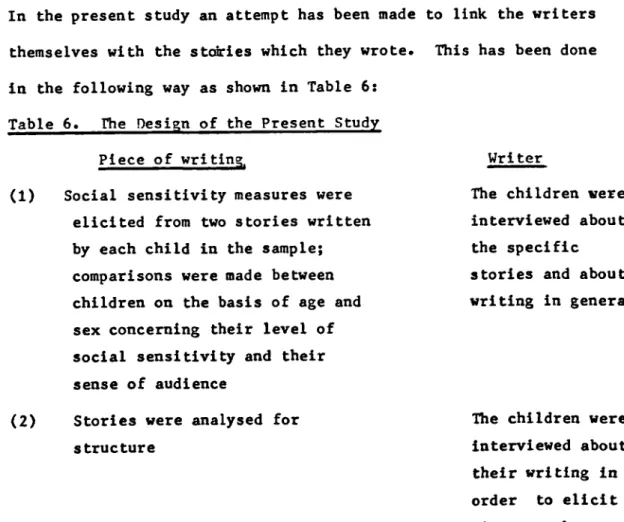
Three categories of writing research. Table6:
The design of the present study.Table
7:
The number of c ildren in each of the four junior school classes in the present study.Table
8:
The choice of themes for story title "Flight".Table
9:
Contexts of stories categorised on a four-point scale. Table 10: The conteit of the story entitled "Uhen I was veryfrightened".
Table 11: The context of the story entitled "Flight" by age of child.
Table 12: The context of "1w/hen I was very frightened" chosen by boys an girls at each age level.
Table 13: The context of "Flight" chosen by boys arid girls at each age level.
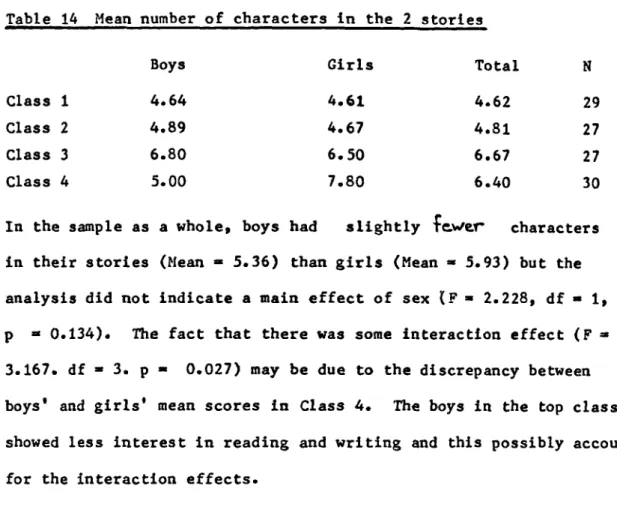
Table 1k: flean number of c'iaracters in the two stories.
Table 15: The numbers of male and femele c h aracters chosen by girls and boys.
Table 16: iean number of male c'aracters at each age level. Table 17: 'ean number of female characters at each age level. Table 18: Criteria used to cateorise story characters as active
or passive.
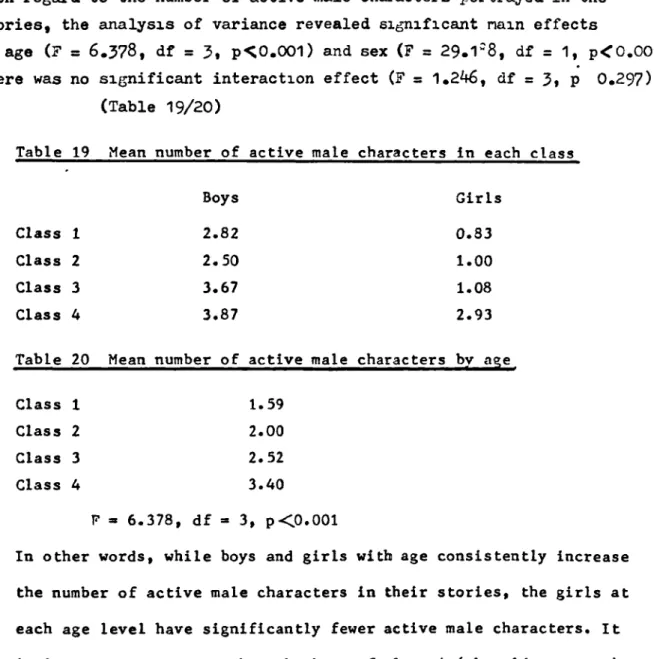
2able 19: 1 ean number of active male c aracters in each class. Table 20: flean number of active male ciaracters by age.
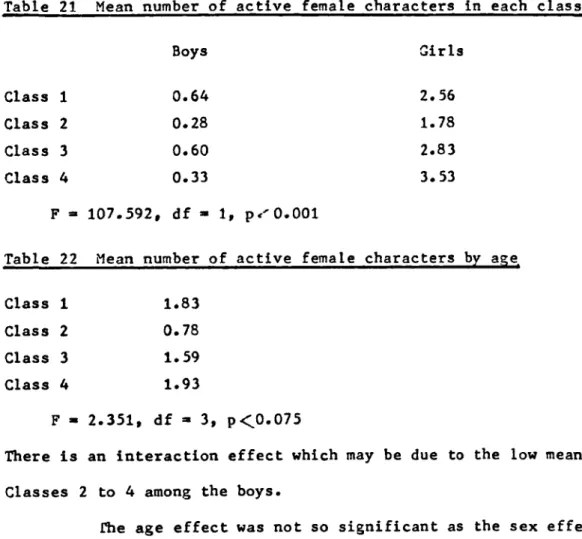
Table 21: Kean number of active fe'ale characters in each class. Table 22: liean number of active female c aracters by age.
Table 23: Categories for coring the written expression of social sensitivity.
Table 24: ?'ean social sensitivity scores for boys and girls at four ace 3cvels.
Table 25: Correlat on coefficients bet'een reading age and social en iivity score.
Table 27: The definition of each of the categories in children's
concepts of what makes a good story.
167
Table
28:
Children's concepts of what makes a good story.169
Table 29: The definition of each of the categories in children'sconcepts of hoii to improve an unsatisfactory story. 178 Table 30: How to improve an unsatisfactory story.
179
Table
31:
Criteria for type of setting.190
Table
32:
Categorisation of setting.191
Table
33:
Three types of development in the event structure.19k
Table 3k: Children's treatment of reactions in the developnentsection of their stories. I
95
Table
35:
Criteria for coding endings.196
Table
36:
Types of endings in the stories.196
Table 37: Criteria for overall structure. 207
8
FIGURES
page
Figure 1: Britton's functional model of written utterances.
33Figure 2: Jose's story:
"Twopeople are playing tick-tack-toe".
53Figure
3:Jamie's composing.
56
Figure
k:
Ashley gives expression to his hero's shouts.
57Figure
5:The story grammar of Mandler and Johnson.
63Figure 6: Percentage of boys and girls in each context for "When
I was very frightened".
125
Figure 7: Percentage of boys and girls in each context for "Flight". 126
Figure
8:
Age trends in the expression of social
sensitivity.i4
Figure
9:
Age trends for boys and girls in the expression of social
sensitivity.
1k5
Figure 1O:Helen's story.
188
Figure 11: !Iigel's story.
200
Figure 12: Daniel's 8tory.
203
CHAPTER 1
rHE_VALUE OF THE IMAGINATION Introduction
"Artistic activity is not simply a luxury available to the leisured classes but is a fundamental as-pect of the human repertoire. Indeed, the
produc-tion of art is not abandoned even in situaproduc-tions in which the greater part of a person's energy uust be expended in the sheer struggle for survival, as the art of concentration camp inmates startlingly testifies." (Winner, 1982, pp 1-2)
Imaginative activity is a universal phenomenon yet one which
has proved extremely difficult for the psychologist to
study. The issues raised are complex. Why do people
engage in creative behaviour when it has no obvious
pract-ical outcome ? Why are we moved when we respond to
litera-ture 7 Why do children engage in fantasy play 7 What
motivates young people to write and act out stories 7 What
has actually happened when a child produces a piece of
creative writing 7 Are there patterns of development which
a child goes through in his creative work 7 Could the
psychologist gain deeper understanding of a child's
emotion-al and, indeed, cognitive development through the study of
creative products 7 What are the conditions in which
crea-tivity may best flourish 7
When one is searching for answers to these and many
other questions of a similar kind, it is logical to turn to
the huge literature on the subject of the psychology of
creativity. A number of reasons are commonly given for the
relativity recent upsurge of interest by psychologists in
this aspect of human endeavour. It is often argued,
particularly in the American studies, that the rapidly
10
discovery in the fields of science and technology; these very
advances have themselves resulted in increased leisure time
and, indirectly, in a need for creative activities as one
means to individual fulfilment. In addition, within the
changing climate of educational theory there is a growing
feeling that psychologists should be able to assess and
evaluate a much wider range of abilities than those
measur-ed by traditional intelligence tests. A major difficulty
is that, as with concepts which are used in a common-sense
way, the term 'creativity' is a loose one and, while most
studies begin with a definition, there is no unanimity in
the scope of definitions adopted. Creativity may be
defined in terms of the end product of the process, or in
the act of creation itself. If it is defined in terms of
the product - the poem or the scientific discovery - we still
require some criterion against which to judge it. If we
concentrate on the process, then we come up against a host
of concepts which are just as difficult to define as
creativity - for example, 'inspiration', 'moment of truth',
'incubation period', 'flash of insight'. In fact, some
psychologists opt out of the controversy by adopting the
operational definition that creativity is what is measured
by tests of creativity, but this approach too can lead to
circular arguments as researchers attempt to define what
is a test of creativity.
the
This thesis focusses on one aspect of process
-the ability of children to create narratives. So, ra-ther
than attempt a global analysis of creativity (if such a
writing. This narrows the field to some extent but the
literature, nevertheless, is large, and, spanning as it does
the disciplines of psychology and English, can appear
formidable since each discipline has its own distinct
type of approach. I will consider both approaches in this
chapter.
If we focus first on the studies which psychologists
have made of creative writing we can distinguish two broad
categories:
1. Writers themselves, their personality, family
history, the cognitive and emotional processes
which are involved in the creation of imaginative
writing.
2. The end product, criteria used to judge it, the
emotions which are expressed In it, the complexity
of the structureof a piece of writing, the analysis
of the language which is used.
This type of approach lends itself to quantitative analysis
although the use of qualitative data is not ruled out.
Literary people, by contrast, tend not to be concerned with
measurement in the narrow sense but they also emphasise
psychological aspects of the creative process. Some case
studies of creative writers at work will be explored in
chapter 3, but for the moment two examples are presented. The
critic Burnshaw (1970) describes the creative process as
sequence of gathering, widening, deepening, self-resolving,
self-discovering' and explains the relationship between
reader and literature in this way: 'The poem's presences form
12
itself remains identical but in the reader it relives in
innumerably varied experiences." Tolkien (1964) writes
about the worlds of reality and the imagination as follows:
"Fantasy is a natural human activity. It certainly does not destroy or even insult Reason; and it does not either blunt the appetite for, nor obscure the perception of, scientific verity. On the contrary. The keener and clearer is
the reason, the better fantasy will it make".
Tolkien, l964,p5O
To Tolkien, the enjoyment of fairy tales does not depend on
whether they could happen in real life. Rather he argues
that the pleasure which we feel when we experience a
con-vincing product of the imagination can be explained as a
perception of its underlying reality or truth. So he
justifies the use of fantasy as a means of deepening
understanding of ourselves, our relationships with others arid
the world which we inhabit.
Both Burnshaw and Tolkien make statements which they go on to
confirm through selected case studies, examples and personal
experiences. Their arguments sound convincing and are
acceptable to the literary reader but would not be considered
as having been convincingly or objectively
demonstrated by the more rigorous psychologists trained in
experimental methods.
Throughout the thesis I have attempted to make links between
researchers who adopt the perspective of the English
special-ist and those who approach the subject as psychologspecial-ists. I
am convinced that if one keeps an open and flexible mind then
the two strands can be successfully woven together, despite
What distinguishes psychologists' studies of creative processes is not the questions asked but the way in which the questions are answered. Whereas the arguments of English specialists and literary people are based on introspection and logical analyses, psychologists found their answers on an empirical, sometimes experimental base. The danger is that the rich-ness of the data is lost in the quest for scientific rigour.
However, sensit.vity and rigour are not necessarily incompat-iblequalities as Winner (1982), an experimental psychologist, shows in her study of the arts ; Arnheim introduces her book by writing:
"Winner keeps the bird in flight but goes after its shadow which, when cast upon the ground, is
reachable, measurable, two dimensional. And as she applies her tools, she glances mindfully and gratefully at that high apparition to which we owe it all." (ibid p v).
Whether I have succeeded in both 'keeping the bird in flight' and maintaining the standards required of a psychologist is for the reader to judge. In this thesis, the developmental trends which appear in children's narrative writing are examined, with particular emphasis on the growth of social, emotional and cognitive awareness in the young writers. I begin by looking at extracts from stories written by children of different ages. (I am indebted to the teachers and children of SS Mary and Peter School, Teddington and Ibstock Place School, Roeharnpton for allowing me to use these pieces of writing).
11f
Typically the narratives of seven-yearolds are straightforward chains of events which contain very tittle t expression 3f
emotion. At this age, children focus on simple, physical traits in their characters; what happens is more important than why it happens, and they usually omit useful descriptive information which would help the reader understand the context within which the story takes place. For example, Lisa at seven writes:
"One day there was a witch and a little girl and one day a witch came at her house and took her away but in the nit she wook up and put her witch in the fier".
Despite the horrific nature of the events in this story, the characters express no emotion and the author gives little direct insight into the motives for their actions. There is no indication that Lisa has been able to identiv with the witch or the little girl and she seems to assume that the reader shares her perspective of the happenings in the story. Lisa's narrative appears egocentric yet even at this age the use of dialogue can enable the child to enter more fully into
the experiences of all the characters and, at the same time, develop a greater sense of reader-awareness. Here Catherine discovers that a conversation can enhance the effectiveness of a atory as she shows how a sapling, newly planted in the farmer's field, gets to know an established tree:
"....Leo turned round and said to the other tree whats your name my name is mini whats your name said mini my name is Leo I licke your name Leo I licke yours mini Thank you Leo How old are you Leo three
When children read aloud this kind of story, they will often role-play the characters by giving each a distinct voice with the result that the piece 'comes alive' for both author and audience. There is some similarity to earlier socio-dramatic play and a growing sensitivity to the
feelings of the various characters can be seen. Ashley, aged seven, shows his understanding of the increased vivid-ness which dialogue gives to both reader and writer when he says to his teacher, 'I like dramatic stories. If you put people saying things its much better. I find it's changed my stories. I started last year. It's more dramatic and exciting. Most people don't care and just do the story, just put things in, but if people things it sounds dramatic...'
By nine or ten, children are beginning to show more empathy for others in their writing. Here Julian describes the feelings and intentions of a young Viking:
"The boat was rocked from side to side and most of the men were thrown Jnto the sea but the strongest of them all was Asbjorn. He was a ten-year-old boy. He stood still as a statue on the deck. And when the last person was knocked overboard he
blushed. After five weeks later Asbjornsaw land in sight. The next week he landed. There was a little humming noise in the distance • voices he thought. And the sound of ebony drums only one of me and thousands of that village. I do not know how to fight a whole village. Aha I will creep in at night when they are all asleep and steal all their jewels and money and food..."
Julian gives enough information about Asbjorn's state of mind for us to enter to some extent into the experience; in
i6
growing understanding of people with a wider knowledge of the world. In a similar way, ten-year-old Daniel shows distinct awareness of the self-image of his hero, Ronald Biggs, and gives some impressions of the fluctuating emotions which an individual can experience:
"I was thirty-seven and I was deforced. I can't stand it any longer I said to myself one day and I disided to be a birglar. I was a birgiar for three years and I became very wealthy but I steel wasn't satisfied. I disided to get into the bigger bussness and became a train robber... "
It is interesting to note that in both these extracts the hero is involved In an internal dialogue with himself as he plans what to do next. Although the story still consists of a chain of events recounted in strict chronological order, the time span is extended and the characters have their adventures in more elaborate and detailed contexts. In addition, there is far more psychological informationabout the reasons which underly the action than is normally found in the writing of younger children.
subtly handled. She acknowledges the surface source of the
story - a television serial which 'worked into her mind' - but
realises after writing it its deeper implications for herself
as an adolescent girl. She says of writing that 'you can
switch off from the world and pretend you are one of the
characters'and identifies themes of loneliness and longing
which pre-occupy her at the moment:
"That night after my mother had left me I set my alarm for twelve o'clock. I didn't have any
problem in going to sleep that night, I thought it would be lovely to see my fiiend John in our own secret moonlit garden Just before I dozed off I put my alarm clock under my pillow and went to sleep. At twelve o'clock my alarm woke me. I had to creep very quietly past my mother's room and down the stairs. I opened the bathroom window, Jumped out of it and down the path which led up to mine and John's moonlit garden. The next moment 1 was walking through a dream garden. Where was John? When I was walking through the moonlight the moon shone on a figure that looked like a boy's figure a figure rather like John's. I started to walk very slowly across the grass to where the person sat on the moonlit grass as I walked I whispered.
'John is that you?' no answer followed so I whisper-ed 'John please answer if you don't I will go back to bed. I knew that if I said that John really would answer if I said that. I still kept walking at last I reached the figure then John said
'Sarah you really are an ass of course its your old pal John'. 'Let's go for our walk in the garden while we can'. So we went for a walk around our garden at the end John said
'Right meet you here this time tomorrow night'. 'Okay' I said and went up the stairs to bed. I was woken by my mother saying 'its time to get up' I thought about lastnight the same question came into my mind was it a dream or not? I cannot explain as John was a statue which came alive with the moon. So I decided to think of it as a dream, then I remembered that I put a flower under my pillow which I picked last night. It was still there"
The mystery remains unresolved but a group of girls from her
class find no difficulty in identifying with the heroine and
18
At fourteen Velma, a pupil at a school for visually impaired children, moves beyond a concern with herself to a deeper consideration of the effect of time's passing on the human condition.
TIME
"Time changing, rearranging:
Time like the syndrome of my mind Fled fast through the valley of a sombre past.
Time that I could not see was there Walked my path, entwined my hair -Shadowed surveillance.
Time meadered my every breath, Showed no shame,
Would not rest.
Time stood iu my shoes, And I was seen,
The little girl I once had been. Time told revealing lies:
Crippled beauty, blurred my eyes. He has no limits to his greed, Fulfils his task, willingly leads. Changes bud to its flower:
With alluring fingers Promised me power.
Time marches through the ages of man, And all creation bows to his will. Time imperious, instrumental -Man stops.
Kings try to escape him, They cannot, and I cannot. "
This poem, by an unusually accomplished writers shows )w effectively the use of images can capture Velma's thoughts about life and death. She seems to be standing back like a spectator, not only looking at the changes which have happened to her as Time 'crippled beauty, blurred my eyes' but also mourning the fact that life for us all has to end.
adjustments which in any case they mus9nake to their widening range of social experiences in real life, but the issue
remains controversial. Some educators would argue that the writings represent not only reflections of existing develop-mental trends but are a part of an active construction of reality by the young writers themselves. It has even been argued that spiritual, religious and other deeply personal experiences can only be expressed in an imaginative form. Langer (1951), for example, says that thinking in images helps us to see patterns and structures in events, and that symbolic forms reveal 'the rationalof feelings,'the rhythm and pattern of their rise and decline and inter-twining in our minds'. Velma herself understands this point of view
intuitively when she says that for her the only way of formulating her thoughts and feelings about abstract issues
like the purpose of existence is through her imaginative writing. A younger child, Denise, describes how, at the age of tn she wrote a piece when her mouse died because it'helped her to understand'
In fact, I have found that talking to children of different ages about the sources of their ideas for stories gives
interesting insights into their thinking processes, so before examining theoretical approaches to the interpretation and evaluation of imaginative writing, I would like to give some examples of ways in which children themselves perceive it. children's views on imaginative writing
"I like making things up. At home I dream about this fantastic world. It doesn't have to be real. I can make it up, like when you have a magic pencil and whatever you want you take from the air"
20
new wood where they are welcomed by a community of moles. It
ends: 'Their misfortune and their bravery had been rewarded
by wonderful people. Who could want more?'
The story is a fantasy about animals yet the situation and
the characterisations are based on real-life observation. The
story is not as remote from Joanna's experience as a first
reading might suggest, and, in fact, when asked about the
sources of her ideas she says: 'I thought about it and I had
been reading a book about animals going away from a forest
fire and when I was writing the story my Mum and Dad were
looking at new homes. At one time we were getting ready to
go and we looked one more time and then Mummy changed her mind'
She admits that she was extremely anxious about the thought of
leaving her familiar home environment, so it was reassuring to
experience the move through an animal adventure.
Mark, aged eleven, makes a similar point when he describes
writing about an imaginary pilot, Joe Smith, who designs his
own plane, test-flies it and crashes to his death.
Mark: Say you're writing about yourself, you're playing the
part of someone in it; you end it as most factual stories
would end. Not many people fly aeroplanes on their first
go. Mostly something breaks and they get killed. You're not
in favour with yourself, more with the story. You don't care
what happens to yourself. You pretend it's someone else.
Really you are them.
H.C.: You are Joe Smith ?
Mark: Yes, you are the Joe Smith and writing a diary of how
you built an aeroplane and won a medal for it. In some
stories, say there was a man called Joe Smith and it crashed
hark bases most of his stories on real events in his own
life or on information which he has read in books. He
admires authors who research the subject before they write
and who create authentic characters and contexts. Of his
favourite novelist, Willard Price, he says, 'In Volcano
Adventure he's actually been into a volcano climbed down
into it. It's like a diary. He's done many of the things
he's written about. He's been to New Guinea and he finds out
what it's like. It's realistic. You feel as if you're one
of the people in the book. It makes you feel that you're
walking through the jungle and capturing all these animals'.
Through his reading and writing of stories, it seems that
Mark is able to enter into the experience of another person
and even take on the role of the other. As he himself says
of imagination, 'Its like scanners in my head, a memory bank.
I sort out the photographs in my head, take out the right one
and take negatives off it of ideas. You select the right
thing you want and feed it through the computer'.
Michelle, who is rather small for an eleven-year-old,
ex,lains why she wrote her story about a girl who shrinks
when she drinks a magic liquid:
I like writing about myself because usually when I want to talk about myself when small no-one wants to listen so I put it in my stories ... I
like people to feel that happened the way I remembered things, to let people know and share my memories and feelings. It depends on what I'm feeling. If I'm feeling I want to explain something that's Ippened I try to put it into my stories. I try to put as much memories as I can ... . When I write stories I try and be like I was and try to remember it. I go back and do it all over again"
She seems not only to be trying to come to terms with her own
22
readers may take her perspective, and experience in imagination
what smallness means.
Mièhelle understands intuitively that stories offer
opportuni-ties for writers and readers to develop self-awareness and
social sensitivity.
By contrast, Jon, aged eleven, uses fantasy to explore what
he calls possibilities and to try out experiences which in
real life are unlikely to happen. His stories are always
about space yet the interpersonal exchanges which occur and
the expressions of feeling and intention have their origins
in real life. For' example, Jargon Plage, 'a slimy green
tetrapod', experiences fluctuating emotions as he carries out
his doomed escape from the cell on Planet Tetran and interacts
with his roboj guards.
The main point for Jon, however, seems to be to enable him to
take onthe role of another person and so extend his range of
experiences. He says:' In adventures you could get a super
muscle builder who could crash a car, or Asterix's magic
potion. On other planets it's even better. You could
be adapted to methane. You have even more possibilities.
This earth has limited possibilities. We don't know what
it's like on other planets. Adventure stories have
poss-ibilities, space stories have even more. You don't need to
be limited by human life. l'his is the best mode I'm in. I
may be able to incorporate social life into space stories'.
Very young children are less articulate in describing the
function which imaginative writing has for them. Their
stories, I have suggested, usually contain plenty of action
but little references to inner feelings or motives. The
part of the narrative and, although events can seem disconnected
to the reader, they are probably clear in the mind of the writer.
Five-year-old Francis, for example, is happy with his story The
Pirate's Magic Cave and sees no need to elaborate for other
people's benefit:
"The pirates had a big boat
In the cave there were hundreds of gold guards They're pretending they're his friends
When he's not looking they'll bash up his boat."
He says. 'It's my best one because I think it's more exciting
than the Wizard one', and goes on, 'I like it ending nasty
and frightening things'. His friend Isabelle agrees.
'Some-times I like happy endings and some'Some-times I like nasty ones,
especially if they're nasty to princesses. I like them beaten
up to have exciting bits'
By seven or eight children can describe more about their own
writing processes. Eight-year-old Johanna's evaluation of one
story shows her awareness of how she can in fantasy take on a new
role:
"I put imaginary things in and I thought about it a lot. It was a fantasy because I would like to have a tree house and rescue someone. I especially dream about rescuing people. They say, Thank you. You saved inylifeY.
Straightforward wish-fulfilment is a common theme amongst younger
children when they talk about stories, yet a longing for magic
things can often go alongside delight in the observation of
everyday experiences. So Simon, at eight, talks about the
value which the reading and writing of stories has for him:
2k
Yet the content is rooted in reality:
"When I'm eighteen I'll look back to when I was eight and see what I wrote. I would think I was doing interesting things - finding birds, watching kestrels and kites, and finding acorns".
The magic lands which have such a fascination for young writers
often contain extremely realistic people and situations, as
Joanne, aged eight, explains:
"I need to put children in it. It makes it good if it's a fairy tale but not an actual fairy tale - not something that is true but it sounds true. They live in a cottage with mother and father and play with toys, like Moonface and Saucepan, and of course that is true. Some of the lands are true but some aren't. Those that sound true are ones where you buy things and they're a lot of money, so that's true in the shops. Some of it is impossible and some isn't".
She does seem to perceive links between the worlds of reality
and imagination, and children of this age will often express
dissatisfaction with a story simply because it goes beyond the
bounds of credibility. Young adolescents, who are more likely
to deal with complexities of emotion and intention in their
stories, will quite consciously describe aspects of the
environment to achieve the right effect and use the events of
a narrative symbolically to illustrate an issue. Tracy, at
thirteen, explains how she has deliberately created a sombre
atmosphere as a backdrop to her story, Doom for the Lion which
is about the cruel killing of a lion by a tiger:
"The November sky was sinking and was heavy on the mountain. And the last of the yellow
leaves were falling to the ground. The lion was getting ready for winter ...
While she indicates the emotions of both killer and victim, at
a deeper level she is concerned with the issue of violence and
"His wife was taken to a zoo with his cubs to live behind bars. No more zebras or hunting no more freedom their lives were wrecked completely wrecked"
Other children in her class question the author's motives for
writing such a gloomy piece, but they show that they share
flacy's concern about cruelty. She justifies the sad theme
although she would rather have a happy ending:
Tracy: "I liked writing about animals because I like animals. I like the words. I don't like the way the lion is killed"
Katy: "Why did you write it then? You could have a fight and then have them slink off into the jungle."
Tracy: "That's not good enough. That's not realisUc. It's better to end the story completely.
Katy: "I think the story shows that if it hadn't been for man the lion wouldn't have been killed. Is that the idea, that man shouldn't interfere?"
Tracy: "Yes. All this trying to interfere with the peaceful life that animals are trying to lead. They're going to chop down all these jungles to make more land, and they don't need more land. They're greedy"
Sian: "the thing is, they say if a man goes and shoots someone in the street, he didn't do it on purpose....he's insane. They give him five years in prison. If a lion kills someone they shoot the poor thing. It's not fair. Animals don't understand.... "
Like Tolkien, these young people have perceived the deeper layer
of meaning which can underlie the surface content of a story.
The imaginary and the real
These interpretations by young writers of their own
work seem to indicate that this kind of activity is of value to
them, but the implications for education continue to be
contro-versial. Do child;en's symbolic transformations of real-life
experiences into imaginative ones deepen their understanding or
simply distort it? Should children be trained to differentiate
26
In the nineteenth century it was actually considered by some to be harmful to read imaginative stories to young children. Tucker(1982,p.59), for example, describes how one Victorian educator, ?lrs.Trimmer, criticised the use of fairy stories because they 'fill the heads of children with confused notions of wonderful and supernatural events'. Similarly, Montessori argued that it was wrong to encourage fantasy in pre-school children since they were not intellectually capable of distinguishing between the imaginary and the real. (She quotes an example of one child who Jumped out of the window in imitation of Goldilocks). Unlike Froebel, who gave a central place in his educational philosophy to the development of the imagination in young children, she stressed that children should be trained to learn about real-life situations. To her, make-believe had no positive influence on the growth of the intellect.
A similar view-point appears in the Board of Education (1927) Handbook of Suggestions for Teachers in which the authors, while recognising that composition can be used to improve fluency and technical accuracy in written English, are still very
grounds that the school's domain is the real and not the
imaginary. (The language programmes of Bereiter and Engelmann
would be one example of this). Others might admit that
imaginative activities are enjoyable as pastimes but they
would argue that the teacher's role does not include the
fostering of a world of make-believe. Fantasy play would be
discouraged because its focus is not on real-life tasks;
fiction would be used in the classroom as a means of
develop-ing children's readdevelop-ing skills, story-writdevelop-ing as a way of
extending writing abilities. Even political arguments have
been used to devalue the use of the imagination in the
educa-tion of children. For example, in Russia, after the Revolution
social realism was deemed to be more suitable for children than
fairy tales and myth.
The inner world of imagination
At the other extreme, influenced by the literature on
psychoanalysis, some educators have argued that the symbolic
images of fantasy - wicked stepmothers, cruel giants and fierce
monsters - can help young children to distance themselves from
the fears and anxieties which form part of their lives. By
their involvement in imaginative stories and fantasy play,
children, it is claimed, are enabled to work through some of
their emotional conflicts. The world of make-believe is viewed
as playing a key role in the emotional development of the child.
From this perspective, the themes of fantasy and imagination
are real since they are about issues like life and death, loss
of the parent, fear of separation and other anxieties of vital
28
Freud, in fact, was influenced in his work on the method of free
association by one of his favourite authors, Ludwig Borie, who
had written an essay'The Art of Becoming an Original Wr.ter in
Three Days'. Jones (1953-57) mentions the effect which this
had on Freud' s thinking at the time and quotes from Borne:
"Here follows the practical prescription I promised. Take a few sheets of paper and for three days in succession write down without any falsification or hypocrisy, everything that comes into your head. Write what you think of yourself, of your women, of the
Turkish War, of Goethe, of the Fonk criminal case, of the Last Judgement, of those senior to you in authority, - and when the three days are over you will be amazed at what novel and startling thoughts have welled up in you. This is the art of becoming an original writer in
three days". (Vol.1, p246)
Freud considered that the narratives invented by authors stand in
the same relation to analysis as do genuine dreams, and suggested
that they gave a direct insight into unconscious processes. His
view of creativity is, of course, only a part of his wider theory
of personality in which he argued that the individual .s torn
between the powerful instinctual drives of the unconscious and
the strong restraints and defences of the super-ego and ego.
Socialisation forbids the expression of primitive wishes which
are therefore sublimated in other directions. If libidinous
urges are channelled into socially acceptable activities, the
person remains healthy; if turned in on the self, neurosis
develops. One of the most important early experiences Freud
argued, was the child's relationship to the parent of the
opposite sex and ih Oedipal crisis which results. The resolu
-tion of the Oedipus complex affects everyone and remaias a theme
in dreams and real lite; creative activity is seen, then, as one
He compares the artist to the dreamer or the child at play:
each is creating an imaginary world in which wishes may be
fulfilled in fantasy. Freud wrote (1908):
"The creative writer does the same as the child at play. He creates a world of phantasy which he takes very seriously .... while separating it sharply from realIty".
Thus Freud sees common elements in play, dreaming, fantasy, art
and neurosis, since each is motivated by powerful unconscious
drives. He claimed that, just as dreams revealed the unconscious
wishes of the dreamer, so the work of art provided a window into
the unconscious. In fact, Freud (1908, 1913, 1928) interpreted
a number of famous works of art to illustrate his hypothesis.
This psycho-analytic approach has continue4 in
psychological studies of children as writers and readers.
Bettelheim (1976) argues that even pre-school. children can
under-stand the underlying themes of fairy stories such as Little Red
Riding Hood. These stories are understood symbolically - the
latent content is used by young children in order to work through
their own fears and anxieties. On the same theme, Cordon(1972,
p.78) suggests that through the forms of art 'man has found a way
of breaking the seal that locks him fast into his inner world' and
goes on 'thus has man found, after all, a way 6f transmitting to
others at least something of his intimate and personal experience,
of gaining for it some social validation and of mediating to
him-self, to his own conscious him-self, a part of this elusive inner
world'. She is saying that perhaps only by creating witches
and giants, arduous journeys and incredible adventures, are
children enabled to find words to describe moving experiences
and intangible ideas.
Supporters of this viewpoint claim that through imaginative play,
30
themes that are meaningful to them but also achieve some kind of
resolution of emotional conflicts. Literary analyses of children's
writing have often adopted this kind of interpretive approach.
Holbrook (1966), for example, using creative writing as a means
of helping difficult or backward children through their own persoal
crises, makes Freudian interpretations of their work. Thus in one
piece, a cloud symbolises hate and aggression, and its name, Black
Skeleton, reveals the writer's 'fear of death'. Holbrook sees this
boy as regressing to an infant stage, through writing, in order to
understand conflicts within himself.
But there. are flaws in such an approach to children's imaginative
work. It is possible that this disturbed adolescent was acting out
his inward fears symbolically in his writing, but it is too easy to
exaggerate the presence of symbols in every piece written by a child.
Freud's approach is a reductionist one which undervalues the manifest
content of the creative product. Furthermore, it is impossible,
using such a model, to predict which individuals will become
accom-plished writers and which neurotics This view in a sense transforms
the forms of art into the jargon of psycho-analysis by treating the
content of the imaginative work as the symptom of underlying
disturb-ance. There is an obvious danger here that, by adopting such an
approach, teachers may wrongly project intense eiiotions on to the
child and miss the real ideas which are being expressed.
Taking the spectator role in imagination
These two broad approaches to the imaginative development
of the child are strikingly different. The first views imagination
as a flight from reality, an escapist activity which has no place in
the school curriculum. The second argues that the internal world of
concept of reality; the second, with its therapeutic orientation,
can run the risk of mistakenly seeing emotional problems in
every-thing which the child produces. I would suggest that, though it
has been constructive for educators to focus on the reality of the
inner experience of the child, the resolution of emotional conflicts
can only be one aspect of the imaginative process.
Recent studies have shown, however, that it is also possible to
demonstrate links between the imagination and children's social and
intellectual development.
Perkins (1981) explores the idea that imaginative processes are not
simply the result of unconscious links between ideas but are really
to do with rational problem-solving and the conscious taking of
decisions. In one study he asked subjects to think aloud as they
wrote a poem without analysing what was happening. If an idea
occurred, they were asked to remember the thoughts which preceded
the idea. Results suggested that imaginative processes are made
up of both rational and intuitive components. He de-mystified
the idea of 'the moment of truth' and argued instead that a work of
art is created logically by the artist. The impression that an idea
comes 'out of the blue' or springs from the unconscious is mistaken.
Instead, Perkins suggests, the moment of insight represents the final
part in a series of logical steps which have been carried out very
quickly. Emig's research (discussed in Chapter 3) into composing
processes would also bear out this hypothesis.
Again, literary individuals give some support for this conclusion.
Keats wrote in a letter to a friend:
"My judgement is as active while I am actually writing as my imagination. In fact, all my faculties are strongly excited and in their full play".
32
Like Tolkien, he seems to be claiming a strongly rational and
self-aware aspect to the creative process. Hardy(1977) expresses a
point of view which is commonly found in the literature on the
philosophy of English teaching when she writes in her analysis
of the function of narrative:
"We often tend to see the novel as competing with the world of happenings. I should prefer to see it as the continuation, in disguising and isolating art, of the remembering, dreaming, and planning that is in life imposed on the uncertain, attenuated, interrupted and unpredictable or meaningless flow of happenings"
(p.14)
Hardy is arguing that narrative is not only an aesthetic phenomenon
invented by artists but is a fundamental way of organising experience
which underlies dreaming, day-dreaming, predicting events in the
future, analysing happenings in the past, coming to terms with
relationships and learning about ourselves. In order to live, she
is saying, we make up stories about ourselves and others. In her
view,'two adults gossiping over the garden fence or a child
fantasising about Bionic Plan are, like the novelist, enga-ed in
the narrative motions of human consciousness'. (p.12)
Britton (1970, 1977), in his influential work on children's
imaginative writing, takes a similar perspective. Story-telling
is not simply a form of escapism which will, with maturity, be
replaced by more realistic concepts of the world, but is also one
important means through which individuals build systematic
representations of experiences which provide both an interpretation
of the past and a system for anticinting, or even making, the
future. Fantasy, he argues, mediates between the individual's
psychological needs and the constraints of reality and he argues
that, as users of language, we orient ourselves in either of two
ways, participant or spectator. When we take the participant
role, we are recording, reporting or classifying the world as it
rn
><
•0
rn
Cl)
hCl)
,rn
,
Ei
-H,
m
c,o
2.
(D
Cl)
CD
C)
-U
1
-I
C',
C,
F
S
rn
rn
Cl)
C/)
m
S
'0
rn
a)
1
A)
F
A,
.-CD
34
transactional mode of writing records an event. By contrast, when
we take the spectator role, we attempt to shape our picture of the
world in order to evaluate experience; this kind of experience
tends to be written about in the poetic mode,
Britton, Burgess, Martin, McL.eod and Rosen (1975) write:
"As participants, our feelings will, tend to be sparked off in action; as spectators, we are able to savour
their quality as feelings. As participants, we are caught up in a kaleidoscope of emotions; as spectators, we have these emotions in perspective". (p.81)
Britton's model of written utterances is represented diagrammatically
in Figure 1.
From this standpoint, the writing of imaginative stories has the
function of helping children to meet the demands of the real world
more effectively. Taking a similar perspective, Applebee(1978)
demonstrates how very young children use stories as a means of
distancing themselves from events in their own lives. By creating
characters, actions and settings, they gain insights into real-life
happenings. He, too, notices developmental trends in social
sensitivity, self-awareness and ability to identify underlying
themes in narratives; Applebee's research is concerned with the
stories which children ta.lI and read.
Other researchers (Wilkinson, Barnsley, Hanna and Swan. 1980) show
how young writers can use the world of imagination as a means of
understanding their own lives.
This type of approach to narrative certainly confirms the
self-reports of children, yet avoids the extremes of focusing too heavily
on deep-seated, emotional conflicts in the child. Furthermore,
links exist between this approach and recent findings in the field
of social cognition, in particular the work by psychologists on the
The relevance of research in social-role-taking
The literature on social cognition gives useful insights
into the function which make-believe might have for childrens
social and intellectual development. Research into social
role-taking (by which is meant the ability to relate the perspective of
another person to one's own) was pioneered by Flavell(1968) with
his identification of levels of role-taking ability. The earliest
stage, he claims, involves a lack of recognition that the other
person's viewpoint differs from one's own; the next shows awareness
of the other's perspective but little understanding of it; in later
stages, the child indicates a growth ofi empathic awareness about the
intentions, thoughts and feelings of other people. Piaget (1932)
had already pointed the way when he argued that early childhood
involves a process of decentring in which both social and cognitive
factoks interact. The Piagetian view is that children come to take
the perspective of others as egocentric thinking declines and that
with maturity comes the ability to understand what other people are
thinking and feeling. Piaget(1932,p.393) claims that,through
reciprocity and mutually shared meanings, the individual develops
in understathling of self and others. In other words, the individual
is actively constructing thought in co-operation with other people.
Although Piaget has been criticised about his views on the actual
age at which children are capable of this kind of social
communi-cation (Borke,1971,1975; Donaldson, 1978; Hughes and Donaldson,
1983; Light, 1980), there is a growing body of research which
confirms that self-understanding is reached through social activity
and that the individual comes to see himself or herself by taking
on the role of the other. this process of social decentration
seems to be aided by activities like socio-dramatic play( Garvey
36
Hartup, 1970; Hoffmnn, 1976. Llght,(1980,p.30) influenced by
Mead's(1934) ideas on the effect of internal dialogues between
self and other, stresses that the role-playing need not actually
happen but may be acted out in solitary play:
"The child may not only practise adult roles but also role-taking activities like those involved in competitive or co-operative situations. He may rehearse past or future interactions with others, imagining the responses of another occupying a complementary role. In these respects solitary play may provide an important context for role-taking developments".
Furthermore, a number of investigators have begun to explore
the links which may be made between the development of social cognition
in children and their growing competence in the comprehension and
creation of stories,(Brown, Collins and Harris, 1978? Stein and
Goldman, 1975).
Stories written for and by children are often about goal-directed
behaviour set in a social and interpersonal context,(Applebee,1978;
Botvin and Sutton-Smith, 1977; Stein and Glenn, 1979), focussing on
friendship, interpersonal conflicts and problems to do with authority
figures and peoplewith power. The understanding of such stories
relies on knowledge about social interactions and the solution of
problems which arise in everyday life1
Stein and Goldman (1981) suggest that in order to
under-stand the behaviour of another person we need to underunder-stand our own
motives and intentions; this process, they argue, is similar to the
comprehension process involved in creating a story character with
problems to solve and difficulties to overcome. They claim that
the development of knowledgeabout intentionality, interpersonal
relations and personality characteristics is important both for
models of story comprehension and(br social development in real
life. A similar argument is presented by psychologists
an4 Byrne (1974), gave children imcoinplete stories and inferred
their level of moral reasoning from the type of consequence which
they produced. In addition, research into developmental changes
in children's concepts of the personality characteristics of
others ( Livesley nd Bromley,1973 ) Peevers and Secord, 1973)
has required subjects to write descrptions of their friends.
Since children often do in fact jicorporate their friends into
stories which they write, it is not difficult to make connections
between studies of children'ssocial cognition and studies of
children's creation of imaginary characters in a narrative.
Of course, children's stories very often incorporate
fantasy. I have discussed earlier some of the different views
which theorists hold as to the role of fantasy in childhood.
Scarlett and Wolf (1979) are strongly critical of Freud's (1908)
contrast between fantasy and reality-oriented cognition. They
do not accept that fantasy is the antithesis of cognition but
argue that it is a mode of thought akin to logic which is slowly
constructed throughout childhood. These ideas are further exp'ored
in chapter 2.
imaginative activities do indeed have It can clearly be argued thatan important learning
function both as a preparation for future social situations and
as a deepening of understanding of self and others. Singer and
Singer (1979) view the activity of fantasy as 'a form of
informa-tion - processing or cognitive behaviour' and see 'the abiLity
to stand situations on their heads and get perspective on theai
as originating in early childhood experiences with imaginative,
make-believe play' (p.211). Clearly this is an important area
for investigation and much research remains to be done to resolve
the controversies arising from it. The essence of the argument
is that symbolic activities - for example, those expressed in
make-believe
pity,
role-taking, story-telling or the writingof
development of reflective thinking and social competence. The
implications of thisfor child-rearing and education are enormous.
Light,
writing specifically about the valueof
fantasy play,con-cludes that symbolic play should he regarded as'an indicator of the
process whereby egocentrism is transcended'.(p.75). Again, Smith
(1982) pointing to the educational value of soclo-dramatic play and its
function in developing innovative skills, writes: 'Fantasy provides
play - which would otherwise be sensori-motor practice' play (Piaget,
1951) - with internal goals which can structure it and bring it to a
more useful level of complexity'.
The view that imaginative role-taking is much more than an assiwilative
activity which reflects a distorted view of reality and that it can
play a constructive part in a child's social and intellectual
development is one which may be echoed in the research into children's
writing. The writing of stories, if viewed along the same perspective,
may be seen s an inportdnt learning ictivity in which not only are
technical skills acquired but also children discover psychological
and social truths about themselves and others.
ron ci us ion
There seems to he growing evidence from a number of sources
that imaginative activities 'r- not only enjoyable in themselves but
.lso have clear intellectual, social and emotional benefits to the
children h. piticipate in them. As 'urrh (1978, p.102) writes:
"The playful attitude Is a healthy and psychologically sensible strategy to cope with a world that is beyond the reach of adequate comprehension. It selectively focuses on what can be
understood
and avoids having to deal with other points of view that could disturb thepresent intellectual balance".
Moreover, the work on mutuality and reciprocity has important
writing community is created in the classroom, there are many
benefits to the child. The writing conference, as described by
Craves (1983) in thapter 3 of this thesis, has the functiin f
creating an trnthreatening context within which ideas can be
formulated and roles experienced in a tentative and exploTatory
way. The growing sense of audience can be developed with
important outcomes for social relationships in real life.
tharacters can be created which provide an opportunity for
enacting situations which have already happened or speculating
about events which might happen. Adventures may be experienced
through the writing of stories without the problem of coping with
everyday conslrtints. rurtwr, children n'oy use the stcrtes as a
means of re-enacting painful or disturbing events in their own lives
and, through this symbolic enactment, keeping control of the situation
and possibly resolving it. Again, mysterious or deeply personal
thoughts and feelings can be expressed in a symbolic way which
captures their meaning.
As we shall see in later chapters, some of the children's
writing mainly reflects their world as they see it. Yet at the same
time, this writing also shows that children may at times use it as a
way of coming to terms with new or disturbing experiences. Their
writing on issues like death, loss, separation, violence is in
some ways a reflection of things as they are perceived by the child
but in other ways shows how they try to understand them. As one
twelve-year-old girl said, 'Entering in your imagination into the
world of other people is like finding doorways into their land'.
In the field of writing in particular, research that
investigates the social and cognitive learning which results from
i0
justification of the arts curriculum in schools. The encouragement
to write can encompass subjective and objective ways of knowing both
about the inner world of experience and about external reality. More
research needs to be done to test hypotheses that imaginative writing
helps the child to shape ideas, to explore lines of thought in a
playful or tentative way and to develop in the capacity to take the
perspective of other people, but investigations which focus only on
the end-produck run the risk of greatly under-estimating the
intentions of the child. More study needs to be done on the
processes which underlie children's use of fantasy and the meaning
which it has for them. Children themselves can illuminate the
sources of their thinking, and sensitive observations of composing
processes are feasible, as Emig(1971) and Graves(1984) have shown.
The fact that there are wide individual differences in the capacity
of children to use their imaginations in a constructive way is also a
matter of importance since it raises the question of the extent to
whIch these processes can be nurtured or inhibited by the responses
of other people. We still know very little about the conditions
within which the imagination of children can bestbe fostered but again
research into writing process by Britton,(1970); by Graves,(1983) and
by Wason,(1984) suggests the need for trust in an audience and
reciprocity between teacher and child; moreover, if a 'writing
community' is created in the classroom, the child is much more likely
to find an autlntic voice.
Finally, any study of the value of the imagination and
cognitive development needs to set limits. There is a danger of
going too far in either of two directions. Too great a reliance on
fantasy can result in unstable, egocentric patterns of thought which
On the other hand, if the individual denies the free flow of
imaginative processes he Is likely to be dominated by forms which
come from outside and which lack life and feeling ; in these
conditions, the child'd authentic voice may never be found.
Smith (1982) makes this point in the context of play when he
argues that 'creative outcomes are likely to be increased if
there is a balance between fantasy play (assimilative) and more
accommodative thoughts and behaviours'. (p.152)
It seems appropriate to end with John Fowles' aside to
the reader in The French Lieutenant's Woman where he writes that
we are all novelists in th sense that we are in the habit of writing
fictional futures for ourselves:
"We screen in our minds hypotheses about how we might behave about what might happen to us; and these novelistic or cinematic hypotheses often have very much more effect on how we actually do behave, when
the re4l future becomes the present, than we generally