Tomsk Polytechnic university, Thermal Power Process Automation Department, Lenina Av. 30, 634050 Tomsk, Russia
Abstract.A new approach prediction of reliability for power semiconductor devices in cyclic mode based on the numerical analysis of nonuniform temperature fields is proposed. We have compared the failure rates of semiconductor power devices in the real thermal regime under natural convection with statistical data. The necessity to consider the actual unsteady temperature fields to enhance the predicted working resource of the power semiconductor in cyclic mode is shown.
1. Introduction
The modern power semiconductor devices can be formally divided into two groups. The first group of devices used primarily for conversion of very high power includes diodes and thyristors. The second group of devices using low and mid-range power represents metal-oxide-semiconductor field effect transistor (MOSFET) and Insulated-gate bipolar transistor (IGBT).
Wide range of these devices enabled their application in the power generation industry and electric vehicles, in mechanical engineering and metallurgy. More than 70% of the generated electricity is converted further with semiconductor devices. In Russia, the share of power semiconductor devices is less than 30% of all electricity generated [1].
It is well known that the failure rate of the device more than doubles with every 10 K of semiconductor device operation temperature increase (in the operating range T) [2]. Effect of reducing the operational reliability with increasing T is observed not only for semiconductor devices but also for transformers in load. Lifetime of the latter is reduced by an average of 2.5% with an increase in ambient temperature of 10 K [3]. It can be concluded that a reliability prediction at all stages of power electronics devices life cycle should be based on an analysis of heat generation and thermal conductivity of these devices during their operation and also with their real working mode (for example – cyclic mode).
The modeling of the power electronics devices using different approaches such as: simplified mathematical model [4]; method of thermal resistance [5]; finite-difference methods [6], with natural convection [7] and together with heat radiation [8] in the stationary [9] and cyclic modes [10].
aCorresponding author:[email protected]
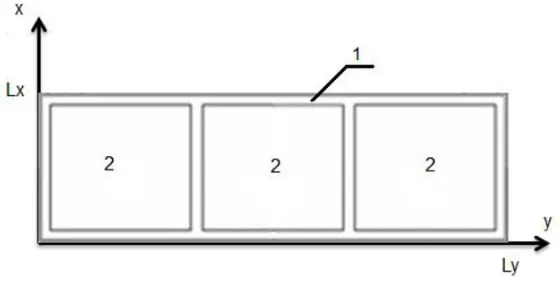
Figure 1. The geometry of solutions (1,2 – area with different thermal characteristics).
Reliability analysis of power generation equipment is usually carried out on the basis of a priori information using the statistical and probabilistic methods. For example a model based on Markov processes was used to predict the reliability of power transformers [11].
Different way for predicting the reliability of power electrical equipment which is based on the physics of failure (POF – Physics of Failure), but not on statistical and probabilistic analysis is proposed [12–17]. The reliability of the power system is considered with aging its components [12] in conjunction with the effect of adverse weather conditions [13]. Power system reliability indices are determined using a mathematical model of degradation of cable products [14]. Reliability indices of a number of electrical devices are defined by taking into account the degradation of the polymer components [15–17]. However the analysis of the failure physics of the objects usually carried out without taking into account the spatial nonuniform unsteady distribution temperature changes over time [12–15].
This article is to analyze failure rates of power semiconductor device in cyclic mode based on the numerical simulation of unsteady inhomogeneous temperature field with the multiple local sources of heat under natural convection conditions.
2. Objective analysis of thermal regimes of a power semiconductor
device
The analysis of heat transfer mode was done for typical power electronics device such as power diode module with a junction temperature Tj=398 K. (Fig.1).
The problem of thermo physical modeling was solved by the method of finite difference [6– 10,16,17].
Boundary conditions three of type with account of radiation were set at the interface with the environment.
In such context, the task comes to the solution of non-stationary thermal conductivity equation:
C(x,y)(x,y)*T
*t =
* *x
(x,y)*T
*x
+**y
(x,y)*T
*y
+Q(tSh,x,y) +(T) (TB−T)
h +
refT4 B−T4
h (1)
with the appropriate initial:
y=Ly,x ∈[0;Lx],z∈[0;Lz] : *y =(T) (Text−T)+ref Text−T .
Where: C – heat capacity;– density; T – temperature; t – time;– thermal conductivity coefficient; Q – heat source; S – source area; h – plate thickness; – convective heat transfer coefficient of the surface; TB – environment temperature; – Stefan-Boltzmann constant; ref – the emissivity of the surface of the plate and the environment.
The coefficient of convective heat transfer is temperature-dependent and determined for every point of the surface [18].
(T)=1.42−1.4·10−3Tavr
N
T −T
ext
L
1
4 ·
The reduced emissivity factor for the product surface and environment is determined by the ratio [18]. ref=
1 surf +
1 ext−1
−1 ·
The thermal conductivity equation (1) with appropriate initial and boundary conditions is solved by the finite difference method [19] by analogy with [16,17]. The diagram of splitting by coordinates was applied for the solution of difference analogues of a three-dimensional equation [20].
3. Statement of work of prediction reliability indices power
semiconductor device in cyclic mode
The analysis to the reliability indices of the diode module two mathematical models such as-Arrhenius [2] and a multiplicative model [21] were selected. The mathematical multiplicative model [21] of reliability evaluation diode module is shown below
=b·Kp·Kf·Kk·Ke, (2) where:b– base failure rate of the power unit; Kp– coefficient of mode, depending on the temperature and the electric load; Kf – functional specificity mode device coefficient; Kk – level of quality coefficient; Ke– stiffness conditions.
It important to note, that base failure rate of the power unit (b) calculated on condition Tconst=
298 K.
Functional specificity mode device coefficient (Kf) are 1 for stationary working mode and 0.6 for cyclic.
Figure 2. Temperature fields (b) of the power semiconductor device (a).
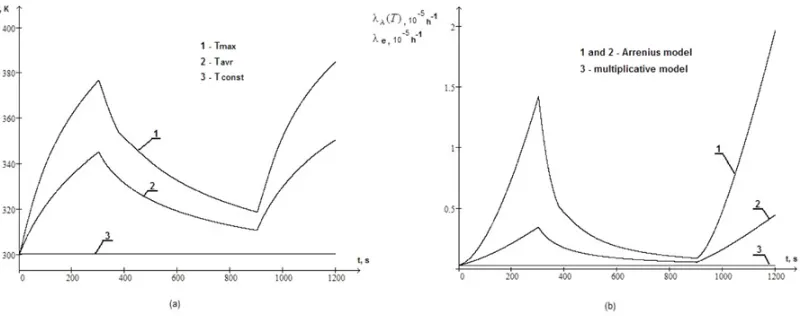
Figure 3. Temperature (a) and failure (b) rate of the power semiconductor device in cyclic mode.
dependent on the temperature [2]:
A(T)=C·exp
−E kT
· (3)
Where: C–constant, E–activation energy, k–Boltzmann constant.
4. Results and discussion
The typical temperature field of the modeled object (Fig. 2a) at ambient temperature Text=298 K at the time t=1200 s is shown in Fig. 2b.
affect the service life of power electronics devices and on the reliability of the equipment which consists of these devices.
5. Conclusion
In the cyclic operation of the semiconductor device failure rate much higher than in the stationary mode. This means that the rate consumption of resources power diode module is faster.
Using the multiplicative model (2) to estimate the CPR failure rate results in a significant overestimate of the devices operating lifetime.
Prediction of reliability indices of power semiconductor device should be carried out on the basis of analysis of actual unsteady nonhomogeneous thermal cyclic mode in the device.
The proposed mathematical technique for the analysis of thermal modes of power semiconductor device may become the basis of POF methods. Using POF methods to predict the reliability of semiconductor devices may allow to minimize the number of acceptance tests. Finally the method based on the physics of failure may become an important component of concepts PDfR (PDfR – Probabilistic Design for Reliability) [23] and DRM (DRM – Dynamic Reliability Management) [24].
References
[1] I.V. Grehov, Bulletin of the Russian Academy of Sciences. 2 (2008)
[2] A.A. Borisov, V.M. Gorbachev, G.D. Kartashow, M.N. Martynov, S.F. Prytkov, Foreign electronics. 5 (2000)
[3] A.N. Nazarychev, D.A. Andreev, Pedro Antonio, E.A. Kireev, Bulletin of the ISPU. 3 (2009) [4] P. van Duijsen, P. Bauer, J. Leuchter, EPE/PEMC. 1. (2010)
[5] E.C.W Jong, J.A Ferreira, P. Bauer, Pow.Elec.Let. 3 (2005)
[6] G.V. Kuznetsov, M.A. Sheremet, Russian Microelectronics. 5 (2009) [7] G.V. Kuznetsov, M.A. Sheremet, Russian Microelectronics. 6 (2010) [8] G.V. Kuznetsov, M.A. Sheremet, Russian Microelectronics. 5 (2011) [9] E.V. Kravchenko, D.J.U. Ivleva, Fundamental research. 6–5 (2013)
[10] G.V. Kuznetsov, E.V. Kravchenko, Elektromagnitnye Volny i Elektronnye Systemy. 11–12 (2005) [11] M. Sefidgaran, M. Mirzaie, A. Ebrahimzadeh, Int.J. of Elect.Pow.&Ener.Sys. 35 (2012)
[12] W. Li IEEE Trans Power Syst, 17 (2002) [13] M.H.J. Bollen IEEE Trans Ind Appl, 37 (2001)
[14] M. Stötzel, M. Zdrallek, W.H. Wellssow, IEEE Proc Gen Transm Distrib. 148 (2001)
[15] D.A. Silva, E.C.M. Costa, J.L. Franco, M. Antonionni, R.C. Jesus, S.R. Abreu, K. Lahti, L.H.I. Mei, J. Pissolato, Int.J. of Elect.Pow.&Ener.Sys. 53 (2013)
[17] G.V. Kuznetsov, E.V. Kravchenko, Journal of Engineering Physics and Thermophysics. 5 (2007) [18] G.N. Dulnev, Heat and mass transfer in radio electronics (Moscow, High School, 1984) [19] A.A. Samarskii, Theory of difference schemes (Moscow, Nauka, 1983)
[20] V.M. Paskonov, V. Polezhaev, Numerical simulation of heat and mass transfer (Moscow Nauka, 1984)
[21] S.F. Prytkov, V.M. Gorbachev, Handbook « Reliability of radioelements » (Moscow, 2012) [22] G.T. Sasse, M. Combrié, Microelectronics Reliability. 52 (2012)
[23] E. Suhir, Microelectronics Reliability. 52 (2012)