University of South Carolina
Scholar Commons
Theses and Dissertations
2016
Sounding Appalachian: /ai/ Monophthongization,
Rising Pitch Accents, and Rootedness
Paul E. Reed
University of South Carolina
Follow this and additional works at:https://scholarcommons.sc.edu/etd Part of theArts and Humanities Commons, and theLinguistics Commons
This Open Access Dissertation is brought to you by Scholar Commons. It has been accepted for inclusion in Theses and Dissertations by an authorized administrator of Scholar Commons. For more information, please [email protected].
Recommended Citation
Sounding Appalachian:
/aI/ Monophthongization, Rising Pitch Accents, and Rootedness
by
Paul E. Reed
Bachelor of Arts Maryville College 2004
Master of Arts
University of Memphis 2007
Submitted in Partial Fulfillment of the Requirements
for the Degree of Doctor of Philosophy in
Linguistics
College of Arts and Sciences
University of South Carolina
2016
Accepted by:
Tracey L. Weldon, Major Professor
Elaine Chun, Committee Member
Michael Montgomery, Committee Member
Allen Montgomery, Committee Member
Erik R. Thomas, Outside Member
c
Dedication
This dissertation is dedicated to the memory of two great men, Paul Henry ‘Pop’
Reed and Dr. Paul Emory Reed Sr. They both exemplified what it meant to be
mountain men. Dad and Pop, I hope you are looking down from your rockers with
Acknowledgments
When I think of the number of people that have helped me throughout the course
of preparing, researching, and writing this dissertation, my gratitude swells. I would
not have been able to produce this work, and I would also not be who I am today.
To the people of Hancock County who shared their lives and stories with me,
thank you. I hope this work shows that I did not and do not take your words for
granted. There would be no dissertation without your voices, and I am eternally
grateful for the privilege of hearing them.
Thank you to Tracey Weldon for your steady and compassionate hand. You are
all that an advisor is supposed to be: kind, encouraging, supportive, and firm when
needed. Your comments, questions, feedback, and exhoration were always helpful
and thorough. You pushed me to see the weaknesses in my argument and my ideas,
but you were also quick to help me to see how to address them. You also knew when
to let me be more independent, as my ideas were flourishing and the dissertation
was coming to fruition. Mastery of the delicate balance of oversight and freedom
characterizes your advisement. I hope one day that I can be the same.
Thank you to Michael Montgomery. With your help and guidance, I found the
proud Appalachian mountain man that was always there inside. Our conversations
helped me to understand who I was, where I came from, and how I could be an
advocate for my region. Along the way, I not only gained a mentor, but a friend. I
cherished our conversations, trips, and collaborations. Thank you for your input into
this work; it would not have happened without you.
my committee. Conversations with Elaine helped me to better understand more
qualitative approaches, and to see how identity can be expressed. I am so grateful
that you helped me see past numbers, tokens, and formants! Allen Montgomery
showed me the wonderful word of statistical analysis. Thank you for showing me how
to bring a modicum of order from the chaos of real-world data. This analysis would
have been much poorer without your help! To Erik Thomas, thank you for opening
my eyes to sociophonetics. Your instruction helped me to even be able to approach
this topic, and your guidance helped me to carry it out.
There are so many of my fellow students who have shared this journey with me.
Thanks to Sandra Keller, Julia McKinney, Sara Lide, and Thor Sawin for spending
many an hour with me writing. Your help, criticism, encouragement, and comments
were always on point, even when I sidetracked us with Skype emojis! We did it! To
the Agraphia Group — Allison, Vic, and Spencer — thanks for helping me to set
writing goals and for encouraging me to meet them. To Emily Garnett and Isabel
Hubbard, #StatPackForLife.
Thanks also to Bridget Anderson, my Appalachian big sister from another mister,
for conversation, encouragement, and insight. I am very grateful to Kirk Hazen for
sharing his dissertation data from Warren County with me, and to Michael J. Fox for
helping me get it. Thanks also to Dennis Preston and Walt Wolfram for conversations
that helped refine my thinking on many topics, both dissertation related and beyond.
I hope to be like you both someday!
I would be remiss if I did not thank the Dean of the College of Arts and Sciences,
Mary Anne Fitzpatrick, for the Dissertation Fellowship during 2014-2015. That award
allowed me to conduct research and to focus on writing, I am very grateful.
Last, but certainly not least, thanks go to my wife, Kristin, my partner in this
journey of life. You are my muse and my anchor. Thanks for the encouragement
euclidean distance and pitch accent onset, for understanding when I had to write,
and for always being there during the hard times and the easy times. I love you so
Abstract
Appalachia, the mountainous region that stretches from northern Georgia to
Pennsyl-vania (ARC, 2015), is a region that has been considered culturally and linguistically
unique in the United States. There is a small but growing body of literature that has
demonstrated that the language varieties of this region, collapsed under the broad
heading of Appalachian English (AE), diverge from Mainstream American English
and other Southern American English varieties (Wolfram & Christian, 1976,
Mont-gomery & Hall, 2004, Labov et al., 2006, among others). Much of this literature has
focused on vowels and morpho-syntax, but other linguistic aspects have not received
much attention, and there is little to no scholarly work on the perception of these
varieties within the region, much less the ideology that underlies the perception.
To begin to fill this gap in knowledge about Appalachian English, this
disserta-tion investigates two features from a sociophonetic viewpoint: /aI/
monophthongiza-tion and intonamonophthongiza-tion. The former has received attenmonophthongiza-tion from tradimonophthongiza-tional descriptive
(Hall, 1942) and sociolinguistic (Wolfram & Christian, 1976; Thomas, 2001, 2003)
perspectives. Research suggests that speakers use this feature in various ways to
in-dex regional, cultural, and ethnic identities (Fridland, 1999, Feagin, 2000, Thomas,
2000, Thomas, 2001, Anderson, 2003, Fridland, 2003, Bernstein, 2006, among
oth-ers). The latter has only been anecdotally noted in the literature, save one study —
Greene (2006), who observed a higher incidence of L+H* accents among AE speakers,
compared to speakers of Mainstream American English or other Southern American
English varieties. The phonetic realization of pitch has been shown to have regional
and other English varieties (e.g., Grabe et al., 2000; Grabe, 2004; Ladd et al., 2009).
The field site for the study is Hancock County, Tennessee, a small, rural county
in north East Tennessee, which is also the hometown of the author. Data come
from sociolinguistic interviews from 25 (13 women, 12 men), all natives to the area. I
employed quantitative methodology to analyze participants’ use of both /aI/
monoph-thongization and rising pitch accents.
Results show that speakers who are more rooted to the local area have more
monophthongal productions of /aI/, use more frequent rising pitch accents, and also
realize rising pitches in a quantitatively different way. Thus, both of these features
and their phonetic realizations can serve as a way to signal local orientation, what I
call rootedness.
Further, these Appalachian speakers are distinct from other Southern speakers
with respect to the relative frequency of rising pitch accents, as well as the phonetic
realization of pitch. Thus, frequent rising pitch and its phonetic realization may
Preface
This dissertation represents a crucial effort in a on-going process of self-recognition
and regional appreciation. On the surface, my dissertation reports on the linguistic
behavior of a small corner of a misunderstood region. But, at its core, it is also the
story of my realization of who I am. I am a proud son of the South, a Tennesseean
with roots that go back as deep as you want, a now-unapologetic Mountain Man. Yet,
I have also carried a sizable chip on my shoulder about the South and my region,
Appalachia. A well-hidden shame about where I come from. But, over the course of
several years, I have reflected upon my region and my people, the good and noble
and the bad and difficult; I have shed that shame. In its stead is now a deeper
understanding and a profound appreciation, a true love, of the people whose voices
echo in the mountains and the vales. Not merely a sycophantic love, but one that is
principled and nuanced.
Along the way, I have read articles, chapters, essays, and books about my region
and my people penned by perceptive, well-meaning, and caring outsiders. Many of
these people are friends and colleagues, and I am very grateful for their work. But I
also noticed something: certain voices were missing. Voices from within the region,
a critical look at us by us, were too rare. An unflinching and nuanced investigation
from an Appalachian perspective was hard to find. This dissertation is my attempt
to rectify this.
It took me over three decades to be comfortable enough in my own skin to own
the mantle of ‘mountain man’, to become aware of the culture and history of me
mis-sion: to investigate how my people talk and move towards understanding why. This
Table of Contents
Dedication . . . iii
Acknowledgments . . . iv
Abstract . . . vii
Preface . . . ix
List of Tables . . . xiv
List of Figures . . . xvi
Chapter 1 Introduction . . . 1
1.1 Sounding Appalachian: Monophthongization and Rising Pitch Accents 15 1.2 Research Questions . . . 18
1.3 Plan of Study . . . 21
1.4 Outline of Dissertation . . . 22
Chapter 2 Literature Review . . . 24
2.1 Standard Language Ideology . . . 24
2.2 Perceptions of Appalachia . . . 28
2.3 Appalachian English . . . 33
2.5 Rising Pitch Accent . . . 41
2.6 Language, Identity, and Place . . . 43
2.7 The Attention-to-Speech Model . . . 49
Chapter 3 Methodology. . . 55
3.1 Geographical Area . . . 55
3.2 Data Collection . . . 68
3.3 Acoustic Analysis . . . 82
Chapter 4 /aI/ Monophthongization . . . 87
4.1 Methods . . . 87
4.2 Overall Distribution . . . 89
4.3 Linguistic Distribution . . . 94
4.4 Social Distribution . . . 98
4.5 Discussion . . . 105
Chapter 5 Rising Pitch Accents . . . 108
5.1 Methods . . . 108
5.2 Rising Pitch Accent in Hancock County . . . 112
5.3 Rising Pitch Accent Comparison with Warren County . . . 117
5.4 Rising Pitch Accent Discussion . . . 121
Chapter 6 Language, Rootedness, and Appalachian Identity . . 124
6.1 Discussions of Place . . . 126
6.3 Individual Case Studies . . . 143
6.4 Discussion . . . 154
Chapter 7 Conclusion . . . 157
7.1 Summary of Findings . . . 157
7.2 Implications . . . 161
7.3 Final Words . . . 170
Bibliography . . . 174
Appendix A Monophthong Examples . . . 196
Appendix B Interview Modules . . . 198
Appendix C Reading Passage . . . 201
Appendix D Word List . . . 203
List of Tables
Table 2.1 Percent of monophthongal/short glide in various lexical items from The Linguistic Atlas of the Gulf States (Pederson et al.,
1986-93). . . 39
Table 2.2 Rates of /aI/ monophthongization in communities across
Ap-palachia and the South. Adapted from Greene (2010). . . 54
Table 3.1 Racial make-up of Hancock County, TN in 2000 and 2010 (U.S.
Census Bureau, 2013) . . . 59
Table 3.2 Age Demographics of Hancock County, TN in 2000 and
2010(Ten-nessee State Government, 2013) . . . 62
Table 3.3 Percent of Educational Attainment for Hancock County adapted
from Tennessee State Government (2013) . . . 62
Table 3.4 Participants from Hancock County . . . 70
Table 3.5 Participants from Hancock County . . . 78
Table 3.6 Top Three Areal Identification Choices and Range for All
Par-ticipants from Hancock County . . . 80
Table 3.7 Top Three Areal Identification Choices and Range for Older
Par-ticipants from Hancock County . . . 80
Table 3.8 Top Three Areal Identification Choices and Range for Younger
Participants from Hancock County . . . 81
Table 4.1 Distribution of /aI/ tokens across Interview Tasks per Speaker . . 88
Table 4.2 Summary of significant effects from mixed effects linear regression 94
Table 4.3 Means, medians, and standard deviations for Euclidean distance
Table 5.1 Demographic information for the Warren County speakers. . . 111
Table 5.2 Average pitch accent frequency for Hancock County speakers and Warren County speakers. Note that the total number of pitch
accents per variety = 100. . . 118
List of Figures
Figure 1.1 The geographic location of Hancock County, TN. . . 4
Figure 1.2 The counties of East Tennessee. . . 5
Figure 1.3 The counties of Middle Tennessee. . . 5
Figure 1.4 The counties of West Tennessee. . . 5
Figure 1.5 The flag of Tennessee. . . 6
Figure 1.6 The proposed State of Cumberland. . . 13
Figure 2.1 Appalachia as defined by the ARC, with the ‘core region’ from Ulack & Raitz (1981) superimposed. . . 34
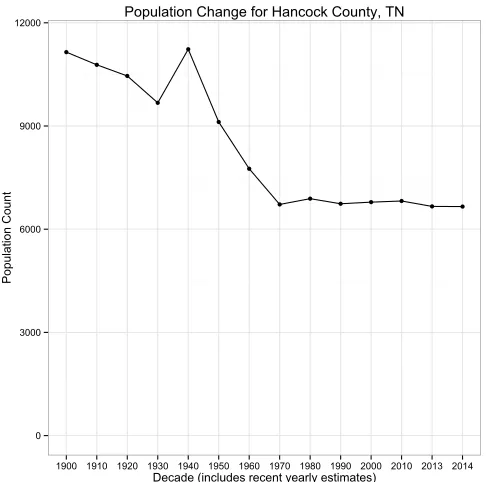
Figure 3.1 The population of Hancock County from 1900-2010 drawn from U.S. Census Bureau (2013). This includes the 2013 and 2014 population estimates. . . 57
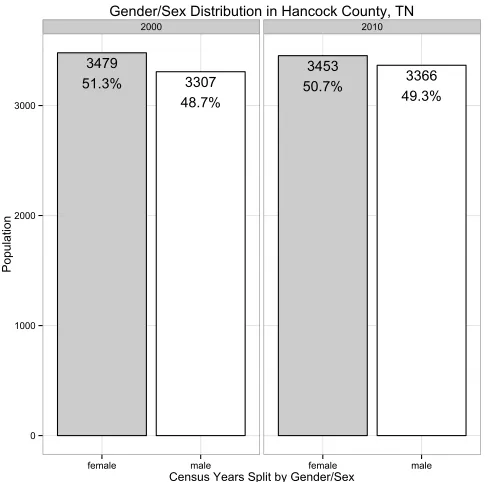
Figure 3.2 The gender/sex distribution of Hancock County from the 2000 and 2010 census records (U.S. Census Bureau, 2013). . . 60
Figure 3.3 Percent of Educational Attainment in Hancock County by Age Group adapted from U.S. Census Bureau (2013) and Tennessee State Government (2013). . . 63
Figure 3.4 The income distribution of individuals in Hancock County from from the 2000 and 2010 censuses (U.S. Census Bureau, 2013; Tennessee State Government, 2013). . . 66
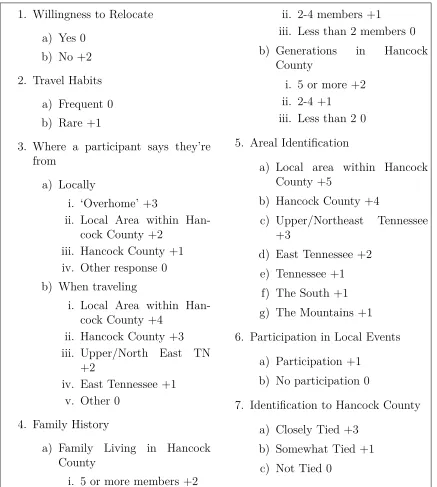
Figure 3.5 The scoring system for the rootedness metric. . . 76
Figure 4.1 Normalized and scaled mean vowel formant values for all speakers. 90
Figure 4.2 Vowel system for all speakers in pre-voiced contexts. . . 91
Figure 4.3 Vowel system for all speakers in pre-voiceless contexts. . . 91
Figure 4.4 Boxplot showing the Euclidean Distance distribution for the
Hancock County speakers. . . 92
Figure 4.5 Euclidean distance measures split by the voicing of the following
segment. . . 95
Figure 4.6 Euclidean distance as a product of the duration of the vowel. The overlay shows no real relationship. Note the x-axis
(dura-tion) has been log transformed. . . 96
Figure 4.7 Euclidean distance as a product of the duration of the vowel separated by voicing of the following segment. Note the x-axis
(duration) has been log transformed. . . 97
Figure 4.8 Euclidean distance measures by Interview Task. . . 98
Figure 4.9 Euclidean distance measures by Interview Task separated by
Speaker Gender. . . 100
Figure 4.10 Euclidean distance measures by duration and interview task.
(Note: Duration is log-transformed). . . 101
Figure 4.11 Euclidean distance measures by Interview Task separated by
Voicing of Following Segment. . . 102
Figure 4.12 Euclidean distance measures by Rootedness separated by
voic-ing of the followvoic-ing segment. . . 103
Figure 4.13 Euclidean distance measures by Rootedness and interview task. . 104
Figure 5.1 Overall distribution of pitch accents for Hancock County speakers. 113
Figure 5.2 The distribution of pitch accents by speaker age in the left panel
and by speaker rootedness in the right panel. . . 114
Figure 5.3 Comparison of Pitch Accent Onset by Speaker Gender for
Figure 5.4 Relationship Between Pitch Accent Onset and Rootedness for
Hancock County speakers. . . 116
Figure 5.5 Comparison of Pitch Accent Onset between Hancock County speakers (Appalachian) and Warren County speakers (Southern). 120 Figure 6.1 Euclidean Distances for Haley and Misty. . . 144
Figure 6.2 Euclidean Distances by Task for Haley and Misty. . . 145
Figure 6.3 The distribution of pitch accents in the left panel and PA-ON in the right panel for Haley and Misty. . . 146
Figure 6.4 Euclidean Distances for Two Hancock County Speakers, Misty and Hugh. . . 150
Figure 6.5 Euclidean Distances by Task for Hugh and Misty. . . 151
Figure 6.6 The distribution of pitch accents in the left panel and the av-erage PA-On in the right panel for Misty and Hugh. . . 152
Figure A.1 Monophthongal ‘might’ from the author’s speech. . . 196
Figure A.2 Monophthongal ‘ride’ from the author’s speech. . . 197
Chapter 1
Introduction
Appalachia is the mountainous region that principally stretches from northern
Geor-gia to Pennsylvania (ARC, 2015)1. Scholars and lay people alike have all too often
treated it as a monolithic area, distinctive in both culture and language. However,
a growing body of literature has demonstrated that the speech varieties there,
col-lapsed under the broad heading of Appalachian English (AE), or sometimes
‘Ap-palachian Englishes’, diverge from Mainstream American English (MAE) and from
other Southern American English (SAE) varieties (Pederson et al., 1986-93; Carver,
1987; Labov et al., 2006, among others)2, and are not monolithic. Much of this
re-search has largely focused on vocalic and lexical features, at the exclusion of many
other features. Furthermore, little is known about how speakers in the region
con-struct locally and regionally place-based identities through their speech. Additionally,
there is scant scholarly work on the ideologies underlying evaluations of AE varieties
by native speakers3. This dissertation aims to fill these empirical lacunae, with an
eye to understanding the persistence of AE forms in the face of marginalization from
both outsiders and insiders (cf. Ryan, 1979). Furthermore, focusing on a small
ru-1The Appalachian Regional Commission (ARC) does have a more expansive definition based on
both geography and socioeconomic factors. See Section 2.3 for a more in-depth discussion.
2These citations do not focus solely on Appalachia, rather dialectal regions of the U.S. and/or
North America. However, their raw material, when taken collectively, shows the quantitative and qualitative distinctiveness of the varieties spoken in Appalachia.
3Some exceptions are Greene (2010), which treats how speakers both accept and reject part
ral community in northeast Tennessee, this study seeks to illuminate how linguistic
behavior conveys a local place-based identity, and how the realizations of a salient,
well-documented feature — /aI/ monophthongization4 — and a less salient, less
well-known feature — the relatively frequent use of rising pitch accents — correlate with
differing degrees of local attachment. A deeper understanding of the native AE
speaker commentary on these features can help to elucidate the impact of widely
cir-culating cultural and linguistic stereotypes on language and how attachment to place
features into language behavior.
In an overview of sociological approaches to place, Gieryn (2000) notes that place
has to have three components: geographic location, material form, and investment
with meaning and value (464-465). Without these, place is merely ’space’, and not
meaningful. He writes,
A spot in the universe, with a gathering of physical stuff there, becomes a
place only when it ensconces history or utopia, danger or security, identity
or memory. In spite of its relatively enduring and imposing materiality,
the meaning or value of the same place is labile - flexible in the hands of
different people or cultures, malleable over time, and inevitably contested.
(Gieryn, 2000:465).
A place is thus geographic space imbued with meaning and value for particular
peo-ple. For nearly 150 years, metropolitan America has viewed Appalachia as a region
of interest; yet this interest has suffered from misinformation and distorted
portray-als. John C. Campbell stated that Appalachia is ‘a land about which, perhaps,
more things are known that are not true than of any part of our country’ (1921:xxi).
Sadly, this almost century-old statement rings as true today as ever. Articles and
4Throughout this dissertation, I will use the International Phonetic Alphabet (IPA) transcription
commentary regularly appear that promote circulating tropes of poverty and
vio-lence, regardless of their veracity or applicability when focusing on Appalachia (e.g.,
Williamson, 2015). The region’s high rates of poverty and its reliance on exploitative
extractive industry, coupled with the vast amounts of governmental investment and
aid since the highly publicized federal War on Poverty beginning in the 1960s, have
buttressed pre-existing stereotypes of the region as backward and uneducated (e.g.,
Luhman, 1990; Ayers, 1996:70-71). There is also the common belief that cultural
practices, such as Child balladry and handicrafts (e.g., Whisnant, 2008), and
linguis-tic patterns have changed little from those that early British and Irish colonists and
immigrants brought with them in the 18th century5. Such a belief reflects the idea
that Appalachia remains in the past, avoiding progress.
In many descriptions of the region and its culture (e.g., Jones, 1975, 1994;
Abram-son & Haskell, 2006), place and place attachment are central. This attachment can be
very localized, potentially even to a particular parcel of ancestral land, often known
as the ‘homeplace’ (Cox, 2006). However, other research suggests (Greene, 2010;
Reed, 2012, 2014a) that some natives may orientaway from the region culturally and linguistically, perhaps due to intense negative perception and stigma of the region
and ways of speaking that are associated with it.
One focus of this dissertation is to explore the extent to which a varying degree
of local place attachment correlates with differing linguistic behavior. There is a long
history of sociolinguistic research on the relationship between language and place,
dating back to Labov’s seminal 1963 study of Martha’s Vineyard (see also Lane,
1998; Solomon, 1999; Johnstone et al., 2006; Johnstone & Kiesling, 2008;
Schoux-Casey, 2013; Carmichael, 2014). Within each of these studies, place as in physical
location was important, but crucially, a speaker’s relationship to place helped explain
5See Montgomery (1998) and Cramer (2014) for scholarly rebuttals to the language preservation
linguistic variation better then mere location.
The focus of this study is my own hometown of Sneedville, TN — a rural
Ap-palachian town, located in Hancock County, which sits on the border of the Southern
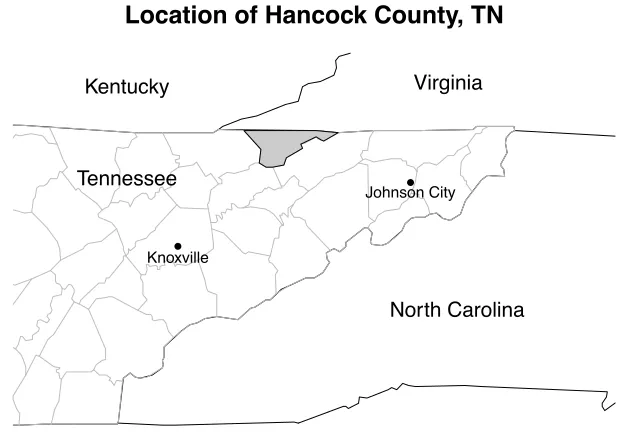
and Central Appalachian regions in Upper East Tennessee (ARC, 2015). Figure 1.1
shows the county’s location, which is shaded in the map.
Location of Hancock County, TN
Kentucky Virginia
North Carolina Tennessee
Knoxville
Johnson City
Figure 1.1: The geographic location of Hancock County, TN.
Any discussion of place and the impact of place in Tennessee necessitates some
background of the state itself, as place features prominently in state history,
partic-ularly for East Tennessee. The following sections outline the Grand Divisions of the
state, explain why the Divisions arose, and then focus on East Tennessee and, in
particular, Upper East Tennessee, and explore why place and the perception of place
are so meaningful in this subregion.
1.0.1 The significance of place in Tennessee history
Tennessee is somewhat unusual among states in the United States in that it has
(see Figures 1.2, 1.3, and 1.4 below). Each division contains roughly one-third of
Figure 1.2: The counties of East Tennessee.
Figure 1.3: The counties of Middle Tennessee.
Figure 1.4: The counties of West Tennessee.
the state’s land area. The counties that comprise each Division are specified by state
law — though some have changed over time (State of Tennessee, 2015). The Grand
Divisions are reflected in the state flag, where the three central stars represent the
Grand Divisions (see Figure 1.5).
The Grand Divisions roughly equate to differences in geography, rugosity, and
elevation, and some geographical features have been declared borders6. East
Ten-nessee is mountainous. It is dominated in the east near the North Carolina border
by valleys and the various mountain chains that are part of the larger Appalachian
range, and the ridge and valley system as one moves west. Middle Tennessee begins
with the Cumberland Plateau and the piedmont region shifting toward flatter land
6A ‘clear’ border between East and Middle Tennessee remains elusive. Further, some counties
Figure 1.5: The flag of Tennessee.
as one moves west. Fertile valleys and lightly rolling landscape characterize most of
Middle Tennessee. The Tennessee River forms the boundary between Middle and
West Tennessee. The westernmost Grand Division is flatter and lower-lying and part
of the expansive Gulf Coastal Plain region. Its character is level, fertile ground, quite
suitable for large-scale agriculture.
The sectionalism of Tennessee and formally recognized Grand Divisions have
im-plications within state government. For example, on the Tennessee Supreme Court,
there can be no more than two justices of the five members of the Court from any
single Grand Division. The Court must also rotate and hold hearings in each Grand
Division during each session term. There are other administrative complexities
relat-ing to the Grand Divisions, such as other requirements that certain committees must
have members drawn from each Grand Division, such as the Public Service
Commis-sion, the Textbook CommisCommis-sion, and other state agencies (State of Tennessee, 2015).
Thus, place has an impact even on state administration.
The differences between the Grand Divisions go deeper than even geography and
governance. A perceived cultural difference also exists. Within the past 30 years, signs
on interstates welcomed visitors to the ‘Three States of Tennessee’. While gone now,
such a motto reveals that the residents of the three Grand Divisions see themselves
Divisions have generally been, at a basic level, competitors when not enemies of one
another. They are divided by a social and economic background of a different nature
— more than by miles, even though the difference is great.’ (63). This sectionalism
has roots in the state’s history, outlined below.
As settlers came west across the mountains or came south down the great
val-leys into what would become Tennessee (it was part of North Carolina in the years
before statehood), political power centralized in growing settlements in what is now
East Tennessee. All of the land that would become Middle and West Tennessee was
off-limits to settlement, as it belonged to various Native American tribes/nations,
especially the Cherokee. This prohibition did not necessarily stop some settlers from
illegally crossing into Native American land. As a result, border violence was a reality.
With large land purchases and plenty of land grabs by white settlers, the population
began to swell. Additionally, the signing of various treaties with the Native
Ameri-can tribes lessened some of the threats of violence. Settlers and speculators expanded
west as the threat of warfare with Native Americans subsided and the land became
legally available. The fertile valleys of what would become Middle Tennessee drew
many settlers, as it was more conducive to agriculture, and the balance of population
and political might shifted westward (Tennessee Blue Book, 2013).
As the state’s population continued to grow, settlers continued to move west,
where the land was flatter and richer. This more fertile land in the western portions
of Tennessee facilitated larger-scale agriculture. As a result, plantation culture and
a type of Southern aristocracy took hold in what is now West Tennessee. Here, the
climate and land were suited to grow cotton on large plantations with slave labor.
West Tennessee’s economy grew to depend on cotton and slave labor. In Middle
Ten-nessee, there were fewer plantations, although there was still a burgeoning plantation
culture based on tobacco, another labor intensive crop requiring involuntary slave
the East, the land was ill suited for large-scale plantation work and most agriculture
occurred on smaller plots of land; thus, plantation culture did not develop in this
area (Bergeron et al., 1999 and Tennessee Blue Book, 2013).
With the booming slave-based economies of Middle and West Tennessee, rich
plantation owners rose in power and influence within state politics. The power had
shifted west (exemplified by the move of the capital to Nashville in 1826, after several
attempts to keep it in East Tennessee7). Not unexpectedly, many from the more
pop-ulous eastern portion resented this loss of power and influence and also felt maligned
with respect to state funding and attention, and there were some calls for forming
a separate state. To maintain a sense of cohesion and to attempt to avoid sectional
crises, the 1834 State Constitution formally recognized the three grand divisions. This
code included the requirement for the State Supreme Court to have representation
from all three grand divisions. Yet this did not solve the sectionalist issues. Like much
of the South, slavery and the slave-based economy also played a large role. Many
of the state’s political issues were deeply divided, particularly due to the economic
power that slavery permitted. The plantation owners in West Tennessee and Middle
Tennessee dominated state politics and were much more aligned with the secessionist
movement spreading across the South. The state was a hotbed of pro- and
anti-slavery sentiment. Thus, in the lead up to the Civil War, many in West and Middle
Tennessee, due to their reliance on slave labor for cotton and tobacco plantations,
called for secession (Tennessee Blue Book, 2013). In contrast, the majority of East
Tennesseans were against secession, mainly to counter the economic might of those
from Middle and West Tennessee. Writing about how East Tennesseans saw slavery,
Crawford notes that in East Tennessee, ‘the free and independent farmers had little
7The state capital was Knoxville from statehood in 1796 until 1807. It was in Kingston (still in
desire to defend the institution of slavery’ (1986:66). This was not a rejection of the
idea of slavery, but a rejection of the economic might and political influence of slave
holders (Kelley, 2012). Many sought actively to secede from the state and remain
part of the larger union. Additionally, during the Civil War itself, Union enlistment
was highest in the East, cementing a feeling of isolation and difference for this part
of the state (Bergeron et al., 1999).
The shift of political and economic power, combined with differing views toward
slavery and secession, consolidated the sectionalism feelings in Tennessee. The brief
overview above provides a broad outlines of why the Grand Divisions were formed and
why perceived differences might remain. This historical background provides context
for why place would be so prominent for many people. Where one lived mattered and
shaped views toward one’s fellow Tennesseans, and there were rather clear divisions
between people based on place and perceptions of place. This history began to imbue
particular places with meaning, such as East Tennessee being different and separate.
Thus, place linked with identity as different perspectives were associated with
ge-ographical areas. The communal memory would focus on being from a particular
place, and would permeate it with meaning derived from both history and identity
(following the Gieryn definition of place above).
1.0.2 The significance of place in East Tennessee
The sense of separateness and perhaps even uniqueness embedded in the fabric of East
Tennessee inspired many attempts to be recognized as independent and formally
dis-tinct. In fact, some say that place features more prominently in East Tennessee than
anywhere else in the state. As observed by Crawford (1986), ‘it has been traditional
in the mountain counties to view those of different experience and culture as real or
potential enemies. And the local residents [of East Tennessee] make little distinction
1995a). Such sentiments derive in part from historical realities and their
interpreta-tion. Tom Lee writes that ’political and economic disputes with the other sections
of Tennessee produced among East Tennesseans a distinctive sectional identity built
around a mythologized historical narrative of heroism and victimization that East
Tennesseans themselves fostered and that persisted through the Civil War and into
the twentieth century’ (Lee, 2010:294). In fact, historian John Inscoe argues that
the stronger regional identity in East Tennessee is what allowed for the stronger
pro-Union sentiment in East Tennessee, in contrast to other mountain areas such as
western North Carolina (Inscoe, 2008:103-123). The community perspective, memory,
and identity in East Tennessee have been impacted by a somewhat unique history,
and that community memory helps to mark place as something very important to
East Tennesseans, and in particular, Upper East Tennesseans.
The roots of the belief that East Tennessee is different begin with the Battle of
Kings Mountain in 1780 during the American Revolution. A large group of
mili-tiamen, later known as the Overmountain Men, mustered in East Tennessee (near
present-day Elizabethton), and marched over the mountains into South Carolina,
south of King’s Mountain. There, the colonial militia defeated the loyalist militia,
marking a turning point in the War. This loss forced British and loyalist forces back
into South Carolina, and thus turned the tide of the Southern campaign (Mace, 2006).
The fact that many of the militiamen were from what would become East Tennessee
became a cause célèbre for the courageous and distinctive nature of the area.
Related to the story of the Overmountain Men is the short-lived State of Franklin,
which seceded from North Carolina in 1784. This is a factoid that most children learn
in their Tennessee History classes during elementary school. In the period just after
the American Revolution, what is now East Tennessee was part of North Carolina.
western frontier and rather distant from state administration, people in the Western
Counties felt isolated from the rest of North Carolina, even though men from these
counties helped mightily during the Revolution. In the aftermath of the war, North
Carolina voted in 1784 to cede the land from the mountains to the Mississippi river
to Congress to help offset war debts. Naturally, the settlers living in this region were
not terribly pleased with this proposal, due to fears about Native Americans and/or
fears about the land being sold to France, Spain, or some other foreign nation. North
Carolina changed course, possibly becoming cognizant of the growing resentment, and
decided not to cede the land. However, the damage was done. Some of the inhabitants
of the Western Counties decided to form their own state in 1784. The newly-formed
state petitioned the U.S. Congress for statehood, and was denied. Thus, the State
of Franklin declared itself independent, and functioned as a separate entity until its
dissolution and re-entry as a part of North Carolina in 1789 (Tennessee Blue Book,
2013:495).
This separatist sentiment never fully left East Tennessee and bubbled to the
sur-face many times in the decades following statehood in 1796. Much of the separatism
stemmed from feelings of being overlooked by Middle and West Tennessee, which was
partly true as state-funded development in Middle and West Tennessee far outpaced
that of East Tennessee during the early to middle decades of the 19th century. These
disparities in funding, influence, and economic power fueled the distrust in the East
of the two western Grand Divisions. As a reaction, there were several proposals in
the antebellum period for East Tennessee independence, stemming from the
polit-ical power shifting to Middle and West Tennessee with the rise of the plantation
aristocracy. These proposals were typically stalled, but the sectionalist differences
continued. For example, a majority of the Tennessee citizenry voted to secede from
the Union, but over 69% of the voters in East Tennessee opposed secession8. As
a reaction against pro-secession forces from Middle and West Tennessee (and some
counties in East Tennessee), the pro-Unionist East Tennessee Convention convened
in 1861 to petition the Tennessee state government and the federal government to
allow East Tennessee to form a separate state, a ‘mountain republic’ (akin to the
suc-cessful separatist movement in Virginia that led to the formation of West Virginia)
(Kelley, 2012). The state government denied this petition, and anti-East Tennessee
sentiment (which was in reality anti-Unionist) ran high. As a result of this petition,
East Tennessee was occupied by Confederate forces, and was not ‘freed’ until late
1863 (Lee, 2010:303-304).
The harsh response to the separatist movement has lived on in the memory of
many and affected the perception of East Tennessee as well. From the sectional
differences and the violent reaction, ’antebellum perceptions of East Tennessee as a
distinctive section within Tennessee evolved into a perception of East Tennessee as a
distinctive region within the South’ (Lee, 2010:294). For decades after the Civil War,
its aftermath, and Reconstruction, East Tennessee viewed the rest of the state
suspi-ciously and vice versa, and was politically distinct (although this political distinction
is now largely gone). The political contrast was known as ‘Mountain Republicanism9’,
in contrast to the ‘Solid South’, which was almost uniformly Democrat. For example,
a state guidebook on Tennessee produced by the Work Projects Administration in
1939 declared ‘To the East Tennessean, West Tennessee is almost as far away and
unknown as Missouri. He looks upon the western section as a swamp and resents
the weight of the powerful Shelby County political machine in state-wide elections.
What West Tennessee is for, he is ‘agin” (WPA, 1939:4, as quoted in Montgomery,
1995a:72).
statewide convention to consider leaving the Union. There were two conventions in 1861, one in February and the decisive one in June. The latter decision caused Tennessee to become the eleventh and final state to join the Confederacy.
In 1959 and again in 1961, future U.S. Congressman James H. Quillen, while
serving as a state legislator, proposed to the state legislature to resurrect the State of
Franklin. One of his first acts as U.S. Congressman in 1963 was to propose that East
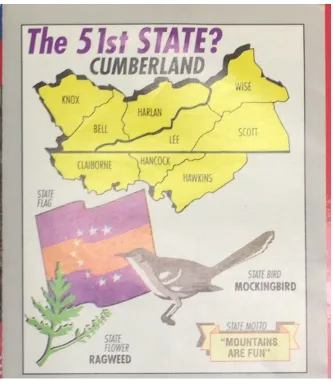
Tennessee become the 51st state. Naturally, this was rejected (Lee, 2010:313). Even
more recently, in 1987, an organization proposed to create the State of Cumberland,
which includes several counties in Upper East Tennessee (Claiborne, Hancock, and
Hawkins), southwest Virginia (Lee, Scott, and Wise), and southeastern Kentucky
(Bell, Harlan, and Knox) (see Figure 1.6). This figure (pulled from promotional
Figure 1.6: The proposed State of Cumberland.
state flag, state bird, state flower, and state motto. While quixotic in nature, such
a proposal highlights a feeling of separateness, and a feeling of difference and not
belonging. Even today, many East Tennessee residents still express a measure of
distrust for Nashville and Memphis, cities that represent Middle and West Tennessee,
respectively.
1.0.3 East Tennessee Identity
This brief overview shows how the perception of East Tennessee as a distinct entity
has historical roots. Such history relates to the investment of identity and
mean-ing from Gieryn (2000) as well as the ‘sense of place’ outlined in Agnew (2002).
The sense of place is the ‘symbolic identification with a place as distinctive’
(Ag-new, 2002:16). Sectional differences manifest themselves in personal identity. Most
residents of Tennessee believe that the Grand Divisions, and East Tennessee in
par-ticular, are separated by profound cultural differences. John Shelton Reed, a noted
sociologist of the South, explains that regional identity is the ‘cognitive entity that
people use to orient themselves’ (Reed, 1983:11). Thus, cultural difference, whether
based on perception or based on some concrete reality, helps people orient themselves
and define themselves as distinct. Ask a Tennessean where he/she is from, and the
response will most likely specify at least the Grand Division. For some, it is the
particular sub-region that is highlighted, e.g., ‘Upper East Tennessee’ or ‘North East
Tennessee’. There is a palpable sense of difference in the minds of state residents,
even if, as Montgomery (1995a) notes ‘though just about everyone native to the state,
regardless of social class, knows that these divisions are there in very human terms, it is usually right nigh impossible for them to pin down what they consist of’(70:
emphasis in original).
Many of the participants in this study identified most strongly with
Tennessee. These participants considered the local area and East Tennessee as
cen-tral to their self-perceptions, and notably, they were not as aligned with the rest of
Tennessee or the broader South. These reports adhere to the notion that regional
and place-based orientation is prominent and central. We might, thus, expect that
language plays some role in signaling or reflecting such an orientation.
1.1 Sounding Appalachian: Monophthongization and Rising Pitch
Ac-cents
As with many stigmatized and misunderstood varieties, speakers of Appalachian
En-glish express a range of opinions regarding the variety (cf. Lippi-Green, 1997:221-228).
Research has begun to show how some speakers associate a strong sense of pride and
identification with local language (Greene, 2010; Reed, 2012, 2014a), similar to
feel-ings toward a local area and region as a whole. In the current study, some participants
expressed pride in their language, noting ‘this is how we talk, there’s nothing wrong
with it’, and ‘it’s like artwork, man, I love it!’ These participants often mentioned
how much the local region and community mean to them, reflecting a place-based
identity. Other participants, however, described efforts to avoid sounding like a
‘coun-try bumpkin’ or ‘hillbilly’ or made reference to their own ‘bad grammar’, ‘coun‘coun-try
slang’, or perhaps ‘horrible sound’. Such varied responses indicate that standard
lan-guage ideologies (Lippi-Green, 1997, 2012) have made quite an impact on speakers’
perceptions of AE. But, at the same time, pride in the local variety is also present.
The literature on AE has identified features that, when viewed together,
distin-guish it from other varieties of American English and subject it to varying levels of
awareness and stigma in the popular mind. Some of these features are much more
salient than others, and are not only recognized but are also commented upon by both
natives and non-natives. Others are less salient, and do not receive the same level of
characteristic features of Appalachian English with differing levels of awareness and
stigma can be used in the construction of local attachment.
1.1.1 Monophthongization of /aI/
Monophthongization10 of /aI/ is surely one of the most salient regional features in
American English, and thus quite well-documented (Kurath & McDavid, 1961;
Peder-son et al., 1986-93; Labov, 1994; Thomas, 2001, 2003; Labov et al., 2006; Baranowski,
2007, among many others). Monophthongization extends across the language varieties
of most of the Southern United States, from the Mid-Atlantic coast to Texas (Kurath
& McDavid, 1961; Pederson et al., 1986-93; Wells, 1982; Thomas, 2001; Labov et al.,
2006). Several systems of monophthongization exist (Thomas, 2003), and its use is
socially stratified (Pederson, 1983; Bernstein, 2006). For example, monophthongal
realizations, particularly in pre-voiceless contexts, have been found to be inversely
correlated with class and education (Pederson, 1983; Pederson et al., 1986-93;
Bern-stein, 2006), and are primarily associated with rural areas (Thomas, 1997; Hazen &
Fluharty, 2004; Irons, 2007; Greene, 2010).
With respect to Appalachia, research has shown that monophthongization is a
highly salient feature of AE (e.g., Hall, 1942; Wolfram & Christian, 1976; Greene,
10There are different ways of analyzing or even labeling monophthongization in the existing
2010; Reed, 2014a). There are also broader studies (Pederson, 1983; Pederson et al.,
1986-93; Labov et al., 2006) that suggest that monophthongization in Appalachia is
more progressive than in other areas with monophthongal varieties. In AE, the
pro-cess occurs in all phonetic contexts (open syllables, pre-voiced, and pre-voiceless) at
much higher rates than other monophthongal areas, occasionally approaching
cate-gorical monophthongal realizations (Hall, 1942; Wolfram & Christian, 1976; Pederson
et al., 1986-93; Greene, 2010). This dissertation will extend this body of research by
considering not only the linguistic, but also the social factors that influence this
process.
AE speakers (and Southerners in general) along with other American English
speakers are aware of monophthongization and its status as a regional and
sub-regional linguistic caricature (Plichta & Preston, 2005). Virtually every popular
depiction of Southern and Appalachian speech displays monophthongal /aI/ as a
noteworthy feature (see e.g., Venable, 2013). Viewed through the indexical lens of
Labov (1972a,b), this feature might best be described a stereotype11. It is actively present in meta-discourse, as well as in humorous depictions of the region’s speech
(e.g., Venable, 2013), etc. Moreover, it is a source of stigma, as reflected in the
follow-ing quote from Misty, one of the participants in my study, ‘I had people to ask me to
say, ‘nice white rice’, and I would, and they would laugh. I realized, that, that they
were laughing at how I was saying it.’ Despite its stigma, monophthongization has
persisted, particularly in Appalachia and in other Southern rural areas, (Bernstein,
2006; Irons, 2007; Greene, 2010; Reed, 2014a, among others). One of the
contribu-tions of this dissertation is to explore why the feature is still thriving in spite of its
stigma (cf. Ryan, 1979). Toward this end, I investigated how speakers with differing
degrees of local attachment realize /aI/.
11Some might claim that it is amarker (Labov, 1972a), but the fact that humorous dictionaries
1.1.2 Rising Pitch Accents
A less salient feature of AE is the presence of a relatively high rate of rising pitch
accents. Researchers have found that the relative frequency of pitch accents and
the phonetic realization of pitch vary regionally in American English (Greene, 2006;
Arvaniti & Garding, 2007; Clopper & Smiljanic, 2011) and British English varieties
(Grabe et al., 2000; Grabe, 2004; Ladd et al., 2009). However, the extent to which
speakers and social groups can be identified by specific pitch patterns and/or the
extent to which speakers convey their regional and cultural identities through pitch
accent (and intonation more broadly) remain virtually unexplored from a
sociopho-netic perspective. Yet speakers in the current study often mentioned ‘how we talk’, or
their ‘tone’, ‘pace’, or ‘rhythm’ as something they recognize in the speech of friends
and neighbors. Given these anecdotal references to intonation, it is somewhat
sur-prising that there is a distinct lack of intonational studies on AE. The only detailed
study of AE intonation patterns to date is Greene (2006), which observed a higher
incidence of L+H* accents (a rising pitch on stressed syllables) among speakers in
a northeastern Kentucky community, compared to speakers of MAE or other SAE
varieties. However, Greene did not investigate precisely where the pitch accent was
anchored in the syllable, nor did she consider possible correlations with local
iden-tity, both of which this dissertation explores. Following Labov (1972a), the frequent
use of rising pitch accents might best be described as an indicator, since no overt commentary or widespread social stigma exists for this feature. As such, this feature
provides a useful comparison to /aI/ monophthongization, particularly as it relates
to local attachment and the linguistic construction of Appalachian identity.
1.2 Research Questions
Given the differences between these two features, several research questions guide this
socially and linguistically. Previous research has found that monophthongization of
/aI/ varies according to numerous social factors, including age, gender, education, and
socioeconomic class (Wolfram & Christian, 1976; Pederson et al., 1986-93; Pederson,
1983; Hazen & Fluharty, 2004; Bernstein, 2006). And, as noted earlier,
monophthon-gization has been shown to occur in all linguistic contexts in AE, thus exhibiting
a wider linguistic distribution than in other varieties. These findings lead to the
following sets of questions:
1. How is monophthongization of /aI/ phonetically realized in this northeast
Ten-nessee community? What are its social and linguistic distributions?
Because there is little previous research for rising pitch accents, this dissertation
also describes the social and linguistic distribution of this feature, guided by similar
overarching questions as those state above:
2. How are rising pitch accents phonetically realized in this northeast Tennessee
community? What are the relative rates of occurrence? What are the social
and linguistic distributions?
In addition to these general questions, the present investigation considers the
difference in salience of these two features, and how this difference in salience shifts as
the presumed attention to one’s speech changes. Monophthongization of /aI/ features
prominently in many descriptions of Appalachian speech and is often caricaturized.
Also, monophthongal productions are somewhat stigmatized (e.g., Bernstein, 2006).
If we follow Labov’s 1972a and 1972b classification of features, monophthongization
would be seen as astereotype. Under these assumptions, we might expect that such a salient and stigmatized feature should become less frequent as a speaker’s attention is
drawn to speech. The linguistic behavior of the speaker will shift in ways that reflect
the social perceptions of a variable. More specifically, the use of socially stigmatized
sociolinguistic interview (conversation, reading passage, word lists) serve as the proxy
for varying degrees of attention. One would thus expect fewer stigmatized features in
the reading passage as compared to the conversation, and fewer still in minimal pair
lists. However, relatively frequent rising pitch accents are not the subject of stigma or
even comment. Speakers do make somewhat opaque mentions of ‘how we talk’; thus,
intonation seems to be much less salient, and speakers seem to not necessarily be
cognizant of its use. Following Labov’s classification scheme, we might operate under
the assumption that they are an indicator. Given the difference in levels of salience and stigma associated with /aI/ monophthongization and rising pitch accents, one
should expect that they would behave differently as more attention is paid to speech,
thus leading to the following questions:
3. How does the production of /aI/ monophthongization and rising pitch accents
vary? Does each feature’s realization shift across tasks?
Finally, previous research (Greene, 2010; Reed, 2014a) has suggested that
monoph-thongization of /aI/, especially in pre-voiceless contexts, is a way of signaling local
identity and orientation, despite being highly stigmatized (Bernstein, 2006; Greene,
2010). For example, Greene (2010) has shown that monophthongization of /aI/ was
practically categorical among her participants in Northeastern Kentucky. And when
juxtaposed with infrequent realizations of AE grammatical features, she argued that
the monophthongization evinced local identity while avoiding the stigma of ‘incorrect’
grammar. Based on these findings, Greene has suggested that opposition to
Main-stream Standard English (MSE) ideology was at the root of the linguistic behavior of
her participants. For frequent rising pitch accents, on the other hand, Greene (2006)
found that AE speakers in the aggregate used relatively more rising pitch accents
than Southern or Mainstream English speakers, but with much individual variation.
In light of these findings, this study considers how these two features correlate with
‘rooted-ness’, as measured by a psychometric instrument created for this dissertation. Thus
as a final research question, I ask:
4. To what extent do /aI/ and rising pitch accent vary according to
rooted-ness/local attachment?
Based on previous research, a reasonable prediction is that monophthongization of
/aI/, particularly in pre-voiceless environments, should be used more frequently by AE
speakers with stronger degrees of rootedness. A second prediction is that rising pitch
accents, by contrast, should likely exhibit a less overt correlation with rootedness,
although the actual acoustic realization of the rising pitch (the anchoring of the
pitch peak) might correlate with degree of rootedness below the level of conscious
awareness.
These four question sets will form the basis for this dissertation. To address them,
the present study follows the plan outlined below.
1.3 Plan of Study
The data for this study were collected through oral history/sociolinguistic interviews
with a social cross-section of Hancock County natives (see Section 3.2.1 for fuller
de-scription). The interviews were designed to elicit identity anecdotes, personal
reflec-tion and recollecreflec-tion, as well as other attitudinal data, all of which further illuminated
the local orientation of speakers and helped to show how local orientation interacted
with linguistic features. Furthermore, the interviews were designed to elicit a range
of speech styles, according to Labov’s (1972b) attention-to-speech model. Such a
model was found to be useful in determining whether/how features like /aI/
monoph-thongization and rising pitch accents, which differ in both salience and stigma, vary
along a style continuum (see Section 3.2.2 for a complete description of the interview
As noted above, the other portion of the fieldwork was the administration of a
Rootedness Metric (RM), which quantified local place-based identity (cf. Williams
& Vaske, 2003; Williams, 2004). The RM was adapted from place and community
attachment measures, which were originally designed to explore how communities
were attached to local state and national parks and wilderness areas (e.g., Williams
& Vaske, 2003). The RM is a questionnaire designed to measure the strength and
breadth of local attachment, i.e. ‘rootedness’, thus allowing for a measurable,
nu-anced view of how localized attachment is (i.e. to one’s local community, county,
region), and crucially, how one speaker’s rootedness can compare to another’s (see
Appendix E for the entire RM). Additionally, the RM permits a comparison of how
a speaker’s rootedness correlates with his/her monophthongization and rising pitch
accent realizations, measuring the impact of local attachment on linguistic behavior.
1.4 Outline of Dissertation
The remainder of the dissertation is organized in the following manner. Chapter
2 provides an overview of relevant literature, including standard language ideology,
Appalachia and its cultural perceptions, Appalachian English, monophthongization
of /aI/, intonation, and the attention-to-speech model. It addresses areas that have
motivated the present dissertation from a variety of perspectives that each shed light
on important issues of research. It also indicates how the present work fills certain
gaps. Chapter 3 describes the research design for this project, providing a detailed
description of the participants, the local area and community, the types of data used
in this study, the data collection methods, and the analysis procedures. Chapter 4
on monophthongization and Chapter 5 on intonation focus on answering the first
three research questions for the respective linguistic features. Each illustrates how
members of this community realize the monophthongization of /aI/ and rising pitch
concluding with sections devoted to rootedness. Chapter 6 then explores rootedness
from a more qualitative perspective, evaluating how participants in the study
dis-cussed place, focusing on the intersection of place and language. Chapter 7 presents
Chapter 2
Literature Review
This dissertation sits at the intersection of sociolinguistics, Appalachian studies, and
phonetics. This chapter reviews the relevant literature, drawn primarily from these
three areas, as they served as the impetus for the present study.
2.1 Standard Language Ideology
In the United States, most forms of prejudice and discrimination face severe backlash
in both the public and the private spheres. However, one type of discrimination often
occurs without censure: linguistic discrimination. Wolfram et al. (1999) state
‘atti-tudes about language can trigger a whole set of stereotypes and prejudices based on
underlying social and ethnic differences’ (27). One example is a dialect quiz that went
viral on social media in 2014 about what area of the country had the ugliest accent
(Evans, 2014). It quickly received thousands of votes and hundreds of comments,
describing various accents as ‘horrible’, ‘terrible’, ‘working class’, ‘dumb’, etc. The
post asked readers to comment on, vote on, and rank various regional and city-based
accents. In the end, the Pittsburgh accent was chosen as the ugliest. It is hard to
imagine that any entity would advertise a competition for the ugliest ethnicity or
race, much less that thousands would participate. The public censure would
cer-tainly be quick and vociferous. Another example is Oak Ridge National Laboratory,
located in Tennessee, which offered employees a Southern accent reduction class. In a
memo, the lab wrote ‘Feel confident in a meeting when you need to speak with a more
it’ (Greenblatt, 2014). The classes were to be led by a speech-language pathologist,
whose profession was aimed at rehabilitating speech from those with impairments,
those suffering from pathologies, or those recovering from accidents and/or trauma.
Predictably, employees reacted negatively, and the laboratory directors cancelled the
classes. Yet another example comes from Underhill (1975), which described situations
in a large news corporation where employees often mocked the speech of Southerners
and Appalachians from recordings of news events. Any employee who spoke with a
regional accent, particularly a Southern or Appalachian accent, faced criticism and
strong encouragement to accommodate to a more ‘educated’ variety. Underhill even
suggested that beliefs about language color the type of news coverage of certain areas,
possibly undercovering tragedies and disasters.
The examples above demonstrate the belief that speaking a certain way is ‘ugly’
or ‘wrong’. Such beliefs stem from ‘standard language ideology’ — the idea that
there are correct and/or educated ways of speaking, and deviations from these
‘stan-dard’ varieties are subject to stigma, prejudice, and discrimination (Lippi-Green 1997;
2012). In the U.S., ‘standard’ varieties are typically linked to the spoken and written
practices of white, educated, middle or upper class speakers, and are often associated
with particular areas of the country1. Interestingly, the standard is usually defined by
what it is not (i.e., the avoidance of any overtly stigmatized features associated with
marginalized groups or regions, see Wolfram & Schilling-Estes, 2006:12-13).
Silver-stein (1996) describes this linkage between ‘standard’ varieties and groups with social
power as reflecting the ‘hegemonic domination’ of the standard. Often, this ideology
favoring ‘standard’ varieties is a covert way to express other types of prejudice and
discrimination, such as racism, sexism, or classism, as the stigmatized ‘non-standard’
varieties are often the language varieties of racial/ethnic minorities, women, those
without education, or lower socioeconomic status groups. Thus, linguistic
nation, since it habitually goes without comment or critique, serves as a proxy for
other types of discrimination, which typically receive public censure if expressed. As
Bloome states,
Those varieties of English associated with white, northern, middle- and
upper- class communities are perceived as better than those varieties of
English associated with groups such as African Americans, Mexicans and
other Latino communities, and people from working class backgrounds
(2008:xiii).
Such stigma extends to region as well, as illustrated by Preston (1989, 1999). One of
the principal regions highlighted by this perceptual dialectology work is the Southern
United States, and specifically the Appalachian region (usually derogatorily
men-tioned as ‘hillbilly’ or ‘mountain’).
Linguistic stigmatization has many social and linguistic consequences. Language
and culture are intrinsically linked, and thus, language and identity also are closely
intertwined. As Bucholtz & Hall (2004a) state, ‘...among the many symbolic resources
available for the cultural production of identity, language is the most flexible and
pervasive’ (369). Thus, the stigmatization of one’s language variety is, by extension,
the stigmatization of one’s culture and identity. Dunstan (2013) elaborates,
‘despite appearance, educational attainment, social class, or other factors,
the moment a speaker of a non-standardized variety of English opens his
or her mouth, he or she may be ‘triggering’ a multitude of stereotypes
and prejudices associated with the group of which his or her speech has
marked him or her as being a member’ (14).
Certain features may trigger stereotypes more than others, as they are more salient to
listeners. Typically, these stereotypes and prejudices are negative, as the groups
Speakers of stigmatized dialects are subject to myriad injustices, from ridicule about
accent (Underhill, 1975, Greene, 2010:vi), to suggestions of speech pathology or the
need for speech therapy (McBride, 2006:155), to job/career discrimination
(Lippi-Green, 2012:239). And yet, non-mainstream accents and dialects are alive and well
in spite of marginalization and stigma (see e.g., Ryan, 1979; Pederson et al., 1986-93;
Thomas, 2001; Labov et al., 2006). As referenced in the Bucholtz and Hall quote
above, the perseverance of these varieties, in the face of discrimination, is perhaps
largely a reflection of their role in the construction of personal and group identity
(cf. Ryan, 1979). Ryan (1979) suggests that ‘low prestige’ or non-mainstream
vari-eties continue to exist for precisely this reason, that language can be used to signify
belonging to groups that are meaningful to the speaker. The term ‘covert prestige’
has been used to describe the desire of individuals to utilize cultural expressions that
demonstrate belonging to groups that are low prestige, from the perspective of more
prestigious groups (e.g., Labov, 1966; Trudgill, 1972). Speakers may want to express
solidarity with and show membership to groups that have lower social status because
this membership is meaningful and important to the speaker, regardless of the lack of
status. If someone desires to construct a non-mainstream identity, whether exhibiting
membership in a non-prestigious or marginalized group or perhaps in opposition to
mainstream ideologies, language can be the vehicle.
Appalachia is a region subject to many circulating stereotypes and tropes,
espe-cially about the language varieties spoken there, yet it also evokes strong positive
associations (See Section 2.2 for elaboration). Writing about her participants in
Eastern Kentucky, Greene writes ‘linguists’ traditional treatment of regional varieties
as un-reflective shows that they have difficulty believing that people might aim to speak with a regional accent’ (2010: 117). As noted earlier, many of my participants
expressed a similar sentiment, talking about how they did not mind speaking
might be perceived as ‘incorrect’ or ‘bad’. From these statements, we see the influence
of both the local pride and standard language ideologies. Speakers then have
par-tially internalized the stigma, yet still recognize the value in how they speak. Given
this seeming contradiction, I have chosen a community in this Appalachian region
to investigate and explore how speakers use language in the construction of
place-based identities that may enter into conflict with social stereotypes and mainstream
ideologies.
2.2 Perceptions of Appalachia
The idea of a Southern mountain region that is somehow culturally and linguistically
different from the rest of the nation has existed in the broader American cultural
mindset for roughly 150 years, resulting in widely circulating stereotypes that color
perceptions of the region for both natives and outsiders. In fact, much of the
Ap-palachian Studies literature is devoted to debunking stereotypes and giving a more
nuanced and realistic picture of this region (cf. Billings et al., 2000; Whisnant, 2008).
Nevertheless, there are two main stereotypes2 about the region that have persisted,
thus contributing to a skewed perception of Appalachian culture and lifestyle among
both outsiders and natives. Williams (2002) describes them as follows:
. . . two defining stereotypes [are] lodged in the American mind: the
Ap-palachian mountaineer, noble and stalwart, rugged and independent,
mas-ter or mistress of the highlands environment, and the profligate hillbilly,
amusing but often also threatening, defined by a deviance and aberration,
a victim of cultural and economic deprivation attributable to mountain
geography (17).
2There are many other stereotypes about the region, particularly related to coal, coal mining,