Interactions Between Crystal Surfaces in Solution and
Agglomeration — a Theoretical Approach
Michael Brunsteiner
A thesis su b m itted to th e University of London in p a rtia l fulfilment of the requirem ents for the degree of D octor of Philosophy
ProQ uest Number: U642 4 7 7
All rights reserved
INFORMATION TO ALL U SE R S
The quality of this reproduction is d ep en d en t upon the quality of the copy subm itted.
In the unlikely even t that the author did not sen d a com plete manuscript
and there are m issing p a g e s, th e se will be noted. Also, if material had to be rem oved, a note will indicate the deletion.
uest.
ProQ uest U 642477
Published by ProQ uest LLC(2015). Copyright of the Dissertation is held by the Author.
All rights reserved.
This work is protected against unauthorized copying under Title 17, United S ta tes C ode. Microform Edition © ProQ uest LLC.
ProQ uest LLC
789 East E isenhow er Parkway P.O. Box 1346
Acknowledgem ents
I would like to th a n k my supervisor, Prof. Sarah L Price, for her su p p o rt and for giving me b o th the freedom I w anted and th e guidance I needed.
I would like to th a n k M ihaly Mezei, Fernando Bresme, John H arding and G erhard H um m er for helpful discussions ab o u t the science.
I would like to th a n k my family, especially my parents, for th eir continued support, for lettin g me do stupid things once in a while and for helping me doing th e right thing, eventually.
A bstract
A gglom eration can have a crucial im pact on th e yield of crystallisation processes and th e product quality. In th is thesis m olecular scale m odelling is used to gain insights into th e m echanism of crystal agglom eration and factors th a t determ ine its progress.
T he first study analyses th e use of the attach m en t energy m odel to predict which surfaces of a crystal would be observed and hence th e crystal morphology. It is shown th a t com paratively simple m odel potentials suffice to provide reasonably accurate morphology predictions w ithin th e lim itations of th e neglect of solvent.
A classical em pirical force held for potash alum (KA1(S0 4)2'12 H2O) is developed. A fter having established its capability to reproduce experim entally determ ined properties of the crystal bulk and th e solution, different potash alum crystal faces in contact w ith aqueous solution are m odelled via M olecular Dynamics sim ulations. A range of different m ethods of m odelling polar crystal surfaces, including a novel one, are investigated. The results are used to rationalise experim ental results quantifying th e agglom erative strength of PA crystallites as a function of super-saturation and th e stru c tu re of th e crystal faces.
C on ten ts
1 Introduction
13
2 M odelling C rystallisation and Agglomeration
18
2.1 Population B alance E q u a tio n s ... 19
2.2 A gglom eration Kernel and E ffic ie n c y ... 21
2.3 Forces between Dispersed P a r t i c l e s ... 26
2.3.1 D L V O -T h eo ry ... 26
2.3.2 T he S tate of the A r t ... 28
2.4 C o n c lu s io n s ... 33
3 M olecular Sim ulation
34
3.1 In tr o d u c tio n ... 343.2 A b-Initio M ethods ... 36
3.3 Classical Model P o t e n t i a l s ... 38
3.3.1 P ertu rb atio n T h e o r y ... 39
3.3.2 Model P otentials in P r a c tic e ...44
3.4 M olecular M e c h a n ic s ... 52
3.5 M olecular D ynam ics ... 55
3.5.1 Integration of the Equations of M o ti o n ... 55
3.5.2 B oundary Conditions and C u to ffs ... 56
3.5.3 E n s e m b le s ... 57
3.6 A dditional Issues in M olecular Dynamics S im u la tio n s ... 63
3.6.1 Long Range Interactions in Interfacial S y s te m s ... 63
3.6.2 C harged S y s t e m s ... 65
3.6.3 T he G rand Canonical E n s e m b le ... 67
4 Crystal M orphologies
70
4.1 In tr o d u c tio n ... 704.2 C o m putational D e t a i l s ... 72
4.2.1 T he C om pounds ... 72
4.2.2 T he Model P o te n tia ls ... 73
4.2.3 A ttachm ent Energy Calculations ... 76
4.2.4 Energy M in im is a tio n ... 77
4.3 Results & D is c u s s io n ... 77
4.3.1 Theoretical M orphologies... 78
4.4 C o n c lu s io n s ... 86
5 Force Field Param eterisation for Potash Alum
88
5.1 I n tr o d u c tio n ... 885.2 The M aterial ... 90
5.3 The Model P o t e n t i a l ... 92
5.4 The S trategy ... 93
5.5 Param eters adopted from th e l ite r a tu r e ... 94
5.6 R e s u lts ... 94
5.6.1 T he A n h y d ra te s ... 94
5.6.2 P o tash A lum P a ra m e te r s ... 98
5.6.3 S tructure ... 98
5.6.4 Local D isorder ... 101
5.6.5 Aqueous Solutions ... 103
6 E lectrostatic Long Range Interactions in 2D-periodic System s
106
6.1 C om p u tatio n al D e t a i l s ... 107
6.2 R esults and D is c u s s io n ... 108
6.3 S u m m a r y ... 115
7 The Surface Structure of Potash Alum
116
7.1 I n tr o d u c tio n ...1167.2 Polar S u r fa c e s ... 118
7.3 T heoretical D eterm ination of Surface S tr u c tu r e s ... 122
7.3.1 C alculation of Surface E n e r g i e s ... 123
7.3.2 M olecular D y n a m i c s ...124
7.4 P otash A lum ... 125
7.4.1 T he (220) and (200) F a c e s ...125
7.4.2 T he (111) F a c e ...125
7.5 C om p u tatio n al M e t h o d s ... 129
7.5.1 T he Model P o t e n t i a l ...129
7.5.2 M D -sim u la tio n s...130
7.6 R e s u lts ...134
7.6.1 Surface Structures ... 134
7.7 D is c u s s io n ... 144
7.8 S u m m a r y ... 149
8 Forces B etw een N ano-C rystallites in Aqueous Solution
150
8.1 C alculating th e Potential of Mean F o r c e ...1518.2 C alculation of Inter Particle Forces, the System G e o m e t r y ... 153
8.2.1 Slit-pore a t C onstant Chemical P o te n tia l... 155
8.2.2 D irect Sim ulation of a Particle Reservoir: The Im m ersed Sandwich 157 8.3 T he M aterial and Model P o t e n t i a l s ... 160
8.3.2 T he C r y s t a l ...161
8.4 Sim ulation C onditions & C om putational D e t a i l s ... 162
8.5 R esults I, Model Potentials and Rigid C r y s ta ls ...165
8.6 R esults II, S tru ctu re and Forces in the Frozen Sandwich ... 171
8.6.1 N eat W a t e r ... 171
8.6.2 KCl Solution ... 181
8.6.3 System S i z e ... 185
8.6.4 Explicit N o n -E q u ilib riu m ...189
8.7 R esults III, S tructure and Forces obtained w ith a Mobile Sandwich . . . . 192
8.7.1 M otion of the N a n o -C ry sta llite s ... 195
8.7.2 S tru ctu re ... 197
8.7.3 E q u i l i b r a t i o n ... 203
8.7.4 F o r c e s ... 208
8.7.5 N o n -E q u ilib riu m ... 211
8.8 D is c u s s io n ... 221
List o f Tables
4.1 C rystallographic and therm odynam ic d a t a ... 73
4.2 Sum m ary of th e different model p o t e n t i a l s ... 74
4.3 Errors in reproducing th e crystal structures and e n e r g i e s ... 78
4.4 Analysis of faces in term s of interplanar spacings... 79
4.5 A ttachm ent energies of p e n ta e r y th r ito l... 80
5.1 R esults of param eter f i t t i n g ... 95
5.2 R esults of lattice energy m in im is a tio n s ... 96
5.3 T he final param eter set for potash a l u m ... 99
5.4 R esults of lattice energy m inim isations of potash alum ... 100
5.5 R adii of solvation shells and diffusion coefficients...104
6.1 G eom etries and system sizes as used in the c a lc u la tio n s ... 109
6.2 R equired C PU t i m e ... 113
7.1 D etails of the po tash alum surface s im u la tio n s ... 133
7.2 C onfigurational energies of potash alum (111) s l a b s ... 143
8.1 KCl Force field p a r a m e te r s ... 163
8.2 L attice param eters and elastic constants (in C Pa) of K C l ... 166
8.3 Setups for S im u la tio n s ... 172
8.4 D etails for th e equilibrium simulations with mobile c r y s t a ll ite s ... 194
List o f Figures
2.1 T he stages of crystal a g g lo m e ra tio n ... 23
2.2 M odelling crystallisation: the problem h ie ra rc h y ...33
4.1 The five m olecular c o m p o u n d s ... 72
4.2 Morphologies: e-caprolactam and ^-succinic a c i d ...82
4.3 Morphologies: urea and p e n ta e ry th rito l... 84
5.1 Ball and stick model of the content of the potash alum u n it c e l l ...90
5.2 T he two possible orientations of the sulfate anions in p o tash a l u m ... 91
5.3 T he stru ctures of ion-water complexes ... 101
5.4 R adial d istribu tio n fu n c tio n s ...102
5.5 Potash alum sam ple a t a pressure of 1 G P a ... 103
5.6 R adial distrib u tion functions of AI2(804)3 and K2SO4 ... 105
6.1 R adial distrib u tio n functions obtained with different tre a tm e n ts of long range in te r a c tio n s ...110
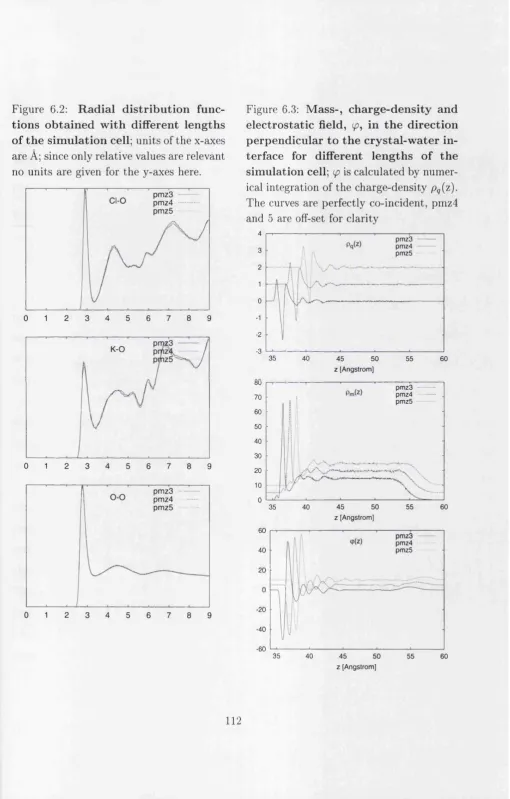
6.2 R adial d istrib utio n functions obtained with different lengths of th e simu lation c e l l 112 6.3 Mass-, charge-density and electrostatic field.I ... 112
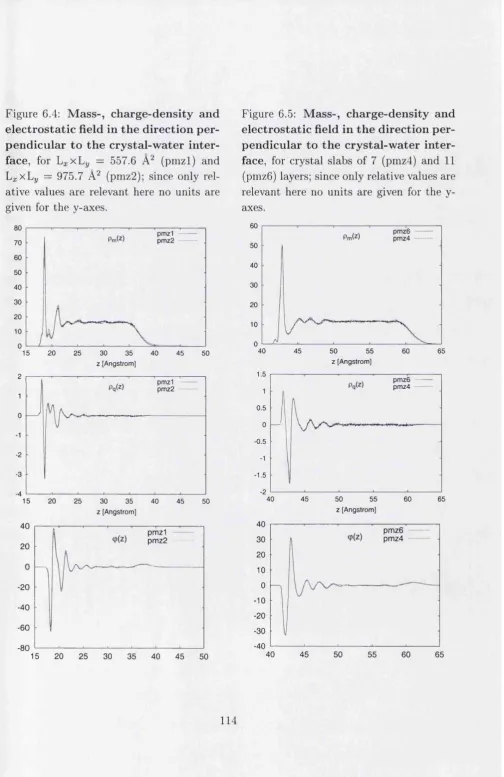
6.4 Mass-, charge-density and electrostatic field I I ...114
6.5 Mass-, charge-density and electrostatic field I I I ...114
7.2 Screw dislocation on the (111) face of potash alum ... 118
7.3 Schem atical illustration of th e different types of surface term in atio n s . . . 119
7.4 M echanisms for the stabilisation of polar s u r f a c e s ...120
7.5 Atomic stru ctu re of the potash alum su rfaces... 126
7.6 Possible reconstructions of th e polar potash alum (111) f a c e ... 128
7.7 Cross section of the MD sim ulation c e l l ... 132
7.8 S tru ctu re of th e (100) and (110) s u r f a c e s ... 136
7.9 S tru ctu re of th e reconstructed (111) s u r f a c e ... 138
7.10 S tru ctu re of th e charged (111) s u r f a c e s ... 140
7.11 S tru ctu re of th e polar (111) surfaces and s o lu tio n s ... 142
8.1 System geom etry for the sim ulation of a slit pore and b u l k ...158
8.2 Snapshots of KCl + w ater systems after 240 ps M D ... 168
8.3 Average mass and charge densities for the rigid crystal w ith F F l ... 169
8.4 Snapshots of th e K Cl-w ater interface after 240 ps M D ...169
8.5 Tim e developm ent of the w ater densities in the p o r e ... 173
8.6 S tru ctu re of the w ater in the pore with geometry A ... 175
8.7 T rajectories of some w ater oxygens in the 6.0 Â p o r e ...176
8.8 Sum m ation of th e F o r c e s ...178
8.9 Forces between th e crystallites for different lateral distances from the pore c e n t e r ... 179
8.10 Averages and RMSD values of the forces for different lateral distances . . . 180
8.11 The average to ta l and stru ctu ral forces for different surface separations . . 180
8.12 N um ber of K"*" and C l“ ions in the p o r e ... 181
8.13 N um ber of w ater molecules in the p o r e ... 182
8.14 Forces as function of lateral ion p o s itio n s ... 183
8.15 Snapshots of th e pore w ith dp = 6.0 Â ... 184
8.17 C om parison of th e inter surface forces in neat w ater and in sa tu ra te d KCl
s o l u t i o n ...185
8.18 R unning averages of f o r c e s ... 187
8.19 Com parison of th e calculated structural forces between nano-crystallites w ith 10 and 12 l a y e r s ... 188
8.20 S tru ctu ral Forces per area and their RMSDs as a function of th e lateral distance to the pore c e n t e r ... 189
8.21 Forces between two nano-crystallites approaching each o th er a t a speed of 2 m /s ... 191
8.22 Forces between two nano-crystallites approaching, m obile vs frozen . . . . 193
8.23 200 ps trajecto ry of th e relative positions of the c r y s ta llite s ... 196
8.24 200 ps T rajectories of K+ and Cl" ions in the pore ... 197
8.25 The trajecto ries of two w ater molecules in a pore w ith dp = 15.6 Â . . . . 198
8.26 Density profiles parallel to th e in te r f a c e s ... 199
8.27 Density profiles norm al to th e s u r f a c e s ... 200
8.28 P air d istrib u tio n functions of ions in the p o r e ... 202
8.29 N um ber of w ater molecules in the p o r e ... 205
8.30 Non-equilibrium: force acting between moving c ry s ta llite s ...213
8.31 Non-equilibrium: num ber of w ater molecules in the pore ...214
8.32 Non-equilibrium: relative K""" and C l" densities ...217
8.33 Non-equilibrium: charge density above s u r f a c e ... 219
C hapter 1
In trod u ction
C rystallisation of m aterials from solution is a technique used in a large num ber of appli cations, ranging from precipitation and purification of fine chemicals and pharm aceuticals to large scale industrial crystallisation of bulk chemicals. [1] The o p tim isation of this tech nique in term s of product quality, purity and yield, power-input and speed is therefore of considerable interest.
One phenom enon th a t can have a m ajor infiuence on the outcom e [1] of a crystallisa tion process is crystal agglom eration, i.e., the aggregation of sm aller crystals followed by fu rther crystal grow th to form a composite larger crystal. T he present thesis is p a rt of a PhD program supported by an EPSRC* grant for a project entitled micro-mechanics of agglomerative crystallisation processes. It is aimed to contribute to an understanding of th e fundam ental mechanisms of crystal agglomeration on a m olecular level.
To predict crystal aggregation and ultim ately agglomeration we need a m ethod for a sufficiently accurate estim ation of th e forces between crystalline particles in solution. So far theoretical approaches to predict the m agnitude of forces between m acro and meso
*The Engineering and Physical Sciences Research Council (EPSRC) is the UK Governments leading
scopic particles in solution have been confined to semi-empirical models w ith a lim ited predictive power. T he m ost widely used of these models, the so called DLVO-theory, [2] is a m ean field approxim ation th a t does not take into account specific interm olecular interactions and th e detailed stru ctu re of surfaces and liquids. N onetheless it rem ained th e m ost accurate theory until not so long ago.
In the early eighties new experim ental methods [3] were developed allowing for the m easurem ent of inter-particle forces in unprecedented detail an d accuracy. New results obtained w ith these m ethods shed some doubt on the applicability of DLVO-theory and extended versions thereof in a num ber of cases. [4] The inter particle force as a function of th e particle particle distance was found to have a structure more complex th a n predicted by m ean field theories. Triggered by these experimental results a su b stan tial am ount of theoretical work, aimed a t revealing th e origin and the nature of th e involved inter particle forces, was done and published in the last decade. For a recent review see Ref. [5]. It was shown th a t these h ith erto unpredicted forces are due to specific interactions between sur faces and p articu lar solvent molecules, additives or impurities, th e microscopic stru ctu re of th e in terstitial solution and spatial correlations between solvated ions. Predicting the infiuence of these factors q u antitatively and from first principles in silico could contribute to an efficient control and optim isation of crystallisation processes and thereby reduce the am ount of the required and usually costly experiments.
lar challenge are events taking place in disordered systems on th e so-called meso-scale, w ith length and tim e scales of 10“ ^ - 10“ ^ meters and 10“ ® - 10® seconds respectively. This corresponds to the characteristic tim e and length scales found in th e description of crystallisation and particle agglom eration.
T he theoretical approach I concentrate on here, classical m olecular sim ulation, i.e.. M olecular M echanics/D ynam ics or Monte Carlo simulations, can norm ally only tackle sm aller length and, in particular, tim e scales than those m entioned above. It is, how ever, a more accurate approach th a n mean field approxim ations. T he m ain objective of th e present work is to assess th e usefulness and the lim itations of m olecular sim ulation for understanding and describing the aggregation of crystalline particles in solution. I concentrate thereby on some methodological issues which, while being undoubtedly of im portance, have rarely been discussed in the literature so far. Before giving a short outlook on th e following chapters two more notes appear to be indicated: Agglom eration and aggregation are, in principal, two different issues. However, as explained in some detail in C h ap ter 2, we can view aggregation as a necessary first step in th e course of an agglom eration event and in the following only this first step will be considered. Therefore th e two term s m ay be used interchangeably on some occasions in this work. Two other concepts th a t are also different in principle are the aggregation of particles in general and crystals in p articular. Here I concentrate on the forces between crystals on close ap proach and on th e stru ctu re of the interfaces and the interstitial solution on a microscopic scale. The surfaces of even perfectly spherical particles w ith a diam eter exceeding a few nanom eters, can be seen as flat to a good approxim ation if viewed a t a m olecular scale and a t close distance. Therefore the term s particle and crystal aggregation are also used interchangeably on some occasions and some theoretical results from th e literatu re actu ally obtained for spherical particles are used to help with the in te rp re ta tio n of features of crystal aggregation.
background of and common methodologies used in classical m olecular sim ulation, and more details ab o u t some specific topics required in the following chapters is given in C h ap ter 3. One ingredient of classical molecular simulation th a t is of u tm o st im portance for obtaining reliable results is th e form and the param eterisation of th e energy expression used to calculate interm olecular potentials and forces. As a consequence of th e sym m etry and the internal stru ctu re of the un it cell crystalline particles of a given m aterial always can, and in m ost cases will, have more th an one type of surfaces w ith a given, and often nearly constant, relative size of these surfaces. This results in a typical shape or m orphology (habit). A specific type of molecular sim ulation is th e well established attach m en t energy m ethod for the prediction of those faces th a t are observed on grown crystals. In C h ap ter 4 th is m ethod is applied to the crystalline solid sta te of different organic m aterials and combined w ith a variety of different types of interm olecular model potentials. T he results are com pared to experimental d a ta thereby scrutinising a t the same tim e b o th our ability to predict crystal morphologies and th e usefulness of various types of classical model potentials for the description of interm olecular interactions in the anisotropic interfacial environm ent.
Due to th e large am ount of experim ental d a ta available, a com m on them e drawing through the rem ainder of this thesis is the consideration of inorganic m aterials. In C hap te r 5 a classical m odel potential for potash alum, a rath er com plex inorganic m aterial, is devised and tested. Here a model potential of a com paratively simple form is used in order to retain sufficient com putational efficiency, so th a t it can be used in large scale M olecular D ynam ics sim ulations. A nother im portant aspect of classical m olecular simu lation is the consistent calculation of electrostatic long range interactions. In C hapter 6
C hapter 2
M od ellin g C rystallisation and
A gglom eration
C rystallisation is a complex process governed by a large num ber of different param eters, and including events on a broad range of different length and tim e scales. T he la tte r point renders the theoretical m odelling of crystallisation a p articu lar challenge. For modelling th e entire process over the whole time-scale one has to coarse grain th e system considerably because modelling its microscopic details is com putationally no t feasible. Thereby we run th e risk of over-looking th e influence of micro-scale events such as, for example, the influence of specific im purities on crystal morphologies. O n th e o ther hand side, if we try to model these micro-scale events explicitly we can only consider a tiny section of th e whole system and thereby overlook time- and spatial correlations between this tiny sam ple and th e rest of th e system. N otw ithstanding these lim itatio n s useful theoretical models for crystallisation have been devised and applied. M ost of th e models used there are based on coarse grained macro-scale descriptions of the system . In Section 2.1 a short overview over these models will be given.
which is justifiable in some cases, or it is included by fitting (sem i-)em pirical models to ex perim ental d ata.[l] In Section 2.2 ways to include inform ation a b o u t particle interactions on a microscopic scale into models for agglomeration are discussed, and in Section 2.3 we review b o th established and recently developed ways to estim ate these interactions via m olecular sim ulation. Finally in Section 2.4 we will draw some conclusions from the literatu re review to provide a justification for the present work.
2.1
P opulation Balance Equations
T he following account on th e theoretical description of crystallisation is essentially a short sum m ary of a chapter in the collection Crystallization Technology [1] edited by A. M ersm ann which provides comprehensive treatise on theoretical as well as practical aspects of crystallisation.
In th e realm of chemical engineering the theoretical description of crystallisation is achieved via a population balance equation (PBE), an integro-differential equation th a t gives the variation in tim e of n{L), th e number density of crystals as a function of a their respective size L
k
where L can be th e diam eter of an approximately spherical particle or th e side length of a cuboid crystal. T he first term in Eqn. 2.1, the change in th e num ber density w ith tim e, equals zero in a continuously driven steady state crystalliser. T h e second term d G n / d L
describes th e change of n in the size interval dL due to crystal grow th rate, G = d L /d t,
of particles growing into and out of dL. D{L) and B {L ) are th e d eath and b irth -rate, respectively, arising from the agglomeration, breakage and a ttritio n of crystals. The last term is th e sum of all flows entering an leaving the crystalliser. Eqn. 2.1 is only one possible form of a population balance equation. Others, including m ore term s accounting, for example, for nucléation have been proposed.[1]
reactor is used since a steady state equilibrium is m athem atically easier to describe. It is possible to set up such a system so th a t barely any agglom eration or breakage occur. If, in addition, th e solution in such a small scale crystalliser is well m ixed so th a t no dissolution of crystals occurs and th e growth rate is the same for all crystals Eqn. 2.1 can be simplified considerably to give
^ + = 0 (2-2)
k
If th e solution fed into th e crystalliser is free of crystals and only one volume flow
V
is removed we can simplify further® + ^ = 0 (2.3)
O L T
T = V/Vi
is th e m ean residence tim e of the suspension in the crystalliser; here we assume th a t th e solution and th e crystals have th e same residence tim e. We can simplify even fu rther by taking th e average growth rateG
to be independent of th e particle size, an assum ption which is justified under certain conditions. Now we can w riteG ^ + ” = 0 (2.4)
O L T
which is a simple ordinary differential equation w ith the solution
n = noexp 1^-— j . (2.5)
If we draw a sem i-logarithm ic plot of the number density against th e particle size a straig h t line results w ith th e negative slope —1 / Gt. For a num ber of m aterials and conditions crystallisation can be described by Eqn. 2.5. In th e m ajo rity of cases, however, th e assum ptions leading to (2.5) are not applicable and size dependent grow th rates, agglom eration and a ttritio n play a non-negligible role, leading to deviations from linearity in the experim entally determ ined log(n) — 1/ G r plot. In these cases we have to reconsider Eqn. 2.1. Solution of this general equation is an arduous task, th e m ain difficulty arising because b o th th e b irth and death-rates are functionals of th e num ber density d istribution
and so the very q u an tity we actually w ant to calculate is needed as in p u t for th e equation. Thus Eqn. 2.1 can only be solved numerically, in most cases w ith an iterativ e algorithm . A lthough this can be done in a reasonable amount of tim e w ith sta te of th e a rt com puters [6] it is questionable in how far Eqn. 2.1 can be used for q u an titativ e predictions because kinetic coefficients for nucléation, growth, a ttritio n and agglom eration need to be specified as input. A considerable num ber of more or less heavily param eterised, sem i-em pirical relations have been devised to calculate these coefficients from m aterial properties and process param eters [7]. In m ost practical work some of these param eters are determ ined by fitting them to reproduce experimental resu lts,[1] leading to relations and param eters th a t are only applicable to specific m aterials a n d /o r conditions.
Smoluchowski investigated agglom eration [8] and published 1917 th e simple relation ship
^ (2.7)
assum ing agglom eration to be a second order process, w ith th e speed of agglom eration being proportional to th e square of th e number concentration of th e particles tim es a coefficient /3, th e agglom eration ra te or kernel. In most of th e theoretical work on ag glom eration published since then Smoluchowski’s relation is assum ed to hold and atten tio n is tu rn ed to If we allow for size dependent agglomeration an d discretise L Eqn. 2.7 tu rn s into a set of differential equations w ith ^ = /3(L). A lthough solving th is set of equa tions is com putationally dem anding it poses no principal restrictions on th e application of Eqn. 2.7. According to B raun et al. [1] more than hundred different kernels, b o th size dependent and size-independent versions, have been published so far. In the present work we will concentrate on th e microscopic factors which determ ine th is coefficient 13.
2.2
A gglom eration K ernel and Efficiency
in th e reactor, surface properties of th e crystal, etc. — has been a notoriously difficult task. Following M ersm ann (page 261 in [1]) we divide /3 into th ree com ponents
= WegAouÆ (2.8)
where ftoii is a function of th e collision frequency determ ined by hydrodynam ic conditions,
PI is a function of the crystal size L. Pcow will prim arily depend on th e type of solvent and on the energy dissipation, i.e., th e geometry of the reactor and th e ag itatio n rate. In practice is frequently taken to be unity. This assum ption, being theoretically not justified, still holds surprisingly often, presumably due to an extensive cancellation of errors. For th e determ ination of pcoii and PI several more or less rigorous recipes have been proposed. [1] kFeff is an efficiency factor, the ratio of attem p ted to successful (in term s of aggregation) collisions. T his factor is found in most common m odels for th e agglom eration kernel, and represents th e effect of inter-particle forces on agglom eration. Two equally charged particles, for example, can be expected to repel each oth er on approach, and thereby avoid aggregation, even if their trajectories would lead to a direct collision in the absence the Coulombic repulsion. These forces result in a low or zero value of Weff.
Figure 2.1: T h e s ta g e s o f c r y s ta l a g g lo m e ra tio n ; A: approach of two crystallites on a macroscopic length scale (collision rate dependent); B: for distances between several nanometers and contact the microscopic structure of the solvent and the concentration of the solute a n d /o r im purities determine the effective interactions between the crystallites; C: after contact the accruement of a crystalline bridge between the particles depends prim arily on the crystal growth rate and thereby on the super-saturation.
•>
• >-■
molecules can cause a variety of different effects causing both a ttra ctio n or repulsion, as will be shown in C hapter 8. The value of is to a large extent determ ined by what happens in stage B. Stage C encompasses phenomena whose occurrence is confined to crystal agglomeration (in contrast to aggregation of non-crystalline particles such as colloids or biological vesicles). Here a solid bridge has formed between the two particles and the agglomeration process is completed by further growth of this bridge.
Here we make the following assumptions: i) The effect of the conditions governing stage A (L, T , r/, etc) on agglomeration is given by the param eters ^coii and These param eters can be calculated with reasonable accuracy using established relations. [1] ii) The im portance of stage C will depend on the super-saturation, the agglomerative bond growth rate and on the yield-strength of this bond. Normally it is not known whether the structure of the solid bridge formed between the two particles is crystalline or amorphous. Therefore the yield-strength cannot be estimated. However, for low up to medium energy input into the reactor (i.e. low stirring rates) we expect agglomeration to be practically irreversible after stage B, and in these cases we do not have to consider stage C. iii)
In m any cases stage B will have a pronounced effect on the agglom eration rate. If we can determ ine th e forces in stage B w ith reasonable accuracy as a function of, e.g., the concentration and identity of additives we have a powerful tool for finding new means to control agglom eration “in silico” , w ithout having to to rely on lengthy and expensive experim ents.
B o th stage A and C will not be considered in this work where we w ant to concentrate on th e efficiency param eter Wes and its determ ination from first principles. The state of th e a rt of determ ining Weff is either fitting it to experim ental d a ta [9] or calculating it as a function of th e interactions and forces between two particles. [10] For the la tte r strateg y we need: 1) th e average forces F{r) between or the interaction energy U{r) of two particles in th e solution as a function of their distance r, 2) a relation to calculate
Wefi from F {r) or U(r). Here we w ant stress th a t if the agglom erating particles are in any m edium oth er th a n vacuum, th e energy U{r) must actually be a free energy or more precisely the po ten tial pf m ean force between the two particles.
T he first prototype of such a function, relating F{r) to VFeff, was proposed by Fuchs in 1934 in the context of th e coagulation of charged aerosols. [11] T he a u th o r sta rts from a generalised version of Smoluchowskis equation (Eqn. 2.7) and considers th e influence of th e repulsive force between equally charged particles on their collision frequency. W ith X being th e probability of a collision between two charged particles, and th is probability for un-charged particles being one, Fuchs arrives at
00
- = W a =
2 a j
^ exp ( ^ ) d r (2.9)2a
In (2.9)
a
is th e radius of th e particles, T the tem perature and 0 (r ) is the p oten tial of the ooelectrostatic force f F ( r ) d r . Later, in 1970, Spielman proposed a m odification of Eqn. 2.9
r
by including th e dependence of the relative diffusivity D12 of two particles 1 and 2 on th eir separation. W ith = linv_^oo D12 = limr->oo(Lli + D2) he arrives a t
i
= = 2aJ g l
exp(g)
d r (2,10)B oth equations 2.9 and 2.10 have been applied to various system s such as polystyrene Latex suspensions [12], protein adsorption onto silica surfaces [13] and zeolite growth [14]. Common to all th is work is th a t the inter particle forces (see point 2 above) were calculated by some, possibly extended, version of th e so-called DLVO-theory which is in fact a very crude way of assessing these forces. B oth the DLVO-theory and oth er more accurate m ethods for calculating F ( r ) are discussed in the next section.
A quite different ansatz for solving th e same problem was m ade by K allay et a l.[15]. T hey assume th a t, a t least for particles in the nanom eter size range, th e transition state theory can be applied to estim ate the aggregation rate p. We w rite for th e aggregation between two particles A and B
A + B ^ A B ^ - ^ A B
(2.11)A B ^ is th e activated complex, i.e., the structure of the agglom erate on to p of the activation energy barrier A^G°, which in this case is the height of the free energy barrier between the separated and th e attach ed (or agglomerated) particles. Using th e form ulation of Eyring as given, e.g., in Ref. [16] we obtain an expression for the reaction ra te or, in this case, th e ra te of agglom eration
^ ^ exp ( - A * G 7 il T ) (2.12)
If we calculate th e force F {r) between two particles A G (r) is, again, nothing else b u t the oo
po ten tial of m ean force, i.e., J F {r)dr. This formalism is appealing because, in contrast
r
2.3
Forces betw een D ispersed Particles
In th e last 20 years a large am ount of work, experimental as well as theoretical, has been devoted to the estim ation of forces between meso-scopic particles in solution. To our knowledge none of th e publications in this field deals explicitly w ith crystal agglomera tion. There is, however, a large body of literature on the interactions between idealised surfaces, between colloidal particles in solution and on the general features of w hat is called electrostatic double layer (ESD) interactions. The bulk of th is work is concerned w ith the interactions between charged particles or macro-ions in aqueous solution. We expect these results to be of p articu lar relevance for the problem a t han d because here we are concerned w ith th e interactions between ionic nano-crystallites in ionic aqueous solutions. Most, if not all, crystals in an aqueous solution will be charged to some extent. Even surfaces as simple as, for example, th e (100) faces of alkali halides have been shown to carry a n et charge in solution. [17] For ionic crystals the anions and cations in the solution will in m ost cases have a different affinity to a given surface [18] For polar sur faces, i.e., surfaces w ith a non-vanishing dipole moment perpendicular to th a t surface, we can expect th is phenom enon to be even more pronounced. M any m olecular crystals have surface groups th a t can undergo ionisation or dissociation. B oth eflfects, th e preferred a t tachm ent of specific ions from solution and surface group ionisation will depend strongly on param eters such as th e pH, th e concentration of various ionic species, additives and im purities in the solution, etc. R ationalising the influence of each of these param eters can provide a m eans for effectively controlling agglomeration and u ltim ately th e yield and quality of th e crystalline product.
2.3.1 DLVO -Theory
nano and m icro-particles can be used to describe at least q ualitatively a wide range of system s. The effective force is calculated as a sum of two contributions: a ttra ctiv e van der W aals and repulsive electrostatic interactions.
For interm olecular forces, th e van der Waals contribution will be discussed in some d etail in Section 3.3. In th e DLVO-theory the interactions between all th e atom s in two macroscopic bodies are integrated over th e volumes of th e two bodies. For example, for two spheres w ith radii r i and T2 a t a separation D the van der W aals p o ten tial is given
E v m = - T (2.13) Expressions sim ilar to (2.13) result for different pairs of ideal shapes (cylinders, semi-infinite surfaces, etc.; see Ref. [1], p. 252). The param eter A is th e so-called Hamaker- constant.[21] If only dispersion is allowed for, A can be approxim ated by th e London theory. [22] A more accurate calculation was proposed by Lifshitz [23]. T he Ham aker constant can also be determ ined empirically by directly m easuring th e force between two particles and in addition there are a few alternative theoretical approaches. [24] In a recent article T hennadil et al. [25] find a com paratively simple theoretical approach to give good agreem ent w ith another high level theoretical approach for polystyrene spheres in water. In a ra th e r sobering article Ackler et al. [24] compare values of th e H am aker constant for a range of m aterials. They find th a t, depending on the m aterial, these values can differ wildly (10-700%) between theoretical and experimental, as well as in between different theoretical, m ethods. However, the VdW forces are basically determ ined by m aterial properties and therefore not easy to m anipulate (which is w hat we w ant to do here). In addition for charged particles a t small separations, the more im p o rta n t contribution is th e electrostatic interaction.
continuum
V^</i(r) = /9(r) (2.14)
where (/>(r) is th e electrostatic potential and p{r) is the average charge density a t a distance
r from a central ion. There is a num ber of ways for solving th is equation for various bou n dary conditions. [26] A consequence of employing this m ean field approxim ation for calculating th e forces due to th e electrostatic interactions is th a t these forces between two equally charged particles can only be repulsive over th e whole range of possible separations. This appears to be plausible but is wrong in some cases. T his and other short-com ings of th e DLVO-theory will be discussed in the next section.
2.3.2
T h e S tate o f th e A rt
field see Ref. [5]. Here we will only look a t the findings published in a few selected and recently published papers th a t are interesting in the context of th e present work. In p articu lar we will try to establish which simplifications included in th e DLVO-theory and o th er m ethods m ust be dismissed for getting a sufficiently realistic model and reliable results for th e forces between particles in solution.
One phenom enon not predicted by DLVO-theory th a t seems to be well established by now is th e fact th a t like-charged particles in ionic solution can have a ttra ctiv e interac tions in th e presence of counter ions w ith a valency u > 2 . This effect is caused by b o th entropie and energetic factors originating from ion-ion correlations in th e vicinity of the charged surfaces. An exam ple for this effect can be found in a p ap er by Wu et al. [30] who perform M onte Carlo sim ulations of macro-ions in a prim itive m odel electrolyte (hard sphere micro-ions in solvent modelled as continuum w ith dielectric p erm ittiv ity of w ater). T hey com pare th eir results w ith results obtained w ith DLVO an d th e Sogami-Ise theory (SI), another m ean field theory, developed to overcome some of th e lim itations of DLVO. T he authors find th a t w ith divalent counter-ions charged particles a ttra c t each other a t a separation of roughly 1.2 micro-ion diam eters while b o th SI and DLVO predict repulsion for all particle separations. In another paper [31] th e same au th ors com pare interaction forces between like-charged and oppositely charged macro-ions in a prim itive model elec trolyte. They find the repulsive and attractive forces obtained for like and oppositely charged macro-ions to be not sym m etric which is also in qualitative disagreem ent w ith DLVO predictions.
Rouzina and Bloomfield [32] define a dimensionless constant T
r = ^ (2.15)
where a is th e average separation of counter-ions in th e solution layer next to the charged surface, z is th e counter-ion valence and Ib is th e B jerrum length defined as
like charged particles in a solution is purely repulsive or w hether they a ttra c t each other a t a distance of ab o u t one ionic diam eter. Later Wu and P rau sn itz found [33] th a t, once properly renorm alised, th e results of a number of other studies confirm th e findings of R ouzina and Bloomfield. This result is appealing because it shows a relatively simple way to estim ate th e boundaries of the regime in param eter space where aggregation of like charged particles can be expected. The values of param eters needed to calculate F can be determ ined in a com paratively simple simulation of a single particle-solution interface. However, th is result cannot be used for quantitative predictions.
G reberg and K jellander [34] investigated a similar system using a solution of the reference hyper-netted chain equation [35] (RHNC) as sim ulation m ethod. This m ethod can in principle yield results equivalent to Monte Carlo sim ulations of simple anisotropic system s such as a prim itive model electrolyte in a slit-pore w ith p lan ar charged walls. In co n trast to th e model of Wu et al., as discussed above, they used counter and co-ions w ith different sizes. They find th a t under these conditions and w ith a p articu lar size ratio between co- and counter-ions the charge distribution above a charged surface can undergo fluctuations (charge-inversion) w ith th e consequence th a t equally charged m acro-particles can also a ttra c t each oth er in the presence of mono-valent counter-ions.
N early all of th e paper published so far in this field use th e prim itive model electrolyte to sim ulate th e solution. Hence specific correlations between th e solvent molecules (water in m ost cases) and the ions and surfaces are not accounted for because th e solvent is m odelled as a continuum solely characterised by its dielectric con stan t e. B urak and An- delm an [36] proposed an extension of the Poisson Boltzm ann equation (PB E , Eqn. 2.14) th a t includes th e effect of ion-solvent correlations. They com pare results for a prim itive model electrolyte between two equally charged surfaces obtained w ith th eir m ethod w ith results obtained w ith th e th e unmodified PBE. The authors conclude th a t solvent me diated forces, related to ion-solvent correlations are another m echanism th a t can induce inter-surface attractio n . For some cases (mono-valent ions, sm all separation, large surface charge) these forces are the leading mechanism for surface a ttractio n .
Marcelja.[37] He extended th e prim itive model by using an effective p o ten tial for the ion-ion interactions. T his effective potential is a sum of th e bare Coulom b interactions, scaled by th e dielectric constant as in th e prim itive model, and a short range oscillat ing contribution. The la tte r is obtained by separate MC or MD sim ulations of th e bulk solution in which the po ten tial of m ean force between two ions is calculated. T he short range contribution is this potential of m ean force minus th e Coulomb force. M arcelja finds th a t the im plicit inclusion of the ion-solvent interactions via effective potentials reveals new insights. The charge density profile above the surface is altered com pared to the P B E description of the system and for 1:1 electrolytes the repulsion a t short separations is noticeably increased. In a subsequent publication by O tto and P atey [38] M arcelja’s findings were qualitatively confirmed b u t here the authors find th a t th e m easured inter surface forces are very sensitive to th e precise form of the effective potentials used and m arked differences in th e forces can be observed w ith effective po ten tials th a t differ by not more th a n th eir respective error-bars. Moreover both M arcelja and O tto and P atey state th a t reliable results can only be obtained by including effective surface-ion po ten tials in addition to the ion-ion potentials.
A m ore direct a tte m p t to include the effect of ion-solvent correlations was m ade by Lee et al. [39]. They perform M onte Carlo simulations of a solution between p lan ar charged surfaces where th e solution consists of ions, hard spheres in teractin g via a Coulomb term and uncharged hard spheres representing the solvent. They find increased repulsion be tween the surfaces independent of th e valency of the ions. A p a rt from showing th a t inclusion of explicit ion-solvent interactions has some influence on th e m easured inter surface forces, this result is not very helpful because an uncharged h ard sphere is a very poor m odel for w ater, the solvent present in m ost interesting “real world” systems.
model for w ater. T he au th o rs [40] find th a t the interactions between charged particles in solution are su b stan tially influenced by th e size of th e counter-ions, w ith a tre n d opposite to th a t found w ith prim itive model electrolytes, they also find th a t th e presence of apolar particles in trace am ounts leads to a considerable enhancem ent of th e attra ctiv e inter action between n eu tral m acro-particles. The model K inoshita et al. use appears to be quite realistic. However, in addition to other shortcomings of th e Reference H yper-netted C hain approach, m acro-particles or surfaces w ith an explicit m olecular stru ctu re cannot be easily included into th is model.
Figure 2.2: M o d e llin g c ry s ta llis a tio n : th e p r o b le m h ie r a r c h y
Crystallisation
Agglomeration
Efficiency
oo" o ^
-)0 o 0 0 ^ 0
Methodology
A/Vwi
Forces
all densities of water as well as of the ions.
2.4
Conclusions
S tarting from crystallisation we have gone all the way down to molecular simulation. We have seen th a t if we want to find a realistic model for crystallisation a hierarchy of problems ensues as shown in Figure 2.2. Apparently one root of the crystallisation problem tree is the inability of molecular simulation to make reliable predictions for the forces between meso-scale particles in solution. Thus, if we want to have a model for the interactions and forces between particles in solution th a t is able to make reliable quantitative predictions, we have to include realistic and explicit descriptions of ion-ion and ion-solvent interactions, as well as a model for the detailed stru cture of the surfaces. If we attem p t to do this we face, as indicated above, formidable methodological problems. Thus most of the work described in this thesis has essentially been done to shed some light onto these problems and to test whether we can obtain any quantitative and reliable results for the forces between meso-scale particles in solution.
C hapter 3
M olecular Sim ulation
3.1
Introduction
M olecular M echanics/D ynam ics and Monte Carlo sim ulations represent only one area of com puter sim ulation of m a tte r and are normally confined to sam ples containing be tween 10^ and 10^ atom s. For the sim ulation of macroscopic sam ples of liquids, a t the price of less detail, we can use various m ethods from the realm of computational fluid dynam ics (CFD) [47]. There are also m ethods th a t were developed to bridge the gap between micro- and macroscopic sim ulation (meso-scale sim ulations), such as smooth par ticle applied mechanics (SPAM) [48] or dissipative particle dynam ics (DPD).[49] On the o th er end of th e (length and tim e) scale, i.e., for very small system s containing less th an 10^ atom s we can include quantum mechanical effects in our sim ulations to get an approx im ate solution of th e Schrodinger equation and investigate the electronic stru ctu re of the m aterial {ab initio calculations). Recipes used here [50] include th e self consistent iterative solution of the H artree Fock equations (HF-SCF) and, although this is not a true ab-initio m ethod, density functional theory (D FT ). One entirely different approach for th e calcu lation of th e microscopic stru ctu re and statistical mechanics of sim ple fluids is based on num erical solutions of th e O rnstein Zernike equation (Perçus-Yevick, hyper-netted chain equations) [51] and extensions thereof for not so simple fluids [35].
and 3.5). Due to the vast am ount of knowledge accum ulated in th e last 50 years in this field this account cannot be more th a n a very short overview. For a more comprehensive description of these methodologies we refer to the textbooks by Allen and Tildesley [53] and by Frenkel and Smit.[54]
3.2
A b-Initio M ethods
One approach to th e determ ination of interm olecular potentials an d forces between two molecules is th e calculation of th e electronic density of the m olecular complex ab initio. Thereby th e tim e independent Schroedinger equation is solved num erically - and approxi m ately - for the system of interest. Various methods are available for th is purpose. Unless an explicit reference is given m ost of the inform ation given in th is section was taken from the book Com putational chem istry by Frank Jensen.[50]
W ith in a molecule th e masses of the nuclei are much greater th a n th e electronic masses, hence th e electrons can respond alm ost instantaneously to any change in th e nuclear positions. Thus we can th in k of th e electrons as moving in an external field of fixed nuclei. W ith in this, so-called, B orn-O ppenheim er approxim ation th e nuclear kinetic energy term can be neglected and the nuclear-nuclear repulsion term can be considered a constant. These two term s can therefore be removed from the H am iltonian in th e tim e independent Schrodinger equation. W h at rem ains is term ed the electronic Schrodinger equation
of two electron coordinates. This can be achieved by building it from Slater D eterm i nants — th e sum of all possible perm utations of the basis functions used. M inim isation of th e energy of th e system leads to a set of so-called Hartree-Fock equations which can be solved iteratively resulting in the self consistent field (SCF) orbitals (H F-SC F-m ethod). R epeating th e calculation w ith different nuclear arrangem ents allows th e p o ten tial energy surface to be m apped ou t and the equilibrium geometries to be found.
W ith th is m ost basic way to calculate ab initio energies one electron can not “see” all th e other electrons b u t ra th e r a sm eared out average charge-distribution, i.e., T he model does not take electron-electron correlation into account. There is a num ber of approxim ate m ethods available to correct for this deficiency. For a review on such advanced m ethods including density functional theory (D FT) see for example Refs. [50, 55].
If one perform s ab-initio calculations for the purpose of calculating interm olecular interactions a n d /o r param eterising/validating classical forcefields no t only th e energy of th e whole system Eab has got to be determ ined bu t also the energies of th e two isolated molecules a and b because the quan tity of interest in th is case is th e interm olecular interaction energy or th e energy difference
AE" = Eab — Ea ~ Eb (3.2)
The m eth od is called th e super-molecular approach and its m ain draw back can be seen im m ediately when considering the m agnitude of the term s in (3.2). A E is norm ally sm aller th a n 20 k j/m o l whereas the term s Eab and Ea + Eb - even for the sm allest molecules - usually exceed 10® k J/m o l. The problem even worsens due to th e so called
called counterpoise correction [56]. An example for the consequences of such a correction is given by Tzeli et al. for th e acetylene-water system [57]. T hey found th a t inclusion of BSSE corrections alters th e equilibrium geometry of the global m inim um and th e features of th e p o ten tial energy surface around it on a qualitative scale.
U ntil no t long ago it was not possible to calculate Eat w ith an error sm aller th a n th e in teractio n energy A E itself w ith reasonable com putational effort. Since th en m ethods and com puter speed improved considerably. To summarise, however, one can say th a t in order to accurately calculate non-covalent molecular interaction energies by ab initio m ethods quite extensive basis sets and elaborate correction schemes have to be employed. M ethods th a t take a good p a rt of th e electron correlation into account are still extrem ely inefficient in term s of th e involved com putational effort (oc or worse). D ensity functional theory is considerably more efficient in accounting for electron correlation b u t perform s poorly when estim atin g the contribution of dispersion (see 3.3.1) to th e energies and forces. [58] Therefore it is desirable to have alternative ways for th e calculation of interm olecular potentials and forces especially for medium-sized or large systems.
3.3
Classical M odel Potentials
T he basic assum ption th a t enables us to sim ulate m aterials a t th e atom ic scale w ith sys tem s containing up to 10® molecules over tim e intervals of up to one micro second is the
energy expression for a given system. In the following we first present th e physical back ground of th e various term s in classical model potentials as derived w ith interm olecular p ertu rb atio n theory. In a second p a rt we discuss the practical im plem entation of model potentials and various simplifications and approxim ations m ade there.
3.3.1
P ertu rb ation T heory
Instead of calculating th e to ta l energy of a dimer and su b tractin g th e m onom er energies, as done in the super-m olecular approach, one can go for a direct calculation of th e interac tions, i.e., th e energy difference by a pertu rb atio n approach. T he individual contributions to the interaction p o ten tial can be calculated w ith a much sm aller com putational effort and can - as an additional benefit - provide insight into the origin of th e contributions to the potential. P ertu rb atio n Theory is the most rigorous approach for th e derivation of classical model potentials
T he to ta l interm olecular energy Utot can be partitioned in to different contributions each of which in tu rn can be a ttrib u te d to distinctive physical principles. The m ost common way of doing th is decom position is given by
Utot
=
Uer
+
Uel
+
Uind
+
Udisp
(3 3)
T he m ain contribution a t short distances is due to the exchange-repulsion energy Uercaused by electron exchange and charge overlap effects. T he electrostatic energy Uei
represents th e Coulomb interaction between the unperturbed charge distributions of the molecules. T he induction (or polarisation) term Uind arises due to th e m odification of the charge density of one molecule caused by the perm anent m ultipole m om ents of th e other. Finally there is th e dispersion energy term Udisp, which is th e only kind of attractiv e interaction between uncharged and non-polar molecules. It can be a ttrib u te d to the interaction of th e instantaneous fluctuations in the charge densities. T he theoretical basis of this decom position is briefly sketched in the following paragraphs.
follows. For a m ore elaborate derivation the reader is referred to [62] and references therein.
T he eigenvalue problem for th e electronic H am iltonian H of th e dim er AB can be w ritten as
{Hq + ^A B = AB (3.4)
where the u n p ertu rb ed operator Hq = Ha + Hb is the sum of the electronic monomer H am iltonians Ha and Hb- The p ertu rb atio n operator V , defined as th e difference between
Hq and th e to ta l H am iltonian H^ collects the interactions between th e electrons of each m onom er w ith th e other monom er respectively. The param eter Ç, w ith 0 < f < 1 defines th e order of th e p ertu rb a tio n expansion. For C = 0 the system is represented as the sum of th e two u n p ertu rb ed molecules, i. e., Ea b{Ç = 0) = Ea -\- Eb = Eq and = 0) =
= ^ 0- This situ atio n can be regarded as the zeroth order approxim ation which is valid only for infinite separation of th e involved particles. For C = 1 th e p ertu rb atio n is fully tu rn ed on and Ea b{Ç = 1) and ^ a s (C = 1) become th e exact energy and wave function respectively of th e interacting dimer.
T he interaction energy Eint = Ea b — Eq and the wave-function can be expanded
as power series in (
oo
E i „ t ( 0 = (3-5)
n= 0 oo
(3.6)
n = 0
W h eth er (3.5) and (3.6) converge for C — 1 depends on th e system considered. W hen introducing th e norm alisation condition
( ^oI ^a b(O ) = 1 (3.7)
th e expression for the interaction energy takes the form
Hence - th e polarisation energy of nth order - is given by
(3.9)
T he term s in (3.5) up to n = 3 can be given a physical in terp retatio n and they can be rigorously related to monom er properties, which considerably facilitates their estim ation and practical evaluation. However, when two molecules approach each other and overlap between th e two charge-distributions occurs the form alism breaks down and one has to go back to a sem i-em pirical description of the interactions. T he decom position in (3.3) includes essentially all term s up to second order in Eint th a t give im p o rtan t contributions for m ost m olecular compounds. In the following p arag rap h s expressions for each of these term s and ways for th eir practical calculation will be given.
E l e c t r o s t a t i c For the interactions of molecular species carrying p erm anent m ultipole m om ents the electrostatic energy is th e first order term and usually th e m ost im p o rtan t contribution to Eint- It is strictly pairwise additive and given by
Uel = (3.10)
It can be expressed in term s of th e to ta l charge distribution pA and pg of th e monomers.
% = J - J (3.11)
For practical calculations th is expression is not very helpful. It can be replaced by a function of R, th e vector between the centres of the two molecules and fl, a set of angles describing the relative orientation of the vector R and the molecule fixed axes.
% = C ' Î (3-12)
h h ki k2 k 1 /
As opposed to m ost em pirical potentials th a t model th e electrostatic interactions m erely by p a rtia l charges, i. e. mono-poles situated a t atom ic centres, th is kind of model p o ten tial can represent anisotropic features of the charge d istrib u tio n around a molecule quite well. In principle molecules of a rb itrary shape can be modelled. However, for molecules w ith a shape far from spherical th e convergence of (3.12) is quite poor. For such cases distributed multipole analysis[dO] (DMA) can yield a b e tte r representation th a n central m ultipoles, as used in (3.12). Here multipoles can be assigned to arb itrarily cho sen sites w ithin a molecule, usually a site on every atom. T hus geom etric features like d-orbitals or vr-electron clouds w ithin arom atic compounds can be m odeled in an intuitive way.
T he calculation of th e distrib u ted m ultipoles for a given molecule is accomplished analysing th e m onom er charge densities which is a relatively cheap ab-initio calculation. Use of DMA in the context of dynam ic simulations is still in an early stage, and the com putational effort involved is between one and two orders of m agnitude greater th a n for trad itio n al point-charge models. Considering, however, th a t th e speed of com puter hardw are typically increases by one order of m agnitude in approxim ately six years the application of DMA in th e context of MD or MC can be assum ed to become feasable in th e near future, even for relatively large systems containing in excess of thousand atom s. This is definitely enough to model dynamically the solid s ta te of m ost small up to m edium sized organic molecules, in order to predict crystal stru ctu res and possible polym orphs from first principles, including tem perature effects. T his is a field of research where accurate model potentials such as those discussed here have already been applied very succesfully.[64]
I n d u c t i o n This is a second order term arising from the p ertu rb a tio n s of the charge density of molecule A due to static electric field generated by th e u n p e rtu rb e d monomer B and vice versa. It is given by
w ith an equivalent term for
By applying a m ultipole expansion, the interaction energy of A can be expressed in term s of th e perm anent m ultipole moments of B and the polarisabilities of A, plus the ori en tatio n dependent functions. Thus it is possible — similar as for th e electrostatic energy — to derive analytic functions startin g from (3.13) to describe the induction interaction q u a n tita tiv e ly [65] in term s of properties of the two isolated molecules. However, ab-initio calculations of polarisabilities are very demanding, let alone th e necessity to allow for the m ovem ent of charges w ithin the molecule. There are m ethods th a t try to mimic a kind of induction effect by allowing for polarisabilities of the molecules, th e sim plest of which being th e so called shell m odel[66]. It is, however, unclear to which extent artifacts can be introduced into the model by proceeding thus.
For th e interaction energy of ions the dispersion term changes as R~^ and hence gives a non-negligible contribution. For (di)polar molecules the leading induction term goes as R~^ and will usually be very small. W hen dealing w ith non-ionic m aterials it is thus common practice to neglect anisotropy and to absorb it em pirically into the dispersion term by fitting to a spherical potential oc R~^.
D is p e r s io n T he dispersion interaction is the only a ttractiv e com ponent between un charged spherically sym m etric molecules (i. e. neutral atom s).
By th e very definition th e dispersion interaction represents a pure interm olecular corre lation effect. It may be viewed as the stabilising energetic effect of the correlations of instantaneous m ultipole mom ents of the monomers. A pplication of a central m ultipole expansion results in
Udisp = - ^ ^ (3-15)
71= 6 ,8 , 1 0 ,...