USING PHONICS SYSTEM TO DEVELOP PUPILS’ READING PROFICIENCY
NOOR SHANA BINTI KAMARUNDZAMAN
A thesis submitted in fulfillment of the requirements for the award of degree of
Master of Education (TESL)
Faculty of Education Universiti Teknologi Malaysia
ACKNOWLEDGEMENT
iv
ABSTRACT
ABSTRAK
vi
TABLE OF CONTENTS
CHAPTER TITLE PAGE
ACKNOWLEDGEMENT i
ABSTRACT ii
ABSTRAK iii
TABLE OF CONTENTS iv
LIST OF TABLES vii
LIST OF FIGURES
LIST OF ABBREVIATIONS
viii ix
1 INTRODUCTION 1
1.0 Introduction
1.1 Background of the Problem
1.2 Statement of the Problem
1.3 Conceptual Framework of the Study
1.4 Objectives
1.5 Research Questions
1.6 Significance of the Study
1.7 Scope of the Study
1.8 Limitation
1.9 Definition of Terms
2 LITERATURE REVIEW 16
2.0 Introduction
2.1 Reading
2.2 Phonological and Phonemic Awareness
2.3 Phonics Approach
2.3.1 Synthetic Phonics Approach
2.4 Standard-based English Language
Curriculum
2.5 Conclusion
16 17 19 21 23 24 26
3 RESEARCH METHODOLOGY 27
3.0 Introduction
3.1 Research Design
3.2 Participants of the Study
3.3 Instrumentation
3.3.1 Accuracy Test
3.3.1.1 Phonemic Awareness Test
3.3.1.2 Decoding Test
3.3.1.3 Key words test
3.3.2 Fluency Test
3.3.3 Semi-structured Interview
3.4 Research Procedure
3.4.1 Phonics Instruction
3.5 Data Triangulation
3.6 Data Analysis
viii
4 FINDINGS AND DISCUSSION 39
4.0 Introduction
4.1 Effects of Using Phonics System on
Pupils’ Reading Proficiency 4.1.1 Effects on Pupils’ Phonemic
Awareness
4.1.2 Effects on Pupils’ Word Attack and Decoding Skill
4.1.2.1 Decoding Test
4.1.2.2 Key words test
4.1.3 Effects on Pupils’ Reading Fluency 4.2 Teacher’s Perception
4.3 Conclusion 39 40 41 43 43 45 47 49 52
5 CONCLUSION AND RECOMENDATIONS 53
5.0 Introduction
5.1 Review of Findings
5.2 Pedagogical Implication
5.3 Limitation of The Study
5.4 Recommendations 5.5 Conclusion 53 54 57 57 58 58 REFERENCES 60
LIST OF TABLES
TABLE NO. TITLE PAGE
2.1 Content Standard and Learning Standard of
Module 2 KSSR 25
3.1 Single Group Pre-Test–Post-test Design 28
3.2 Methods on how the research questions are
addressed 31
4.1 Paired Sample T-Test for PAT 42
4.2 Paired Sample T-Test for Decoding Test 44
x
LIST OF FIGURES
FIGURE NO. TITLE PAGE
1.1 Conceptual framework of the Study 7
2.1 Inside-out and Outside-in Reading Process 19
2.2 Reading Approaches 21
3.1 Process of Data Collection 29
3.2 Flow Chart of the Research Procedure 35
3.3 Data Triangulation Diagram 37
4.1 Pupils’ Achievements in the Post-test 40
4.2 Percentage of Pupils’ Improvement in PAT 41
4.3 Percentage of Pupils’ Improvement in
Decoding Test 44
4.4 Percentage of Pupils’ Improvement in
Key words Test 45
4.5 Percentage of Pupils’ Improvement in
Fluency Test 47
LIST OF ABBREVIATIONS
PAT - Phonemic Awareness Test
L1 - First language
L2 - Second Language
MOE - Ministry of Education
LINUS - Literacy and Numeracy
KBSR - Kurikulum Bersepadu Sekolah Rendah
1
CHAPTER 1
INTRODUCTION
1.0 Introduction
Reading is one of the components in acquiring knowledge. In second language acquisition (SLA) reading plays an important role in helping learners to gain comprehensible input. According to Krashen (1985), comprehensible input means meaningful and useful input that learners need in acquiring the language. By supplying the learners with comprehensible input, it may help them to acquire the language in more meaningful ways and see how the language works in different type of situation and condition. Reading is one of the best ways of getting the inputs; however, teachers must assist the young learners in getting the right reading materials in order to ensure they will get comprehensible input through the reading. Furthermore, reading is a skill necessary for children’s success both in school and throughout life (Anderson et al, 1985).
children to comprehend the knowledge that they acquire through printed materials. Through reading practice, their reading ability will improve and it will benefit them in both academics and daily life
In Malaysia, English is the second language (L2) and being taught in both primary and secondary schools. The aim of learning English in primary schools is to equip pupils with basic language skills in listening, speaking, reading and writing to enable them to communicate effectively in a variety of contexts that is appropriate to the pupils’ level of development (MOE, 2011). This is to help them to comprehend the language and use it in their real life situation later on. Each pupil and student in Malaysia is provided with English reading materials from the Ministry of Education (MOE) starting in Year 1. Therefore, it can be concluded that each Malaysian citizen (at the age of 7 and above) had learnt English for at least 6 years in primary and 5 years in secondary school.
However, according to The News Straits Time (2006), MOE reported that 162 000 students from primary and secondary schools in Malaysia are illiterate. Furthermore, a research by Fong Peng Chew (2012) showed that the overall English literacy rate for the secondary school students in Malaysia is only 27.2%. This shows that most of the students graduated from secondary schools are illiterate in English.
3
1.1 Background of the Problem
Even though English had been the main subjects in all of national schools in Malaysia, the number of students who are illiterate in English is still high. Illiterate in this context means students are not able to read, communicate or write in English. Students who score poorly in English often struggle in securing a better career in their working environment.
According to Eidger (2001), although there are many different definitions of literacy, reading seems to be important skill in literacy. Reading skill is seen as the important skill for young learners as it is one of the important sources for language input. Moreover, delayed readers usually score poorly in language test. Any child who does not learn to read early and well will not easily master other skills and knowledge, and is unlikely to ever flourish in school or in life (Teaching Reading is Rocket Science, 1999). This may relate to the recognition that reading is probably the most important skill for L2 learners in academic context (Grabe, 1991). Besides that, reading is also known as an important source of language input. Previously in the Kurikulum Bersepadu Sekolah Rendah (KBSR), MOE emphasise on the integrated skills approach and reading was taught using the whole language approach. However, many pupils, especially in the rural areas faced the difficulties in reading and it led to other literacy problem when they enter the secondary school.
1.2 Statement of the Problem
In 2011, MOE decided to use the traditional skill-based approach to promote basic literacy among the primary school pupils and introduced the Standard-based English language Curriculum (KSSR) for primary school which uses the modular structure. By organising the curriculum standards under five modules (for Year 1 and Year 2), pupils will be able to focus on the development of salient language skills or sub-skills under each module through purposeful activities in meaningful contexts (MOE, 2011). This modular approach is different from the previous syllabus where the focus is on the integrated skill.
The KSSR reading module will focus and emphasise on phonemic awareness. This is to ensure that the pupils will be able to recognise letter sound which is useful to promote early reading skill. According to Curtis (2004), even though the approach may be different for older children, phonemic awareness is a critical building block for comprehension. Phonemic awareness is the ability to hear, identify and manipulate individual sound in spoken words (MOE, 2011). The phonemic awareness can be developed by means of phonics. According to Brook et
al (2006), phonics is an approach of teaching reading which focuses on the
relationship between letters and sound. In adapting the new KSSR syllabus, teachers need to use phonics system in teaching reading skill.
5
However, in the new curriculum standard, pupils’ reading skill will be assessed in separation of other skill and teachers need to develop accuracy and fluency in pupils reading skills as well as their understanding of the text.
In implementing the new reading approach in Malaysian primary schools, selected teachers from all primary schools in Malaysia were given a short course on how to use the phonics system in teaching reading skill. Though, not all the English teachers had attended the course and they are not familiar with phonics system, they still have to teach pupils how to read by using phonic system. The effectiveness of using the phonics system to developpupils’ reading proficiency is indefinite as there is very little research has been conducted on the effects of using phonics system to develop reading proficiency in Malaysia. Therefore, this study aims to investigate the effects of using phonic system to develop reading proficiency among Year 2 pupils in Malaysia.
1.3 Conceptual Framework of the study
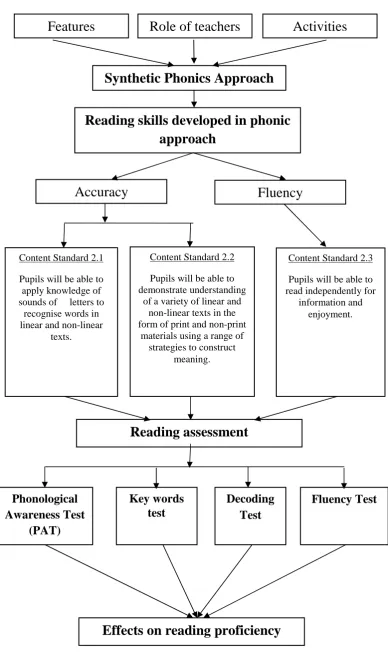
In this study, all the key concepts were highlighted in the conceptual framework as in Figure 1.1. The first key concept is the phonic approach. Generally there are two types of phonics; analytic phonics and synthetic phonics. Both have different features and criteria. In this context of study, the synthetic phonics will be used as it matches the requirement listed by MOE for teaching phonics in reading module. There are three main factors that relate with the phonic approach which are; the syntheticphonics features, teacher’s role and classroom activities.
pupils. The focuses are on accuracy and fluency. According to the Year 2 KSSR syllabus (2011), the pupils need to fulfil three content standards to ensure that they achieve the objectives of reading skill in Year 2. Two of them are for reading accuracy and the other one is for reading fluency (Table 2.1).
The third key concept is the reading assessment which will be carried out to investigate the effects of phonics approach on pupils’ reading proficiency.There will be four reading assessment on reading accuracy and reading fluency at the end of the reading lessons. In order to assess pupils’ knowledge in letter sounds and ability to recognise words, a Phonemic Awareness Test (PAT) will be conducted. To assess pupils’ word recognition and word attack skills, the key words test and a decoding test will be carried out. Then, the fluency test will be carried out to assess pupils’ fluency in reading the whole text.
7
Figure 1.1 : Conceptual Framework
Reading assessment
Accuracy
Fluency
Activities
Features
Role of teachers
Synthetic Phonics Approach
Reading skills developed in phonic
approach
Content Standard 2.3
Pupils will be able to read independently for
information and enjoyment. Content Standard 2.2
Pupils will be able to demonstrate understanding
of a variety of linear and non-linear texts in the form of print and non-print
materials using a range of strategies to construct
meaning. Content Standard 2.1
Pupils will be able to apply knowledge of sounds of letters to
recognise words in linear and non-linear
texts. Key words test Decoding Test Phonological Awareness Test (PAT) Fluency Test
1.4 Objectives
The objectives of this study are:
1 To study the effects of phonics approach on:
a pupils’word attack and decoding skill
b pupils’phonemic awareness c pupils reading fluency
2 To examine teachers’ perceptions on using phonics approach for
reading lesson
1.5 Research Questions
This study aims to answer the following questions:
1 What are the effects of using phonics approach on:
a pupils’word attack and decoding skill ? b pupils’phonemic awareness ?
c pupils’reading fluency ?
2 What are teachers’perceptions on using phonics approach for
9
1.6 Significance of study
This study is beneficial for MOE, Year 2 teachers and Year 2 pupils. Firstly, MOE may use the findings from this study as feedback to their new curriculum design especially for reading module in Year 2 curriculum standard. Even though the KSSR started in 2011, it is necessary to have a study on the teaching approach required, in order to get feedback from teachers and pupils. Moreover, from this study, MOE can get the empirical evidence on the issues that arise related to the new reading module in Year 2 curriculum standard. Besides MOE, the teachers training centre may use the findings as a reference for them to design or improvise their syllabus for future trainees program for teachers.
Secondly, since phonics system is new to many teachers, from this study teachers can gain feedback on the effect of using phonics and make comparison on other teaching approach. Moreover, teachers can make modification and refine their teaching strategy especially for reading lessons.
Finally, it may increase pupils’ motivation on reading when they can blend the letter sounds. Besides that, through this study, it may improve pupils’ spelling and speaking skill. This is because learning through phonics system is not only help reading proficiency but improve pupils’spelling and pronunciation as well.
1.7 Scope of the study
phonics approach when they were in Year 1. However, the lesson was only for single letter sounds for examples /s/, /æ/ and /t/. Furthermore, the Year 1 teachers may not use the same approach as they were not given any briefing/course on how to carry out the phonics approach.
In this study pupils were taught by a teacher who had been briefed on how to conduct their lesson using synthetic phonics and what phonemes and graphemes that they need to cover in their lessons. The teacher needs to follow the guidelines listed by the researchers but she is free to create her own activities.
The duration of this study consisted eight reading lessons or equal to eight hours. In each lesson, teacher introduced different types of phonics symbols and carry out relevant and meaningful activities to promote pupils’ reading fluency. At the end of the eight lessons, four tests were conducted to assess pupils’ reading proficiency.
11
1.8 Limitation
In this context of study, pupils’ reading proficiency was assessed only on pupils’ accuracy and fluency. This is to meet the content standards objective as in KSSR curriculum standards. Furthermore, the guidelines and requirement of teaching lessons followed the KSSR curriculum standards. In future there should be a study to investigate the effects of phonics system to promote pupils reading proficiency that will also cover the reading comprehension skill and orthographic knowledge.
This study covered only eight hours of lessons and four phonics symbols as listed in Year 2 English textbook. The symbols selected are the symbols that pupils need to learn in their first 5 units. Therefore, the findings did not generalise the effect of using phonics system on pupils’ reading proficiencyin other context.
In general, there are two types of phonics, synthetic phonics and analytic phonics. For this study, synthetic phonics approach was used instead of analytic phonics. This is because the features and procedures of synthetic phonics approach meet the criteria of teaching phonics as in KSSR curriculum standards. According to Brook et al, (2006), synthetic phonics refers to an approach to the teaching of reading in which phonemes and graphemes are blend together. While based on MOE (2011), pupils should be made aware of the relationship between phonemes and graphemes.
1.9 Definition of terms
In this study, a few keywords that relate with Standard-based English language Curriculum (KSSR) and phonics are highlighted.
1.9.1 KSSR
Standard-based English language Curriculum (KSSR) is a new curriculum standard introduced by MOE in 2011. In this study, KSSR curriculum standard is used as a reference and guidelines. This is because this study was carried out in national primary school and the participants were the Year 2 pupils. Furthermore, the teaching lesson was based on the KSSR requirements.
1.9.2 Content standards and learning standards
13
1.9.3 Phonics
In general phonics is an approach of teaching people to read by pronouncing letters and sounds. According to Longman Dictionary of Cotemporary English (2005), phonics means a method of teaching people to read in which they are taught to recognize the sounds that the letter presents. There are two types of phonics which are synthetic and analytic phonics.
1.9.3.1 Synthetic phonics
In this context of study, synthetic phonic approach was used in the teaching lesson. This is because it meets the guidelines as listed in the KSSR curriculum standards. Synthetic phonics refers to an approach to the teaching of reading in which the phonemes associated with particular graphemes are pronounced in isolation and blended together (Brooks et al, 2006). Phonemes is the sounds of spoken language and graphemes is the letters and spelling that represent those sounds in written language (MOE, 2011).
1.9.4 Phonemic Awareness Test
1.9.5 Decoding Test
Decoding is the process of using letter sound correspondences to recognize words.Decoding test is an assessment that examines pupils’decoding skills to assess their reading accuracy. As for this study, in the decoding test, the pupils need to read a list of words, passage of text or paragraph as clearly and correctly as possible. The teacher recorded any mistakes that the pupils make and analyse them.
1.9.6 Key words test
For this study, the key words test tested pupils in reading and pronouncing 20 words accurately. The words list was taken from the KSSR curriculum standard. According to MOE (2011), the key words are the words that must be mastered by all pupils according to their stages of development.
1.9.7 Fluency Test
15
1.10 Conclusion
This study investigated the effectsof using phonics system on pupils’ reading proficiency. It is derive from the illiterate issues that concern MOE for the past recent years. Due to the issue, MOE introduced the new KSSR curriculum standard in 2011. With the new KSSR curriculum standards, it is essential for teachers to begin teaching the basic literacy skills. This is to help to build a strong foundation of language skills.
REFERENCES
Adams, M. J. (1990). Beginning to Read: Thinking and Learning about Print. MIT Press, United State of America.
Anderson, R.C., Hiebert, E. H., Scott, J.A., & Wilkinson, I. A. G. (1985). Becoming
a nationof readers: The report of the Commission on Reading. Washington,
DC: National Academy of Education, Commission on Education and Public Policy.
Baumel, J. (2000). Learning to Read – Research Inform Us, Schwab Learning.org,
Retreieved May 2, 2013, from
http://www.schwalblearning.org/Articles.asp?r=22
Brooks, C.J Togerson and Jill Hall (2006). A Systematic Review of the Research
Literature on the Use of Phonics in the Teaching of Reading and Spelling, The
University of Sheffield 2006.
Bryman, A. (2004), Triangulation and Measurement. Department of Social Sciences, Loughborough University Loughborough, Leicestershire,
Cambridge International Dictionary of English (1997).
Creswell, J. W. (2003). Research design: Qualitative, quantitative, and mixed
methods approaches. Thousand Oaks. CA: SAGE.
Curtis, M. (2004). Adolescent who Struggle With Word Identification: Research and
Practice, Adolescent Literacy Research and Practice, New York.
Cziko, C., Greenleaf, C., Hurwitz, L., and Schoenbach, R. (2000). What is Reading? Reading For Understanding. The Quarterly, 22(3).
David, M. K. (2004). Language policy in Malaysia: Empowerment of
disenfranchisement? In S. Mansoor, S. Meraj, & A. Tahir (Eds.), Language policy planning and practice: A south Asian perspective, (pp. 79-90). Karachi,
Pakistan: Aga Khan University and Oxford University Press.
61
Donald, Potter L. (2004). A Chalkboard Approach to Teaching Rudolf Flesch’s
Phonics Exercises with Blend Phonics. The Natural Phonics Primer with Blend
Phonics.
Drever, E. (1995). Using Semi-Structured Interviews in Small-Scale Research, A
Teacher's Guide. Edinburgh: Scottish Council for Research in Education.
Drucker, M. J. (2003). What Reading Teachers Should Know about ESL Learners. The Reading Teacher 57(1), 22-29.
Ediger, Anne (2001). Teaching Children Literacy Skills in a Second Language, Teaching English as a second or foreign language 3, 53-169.
Ehri, L. C., and Wilce, L. C. (1985). Is the First Stage of Printed Word Learning Visual or Phonetic?. Reading Research Quarterly. 20(2), 163-179.
Ehri, L. C., Nunes, S. R., Stahl, S. A. and Willow, D. M., (2001). Systematic Phonics
Instruction Helps Students Learn to Read: Evidence from The National
Reading Panel’s Meta-Analysis, Review of Educational Research, 71(3),
393-447.
F. P. Chew. (2012). Literacy among the Secondary Schools Students in Malaysia
International Journal of Social Science and Humanity, Volume 2 (No. 6).
Geva, E. and Siegel, L. S. (2000). Orthographic and Cognitive Factors in The
Concurrent Development of Basic Reading Skills in Two Languages, Reading
and Writing: An Interdisciplinary Journal, 12(1), 1-30.
Grabe, W. (1991). Current Developments in Second Language Reading Research, TESOL Quarterly, 25(3), 375-406.
Grabe,W. and Stoller,F.L. (2001). Reading for academic purposes: Guidelines for
the ESL/EFL teacher, Teaching English as a Second or Foreign Language (3),
187-203, Boston: Heinle & Heinle.
Gravetter, F. J., and Wallnau, L. B. (2011). Essentials of Statistics for the Behavioral
Sciences. Wadsworth, Cengage Learning. United States of America.
Griffith, P. L. and Olson, M. W. (1992). Phonemic Awareness Helps Beginning
Grover J. Whitehurst and Christopher J Lonigan, (1998). Child Development and
Emergent Literacy, Child Development 68(3), 848-872.
Grover J. Whitehurst and Christopher J. Lonigan, (2002). Handbook of Early
Literacy Research, The Guildford Press.
J. S. Chall, Vicki A. Jacobs and L. E. Baldwin (1990). Reading Crisis: Why Poor
Children Fall Behind, First Harvard University Press.
Koda, K. (2005). Insight into Second Language Reading, Cambridge University Press.
Konza, D. (2011). Phonological Awareness, Research into Practice, Retrieved on April 11, 2013, from www.decd.sa.gov.au/
Krashen, S.D. (1985). The Input Hypothesis, Harlow: Longman.
Lacking the Basics, (23 May 2006). News Straits Times.
Lems, K., Miller, L. D., and Soro, M. T. (2010). Teaching Reading to English
Language Learners: Insight From Linguistics.The Guilford Press. New York.
Liberman, I. Y. and Liberman, A. M. (1992). Whole language versus code emphasis:
Underlying assumptions and their implications for reading instruction,
Reading Acquisition, (343–366). Hillsdale, NJ, England: Lawrence Erlbaum Associates, Inc.
Lindsey, K. A., Manis, F. R., & Bailey, C. E. (2003). Prediction of first-grade
reading in Spanish-speaking English-language learners, Journal of Educational Psychology, 95, 482–494.
Lisa A. Guion, David C. Diehl, and Debra McDonald, (2011). Triangulation:
Establishing the Validity of Qualitative Studies, University of Florida.
McBride-Chang, C., & Kail, R. V. (2002). Cross-cultural similarities in the
predictors of reading acquisition, Child Development, 73, 1392–1407
McKenna. M. C., and Katherine A. Dougherty Stahl. (2009). Assessment for
63
Ministry of Education Malaysia (2011). The English Language Curriculum for
Primary Schools. MOE Curriculum Development Centre.
Morgan, P. L., and Fuchs, D. (2010). Is There Bidirectional Relationship Between Children’s Reading Skill and Reading Motivation? In Malloy, J. A., Marinak,
B. A., and Grambrell, L. B. Essential Reading for Motivation. International Reading Assoc.
National Center for Education Statistics (2009). The Nation's Report Card: Reading
2009 (NCES 2010–458). Institute of Education Sciences, U.S. Department of
Education, Washington, D.C.
Purewal, S. (2008). Synthetic Phonics and The Literacy Development of Second
Language Young Learners. University of Leeds. UK.
Sidek, H. M. (2010). An Analysis of the EFL Secondary Reading Curriculum In
Malaysia: Approaches To Reading And Preparation For Higher Education.
University of Pittsburgh.
Shioshita, J. (1997). Beyond good intentions: Selecting multi-cultural literature.
Action Alliance for Children. Oakland.
Stahl, S.A. and Murray, B.A. (1994). Defining Phonological Awareness and Its
Relationship to Early Reading, Journal of Educational Psychology 86, 221–34. Stuart, M. (1999). Getting Ready for Reading: Early Phonemes Awareness and
Phonics Teaching Improve Reading and Spelling in Inner-City Second Language Learners, British Journal of Educational Psychology 69(4),
587-605.
Teaching Reading is Rocket Science (1999). What Expert Teachers of Reading
Should Know and Be Able To Do.
Torgesen, J. K., Houston, D., Rissman, L., and Kosanovich, M. (2007). Teaching All
Students To Read In Elementary School: A Guide For Principals. Florida
Center for Reading Research. Florida State University.
Torgesen, J. K. , Wagner, R. K., Rashotte, C. A., Lindamood, P., Rose, E., Conway, T. and Garvan, C. (1999). Preventing Reading Failure in Young Children with Phonological Processing Disabilities: Group and Individual Responses to Instruction. Journal of Educational Psychology, 91(4), 579-593.
Uribe, D. (2009, March). Rejecting the indiscriminate use of phonics. Literacy
Weaver, C., Gillmeister-Krause, L., and Vento-Zogby, G. (1996). Creating Support for Effective Literacy Education. Heinemann. Retrieved August 23, 2013, from http://www.heinemann.com/shared/onlineresources/08894/08894f2.html Wells, J. C. (2000). Overcoming Phonetic Interference. English Phonetics, Journal
of English Phonetics Society of Japan.
Wigfield, A. (2010). Children’s Motivation for Reading and Reading Engagement.
In Malloy, J. A., Marinak, B. A., and Grambrell, L. B. Essential Reading for
Motivation. International Reading Assoc.
Ziegler, J. C. and Goswami, U. (2005). Reading Acquisition, Developmental
Dyslexia and Skilled Reading Across Languages: A psycholinguistic Theory.