Copyright © 2018 Andino Maseleno et al. This is an open access article distributed under the Creative Commons Attribution License, which permits unrestricted use, distribution, and reproduction in any medium, provided the original work is properly cited.
International Journal of Engineering & Technology, 7 (3) (2018) 1124-1129
International Journal of Engineering & Technology
Website: www.sciencepubco.com/index.php/IJET doi: 10.14419/ijet.v7i3.9789
Research paper
Demystifying Learning Analytics in Personalised Learning
Andino Maseleno1*, Noraisikin Sabani2, Miftachul Huda3, Roslee Ahmad4, Kamarul Azmi Jasmi3,
Bushrah Basiron3
1Department of Information Systems, STMIK Pringsewu, Lampung, Indonesia 2Faculty of Humanities, Curtin Universiti, Malaysia
3Universiti Teknologi Malaysia, Sekudai, Johor, Malaysia 4Universiti Sains Islam Malaysia, 71800 Nilai, Negeri Sembilan, Malaysia
*Corresponding author E-mail:[email protected]
Abstract
This paper presents learning analytics as a mean to improve students’ learning. Most learning analytics tools are developed by in-house individual educational institutions to meet the specific needs of their students. Learning analytics is defined as a way to measure, collect, analyse and report data about learners and their context, for the purpose of understanding and optimizing learning. The paper concludes by highlighting framework of learning analytics in order to improve personalised learning. In addition, it is an endeavour to define the characterising features that represents the relationship between learning analytics and personalised learning environment. The paper pro-poses that learning analytics is dependent on personalised approach for both educators and students. From a learning perspective, stu-dents can be supported with specific learning process and reflection visualisation that compares their respective performances to the overall performance of a course. Furthermore, the learners may be provided with personalised recommendations for suitable learning resources, learning paths, or peer students through recommending system. The paper’s contribution to knowledge is in considering per-sonalised learning within the context framework of learning analytics.
Keywords:learning analytics; framework; personalised learning.
1.
Introduction
In recent years, there is a change in the way students learn, as the emerging connected learning pedagogies [1][2][3] suited online learning and improved the learning experiences of students. As a result, it reduced the need for direct involvement of teacher [4]. Online learning has changed the ways in which education has been conducted [5]. Online learning is also known as e-learning, and having the majority of the people on this planet being aslightly addicted to their devices. Online learning and blended learning have been increasing and being more personalised. Blended learn-ing can be characterized as the blend of many approaches to peda-gogy and a large variety of technology or media integrated with traditional classroom activities (face-to-face) [6][7].
In relation to ways of how blended or online learning environment can be personalised, it lays on the values of personalised learning by putting the learner at the heart of the education system [8]. Personalised learning shifts the role of students from being simply a consumer of education to a co-producer and collaborator of their learning pathway [9]. For a student, personalised learning actively engages students in the process of learning, leading to improved learning outcomes and learning experiences. For institutions, it enhances their reputation as one that values and supports individu-al student’s learning [10]. Personindividu-alised learning is a three-part process, which include instructional planning that promotes deeper student learning; understanding of each student’s learning needs and interests; and provisioning of appropriate learning experiences that match each student’s unique learning profile [11].
Learning analytics is receiving increased attention, in part because
it offers to assist educational institutions in increasing students’ learning retention, improving students’ learning success, and eas-ing the burden of accountability [12]. By useas-ing learneas-ing analytics and optimizing it in the learning environment, tutors for example, can predict the students’ future performances in their study cours-es [13]. Learning analytics are distinguished by their concern in providing value to learners, whether in formal, informal or blend-ed settings [14]. Principally, learning analytics deals with the de-velopment of methods that leads to effective use of educational data sets to support the learning process. Learning analytics refers to the application of analytic techniques to analyse educational data, which includes providing data about learner and teacher activities, identifying patterns of behaviour and providing actiona-ble information to improve learning and learning related activities. It is used by educators to obtain insights and optimize the learning processes of their students. Learning analytics is the third wave of large-scale developments in instructional technology that began with the advent of the learning management system [15].
2.
Personalised Learning: A Summary
With regards to personalised learning, the use of the term person-alised learning dates back to at least the early 1960s [16]. Within earlier era, personalised learning is often depicted as a one-to-one tutoring system with a teacher being assigned a small group of students. As such, it remains for many a privileged system of tu-toring [17].
personali-International Journal of Engineering & Technology 1125
zation, especially through the usage of technology. Information technology can modify the style of teaching [18]. Jenkins and Keefe [19] defined personalization as a way for educational insti-tutions’ efforts to in considering students variants needs and char-acteristics within the teaching and learning process. In addition, it focuses on the usage of “flexible instructional practices” in order to further facilitate their personalization endeavours. On the other hand, a more technologically inclined personalization may be as defined by Chatti et al. [20], focusing on the usage of algorithm within an online system in order to personalize students’ learning experiences, based on, among others, their needs, learning prefer-ences and available online materials. Finally, in 2010, the U.S. Department of Education published the definition in the National Educational Technology Plan, whereby personalization refers to instruction that is paced to learning needs, tailored to learning preferences, and tailored to the specific interests of different learn-ers. In an environment that is fully personalised, the learning objectives, content, pace as well as the method may all vary [21]. Sampson, Karagiannidis and Kinshuk [22], indicated that there are a number of personalization parameters that needs to be consid-ered, including the students’ requirements, abilities, schemata and interests. The learning should not be time bounded and ideally, focuses on the progress of individual students. As it reduces teacher-centredness, it is anticipated that the learners are self di-rected as well. Focusing on the online variance of personalised learning, the extent of technological use influences its usage and functions within the learners’ learning process. To illustrate, ChanMin Kim [23] demonstrated how the usage of VCA or virtual change agents assisted students personally in driving students’ motivation in attempting their remedial mathematics course by providing motivational responses throughout their learning pro-cess. There are also other experiments, involving usage of adap-tive hypermedia tool; and web-based learning system [24][25]. While LMS and MOOC is not traditionally considered a personalised learning environment or platform, the advancement of INTUITEL, study conducted by Henning et al. [26] indicated of the possibilities of these media to be more personalised through added technological dimensions.
In a more advanced side of personalised learning is the PLE, or personalised learning environment. Multiple studies has been done relating to it, including the usage of Personalised Visual Narratives to enhance students’ learning engagement [27]; the use of Concept Maps in PLE to subdue students’ learning difficulties [28]; the use of PLE to advocate learners’ empowerment towards their own learning process and progress [29] and the use of microcredentials offered in PLE for teachers’ professional advancement [30]. An element that should be noted is within the technologically inclined personalised learning environment, there is a need to monitor the students’ details and progress, which be-comes the main function of learning analytics.
3.
Defining Learning Analytics in Personalised
Learning
The term learning analytics came into use in 2009 [21]. Siemens and Gasevic [31] defined learning analytics as a specialty area whereby it focuses on students’ data, in terms of collecting, ana-lyzing and reporting in order to understand and improve the learn-ing experiences to an optimum level. While the use of analytics and data analytics is relatively new in education, in the past, this was typically driven by the needs of the education sector to sup-port data-driven decision-making and planning [32]. Learning analytics are defined by the Society for Learning Analytics Re-search (SoLAR) as the measurement, collection, analysis and re-porting of data about learners and their contexts, for understanding purposes and optimizing learning and the environments in which it occurs [33]. Learning analytics is also related to academic analyt-ics. The term academic analytics was first described by Goldstein and Katz [34]. In contrast to learning analytics, academic analytics
focuses on the improvement of organizational processes, work-flows, resource allocation, and institutional measurement, through the use of learner, academic, and institutional data. Academic analytics also helps address the public’s desire for institutional accountability with regard to students’ success, given the wide-spread concern over the cost of higher education and its challenges in terms of economic and budgetary conditions, which is prevail-ing worldwide compassionate based learnprevail-ing enhancement [35]. By replacing academic with learning, the definition of academic analytics could also be used for learning analytics.
However, learning analytics is more specific than academic ana-lytics, focusing only on the learning process and service learning engagement [36][37]. At academic institutions, learning analytics concentrates on data relevant to students and instructors at the level of the individual learner or course and on using analytic techniques to improve students’ learning outcomes by targeting better instructional, curricular as well as supporting resources, interventions and learning culture empowerment [38][39][40]. Learning analytics empowers learners to understand the wealth of data related to learning [41]. The idea of learning analytics pro-vides a new model for college and university leaders to improve teaching, learning, organizational efficiency, and decision making and as a consequence, serve as a foundation for systemic change. Learning Analytics allows stakeholders to understand and apply the use of intelligent data, learner-produced data, and analysis models in order to discover information and social connections, and to predict and advise on learning [42]. Learning analytics mainly intends to help teachers and students to be involved based on the evaluation of educational data [43]. Learning analytics places a greater emphasis on the qualitative data that originate from learning behavior [44] while analyzing quantitative metrics. In a personalised learning system, pursuing many study paths can give students the interest and engagement that will support higher levels of learning in the basis of counselling service to enhance learning culture [45]. Students can acquire competencies by tap-ping into resources both in and outside of school with an innova-tive learning environment [46]. Broadened learning openings, for example, apprenticeships, group administrations, autonomous examinations, online courses, entry level positions, performing gatherings, and private guidelines and also double enlistment pro-grams, offer students the chance to fabricate authority toward abilities in ways that match their styles and premiums as guided, observed, and surveyed by educators with an innovative teaching adaption [47]. Group based, work-based, and benefit based learn-ing not just give students a road to exhibit learnlearn-ing in true settlearn-ings, however students likewise have genuine chances to have any kind of effect in their neighborhood, state, national, and worldwide groups. However, personalised learning is still of value as it is a promising path to differentiate learning for all students and as such, prepares them for college, career and community in the 21st centu-ry [48].
1126 International Journal of Engineering & Technology
4.
Learning Analytics in Personalised
Learning
Educational data is the foundation of learning analytics process and learning is an iterative process that results from an active par-ticipation in a self-guided and externally supported process. Learning analytics is a multi-disciplinary field involving machine learning, artificial intelligence, information retrieval, statistics, and visualization [52]. According to Suthers [53], learning analytics is an emerging field that combines the areas of computational sci-ences and education, using computational techniques to capture and analyse data from within the learning environment. Learning analytics have been used for a range of applications, for example Purdue signals for student retention [54, LOCO to provide
educa-tors with feedback on students’ learning activities and performance [55], and LASyM to analyse
students’ behaviours with the intent of increasing the impact of analytics on teaching and learning in such environments [56]. However, predicting students’ learning success and providing proactive feedbacks have been two of the most frequently adopted tasks associated with learning analytics [57].
Personalised learning and advancements in technology have the potential to empower students to take greater ownership over their learning and to empower teachers to personalised learning based on individual students’ needs. The concept of personalised learn-ing environment has emerged as a concept in line with the Web 2.0 tools that serves to integrate essential learning outcomes such as lifelong learning and self-directed learning [5]. Personalised learning combines the how and what of learning. A personalised approach recognizes that there are still core requirements and expectations. A strong focus must remain on foundational skills, including reading, writing, oral language and numeracy. Addition-ally, there will still be a required body of knowledge in various subjects or disciplines. However, learning is the focus of attention rather than instruction; the focus is on nurturing curriculum based on learning preferences with the learning ability [58] and innova-tive teaching competencies [35][80]. The design or the curriculum and teaching cycle is set in such a way that it is not time bounded and it allows students to interact to content in multiple ways. According to IMS Global Learning Consortium [59], there are three characteristics that is required in a technological platform innovation, which are seamlessness: focusing on the usage and integration of variable of available digital tools and resources; agility: the plug and connectivity of apps to educational institu-tions in just-in-time manner for the purpose of personalizing stu-dents’ learning; and effective investment towards the viability and usage of technology for maximum learning impact. Due to this, IMS standards focus on the need of interoperability standards, which allows a variety of digital curriculum resources to be inte-grated within the educational institutions, based on the available enterprise software in a seamless manner. Through such innova-tion, it will provide opportunity for the students to experience personalised instruction with global connectivity [60].
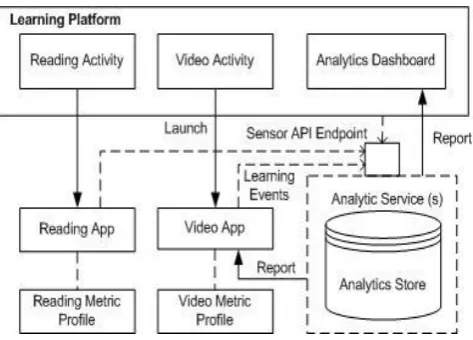
Abel, Brown and Suess [61] indicated on the onset of connected learning, whereby students are in better position to personalize their learning in terms of connections, collaborations and the use or available resources. Another edge that connected learning may be able to offer it to connect what was once thought to be un-connectable, through the interplay of all of the educational institu-tions’ stakeholders, and is founded through the usage of IT infra-structure as its underpinnings. Additionally, such collaboration is anticipated to grow organically, making it seems to be more natu-ral, and requiring the students to be on the outlook and having more agility in seizing any opportunity to learn [36]. It aims to shy away from the current standardized curriculum and assessments. The use of learning analytics, is among others becomes the gate-way to the attainments of these endeavours. Figure 1 shows IMS learning analytics measurement framework [62].
Fig.1: IMS learning analytics measurement framework (Adopted from
IMS Global Learning Consortium)
The Learning Platform Administrator designs two learning devic-es interoperability Apps. The learning devicdevic-es interoperability design URL/XML shows the Learning Platform that these Apps bolster, which incorporates a Reading and Video Metric Profile separately. The Learning Platform Administrator designs the Sen-sor API Endpoint URL in the learning devices interoperability settings. This is a URL gave by the Analytics Service. The URL could have an implanted API Key approving access. An Instructor includes a Reading and Video Activity utilizing the learning de-vices interoperability Apps, keeping in mind the end goal to clude two exercises; the Instructor starts a learning devices in-teroperability dispatch. Amid the dispatch, since the Apps bolster IMS Metric Profiles, the LMS includes the Sensor API Endpoint URL as one of the dispatch parameters. The App gets the Sensor API Endpoint as a major aspect of the dispatch and stores this for sometime later. A student begins getting to a course in the Learn-ing Platform and as a component of the assignments starts utiliz-ing the Readutiliz-ing and Video. Amid this utilization, the student plays out a few run of the mill activities, for example, Reading a page, Highlighting an area, Adding a Bookmark, Viewing the video, Taking a note on the Video at a specific time amid playback. The learning devices interoperability Apps record the student's activi-ties. Since the Learning Platform gave a Sensor API endpoint amid dispatch, each App begins presenting Learning Events on the Sensor API endpoint. The Analytics Service is an intermediary for a commonplace devouring administration for measurements caught and marshaled by means of the IMS system. The investiga-tion Service records the Learning Events to its store and underpins and gives more definite examination of the measurements to yield higher request usefulness, for example, dashboards, sugges-tions/alarms, versatile sequencing.
International Journal of Engineering & Technology 1127
Student Evaluation, Summative Assessment, Formative Assessment
Assessment Learning Analytics Processor
User Interface Student Learning
Interface Educator Interface
Personalised
User Profile Learning Record
Capture and Analyse Data Statistics, Machine Learning, Artificial
Intelligence, Information Retrieval Student Achievement, Staff Performance Reviews, At Risk Students,
Selection Criteria, Effectiveness of Teaching Strategies, Refinement of Teaching and Learning Strategies, Reputation and Accreditaion of Program Personalised Learning Environment
Fig.2: Learning analytics in personalised learning environment
Student learning is positioned as constant in the personalised learning environment, with time positioned as a variable resource in support of the personalised learning process. Data and data systems allow for historical student data and formative data for teachers to use to differentiate for each student. The student and the teacher regularly discuss feedback, progress, and next steps as they both demonstrate commitment to learning and growth [43]. In addition, user interface provides a user friendly and adaptive inter-face for communicating with learner and educator. User interinter-face generate reports and dashboards using a drag-and-drop interface and a rich library of visualizations and chart types. The results are published and distributed in PDF, Word, Excel or Power Point format. Reports are automatically updated when data is refreshed. The analysis of data collected from the interaction of users with educational and information technology has attracted much atten-tion as a promising approach for advancing our understanding of the learning process. The initial value of learning preferences with interaction [64] to give insights into innovative learning environ-ment [65] has to be involved with the assurance of measureenviron-ment process [66] in incorporating the diagnostic procedural stage [67]. In particular, this initiative refers to enhance the learning expertise among the students [68], in trying to give then the chance in urg-ing to achieve the civic based leadership within the service learn-ing [69] through maximizlearn-ing the learnlearn-ing resources together with learning environment [70][71]. Moreover, the social concern in sustaining the learning outcome [72][73] should be engaged with digital application of guidelines in driving the technology adop-tion [74][75][76]. In this view, the potentials of personalised learning will give insights into collaborating with the learning achievement through expanding accentuation on capabilities. In terms of accommodating the abilities together with information in creating the way of circumstances, the learning could be combined with skillful adoption in the sense that can be explored into the stage of considering critical thinking assigned with computerized proficiency. As a result, both individual and social level in incor-porating the entire duty is applied through consolidating the level of creative imagination advancement in looking at in a whole on social comprehension [77][78]. Both coordinated and self-guided learning [79][80] together with comprehensive learning [81][82] associated with ethical competence [83] should be achieved in entire look into the powerful inclusion towards the stage of conditions on personalised learning with professional and ethical balance in creative learning.
5.
Conclusion
Learning is really a lifelong journey. Learning happens in sustainable educational programs. Personalised learning models encourage all students to grow to their fullest potential and leave school prepared for meaningful futures. In personalised learning framework, personalised learning approaches concentrate on rein-forcing the sudents' learning procedure by urging students to ef-fectively partake in encouraging a solid learning condition, fortify-ing associations with grown-up partners, gettfortify-ing to be plainly mindful of their individual adapting needs, and recognizing and applying learning methodologies that work best for them. Personalised learning perceives that no two students learn similarly or at a similar pace. Be that as it may, with personalised realizing there will be expanded accentuation on capabilities. By applying their abilities and information in new, frequently interdisciplinary circumstances, students will create skills, for example, basic considering and critical thinking, joint effort and administration, correspondence and computerized proficiency, individual and social duty, imagination and advancement, and worldwide and social comprehension. Powerful personalised learning conditions give apparatuses and learning assets that students use in self-coordinated and self-guided learning. Moreover, student engagement and freedom are the center objectives. Incorporated and drawing in learning investigation devices can increase information obtaining, aptitude advancement, and whenever utilization of learning in extensive assignments. Adjustment to the pace and teaching method would expect access to substance and apparatuses for adapting, anyplace, and on any gadget. The structure thought of learning examination gives a model to enhance instructing, learning, authoritative proficiency, and basic leadership and as a result, fill in as an establishment for fundamental change. This implies the learning procedure is centered around the requirements, qualities and yearnings of every individual student. As the framework esteems personalised learning, students assume an undeniably dynamic part in planning their own training way as they create and develop, while being considered expanding responsible for their own particular learning
achievement.
References
[1]. Baran, E. (2013). Connect, Participate and Learn: Transforming Pedagogies in Higher Education, Bulletin of the IEEE Technical Committee on Learning Technology, Vol. 15 No. 1, pp. 9-12. [2]. EDUCAUSE. (2013), "7 things you should know about connected
learning." Retrieved July, 2016, fromhttps://library.educause.edu/resources/2013/5/7-things-you-should-know-about-connected-learning
[3]. Siemens, G. (2004), “Connectivism: A Learning Theory for the
Digital Age.” Elearnspace
http://www.elearnspace.org/Articles/connectivism.htm
[4]. Sin, K and L. Muthu. (2015), “Application of Big Data in Education Data Mining and Learning Analytics – A Literature Review”, IC-TACT Journal n Soft Computing, Vol. 5 Issue 4, pp. 1035-1049. [5]. Halim, N.D.A., M.B. Ali, and N. Yahaya. (2011), “Personalized
Learning Environment: Accommodating Individual Differences in Online Learning”, International Conference on Social Science and Humanity, IPEDR vol. 5 No. 2, pp. V2-398-V2-400.
[6]. Picciano, A.G. (2014), “Big Data and Learning Analytics in Blend-ed Learning Environments: Benefits and Concerns”, International Journal of Artificial Intelligence and Interactive Multimedia. Vol. 2 No. 7, pp. 35-43.
[7]. Trapp, S. (2006). E. Tomadaki and P. Scott (Eds.): “Innovative Approaches for Learning and Knowledge Sharing,” EC-TEL 2006 Workshops Proceedings, ISSN 1613-0073, pp. 28-35, 2006. [8]. Leadbeater, C. (2008). We think: Mass innovation, not mass
pro-duction. London, UK: Profile.
1128 International Journal of Engineering & Technology
[10]. Bentley, T. and R. Miller. (2004). Personalised learning: creating the ingredients for system and society wide change. (IARTV Occa-sional paper No 87). Melbourne, Australia: Incorporated Associa-tion of Registered Teachers of Victoria.
[11]. Creel, M. (2016), “Serious about Personalized Learning? Three Things Teachers and Leaders Do to Personalize Learning For In-structional Leaders and Teachers”, Powerful Practices, The Instruc-tional Leadership Experience.
[12]. Uhler, B.D. and J.E. Hurn. (2013), “Using Learning Analytics to Predict (and Improve) Student Success: A Faculty Perspective”, Journal of Interactive Online Learning, Vol. 12 No. 1, pp. 17-26. [13]. Khalil, M. and M. Ebner. (2015). “Learning Analytics: Principles
and Constraints”. In Proceedings of World Conference on Educa-tional Multimedia, Hypermedia and Telecommunications 2015. pp. 1326-1336. Chesapeake, VA: AACE.
[14]. Ferguson, R. (2012). “Learning analytics: drivers, developments and challenges”. International Journal of Technology Enhanced Learning, Vol. 4 Issue 5/6 pp. 304–317.
[15]. Brown, M. (2011), “Learning Analytics: The Coming Third Wave”, First International Conference on Learning Analytics and Knowledge (LAK11) conference.
[16]. Epstein, S. B. Epstein. (1961). The First Book of Teaching Ma-chines. Danbury, CT: Franklin Watts, Inc.
[17]. Gallagher, R.P. (2014). “Implementations of technology enhanced personalized learning: exploration of success criteria, concerns, and characteristics”, No. 3628787 EdD, proquest dissertations and the-ses full text; proquest dissertations and thethe-ses global database, Pep-perdine University, Ann Arbor, MI, available at: http://search.proquest.com/docview/
[18]. Abdrakhmanova, Zh. K. Aisultanova, Chaltikenova Lyazat and Zh. Satkenova, 2017. Implementation of Modern Computer Science and Information Technologies in Teaching. Journal of Engineering and Applied Sciences, 12: 573-577.
[19]. Jenkins, J.M. and J. W. Keefe, (2002) “Two schools: Two ap-proaches to personalized learning,” Phi Delta Kappan, vol. 83, no. 6, pp. 449-456.
[20]. Chatti, M.A., M. R. Agustiawan, M. Jarkeet al. (2010), “Toward a personal learning environment framework,” International Journal of Virtual and Personal Learning Environments (IJVPLE), vol. 1, no. 4, pp. 66-85.
[21]. US Department of Education (2010), Transforming American Edu-cation: learning powered by technology. Washington DC: Author. Retrieved from https://www.ed.gov/sites/default/files/NETP-2010-final-report.pdf
[22]. Sampson, D., C. Karagiannidis, and Kinshuk. (2002), “Personalised Learning: Educational, Technological and Standardisation Perspec-tive,” Interactive Educational Multimedia, vol. 4, pp. 24-39. [23]. Kim, C. “The role of affective and motivational factors in designing
personalized learning environments,” Educational Technology Re-search and Development, vol. 60, no. 4, pp. 563-584, 2012. [24]. McDonald, J. and J. Timonen. (2009), “How could pedagogy make
a choice between personalized learning systems,” Proceedings of the Authoring of Adaptive and Adaptable Hypermedia.
[25]. Thyagharajan, K. and R. Nayak. (2007), “Adaptive content creation for personalized e-learning using web services,” Journal of Applied Sciences Research, vol. 3, no. 9, pp. 828-836.
[26]. Henning, P.A., F. Heberle, A. Streicheret al. (2014), “Personalized Web Learning: Merging Open Educational Resources into Adaptive Courses for Higher Education,” Personalization Approaches in Learning Environments, pp. 55.
[27]. Yousuf, B., and O. Conlan. (2014), "Enhancing Learner Engage-ment through Personalized Visual Narratives." pp. 89-93. [28]. Lin, Y.-S., Y.-C. Chang, K.-H. Liew et al. (2015), “Effects of
con-cept map extraction and a test-based diagnostic environment on learning achievement and learners' perceptions,” British Journal of Educational Technology, pp. n/a-n/a.
[29]. Mohd, C. K. N. C. K., F. Shahbodin, A. N. C. Pee et al. (2013), “Personalized Learning Environment (PLE) Approach: Preliminary Analysis in Malaysian’s Secondary School,” International Journal of Computer and Information Technology, vol. 2, no. 03, pp. 2279-0764.
[30]. Gamrat, C., H. T. Zimmerman, J. Dudek et al. (2014), “Personalized workplace learning: An exploratory study on digital badging within a teacher professional development program,” British Journal of Educational Technology, vol. 45, no. 6, pp. 1136-1148.
[31]. Siemens, G., and D. Gasevic. (2012), “Guest Editorial-Learning and Knowledge Analytics,” Educational Technology & Society, vol. 15, no. 3, pp. 1-2.
[32]. Baker, R.S.J.D., and K. Yacef. (2009). The State of Educational Data Mining in 2009: A Review and Future Visions. Journal of Ed-ucational Data Mining, Vo. 1 No. 1, pp. 3–17.
[33]. SoLAR (Society for Learning Analytic Research. (2011), “Open Learning Analytics: an integrated & modularized platform. Proposal to design, implement and evaluate an open platform to integrate heterogeneous learning analytics techniques, SoLAR.
[34]. Goldstein, P.J., and Katz, R. N. (2005). Academic analytics: The uses of management information and technology in higher educa-tion, ECAR Research Study Volume 8. Retrieved from http://www.educause.edu/ers0508
[35]. Huda, M., Jasmi, K. A., Embong, W. H., Safar, J., Mohamad, A. M., Mohamed, A. K., Muhamad, N. H., Alas, Y., & Rahman, S. K. (2017a). Nurturing Compassion-Based Empathy: Innovative Ap-proach in Higher Education. In M. Badea, & M. Suditu (Eds.), Violence Prevention and Safety Promotion in Higher Educa-tion Settings (pp. 154-173). Hershey, PA: IGI Global. doi:10.4018/978-1-5225-2960-6.ch009
[36]. Huda, M., Jasmi, K. A., Alas, Y., Qodriah, S. L., Dacholfany, M. I., & Jamsari, E. A. (2017b). Empowering Civic Responsibility: In-sights From Service Learning. In S. Burton (Ed.), Engaged Scholar-ship and Civic Responsibility in Higher Education(pp. 144-165). Hershey, PA: IGI Global. doi:10.4018/978-1-5225-3649-9.ch007 [37]. Long, P., and G. Siemens. (2011), “Penetrating the fog: analytics in
learning and education”, Educause Review Online, Vol. 46 No. 5, pp. 31-40.
[38]. Elias, T. (2011). Learning analytics: Definitions, processes and
potential. Retrieved from
http://learninganalytics.net/LearningAnalyticsDefinitionsProcessesP otential.pdf
[39]. Barneveld, A.V., K.E. Arnold, and J.P. Campbell. (2012). Analytics in Higher Education: Establishing a Common Language (ELI Paper 1: January 2012). Boulder, CO: EDUCAUSE Learning Initiative. Retrieved from http://net.educause.edu/ir/library/pdf/ELI3026.pdf [40]. Huda, M., Sabani, N., Shahrill, M., Jasmi, K. A., Basiron, B., &
Mustari, M. I. (2017c). Empowering Learning Culture as Student Identity Construction in Higher Education. In A. Shahriar, & G. Syed (Eds.), Student Culture and Identity in Higher Education (pp. 160-179). Hershey, PA: IGI Global. doi:10.4018/978-1-5225-2551-6.ch010
[41]. Clow, D. (2013). An overview of learning analytics. Teaching in Higher Education, Vol. 18 No. 6, pp. 683-695, doi: 10.1080/13562517.2013.827653.
[42]. Long, P., and G. Siemens. (2011), “Penetrating the fog: analytics in learning and education”, Educause Review Online, Vol. 46 No. 5, pp. 31-40.
[43]. Retalis, S., A. Papasalouros, Y. Psaromilogkos, S. Siscos, and T. Kargidis. (2006), “Towards networked learning analytics-A concept and a tool,” in Proceedings of the 5th International. Conference Networked Learning, Lancaster University, United Kingdom, 2006, pp. 1-8.
[44]. Becker, B. (2013), “Learning analytics: Insights into the natural learning behavior of our students”, Behavioral & Social Sciences Librarian, Vol. 32 No. 1, pp. 63-67, doi:10.1080/01639269.2013.751804.
[45]. Huda, M., Jasmi, K. A., Mustari, M. I., Basiron, B., Mohamed, A. K., Embong, W., ... & Safar, J. (2017d). Innovative E-Therapy Ser-vice in Higher Education: Mobile Application Design. International Journal of Interactive Mobile Technologies, 11(4), 83-94.
[46]. Huda, M., Haron, Z., Ripin, M. N., Hehsan, A., & Yaacob, A. B. C. (2017e). Exploring Innovative Learning Environment (ILE): Big Data Era. International Journal of Applied Engineering Re-search, 12(17), 6678-6685.
[47]. Huda, M., Shahrill, M., Maseleno, A., Jasmi, K. A., Mustari, I., & and Basiron, B. (2017f). Exploring Adaptive Teaching Competen-cies in Big Data Era. International Journal of Emerging Technolo-gies in Learning, 12(3), 68-83.
[48]. Weber, C., C. Biswell, and W. Behrens. (2014). Exploring critical issues in gifted education: A case studies approach. Waco, TX: Pru-frock Press.
[49]. BC’s Education Plan. (2015), “Focus on Learning”, British Colum-bia Ministry of Education.
[50]. Huda, M., Jasmi, K. A., Basiran, B., Mustari, M. I. B., & Sabani, A. N. (2017g). Traditional Wisdom on Sustainable Learning: An In-sightful View From Al-Zarnuji's Ta 'lim al-Muta 'allim. SAGE Open, 7(1), 1-8.
International Journal of Engineering & Technology 1129
Chancellor (Academic) for the Vice-Chancellor’s Retreat, March 23rd & 24th.
[52]. Chatti, M.A., A.L. Dyckhoff, U. Schroeder, and H. Thüs. (2012), “A Reference Model for Learning Analytics”, International Journal of Technology Enhanced Learning, Vol. 4 Issue 5/6, pp. 318-331 [53]. Suthers, D., and K. Verbert. (2013), “Learning analytics as a
“mid-dle space” “, Proceedings of the Third International Conference on Learning Analytics and Knowledge, 1-4, New York, USA: ACM. [54]. Pistilli, M.D., K.E. Arnold, and M. Bethune. (2012). Signals: Using
Academic Analytics to Promote Student Success. EDUCAUSE
Re-view Online. Retrieved from
http://www.educause.edu/ero/article/signals-usingacademic-analytics-promote-student-success
[55]. Ali, L., M. Hatala, D. Gasevic, and J. Jovanovic. (2012). A qualita-tive evaluation of evolution of a learning analytics tool. Computers & Education. 58 (1), pp. 470-489.
[56]. Tabaa, Y., and A. Medouri. (2013), “LASyM: A Learning Analytics System for MOOCs”, International Journal of Advanced Computer Science and Applications, Vol. 4 No. 5, pp. 113-119.
[57]. Dawson, S., D. Gašević, G. Siemens, and S. Joksimovic. (2014). Current State and Future Trends: A Citation Network Analysis of the Learning Analytics Field. In Proceedings of the Fourth Interna-tional Conference on Learning Analytics and Knowledge (pp. 231– 240). New York, NY, USA: ACM. doi:10.1145/2567574.2567585 [58]. Othman, R., Shahrill, M., Mundia, L., Tan, A., & Huda, M. (2016).
Investigating the Relationship Between the Student’s Ability and Learning Preferences: Evidence from Year 7 Mathematics Stu-dents. The New Educational Review, 44(2), 125-138.
[59]. IMS Global Learning Consortium. (2015), “Annual Report 2015: Better Learning from Better Learning Technology”. Retrieved from http://www.imsglobal.org/sites/default/files/2015annualReport.pdf. [60]. IMS Global Learning Consortium. (2016). “Transitioning to
Inte-grated Digital Curriculum Using IMS Standards”. Retrieved from: https://www.imsglobal.org/sites/default/files/K12transition2016.pdf, [61]. Abel, R., M. Brown, and J. Suess. (2013), “A New Architecture for
Learning,” Educause Review, vol. 48, no. 5, pp. 88.
[62]. IMS Global Learning Consortium. (2013), “Learning Measurement for Analytics Whitepaper”. Retrieved from https://www.imsglobal.org/sites/default/files/caliper/IMSLearningA nalyticsWP.pdf
[63]. CAPSS (Connecticut Association of Public School Superintendents). (2014), “A Look To The Future: Personalized Learning in Connect-icut, White Paper on Personalized Learning”, 2014.
[64]. Huda, M., Maseleno, A., Jasmi, K. A., Mustari, I., & Basiron, B. (2017k). Strengthening Interaction from Direct to Virtual Basis: Insights from Ethical and Professional Empowerment. International Journal of Applied Engineering Research, 12(17), 6901-6909. [65]. Huda, M., Haron, Z., Ripin, M. N., Hehsan, A., & Yaacob, A. B. C.
(2017l). Exploring Innovative Learning Environment (ILE): Big Data Era. International Journal of Applied Engineering Research, 12(17), 6678-6685.
[66]. Maseleno, A., Huda, M., Siregar, M., Ahmad, R., Hehsan, A., Haron, Z., Ripin, M.N., Ihwani, S.S., and Jasmi, K.A. (2017). Combining the Previous Measure of Evidence to Educational Entrance Examination. Journal of Artificial Intelligence 10(3), 85-90.
[67]. Maseleno, A., Pardimin, Huda, M., Ramlan, Hehsan, A., Yusof, Y.M., Haron, Z., Ripin, M.N., Nor, N.H.M., and Junaidi, J. (2018a). Mathematical Theory of Evidence to Subject Expertise Diagnostic. ICIC Express Letters, 12 (4), 369 DOI: 10.24507/icicel.12.04.369 [68]. Maseleno, A., Huda, M., Jasmi, K.A., Basiron, B., Mustari, I., Don,
A.G., and Ahmad, R. (2018b). Hau-Kashyap approach for student’s level of expertise. Egyptian Informatics Journal, doi.org/10.1016/j.eij.2018.04.001.
[69]. Huda, M., Teh, K.S.M., Nor, N.H.M., and Nor, M.B.M. (2018a). Transmitting Leadership Based Civic Responsibility: Insights from Service Learning. International Journal of Ethics and Systems, 34(1), 20-31.
[70]. Huda, M., Maseleno, A., Muhamad, N.H.N., Jasmi, K.A., Ahmad, A., Mustari, M.I., Basiron, B. (2018b). Big Data Emerging Technology: Insights into Innovative Environment for Online Learning Resources. International Journal of Emerging Technologies in Learning 13(1), 23-36. doi:10.3991/ijet.v13i01.6990
[71]. Huda, M., Maseleno, A., Teh, K.S.M., Don, A.G., Basiron, B., Jasmi, K.A., Mustari, M.I., Nasir, B.M., and Ahmad, R. (2018c). Understanding Modern Learning Environment (MLE) in Big Data
Era. International Journal of Emerging Technologies in Learning. 13(5), 71-85. doi: 10.3991/ijet.v13i05.8042
[72]. Rosli, M.R.B., Salamon, H.B., and Huda, M. (2018). Distribution Management of Zakat Fund: Recommended Proposal for Asnaf Riqab in Malaysia. International Journal of Civil Engineering and Technology 9(3), pp. 56–64.
[73]. Aminin, S., Huda, M., Ninsiana, W., and Dacholfany, M.I. (2018). Sustaining civic-based moral values: Insights from language learning and literature. International Journal of Civil Engineering and Technology. 9(4), 157-174.
[74]. Huda, M., Jasmi, K. A., Mustari, M. I., Basiron, B., Mohamed, A. K., Embong, W., ... & Safar, J. (2017g). Innovative E-Therapy Service in Higher Education: Mobile Application Design. International Journal of Interactive Mobile Technologies, 11(4), 83-94.
[75]. Huda, M., Siregar, M., Ramlan, Rahman, S.K.A., Mat Teh, K.S., Said, H., Jamsari, E.A., Yacub, J., Dacholfany, M.I., & Ninsiana, W. (2017j). From Live Interaction to Virtual Interaction: An Exposure on the Moral Engagement in the Digital Era. Journal of Theoretical and Applied Information Technology, 95(19), 4964-4972.
[76]. Huda, M. (2018). Empowering Application Strategy in the Technology Adoption: Insights from Professional and Ethical Engagement. Journal of Science and Technology Policy Management. doi.org/10.1108/JSTPM-09-2017-0044.
[77]. Huda, M., & Teh, K. S. M. (2018). Empowering Professional and Ethical Competence on Reflective Teaching Practice in Digital Era. In Dikilitas, K., Mede, E., Atay D. (Eds). Mentorship Strategies in Teacher Education (pp. 136-152). Hershey, PA: IGI Global. doi: 10.4018/978-1-5225-4050-2.ch007
[78]. Huda., M. & Sabani, N. (2018). Empowering Muslim Children’s Spirituality in Malay Archipelago: Integration between National Philosophical Foundations and Tawakkul (Trust in God). International Journal of Children's Spirituality, 23(1), 81-94. [79]. Moksin, A. I., Shahrill, M., Anshari, M., Huda, M., & Tengah, K. A.
(2018). The Learning of Integration in Calculus Using the Autograph Technology. Advanced Science Letters, 24(1), 550-552. [80]. Huda, M., Anshari, M., Almunawar, M. N., Shahrill, M., Tan, A.,
Jaidin, J. H., ... & Masri, M. (2016a). Innovative Teaching in Higher Education: The Big Data Approach. The Turkish Online Journal of Educational Technology, 15(Special issue), 1210-1216.
[81]. Huda, M., Yusuf, J. B., Jasmi, K. A., & Nasir, G. A. (2016b). Understanding Comprehensive Learning Requirements in the Light of al-Zarnūjī’s Taʻlīm al-Mutaʻallim. Sage Open, 6(4), 1-14. [82]. Huda, M., Yusuf, J. B., Jasmi, K. A., & Zakaria, G. N. (2016c).
Al-Zarnūjī's Concept of Knowledge ('ilm). SAGE Open, 6(3), 1-13. [83]. Huda, M., Jasmi, K. A., Mohamed, A. K., Wan Embong, W. H., &