URBAN PLANNING
A
CON
CEPTUAL F
RAMEWORK
IBRAHIM NGAH
Department of Urban and Regional Planning
Faculty of Built Environment
Universiti Teknologi
Malaysia
Skudai, Johor
Abstract
This paper examines the concept and approaches in urban planning. Urban planning is conceived as physical plan n ing dea li ng with three key systems i.e. activity systems, land development syst e m and environmen t a l system. There has been shifting in emphasis in the pra c t ic e of urban planning from a purely urban design approach to emphasis on enviro nm e n t a l issues, planning methods and development of IT. This paper also touches on the imp o rtance of partners hip approach in plan making and implementation.
1.0 Int roduction
Urban planning either in the form of designing new urban settlemen ts , promoting urban gr owth or as the regulation of urban development is an activity that has existed since the first civilisation. Although the na ture, form an d ap p r o a c hes to urban planning differ from pla ce to pla ce and are evo lvin g , the basic purpose of planning still remains unchanged - to en s u r e healthy, safe and effic ie n t urban environment for people to live in and perform their activi ties.
We ado p t planning be cause of the belief that our ac ti on s that are ba sed on planning will produce better results th an without planning . We plan ou r actio ns beforehand to co nsid er various factors that affec t the outcome and to determine the possible future impacts of our current actions. Planning is also important to ensure that what we ha ve de cided will not only fulfill the needs of the pres ent but als o compatible with the needs of future generation.
Urban planning is becoming more vital as the soci ety become s more urbanized . The rapid rate of urban growth as the result of concentration of economic activities in urban areas an d rural -urban migration ha s crea te d vario us pro bl ems due to lack of planned development , such as squatters, traffi c congestion, soil erosion, an d en v ir on menta l polution. Ext ensive land clearing an d slo pe cu ttin g ha v e not on ly dam a g ed natu r al ecolog ic a l sy stemsbut have also exp os ed vast are a s of land to erosion and sil t a ti o n of
JURN AL ALAM BINA J[LID 1 NO .1: MAC 1998
str ea ms an d rivers. Degradation of the enviro n me n t is more serio us in larg e metropolitan areas suc h as the Klang Valley re gion, as a re sult of rapid urban development.
The enviro n ment in wh ic h planning operates is be c om ing more com p lex an d dynamic. There is also an increasing aware n e ss am on g the publi c on the issue s relat ed to en vi ro n me nt an d the need to mana g e natu r a l re s ourc e s an d to produ c e quality living con d it ions. Pressure for the preservation of natural en v ir o n ment has als o increas ed not on ly fro m within cou n t r ies bu t also fro m inte r nat io nal organizatio ns.
2.0 Concepts Of Urban Planning
The conce p t of urban plannin g vary depending on the con t e x t , exp e r ie nce an d practic e of urban planning in particular pla ces and time. In Britain, fo r exam p le. until the ea r ly 19 60s ur b an planning was strongly in fl u e nced by urban design tr a d it io n th a t viewed planning as th e thre e dimen sional de sign of towns (He ale y , 19 82). Ur ba n planning was conceived as an activity that produced com p re hensive ma s ter plans, design of neighbourhoods, gard e n cities and utopian ideals for citie s . La ter on as urban planning profe s sion devel op ed an d with th e in flue nce of social scien ti fic meth od ology . the focus of urban planning shifted from a prominentry physical design exer c is e to the rati onal
urban planning shifted from a prominently physical design exercise to the rational procedure of producing plans and control over the development of the urban area.
This paper will focus on the basic concept of urban planning from a systematic point of view developed by Chapin and Kaiser (1979). This approach is still relevant. since the essence of urban planning is land use based. although the approach of planning today has changed from producing 'blue print' to the more strategic approach of structure and local planning.
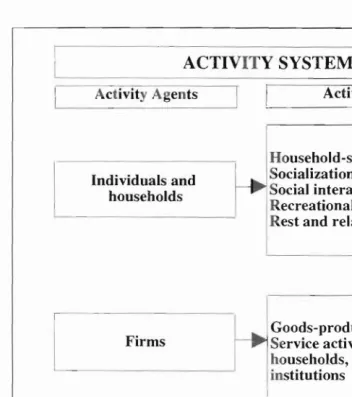
Urban planning basically deals with the key systems that influence the physical structure of the city. These are activity systems. development systems and environmental systems. Activity systems as concerned with how man. through his institutions such Is households. firms and governments. organises his affairs in the pursuit of human needs and how these institutions interact with one another in time and space. Activity systems determine demands for various urban spaces such as housing. recreation. commercial. urban facilities and infrastructure (Figure 1).
The land development system focusses on processes that convert space and adapt it for use of activitiy systems. The principal agents in the development systems include pre development landowners. developers. consumers, financial intermediaries and public agencies. They relate to the supply side of the urban development process (Figure 2).
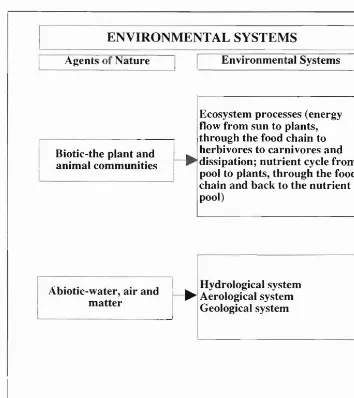
The third class of systems that influence urban development is the environmental systems that provide the niche for human existence and the habitat and the resources to sustain man. These include plant. animal life systems and the fundamental processes relating to water. air and matter. Environmental systems function both to constrain and to enhance the functioning of the other two system classes (Figure 3).
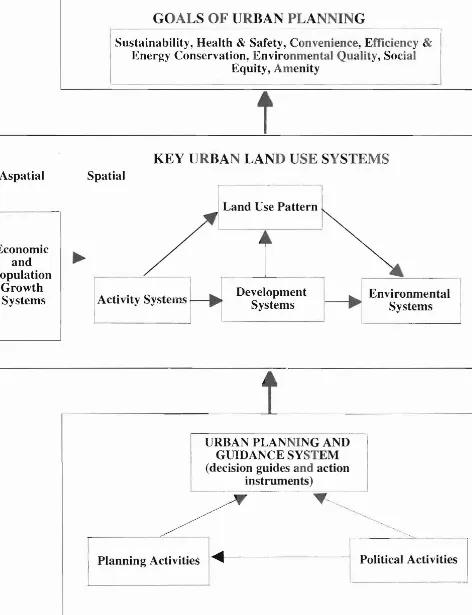
Urban planning is viewed as the process of intervention in the urban land use systems to achieve certain goals of urban development that relate to public interest such as sustainability. health safety. convenience. efficiency, energy conservation, environmental quality. social equity and amenity (Figure 4).
Planning activities include the preparation of development plans and the conducting of planning studies that can be used as gutdes for planning decisions. The preparation of development plans involves not only urban planners but also other various agencies and the public. The decision to adopt a particular plan and approval of development proposal is made by the state or local authority concerned. Development control is one of the important mechanisms in planning to ensure that the proposed urban development complies with planning guides.
3.0 Sh iftin g Themes In Urban Planning
3.1 Master Plann ing
Master planning is one of the earlier approaches to planning that is trying to solve urban problems through the medium of the plan or the blue print. Urban development regulations are based on land use map, zoning, density control. building regulation and planning standards. The approach
a ttempts to influence or direct all acti v it ie s related to the physical environment for the public benefit and amenity. Due to its physical nature and rigidity. the master planning approach is regarded as failing to deal with various social issues such as urban
poverty. unemployment and urban
inequalities. and such unable to cope with the rapid technological and economic change. The master planning approach incorporated under Town Board Enactment or Cap 137 was practiced in Peninsular Malaysia for at least 50 years until the end of 1970s. before it was replaced by a development planning system under the Town and Country Planning Act of 1976.
3.2 Procedural Planning
Procedural planning emphasises on solving urban problems based on rational procedures and methods for decision making. The procedures and methods basically focus on the planning process that begins with the clarification of policy goals. systematic analysis. logical generation of policy alternatives, systematic evaluation of these alternatives and monitoring performance. Urban planning is conceived as a continous process of managing urban change. The plan. although in principle deals with land use matters, incorporates elements of social and
ACTIV
ITY
SYSTEMS
Activity Agents
Individuals and households
Firms
Institutions
- .
~
I
Activity Systems
Household-sustaining activities
Socialization activities
Social interaction activities
Recreational activities
Rest and relaxation activities
Goods-producing activities
Service activities to individuals,
households, firms, and
institutions
Human development activities ~ Basic public service activities
I
Acti~itiesfor the welfare of---~ special groups
Source:Adapted fro mCha pinand Kaise r (1979:29)
FIGURE 1: ACTIVITY SYSTEMS
LAND
D
E
VEL
O
PM
EN
T
S
YSTE
MS
I
I
[
De
velop
ment A
gents
De
v
e
lop
ment
Syste
ms
I
I
I
L
and marketing (a
s
sessmen
t
of
Predevelopment
-
~
utility of con
tinuing
land in
landowners
p
resent state v
s.
retur
n from
IseIli
n
g or
leasing
it
)
I-J
L
and
con~er
si
o
n
or
Developers
I
reconversion
I
I
_
~
P
u rchasing or
le
as
in
g loc
ations
Consumers
I
I
and facilities
Acquisition a
nd
devel
op me
nt-Financial intermediaries
~
fi
n
a ncing transactions
f-
~
R
e
v
iew
an
d a
p pr
ov
al
o
f land
u
se
Public agencies
l
a
nd
devel
o
pment
Source:Adaptedfrom Chapin and Kaiser(1979:30)
FIGURE 2: LAND DEV
ELOPMENT
S
Y
ST EMS
ENVIRONMENTAL SYSTEMS
Agents of Nature
Biotic-the plant and
~
.
animal communities
I
Abiotic-wa ter , air and -~matter
Environmental Systems
Ecosystem processes (energy flow from sun to plants, through the food chain to herbivores to carnivores and dissipation; nutrient cycle from pool to plants, through the food chain and back to the nutrient pool)
Hydrological system Aerological system Geological system
Source :Adap ted fro m ChapinandKaiser (1979:30-31)
FIGURE 3: ENVIRONMENTAL SYSTEMS
G
O
ALS OF
U
RBAN PL
A
NNIN
G
r - - - -- - -
-Sustainability, Health &
Safety, C
o
nve
n
i
e
nce,
E
fficie
nc
y
&Energy Conservation,
E
nviro
n
m
e
nta l Qual
ity
, So
ci
a
l
Equity,
Am
enity
Aspatial
Economic
and
Population
Growth
Systems
KEY U
RBA
N
LAN
D
U
S
E
S
YS
TE
MS
Spatial
/
Land Use Pallern
__
r=
~
....
Development
~
Environmental
Activity Systems t--
~S
...
ystems
1_Systems
.---
-
- -
-
- - - _
._
URBAN PLAN
NING
AND
GUIDANCE SY
S
TEM
(
decision guides
a
nd
action
instruments
)
-
-
-
.
--
~
'--
/
- - - -..
,
-
;
~
,
,----
/
...' ... ...,Planning Activities
Political Activities
Source: Adapted from Chapi nand Kaiser(1979:65)
FIGURE 4: URBAN PLANNING FRAMEWORK
economic planning. Tile policies and
proposals in the plan are constantly reviewed
to mo nitor its performance an d to makc
adj u s tment whenever necessary. The
procedural planning approach was q uitc
dominant in the UK until 1970s.
This approach is incorporated in the cu rren t
development plan system in Peninsular
Ma la ys ia un der the Town an d Country
Plann ing Act of 197 6. The preparation of
Structure Plan and Local Plan is supposed to
follow the rational proc e d u r e s and methods
such as the systematic analysis of strategic
sectors. identification of problems and issues.
and the derivation of proposals on the basis
of the findings. The public is also given
opportunities to comm ent on the findings of
the Report of Survey and also propos als in
the Draft Plan which are exhibited.
In reality the implementation of procedural planning is basically too ideal given limited
information available to fulfil the requirement
for rational model. The political
circumstances also inhibit the application of the rational model. The preparation of the plan was also time consuming because of the
various procedures that needed to be
followed before the plan could be gazetted.
Given the rate of growth of the Malaysian
economy and the rate of urban development,
changes have occured too quickly for the plan
to cope. Although Structure Plan is claimed
to be flexible. most of the plan that had been
prepared are already outdated and some of them become obsolete even before gazetted.
In addition. the development plan system had
been too focused on the process and
procedures of the preparation. with less
thought given to developing proposals. As a
result poor quality plan have in some cases
been produced and many policies have not
been implemented (Abdul Munit Kasimin, 1996).
3.3 Th e 1990s-Sustainable Development
Sustainable development emerged as a result
of the increase awareness among the public
on the issue of the environment, particularly
in relation to problem of urbanization,
degradation of the environment and depletion
of resources. Earlier concern on
environmental sustainability was expressed
at the Biosphere Conference in Paris in 1968
which calle d for the conservation of natural
resources in the interest of sustainable future
use by mankind. However. the sta r ti n g point
JURNA L ALAM BINAJILl D 1NO.1 : MAC 1998
of the su s ta in a b le development concept that
drew global attention was the declaration of
the UN's Co n fe r e nc e on Environment an d
Development at Rio de Jeneiro in 1992 which
issued Agenda 21 . The conference marks the
tu r n in g point for a more deliberate
integration of environmental factors in
planning and development. The following are
som e of the principles from Rio Declaration
on Environment and Development (Selman,
1993) :
• Sustainable co n s u m p ti o n of resources
(environmentally sound use of new and
renewable sources of energy and natural
resources. purchasing policies etc.)
• Sustainable human se t tl e m e n t s
(innovative planning strategie s, gUiding
cities along sustainable paths etc.)
• Integration of environment and
development in decision making (in
planning. EIA, data management etc).
• Sustainable Resource Management
(protection of mountain areas,
su s t a i n a b le agriculture and rural
development, conservation of biological diversity, protection of marine resources,
including the integrated management and
su s ta in a b le development of coastal areas).
• Envtrorimentally so u n d management of
solid wastes.
In response to the global issues of the
environment, including the Agenda 21, as
well as the few incidents on environmental
disasters that have occurred within the last
few years. some measures considering
environmental factors in development have
been taken by the Malaysian government in
the planning process. In relation to urban
planning in Peninsular Malaysia. the recent
1996 amendment of the Town an d Country
Planning Act of 1976 includes measures for
the provision of adequate open spaces. the
preservation of the natural topography, the
protection of trees. the conservation and
rehabilitation of b u i ld i ng s of historical
sign tfica n ce , architectural merit and cultural
heritage . and the needs to prepare and submit
a Dev elopment Proposal Report which
indicate the impact of the proposed
development on the surrounding areas. when
su b m ittin g application for ap p r ova l of the
development (Zainuddin. 1996). The impact of the new requirements in planning is yet to
be se e n , but basically its effectiveness
depend s not only on the co m m it m e n t of
planners but more importantly. the decision
makers who approve the development and
the developers who are directly involved in
the implemention of development projects on
the ground.
3.4 Information Technology (IT) and Urban Planning
The period of the 1990s has seen rapid technological development. in particular the
growth of information and telecom
munication technologies. As mentioned by
Peter Dicken (1992), the advances that have had great impact on development involve
convergence of computer and telecom
munication technologies into a single system of information processing and exchange. This enables global comunication to take place easily and cheaply thus facilitate the firms to organise their activities across international boundaries and create a complex of inter linkages across nations that has been termed
"glob aliza ti on ". Communication system have
been transformed radically with the development of satellites technology and optical fibre networks linking together with
computer technology. The impact of the IT
has begun to take place as more people, firms and institutions are using the technology including personal computer, internet, fax
and cellular phone for communication. It is
too early to assess the impact on the behavior of the society although Alvin and Heidi Tofler (1994) did suggest some of the probable consequences to the society.
In urban planning, some ideas of integrating
IT have been developed. The concepts such as
an "Intelligent City", "Mu lti- m e d ia Super Corridor", "Eco- Media City" are some of the emerging themes in urban development and
planning. The planning of the future city
needs to incorporate the development of an IT infrastructure linking the global IT networks to individual units in urban centres.
4.0 Towards Partnership Approach In Urban Planning
The effective implementation of planning strategies and vision for the city depend on the actions of various actors in the urban
development process. Within the context of
liberalization, the role of the private sector will become more important in providing
infrastructure and services to the public. The
8
public sector should play an important role as facilitator and enabling agent in the
development process, providing an
environment and mechanisms for the performance of the private sector to achieve
the overall vision of development. The
involvement of the private sector in urban
developmen t should begin from the
formulation of the urban plan. This is
important because the outcome of planning has important implications for future private investment. The involvement of the private sector will ensure that the plan fonnulated will not only consider the general interest of the public but also economic and financial
implications of the plan. At the same time
those in the private sector will be able to understand better the planning process and procedures for development and provide greater certainty in investment decision.
Under the current planning system in Peninsular Malaysia, the framework for public participation (including private sector) in the preparation of Structure and Local plans is provided under the Town and Country Planning Act of 1976. The participation of the public in the formulation of the Structure
Plan is mandatory at two stages:
a . After survey and analysis had been
completed and the report of survey is
ready for the public.
b. When the draft structure plan is ready
for public inspection at which time the public is allowed to make objections.
In the case of Local Plan only the draft plan is required to be made availabe for public inspection and comments.
The experience of Structure Plan shows that the participation from the public was not encouraging even in large metropolitan areas. The number of people visited the plan exhibition was relatively very small, and not many memoranda were received by the local
authorities (Goh Ban Lee, 1991). The real
reasons for the poor participation from the public are not known but it is obvious that the mechanisms of public participation adopted which allow participation only after the documents are completed is not effective.
In the process of plan formulation there is a
need for supporting mechanisms, other than
inviting participation through exhibition, for
an effective involvement of the private sector,
dep artm ents and agen ci e s . selec t e d repre s entatives from the private secto r an d ot her sta ke holders to provid e con tin uous input to the process of plan prep aration . This co re gr o u p might function in a mann er sim ilar to a steeli n g co m m ittee.
For wider participation a ser ies of workshops and brainstorming sessio ns cou ld be condu ct ed to discus s lo c al issu es, for m u la ti o n of vision. ob jec t ives and propos als.
5.0 Conclusion
Planning is needed much more today than in the pa s t bec au s e we are de aling with more people. with different needs an d ex p ectatio ns.
The rap id adva n c e me n t in te chn ol ogy not on ly increa ses the complexity of the urban sit ua tio n but also incre a s e s the rate of cha nge an d magnitude of impa cts. Urbanization also results in pre s sure for the ra p i d ex p lo it a t io n of natural resourc es; without proper management of res ourc es there is a tendency towards degradation of the environment.
The partnership between public an d private sec to r s in urban planning is one of the mech anism s for an effective implementation of u rban de v el opment programs to achieve urban visions in the future.
Bibliography
1. Abdul Munit Kasmin (1996 ). Ke Arah Pembangunan Suatu Kerangka Keberkesanan Pelaksanaan Dasar Rancangan Struktur Yang Melibatkan Sektor Awam Pada Peringkat Awal Keputusan Dasar.
Te st s Ph. D Perancang an Bandar &
Wila yah. Skudai: UTM.
2. Cha p in . F.S an d Kais er, E.J (1979 ).
Urban Land Use Planning. Th ir d Edition. Urbana: University of Illinois Pres s .
3. Dicken. P (1992). Global Shift. Second Edition. London: Paul Cha p man .
4. Goh Ban Lee (1991). Urban Planning in Malaysia. Kuala Lumpur : Tempo Publishing.
JU RN AL ALAM BINAJI LI D 1NO.1 :MAC 1998
5. Healey . Patsy et al (1982). Planning Theory : Prospect for the 1980s.
Oxfo rd: Pergamon Press.
6. Selman. P (1993 ). Planning Post-Rio.
The Planne r. May 1993, pp 17 - 19.
7. Toffl er , A an d Toffler, H ( 1994).
Creating A New Civilization. Atlanta: Turner Publishing.
8. Zainu d din Muhammad (1996).
Pindaan Akta Perancangan Bandar dan Desa dan Implikasinya Terhadap Aktiviti Perancangan dan Pembangunan .
9. Planning Me thod s : Towa rds Achieving Sustain abl e Co m m u n i t y. Pap er Pre s ent ed at 15th. Earoph World Congres s on Sustainable Communitie s . Auckland. 3 - 7 Sep t 1996.