A Preisach Model for Quantifying Hysteresis
in an Atomic Force Microscope
Ralph C. Smith
∗, Murti Salapaka
†and Luke Cherveny
‡∗,‡
Center for Research in Scientific Computation, North Carolina State Univ., Raleigh, NC 27695
†Electrical Engineering Department, Iowa State University, Ames, IA 50011
Abstract
Atomic force microscopes employ stacked or cylindrical piezoceramic actuators to achieve sub-angstrom reso-lution. While these devices produce excellent set-point accuracy, they exhibit hysteresis and constitutive nonlin-earities even at low drive levels. Feedback mechanisms can mitigate the deleterious effects of these nonlinnonlin-earities for low frequency operation but such techniques fail at higher frequencies due to increased noise to signal ratios. In this paper, we quantify the hysteresis and constitutive nonlinearities through a Preisach model. As illustrated through a comparison with experimental data, this provides a characterization which is sufficiently accurate for inclusion as an inverse compensator in various control designs.
Keywords: Atomic force microscope, hysteresis, constitutive nonlinearities, Preisach model
1. Introduction
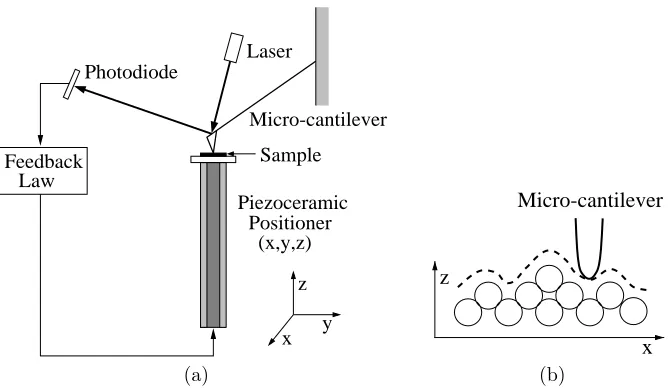
Atomic force microscopes are a subclass of scanning probe microscopes which have redefined diagnostic capabilities in fields ranging from material science to cell biology. To illustrate the construction, capabilities and and current research directions concerning atomic force microscopy, consider the prototypical design depicted in Figure 1a. Longitudinal and transverse actuation is provided by either a piezoceramic shell or a stage forced by a stacked actuator as depicted in Figure 2. As the sample is moved laterally, displacements in an adjacent microcantilever are sensed by monitoring changes in the reflected laser path. Corresponding forces are determined from Hooke’s law and a feedback law is used to determine the distance through which the sample should be raised or lowered to maintain constant forces. After one sweep, this produces a profile of the sample as illustrated in Figure 1b. Details regarding the construction and applications utilizing atomic force microscopes and scanning tunneling microscopes (STM) can be found in [8].
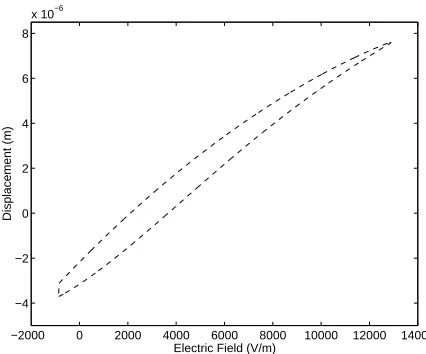
The accuracy of the atomic force microscope is naturally correlated with the accuracy of the stages employed for lateral (x-y) and transverse or vertical (z) transduction. Two configurations which are currently employed are stacked actuators utilizingd33 motion and cylindrical actuators poled ford31 motion. The stacked actuator offers the advantage of simplified construction whereas the cylindrical configuration offers better isolation from exogenous vibrations in addition to small stage construction. While both configurations provide highly repeatable and accurate set point placement, the relations between input voltages and generated strains or displacements exhibit hysteresis and constitutive nonlinearities as illustrated in Figure 3 with data collected from an AFM employing a stacked actuator. At low frequencies, feedback mechanisms can adequately attenuate these effects thus leading to the success of the technologies. However, at the higher frequencies required for current and future applications, two phenomena degrade the accuracy achieved by present control techniques: (i) The piezoceramic materials exhibit increased hysteresis and (ii) The noise to signal ratio in the sensing component of the device
Piezoceramic Positioner
(x,y,z) Sample Micro-cantilever Laser
Photodiode
z
y x Law
Feedback
z
x
Micro-cantilever
(a) (b)
Figure 1. (a) Configuration of a prototypical AFM; (b) Surface image determined after one lateral sweep.
increases to the point where feedback mechanisms are amplifying noise rather than attenuating unmodeled dynamics.
A number of techniques have been developed to quantify hysteresis in piezoceramic materials including phe-nomenological, macroscopic models [6, 7, 15], quasi-macroscopic energy-based models [12, 13, 16] and microscopic models. In this application, the requirement of real-time implementation precludes the use of microscopic models due to the large number of required parameters. We focus here on the development of an appropriate Preisach model due to the generality of the formulation and the rich mathematical framework for the theory. The accu-racy of this model is comparable to that obtained with an energy-based formulation [14] while providing a more general framework. However, the disadvantage of the technique lies in the large number of required parameters and difficulties posed by operating conditions having potential temperature variations and broadband require-ments (see [5, 10] for general discussion regarding techniques for accommodating temperature and frequency dependence in Preisach operators).
Appropriate constitutive relations are summarized in Section 2 and a Preisach model quantifying the hys-teretic relation between input fields and the polarization generated in the piezoceramic positioning elements is presented. The performance of the model is illustrated in Section 3 through a comparison with experimental data plotted in Figure 3.
(a)
(b)
z actuator x-y actuator
−2000 0 2000 4000 6000 8000 10000 12000 14000 −4
−2 0 2 4 6 8
x 10−6
Electric Field (V/m)
Displacement (m)
Figure 3. Relation between the input field E and displacements generated by a stacked PZT positioning mechanism in an AFM.
2. Constitutive Models
We consider the quantification of the nonlinear and hysteretic relation between input fields E and strainse
generated in the piezoceramic actuator in two steps; (i) the quantification of the relation between E and the polarizationP and (ii) the characterization of the relation betweenP ande. Based on experimental data in [13], we make the assumption that for the drive levels under consideration, hysteresis and constitutive nonlinearities are primarily manifested in the relation betweenE andP. It is this component that we characterize through a Preisach model. We further assume that the relation betweenP andeis approximately linear as substantiated by classical references [4, 9]. Experiments to validate this latter assumption are currently being performed.
To simplify the discussion, we focus on the development of a constitutive model for the stacked actuator depicted in Figure 2a. The extension of the 1-D constitutive relations to the cylindrical geometry is addressed in [14] and a Preisach model for that actuator configuration can be developed by employing the Preisach relations summarized in Section 2.2 in the 2-D constitutive expressions in [14].
2.1. Constitutive Relations
To motivate an appropriate form for the 1-D constitutive relations for piezoceramic materials, consider first the case of an idealized material which exhibits negligible hysteresis, constitutive nonlinearities, or structural damping. Letσdenote the stress in the material and letsP, cP = 1/sP respectively denote the Young’s modulus and compliance at constant polarization. As illustrated in [9], consideration of the elastic Gibbs free energy for piezoelectric materials then yields the linear constitutive relations
e=sPσ+βP
E=−bσ+χσP
or equivalently
σ=cPe−cPβP
P =χε0E+γσ.
(1)
Hereb, γandχσ= 1/(χε0) are piezoelectric and electric coupling coefficients,χdenotes the electric susceptibility,
andε0is the permittivity of free space. To express the actuator relation in (1) in terms of input voltagesV, the
his the material thickness, to obtain
σ=cPe−cPdV /h
P=χε0E+γσ.
The specific nature of the piezoelectric coefficientd= βχε0 depends on the configuration of the actuator and
manner through which it is poled. The stacked actuator utilizes ad33 effect in which fields in the 3 direction
generate displacements in the 3 direction. Alternatively, transverse displacements in the cylindrical transducer are generated by the d31 effect in which fields through the shell thickness generate longitudinal (1-direction)
displacements.
To incorporate internal damping, saturation nonlinearities, and hysteresis, we generalize (1) to obtain
σ=cPe+cDe˙−cPβP(E, σ)
P =F(E, σ) (2)
wherecD is the Kelvin-Voigt damping parameter andF quantifies the hysteresis and constitutive nonlinearities
inherent to the materials.
One technique for specifyingF is based on the domain wall models detailed in [12, 13] and an AFM model based on this theory is provided in [14]. Alternatively, one can specifyF through a Preisach characterization as discussed in the next subsection.
2.2. Preisach Model
To quantify the nonlinear hysteretic relation between the input field and generated polarization, we consider a general Preisach expansion in which the hysteresis is represented as an expansion based on piecewise constant kernels. More general discussion regarding Preisach models for piezoceramic materials can be found in [6, 7, 15] while analogous theory for magnetostrictive and shape memory compounds can be found in [1, 2, 3, 5, 10, 17].
To motivate a general Preisach kernel, we consider first a single relay operatorks. This kernel is characterized
in terms of crossing timesτ(t) defined by
τ(t) ={η∈(0, t]|u(η) =s1 oru(η) =s2}
whereu=E denotes the input function and s= (s1, s2) are points in the Preisach half plane
S=©s∈lR2|s= (s1, s2), s1< s2ª.
The valuess1, s2 are threshold values for the multivalued kernel as reflected in the definition
[ks(u, ξ)](t) =
[ks(u, ξ)](0) if τ(t) =∅
−1 if τ(t)6=∅andu(maxτ(t)) =s1
+1 if τ(t)6=∅andu(maxτ(t)) =s2.
A depiction of this kernel is given in [15]. The starting value
[ks(u, ξ)](0) =
−1 if u(0)≤s1
ξ if s1< u(0)< s2
+1 if u(0)≥s2
defines the initial state of the kernel in terms of the parameterξ∈ {−1,1}.
The output remains on a branch until a threshold is reached in the monotonically increasing input u. At that point, the output jumps to the other saturation value and remains there until the other threshold value is reached. For example, an output response starting with a value of−1 will retain that value until u(t) reaches
The classical Preisach operators are then defined in terms of parallel collections of these single relay operators. To this end, we letMdenote the set of all finite, signed Borel measures onS and let ξbe a Borel measurable function mappingS → {−1,1}. Foru∈C[0, T] andµ∈ M, the Preisach operator is defined by
[Pµ(u, ξ)](t) =
Z
S[ks(u, ξ(s))](t)dµ(s).
The goal in the parameter identification problem is to estimateµso that a model response “fits” experimental data in a least squares sense. Details regarding the convergence property of the operator with regard to both parameters and time, and extensions to Krasnoselskii-Pokrovskii kernel which avoid the convergence difficulties are summarized in [15].
To numerically implement the Preisach model, it is necessary to approximate both the operator and measure. As detailed in [1, 15], the discrete operator is given by
[Pm(u, ξ)](t) = m
X
i=1
[kni(u, ξni)](t)αni (3)
whereni are nodes in the restricted Preisach planeS∆={(s1, s2)|smin≤s1≤s2≤smax}andαni are weights
in the expansion
µm=
m
X
i=1
αniδni (4)
used to approximate the measure µ by a linear combination of Dirac measures with atoms at ni. Details
regarding the convergence properties of the approximate operator and measures are provided in [1] while an inversion technique utilizing a discrete Preisach operator of this form is experimentally implemented in [17]. The performance of the operator (3) for quantifying the hysteresis and constitutive nonlinearities in the piezoceramic actuators employed in the AFM is illustrated in the next section.
3. Model Validation
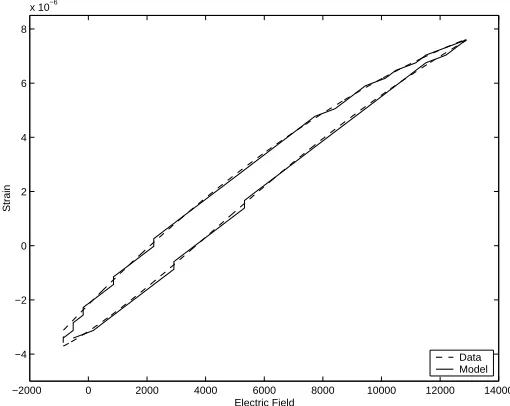
To illustrate the predictive capabilities of the model, we consider the characterization of hysteretic data collected from the stacked actuator depicted in Figure 2a. This data was collected at low frequency and hence represents a quasistatic application of both the device and model. As illustrated in Figure 4, the data is both hysteretic and exhibits certain saturation nonlinearities.
To a construct a Preisach model capable of characterizing the asymmetric hysteresis loop, the measureµ(s) was approximated by the expansion (4) with the coefficientsαni chosen through a least squares fit to the data.
The resulting model response obtained using 80 coefficients accurately characterizes the data as illustrated in Figure 4. Hence the Preisach model provides a technique for accurately quantifying the nonlinear constitutive properties of the transducer but at the expense of a large number of nonphysical coefficients.
4. Concluding Remarks
The Preisach techniques employed here provide a general methodology for characterizing hysteresis inherent to the piezoceramic positioning mechanisms employed in atomic force microscopes. While illustrated in the context of a stacked actuator, analogous models can be developed for a cylindrical transducer by incorporating the Preisach model in 2-D constitutive relations employed in general thin shell theory (see [14]). This provides a technique for constructing a variety of full and reduced-order models for nanopositioners.
−2000 0 2000 4000 6000 8000 10000 12000 14000 −4
−2 0 2 4 6 8
x 10−6
Electric Field
Strain
Data Model
Figure 4. Experimental data from the stacked actuator and model prediction.
Acknowledgements
The research of R.C.S. was supported in part through the NASA grant NAG-1-01041 and in part by the Air Force Office of Scientific Research under the grant AFOSR-F49620-01-1-0107.
References
[1] H.T. Banks, A.J. Kurdila and G. Webb, “Identification of hysteretic control influence operators representing smart actuators Part I: Formulation,”Mathematical Problems in Engineering, 3, pp. 287-328, 1997.
[2] H.T. Banks, A.J. Kurdila and G. Webb, “Identification of hysteretic control influence operators representing smart actuators Part II: Convergent approximations,”Journal of Intelligent Material Systems and Structures, 8(6), pp. 536-550, 1997.
[3] M. Brokate and J. Sprekels,Hysteresis and Phase Transitions, Springer-Verlag, New York, 1996.
[4] W.G. Cady,Piezoelectricity, McGraw-Hill, New York, 1946.
[5] E. Della Torre,Magnetic Hysteresis, IEEE Press, New York, 1999.
[6] W.S. Galinaitis and R.C. Rogers, “Compensation for hysteresis using bivariate Preisach Models,” SPIE Smart Structures and Materials, 1997, Mathematics and Control in Smart Structures, San Diego, CA, 1997.
[7] P. Ge and M. Jouaneh, “Modeling hysteresis in piezoceramic actuators,”Precision Engineering, 17, pp. 211-221, 1995.
[8] P.K. Hansma, V.B. Elings, O. Marti and C.E. Bracker, Scanning Tunneling Microscopy and Atomic Force Microscopy: Application to Biology and Technology, Science, 242, pp. 209-242, 1988.
[9] T. Ikeda,Fundamentals of Piezoelectricity, Oxford University Press, Oxford, 1990.
[10] F. Liorzou, B. Phelps and D.L. Atherton, “Macroscopic models of magnetization,” IEEE Transactions on Magnetics, 36(2), pp. 418-428, 2000.
[12] R.C. Smith and C.L. Hom, “Domain wall theory for ferroelectric hysteresis,”Journal of Intelligent Material Systems and Structures, 10(3), pp. 195-213, 1999.
[13] R.C. Smith and Z. Ounaies, “A domain wall model for hysteresis in piezoelectric materials,” Journal of Intelligent Material Systems and Structures, 11(1), pp. 62-79, 2000.
[14] R.C. Smith and M. Salapaka, “Model Development for the Positioning Mechanisms in an Atomic Force Microscope,” Center for Research in Scientific Computation Technical Report CRSC-TR01-29;International Series of Numerical Mathematics, to appear.
[15] R.C. Smith and S. Seelecke, “An Energy Formulation for Preisach Models,” Center for Research in Scientific Computation Technical Report CRSC-TR02-10; Smart Structures and Materials 2002, Modeling, Signal Processing and Control in Smart Structures, to appear.
[16] R.C. Smith, S. Seelecke and Z. Ounaies, “A free-energy model for piezoceramic materials,” Center for Research in Scientific Computation Technical Report CRSC-TR02-09; Smart Structures and Materials 2002, Modeling, Signal Processing and Control in Smart Structures, to appear.