A quantum Monte Carlo and density functional theory study
of the electronic structure of peroxynitrite anion
J. A. W. Harklessa)
Department of Chemistry, University of California at Berkeley, Berkeley, California 94720-1460 and Chemical Sciences Division, Lawrence Berkeley National Laboratory, Berkeley, California 94720
J. H. Rodriguez
Department of Physics, Purdue University, West Lafayette, Indiana 47907-1396
L. Mitas
Department of Physics, North Carolina State University, Raleigh, North Carolina 27695-8202
W. A. Lester, Jr.
Department of Chemistry, University of California at Berkeley, Berkeley, California 94720-1460 and Chemical Sciences Division, Lawrence Berkeley National Laboratory, Berkeley, California 94720
共Received 16 April 2002; accepted 17 December 2002兲
Single point calculations of the ground state electronic structure of peroxynitrite anion have been performed at the optimized cis geometry using the restricted Hartree–Fock共RHF兲, Møller Plesset second order perturbation theory 共MP2兲, generalized gradient approximation density functional theory共GGA DFT兲in the B3LYP form and two quantum Monte Carlo共QMC兲methods, variational Monte Carlo 共VMC兲and diffusion Monte Carlo 共DMC兲. These calculations reveal differences in atomization energies estimated by B3LYP共287.03 kcal/mol兲, MP2 共290.84 kcal/mol兲, and DMC, 307.4共1.9兲kcal/mol, as compared to experiment, 313共1兲kcal/mol. The error associated with MP2 and B3LYP methods is attributed largely to differential recovery of correlation energies for neutral nitrogen and oxygen atoms relative to the oxygen and peroxynitrite anions. In addition, basis set studies were carried out to determine potential sources of error in MP2 and B3LYP valence energy values. Our studies indicate that MP2 and B3LYP valence energies are strongly dependent on the presence of diffuse functions for the negative ions O⫺and ONOO⫺. © 2003 American Institute
of Physics. 关DOI: 10.1063/1.1544732兴
I. INTRODUCTION
Peroxynitrite (ONOO⫺) is formed by the direct and rapid reaction of nitric oxide with superoxide anion.1–3 Be-cause ONOO⫺ can act as a one-electron oxidant or a two-electron oxidant, it is able to react with a number of biomol-ecules including proteins,4 –11 DNA,12,13 lipids,14 and antioxidants.15,16The reactivity profile of peroxynitrite sug-gests that it is capable of crossing biological membranes faster than its known decomposition rate.17Studies also sug-gest that production of peroxynitrite plays a pivotal role in the apoptosis 共programmed cell death兲 of neural cells18 and aortic smooth muscle cells in rats.19 Similarly, peroxinitrite has been shown to induce apoptosis in human leukemia cells20,21with clear dependence on its length of exposure and concentration. The same study also suggested the ineffective-ness of peroxynitrite at inducing apoptosis in some normal endothelial human cells.20 The high reactivity of peroxyni-trite and its potential role in a wide variety of human diseases have stimulated our present study.
Theoretical studies of peroxynitrite22–25have given some insight on its geometry and electronic structure. Some prop-erties of this anion have also been inferred from studies of ONOOM 共M⫽Li,Na,K兲 共Ref. 26兲 or decomposition of ONOOH.27 None of these studies focus on direct calcula-tions of the molecule as it is formed in vivo, in its unattached ionic state. Factors that may account for the limited applica-tion of computaapplica-tional methods to this system are difficulties encountered with some basis set ab initio methods in treating negative ions of molecules containing nitrogen and oxygen atoms. Motivated by success with quantum Monte Carlo 共QMC兲 in the diffusion Monte Carlo 共DMC兲 approach in treating negative ions28 –30 and, in particular, accurate deter-minations of atomization energies of molecular systems,31–34 we undertook the present study to characterize more fully this important system of biological interest.
The remainder of the paper is organized as follows: Sec-tion II presents a brief discussion of DMC to highlight the basic ideas of the method; Sec. III describes the equilibrium geometry and some aspects of the electronic structure of ONOO⫺; Sec. IV presents valence and atomization energies obtained with various basis sets and methods; and Secs. V and VI discuss the results with some commentary on poten-tial sources of error.
a兲Bell Labs Cooperative Research Fellow at the University of California,
Berkeley. Present address: Physical and Chemical Properties Division, Na-tional Institute of Standards and Technology, 100 Bureau Drive, Stop 8380, Gaithersburg, Maryland 20899-8380.
4987
II. COMPUTATIONAL METHODS
A. Variational Monte Carlo„VMC…
There is a similarity between the Schro¨dinger equation in imaginary time共⫽t兲, written in atomic units,
⌽
⫽
1
2ⵜ
2⌽⫹V⌽ 共1兲
and a classical diffusion equation with a rate term,
dC
dt ⫽Dⵜ
2C⫹kC. 共2兲
In Eq.共1兲,⌽is a quantum mechanical wave function, andⵜ2 and V are the kinetic and potential energy operators, respec-tively. In Eq. 共2兲, C is the concentration, D is the diffusion constant, and k is a rate constant. When the quantum me-chanical wave function in Eq. 共1兲, serves as a probability density in imaginary time, no real time dynamics can be obtained.35–39Using⌽ in this manner is analogous to con-sidering it as a concentration of electrons undergoing rate and diffusion processes.
The conceptually simple variational Monte Carlo共VMC兲 method40– 44uses Monte Carlo integration to evaluate a trial function. Unlike basis set expansion ab initio methods which rely on accurate integration of molecular integrals to achieve high accuracy, VMC trial functions may be of any form. In atomic and molecular applications, this trial function is often a product of an independent particle wave function typically computed in one of the following approximations: Hartree– Fock共HF兲, configuration interaction共CI兲, or complete active space self-consistent field共CASSCF兲, and a correlation func-tion that is explicitly dependent on interparticle distances. The probability distribution used in the Monte Carlo integra-tion is taken as the square modulus of the trial funcintegra-tion, and in all-electron VMC the energy is an upper bound to the exact energy of the state being evaluated. The form of the estimator used in VMC is
具
E典
⫽具
⌿兩H兩⌿典
具
⌿兩⌿典
⫽冓
⌿
冏
H⌿⌿冏
⌿冔
具
⌿兩⌿典
⫽具
⌿兩EL兩⌿典
具
⌿兩⌿典
⫽具EL典
,共3兲 where EL is the ‘‘local energy,’’ defined as H⌿共B兲/⌿共R兲.
B. Diffusion Monte Carlo
The DMC method is based on stochastic simulation of the Schro¨dinger equation in imaginary time; the latter may be written,45– 47
f
t⫽
1
2ⵜ共ⵜ⫺F兲f⫺共EL⫺ET兲f , 共4兲
where the distribution
f⬅⌿T⌽. 共5兲
Here⌿Tis a known wave function and⌽is the exact
solu-tion, and
F⬅ln兩⌿T兩2 共6兲
is labeled the quantum force. The parameter ETis an energy
offset, and
EL共R兲⬅
Hˆ⌿T共R兲
⌿T共R兲 共
7兲
is the local energy, where R denotes the 3N coordinates of the system. We choose⌿Tas the product of an
independent-particle wave function, ⌿0, and a correlation function U, i.e.,
⌿T⫽⌿0exp U, 共8兲
where
U⬅U共ri j,ri␣,ri兲. 共9兲
In Eq.共9兲, the ri jare electron–electron distances, and the ri␣
and ri are electron–nuclear distances. The parameter ET is
generally chosen to be close to the expected value of the local energy in order to reduce the magnitude of the last term on the r.h.s. of Eq.共4兲. The function F produces a drift in the simulation that increases sampling in the regions where the wave function is large. The fixed node approximation im-poses the nodal structure of ⌿T on ⌽ which insures f is non-negative for all R.
In the present study, the independent particle wave func-tion ⌿0 is chosen as a restricted Hartree–Fock共RHF兲wave function. The correlation function is a Schmidt–Moskowitz44 adaptation of the Boys–Handy function,48 which includes terms describing two- and three-body interactions. The cor-relation function parameters were optimized by minimizing the variance of the energy estimate from a Monte Carlo in-tegration.
There are a number of DMC studies that have demon-strated the successful application of this method in conjunc-tion with effective core potentials 共ECP-DMC兲.49–54 More specifically, ECP-DMC studies of second row bond energies and electron affinities have been reported which agree well with experiment54,55 and have been able to distinguish be-tween alternative experimental analyses.56The DMC method is relatively insensitive to choice of basis set for the independent-particle part of the trial function. With a single-reference wave function, we used a cc-pVTZ basis set57with no F functions for single-point energy calculations. In DMC, effective sampling of the regions of space occupied by core electrons is costly; it is this additional cost that serves as additional motivation for using ECP’s. Estimates of compu-tational effort for all-electron QMC for atoms yield 55– 65 dependence, where Z is the atomic number.50 The use of ECP’s has been found to reduce this dependence to roughly
In addition to the benefits of ECPs in general, there are alternative ECPs that have been recently developed for the oxygen and nitrogen atoms which enhance the efficiency of DMC simulations. These ECPs, which are similar to the soft ECPs of condensed matter physics58 and to a soft ECP re-ported for carbon,59 are characterized by the absence of the
r⫺2 term common to ECPs in quantum chemistry.59,60DMC simulations using the soft ECP are found to yield a smaller statistical error bar than the Stevens, Basch, and Krauss 共SBK兲 function60 for comparable computing time. The soft ECP also yields comparable valence variational Monte carlo 共VMC兲 energies and slightly lower valence DMC energies, compared to the SBK ECP. For these reasons, we carried out DMC calculations only using soft ECPs.
III. GEOMETRY AND VALENCE ELECTRONIC STRUCTURE
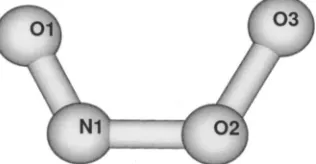
The geometry of ONOO⫺ was optimized at the B3LYP/6-311⫹G*, B3LYP/cc-pVTZ, and MP2/cc-pVTZ levels. The B3LYP parameters obtained with 6-311⫹G*共92 basis functions兲 and cc-pVTZ 共140 basis functions兲 were very close and displayed similar trends as those derived from MP2; see Table I. In agreement with previous studies,22,23 our optimizations revealed the planar cis conformer as the most stable geometry with outer O1vN1, central N1–O2, and outer O2–O3 bonds共Fig. 1兲.
Figure 2 shows the frontier Kohn–Sham orbitals of ONOO⫺. The HOMO is mainly localized on the terminal oxygen of the superoxide fragment. By contrast, the LUMO is mainly localized on the nitric oxide fragment and in this regard is analogous to the*orbitals of free NO.61To check the nature of the singlet ground state of ONOO⫺ both re-stricted and unrere-stricted density functional calculations were carried out. The frontier orbitals with ␣ and  spin index were indistinguishable in the unrestricted calculation
con-firming the closed-shell singlet character of the ONOO⫺ ground state. We also notice that, despite the auxiliary char-acter of Kohn–Sham orbitals,62 which makes it difficult to give them a well defined physical meaning, DFT and ab
initio wave function methods共MP2兲yielded similar trends in frontier orbital composition and charge distribution. As shown in Table II, most of the negative charge is localized on the terminal oxygen of the superoxide fragment 共O3兲, con-sistent with the spatial distribution of the HOMO. The per-oxynitrite anion is known to react with transition metal-containing complexes, for example with the irons of hemoproteins.63 The similarity of its LUMO with the *
orbitals of free NO strongly suggests that some similar metal–ligand bonding interactions are at work in the binding to metals of these two ligands.64
IV. CALCULATED ENERGIES
For the QMC calculations, we used RHF/cc-pVTZ
orbit-als generated at the B3LYP/cc-pVTZ optimized
geometry.57,65Ground state energy calculations with each of the above methods at their respective optimized structures revealed a specific ordering of total valence energies calcu-lated by RHF, MP2, and B3LYP, as well as VMC and DMC. The ordering of the energies in Table III is typical for this group of methods.
Although the VMC and DMC calculations used RHF orbitals with a cc-pVTZ basis, the QMC results only have a small, indirect basis set dependence. Basis set effects in DMC are limited to instances of poor description of the or-bitals from traditional ab initio techniques. In order to guar-antee effective orbital descriptions, we used either large basis sets or custom bases that have been developed to work well in DMC calculations. We also included a VMC valence en-ergy for the SBK-ECP for comparison with a soft ECP de-veloped by one of us 共L.M.兲. As mentioned above, the soft ECPs are more stable and provide slightly lower energies. The increased efficiency of the soft ECP can be observed by comparing the error bars of the VMC calculations: 0.0025 TABLE I. Optimized bond lengths 共angstroms兲 and angles 共degrees兲 of
ONOO⫺.
B3LYP 6-311⫹G*
B3LYP cc-pVTZ
MP2 cc-pVTZ
O1vN1 1.213 1.214 1.234 N1–O2 1.367 1.362 1.336 O2–O3 1.388 1.382 1.358
O1–N1–O2 116.3 116.1 115.4 N1–O2–O3 118.4 118.4 117.9
FIG. 1. Optimized geometry of peroxynitrite ion. Metric parameters are given in Table I.
FIG. 2. HOMO共left兲and LUMO共right兲of peroxynitrite calculated at the B3LYP/cc-pVTZ level. The HOMO is mainly localized on the superoxide fragment, whereas the LUMO is mainly localized on the nitric oxide frag-ment.
TABLE II. NBO atomic charge densities of ONOO⫺共cc-pVTZ basis兲.
B3LYP MP2
O1 ⫺0.457 ⫺0.419
N1 ⫹0.196 ⫹0.174
O2 ⫺0.142 ⫺0.087
Hartree共SBK兲and 0.0010 Hartree共soft兲. These statistics are for equivalent computer time; halving the error in the VMC calculation with the SBK ECPs would require about four times more computational effort. The increased efficiency is the reason we restricted use to only the soft ECPs in the DMC calculations. Soft ECPs suitable for QMC have re-cently been extended to Be through Ne and Al through Ar.66 We used the following expression to estimate the atomi-zation energy (Ea) of peroxynitrite in VMC and DMC,
Ea⫽E共O⫺兲⫹2E共O兲⫹E共N兲⫺关E共ONOO⫺兲⫺ZPE兴,
共10兲 where E is the Monte Carlo valence energy of the indicated species, and ZPE is the zero-point vibrational energy deter-mined by theory. We used an identical construction for the atomization energy estimates in the all-electron calculations for B3LYP, MP2, and RHF. While we computed energies for all species with and without the use of ECP’s in the RHF, MP2, and B3LYP methods, we report the all-electron values in Table IV. The ‘‘valence’’ values reported in the other tables incorporate the ECP’s of Stevens, Basch, and Krauss,60and are included as such to facilitate comparison to our ECP Monte Carlo energies. We find that the oxygen an-ion is a reasonable choice for the charged atomic species because it is more electronegative than nitrogen, and because of our use of the electron affinity of oxygen in computing an experimental atomization energy. This decision is also sup-ported by examination of the results from the basis set meth-ods, which consistently placed partial negative charges on the oxygens independent of the level of theory or basis set used 共Table II兲. The experimental atomization energy was estimated by taking the difference of the heats of formation for the three atomic species from standard reference tables67 and the heat of formation reported by Mereyni et al.68 As shown in Table IV, atomization energies obtained with RHF,
MP2, B3LYP, and VMC yield estimates in poor accord with the experimental atomization energy. Good agreement, how-ever, is obtained with DMC.
V. DISCUSSION
Calculated oxygen anion valence energies provide the clearest indicator of a potential source of error in estimating the atomization energy from ab initio wave function and GGA DFT methods for the present systems. Changing from the 6-311⫹G* 共92 basis functions兲 to the larger cc-pVTZ 共142 basis functions兲unexpectedly decreased the valence en-ergies calculated with ROHF and B3LYP 共Table V兲. The generally expected effect of increasing the number of basis functions is a decrease in energy due to an improved ability to approximate the wave function of a given system. This unexpected basis set effect encountered in ROHF and B3LYP energies led us to investigate the specific role of the types, as opposed to the number, of basis functions. More specifically, additional calculations were performed using the 6-311G*and aug-cc-pVTZ bases to complete Table V and to investigate the effect of diffuse functions on the converged valence energies of O⫺ and ONOO⫺.
In Table VI we compare valence energy differences from calculations with the 6-311G*and 6-311⫹G* split-valence bases, and calculations with the cc-pVTZ and aug-cc-pVTZ bases. With the additional diffuse functions, the ROHF 共B3LYP兲energies for the oxygen anion in the split-valence bases were lowered by 0.039 共0.057兲 Hartree, whereas the peroxynitrite energies were lowered by 0.021 共0.033兲 Har-tree. For the correlation consistent bases, oxygen anion en-ergies decreased by 0.024 共0.038兲Hartree and peroxynitrite energies by 0.014共0.027兲Hartree. Upon addition of diffuse functions, the MP2 energy decreases were roughly equal for O⫺ and ONOO⫺ in the correlation consistent bases. These findings, however, are consistent with reports that stress the need for diffuse orbitals when treating negative ions.69,70 Even though single point 6-311⫹G* calculations on TABLE III. Valence energies of ONOO⫺共hartree兲.
Method 6-311⫹G* cc-pVTZ aug-cc-pVTZ RHF ⫺56.670 29 ⫺56.717 48 ⫺56.732 53 MP2 ⫺57.484 05 ⫺57.655 72 ⫺57.702 77 B3LYP ⫺57.820 00 ⫺57.853 68 ⫺57.875 57 VMC/SBK ECP ⫺57.5005共25兲a
VMC/soft ECP ⫺57.5111共10兲a
DMC/soft ECP ⫺57.8509共9兲a aTruncated cc-pVTZ basis set without F functions.
TABLE IV. Atomization energies of ONOO⫺共kcal/mol兲.
Method 6-311⫹G* cc-pVTZ aug-cc-pVTZ All-electron RHF 62.65 78.19 69.63 All-electron MP2 267.11 290.84 282.99 All-electron B3LYP 286.01 287.03 276.02 VMC/soft ECP 204.0共1.8兲a
DMC/soft ECP 307.4共1.9兲a
Experimentb 313共1兲
aTruncated cc-pVTZ basis set without F functions. bReferences 67 and 68.
TABLE V. Valence energies of O⫺共hartree兲.
Method 6-311G* 6-311⫹G* cc-pVTZ aug-cc-pVTZ ROHF ⫺15.590 00 ⫺15.627 96 ⫺15.617 95 ⫺15.641 32 MP2 ⫺15.752 16 ⫺15.810 27 ⫺15.825 70 ⫺15.868 12 B3LYP ⫺15.856 35 ⫺15.917 33 ⫺15.893 80 ⫺15.932 65 VMC ⫺15.8233共5兲a
DMC ⫺15.8854共8兲a aTruncated cc-pVTZ basis set without F functions.
TABLE VI. Change in anion electronic energies due to addition of diffuse functions 共hartree兲. ⌬Ecc⫽Eaug-cc-pVTZ⫺Ecc-pVTZ
a
and ⌬Esv⫽E6-311⫹G*
⫺E6-311G*.b
⌬Esv, O⫺ ⌬Ecc, O⫺ ⌬Esv, ONOO⫺ ⌬Ecc, ONOO⫺
RHF ⫺0.038 554 ⫺0.023 829 ⫺0.021 175 ⫺0.014 166 MP2 ⫺0.055 501 ⫺0.043 883 ⫺0.038 974 ⫺0.046 126 B3LYP ⫺0.057 427 ⫺0.037 638 ⫺0.032 575 ⫺0.026 744
ONOO⫺ included a smaller number of basis functions as compared to cc-pVTZ, our results strongly suggest that it is the presence of diffuse functions in the former basis set that mainly accounts for the improved energies of the anions studied. In fact, for neutral oxygen and nitrogen the energies were slightly lower for cc-pVTZ relative to 6-311⫹G*. This observation is also consistent with studies that report little effect of diffuse functions on some neutral molecules.70 In addition, the energy differences due to basis set effects were consistent regardless of the presence of ECPs. Improvement due to diffuse functions differed in the third decimal place, with basis set effects being more pronounced in the valence calculations 共Table VII兲.
VI. CONCLUSIONS
The RHF, MP2, B3LYP DFT, and DMC methods have been used to calculate the atomization energy of peroxyni-trite anion. The DMC results are found to lie closest—within 5 kcal/mol—to the experimental value. We also found that the use of soft ECPs instead of the traditional SBK-ECPs provided substantial benefit by improving the overall effi-ciency of VMC and DMC calculations.
Atomization energy estimates from B3LYP and MP2, even with large basis sets, were in poor agreement with the experimental value. At the cc-pVTZ level, the MP2 and B3LYP methods underestimate the experimental value by ap-proximately 25 kcal/mol and 40 kcal/mol, respectively. The atomization energy obtained with VMC was in particularly poor agreement. We attribute the underperformance of VMC to the use of a single-reference starting point for a system with multireference characteristics. At the same time, ROHF, MP2, and B3LYP valence energies of the oxygen anion showed a larger decrease than those of peroxynitrite upon addition of diffuse functions in the split-valence bases. This suggests that a main source of error when calculating atomi-zation energies with these latter methods is the difference in improvement of the valence energies of the anions and atoms of Eq.共10兲due to differences in levels of correlation energy recovered. Finally, our analysis of the valence energies reit-erates the need for diffuse functions when treating negative ions such as O⫺and ONOO⫺.
ACKNOWLEDGMENTS
J.A.W.H. thanks Bell Labs for providing fellowship sup-port. This work was supported by the Director, Office of Science, Office of Basic Energy Sciences, Chemical Sci-ences Division of the U.S. Department of Energy under
Con-tract No. DE-AC03-76F00098, and by NSF Grant No. DMR-0102668 共L.M.兲. Calculations were performed at the National Energy Research Scientific Computing Center 共NERSC兲and the National Center for Supercomputer Appli-cations 共NCSA兲.
1
J. S. Beckman, J. Chen, P. A. Marshall, and B. A. Freeman, Proc. Natl. Acad. Sci. U.S.A. 87, 1620共1990兲.
2R. E. Huie and S. Padmaja, Free Radical Res. Commun. 18, 195共1993兲. 3N. V. Blqugh and O. C. Zafiriou, Inorg. Chem. 24, 3504共1985兲. 4
H. Ischiropoulos, L. Zhu, J. Chen, M. Tsai, J. C. Martin, C. D. Smith, and J. S. Beckman, Arch. Biochem. Biophys. 298, 431共1992兲.
5J. S. Beckman, H. Ischiropoulos, L. Zhu, M. V. D. Woerd, C. Smith, J.
Chen, J. Harrison, J. C. Martin, and M. Tsa, Arch. Biochem. Biophys. 298, 438共1992兲.
6
B. Alvarez, H. Rubbo, M. Kirk, S. Barnes, B. A. Freedman, and R. Radi, Chem. Res. Toxicol. 9, 390共1996兲.
7S. Padmaja, M. S. Ramezanian, P. L. Bounds, and W. H. Koppenol,
Re-dox. Rep. 2, 173共1996兲.
8
W. A. Pryor, X. Jin, and G. L. Squadrito, Proc. Natl. Acad. Sci. U.S.A. 91, 11173共1994兲.
9S. Padmaja, G. L. Squadrito, and W. A. Pryor, Arch. Biochem. Biophys.
349, 1共1998兲.
10R. Floris, R. Piersma, G. Yang, P. Jones, and R. Wever, Eur. J. Biochem.
215, 767共1993兲.
11L. Castro, M. Rodriguez, and R. Radi, J. Biol. Chem. 269, 29409共1994兲. 12P. A. King, V. E. Anderson, J. O. Edwards, G. Gustafson, R. C. Plumb, and
J. W. Suggs, J. Am. Chem. Soc. 114, 5430共1992兲.
13P. A. King, E. Jamison, D. Strahs, V. E. Anderson, and M. Brenowitz,
Nucleic Acids Res. 21, 2473共1993兲.
14R. Radi, J. S. Beckman, K. M. Bush, and B. A. Freeman, Arch. Biochem.
Biophys. 288, 481共1991兲.
15R. Radi, J. S. Beckman, K. M. Bush, and B. A. Freeman, J. Biol. Chem.
266, 4244共1991兲.
16
D. Bartlett, D. F. Church, P. L. Bounds, and W. H. Koppenol, Free Radic. Biol. Med. 18, 85共1995兲.
17J. Lee, J. A. Hunt, and J. T. Groves, J. Am. Chem. Soc. 120, 7493共1998兲. 18J. N. Keller, M. S. Kindy, F. W. Holtsberg, D. K. St. Clair, H. C. Yen, A.
Germeyer, S. M. Steiner, A. J. Bruce-Keller, J. B. Hutchins, and M. P. Mattson, J. Neurosci. 18, 687共1998兲.
19M. O’Connor, A. L. Salzman, and C. Szabo, Shock 8, 439共1997兲. 20K.-T. Lin, J.-Y. Xue, M. Nomen, B. Spur, and P. Y.-K. Wong, J. Biol.
Chem. 270, 16487共1995兲.
21
K.-T. Lin, J.-Y. Xue, F. F. Sun, and P. Y.-K. Wong, Biochem. Biophys. Res. Commun. 230, 115共1997兲.
22M. Krauss, Chem. Phys. Lett. 222, 513共1994兲.
23H.-H. Tsai, T. P. Hamilton, J.-H. M. Tsai, J. G. Harrison, and J. S.
Beck-man, J. Phys. Chem. 100, 6942共1996兲.
24G. V. Shustov, R. Spinney, and A. Rauk, J. Am. Chem. Soc. 122, 1191
共2000兲.
25M. D. Bartberger, L. P. Olson, and K. N. Houk, J. Am. Chem. Soc. 11, 710
共1998兲.
26
H.-H. Tsai, T. P. Hamilton, J.-H. M. Tsai, J. G. Harrison, and J. S. Beck-man, J. Phys. Chem. 100, 6942共1996兲.
27J. D. Watts共personal communication兲.
28R. N. Barnett, P. J. Reynolds, and W. A. Lester, Jr., J. Chem. Phys. 84,
4992共1986兲.
29T. Yoshida, Y. Mizushima, and K. Iguchi, J. Chem. Phys. 89, 5815共1988兲. 30G. Morosi, M. Mella, and D. Bressanini, J. Chem. Phys. 111, 6755共1999兲. 31J. C. Grossman, W. A. Lester, Jr., and S. G. Louie, J. Am. Chem. Soc. 122,
705共2000兲.
32
J. A. W. Harkless and W. A. Lester, Jr., J. Chem. Phys. 113, 2680共2000兲.
33J. C. Grossman and L. Mitas, Phys. Rev. Lett. 79, 4353共1997兲. 34C. W. Greeff and W. A. Lester, Jr., J. Chem. Phys. 106, 6412共1997兲. 35J. B. Anderson, Int. Rev. Phys. Chem. 14, 14共1995兲.
36
K. Ragavachari and J. B. Anderson, J. Phys. Chem. 100, 12960共1996兲.
37
Recent Advances in Quantum Monte Carlo Methods, edited by W. A.
Lester, Jr.共World Scientific, Singapore, 1997兲.
38D. M. Ceperley and L. Mita´sˇ, Adv. Chem. Phys. XCIII, 1共1997兲. 39J. B. Anderson, Rev. Comput. Chem. 13, 133共1999兲.
40
R. E. Lowther and R. L. Coldwell, Phys. Rev. A 22, 14共1980兲.
41S. Y. Huang, Z. Sun, and W. A. Lester, Jr., J. Chem. Phys. 92, 597共1990兲. 42C. J. Umrigar, K. G. Wilson, and J. W. Wilkins, Phys. Rev. Lett. 60, 1719
TABLE VII. Valence energies of oxygen and nitrogen atoms共hartree兲.
O N
6-311⫹G* cc-pVTZ 6-311⫹G* cc-pVTZ ROHF ⫺15.646 47 ⫺15.658 63 ⫺9.630 54 ⫺9.637 93 MP2 ⫺15.772 97 ⫺15.812 26 ⫺9.717 10 ⫺9.740 70 B3LYP ⫺15.862 73 ⫺15.873 23 ⫺9.765 39 ⫺9.771 85 VMC ⫺15.8067共6兲a ⫺9.7394共2兲a
共1988兲; C. J. Umrigar, Int. J. Quantum Chem., Quantum Chem. Symp. 23, 217共1989兲.
43J. W. Moskowitz and M. H. Kalos, Int. J. Quantum Chem. 20, 1107
共1981兲.
44K. E. Schmidt and J. W. Moskowitz, J. Chem. Phys. 93, 4172共1990兲. 45B. L. Hammond, W. A. Lester, Jr., and P. J. Reynolds, Monte Carlo
Meth-ods in Ab Initio Quantum Chemistry共World Scientific, Singapore, 1994兲.
46D. M. Ceperley and L. Mita´sˇ, Adv. Chem. Phys. XCIII, 1共1996兲. 47
J. B. Anderson, Rev. Comput. Chem. 13, 133共1999兲.
48S. F. Boys and N. C. Handy, Proc. R. Soc. London, Ser. A 310, 63共1969兲. 49M. M. Hurley and P. A. Christiansen, J. Chem. Phys. 86, 1069共1987兲. 50B. L. Hammond, P. J. Reynolds, and W. A. Lester, Jr., J. Chem. Phys. 87,
1130共1987兲.
51
P. A. Christiansen, J. Chem. Phys. 88, 4867共1988兲.
52P. A. Christiansen, J. Chem. Phys. 93, 6654共1990兲.
53H. J. Flad, A. Savin, and H. Preuss, J. Chem. Phys. 97, 459共1992兲. 54C. W. Greeff, W. A. Lester, Jr., and B. L. Hammond, in Recent Advances
in Quantum Monte Carlo Methods, edited by W. A. Lester, Jr. 共World
Scientific, Singapore, 1997兲, p. 117.
55L. Mita´sˇ and J. C. Grossman, in Recent Advances in Quantum Monte
Carlo Methods, edited by W. A. Lester, Jr.共World Scientific, Singapore,
1997兲, p. 133.
56
C. W. Greeff and W. A. Lester, Jr., J. Chem. Phys. 106, 6412共1997兲.
57T. H. Dunning, Jr., J. Chem. Phys. 90, 1007共1989兲. Basis sets were
ob-tained from the Extensible Computational Chemistry Environment Basis Set Database, as developed and distributed by the Molecular Science Computing Facility, Environmental and Molecular Sciences Laboratory which is part of the Pacific Northwest Laboratory, P.O. Box 999, Richland, Washington 99352, USA, and funded by the U.S. Department of Energy.
The Pacific Northwest Laboratory is a multiprogram laboratory operated by Battelle Memorial Institue for the U.S. Department of Energy under Contract No. DE-AC06-76RLO 1830. Contact David Feller or Karen Schuchardt for further information.
58T. Sasake, A. M. Rappe, and S. G. Louie, Sci. Rep. Res. Inst. Tohoku
Univ. A 39, 37共1993兲.
59C. W. Greeff and W. A. Lester, Jr., J. Chem. Phys. 109, 1607共1998兲. 60W. J. Stevens, H. Basch, and M. Krauss, J. Chem. Phys. 81, 6026共1984兲. 61
J. H. Rodriguez, Y.-M. Xia, and P. G. Debrunner, J. Am. Chem. Soc. 121, 7846共1999兲.
62R. G. Parr and W. Yang, Density Functional Theory of Atoms and
Mol-ecules共Clarendon, Oxford, 1989兲.
63
D. Pietraforte, A. M. Salzano, G. Scorza, G. Marino, and M. Minetti, Biochemistry 40, 15300共2001兲.
64
NBO 4.0, E. D. Glendening, J. K. Badenhoop, A. E. Reed, J. E. Carpenter, and F. Weinhold共Theoretical Chemistry Institute, University of Wiscon-sin, Madison, 1996兲.
65
M. J. Frisch, G. W. Trucks, H. B. Schlegel et al.GAUSSIAN 94, Revision E.1, Gaussian, Inc., Pittsburgh, PA, 1995.
66I. Ovcharenko, A. Aspuru-Guzik, and W. A. Lester, Jr., J. Chem. Phys.
114, 7790共2001兲.
67
Handbook of Chemistry and Physics, 64th ed.共CRC, Boca Raton兲, pp.
D-77, D-78, E-62.
68G. Merenyi, J. Lind, S. Goldstein, and G. Czapski, J. Phys. Chem. A 103,
5685共1999兲.
69W. J. Hehre, L. Radom, P. v. R. Schleyer, and J. A. Pople, Ab Initio
Molecular Orbital Theory共Wiley, New York, 1986兲.
70J. B. Foresman and A. Frisch, Exploring Chemistry with Electronic