Possibility to Use Solar Chimney to Improve
Stack Ventilation in Tropical Climate
Agung Murti Nugroho 1, Mohd Hamdan Ahmad 2
1. PhD Candidate, Lecturer, University of Brawijaya, Malang, Indonesia
2. Associate Professor, Department of Architecture, Faculty of Built Environment, Universiti Teknologi Malaysia, 81310 Skudai, Johor, Malaysia
ABSTRACT: The climatic conditions of the tropical regions are characterized by high
air temperatures, high relative humidity and very low wind speeds, which make the environmental conditions uncomfortable. A good dwelling design can keep the indoor environment favorable and comfortable during most of the year without the use of any mechanical devices. Depending on ambient conditions, natural ventilation may lead to indoor thermal comfort without mechanical cooling. However, in cases where the wind effect is not well captured or outdoor wind speed is very low, then stack ventilation may be a viable alternative. Stack ventilation standing involved temperature difference experiments which can be done using both experimental and numerical study. This paper evaluates the possibilities of use of solar chimney to improve stack ventilation in Malaysia’s climatic conditions. The use of solar chimneys as stack ventilation in buildings is one way to increase natural ventilation and, as a consequence, improve indoor air quality. The discussion of previous researches indicated that application of solar chimney strategy can increase ventilation performance in the room with optimize configuration variable. Based on the above results a next strategy will be developed to improve stack ventilation.
Keywords: Stack ventilation, Solar Chimney.
Introduction
comfort ills. According to Hui (1998), the indoor air velocity is about 0.04m/s – 0.47 m/s in low rise building under Malaysian climate condition. The reasons may be due to inappropriate design solutions for indoor air movement or low outdoor air velocity remains to be determined. However, recent data from the Malaysian Metrological Service Department showed that mean outdoor air velocity is between 1 m/s to 1.5 m/s and less in suburban terrain roughness (Majid, 1996).
Natural ventilation may result from air penetration through a variety of unintentional openings in the building envelope, but it also occurs as a result of manual control of building’s openings doors and windows. Air is driven in and out of the building as a result of pressure differences across the openings, which are due to the combined action of wind and buoyancy-driven forces. Today, natural ventilation is not only regarded as a simple measure to provide fresh air for the occupants, necessary to maintain acceptable air-quality levels, but also as an excellent energy-saving way to reduce the internal cooling load of housing located in the tropics. Depending on ambient conditions, natural ventilation may lead to indoor thermal comfort without mechanical cooling being required.
Natural Stack Ventilation
through lower openings near its base (Majid, 1996). The same principle can be applied for opening at differences height, the different in pressure between them is due to the vertical gradient (Awbi, 2004).
As applied to a hot humid condition with open windows, the temperature differences between inside and outside is unlikely to exceed 5º C; the maximum height difference between inlet and outlet in a single storey building is less than 1.5m (for a total ceiling height of 3m and an inlet with a sill height of 0.6 m and an outlet with a sill height at 1.8m), the wind speed in the opening would be just over 0.3m/s, but with an average internal wind speed considerably lower and certainly less than 0.25m/s. Following this, Evans (1980) stated that the stack effect cannot be relied on to provide cooling using air movement over the skin under hot humid condition. It utilizes solar radiation, which is abundant in these regions, to generate the buoyant flow. However, as currently applied, the induced air movement is insufficient to create physiological cooling. Velocities associated with natural convection are relatively small, usually not more than 2 m/s (Mills, 1992). Air movement created by the stack effect is usually too weak to achieve physiological cooling. It is less than the recommended air speed range for cooling of 0.15 to 1.5m/s in tropical condition (Satwiko, 1994). More studies are needed to improve the ventilation performance of this cooling method. It can be seen that two means are available for improving air movement: firstly, by increasing the air volume (stack height) and secondly, by increasing the air temperature difference. Meanwhile, the indoor air temperature has to be kept low. All the above designs involve stack effect.
Solar Induced Ventilation
The first type incorporates glazed element in the wall to absorb solar irradiation into the wall structure. The building has double walls which are combined into a shaft at their upper end. The south facing shaft wall was made from glass. The solar radiation that penetrates the glass heats the inner wall. Eventually, this inner wall heats the air which will rise and induce a flow of fresh air from the openings below (Watson, 1979). Two examples of stack induced ventilation concepts is solar collector and stack height. The former shows one way to amplify stack effect by utilizing solar collectors and increasing the height of the hot air column (stack height). Critical parameters of this design are the stack height and cross sectional area of its inlet and outlet. A massive and high version of this type is needed to generate indoor air velocity as high as 1.0 to 2.0 m/s, which can be achieved easily in an ordinary shallow buildings (with no obstruction at all).
The second, form is the solar chimney which has long been known, and applied in vernacular architectural designs. In general, the induced air movement is not used directly to suck indoor air. Instead, it is used for ventilating the building (such as in the double skin building). A stack chimney is usually designed in combination with a wind tower in hot arid climatic regions. In many types of ventilated building, winds are considered to be more important than buoyancy. This is because wind induced ventilation flow is commonly stronger than stack induced flow, in particular, in low rise buildings. A milk house that was built in 1800s is a historical example of a stack chimney application (Satwiko, 1993).
is quite obvious. In his study the term Solar chimney seems to be more suitable as the chimney takes the form of a roof (Barozzi, 1992).
Research of Solar Chimney Ventilation
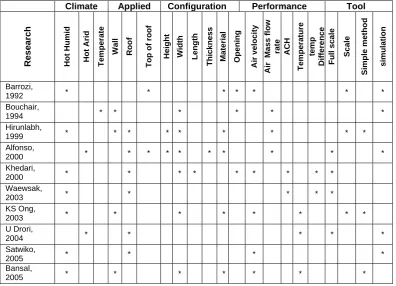
Bansal (2005) developed a steady sate mathematical model for solar chimney system consisting of solar air heater connected to a conventional solar chimney. The estimated effect of the solar chimney was shown to be substantial in promoting natural ventilation for low wind speeds. Table 1 gives the summary of the review on researches on solar chimney ventilation.
Table 1 Summary of previous research related to solar chimney
Climate Applied Configuration Performance Tool
Res ear ch Hot H umi d Hot Ari d Tem p erate
Wall Roo
f Top of roof Heigh t W idth Leng th Thick ness
Material Ope
n
in
g
Air veloci
ty
Air Mass fl
ow
rate ACH
Tem p erat ure tem p Differe nce Full sca le Scale Simple met h o d simula tio n Barrozi,
1992 * * * * * * *
Bouchair,
1994 * * * * * *
Hirunlabh,
1999 * * * * * * * * *
Alfonso,
2000 * * * * * * * * * *
Khedari,
2000 * * * * * * * * *
Waewsak,
2003 * * * * *
KS Ong,
2003 * * * * * * * *
U Drori,
2004 * * * * *
Satwiko,
2005 * * * *
Bansal,
2005 * * * * * * *
Many researches and experiments on solar chimney have been carried out under different conditions and utilizing different building element. From review it is found that researches on solar chimney ventilation can be categorize into:
a. Solar chimney strategy and application
solar chimney. Barrozi (1992) and Alfonso (2003) developed solar chimney built on the top of building that can be used to determine the conventional solar chimney. Barrozi (1992) experimented the building prototype in Nigeria consisted of a single chamber. The dimensions were approximately 5.5m (length) x 3.5m (width) x 3.0m (height), with a corrugated metal roof and fiberboard ceiling. The experiment was performed with a 1:12 scale model of the prototype, constructed with the same materials where possible. A solar chimney was built into the roof to provide ventilation and cooling. Air flowed through the windows and was exhausted out through the top of the solar chimney. Alfonso (2000) indicated the use of solar chimneys in buildings is one way to increment natural ventilation and, as a consequence, to improve indoor air quality. In order to evaluate the contribution of solar chimneys to the natural ventilation of buildings, two chimneys were built, one solar and the other one conventional, each one installed in one compartment of a test cell located in Porto, Portugal.
Khedari (2000), Waewsak (2003), Drori (2004) and Satwiko (2005) developed a roof solar collector that can be used to determine the roof solar chimney. Khedari’s roof solar collector can reduce the mechanical cooling energy cost of new housing built in a hot and humid region, with maximize the natural ventilation and minimize the fraction of sun energy absorbed by a dwelling. The roof solar collector “RSC” used CPAC Monier concrete tiles and gypsum board. Two units of RSC were integrated in the roof structure of the school solar house. The effects of air gap and openings of RSC on the induced air flow rate and thermal comfort were experimented. Waewsak (2003) investigated the performance of a new multi-purpose bio-climatic roof (BCR) developed by The Building Scientific Research Center, Thailand. The innovative
functions of this BSRC-BCR are to decrease daily heat gain through the roof fabrics,
to induce significant air ventilation rate, which improves the thermal comfort of
residents, to ensure appropriate day lighting without any overheating and to act as a
roof radiator during nighttime. Drori (2004) presented a research experimental
the building and forming a duct connected to the inner space of the building. Heated air flows out of the duct while fresh air is sucked into the manufactured home from the surroundings. Satwiko (2005) developed of the prototype roof chimney which takes advantages of the abundant solar radiation of hot humid climatic regions to create buoyancy driven ventilation. This research grows out of a desire to find a Solar-Wind Generated Roof Ventilation System for low-cost dwellings located in high building density urban areas where horizontal air movement is restricted. Solar-Wind Generated Roof Ventilation System was developed as a technique to improve indoor air velocity. It utilizes the available solar radiation and wind to maximize air temperature and wind pressure differences, respectively. A simple residential building type T21 (3x7 m2) located in a high building density area was taken as the case study.
assumed to have negligible mass. Bansal’s (2005) studies are based upon the theoretical modeling and experimental validation studies conducted for a small-sized solar chimney, specially having absorber length less than 1m. The additional purpose of conducting this study for small-sized absorber length was to explore the possibility of using small-size window openings as solar chimneys in hot and arid climatic conditions.
b. Solar chimney and configuration variable
Studies on impact of configuration variable on solar chimney have been expressed in terms of height, length, width, thickness, material and opening. Several studies were concerned with height variable of solar chimney design ventilation. Hirunlabh (1999) found the temperatures increased with increased Metal Solar Wall (MSW) heights. In addition, temperature along the metallic wall height is at a maximum at the middle of the MSW and at minimum near the opening due to the incoming room air at the bottom of the MSW and to the contact with ambient air a the top. Experimental investigations of the performance of the MSW showed that with 1m height and 03.4 cm gap the MSW would produce optimum natural ventilation. Alfonso (2000) evaluated height parameters of solar chimney for satisfying the needed average flow rate. To evaluate the effect of chimney height on ventilation flow rate, several dimensions of chimney height between 0.5 and 3m were simulated. Air flow rate increases for higher values of height (H). The Amplitude in air flow rate (differences with between daily maximum and minimum) increases with chimney height.
Khedari (1998) showed the impact of length variable for solar chimney ventilation. This air velocity could be increased by increasing the surface area of solar chimney or the number of units of solar chimneys on roof, eastern and western walls.
In another study by Alfonso (2000) analyzed the effect of the thickness variable of solar chimney by performing simulations for thicknesses of 5, 10, 15 and 20 cm. Thickness does not change significantly the average flow rates, the maximum being obtained for 10cm. However, air flow distribution along time has some differences. A higher thickness allows more energy storage in the wall, decreasing the flow rate during sunshine hours and increasing it during the night period. However, thicknesses above 10cm do not produce a significant difference in the flow rate time distribution. To investigate the effect of insulation thickness on ventilation flow rate, new simulations for a thickness of 0 and 5 cm were performed. The use of insulation increases both daily and night flow rates. A thickness of 5cm gives results that are similar to the ones of an ideal insulation. Therefore, there is no need of a much higher thickness, for the climatic conditions considered.
surface of the heat absorbing wall is painted black to increase solar radiation absorption. The heat absorbing wall was made of pre-laminated polyurethane sheet, similar to the other solid walls. A 50 mm thick polystyrene sheet was attached to the back of the heat absorbing wall to provide additional heat insulation. The glass cover and the heat absorbing wall provided an air gap through which air could flow. Bansal (2005) used on the exposed side of the shutter of wall solar chimney with a 1mm thick aluminum sheet was attached with the help of glue and nails to act as a solar radiation absorber for the setup. Aluminum sheet was painted black with ordinary paint. On the same side, a telescopic frame of matching size was made with a provision of sliding on rollers. The face of this parallel to the sliding shutter was made with float glass. The vertical side of this telescopic part (parallel to the shutter) was made of 4 mm thick float glass. On the vertical face opposite the absorber, an opening was provided for suction of air from the surroundings. All the sides, exposed to ambient, were insulated using 2.5-cm-thick thermocol (EPS) sheets, for prevention of heat transfer. Similarly, on the backside of the absorber that faces inside of the chamber, 5 cm insulation was provided for prevention of flow of heat in this direction. It can be concluded that in hot climatic conditions, when windows are kept closed/ covered for preventing the entry of solar heat, the concept of solar chimney can be utilized by making minor modifications in the existing window design.
became more and more significant. Consequently, the friction loss at the inlet became the major contribution to the total pressure loss and determined the mass flow rate through the whole system at the large chimney widths. Khedari (2000) investigated different free opening vents. Its dimensions are as follows: 2.68 m height, 3.35m width and 3.45m length. The solar house has a window and a door with a grill on the northern side. The variation of induced air flow rate by Roof Solar Collector for the different opening vents RSC1, RSC2 and RSC3. It was found that with equal and larger size of free inlet–outlet openings, configuration RSC1, the induced air flow rate was the highest one. Therefore, opening vents have to be of equal size and as large as possible. A higher number of Air Change Rate (ACH) could be done by increasing the surface area of RSC, i.e., increasing the number of RSC units and making use of walls to act similarly. Opening the window and door is less efficient than using solar chimneys, as temperature difference between the rooms and ambient was higher than that obtained with solar chimneys.
c. Solar chimney strategy and performances parameters
facade of room. Ong (2003) showed the higher air velocity through the large air gap of solar chimney, causing greater cooling effects on the heat absorbing wall and glass which then tended to be lower. Air velocity increased with solar radiation and larger air gaps. Air velocities between 0.25 m/s and 0.39 m/s for radiation intensity up to 650 W m were obtained. No reverse air flow circulation was observed even at the large gap of 0.3m. It could be seen that the solar chimney induced air flow rates of between 0.25m/s and 0.39m/s at air gaps between 0.1m and 0.3m, respectively at 650 W/m. Satwiko (2005) found, ‘The Solar Wind Generated Roof Ventilation System’ could generate an indoor air speed range from 0.15 to 0.7m/s, with all windows closed, and applying the wind speed of 3.53m/s at 10m above the ground, combined with solar radiation of 540 W/m2. When the wind was calm (0 m/s), the heat from absorbed solar radiation can create an indoor air velocity of 0.4m/s. Obtains thermal comfort through physiological cooling. Increasing air movement is the most logical way to passively achieve thermal comfort in a hot humid climate. Bansal (2005) analyzed the small size solar chimney has opened possibilities of utilizing windows as solar chimneys since the flow velocity up to 0.24m/s has been experimentally recorded. For the three combinations that were experimentally investigated, the highest flow velocity in the chimney was found to be 0.24m/s.
Several studies have been looked about the air mass flow rate performance in solar chimney (Bouchair, 1994; Hirunlabh, 1999 and Alfonso, 2000). In Bouchair’s experiments (1994), a mass balance investigation was also carried out for the mass flow rate through the window (room, inlet), the chimney inlet and the chimney outlet. However, at a chimney width of 0.5m, the measured mass flow rate at the chimney outlet was higher than that through the window and the chimney inlet. Hirunlabh (1999) found that the Metalic Solar Wall with 14.5 cm air gap and 2 m2 of surface area (HxW: 2x1m) produced the highest air mass flow rate of about 0.01-0.02 kg/s. Alfonso (2000) concluded that a significant increase in ventilation rate can be achieved with solar chimney. Average flow rates for a solar chimney are always higher than the ones for a conventional chimney.
the average number of induced air change is about 4–5 ACH, which is not sufficient to satisfy complete resident thermal comfort. A higher number of ACH, depending on season, up to 20 is required for houses without any mechanical cooling device. Waewsak (2003) complete a field measurements of the thermal and lighting performance of the BSRC-BCR demonstrated that this innovative bio-climatic roof could reduce heat gain significantly and induce significant air change. With these characteristics, it is expected that the bio-climatic roof can achieve thermal comfort without any mechanical devices during a long period annually where outdoor temperature is not excessive. The rate of induced air change depends mainly on the intensity of solar radiation. The corresponding induced ACH by BSRC-BCR was quite high during the day varying between 10–15 in summer and 5– 8 in winter. Obviously, this high air change rate induced by BSRC-BCR is due to the fact that more heat is admitted through the transparent tiles. Therefore, the BSRC-BCR can improve indoor thermal comfort considerably. To satisfy resident comfort for different activities and non-air conditioned spaces, a higher ACH is required (about 20–25 ACH). This could
be achieved easily by increasing the number of units of BSRC-BCR.
especially during the afternoon hours. The results show that effective induced ventilation has been achieved, and the air temperature inside the structure typically followed the ambient temperature. In contrast, when the manufactured home had no openings, the temperature inside it was considerably higher than the ambient, especially during the afternoon hours. Bansal (2005) indicated the calculated temperature of glass and air in the flow channel tends to be lower than their respective measured values of the small size solar chimney. It has been found that the developed theoretical model slightly under-predicts the temperatures of glass and air in the flow channel. Nevertheless, it can be concluded that the model can predict the performance of such systems well and this approach is even applicable to small-sized solar chimneys. More heat loss from the absorber reduces its temperature and increases the temperature of air. Due to this increase, the temperature difference between glass and air is reducing; hence the heat transfer from glass to air also gets reduced.
Studies on solar chimney and temperature differences carried out by Khedari (2000) and Waewsak (2003). Khedari (2000) showed the use of Roof Solar Collector to reduce the rate of heat transferred through a ceiling by inducing natural ventilation. The temperature of CPAC Monier, air and gypsum board is changing along with the intensity of solar radiation. When the solar chimney ventilation system was in use, room temperature was near that of the ambient air, indicating a good ability of the solar chimney to reduce house’s heat gain and ensuring thermal comfort. Waewsak (2003) showed the variations of the temperature differences (TD) index for different days in summer and winter, respectively. It can be seen that the TD index of Bio Climatic Roof (BCR) was almost always below or close to neutral (zero) particularly during the hottest midday period (10:00 a.m.–3:00 p.m.). This means that indoor air temperature is distinctly lower than outdoor and BCR has good potential for
decreasing heat accumulation and inducing a high ventilation rate. When compared
to RSC, BCR performs much better as the daytime index is smaller than that of RSC.
It should be pointed out that the TD index is higher than zero in the afternoon (after 4
p.m.) due to the heat gain through the non-insulated west wall (common masonry
coolers. From these results, it can be concluded that the BCR roof design could decrease heat accumulation efficiently year round.
d. Solar chimney and research tool
based on continuous temperature monitoring performed inside and outside the building in summer. Velocity measurements inside the building were performed, as well. Typical experimental runs took from 12 h to a few days. An extensive experimental study included temperature and velocity measurements both in the modified open and the original closed structure, with typical experimental runs from at least one full day to several days long.
Mathematic studies on wall solar chimney use were investigated by using Metal Solar Wall “MSW” by Hirunlabh (2001). Comparison between numerical study and experimental results showed a good agreement. Therefore the numerical model is validated. Thus, it can be used to evaluate the long term reduction of heat transfer into the habitation. Ong (2003) used a mathematical model to simulate the thermal performance of a solar chimney by predicting the surface temperatures of the wall and glass cover and the temperature and induced natural convection flow rate of the air stream in the chimney. More satisfactory qualitative agreement was obtained between experimental and theoretical results. The difference between experimental and predicted instantaneous efficiency values was about 10% in all cases. Bansal (2005) developed a mathematical model for predicting airflow velocity in a solar chimney, through predicting temperature of the absorber, air in flow channel and glass cover. Experimental validation of the model has been done using a solar chimney having less than a 1-m-high absorber. Good agreement between observed and calculated results has been obtained. A mathematical model of the experimental setup was developed for estimating the performance of the solar chimney under different ambient conditions. Validation of the theoretical model with the experimental results was carried out in two steps. The first step was the validation of temperatures at various points and the second one was the validation of the airflow rate.
typical to the system investigated during the day hours. The temperatures of the heated metal sheet and the ambient air were almost constant for 4–5h about noon. Since these temperatures determine the system performance, it was assumed that steady ventilation of the structure could be achieved. For this reason, steady-state simulations were performed at this stage. Transient simulations would have required much more computing resources, and will be performed in the future. The research by Satwiko (2005) used computer simulation techniques to calculate and analyze the aerodynamic and thermal performances of SiVATAS. This included the aerodynamics and thermal consequences for any changes in its form and material. A general purpose computational fluid dynamics (CFD-ACE+) program was utilised to explore, analyse and develop a roof model based on its aerodynamics and thermal performance to obtain optimum wind pressure and temperature differences. Comparisons were made with physical scale models. The CFD program requires inputs representing problem type, flow domain (material, type of flow, etc.), boundary conditions (walls, inlet, outlet, symmetric wall), and calculation method. The problem type is used to activate calculation modules; in this case, Flow, Heat Transfer, and Turbulence modules.
Conclusion
Previous sections reviewed the literature about solar chimney in order to get a clear understanding of the state-of–art knowledge in the field and identify the areas which had not been covered in the past. The review revealed that research on solar chimney had been focused mainly on four issues: solar chimney strategy and application, impact configuration variable, impact performance parameters, and solar chimney research tool. Many studies in hot humid tropical climate suggested that possibility the use of solar chimney to increase stack ventilation in the building but still not enough for thermal ventilation requirement. Also, little studies are applied of combination of solar chimney type in the building to increase thermal ventilation performance.
done was only little research done on related solar chimney configuration with room configuration. Review also suggests that solar chimney have a significant impact on the thermal ventilation specially for psychological cooling. Few studies have looked into this aspect under different thermal comfort ventilation standard, and with different solar chimney strategies. Further they do not produce holistic performance result for any particular climate and thermal comfort standard. Generally, research tool in solar chimney studies used experiment model, but many numeric and computational method was validation. Validation result shows good agreement with real measurement. However, little research done by computational tool and was validations with many experimental model.
Thus, the above reviews suggest that solar chimney strategy on increase air velocity and decrease air temperature has been dealt as separate issues. There is no specific research done to study the relationship between optimal solar chimney configuration and psychological cooling performance. Therefore this next research attempts to focus on the solar chimney configuration to improve stack ventilation for thermal ventilation in tropical condition.
References
Abdul Majid Ismail, 1996, Wind Driven Natural Ventilation in High-Rise Office Building With Special Reference To The Hot-Humid Climate of Malaysia, University of Wales College of Cardiff, PhD, Thesis,
Alfonso, Clito.2000. Solar Chimneys: Simulation and Experiment, Energy and Buildings, Vol. 32, Pergamon Press., pp. 71–79.
ASHRAE Handbook Fundamentals, 1989. American Society of Heating and Air Conditioning Engineers, Inc. Atlanta.
Awbi, Hazim B., 2003. Ventilation of Building, Spon Press, London.
Bansal, N.K, R. Mathur, M.S. Bhandari, 1994. A Study of Solar Chimney Assisted Wind Tower System for Natural Ventilation in Buildings, Building and Environment, Vol. 29, 4, Pergamon Press., pp. 495-500.
Barozzi G.S., Imbabi M.S.-E., Nobile E., Sousa A.C.M. 1992. Physical and Numerical delling of a Solar Chimney-based Ventilation System for Buildings. Building and Environment, Vol.27, No.4, Oxford: Pergamon Press, pp.433-45.
Drori, U, G.Zizkind, Induced ventilation of a one-story real size building, Energy and Building. Vol 36, 2004
Evans M, Housing Climate and Comfort, The Architectural Press Ltd., London, 1980
Flomerics Limited. 2000. “Flo Vent User’s Guide”
Gan, G, A. 1998. Numerical Study of Solar Chimney for Natural Ventilation of Buildings with Heat Recovery, Applied Thermal Engineering, Vol. 18, Oxford: Pergamon Press , p 1171-1187
Hui Seng Kin, 1998. Natural Ventilation of Low Cost Dwellings in The Hot Humid Tropics Malaysia, Master Thesis
Hunt, G.R., Linden, P.F., 1999. The Fluid Mechanics of Natural Ventilation— Displacement Ventilation by Buoyancy-Driven Flows Assisted by Wind. Energy Environ. Vol. 34, pp. 707–720
Khedari J, Weerapong Mansirisub, Sompong Chaima, Naris Pratinthong, Jongjit Hirunlabh. 2000. Field Measurements of Performance of Roof Solar Collector, Energy and Buildings, Elsevier Science Ltd. ,Vol 31, pp 171–178.
Khedari J. 2000. Field Measurements of Performance of Roof Solar Collector, Energy and Buildings, Elsevier Science Ltd. ,Vol 31, pp 171–178.
K.S. Ong, C.C. Chow. 2003. Performance of a Solar Chimney, Solar Energy, Elsevier Science Ltd., Vol. 74, pp 1–17.
Mills A.F.1992. Heat Trans Boston: Irwin. p.293.
M Rajeh. 1989. Natural Ventilation in Terrace Housing of Malaysia: Effect of Air Well on Air Flow and Air Velocity, University of Queensland, Master Thesis.
Sapian Abdul Razak. 2004. Possibilities of using Void to Improve Natural Cross Ventilation in High-rise Low Cost Residential Building, Thesis.
Satwiko, Prasasto.1994. The Development and Modelling of a Natural Ventilation System for Indonesian Conditions, Thesis Master of Building Science, Victoria University of Wellington.
Satwiko, Prasasto.2005. Solar-Wind Generated Roof Ventilation System (SiVATAS) for a Warm-Humid Climate, International Journal of Veentilation, Vol 3 No 3, 2005
Waewsak. J, Hirunlabh, Khedari, U.C.Shin, Performance Evaluation of the BSRC multi purpose Bio-Climatic Roof, Building and Environment, Vol 38, 2003