Develop a Model to Measure the Ethical Effects of
Students through Social Media Use
FAHAD ABDULLAH MOAFA1, KAMSURIAH AHMAD1, WALEED MUGAHED AL-RAHMI2, NORAFFANDY YAHAYA2, YUSRI BIN KAMIN2, MAHDI M ALAMRI3
1Faculty of Information Science and Technology, Universiti Kebangsaan Malaysia, Malaysia 2Faculty of Education, Universiti Teknologi Malaysia, 81310, UTM Skudai, Johor, Malaysia
3Faculty of Education, Education Technology Department, King Faisal University, Alahssa, Saudi Arabia Corresponding author: Noraffandy Yahaya (email: [email protected] & [email protected]).
This work was supported by Faculty of Information Science and Technology, Universiti Kebangsaan Malaysia by giving the authors an opportunity to conduct this research. This research is funded by Universiti Kebangsaan Malaysia under Exploratory Research Grant Scheme ERGS/1/2013/ICT07/UKM/02/1. Moreover, the authors extend their appreciation to the Research Management Centre (RMC) at Universiti Teknologi Malaysia (UTM) for funding this project under grant number PY/2018/02903: Q.J130000.21A2.04E40.
ABSTRACT Social media users can be negatively affected by cyber harassment. These effects can cause emotional distress and lead people to stop using social network sites or to end their life. In addition, the users of this technology usually get upset when network providers interfere and consider such interference to be unfair. Therefore, this study attempted to mitigate the gap in the literature concerning the use of social media for engaging in cyber Harassment in the context of higher education. Therefore, the main objective was to develop a model that will bridge this gap. The model developed in this study is based on the Unified Theory of Acceptance and Use of Technology (UTAUT), Theory of Planned Behaviour (TPB) and technology support. To achieve the study‟s objectives, a questionnaire was used as the main data collection method, and it was distributed to 340 students who used social media. This study argues that these decisions of interference can be handled by employing a method that users find sufficient and appropriate. In conclusion, this research specifically proposes a model for identifying the significant factors that are anticipated to play major roles in minimizing cyber harassment among Saudi students. The proposed model will help administrations and decision-makers formulate strategies that can significantly affect anti-cyber harassment among students.
INDEX TERMS Social Media Used, Engage in Cyber Harassment, Ethical Effects, Technology Use, Theory of Planned Behavior (TPB)
I. INTRODUCTION
The situation where individuals misuse digital media for the purpose of causing emotional damage to others is called cyber harassment [1]. This behavior leads to the suffering of others. Statistics from the United States show that over a half a million people age 18 or older were victims of this harassment [2]. In addition to the fact that victims may stop using these networks, which negatively affects these networking sites [3, 4], the victims may also end their lives [5]. An example of that is the story of an 18-year-old student from the states who committed suicide after he discovered that his roommate spied on him electronically and then used Twitter to gossip about him. Currently, the ways that people communicate, study, work, and interact is strongly influenced by technology, which has penetrated communities, businesses, and the lives of individuals. Much attention by the media has been paid to the issue of cyber harassment, which has become a popular area of research
can be no doubt that the use of innovation and technology is accelerating.
In 2013, as reported by the UN‟s International Telecommunication Union (ITU), 39% of the people in the word (over 2.7 billion people), were using the internet. Societies are given more opportunities and privileges through the rapid development of the internet and the technology of communication. As reported by a study on the use of the internet by children, 93% of children appeared to use the internet weekly, and 60% of 9 to 16-year-olds use it daily. This study, which was conducted on more than 25,000 children in 25 European countries, also reported that 87% of these children use the internet in their homes and 63% use it in colleges. Although teenagers use various technologies to access sexual health information, digital media is still short in filling the sexual health gap.
II. CYBER HARASSMENT EFFECTS
Plenty of services are provided through the internet. Some of these common services are online information exchanges, voting, business transactions, shopping, learning, and online gaming. Regardless of this background, the internet carries much potential for its users, such as better communications, better opportunities in commerce and more developed lives for individuals. All of these privileges directly influence the various behaviors, including financial, social, and the ethical ones. Many activities done through the internet are not harmful to people or individuals, but some activities tend to be the opposite and do not abide by ethical and social norms. These actions are normally conducted by individuals who do not have the same fear of consequences as in the physical world. Some of these corrupt activities might be illegal file-sharing, the accessibility of explicit adult-oriented materials and the possibility of sending spam to millions. These activities can harm lots of users, including businesses and organizations. There is no doubt that the repercussions of cybercrime are a serious global concern. The Kingdom of Saudi Arabia (KSA) is one of many countries that is suffering from cybercrime, and the KSA is one of the most affected countries in the Middle East according to a report from Symantec. In 2014, 62% of internet users in Saudi Arabia faced cybercrimes. Cybercrime is rising across Saudi society, and protecting against cyber threats is an ongoing management challenge for
organizations. The Saudi official report estimated that more than 3.6 million people fell victim to cybercrime [9], which costs individuals a combined US$0.5 billion a year [10]. Saudi Arabia is in the 16th place of the countries that suffer the most from cybercrime in the world[11]. In contrast, [12, 13] students and researchers have positive attitudes and intentions to use social media for educational purposes. As mentioned earlier, in the introduction of this study, cyber harassment is defined as a type of cybercrime in official reports made by Saudi government authorities who specialize in security aspects of information and electronic crimes. They indicate that there is a sharp rise in the proportion of electronic crimes, especially in cyber extortion crimes, and assure that cybercrime is on the rise across Saudi Arabia. The rate increased by 57% in 2014 compared to 2013, and protecting against cyber threats is an ongoing management challenge for organizations [15].
III. THEORETICAL MODEL
the subjective norm (SN), and the perceived behavior control (PBC), which were first referred to in TPB and DTPB. Thinking that they need to implement changes in their work processes, the peers of users might find that they need to use a particular system. To have certain outcomes, employees may insist on using the system. In this case, subjective norms or intentions are not influenced by a monolithic normative structure because the referent groups can terminate one another. Therefore, there were some suggestions that normative beliefs should be decomposed into two referent groups (peers and superiors) since the anticipation of both peers and superiors can be different [17]. In the case of the Perceived behavior control (PBC), three constructs were identified. These constructs are self-efficacy, resource facilitating conditions, and technology facilitating conditions. The first has to do with perceived ability. It is estimated that higher levels of behavioral intentions and IT usage can result from higher levels of self-efficacy [21]. In addition, the UTAUT model is used to discover the demographic factors (moderating factors) that influence the use of new technology by individuals [22]. According to Pew Research Center, UTAUT Factors such as age and gender can affect the experience of
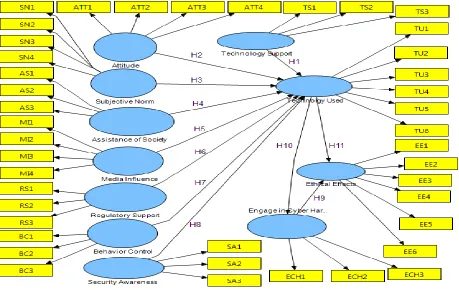
Cyber harassment [23]. Therefore, this study will bridge this gap by introducing a conceptual framework where Theory Planned Behavior (DTPB) is decomposed into the Unified Theory of Acceptance and Use of Technology (UTAUT) and technology support. Therefore, the current model can benefit academics since it illustrates how these factors are related. However, this research found that technology uses for cyber harassment via students results in the three main themes of social, ethical and financial effects. Therefore, the measured, relevant variables for the technology used and the intentions to engage for cyber harassment that were adopted as independent variables in this research are the following: technological support, attitudes, subjective norms, seeking assistance from society, the mass media‟s influence, perceived behavioral control, regulatory support and the governmental role, and security awareness. Additionally, intentions to engage in cyber harassment and technology use for cyber harassment were adopted as mediating variables. Finally, the dependent variables that influence students are the three main themes of social, ethical and financial effects. See Figure 1.
In this section, the model of the current study and the hypotheses based on the model are presented. Moreover, the different factors related to the model of the current study are discussed in the following sections from 3.1 to 3.11.
3.1 TECHNOLOGY SUPPORT
One of the main reasons why some countries are not developed in terms of ICT is because they do not have easy access to the internet or computers. According to Goh (1995), the endeavors of providing the appropriate infrastructure, the necessary tools, internet access and software are known as technology support [24]. The quality of technology and internet services is connected to technology support. A significant positive relation was found between technology support and perceived behavioral control in the case of tertiary students in Malaysian universities. A study found that the availability of technology support would affect those students‟ adoption of the online educational services. In contrast, [25] students and researchers have a positive attitude towards and intentions to use technological tools such as social media for educational purposes.
H1: There is a significant relationship between technology support and the technology used for cyber harassment.
3.2 ATTITUDE
Both theory of reasoned action TRA and Theory of Planned Behaviour TPB are used to estimate and describe the various behaviors that are linked to the limited set of constructs [27]. In this study, DTPB [17] is used, and five perceived attributes of innovation are identified to measure the relation between attitudinal beliefs and innovation. These attributes are perceived ease of use, perceived usefulness, compatibility, trial ability and observability. Other factors were identified by researchers that were related to the attitude dimension in terms of behavioral intentions in adopting new innovations. For example, factors such as perceived risk and trust and awareness were added to the attitude dimension towards behavioral intentions by Al-Majali et al. [28]. The low levels of security and privacy over the internet create a risk that is presented by an obstacle in adopting new technology. Meanwhile, other researchers consider that the use of social media has
positive impacts on collaboration and engagement among students [29].
H2: There is a significant relationship between attitudes and the technology used for cyber harassment.
3.3 SUBJECTIVE NORM
A subjective norm is defined as the social pressure to carry out a certain behavior [30]. The behavior of individuals to abide by security policies is influenced by Subjective norms. The recognition of the risks and the severity of threats is influenced by the protective behaviors of important people, such as mass media, family, friends, leaders, or colleagues [31]. Seeking protective knowledge from those people can enhance the way in which individuals address these threats [32, 33, 34]. Abiding by security protection behaviors in the workplace [34] and home [35] can be positively influenced by social norms. The DTPB model was utilized by Taylor and Todd [17] to explore the impact of the family on several computer centers‟ potential users.
H3: There is a significant relationship between subjective norms and the technology used for cyber harassment.
3.4 SEEKING ASSISTANCE OF SOCIETY
Many behavioral researchers consider social seeking assistance such as family as one of the subjective behavioral norms that has an influence upon individuals‟ behaviors [17]. In the field of peoples‟ behaviors towards IT usage, especially toward the adoption of new technology services, there are two previous studies confirming the family‟s influence as one of the subjective norm determinants in regard to an individual‟s minimization of cyber harassment and other technology services. For example, Fang and Shih [36] discuss the family‟s influence upon the subjective norms in the behaviors of a number of bank clients in Taiwan. The results show that family significantly and positively affects the subjective norms. Nor and Pearson [37] conducted a study in Malaysia in IBS. The researchers confirm the important role played by the family in the behaviors of a number of college students in Malaysia.
H4: There is a significant relationship between seeking the assistance of society and the technology used for cyber harassment.
3.5 MASS MEDIA INFLUENCE
teens log on to a social media site more than 10 times a day and more than half of adolescents log on more than once a day. Individual identities are formed through our connection with others, and what drives online and mobile communication is a young person‟s desire to connect with their peers anywhere and at any time. Social networking sites also allow for the public sharing of information, which can have intended and unintended risks for teens and young adults, and sexting can also create unintended consequences, such as harmed reputations, broken relationships, and shattered friendships [39]. This contrasts with previous studies [40, 41] where social media is used for engagement among students.
H5: There is a significant relationship between the mass media influence and the technology used for cyber harassment.
3.6 REGULATORY SUPPORT
On a global level, regulations for the use of the internet are posing a remarkable challenge to the law. This is due to several reasons. First, only approximately 10% of the cybercrimes are usually reported and approximately 2% of these cases are prosecuted in an appropriate way [42]. Second, it is easy for the offenders to seek shelter or hide from the local and global internet laws due to the weakness of cross-border enforcement. This is also different across countries based on their moral values and laws [43]. The concept of regulatory support is known as the roles implemented by governments to handle e-business through regulations and incentives [46].
H6: There is a significant relationship between regulatory support and the technology used for cyber harassment.
3.7 SECURITY AWARENESS
There are several reasons why college students use technology and information systems (IT/IS). Some of these reasons are taking online courses, using email, using the blackboard system, accessing social networks, and using their smart iPads, phones, and PCs. As this phenomenon is rapidly decreasing, there is a need to protect information and systems against security attacks. IS security, as reported by the EDUCAUSE member institution survey [47], is considered as having the first or the second highest “potential to become increasingly important in the coming years”. It has been observed that 83% of the victims were not targets of choice but of opportunity [48].
Opportunistic attacks refer to the fact that victims are targeted in the first place because of a weakness that was utilized by the attackers. Therefore, students should be aware of how to defend their systems and information against such attacks. Non-malicious end-users who do not respect IS security policies are the direct cause of more losses than malicious users [49]. For college students, being well-informed in terms of technology does not mean that they understand how to defend their information and systems effectively against such attacks. It is suggested that users should raise their security awareness and enhance their security techniques and procedures [50].
H7: There is a significant relationship between security awareness and the technology used for cyber harassment.
3.8 PERCEIVED BEHAVIOR CONTROL
H8: There is a significant relationship between perceived behavioral control and the technology used for cyber harassment.
3.9 ENGAGE IN CYBER HARASSMENT
The influence of attitudes on behaviors through behavioral intentions in TRA has been illustrated by Fishbein and Ajzen [19]. Attitudes, in some studies, were reported to have strong influences on behaviors and can anticipate behaviors more than behavioral intentions [52, 53]. Previous literature on attitudes argues that it is a significant factor in new technology adoption [29, 54]. The existing literature shows that verbal, physical and cyber harassment and negative bystander behaviors are normally associated with the attitude towards cyber harassment [55]. Compared to subjective norms and perceived behavioral controls, one of the important studies in this area discovered that adolescents‟ intentions to cyber bully can be mostly predicted by the attitude towards cyber bullying [57]. Similarly, adolescents with aggressive attitudes are more likely to be involved in cyber bullying. Based on the existing literature, this attitude has been approached from different perspectives. Furthermore, there is a consistency in the findings on the relationship between both behavior intentions and attitudes. It is also found that intention-formation across behavioral domains in adolescents [27] includes aggressive acts such as peer sexual harassment and abuse [61]. These domains can be interpreted by attitudes, social norms, and self-efficacy principles [30, 59]. Nevertheless, there is not much correspondence between intentions and actual behaviors [62]. Thus, it is suggested by researchers that DTPB approaches can be combined with theory-driven variables in order to explain specific behaviors in particular situations and social contexts [63]. Therefore, we recommend that colleges and universities encourage students to use social media for engagement in educational purposes [60].
H9: There is a significant relationship between intentions to engage in cyber harassment and ethical effects.
3.10 TECHNOLOGY AND SOCIAL MEDIA USED EFFECTS
Adolescents can get access to multiple options for interaction through social networking sites (SNS) [64, 65]. Although, there is not a unified definition of harassment, it mostly refers to the “rude, threatening or offensive content directed at others by friends or strangers and performed via electronic means such as internet or mobile
phones” [67, 68]. Cyberbullying, hate speech, single insults, cyber stalking, spamming, identity theft or online sexual harassment are all considered forms of harassment. In statistics regarding harassment, it was reported that 21% of adolescents in Canada, 14% of Swedish boys, 20% of Swedish girls, 51% of the adolescents in Singapore, and 69.9% in Portuguese reported being the victim of cyber harassment in the past year [69, 67]. Meanwhile, other researchers consider that the use of social media has positive impacts on collaboration and engagement among students [70, 71]. Other issues were raised, such as the language barrier in using SNS on Facebook and Twitter. Although the English language is used on these sites and translation options are provided, it still does not include all languages and the accuracy level of the translations might not be appropriate [72].
H10: There is a significant relationship between the technology used for cyber harassment and engagement in cyber harassment.
H11: There is a significant relationship between the technology used for cyber harassment and the ethical effects.
3.11 ETHICAL EFFECTS
that lead to better ethical actions, the enhancement of individuals should be reinforced through the initial stages to the higher stages of moral development [85]. Useful tools to achieve this target are education and discussions targeting these ethical dilemmas. Ethical decisions are a complicated process that are linked to the do or don‟t intentions. This might be difficult since there is not a recognized approach for teaching ethical issues nor a generally accepted theory of Computer Ethics [86]. In such case, individuals‟ intentions to behave unethically in SNSs are more accepted than other kinds of unethical behaviors. There may be several reasons, such as opportunity, belief systems, cultural elements or social elements. Generally, preventive plans and actions fail mostly because there are no attempts to systematically theorize unethical behavior in the context of SNSs. This directly influences people who use the internet and other information and communications technologies (ICTs).
IV. RESEARCH METHODOLOGY
The current study uses a questionnaire that is administered by an enumerator. This questionnaire collected data from students with different nationalities. Using Smart PLS 3.0, the reliability and validity of the model were measured. To develop a model that can manage, be applied to, analyze e-learning use, a suitable methodology is employed to guide this inquiry. The current quantitative study uses a questionnaire as the major tool of data collection. Random sampling is used and a total number of 340 university students participated in the study of Krejcie and Morgan [87]. Undergraduate students received a total of 106 questionnaires. Smart PLS and the SPSS Version 20 software are used to analyze the data. Based on the study‟s objective, the instrument of data collection and the models were identified [88, 89, 90]. A pilot study was conducted prior to the main study and an acceptable level of Cronbach‟s alpha was obtained. The students had to respond on a 5-point scale ranging from (1) as “strongly disagree” to (5) as “strongly agree.” First, Partial Least Square Structural Equations Modeling (PLS-SEM) in Smart PLS 3.0 was used to confirm the validity and reliability of the measurement model. To determine the goodness-of-fit of the model, factor loadings were used to confirm the construct validity, composite reliability, Cronbach‟s alpha, and convergence validity. For the confirmation of
discriminant validity, it was recommended by Hair et al. [91] to use the criterion test for that purpose. The measures used in this study were adopted from the Theory of Planned Behaviour (TPB) into the Unified Theory of Acceptance and Use of Technology (UTAUT) as well as technology support. The variables that are included are technology support (TS), subjective norms (SN), the assistance of society (AS), attitudes (ATT), media influence (MI), regulatory support (RS), security awareness (SA), behavioral controls (BC), the technology used (TU), engagement in cyber harassment (ECH), and ethical effects (EE). Moreover, the measures that were used in prior studies [51, 6, 8, 10, 25, 52] are adopted in the current study. The 42-item questionnaire was distributed among the respondents. See the Appendix.
V. RESULTS AND DISCUSSION
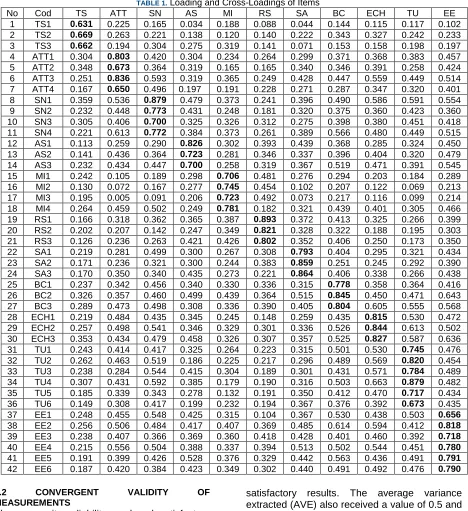
The questionnaires were completed by 340 respondents. There were 151 male respondents and 189 female respondents, equating to 44.4% and 55.6 of the total sample, respectively. 7 respondents (2.1%) were less than 17 years old, while 205 respondents (60.3%) were in the 18-27-year-old category. 128 respondents (37.6%) were above 28 years old. With regards to the marital status of respondents, 163 (47.9%) respondents were single, 153 (45.0%) respondents were married, 18 (5.3) respondents were divorced, and 6 (1.8%) respondents were widowed. Regarding their levels of education, 110 (32.4%) respondents were in the preliminary level, 139 (40.9%) respondents were in level one, 20 (5.9%) respondents were in level two, 25 (7.4%) respondents were in level three, and 46 (13.5%) respondents were in level four. Cronbach‟s alpha, the composite reliability, and the convergent validity were calculated before the hypotheses testing in order to test the construct validity. Discriminant validity was also tested for this study based on the recommendations of Fornell and Larcker [93].
5.1 CONSTRUCT VALIDITY OF MEASUREMENTS
TABLE 1. Loading and Cross-Loadings of Items
No Cod TS ATT SN AS MI RS SA BC ECH TU EE
1 TS1 0.631 0.225 0.165 0.034 0.188 0.088 0.044 0.144 0.115 0.117 0.102
2 TS2 0.669 0.263 0.221 0.138 0.120 0.140 0.222 0.343 0.327 0.242 0.233
3 TS3 0.662 0.194 0.304 0.275 0.319 0.141 0.071 0.153 0.158 0.198 0.197
4 ATT1 0.304 0.803 0.420 0.304 0.234 0.264 0.299 0.371 0.368 0.383 0.457
5 ATT2 0.348 0.673 0.364 0.319 0.165 0.165 0.340 0.346 0.391 0.258 0.424
6 ATT3 0.251 0.836 0.593 0.319 0.365 0.249 0.428 0.447 0.559 0.449 0.514
7 ATT4 0.167 0.650 0.496 0.197 0.191 0.228 0.271 0.287 0.347 0.320 0.401
8 SN1 0.359 0.536 0.879 0.479 0.373 0.241 0.396 0.490 0.586 0.591 0.554
9 SN2 0.232 0.448 0.773 0.431 0.248 0.181 0.320 0.375 0.360 0.423 0.360
10 SN3 0.305 0.406 0.700 0.325 0.326 0.312 0.275 0.398 0.380 0.451 0.418
11 SN4 0.221 0.613 0.772 0.384 0.373 0.261 0.389 0.566 0.480 0.449 0.515
12 AS1 0.113 0.259 0.290 0.826 0.302 0.393 0.439 0.368 0.285 0.324 0.450
13 AS2 0.141 0.436 0.364 0.723 0.281 0.346 0.337 0.396 0.404 0.320 0.479
14 AS3 0.232 0.434 0.447 0.700 0.258 0.319 0.367 0.519 0.471 0.391 0.545
15 MI1 0.242 0.105 0.189 0.298 0.706 0.481 0.276 0.294 0.203 0.184 0.289
16 MI2 0.130 0.072 0.167 0.277 0.745 0.454 0.102 0.207 0.122 0.069 0.213
17 MI3 0.195 0.005 0.091 0.206 0.723 0.492 0.073 0.217 0.116 0.099 0.214
18 MI4 0.264 0.459 0.502 0.249 0.781 0.182 0.321 0.439 0.401 0.305 0.466
19 RS1 0.166 0.318 0.362 0.365 0.387 0.893 0.372 0.413 0.325 0.266 0.399
20 RS2 0.202 0.207 0.142 0.247 0.349 0.821 0.328 0.322 0.188 0.195 0.303
21 RS3 0.126 0.236 0.263 0.421 0.426 0.802 0.352 0.406 0.250 0.173 0.350
22 SA1 0.219 0.281 0.499 0.300 0.267 0.308 0.793 0.404 0.295 0.321 0.434
23 SA2 0.171 0.236 0.321 0.300 0.244 0.383 0.859 0.251 0.245 0.292 0.390
24 SA3 0.170 0.350 0.340 0.435 0.273 0.221 0.864 0.406 0.338 0.266 0.438
25 BC1 0.237 0.342 0.456 0.340 0.330 0.336 0.315 0.778 0.358 0.364 0.416
26 BC2 0.326 0.357 0.460 0.499 0.439 0.364 0.515 0.845 0.450 0.471 0.643
27 BC3 0.289 0.473 0.498 0.308 0.336 0.390 0.405 0.804 0.605 0.555 0.568
28 ECH1 0.219 0.484 0.435 0.345 0.245 0.148 0.259 0.435 0.815 0.530 0.472
29 ECH2 0.257 0.498 0.541 0.346 0.329 0.301 0.336 0.526 0.844 0.613 0.502
30 ECH3 0.353 0.434 0.479 0.458 0.326 0.307 0.357 0.525 0.827 0.587 0.636
31 TU1 0.243 0.414 0.417 0.325 0.264 0.223 0.315 0.501 0.530 0.745 0.476
32 TU2 0.262 0.463 0.519 0.186 0.225 0.217 0.296 0.489 0.569 0.820 0.454
33 TU3 0.238 0.284 0.544 0.415 0.304 0.189 0.301 0.431 0.571 0.784 0.489
34 TU4 0.307 0.431 0.592 0.385 0.179 0.190 0.316 0.503 0.663 0.879 0.482
35 TU5 0.185 0.339 0.343 0.278 0.132 0.191 0.350 0.412 0.470 0.717 0.434
36 TU6 0.149 0.308 0.417 0.199 0.232 0.194 0.367 0.376 0.392 0.673 0.435
37 EE1 0.248 0.455 0.548 0.425 0.315 0.104 0.367 0.530 0.438 0.503 0.656
38 EE2 0.256 0.506 0.484 0.417 0.407 0.369 0.485 0.614 0.594 0.412 0.818
39 EE3 0.238 0.407 0.366 0.369 0.360 0.418 0.428 0.401 0.460 0.392 0.718
40 EE4 0.215 0.556 0.504 0.388 0.337 0.394 0.513 0.502 0.544 0.451 0.780
41 EE5 0.191 0.399 0.426 0.528 0.376 0.329 0.442 0.563 0.436 0.491 0.791
42 EE6 0.187 0.420 0.384 0.423 0.349 0.302 0.440 0.491 0.492 0.476 0.790
5.2 CONVERGENT VALIDITY OF
MEASUREMENTS
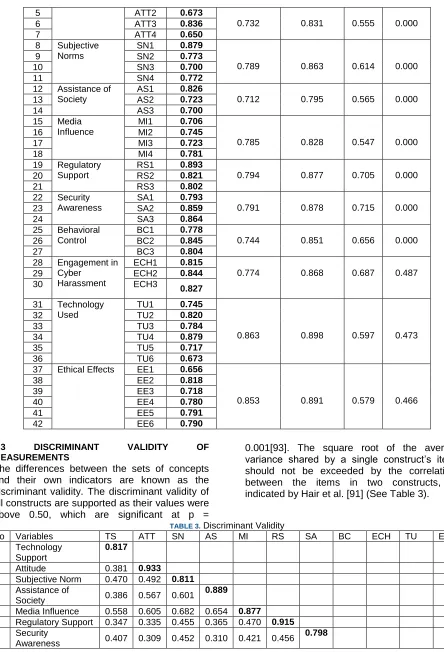
The composite reliability produced satisfactory results that were above 0.70. The values ranged from 0.692 to 0.898. The results of the Cronbach were between 0.712 to 0.863, thus indicating
satisfactory results. The average variance extracted (AVE) also received a value of 0.5 and ranged from 0.528 to 0.715. Table 2 below illustrated the results of the confirmatory factor analysis (CFA).
TABLE 2. Constructs, Items, and Confirmatory Factor Analysis Results
No Variables Code Factors
Loading
Cronbach‟s Alpha
Composite Reliability
AVE R
Square 1 Technology
Support
TS1 0.631
0.786 0.692 0.528 0.000
2 TS2 0.669
3 TS3 0.662
5 ATT2 0.673
0.732 0.831 0.555 0.000
6 ATT3 0.836
7 ATT4 0.650
8 Subjective Norms
SN1 0.879
0.789 0.863 0.614 0.000
9 SN2 0.773
10 SN3 0.700
11 SN4 0.772
12 Assistance of Society
AS1 0.826
0.712 0.795 0.565 0.000
13 AS2 0.723
14 AS3 0.700
15 Media Influence
MI1 0.706
0.785 0.828 0.547 0.000
16 MI2 0.745
17 MI3 0.723
18 MI4 0.781
19 Regulatory Support
RS1 0.893
0.794 0.877 0.705 0.000
20 RS2 0.821
21 RS3 0.802
22 Security Awareness
SA1 0.793
0.791 0.878 0.715 0.000
23 SA2 0.859
24 SA3 0.864
25 Behavioral Control
BC1 0.778
0.744 0.851 0.656 0.000
26 BC2 0.845
27 BC3 0.804
28 Engagement in Cyber
Harassment
ECH1 0.815
0.774 0.868 0.687 0.487
29 ECH2 0.844
30 ECH3 0.827
31 Technology Used
TU1 0.745
0.863 0.898 0.597 0.473
32 TU2 0.820
33 TU3 0.784
34 TU4 0.879
35 TU5 0.717
36 TU6 0.673
37 Ethical Effects EE1 0.656
0.853 0.891 0.579 0.466
38 EE2 0.818
39 EE3 0.718
40 EE4 0.780
41 EE5 0.791
42 EE6 0.790
5.3 DISCRIMINANT VALIDITY OF
MEASUREMENTS
The differences between the sets of concepts and their own indicators are known as the discriminant validity. The discriminant validity of all constructs are supported as their values were above 0.50, which are significant at p =
0.001[93]. The square root of the average variance shared by a single construct‟s items should not be exceeded by the correlations between the items in two constructs, as indicated by Hair et al. [91] (See Table 3).
TABLE 3. Discriminant Validity
No Variables TS ATT SN AS MI RS SA BC ECH TU EE
1 Technology Support
0.817
2 Attitude 0.381 0.933
3 Subjective Norm 0.470 0.492 0.811
4 Assistance of
Society 0.386 0.567 0.601
0.889
5 Media Influence 0.558 0.605 0.682 0.654 0.877
6 Regulatory Support 0.347 0.335 0.455 0.365 0.470 0.915
7 Security
Awareness 0.407 0.309 0.452 0.310 0.421 0.456
8 Behavioral Control 0.452 0.452 0.516 0.467 0.588 0.332 0.417 0.891
9 Engagement in
Cyber Harassment 0.520 0.639 0.584 0.587 0.596 0.424 0.316 0.442
0.883
10 Technology Used 0.391 0.486 0.587 0.697 0.596 0.288 0.258 0.414 0.618 0.871
11 Ethical Effects 0.250 0.350 0.355 0.338 0.293 0.312 0.196 0.198 0.363 0.304 0.830
5.4 ANALYSIS OF THE STRUCTURAL MODEL
As planned in this stage, the research hypotheses are examined and the relations between the constructs were investigated. Through the use of Smart PLS 3.0, the PLS
algorithm was applied in order to achieve this objective. The resulting path coefficients are illustrated in Figure 1, while the results of the hypotheses were illustrated in Figures 2 and 3.
FIGURE 3. Path Coefficients‟ T Values
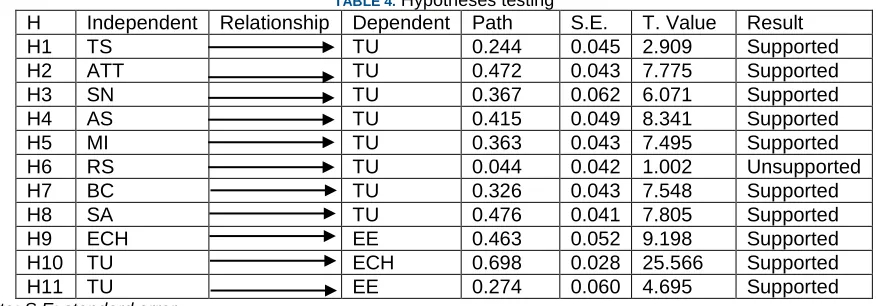
Regarding the first hypothesis, the relation between technology support and technology used is positive and significant (β = 0.244, t = 2.909, p < 0.001). Thus, the results positively support the first hypothesis. The second hypothesis is also supported as the analysis shows a positive relationship between attitudes and the technology used (β = 0.472, t = 7.775, p < 0.001). The third hypothesis is also positively supported, as there is a significant relationship between the subjective norms and the technology used (β = 0.367, t = 6.071, p < 0.001). Similarly, the fourth hypothesis on the relationship between the assistance of society and the technology used is positive and significant (β = 0.415, t = 8.341, p < 0.001). Thus, the fourth hypothesis is also supported by
0.476, t = 7.805, p < 0.001). The next hypothesis is also supported as the analysis shows a positive relationship between engaging in cyber harassment and the ethical effects (β = 0.463, t = 9.198, p < 0.001), which also supports the ninth hypothesis. Additionally, the tenth hypothesis on the relationship between the
technology used and engaging in cyber harassment is supported (β = 0.698, t = 25.566, p < 0.001). For the final hypothesis, the relationship between the technology used and the ethical effects is significant (β = 0.274, t = 4.695, p < 0.001). The results are presented in Table 4.
TABLE 4. Hypotheses testing
H Independent Relationship Dependent Path S.E. T. Value Result
H1 TS TU 0.244 0.045 2.909 Supported
H2 ATT TU 0.472 0.043 7.775 Supported
H3 SN TU 0.367 0.062 6.071 Supported
H4 AS TU 0.415 0.049 8.341 Supported
H5 MI TU 0.363 0.043 7.495 Supported
H6 RS TU 0.044 0.042 1.002 Unsupported
H7 BC TU 0.326 0.043 7.548 Supported
H8 SA TU 0.476 0.041 7.805 Supported
H9 ECH EE 0.463 0.052 9.198 Supported
H10 TU ECH 0.698 0.028 25.566 Supported
H11 TU EE 0.274 0.060 4.695 Supported
Note: S.E: standard error
5.5 DISCUSSION
The current study investigated the different factors attached to the prediction of teenagers‟ willingness to defend them against harassment online. It is of a great importance to conduct studies exploring the various factors of cyber harassment in the Saudi context. To achieve this purpose, the current study uses the Decomposed Theory of Planned Behavior (DTPB) [17, 18]. It also utilizes the Theory of planned behavior (TPB) [19], which is considered an extension to the theory of reasoned action. Taylor and Todd in June 1995 founded the Decomposed Theory of Planned Behavior (DTPB) in their study named “Understanding Information Technology usage: a test of competing models”. In particular, three dimensions are investigated in the current study and decomposed into specific belief dimensions [17]. These dimensions are subjective norms (i.e., social influences), attitudinal beliefs, and perceived behavioral controls. Furthermore, the demographic factors (moderating factors) that affect the way that individuals use technology are explored through UTAUT [22]. The current study is an attempt to bridge this gap by combining Theory of Planned Behaviour (TPB) the Unified Theory of Acceptance and Use of Technology (UTAUT) and technology support in the conceptual framework of the study. Computers and the internet are known as facilitating tools in classrooms [47, 50] and many the students in our sample were either involved
and control they have over them through humiliation. Supported by previous studies, the victims of online harassment go through the same assessment processed as those with health risks. Cyber bullying in the current study is investigated within the confines of a certain social media platform that is considered popular among teenagers, including those in the Kingdom of Saudi Arabia (KSA). The findings of the current study indicate that regardless of the fact that these social networks are there to enhance our social experiences, many negative experiences were identified and reported. For Facebook, more than half of the people who use this platform reported that have been the victims of Facebook bullying at least one time in the last year. Additionally, most of these students have been confronted with abusive actions on this platform. As the use of the internet becomes a daily activity practiced by teenagers, it is expected that they face information or experiences regarding other online threats, such as being victims of online hacking and data theft [9, 48]. Avoiding strangers on the internet and using online fabricated personas are common protective behaviors against online threats and are considered as protective measures against these attacks [67]. Conversely, the web and web-based social networking have significantly expanded in simplicity and speed, and thus social networking sites also allow for the public sharing of information, engagement, and collaborative learning [94, 95]. The findings are also in line with other previous studies conducted about Facebook is used for communication entertainment and sharing news, pictures and songs. In addition, their Facebook profile picture is alone and students were aware that swearing is considered a form of misconduct, which is a good sign [96].
VI. CONCLUSION
To sum up, there is an urgent need to raise awareness among young users on to how to address the online information. Additionally, parents and others should be able to address sexual health web sites and content in traditional media in which healthier sexual behaviors are promoted. This is of a great importance to help
putting adolescents on the right track. The current research has eleven hypotheses, and the results supported and verified ten of them. A significant relationship was observed among the factors proposed in the hypotheses, such as technology support, attitudes, subjective norms, societal assistance, the mass media‟s influence, security awareness, perceived behavioral controls, engagement in cyber harassment, technology and social media effects, and ethical effects. However, one hypothesis that has an insignificant relationship is between the regulatory support and technology and social media effects. Thus, it is recommended that future research takes the current work as a starting point to explore and investigate more on cyber harassment and its creation. It is recommended that future research builds on the current work and investigates more aspects related to the creation of cyber harassment. Moreover, the influence of technology‟s and social media‟s effects can also be the core of future research and exploration. In future studies, other factors related to cyber harassment can be taken into consideration. In the same vein, demographic factors and a more comprehensive sample could be the targets of future attempts. For the participants, research should not be restricted only to students and it is preferred to involve other users, such as instructors and supervisors. For the research design, qualitative approaches represented mainly by interviews should be employed in future works.
ACKNOWLEDGEMENTS
We would like to thank Faculty of Information Science and Technology, Universiti Kebangsaan Malaysia by giving the authors an opportunity to conduct this research. This research is funded by Universiti Kebangsaan Malaysia under Exploratory Research Grant Scheme ERGS/1/2013/ICT07/UKM/02/1. Moreover, the authors extend their appreciation to the Research Management Centre (RMC) at Universiti Teknologi Malaysia (UTM) for funding this project under grant number PY/2018/02903: Q.J130000.21A2.04E40.
REFERENCES
[1] P. Bocij, Cyberstalking: Harassment in the Internet age and how to protect your family. Greenwood Publishing Group, 2004.
[2] K. Baum, S. Catalano, M. Rand, and K. Rose, „Stalking Victimization in the United States‟, 2009.
[3] J. Avery, „Gender bender brand hijacks and consumer revolt: The Porsche Cayenne story‟, Consum. Behav. Hum. Purs. happiness world goods, pp. 645–649, 2010. [4] K. D. Martin and N. C. Smith, „Commercializing Social
Interaction: The Ethics of Stealth Marketing‟, J. Public Policy Mark., vol. 27, no. 1, pp. 45–56, 2008.
[6] M. BAER†, „Cyberstalking and the Internet Landscape We Have Constructed‟, 2010.
[7] L. P. Sheridan and T. Grant, „Is cyberstalking different?‟, Psychol. crime law, vol. 13, no. 6, pp. 627–640, 2007. [8] S. Livingstone, L. Haddon, and A. Görzig, „Risks and
safety on the internet: The perspective of European children‟, Lse, p. 170, 2011.
[9] B. Mohamed and E. Elnaim, „Cyber Crime in Kingdom of Saudi Arabia : The Threat Today and the Expected Future‟, vol. 3, no. 12, pp. 14–19, 2013.
[10] A. Horbury, „cybercrime-takes-its-toll @ www.symantec.com‟, symantec, 2013. [Online]. Available: https://www.symantec.com/connect/blogs/cybercrime-takes-its-toll.
[11] K. Almarhabi, „Adherence to ICT Security and Privacy Policies in Saudi Arabia‟, vol. 147, no. 4, pp. 13–18, 2016. [12] W. M. Al-Rahmi, N. Alias, M. S. Othman, I. A. Ahmed, A.
M. Zeki, and A. A. Saged, “Social media use, collaborative learning and students' academic performance: a systematic literature review of theoretical models,” Journal of Theoretical & Applied Information Technology, vol. 95, no. 20, pp. 5399-5414, 2017.
[13] W. M. Al-Rahmi, M. S. Othman, and L. M. Yusuf, “The effect of social media on researchers‟ academic performance through collaborative learning in Malaysian higher education,” Mediterranean Journal of Social Sciences, vol. 6 no. (4), pp. 193-203, 2015. http://doi:10.5901/mjss.2015.v6n4s1p193
[14] A. AlKaabi, „Strategic framework to minimise information security risks in the UAE‟, University of Bedfordshire, 2014.
[15] B. Mohamed and E. Elnaim, „Cyber Crime in Kingdom of Saudi Arabia : The Threat Today and the Expected Future‟, Inf. Knowl. Manag., vol. 3, no. 12, pp. 14–19, 2013.
[16] A. Obaid and S. Alkaabi, „Combating Computer Crime : An International Perspective‟, no. October, 2010.
[17] S. Taylor and P. Todd, „Decomposition and crossover effects in the theory of planned behavior: A study of consumer adoption intentions‟, Int. J. Res. Mark., vol. 12, no. 2, pp. 137–155, 1995.
[18] S. Taylor and P. A. Todd, „Assessing IT usage: The role of prior experience.‟, Manag. Inf. Syst. Q., vol. 19, no. 4, pp. 561–570, 1995.
[19] M. Fishbein and I. Ajzen, „Belief." Attitude, Intention and Behavior: An Introduction to Theory and Research Reading‟, vol. 6, 1975.
[20] A. Bandura, „Self-efficacy: Toward a Unifying Theory of Behavioral Change‟, Psychol. Rev. Univ., vol. Vol. 84, no. No. 2, pp. 191–215, 1977.
[21] D. R. Compeau and C. A. Higgins, „A Social Cognitive Theory Perspective On Individual Reactions To Computing Technology‟, Int. Conf. Inf. Syst. AIS Electron. Libr., p. 55, 1991.
[22] G. B. D. and F. D. D. Viswanath Venkatesh, Michael G. Morris and M. Quarterly, „User Acceptance of Information Technology: Toward a Unified View‟, J. Chem. Inf. Model., vol. 53, no. 9, pp. 425–478, 2003.
[23] M. Duggan, L. Rainie, A. Smith, C. Funk, A. Lenhart, and M. Madden, „Online Harassment‟, 2014.
[24] W. Nasri and L. Charfeddine, „Factors affecting the adoption of Internet banking in Tunisia: An integration theory of acceptance model and theory of planned behavior‟, J. High Technol. Manag. Res., vol. 23, no. 1, pp. 1–14, 2012.
[25] W. M. Al-Rahmi, M. S. Othman, and L. M. Yusuf, “Social media for collaborative learning and engagement: Adoption framework in higher education institutions in Malaysia,” Mediterranean Journal of Social Sciences, vol. 6 no. 3S1, pp. 246-252, 2015. http://doi:10.5901/mjss.2015.v6n3s1p246
[26] N. O. Ndubisi, „Factors influencing e-learning adoption intention : Examining the determinant structure of the decomposed theory of planned behaviour constructs‟,
HERDSA 2004 Conf. Proc., no. November, pp. 252–262, 2004.
[27] K. Hamilton and K. M. White, „Extending the theory of planned behavior: the role of self and social influences in predicting adolescent regular moderate-to-vigorous physical activity.‟, J. Sport Exerc. Psychol., vol. 30, pp. 56–74, 2008.
[28] A. M. Al-Majali, A. Q. Talafha, M. M. Ababneh, and M. M. Ababneh, „Seroprevalence and risk factors for bovine brucellosis in Jordan‟, J. Vet. Sci., vol. 10, no. 1, pp. 61– 65, 2009.
[29] W. M. Al-Rahmi, M. S. Othman, and L. M. Yusuf, “Effect of Engagement and Collaborative Learning on Satisfaction Through the use of Social Media on Malaysian Higher Education. Research Journal of Applied Sciences, Engineering and Technology, vol. 9, no. 12, pp. 1132-1142, 2015.
[30] I. Ajzen, „The theory of planned behavior‟, Orgnizational Behav. Hum. Decis. Process., vol. 50, pp. 179–211, 1991. [31] J. M. Smyth et al., „Stalking Victimization Among College
Women and Subsequent Help-Seeking Behaviors.‟, J. Am. Coll. Heal., no. January, 2009.
[32] J. Zhang, B. J. Reithel, and H. Li, „Impact of perceived technical protection on security behaviors‟, Inf. Manag. Comput. Secur., vol. 17, no. 4, pp. 330–340, 2009. [33] R. LaRose, N. J. N. Rifon, and R. Enbody, „Promoting
personal responsibility for internet safety‟, Commun. ACM, vol. 51, no. 3, pp. 71–76, 2008.
[34] S. Pahnila, M. Siponen, and A. Mahmood, „Employees‟ behavior towards IS security policy compliance‟, Proc. Annu. Hawaii Int. Conf. Syst. Sci., pp. 1–10, 2007. [35] Y. Li and M. Siponen, „A Call for Research on Home
Users‟ Information Security Behaviour‟, Pacific Asia Conf. Inf. Syst., pp. 1–11, 2011.
[36] K. Fang and Y.-Y. Shih, „The use of a decomposed theory of planned behavior to study Internet banking in Taiwan‟, Internet Res. Electron. Netw. Appl. Policy, vol. 14, no. 3, pp. 213–223, 2004.
[37] K. M. Nor and J. M. Pearson, An Exploratory Study Into The Adoption of Internet Banking in a Developing Country: Malaysia, vol. 7, no. 1. 2008.
[38] G. S. O‟Keeffe et al., „The Impact of Social Media on Children, Adolescents, and Families‟, Pediatrics, vol. 127, no. 4, pp. 800–804, 2011.
[39] S. Livingstone and D. R. Brake, „On the rapid rise of social networking sites: New findings and policy implications‟, Child. Soc., vol. 24, no. 1, pp. 75–83, 2010.
[40] W. M. Al-Rahmi, M. S. Othman, and L. M. Yusuf, “Using Social Media for Research: The Role of Interactivity, Collaborative Learning, and Engagement on the Performance of Students in Malaysian Post-Secondary Institutes. Mediterranean Journal of Social Sciences, vol. 6, no. 5, pp.536-546, 2015. http://dx.doi.org/10.5901/mjss.2015.v6n5s2p536 [41] W. M. Al-Rahmi, M. S. Othman, and M. Musa, “The
Improvement of Students' Academic Performance by Using Social Media through Collaborative Learning in Malaysian Higher Education,” Asian Social Science, vol. 10, no. 8, 2014.. Doi: http://dx.doi.org/10.5539/ass.v10n8p210
[42] Symantec, „Internet Security Threat Report 2011 Trends‟, vol. 17, no. April, pp. 1–52, 2012.
[43] R. Broadhurst and Y. Chang, „Cybercrime in Asia:Trend and challenges‟, Asian Handb. Criminol., no. FEBRUARY, pp. 1–26, 2012.
[44] Boni Pudjianto and Zo Hangjung, „Factors Affecting e-Government Assimilation in Developing Countries‟, Commun. Policy Res., pp. 1–14, 2009.
[45] S. Zhu, S. Setia, and S. Jajodia, „LEAP: efficient security mechanisms for large-scale distributed sensor networks‟, CCS ‟03 Proc. 10th ACM Conf. Comput. Commun. Secur., pp. 62–72, 2006.
migration at the firm level‟, Inf. Manag., vol. 43, no. 2, pp. 204–221, 2006.
[47] B. L. Ingerman and C. Yang, „Top-Ten IT Issues, 2011.‟, Educ. Rev., vol. 46, no. 3, p. 24, 2011.
[48] W. Baker et al., „2011 Data Breach Investigations Report 2011 Data Breach Investigations Report ( DBIR )‟, Verizon RISK Team Rep., pp. 1–72, 2011.
[49] R. Richardson, „Computer Crime and Security Survey 2010/2011‟, CSI Dir., vol. 2011, pp. 1–40, 2011.
[50] M. T. Siponen, „A conceptual foundation for organizational information security awareness‟, Inf. Manag. Comput. Secur., vol. 8, no. 1, pp. 31–41, 2000.
[51] I. Ajzen, „From intentions to actions: A theory of planned behavior‟, in Action control, Springer, 1985, pp. 11–39. [52] S. L. Albrecht and K. E. Carpenter, „Attitudes as predictors
of behavior versus behavior intentions: A convergence of research traditions‟, Sociometry, vol. 39, no. 1, pp. 1–10, 1976.
[53] P. M. Bentler and G. Speckart, „Models of attitude– behavior relations.‟, Psychol. Rev., vol. 86, no. 5, p. 452, 1979.
[54] and J. W. Shi, Weihua, Narcissus Shambare, „The adoption of internet banking: An institutional theory perspective of Financial Services Marketing Vol.‟, J. Financ. Serv. Mark. Vol., vol. 11, no. 3, 2007.
[55] K. R. Williams and N. G. Guerra, „Prevalence and Predictors of Internet Bullying‟, J. Adolesc. Heal., vol. 41, no. 6 SUPPL., pp. 14–21, 2007.
[56] W. Heirman and M. Walrave, „Predicting adolescent perpetration in cyberbullying: An application of the theory of planned behavior‟, Psicothema, vol. 24, no. 4, pp. 614– 620, 2014.
[57] W. Heirman and M. Walrave, „Predicting adolescent perpetration in cyberbullying: An application of the theory of planned behavior‟, Psicothema, vol. 24, no. 4, 2012. [58] I. Ajzen, „Constructing a TpB Questionnaire : Conceptual
and Methodological Considerations‟, Time, pp. 1–13, 2002.
[59] Icek Ajzen, „Perceived Behavioral Control, Self-Efficacy, Locus of Control, and the Theory of Planned Behavior1‟, J. Appl. Soc. Psychol., vol. 80, no. 6, pp. 2918–2940, 2002. [60] W. M. Al-Rahmi, A. M. Zeki, N. Alias, and A. A. Saged,
“Use of social media and its impact on academic performance among university students in Malaysian Higher Education,” Anthropologist, vol. 28, no. 1-2, pp.
52-68, 2017.
http://dx.doi.org/10.1080/09720073.2017.1317962 [61] M. Y. Li, I. Frieze, and C. S. Tang, „Understanding
adolescent peer sexual harassment and abuse: using the theory of planned behavior.‟, Sex. Abus. A J. Res. Treat., vol. 22, no. 2, pp. 157–71, 2010.
[62] T. L. Webb and P. Sheeran, „Mechanisms of implementation intention effects: the role of goal intentions, self-efficacy, and accessibility of plan components.‟, Br. J. Soc. Psychol., vol. 47, no. September, pp. 373–95, 2008.
[63] C. J. Armitage and M. Conner, „Efficacy of the Theory of Planned Behaviour: A meta-analytic review‟, Br. J. Soc. Psychol., vol. 40, pp. 471–499, 2001.
[64] N. B. Ellison, C. Steinfield, and C. Lampe, „The benefits of facebook “friends:” Social capital and college students‟ use of online social network sites‟, J. Comput. Commun., vol. 12, no. 4, pp. 1143–1168, 2007.
[65] S. Livingstone, „Taking risky opportunities in youthful content creation: Teenagers‟ use of social networking sites for intimacy, privacy and self-expression‟, New Media Soc., vol. 10, no. 3, pp. 393–411, 2008.
[66] A. Lenhart et al., „Teens , Kindness and Cruelty on Social Network Sites‟, PewResearchCenter, pp. 1–86, 2011. [67] M. O. Lwin, B. Li, and R. P. Ang, „Stop bugging me: An
examination of adolescents‟ protection behavior against online harassment‟, J. Adolesc., vol. 35, no. 1, pp. 31–41, 2012.
[68] J. Wolak, K. J. Mitchell, and D. Finkelhor, „Does Online Harassment Constitute Bullying? An Exploration of Online
Harassment by Known Peers and Online-Only Contacts‟, J. Adolesc. Heal., vol. 41, no. 6, pp. S51–S58, 2007. [69] T. Beran and Q. Li, „Cyber-Harassment: A Study of a New
Method for an Old Behavior‟, J. Educ. Comput. Res., vol. 32, no. 3, pp. 265–277, 2005.
[70] W. M. Al-Rahmi and A. M. Zeki, “A model of using social media for collaborative learning to enhance learners‟ performance on learning,” Journal of King Saud University - Computer and Information Sciences, vol. 29, no. 4, pp.
526–535, Oct. 2017.
http://dx.doi.org/10.1016/j.jksuci.2016.09.002
[71] W. M. Al-Rahmi, M. S. Othman, and L. M. Yusuf, “The Role of Social Media for Collaborative Learning to Improve Academic Performance of Students and Researchers in Malaysian Higher Education,” The International Review of Research in Open and Distributed Learning, vol. 16, no. 4, Nov. 2015.
[72] T. E. Bosch, „Using online social networking for teaching and learning: Facebook use at the University of Cape Town‟, Communicatio, vol. 35, no. 2, pp. 185–200, 2009. [73] E. J. Appel, Cybervetting: Internet Searches for Vetting,
Investigations, and Open-Source Intelligence. Crc Press, 2014.
[74] I. Byrnside, „Six clicks of separation: The legal ramifications of employers using social networking sites to research applicants‟, Vand. J. Ent. Tech. L., vol. 10, p. 445, 2007.
[75] S. Rothberg, „Do employers really hire candidates from Facebook and MySpace? FurstPerson/Sprint does‟, vailable www. Coll. com/weblog/2008/04/do_ employers_re. php# more (accessed May 3, 2008), 2008. [76] M. F. Plattner et al., „Comparing the Arab Revolts Do New
Democracies Support Democracy ? Do New Democracies Support Democracy ?‟, vol. 22, no. 4, 2011.
[77] G. Hull, H. R. Lipford, and C. Latulipe, „Contextual gaps: Privacy issues on Facebook‟, Ethics Inf. Technol., vol. 13, no. 4, pp. 289–302, 2011.
[78] L. Bilge, T. Strufe, D. Balzarotti, E. Kirda, and S. Antipolis, „All Your Contacts Are Belong to Us : Automated Identity Theft Attacks on Social Networks‟, Www 2009, pp. 551– 560, 2009.
[79] J. Peluchette and K. Karl, „Examining Students‟ Intended Image on Facebook: “What Were They Thinking?!”‟, J. Educ. Bus., vol. 85, no. 1, pp. 30–37, 2009.
[80] H. Haron and F. B. M. Yusof, „Cyber stalking: The social impact of social networking technology‟, 2010 Int. Conf. Educ. Manag. Technol., pp. 237–241, Nov. 2010. [81] S. Hinduja and J. W. Patchin, „Bullying, cyberbullying, and
suicide‟, Arch. Suicide Res., vol. 14, no. 3, pp. 206–221, 2010.
[82] F. A. Moafa, K. Ahmed, W. M. Al-Rahmi, N. Alias, M. A. Obaid “Factors for Minimizing Cyber Harassment Among University Students: Case Study In Kingdom Of Saudi Arabia (KSA),” Journal of Theoretical & Applied Information Technology, vol. 96, no. 6, 2018.
[83] F. A. Moafa, K. Ahmed, W. M. Al-Rahmi, N. Yahaya, Y. Kamin, M.M. Alamri “Cyber Harassment Prevention Through User Behavior Analysis Online In Kingdom Of Saudi Arabia (KSA),” Journal of Theoretical & Applied Information Technology, vol. 96, no. 6, 2018.
[84] W. M. Al-Rahmi, M. S. Othman, and L. M. Yusuf, “The effectiveness of using e-learning in Malaysian higher education: A case study Universiti Teknologi Malaysia,” Mediterranean Journal of Social Sciences, vol. 6, no. 5,
pp. 625- 637, 2015.
https://doi.org/10.5901/mjss.2015.v6n5s2p625
[85] L. Kohlberg, „The Cognitive-Developmental Approach to Moral Education‟, Phi Delta Kappan, vol. 56, no. 10, pp. 670–677, 1975.
[86] L. Floridi and J. W. Sanders, „Mapping the foundationalist debate in computer ethics‟, Ethics Inf. Technol., vol. 4, no. 1, pp. 1–9, 2002.
Measurement, vol. 30, no. 3, pp. 607-610, 1970. doi: https://doi.org/10.1177/001316447003000308
[88] Y. Wang, Assessment of learner satisfaction with asynchronous electronic learning systems. Information and Management. 41:2003, pp75–86.
[89] S.S. Liaw, Understanding computers and the Internet as a work assisted tool. Computers in Human Behavior. 23(1): 2007, pp399–414.
[90] W. M. Al-rahmi, M. S. Othman and L. M. Yusuf, Exploring the Factors that Affect Student Satisfaction through Using E-Learning in Malaysian Higher Education Institutions. Mediterranean Journal of Social Sciences, 6(4): 2015, pp299-310.
[91] J.F. Hair, C. M. Ringle and M. Sarstedt, PLS-SEM: Indeed a silver bullet. Journal of Marketing Theory and Practice. 18(2): 2010, pp139–152.
[92] M. Chow, D. K. Herold, T. M. Choo and K. Chan, Extending the technology acceptance model to explore the intention
to use Second Life for enhancing healthcare education. Computers and Education. 59(4): 2012, pp1136-1144. [93] C. Fornell and D. F. Larcker, Evaluating structural equation
models with unobservable variables and measurement error. Journal of Marketing Research, 1981, pp39-50. [94] W.M. Al-Rahmi, N. Alias, M.S. Othman, V.I. Marin, G. Tur
"A model of factors affecting learning performance through the use of social media in Malaysian higher education", Computers & Education, 121, 2018, pp.59-72.
[95] W.M. Al-Rahmi, N. Alias, M.S. Othman, A.I. Alzahrani, O. Alfarraj, A.A. Saged, N.S.A Rahman "Use of E-Learning by University Students in Malaysian Higher Educational Institutions: A Case in Universiti Teknologi Malaysia", IEEE Access, 6,2018, pp.14268-14276.