An integral equation study of a simple point charge model of water
M. Lombardero, C. Martı´n, and S. Jorge
Instituto de Quı´mica Fı´sica Rocasolano, CSIC, Serrano 119, E-28006 Madrid, Spain and Departamento de Quı´mica Fı´sica I, Universidad Complutense, E-28040 Madrid, Spain
F. Lado
Department of Physics, North Carolina State University, Raleigh, North Carolina 27695-8202
E. Lombaa)
Instituto de Quı´mica Fı´sica Rocasolano, CSIC, Serrano 119, E-28006 Madrid, Spain
~Received 11 June 1998; accepted 7 October 1998!
We present an extensive integral equation study of a simple point charge model of water for a variety of thermodynamic states ranging from the vapor phase to the undercooled liquid. The calculations are carried out in the molecular reference-hypernetted chain approximation and the results are compared with extensive molecular dynamics simulations. Use of a hard sphere fluid as a reference system to provide the input reference bridge function leads to relatively good thermodynamics. However, at low temperatures the computed microscopic structure shows deficiencies that probably stem from the lack of orientational dependence in this bridge function. This is in marked contrast with results previously obtained for systems that, although similarly composed of angular triatomic molecules, do not tend to the tetrahedral coordinations that are characteristic of water. © 1999 American Institute of Physics.@S0021-9606~99!52202-2#
I. INTRODUCTION
The description of liquid water from a microscopic per-spective hinges on the knowledge of its interaction potential, which in particular should be able to account for the tetrahe-dral coordination of the solid and the larger coordination numbers — and consequently larger density — found upon melting. On the one hand, several attempts have been made to attain a pure ab initio description of liquid water,1but the practical limitations to small sample sizes and short time spans considerably constrain the range of problems to which this sort of approach can be applied. On the other hand, a large and growing number of simple effective intermolecular potentials has been proposed. Without attempting to be ex-haustive, we can catalog those that deal with the molecule as a rigid entity ~TIP4,2 SPC,3 SPCE4!, those that allow for flexible bonds,5 those that explicitly incorporate N-body ef-fects through polarizability,6and finally those that allow for dissociation, such as the central force model.7
With such varied competition for the title of ‘‘the’’ model of water, it is obviously difficult to venture a sound
~and lasting!assessment of which of these models might be considered the most adequate. Nevertheless, one of the most successful simple models, shown able to reproduce the most significant features of liquid water, has turned out to be the simple point charge ~SPC! model3 or its extended version4
~SPCE!. A large number of works have concentrated on computer simulation studies of this model to examine not only structure, thermodynamics, and dielectric properties,8 but also phase equilibrium.9 In contrast, theoretical ap-proaches have been constrained by the formidable task of appropriately dealing with the threefold orientational degrees
of freedom of the molecules and hence most theoretical ef-forts have gone into RISM-like ~reference interactive site model!theories, either in its original form10or in the proper RISM equation of Chandler, Silbey, and Ladanyi,11 applied to water by Lue and Blankschtein.12
Very recently, the present authors have cast the molecu-lar Ornstein–Zernike ~OZ!equation into a form suitable for application to real molecular fluids composed of nonlinear molecules.13,14 Calculations performed on realistic models for H2S and SO2 showed that the molecular OZ equation with a reference-hypernetted chain~RHNC!closure employ-ing a simple hard-sphere reference bridge function was very accurate in its predictions of the microscopic structure, ther-modynamics, and dielectric constant ~when the proper charge distribution was used!, even for a system with a rela-tively large degree of anisotropy and polarity such as SO2.
This success suggested that the simple RHNC recipe might be put to a more stringent test, namely the study of water. This is the task we undertake in the present work. Since the SPCE model for water is very similar to the point-charge model successfully used in Ref. 14 for H2S, one might expect that the same procedure, using a spherically symmetric reference bridge function, should perform nicely for water as well. We shall see, however, that crucial differ-ences arise in the case of water that are closely associated with the tendency of this substance to form tetrahedral coor-dinations, a tendency lacking in liquid H2S or SO2. We con-clude that one needs an orientationally dependent reference bridge function that reflects this feature to construct a reli-able RHNC recipe for liquid water.
In Sec. II, we briefly sketch the essential aspects of the theory, with some emphasis on the optimization procedures a!Electronic mail: [email protected]
1148
utilized throughout these calculations. In Sec. III we present a detailed comparison of the RHNC results with data from molecular dynamics simulations,15 paying particular atten-tion to properties at room temperature and on the isochore
r51 g/cm3. Here the tetrahedral ordering of water is made evident by appealing to an analysis of the three-body corre-lation function. In the low-temperature, high-density regime the microscopic structure obtained from the theory is far from satisfactory. The structural data are more accurate at somewhat higher temperatures and especially so in the su-percritical regime. Surprisingly, the simple RHNC theory performs reasonably well for the thermodynamics over the whole temperature range studied.
II. THEORY
Since the details of the numerical procedure can be found in Ref. 14, we will simply recall here the essential equations that constitute the RHNC integral equation ap-proximation. Once again our starting point is the OZ relation, which for molecular fluids reads
g~12!5 r
8p2
E
d3c~13!@c~32!1g~32!#, ~1!wherer is the number density and*d35*dr3dv3 denotes integration over positions and orientations of molecule 3. Here c(12) is the direct correlation function and g(12) 5g(12)212c(12) is the indirect correlation function,
where g(12)5g(r12,v1,v2) is the molecular pair distribu-tion funcdistribu-tion.
The OZ relation is supplemented with a closure that es-tablishes a functional relation between c(12) and g(12). In the case of the RHNC approximation, this is
c~12!5exp@2bu~12!1g~12!1B0~12!#2g~12!21, ~2! whereb51/kBT, u(12) is the intermolecular pair potential, and B0~12!the so-called bridge function, which is obtained from a reference system whose physical parameters may be optimized by some criterion. Following Ref. 14, we use here as a reference system the hard sphere fluid. The only optimi-zation parameter available is then the hard sphere diameter d, which we adjust to satisfy the criterion of free energy minimization.16This leads to the condition
r
E
dr@g00000 ~r!2gHS~r;d!#]BHS~r;d!
]d 50. ~3!
The hard sphere~HS! fluid bridge function BHS(r;d) is ob-tained from the Verlet–Weis–Henderson–Grundke17,18 pa-rametrization. The solution of Eqs.~1!–~2!proceeds through expansions in angular basis functions:
X~12!5
(
l1,l2,m,n1,n2 @~2l111!~2l211!#1/2
3Xl
1l2m
n1n2
~r12!Dmn
1
l1
~v1!*Dm¯ n
2
l2
~v2!*, ~4! wherev5(f,u,x) are the Euler angles referred to the axial line r12 joining the molecular centers and Dmn
l
(v) are gen-eralized spherical harmonic coefficients in the convention of
Rose.19Thus one sees that g000 00
(r) in Eq.~3!is the first term in the angular expansion of g(12) and is just the center-to-center~or radial!distribution function. Specific expressions to evaluate thermodynamic and dielectric properties as well as to calculate site–site correlation functions from the expan-sion coefficients can be found in Refs. 13 and 14. An alter-native procedure for the evaluation of site–site functions from the molecular g(12) has recently been described by Richardi et al.20
Once the interaction model has been chosen, one can iteratively solve the nonlinear system of Eqs. ~1!–~2! until convergence is reached for a given reference diameter d, systematically modify d, and repeat the calculation until con-dition~3!is further satisfied. This straightforward implemen-tation of the optimization is however somewhat tedious, since it requires repeated solutions of the fairly intricate in-tegral equation. Thus, we resort to the strategy devised by Lombardero et al.21for systems of linear molecules. In this scheme, the hard sphere diameter of the reference system — which will be correlated only with the single set of Lennard-Jones parameters e, s that occurs in the SPC and SPCE models for the O–O interaction — is determined as a func-tion of density and temperature according to the prescripfunc-tion
d5a@252ln~kBT/e!#@251ln~rs3!#. ~5!
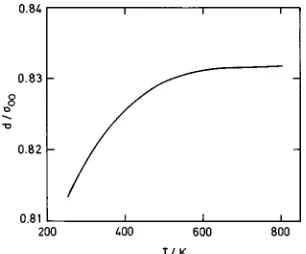
The length parameter a in turn is determined using as a standard the optimized diameter d calculated by means of Eq. ~3! at a high density state (r50.997 g/cm3) for each isotherm. Obviously, for extensive computations, this proce-dure will produce a considerable saving of computer time. The temperature evolution of the optimized diameter for the high density state is displayed in Fig. 1.
We now recall the definition of the SPCE model for water as proposed by Berendsen et al.4 These authors in-cluded a self-energy correction in the original SPC model; the new interaction is characterized by three point masses with OH distances of 1 Å and angle HOHˆ5109.47°~i.e., the tetrahedral angle!. Point charges equal to 20.8476e and 10.4238e are located at the O and H sites, respectively, where e is the elementary charge. In addition to the Coulomb interactions, the model incorporates dispersion forces via a single Lennard-Jones interaction between the oxygens:
UOOLJ~12!52
S
Ar
D
6 1
S
Br
D
12
, ~6!
with the parameters A53.7122 Å ~kJ/mol!1/6 and B53.428 Å~kJ/mol!1/12. This gives a value ofeOO/kB578.197 K and
sOO53.1656 Å. In Fig. 2, we show the atom–atom distribu-tion funcdistribu-tions of water at room temperature from neutron scattering22and from a molecular dynamics~MD!simulation using the SPCE interaction. This comparison illustrates the ability of this simple interaction to model the structure of liquid water.
III. RESULTS AND DISCUSSION
All the integral equation calculations presented here have been carried out using 512 points with a grid sizeDr 50.02sOOon the center-to-center distance r. In the spherical harmonic expansions, Eq. ~4!, we have used coefficients up to and including X333
33
(r). All the simulations have been per-formed for a 256 molecule sample in the canonical ensemble15using Berendsen’s thermostat,23with a time con-stant for temperature coupling of 0.4 ps and a time step of 0.001 ps. A typical run comprises 10 000 configurations for thermalization and 35 000 for averaging of thermodynamic and structural properties. Given the success of the SPCE model in representing liquid water, we begin the study with ambient thermodynamic conditions, namelyr50.997 g/cm3 and T5298.15 K. For this state we use the full optimization procedure, Eq.~3!, and derive atom–atom distribution func-tions from the coefficients of g(12) using the procedure out-lined in Ref. 14. The computed thermodynamic properties from this calculation are summarized in Table I, along with the corresponding MD data. The agreement is reasonable
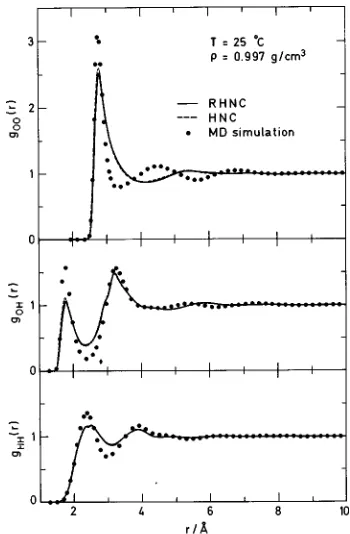
although not remarkable. The calculated structure, on the other hand, ~seen in Fig. 3!, is decidedly poor, particularly for the O–O distribution function. Moreover, comparison with results from the ordinary hypernetted chain ~HNC! ap-proximation, with B0(12)50, suggests that the reference hard-sphere bridge function has little effect on the structure. In the O–H distribution function, we see that the position of the OH hydrogen bond is correctly located. As with gHH(r), however, the amplitudes are off.
The notable mismatch of the O–O structure needs some explanation. To gain insight into the temperature dependence of the pair structure of water, we have performed several MD runs at r51 g/cm3 and T ranging from 300 to 700 K. The
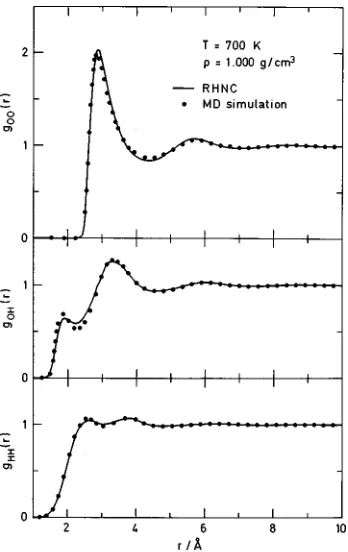
gOO(r) curves from these calculations are displayed in Fig. 4. They exhibit a rather peculiar behavior, in that the 700 K distribution function seems to have somewhat more structure than the 400 K curve, while an abrupt change occurs at 300 K where considerably more pair structure shows up. The integral equation results for gOO(r) in Fig. 3 appear to fit those of MD at a higher temperature. Actually, when one compares the RHNC results for 700 K with those of simula-tion at the same temperature, the agreement is seen to be
FIG. 2. Atom–atom distribution functions for water at ambient conditions from MD~SPCE model!and experiment~Ref. 22!.
TABLE I. Thermodynamic properties of the SPCE model of water at am-bient conditions and above the critical temperature obtained from MD simu-lation and RHNC integral equation.
p/kbar U/~kJ/mol!
T/K r/(g/cm3) MD RHNC MD RHNC
298.15 0.997 0.00~0.54! 20.06 246.79~0.21! 242.06 700.00 0.320 0.32~0.21! 0.36 217.63~0.54! 217.71 700.00 1.000 7.86~0.98! 8.88 232.57~0.44! 230.50
excellent~Fig. 5!. If we now move to the supercritical region shown in Fig. 6 (r50.32 g/cm3, T5700 K!, we find the integral equation continues to provide excellent estimates. This agreement applies to the thermodynamic properties as well~see Table I!. Now, keepingr fixed at 0.32 g/cm3, we
proceed to lower the temperature and monitor the behavior of the isothermal compressibility. The evolution with tem-perature of this quantity can be observed in Fig. 7. We see that the estimate for the critical temperature Tc5678 K is not far off from the Gibbs ensemble Monte Carlo results of Guis-sani and Guillot,9 TcGEMC5657 K. For the critical pressure we obtain pc5303 bar, which is of the same order as the proposed estimates9 pcMC5160– 189 bar. Further, we obtain
«55.6 for the dielectric constant at the critical point, in good agreement with the value reported by Guissani and Guillot,9
«MC56. This last datum stands in contrast with the poor result furnished by the theory at ambient conditions, « 553, well below the simulation value of «MC581. Taking
FIG. 4. MD data for the oxygen–oxygen distribution function in SPCE water along ther51 g/cm3isochore for various temperatures.
FIG. 5. Atom–atom distribution functions for high temperature~700 K! SPCE water from MD~solid circles!and RHNC~solid lines!.
FIG. 6. Atom–atom distribution functions for supercritical SPCE water from MD~solid circles!and RHNC~solid lines!.
into account the deviations exhibited by the theoretical dis-tribution functions seen in Fig. 3, it would be surprising if a quantity as closely linked with the orientational order of the fluid as is the dielectric constant would be reproduced with better accuracy.
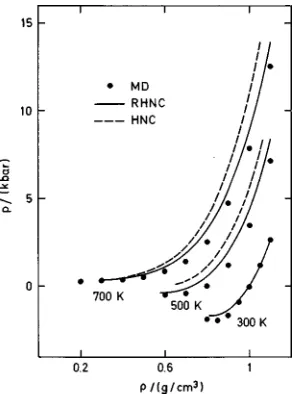
In order to assess the overall behavior of the integral equation results, we have performed calculations along sev-eral isotherms. The resulting internal energies and pressures are plotted in Figs. 8 and 9, respectively. For comparison, we also include results from the HNC equation. It turns out that the HNC approximation seems to have no physical solution for T5300 K. For the RHNC approximation at 300 K, it is striking that the pressures are rather accurate while energy values show discrepancies of about 10%. But what is more surprising is that on average the approximation should be so much better for the thermodynamics overall than for the structure at low temperature. For the sake of completeness, we include in Fig. 10 the zero pressure curve comparing
results from theory, MD in the isothermal–isobaric ensemble,15 and experiment.24 For the MD runs, we have also used Berendsen’s thermostat and barostat,23 with time constants of 0.4 ps for temperature coupling and 0.5 ps for pressure coupling. Regarding the integral equation, the zero pressure results are obtained by fine tuning the density until the virial pressure vanishes. These are perhaps the thermo-dynamic conditions where discrepancies are most apparent. The theoretical calculation does not exhibit at all the very significant density maximum, which is found both experi-mentally and in the simulation.
To find an answer to these puzzles one must go beyond the pair structure. Thus, we have extracted from the simulations the three-body distribution function
gOOO(3) (r12,r23,u123) for r125r2352.75 Å, which corresponds to the position of the maximum in the pair function gOO(r). We plot this quantity in Fig. 11 as a function of u123, the
FIG. 8. Internal energy for SPCE water along various isotherms from MD
~solid circles!, RHNC~solid lines!, and HNC~dashed lines!.
FIG. 9. Pressure for SPCE water along various isotherms from MD~solid circles!, RHNC~solid lines!, and HNC~dashed lines!.
FIG. 10. The density maximum in water at zero pressure. Empty circles correspond to experimental data from Ref. 24, filled circles to NPT MD calculations, and the solid line to RHNC results.
FIG. 11. Three-body distribution function between oxygen atoms from MD simulation for r125r1352.75 Å, which corresponds to the maximum in
angleformed by the vectors r12 and r23 ~vectors that in this case go from O atom to O atom!; here we see the evolution in this distribution with temperature. The growth of the maximum fromuOOO5100° to 120° indicates the buildup of tetrahedral ordering. This tetrahedral ordering is averaged out in the pair functions and that is why gOO(r) at 400 K is less structured than gOO(r) at 700 K ~see Fig. 4!. The ab-sence of the second neighbor peaks is characteristic of fluids with tetrahedral local order, as in the case of liquid and amorphous silicon.25This appears to be the core of the prob-lem. At room temperature SPCE water is close to the freez-ing point and the particles tend to organize in open structures that locally present the ordering characteristics of the solid. From the work of Rosenfeld,26 we know that the reference system bridge function should contain the basic geometric relations of the system, and hence it is obvious that the hard sphere fluid, which crystallizes in closed packed structures, is a poor candidate to account for the geometric features of loosely coordinated systems like water at room temperature. Although it is the pair potential that induces the tetrahedral ordering, of all the pair functions involved in the closure relation @Eq. ~2!#only the bridge function directly accounts for the effect of N-body correlations (N>3). Also, since the density maximum in water is closely connected with changes in the local coordination numbers, it is easy to understand the inability of the spherically symmetric bridge function to cap-ture these crucial feacap-tures. On the other hand, in other sys-tems with strong local order like acetonitrile27 the HNC seems to be reliable even at low temperatures where the or-dering starts to resemble that of the solid. The same can be said about the performance of the HNC for acetone and chloroform20 which exhibit quite large spatial correlations. However, none of these systems crystallizes in tetrahedral arrangements, and in all their center-to-center pair distribu-tion funcdistribu-tions the second neighbor peak is clearly visible. It is obvious that further investigations are needed to thor-oughly understand how local geometries influence the per-formance of integral equation approximations.
In summary, we have investigated the behavior of the molecular RHNC theory with hard-sphere bridge function for the SPCE model of water and find that, while the theory performs fairly well in the moderate to high temperature re-gime both for the structure and thermodynamics, the com-puted microscopic structure — in particular gOO(r) — at room temperature shows large discrepancies. An analysis of the oxygen three-body function, gOOO(3) (r12,r23,u123), indi-cates that these discrepancies might well be ascribed to the buildup of tetrahedral ordering, which cannot be properly
incorporated into the RHNC approximation via a spherically symmetric hard-sphere bridge function. Future work should thus aim at incorporating those geometric features into the reference bridge function.
ACKNOWLEDGMENTS
This work was supported in part by the Direccio´n Gen-eral de Ensen˜anza Superior, Spain under Grant No. PB94-0112. F. L. thanks the Direccio´n General de Ensen˜anza Su-perior, Spain for sabbatical support under Grant No. SAB95-0373 during the early part of this work.
1
K. Laasonen, M. Sprik, M. Parrinello, and R. Car, J. Chem. Phys. 99, 9080~1993!.
2W. L. Jorgensen, J. Chem. Phys. 77, 4156~1982!.
3H. J. C. Berendsen, J. P. M. Postma, W. F. van Gunsteren, and J.
Her-mans, in Intermolecular Forces, edited by B. Pullmann ~Reidel, Dor-drecht, 1981!.
4H. J. C. Berendsen, J. R. Grigera, and T. P. Straatsma, J. Phys. Chem. 91,
6269~1987!.
5G. C. Lie and E. Clementi, Phys. Rev. A 33, 2679~1986!. 6
J. W. Halley, J. R. Rustad, and A. Rahman, J. Chem. Phys. 98, 4110
~1993!; I. M. Svishchev, P. G. Kusalik, J. Wang, and R. J. Boud, ibid. 105, 4742~1996!; A. A. Chialvo and P. T. Cummings, ibid. 105, 8274~1996!; L. M. Dang and T. Chang, ibid. 106, 8149~1997!.
7H. L. Lemberg and F. H. Stillinger, J. Chem. Phys. 62, 1677~1975!. 8
B. Guillot, J. Chem. Phys. 95, 1543~1991!, and references therein.
9Y. Guissani and B. Guillot, J. Chem. Phys. 98, 8221~1993!. 10B. M. Pettitt and P. J. Rossky, J. Chem. Phys. 77, 1451~1982!. 11D. Chandler, R. Silbey, and B. M. Ladanyi, Mol. Phys. 46, 1335~1982!. 12
L. Lue and D. Blankschtein, J. Chem. Phys. 102, 5427~1995!.
13
F. Lado, E. Lomba, and M. Lombardero, J. Chem. Phys. 103, 481~1995!.
14M. Alvarez, F. Lado, E. Lomba, M. Lombardero, and C. Martı´n, J. Chem.
Phys. 107, 4642~1997!.
15All MD results presented in this paper have been generated using the DL_POLYprogram.DL_POLYis a package of molecular simulation routines written by W. Smith and T. R. Forester. Copyright: The Engineering and Physical Sciences Research Council, acting through its Daresbury and Rutherford Appleton Laboratory at Daresbury Laboratory, 1994.
16
F. Lado, Phys. Lett. A 89, 196~1982!; J. Chem. Phys. 81, 4592~1984!.
17
L. Verlet and J. J. Weis, Phys. Rev. A 5, 939~1972!.
18D. Henderson and E. W. Grundke, J. Chem. Phys. 63, 601~1975!. 19M. E. Rose, Elementary Theory of Angular Momentum ~Wiley, New
York, 1957!.
20
J. Richardi, P. H. Fries, R. Fischer, S. Rast, and H. Krienke, Mol. Phys.
93, 925~1998!.
21M. Lombardero, C. Martı´n, and E. Lomba, J. Chem. Phys. 97, 2724
~1992!.
22A. K. Soper and M. G. Phillips, Chem. Phys. 107, 47~1986!. 23
H. J. C. Berendsen, J. P. M. Postma, W. F. van Gunsteren, A. DiNola, and J. Haak, J. Chem. Phys. 81, 3684~1984!.
24G. S. Kell, J. Chem. Eng. Data 20, 97~1975!.
25F. H. Stillinger and T. A. Weber, Phys. Rev. B 31, 5262~1985!. 26
Y. Rosenfeld, Phys. Rev. Lett. 72, 3831~1994!.
27
P. H. Fries, W. Kunz, P. Calmettes, and P. Turq, J. Chem. Phys. 101, 554