EXTENSIBLE MARKUP LANGUAGE MIGRATION FRAMEWORK FOR MALAYSIAN CASE LOGISTICS DATA EXCHANGE
UMUSSAA’DAH BINTI ADAM
A thesis submitted in fulfilment of the requirements for the award of the degree of
Master of Science (Computer Science)
Faculty of Computing Universiti Teknologi Malaysia
My deepest gratitude to all that have given me support and loved me
My beloved husband Syed Abdul Fattah Al-Qudsy
My Parents,
Tn. Hj. Adam Bin Hj. Abd Majid and Pn. Hjh. Marminah Binti Hj. Md Noor My Parents in-laws
Tn. Syed Yahya Al-Qudsy & Pn. Sharifah Rahimah Al-Khaireid
My Siblings
Madzin Adam, Dr. Rohaida Adam, Salina Adam, UmulHusna Adam, UmulKarimah Adam
My lab mates and friends
Fauziah Abd Rahman, Nuridarliyanti, Mazilah Abdullah, Shafaatunnur, Raziah Noor, Ahgalyah, Marva Mabolghesin, Syufiza Syukor, Haslinda SAN, Rabiah
eldawiah, Amy Hamijah, Irny, Ferishteh and others.
ACKNOWLEDGEMENT
Alhamdullillah, most thankful to Allah s.w.t for blessing me in completing this thesis. Allah has given me all the strength and passion and solutions to face all obstacles along this research journey.
I would like to thank Prof. Dr. Mohammad Ishak Bin Desa, my main supervisor, and Mr. Mohd Iskandar Bin Illyas, my co-supervisor, for their commitment, valuable guidance and comments in assisting me to complete this thesis. Without their guidance this study would not have been possible.
I also want acknowledge Ministry of Science Technology and Innovation (MOSTI) for the National Science Fellowship (NSF) scholarship award for their financial support in this study.
Special thanks to all respondents in the survey and all personnel that were interviewed for the case study, especially the Royal Malaysian Customs Department West Port (Kastam Di Raja Malaysia Pelabuhan Barat), Total Logistic Services (M) Sdn Bhd., Kontena Nasional Global Logistics Sdn. Bhd., MAMPU, and Dagang Net Technologies Sdn. Bhd. for your time and cooperation.
ABSTRACT
ABSTRAK
TABLE OF CONTENTS
CHAPTER TITLE PAGE
ACKNOWLEDGEMENT vi
ABSTRACT vii
TABLE OF CONTENTS ix
LIST OF TABLES xiii
LIST OF FIGURES xiv
GLOSSARY OF TERMS xvii
LIST OF APPENDICES xviii
1 INTRODUCTION
1.1Introduction 1
1.2Background of Problem 3
1.3Problem Statement 7
1.4Research Questions 8
1.5Research Objectives 8
1.6Scope of Research 9
1.7Significance of Research 9
1.8Structure of the thesis 10
2 LITERATURE REVIEW
2.1Introduction 12
2.1.1 Literature review process 13
2.1.2 Flow of Literature Review 14
2.2Previous Research of IT in Logistics 16
2.3Logistics Standard Data Exchange 21
DECLARATION DEDICATION
ACKNOWLEDGEMENT ABSTRACT TABLE OF CONTENTS LIST OF TABLES LIST OF FIGURES GLOSSARY OF TERMS LIST OF APPENDICES
2.3.1 Definition of Standard Data Exchange 21 2.3.2 Electronic Data Interchange (EDI) 24
2.3.3 Extensible Markup Language (XML) 28
2.4XML Framework 30
2.5Motivation for Migration 31
2.5.1 The Need of Migration Framework 32
2.5.2 Migration issues of non-usage of XML 34
2.6Migration Framework 35
2.6.1 Migration Efforts 35
2.6.2 Migration Theory and Model 37
2.6.3 Readiness Towards Migration 45
2.6.4 Component of XML Migration Framework 49
2.7Chapter Summary 50
3 RESEARCH METHODOLOGY
3.1Introduction 51
3.2Research Approach 53
3.3Research Strategy 55
3.3.1 Chosen Strategy: Case study 56
3.4Research Design 57
3.5Research Operational Framework 59
3.5.1 Surveys 60
3.5.2 Sampling Method 62
3.5.3 Sample Size 62
3.5.4 Questionnaire 62
3.5.5 Data Collection 63
3.6Research Flow 66
3.7Chapter summary 69
4 DATA COLLECTION AND ANALYSIS
4.1Introduction 70
4.2Preliminary Result on Screening Survey 72 4.2.1 Respondent’s and Companies Profile 72
4.2.3 EDI to XML Migration 75 4.3A General Overview of Selected Case Study 82
4.4Main Case Study: Customs Department (Kastam DiRaja Malaysia-KDRM) and Embedded Unit of Analysis 1: CTM in Custom Department (KDRM) 82
4.5Embedded Case Study 90
4.5.1 Embedded Unit of Analysis 2:
Kontena Nasional Berhad 90
4.5.2 Embedded Unit of Analysis 3: Total Logistic Services (M) Sdn. Bhd 92
4.6Within Case Comparison 95
4.7Interview with Dagang Net Technologies Sdn. Bhd. 96
4.8Chapter summary 97
5 PROPOSED FRAMEWORK AND EVALUATION
5.1Introduction 98
5.2XML Migration Framework Version 1 100
5.2.1 Overall Migration Framework 101
5.2.2 Migration Guidelines 102
5.3Evaluation Methods 104
5.3.1 Evaluation for XML Migration Framework 105
5.3.2 Questionnaire Design 106
5.3.3 Distributing Questionnaire 106
5.4Evaluation Outcomes 107
5.4.1 Section One 107
5.4.2 Section Two 108
5.5Chapter Summary 109
6 CONCLUSIONS
6.1Introduction 110
6.2Research Summary 112
6.3Research Contributions 112
REFERENCES 115
LIST OF TABLES
TABLE NO. TITLE PAGE
1.1 Cost of SMK DagangNet Implementation as of July 2005
5
1.2 EDI Charges for NSW Implementation 2010 6
2.1 Previous researches on IT in logistics 18
2.2 Element of migration (Dennis, et al., 2010) 40 2.3 Categorizations of Findings from Migration
Framework Literature
51
3.1 Characteristics of Qualitative Research (adapted from Creswell, 2003)
56 3.2 Summary of Research Objectives, Research
Questions and Methods
60
3.3 Population of Logistics Companies in Malaysia 63 3.4 Summary of Questions Asked and Scale Used in
Questionnaire
65
4.1 Profile of Respondents and Company 74
4.2 Findings Based on Element of Migration and ADKAR: Embedded Unit of Analysis 1
91
4.3 Findings Based on Element of Migration and ADKAR: Embedded Unit of Analysis 2
93
4.4 Findings Based on Element of Migration and ADKAR: Embedded Unit of Analysis 3
96
4.5 Within Case Comparison 97
5.1 XML Migration Guidelines 105
5.2 Expert’s position and background 109
LIST OF FIGURES
FIGURE NO. TITLE PAGE
1.1 Organizational of Chapter 1 2
1.2 Organization of Thesis 11
2.1 Organization of Chapter 2 14
2.2 Literature review model 15
2.3 Literature Review Flow 16
2.4 Previous Researches on IT in logistics 21
2.5 Overview of EDI Transaction (Segev, et al., 1996)
26
2.6 Style of Migration from Previous Research
34
2.7 Migration issues focus from previous research
47
2.8 The ADKAR Model of Change
Management
48
3.1 Organization of Chapter 3 54
3.2 The Inductive Logic of Research in Qualitative Study
55
3.3 Basic Types of Designs for Case Studies (Yin, 2009)
58
3.4 Research Operational Framework 61
3.5 Survey process 62
3.6 Interview process 66
3.7 Research Flow to Achieve Objective 1 68
4.1 Organization of Chapter 4 73
4.2 Standard Data Exchange Used 76
4.3 Type of EDI Currently in Use 76
4.4 EDI Management 77
4.5 Familiarity With XML as Standard Data Exchange
4.6 Availability of XML Migration Framework 78
4.7 Conversion Strategy 79
4.8 Contingency Plan Based on Business Process 79
4.9 Hardware Installation 80
4.10 Software Installation 80
4.11 Data Conversion 81
4.12 Management Policies 82
4.13 Cost and Benefit 82
4.14 Motivating People for Adoption 83
4.15 Training 83
4.16 Port Klang Community 84
4.17 SMK-DagangNet Infrastructure Interface 87
4.18 EDI message flow in SMK 88
4.19 EDI interface at Customs West Port 90
4.20 EDI System Interface at Total Logistics 95
5.1 Organization of Chapter 5 101
5.2 XML Migration Framework Version 1 102
5.3 XML Migration Framework for Exchange of Logistics Data
104
GLOSSARY OF TERMS
ePCO - Electronic Preferential Certificate of Origin IATA - International Air Transport Association PAA - Pre-Declaration Message Format (XML) SMK - Sistem Maklumat Kastam
EDI - Electronic Data Interchange
LIST OF APPENDICES
APPENDIX TITLE PAGE
AThis is the Title of My First Appendix Error! Bookmark not defined.
BSecond Appendix
Error! Bookmark not defined.
CMy Third Appendix
Error! Bookmark not defined.
A XML Type and Clustering 127
A B XML Framework : Literature Review Summarized 129
B C Previous Research on Migration: Literature Review
Summarized 143
C D Data Collection Permission Letter 159
D E Online Survey Questionnaire 161
E F Mailed Survey 173
G Interview Question 178
F H NVIVO Transcribing and Data Analysis 180
G I Framework Guidelines and Evaluation Questionnaire 181
CHAPTER 1
INTRODUCTION
1.1 Introduction
Figure 1.1: Organizational of Chapter 1
Section Description
This section introduces the chapter and gives an overview of the chapter.
This section describes background of the problem.
This section depicts the problem statement of the research.
This section states identified research question.
This section states the objectives of the research.
.
This section explains the research assumption of the research.
This section describes scope of the research.
This section highlights the significant of the research based on its contribution to theory, practice and methodology.
This section describes the structure of the thesis and gives an overview of the whole research.
1.1 Introduction
1.4
Research Questions
1.7 Scope of the
Research 1.2 Background of Problem 1.3 Statement of Problem 1.5 Research Objectives 1.8
Significant of the research
1.9 Structure of the
thesis 1.6
1.2 Background of Problem
The rapid changes in computer and information technology are having reflective changes on logistics management (Schary and Coakley, 1991). Supply chain management (SCM) and logistics is the 21st century global operations strategy for achieving organizational competitiveness (Gunasekaran and Ngai, 2004).
Previous studies conducted by Ang et. al. (2003) and Krishapillai (2007) have stated that the standard data exchange among logistics companies and customs was Electronic Data Interchange (EDI) using the international standard of UN / EDIFACT (United Nations / EDI for Administration, Commerce and Transport). In Malaysia, EDI technology has been the standard data exchange and being used by logistics companies since 1994. EDI is mainly used for import export activities such customs declaration, duty payment and port released (Krishnapillai, G., 2007).
problems associated with the use of the systems Ketikidis , et al., (2006).
However, preliminary study from this research has come up with different findings. A survey was conducted on 30 logistic transportation companies, which are shipping agents, freight forwarders and forwarding agents, where seven or 23.3% of the subjects responded. From the survey, it was found that 72% of companies were using EDI as standard data exchange, 14% percent were using EDI and XML, and another 14% were using a combination of EDI, XML and other standards such as plain text format (FTP), Cargo-Imp IATA for air freight and RosettaNet. The preliminary study also found that none of the respondent used VAN EDI but 86% percent used InternetEDI. These findings are in contrast with the findings by Ketikidis.
Furthermore, even though the preliminary study found that some companies were already using XML or RosettaNet, but the usage is not for import/export declaration and customs clearance between customs and logistic transportation companies. This is supported by Dagang Net Technologies Sdn. Bhd. (2010), eLogistics (RosettaNet) that represent manufactures, retailers, customers and MNC’s (Multinational Companies). In fact, the standard bodies of EDI messages were EDIFACT and not XML by W3C (World Wide Web Consortium).
standard data exchange especially for import/export declaration, customs clearance among logistics transportation companies and Customs Department.
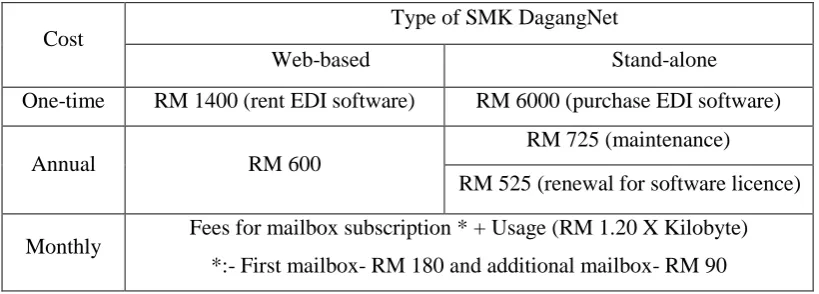
Table 1.1 shows the cost of EDI implementation, which also known as SMK DagangNet (Gangeswari, 2007). The cost of SMK implementation varies depending on its type as shown in Table 1.1. Stand-alone system costs higher than web-based EDI as stand-alone system requires users to purchase software, besides this type of system also entails costs for maintenance and licence’s renewal. However, monthly charges are similar for both systems where these are charges subject to number of mailboxes subscribed and usage of data element.
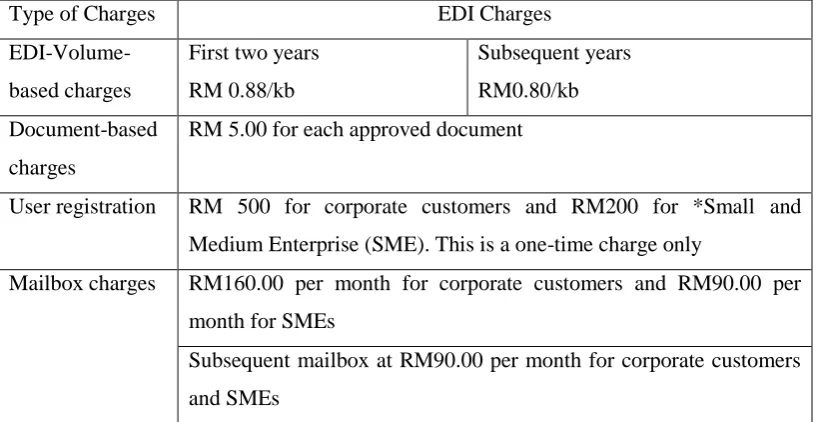
Table 1.2 shows EDI charges for National Single Window (NSW) implementation in 2010 (Salleh, 2010), where the charges were based on EDI-Volume, document-based, registration and mailbox charges. Compared to the previous charges shown in Table 1.1, there are EDI usage and mailbox charges by Dagang Net Technologies Sdn. Bhd before and after NSW implementation. Thus, this clearly shows that there are non-usage of XML among logistics transportation companies and Customs Department as standard of logistics data exchange.
Cost
Type of SMK DagangNet
Web-based Stand-alone
One-time RM 1400 (rent EDI software) RM 6000 (purchase EDI software)
Annual RM 600
RM 725 (maintenance)
RM 525 (renewal for software licence)
Monthly Fees for mailbox subscription * + Usage (RM 1.20 X Kilobyte)
Table 1.2: EDI Charges for NSW Implementation 2010
XML is emerging as the information transfer medium between firms and service providers that have transaction volumes to justify the use of EDI. XML has become a near-universally accepted and supported mechanism for data exchange across platforms and applications. XML data structures, known as schemas, provide a mechanism to develop and adopt common formats for universal data exchange, thereby, allowing separate information systems to communicate. XML provides a formal, self-documenting structure to share data, independent of the software that produced it. It also provides a mechanism for long-term archiving of data that might otherwise be difficult to access when host applications are retired. XML schemas have been developed in many industries, including publishing, insurance, education, and electronics. Cross and other industry experts believe that the deployment of XML ultimately may improve data exchange among companies in a low cost (X. Lu, Ye, Yang, and Yu, 2009).
The potentials of XML can overcome the weaknesses of EDI; however, in the context of Malaysian logistics industry, there are still non-usage of XML as standard data exchange, especially in import/export declaration and customs clearance.
Type of Charges EDI Charges
EDI-Volume-based charges
First two years
RM 0.88/kb
Subsequent years
RM0.80/kb
Document-based
charges
RM 5.00 for each approved document
User registration RM 500 for corporate customers and RM200 for *Small and
Medium Enterprise (SME). This is a one-time charge only
Mailbox charges RM160.00 per month for corporate customers and RM90.00 per
month for SMEs
Subsequent mailbox at RM90.00 per month for corporate customers
Preliminary study has found that all respondents did not have any XML migration framework to migrate from EDI to XML.
Therefore, it is vital to explore the current situation of logistics standard data exchange in the context of Malaysia logistics industry in order to understand the non-usage of XML as standard data exchange and suitable framework to assist them to migrate from EDI to XML.
1.3 Problem Statement
In the context of logistics industries in Malaysia, preliminary study shows that only 14% of the logistics related companies were using XML as the standard data exchange. Therefore, there is a need to study the current situation in order to identify the factors and understand the non-usage of XML as logistics standard data exchange in Malaysia.
Customs Department prepare for XML migration.
1.4 Research Questions
Based on the problem statement described in the previous section, two research questions outlining this research are identified.
i. What are the factors of the non-usage of XML among the logistics transportation companies and Royal Malaysian Customs Department? ii. What are the appropriate components that need for developing
migration framework to assist the Royal Malaysian Customs Department and logistics companies to migrate from EDI to XML?
1.5 Research Objectives
The main objectives of this research are:
i. To identify factors that causes the non-usage of XML as a standard data exchange among logistics transportation companies and Royal Malaysian Customs Department.
1.6 Scope of Research
The scopes of this research are limited as followed:
i. This research is done in the context of Malaysian logistics Industry. The main focus of the study is the Royal Malaysian Customs Department (Jabatan Kastam DiRaja Malaysia), which will be referred as Customs Department, while the business partners of the Customs Department, such as the forwarding agents, freight forwarders and shipping agents are the sub-case study.
ii. The output of this research is a migration framework that consists of a model and guidelines that can assist XML migration. Therefore, this research is only involved in the planning phase; the design and implementation of the XML migration process are not taken into account.
1.7 Significance of Research
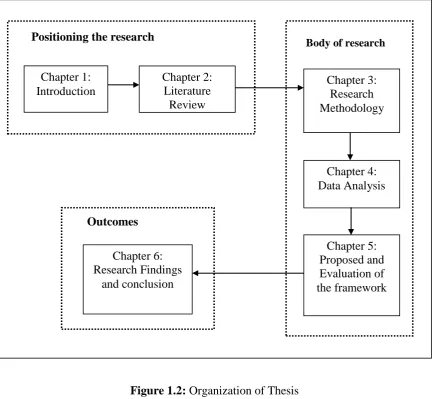
This thesis consists of six chapters. The structure of the thesis, as shown in Figure 1.2, is grouped into three sections: positioning the research, body of research and outcomes. The thesis presents the development of the research in a structured and coherent manner. There are inter-relationships between different chapters and sections of the thesis and they are clearly stated in the chapters.
Chapter 1 provides an overview of the thesis. It describes the background of the problem, statement of the problem, objective of the study, scope of the study, and their significance, as well as the structure of the thesis.
Chapter 1: Introduction
Chapter 2: Literature
Review
Chapter 3: Research Methodology
Chapter 4: Data Analysis
Chapter 5: Proposed and Evaluation of the framework Chapter 6:
Research Findings and conclusion Positioning the research
Body of research
Outcomes
Chapter 2 discusses literature review on technology in logistics industry, EDI and XML technology, migration technology to support the research problem background while highlighting previous related researches that have been done to support this research.
Chapter 3 elaborates on the research methodology used in accessing the case studies conducted in this chapter. This chapter also gives an overview of qualitative research followed by the description of qualitative research approaches in information systems research and the case study methodology. Explanation on the step-by-step process for data collection and analysis are also discussed.
Chapter 4 reports on the case studies conducted. This chapter also discusses the results and findings from the case studies. The outcome from this chapter is important in developing the migration framework proposed in Chapter 5.
Chapter 5 discusses the proposed XML migration framework. It also provides the details of each phase in the migration framework together with the guidelines for the companies. The end of the chapter discusses the verification and validation of the migration framework.
REFERENCES
Aiken, P., and Allen, D. (2004). XML for Data Management. San Francisco: Morgan Kaufmann/Elsevier.
Ang, C.-L., Tahar, R. M., and Murat, R. (2003). An Empirical Study on Electronic Commerce Diffusion in the Malaysian Shipping Industry. The Electronic Journal on Information systems in Developing Countries, 14(1), 9.
Angeles, R. (2000). Revisiting the role of Internet-EDI in the current electronic commerce scene. Logistics Information Management, 13(1), 12.
Auramo, J., Kauremaa, J., and Tanskanen, K. (2005). Benefits of IT in supply chain management: an explorative study of progressive companies. International Journal of Physical Distribution and Logistics Management, 35(2), 19.
Baglieri, E., Secchi, R., and Croom, S. (2007). Exploring the impact of a supplier portal on the buyer–supplier relationship. The case of Ferrari Auto. Industrial Marketing Management, 36, 8.
Banerjee, S., and Golhar, D. Y. (1994). Electronic data interchange: Characteristics of users and nonusers. Information and Management, 26(26), 11.
Barut, M., Faisst, W., and Kanet, J. J. (2002). Measuring supply chain coupling: an information system perspective. European Journal of Purchasing and Supply Management, 8, 11.
Bergendahl, G. (2005). Models for investment in electronic commerce—financial perspectives with empirical evidence. Omega The International Journal of Managemnet Science, 33, 14.
Bienstock, C. C., Royne, M. B., Sherrell, D., and Staffor, T. F. (2007). An expanded model of logistics service quality: Incorporating logistics information technology. International Journal of production economics, 113(1).
Bourlakis, M., and Bourlakis, C. (2006). Integrating logistics and information technology strategies for sustainable competitive advantage. Journal of Enterprise Information Management, 19(4), 14.
Bowersox, D. J., Closs, D. J., and Cooper, M. B. (2010). Supply Chain Logistics Management (3rd ed.). New York: McGraw-Hill/Irwin.
Brodie, M. L. (1992). The promise of distributed computing and the challenges of legacy information systems. Paper presented at the Advanced Database Systems: Proceedings of the 10th British National Conference on Databases, New York/Heidelburg.
Caldelas-Lopez, A., and Pastor, J. (2006). Towards a Research Agenda for SCM systems. Americas Conferences on Information Systems (AMCIS), 6.
Cambridge Systematics, I. (2004). XML Schemas For Exchange Of Transportation Data (No. Project No. 20-64): National Cooperative Highway Research Program (NCHRP).
Chicone, R. G. (2009). An Exploration of Security Implementations for Mobile Wireless Software Applications within Organizations. Northcentral University, Arizona.
Chiu, R.-K., and Chen, J. C. H. (2005). A generic service model for secure data interchange. Industrial Data Management and Data Systems, 105(5), 18. Connelly, M. (2008). Change-Mnagement-Coach.com. Change Management Model,
from http://www.change-management-coach.com
Coronado M., A. E., Coronado M., E. S., and Lalwani, C. S. (2009). Wireless vehicular networks to support road haulage and port operations in a multimodal logistics environment. IEEE/INFORMS International Conference on Service Operations, Logistics and Informatics, SOLI 2009 6.
Coyle, J. J., Bardi, E. J., and C. John Langley, J. (2003). The management of business logistics: a supply chain perspective (7th ed.). Mason, Ohio: South-Western College Pub.
Creswell, J. W. (2003). Research Design Qualitative, Quantitative and Mixed Methods Approaches (Second ed.). California: Sage Publications,Inc.
UK general haulage companies. International Journal of production economics, 106, 16.
Dennis, A., Wixom, B. H., and Roth, R. M. (2010). Systems Analysis and Design (Fourth Edition ed.): John Wiley and Sons, Inc.
Furulund, K. M. (2007). Empirical Research on Software Effort Estimation Accuracy. University of OSLO.
Gangeswari. (2007). The Implementation of EDI in manufacturing companies in Malaysia. University Teknologi Malaysia.
Gebresenbet, G., and Ljungberg, D. (2001). Coordination and Route Optimization of Agricultural Goods Transport to attenuate Environmental Impact. J. agric. Engng Res, 4(80), 14.
Germain, R. (1993). The adoption of logistics process technology by manufacturers Journal of Business Research, 27(1), 12.
Giannopoulos, G. A. (2004). The application of information and communication technologies in transport. European Journal of Operational Research(152), 19.
Gregory, A. T. (2000). XML schema design for business-to-business e-commerce. Retrieved from http://scientific.thomsonwebplus.com
Grieger, M. (2003). Electronic marketplaces: A literature review and a call for supply chain management research. European Journal of Operational Research, 144, 15.
Gunasekaran, A., and Ngai, E. W. T. (2004). Information systems in supply chain integration and management. European Journal Of Operational Research, 159(159), 27.
Gutiérrez, G., and Durán, A. (1997). Information technology in logistics: a Spanish perspective. Logistics Information Management, 10(2), 7.
Hager, M. A., Wilson, S., Pollak, T. H., and Rooney, P. M. (2003). Response Rates for Mail Surveys of Nonprofit Organizations: AReview and Empirical Test. Nonprofit and Voluntary Sector Quarterly, 32(2), 16.
Hameri, E. E. a. A.-P., and Lähteenmäki, K. (1991). Experiences of different approaches in logistics Engineering Costs and Production Economics, 21(2), 15.
Hamilton, J. W. (1993). Wireless communication systems: A satellite-based communications approach for competitive advantage in logistic and transportation support services Computers in Industry, 21(3), 5.
Hammant, J. (1995). Information technology trends in logistics. Logistics Information Management, 8(6), 6.
Harrelson, B. (2000). The B2B Standards War: Connect or Die. eAI Journal, 5. Helo, P., and Szekely, B. (2005). Logistics information systems An analysis of
software solutions for supply chain co-ordination. [Journal]. Industrial Management and Data Systems, 105(1), 14.
Hiseh, C.-t., and Lin, B. (2004). Impact of Standardization on EDI in B2B development. Industrial Management and Data Systems, 104(1), 10.
Hong, W., and Zhu, K. (2006). Migrating to internet-based e-commerce: Factors affecting e-commerce adoption and migration at the firm level. Information and Management, 43, 18.
Huang, S., and Liu, H. (2009). A customer driven model for integrated supply chain management system. International Seminar on Business and Information Management, ISBIM 2008 2, 4.
Hughes, E. R., Rosenthal, A. S., Hyland, R. S., Schafer, A. L., Litvintchouk, S. D., and Surer, S. L. (1997). A Methodology for Migration of Legacy Applications to Distributed Object Management. IEEE, 9.
Iahad, N. (2007). Task and Collaboration Design Guidlines Towards Effective Group -Based Threded Discussion. Manchaster Business School.
Illyas, M. I. (2001). Pembentukan Metodologi Keperluan Maklumat Institusi Perubatan Akademik Tempatan. Universiti Teknologi Malaysia.
J.Closs, D., Goldsby, T. J., and Clinton, S. R. (1997). Information Technology influences on world class logistics capability. International Journal of Physical Distribution and Logistics Management, 27(1), 13.
in B2B E-Commerce: Evidence from an Emerging Logistics Market. Proceedings of the IEEE International Conference on Automation and Logistics Qingdao, China September 2008, 6.
Jun, M., and Cai, S. (2003). Key obstacles to EDI success: from the US small manufacturing companies' perspective. Industrial Management and Data Systems, 103(3), 11.
Kearns, B. (2004). Technology and Change Managemnet. School of Computing Research Paper (ITSM), 24.
Keil, T., Eloranta, E., Holmstrom, J., Jarvenpaa, E., Takala, M., Autio, E., et al. (2001). Information and communication technology driven business transformation - a call for research. Computer In Industry, 44, 20.
Kengpola, A., and Tuominen, M. (2006). A framework for group decision support systems: An application in the evaluation of information technology for logistics firms. Int. J. Production Economics, 101, 13.
Ketikedis, P. H., Koh, S. C. L., Dimitriadis, N., Gunasekaran, A., and Kehajova, M. (2006). The use of information systems for logistics and supply chain management in South East Europe: Current status and future direction. Omega The International Journal of Managemnet Science, 36, 8.
Kia, M., Shayan, E., and Ghotb, F. (2000). The importance of information technology in port terminal operations. International Journal of Physical Distribution and Logistics Management, 30, 14.
Kim, C., Yang, K. H., and Jaekyung Kimc. (2006). A strategy for third-party logistics systems: A case analysis using the blue ocean strategy. Omega The International Journal of Managemnet Science, 36(4).
Kim, S. W., Jung, R., and Kim, M. S. (2005). Frameworks on New XML/EDI System for B2B Shipping Companies in Korea. IEEE Computer Society / Proceedings of the 2005 Third ACIS Int'l Conference on Software Engineering Research, Management and Applications (SERA’05), 6.
Lee, M. K. O. (1998). Internet-based financial EDI: towards a theory of its organizational adoption. Computer Networks and ISDN Systems, 30, 10. Levy, Y., and Ellis, T. J. (2006). A Systems Approach to Conduct an Effective
Literature Review in Support of Information Systems Research. Informing Science Journal, 9.
Leyland, V. (1993). Electronic Data Interchange A Management View: Prientice Hall.
Lim, B. B. L., and Wen, H. J. (2002). The impact of next generation XML. Information Management and Computer Security.
Liu, X., and Ma, S. (2005). Quantitative Analysis of Enterprise's Logistics Capability Based on Supply
Chain Performance. IEEE Computer Society / Proceedings of the 2005 IEEE International Conference on e-Business Engineering (ICEBE’05), 4.
Lu, E. J.-L., Tsai, R.-H., and Chou, S. (2001). An Empirical study of XML/EDI. The Journal of Systems and Software, 58, 9.
Lu, X., Ye, L., Yang, C., and Yu, J. (2009). Embedded XML Data Exchange for Asynchronous Communication Between E-commerce Systems. Paper presented at the 2009 International Conference on Management of e-Commerce and e-Government.
Lyons, K. (2010). An Analysis of the Radio Frequency Identification (RFID) Technology Implementation within an Independent Public Library System: A Case Study of the North Canton, Ohio Public Library. Nova Southeastern University.
Medjahed, B., Benatallah, B., Bouguettaya, A., Ngu, A. H. H., and Elmagarmid, A. K. (2003). Business-to-business interactions: issues and enabling technologies. The VLDB Journal, 12, 27.
Minxi, W., Ningyun, J., and Lu, L. (2007). Security Problems And Solutions For Internet-Based EDI. Paper presented at the International Conference on Transportation Engineering 2007 (ICTE 2007).
CoronadoMondragon, C. E. (2009). Facilitating multimodal logistics and enabling information systems connectivity through wireless vehicular networks. Int. J.Production Economic(122), 12.
Morrison, M. (2006). Sams Teach Yourself XML in 24 Hours (3rd Edition ed.): Sams Publication.
Ngai, E. W. T., Lai, K.-H., and Cheng, T. C. E. (2008). Logistics information systems: The Hong Kong experience. International Journal of production economics, 113, 12.
Nurmilaakso, J.-M. (2008a). Adoption of e-business functions and migration from EDI-based to XML-based e-business frameworks in supply chain integration. International Journal of production economics, 13.
Nurmilaakso, J.-M. (2008b). EDI, XML and e-business frameworks: A survey. Computer In Industry, 59, 10.
Nurmilaakso, J.-M., Kettunen, J., and Seilonen, I. (2002). XML-based supply chain integration : a case study. Integrated Manufacturing Systems, 13(8), 10. Nurmilaakso, J.-M., Kotinurmi, P., and Laesvuori, H. (2006). XML-based e-business
frameworks and standardization. Computer Standards and Interfaces, 28, 15. Oliveira, T., and Martins, M. F. (2011). Literature Review of Information
Technology Adoption Models at Firm Level. The Electronic Journal Information Systems Evaluation, 14(1).
Otto, A., and Kotzab, H. (2003). Does supply chain management really pay? Six perspectives to measure the performance of managing a supply chain. European Journal of Operational Research, 144, 13.
Pedroso, M. C., and DaviNakano. (2009). Knowledge and information flows in supply chains: A study on pharmaceutical companies. Int. J. Production Economics(122), 9.
Piplani, R., Pokharel, S., and Tan, A. (2004). Perspective on the Use of Information Technology at Third Party Logistics Service Providers in Singapore. Asia Pacific Journal of Marketing and Logistics, 16(1), 8.
Ramani, K. V., Yap, R., and Pavri, F. (1995). Case study Information technology enables business process reengineering at YCH DistriPark (Singapore). Journal of Strategic Information Systems, 4(1), 8.
Riezebos, J., Klingenberg, W., and Hicks, C. (2009). Lean Production and information technology: Connection or contradiction? Computers in Industry(60), 11.
Rodon, J., Ramis-Pujol, J., and Christiaanse, E. (2007). A process-stakeholder analysis of B2B industry standardisation. Journal of Enterprise Information Management, 20(1), 13.
Rutner, S. M., Gibson, B. J., and Williams, S. R. (2003). The impacts of the integrated logistics systems on electronic commerce and enterprise resource planning systems. Transportation Research Part E, 39, 11.
Sachan, A., and Datta, S. (2005). Review of supply chain management and logistics research. International Journal of Physical Distribution and Logistics Management, 35(9), 42.
Salleh, Z. M. (2010). Towrads a Single Window Trading Environment Case of Malaysia's National Single Window: Dagang Net Technologies Sdn Bhd, Malaysia.
Schary, P. B., and Coakley, J. (1991). Logistics Organization and the Information System. The International Journal of Logistics Management, 2(2).
Scho¨nsleben, P. (2000). With agility and adequate partnership strategies towards effective logistics networks. Computers in Industry, 42, 10.
Segev, A., Porra, J., and Roldan, M. (1996). Financial EDI Over the Internet: Case Study II. Paper presented at the Proceedings of the Second USENIX Workshop on Electronic Commerce.
Sekaran, U. (2003). Research Methods for Business A Skill Buliding Approach (Fourth ed.): John Wiley and Sons, Inc.
Shang, K.-c., and B.Marlow, P. (2005). Logistics capability and performance in Taiwan’s major manufacturing firms. Transportation Research Part E, 41, 18.
Logistic chain modelling. European Journal of Operational Research, 87, 20. Stefansson, G. (2002). Business-to-business data sharing: A source for integration of
supply chains. Int. J. Production Economics, 75, 12.
Subramani, M. (2004). How Do Suppliers Benifit From Information Technology Use In Supply Chain Relationships? MIS Quarterly, 28(1), 30.
Tan, K. C. (2001). A frame work of supply chain management literature. European Journal Of Purchasing and Supply Management, 7, 9.
Tan, K. S., Chong, S. C., and Eze, U. C. (2009). Internet-based ICT adoption:evidence from Malaysian SMEs. Unpublished Research paper. Turban, E., Leindner, D., McLean, E., and Wetherbe, J. (2008). Information
Technology for Management Transforming Organizations In The Digital Economy 6th. ed. : John Wiley and Sons (Asia) Pte Ltd.
Vermeer, B. H. P. J. (2000). How Important is Data Quality for Evaluating the Impact of EDI on Global Supply Chains? Proceedings of the 33rd Hawaii International Conference on System Sciences - 2000, 10.
W.Y.Wong, C., Kee-hungLai, and E.W.T.Ngai. (2009). The role of supplier operational adaptation on the performance of IT-enabled transport logistics under environmental uncertainty. Int. J.Production Economics(122), 9.
Wagner, M. (2001). Intel Readies EDI Retirement Chip Maker Migrating Transactions To Rosettanet XML Specs; 50 Partners Already On Board. InternetWeek,
Webster, J., and Watson, R. T. (2002). Analyzing The Past To Prepare For The Future:Writing A literature Review. MIS Quarterly, 26 11.
Whitehead, P., Friedman-Hill, D. E., and Veer, E. V. (2002). Java and XML: Wiley Publishing, Inc.
Woo, S. H., Choi, J. Y., Kwak, C., and Kim, C. O. (2009). An active product state tracking architecture in logistics sensor networks. Computers in Industry, 60, 12.
Wu, B., Lawless, D., Bisbal, J., Grimson, J., Wade, V., O’Sullivan, D., et al. (1997). Legacy Systems Migration - A Method and its Tool-kit Framework. IEEE, 9. Wu, F., Yeniyurt, S., Kim, D., and Cavusgil, S. R. T. (2006). The impact of
Wu, I.-L., and Chuang, C.-H. (2009). Analyzing contextual antecedents for the stage-based diffusion of electronic supply chain management. Electronic Commerce Research and Applications, 8, 13.
Xuhua, P. (2008). Information Technology in Logistics and Supply Chain Management. Proceedings of the IEEE International Conference on Automation and Logistics Qingdao, China 4.
Yen, D. C., Huang, S.-M., and Ku, C.-Y. (2002). The impact and implementation of XML on business-to-business commerce. Computer Standards and Interfaces, 24(24), 15.
Yin, R. K. (2003a). Applications of Case Study Research (Second Edition ed. Vol. 34). Thousand Oaks, California: Sage Publication, Inc.
Yin, R. K. (2003b). Case Study Research Design and Methods (Third Edition ed. Vol. 5). Thousand Oaks, California: Sage Publication, Inc.
Yin, R. K. (2009). Case Study Research Design and Methods. 4th. ed. Vol. 5. California: Sage Publication, Inc.
Zhang, Z., Yang, H., Zhou, D., and Zhong, S. (2010). A SOA Based Approach to User-Oriented System Migration. Paper presented at the 2010 10th IEEE International Conference on Computer and Information Technology (CIT 2010).
Zhao, X.-x., Tao, F., Hu, Y.-f., and Zhou, Z.-d. (2007). Resource Modeling of Logistic Grid System Based on XML. Proceedings of the IEEE International Conference on Automation and Logistics August 18 - 21, 2007, Jinan, China, 5.