Review
Survey on Representation Techniques for Malware Detection
System
1,2
Gamal Abdel Nassir Mohamed and 1Norafida Bte Ithnin
1Faculty of Computing, University Technology Malaysia, Skudai, Malaysia 2Department of Computing, Muscat College, Muscat, Sultanate of Oman, Oman
Article history
Received: 04-12-2016 Revised: 04-03-2017 Accepted: 08-07-2017
Corresponding Author: Gamal Abdel Nassir Mohamed Faculty of Computing, University Technology Malaysia, Skudai, Malaysia Email:[email protected]
Abstract: Malicious programs are malignant software’s designed by hackers or cyber offenders with a harmful intent to disrupt computer operation. In various researches, we found that the balance between designing an accurate architecture that can detect the malware and track several advanced techniques that malware creators apply to get variants of malware are always a difficult line. Hence the study of malware detection techniques has become more important and challenging within the security field. This review paper provides a detailed discussion and full reviews for various types of malware, malware detection techniques, various researches on them, malware analysis methods and different dynamic programming-based tools that could be used to represent the malware sampled. We have provided a comprehensive bibliography in malware detection, its techniques and analysis methods for malware researchers.
Keywords: Malicious, Malware Representation, Detection Techniques, Analysis Methods, Dynamic Programming
Introduction
Representation of malware basically deals with how the collected malware samples are being transformed from specific format to another by applying certain techniques to represent them such as a system call representation technique (Mehdi et al., 2010) and Opcode sequences as representation of executable data-mining-based (Santos et al., 2013). In this study, besides providing the researchers with full and comprehensive literature on malware definitions, types, various detection techniques and methods, we aim at giving researchers an idea about various techniques that are used for representing the malware samples as we will conduct a deep survey on some representations that are based on the major malware detection techniques. We are proposing the string representation technique as a solution for some drawbacks/disadvantages caused by representation techniques been used by researchers in the recent years our survey will be focused or limited to analysing some techniques based on machine learning, data mining, API call graph and String (Signature based technique). The proposed string representation will be based on these representation techniques drawbacks/disadvantages. Our survey will touch upon some of the tools that are used in implementing some of these and other malware representation techniques as we
gain unauthorized access to a computer system (Santos et al., 2013). In the case of the malware infecting executable codes when this happen the file or files got infected will be residing in memory the moment the user executes them and hence they will infect any other files that the user may execute afterwards. It has a tremendous negative impact on the computer security (Mehdi et al., 2010). With the use of antivirus programs and firewall many malware could be defeated “to some extent” especially those been very active through the network, but at the same time, if we disable the use of antivirus and firewalls for a single day, this may show strong proof of the fast spread of this malicious software. The techniques that are being developed and applied by the researchers to detect the malware are clearly explained and known through the malware detectors. Of no doubt, malware has grown in volume and complexity and this has proven and experienced the danger of this malicious software. It is found that 1 in 8 legitimate Websites has a critical vulnerability, (Patil and Patil, 2015). Following a pull-based model, as the technique uses two categories of web infection by means of delivering malware into it as first various social engineering techniques are used by the attackers so that they can attract the visitors to download the malware. The second category involves the underhanded tactic of targeting various browser vulnerabilities to automatically download and run i.e., unknowingly to the visitor, the binary upon visiting a website (Mavrommatis and Monrose, 2008) last but not least, there exist a gap between the various detection techniques and the representation methods used. This is very clear as in the case of API call graph which has a major issue related to its NP-Complete problem because of its computational complexity and also during the construction phase of the graph it is difficult to build a precise call graph from information collected about malware samples (Patil and Patil, 2015).
Types of Malware
As stated above malware as a malicious software is a set of codes that are designed by hackers with an intent to harm others information or computer systems. With this background in mind and as it is shown in the above Fig. 1 we can classify the malware into different categories or types. In the above Fig. 1, the researchers have given a category for different types of malware in terms of their existence and spread and activation during the period that prior to the year 2011. From the percentages shown we can easily say that the Trojan horses followed by Virus have taken the maximum percentage whereas other malware has taken some different ranges of percentages.
Fig. 1: Types of malware by categories (Piyanuntcharatsr et al., 2015)
Viruses
It has been defined by some researchers as pieces of code that insert itself into other program(s) known as virus host and get replicated. This host is very important and necessary for the virus so as to cause harm to the computer or data. As Idika and Mathhur (2007) emphasizes, a virus may use some utility software such as word processing application and attach itself to it, once the user lunched that utility software the virus will get activated and it may reach the level of disabling the malware detectors enabled in that particular computer system.There are viruses which can evolve into various types by duplicating itself. These types of viruses are known as metamorphic viruses. Unlike most of other malware the virus has disadvantage that it cannot be active unless it/its host been launched/executed, but same time the dangerous of it is driven by the fact that in order to get spread it needs a host so as to attach itself to and then do its harmful job, this host could be a useful file created by the user using any of the computer languages. Once the file is launched the virus will get activated and it can go up to the level of disabling any detection utility that has been installed in the computer system for the sake of detecting any malware. Hence basically a virus is a malware that does self-replication into other existing files or programs that could be executed and this action is repeated by the infected file for other uninfected files to make the virus spread within the same computer system or even can shift between various computers through usage of infected external media such as USB, CD/DVD, Floppy Disk and so on.It is also a well-known fact that the virus cannot simply spread through the network as this is done by another type of malware, discussed below, called worm. As mentioned above the two types of virus classification, in this case, can be classified as polymorphic and metamorphic malware.
Polymorphic Virus
Metamorphic Virus
In this type of virus, the internal structure of the malware gets changed after every execution with its overall functionality remains the same, which could be considered an advanced version of the polymorphic virus (Lin and Stamp, 2011). For morphing the internal structure of the malware there are different approaches been followed, they could be discussed as in the case of ‘Subroutines Permutation’ where the subroutine definitions get arranged by malware writers within the code, as the time of maintaining the ordering of subroutine calls this result into generating codes that have equal functionality but different in their structure. Another approach is what is called ‘Instruction Recording’ where instructions are rearranged in a program to generate the morphed copies (Rad et al., 2012). Further, when an instruction or sequences of instructions are replaced by its functionality equivalent instruction in order to generate new variants of same code this is called as ‘Instruction Equivalence’ (Walenstein et al., 2007). Last but not least an approach some junk code or dead codes otherwise called do-nothing instructions which are basically inserted into software which will not affect the execution of the program, these dead codes are added to facilitate code obfuscation (Al Daoud et al., 2008). Certain algorithms have been used such as: Feng-Doolittle algorithm, a clustering algorithm, Prim’s algorithm and MSA construction algorithm.
Worms
By exploiting operating systems vulnerabilities this type of malware spreads over computer networks. Although they are been classified as viruses, but the main different between them and the viruses is that they have the ability to self-replicate where viruses need human activity to spread in the computer system, in this sense, the propagation of computer worms is often based on the sending of mass emails with infected attachments to user’s contacts(Rey, 2015). The worm replicates itself by executing its own code independent of any other program. The primary distinction between a virus and a worm is that a worm does not need a host to cause harm. Another distinction between viruses and worms is their propagation model. In general, viruses attempt to spread through programs/files on a single computer system. However, worms spread via network connections with the goal of infecting as many computer systems connected to the network as possible (Idika and Mathur, 2007).
Trojan Horses
This malicious software will be embedded by the one who has designed it i.e., hackers for example, in any kind of application or even a system that is intended and appears to perform some function or action which apparently useful like for example give the information about the local weather but in fact it is performing some
other action for example collecting whatever possible information about the user who has used the application or the computer system and not only gazer them but also send them to a host which is reported to be malicious one, in this case, such type of Trojan horses could be classified as spyware as well (Landwehr et al., 1994).
Spyware
The personal information is not only gathered by the malicious software either by replicating or morphing or through the network, the term spyware could refer to such software which monitors and gathers personal information about the user as when he/she visited the particular page(s) frequently or accessing of email address or even the continuous usage of the credit card number or key pressed by user and so on. Moreover, it enters the system whenever free trial software is downloaded (Vinod et al., 2009).
Adware
It is again malicious software but unlike Spyware it appears whenever an advertisement is played or implemented by particular software automatically this could be referred to what we call Adware. By monitoring the Internet user’s’ activities, for example, many malware developers can add any Adware to any software that supports the add-ins, the most common adware programs according to Vinod are free games, peer-to-peer clients like kaZaa Bear Share etc (Vinod et al., 2009).
Botnet
much because maintenance of various connections over single server is difficult. The next configuration is a hierarchical structure where bot master connects to hundreds of bots which in turn is connected to many bots. Thus this configuration could scale much larger extent (Vinod et al., 2009).
One of the most powerful ways to pursue any computationally challenging task is to leverage the untapped processing power of a very large number of everyday endpoints. This is the idea behind the modern botnet: A collection of compromised workstations and servers distributed over the public Internet, which jointly serve the agenda of a malicious or criminal entity. Once infiltrated with malware in a variety of ways, these compromised systems (“bots”) typically link back to a Command and Control (C and C) server and wait for instructions. The botnet can then be used for tasks ranging from Distributed Denial of Service (DDOS) attacks to spam-marketing on a mass scale and collecting sensitive credit card/financial data leading in short order to identity theft and fraud (Lee et al., 2010b).
Ransomware
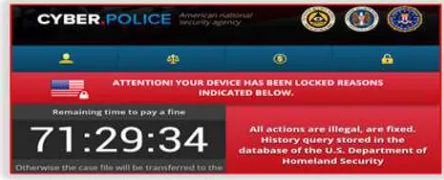
According to a research Pathak and Nanded (2016) they have defined Ransom ware as such kind of malware that attempts to extract money from a computer user by contaminating and taking control of the victim’s machine or the files or documents stored on it as they use the encryption of all those user’s files so as to prevent the user from using them unless a ransom is paid. They have preceded more in their introduction to explained that in general, the Ransomware will performs some actions to the user’s computer or data as it either locks the computer to prevent normal usage or encrypts the documents and files on it to prevent access to the documents and files. The ransom demand is displayed, usually either via a text file as shown in the above Fig. 3 or as a web page in the web browser. This type of malware exploits the victim's embarrassment or fear to force them to pay the ransom demanded. (Pathak and Nanded, 2016).
Rootkit
With this type of malware the targeted computer is been accessed or controlled remotely without giving the user or other security program any chance to detect it. So because of their stealthy operation their prevention, detection and removal are difficult (Rey, 2015). It has been also defined as a malicious code that is designed to hide the presence of other malware. They are usually combined with other malware such as a backdoor, so that remote access could be performed by the attacker so that the detection of it becomes very difficult (Satrya et al., 2015).
Fig. 2: The structure of a botnet (Lee et al., 2010a)
Fig. 3: A sample of a typical ransom ware (Elhadi et al., 2012)
Backdoor
It is referred to the concept of the malware that installs itself into a computer enabling the attacker to access the computer. They allow an attacker to connect to a computer with little or no verification and execute a command on the local system (Satrya et al., 2015). It could be further defined as a mechanism which bypasses a normal security check.
Scareware
It is a kind of malicious software that is designed to fright the infected user to buy something it has an interface that makes it look like an antivirus. This malicious software informs the user that they are attacked by a virus and the only way to clean it is to buy their software (Satrya et al., 2015). More specifically it could be also defined as malicious computer programs intended to trick a user into buying and downloading needless and possibly dangerous software, such as fake antivirus protection.
its main aims may be related to force hits to a particular website so as to increase its advertising revenue.
According to (Aycock, 2006) some types of malware have been pointed out with a clear explanation for each of them since some of them have already been mentioned above, hence herewith we are touching upon the rest of those he has mentioned and not given by us above.
Logic Bomb
It is malicious software which consists of two parts; payload which an action to perform and a trigger which is a Boolean condition that is assessed and controls when the payload is executed. Logic bombs can be inserted into the existing code or could be standalone (Aycock, 2006).
Hybrid, Droppers and Blended Threats
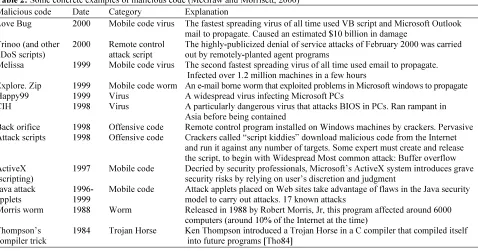
It is a kind of malware which has got different hybrid characteristics of different malware and the chance to exist will be given by the software itself. An example for that is the “Thompson’s compiler trick” shown in Table 2 below (McGraw and Morrisett, 2000). A dropper is another combination of malware which leaves behind or
dropped other malware. When a virus tempt to propagate itself as it exploits a technical vulnerability, this what is known as a blended threat in addition to exhibiting “traditional” characteristics (Aycock, 2006).
Zombies
They are considered as a malware from the nature of their link with spreading it i.e., since they are defined and known as such computers that have been cooperated as the attacker can use them for different tasks and their main common tasks here is to send spam and participating in coordinated, large-scale denial-on-service attacks (Aycock, 2006). We have taken some of the statuses of that malware as stated by the book writer and designed a table which includes some comparison of the same so as to give the researcher a clear picture of the nature of the activity of such malware the table is shown as below.
The above Table 1 shows how the status and functionality of different types of virus is taking place with respect to its ability to self-replicating, population growth and the nature of its existence or behaviour.
Table 1: Status and Functionality of some Malware (Aycock, 2006) Status and functionality
--- Virus name Self-replicating Population growth Parasitic
Logic bomb No Zero Possibly
Trojan horse No Zero Yes
Back door No Zero Possibly
Virus Yes Positive Yes
Adware No Zero No
Table 2: Some concrete examples of malicious code (McGraw and Morrisett, 2000) Malicious code Date Category Explanation
Love Bug 2000 Mobile code virus The fastest spreading virus of all time used VB script and Microsoft Outlook mail to propagate. Caused an estimated $10 billion in damage
Trinoo (and other 2000 Remote control The highly-publicized denial of service attacks of February 2000 was carried dDoS scripts) attack script out by remotely-planted agent programs
Melissa 1999 Mobile code virus The second fastest spreading virus of all time used email to propagate. Infected over 1.2 million machines in a few hours
Explore. Zip 1999 Mobile code worm An e-mail borne worm that exploited problems in Microsoft windows to propagate Happy99 1999 Virus A widespread virus infecting Microsoft PCs
CIH 1998 Virus A particularly dangerous virus that attacks BIOS in PCs. Ran rampant in Asia before being contained
Back orifice 1998 Offensive code Remote control program installed on Windows machines by crackers. Pervasive Attack scripts 1998 Offensive code Crackers called “script kiddies” download malicious code from the Internet
and run it against any number of targets. Some expert must create and release the script, to begin with Widespread Most common attack: Buffer overflow ActiveX 1997 Mobile code Decried by security professionals, Microsoft’s ActiveX system introduces grave (scripting) security risks by relying on user’s discretion and judgment
Java attack 1996- Mobile code Attack applets placed on Web sites take advantage of flaws in the Java security applets 1999 model to carry out attacks. 17 known attacks
Morris worm 1988 Worm Released in 1988 by Robert Morris, Jr, this program affected around 6000 computers (around 10% of the Internet at the time)
Also referring to the nature of virus, it is very clear that only the virus as a malware has the ability to do self-replication whereas other four types of malware have not. Also, it has a positive tendency to achieve a considerable amount of population growth where others show zero ratios these two has resulted into virus been classified as parasitic where other ranges from possibility to be to not to be. Is it difficult to detect a malware? It is an interesting question that might arise here and as we are addressing it we can very much say that detecting malware has become a difficult task just because of the transparent and different types of known and unknown malicious software is playing a main part in this (Christodorescu and Jha, 2004) have focused on testing anti-virus software in order to address the issue of testing detectors of malicious software (such as commercial virus scanners), but it is observed that generally their techniques are applicable to other types of malware detectors. In order to understand the difficulties in testing malware detectors they claim that one has to understand the obfuscation-deobfuscation game that malware writers and developers of malware detectors play against each other. They argue that malware detectors deploy better detection algorithms as advance malware writers detection techniques use better hiding techniques to evade detection (Christodorescu and Jha, 2004).
They have taken the polymorphic and metamorphic viruses as examples to justify their argument which that since these two types of viruses are specially designed to avoid detection tools. This could be discussed in more details so as to give the writer a clear picture about the difficulty of detecting the malware. A polymorphic virus follows the technique of morphing itself so as to avoid detection. By encrypting the malicious payload and then decrypt it as the execution time is taken place this is a common technique to “morph” viruses. To obfuscate the decryption routine, several transformations are applied such as register reassignment (permuting the register allocation) and nop-insertion, code transposition (changing the order of instructions and placing jump instructions to maintain the original semantics). In case of metamorphic viruses it is observed that they attempt to evade heuristic detection techniques by using more complex obfuscations. The viruses changes their code when these malicious software replicate, they change their code in a different ways, such as code transposition, substitution of equivalent instruction sequences, change of conditional jumps and register reassignment. It is also been seen that they can “weave” the virus code into a host program, making detection almost impossible by traditional heuristics and this because of the fact that the virus code is mixed with program code and the virus entry point is no longer at the beginning of the program (these are designated as entry point obscuring viruses) (Christodorescu and Jha, 2004). Here two questions could be raised looking into given the obfuscation-deobfuscation game and the code reuse practiced by virus writers:
Question 1: With respect to the obfuscations or variants of known malware, how resistant is a malware detector?
Question 2: Can a hacker or a blackhat1 determine its detection algorithm using limitations of a malware detector in handling obfuscations?
The motivation for the first question exists by the obfuscation-deobfuscation game. Whereas the second question is motivated by the fact that if a blackhat knows the detection algorithm used by a malware detector, they can better target their evasion techniques. In other words, the “stealth” of the detection algorithm is important (Christodorescu and Jha, 2004). In the same line of argument McGraw and Morrisett provide detailed descriptions of various types of malware. They have noted that categorizing malicious code has increasingly become more complex as newer versions appear to be combinations of those that belong to existing categories. They have provided a table which includes some concrete examples of malicious code is provided and they have also given a note that “recent versions of malicious code are really amalgamations of different categories” (McGraw and Morrisett, 2000). Although the statistic has some old historical background but still it provides the researchers with good view and helps in giving a clear idea about the concept of some categories of used malware and this certainly will support the idea of how detecting malware was and still a difficult task which needs a proper techniques to be used in order to design or develop models that can act as a services or tools of detection. With this background, the table provided below which was given McGraw and Morrisett (2000) that shows some explanation for some malicious code has been taken on different dates and from various categories. In order to discuss the content of the above table given McGraw and Morrisett (2000) on their research titled “Attacking malicious code,” our first attention as researchers go to the year 1984 which is the eldest year among the other years provided i.e., on the range starting from 1984 to 2000. Looking to this year we found that malicious code been taken was categories as Trojan Horse this indicates that this malware was very strong and active since that time especially if we look into the fact that the introducer of it has used it for a C compiler which is one of the high-level languages. Also, our attention goes to some malicious codes that are related to attacking mobile devices during a pretty long time from now which is 1996 to 1999. The category has also included a malicious code of remote control nature.
Malware Analysis Methods
horse). It is an important prerequisite for the development of removal tools that can thoroughly delete malware from an infected machine; it is also considered being a necessary step to develop effective detection techniques for malicious code. Traditionally, it has been a tedious manual process which is time-intensive. Unfortunately, the number of samples that need to be analyzed by security vendors on a daily basis is constantly increasing (Bayer et al., 2006). One of the most important multi-step processes that provide insight into malware structure and functionality is malware analysis. In this analysis process, there is an important step which is used to observe malware relations with respect to the system and is achieved by employing dynamic coarse-grained binary-instrumentation on the target system; this step is known as behavior monitoring. At the same time, when an initial examination is performed for the collected malware, this is called as profiling. Malware analyses can categories fall into two main methods; one is based on analyzing a given sample during execution which is called dynamic analysis, while another one refers to analyze a sample by extracting useful information without executing it and this is known as static analysis. A brief introduction to both types with the knowledge of their limitations as an approach to malware analyses is discussed. It is a fact that from a traditional point of view in the case of malware detection there are two major approaches which are basically split based on how it will analyze the malware, they are hence static or dynamic analysis (see review (Egele et al., 2012). In the case of static analysis, their way of analyzing this malware is done as a direct analyze in binary form, or additionally unpacked and/or decompiled into assembly representation. Whereas in the case of dynamic analysis, it is done through hooking or some access into the internals of virtualization environment the binary files are executed and the actions are recorded. So it is valid to mention that in the case of dynamic analysis it can provide observation of malware action which is less vulnerable to obfuscation (Moser et al., 2007) and makes it harder to recycle existing malware. However, in practice, automated execution of software is difficult, since malware can detect if it is running in a sandbox and prevent itself from performing the malicious behavior.
Hence for machine learning approaches, this makes the static analysis more amenable and as data size increased this will result and enable a better performance (Banko and Brill, 2001). Machine learning has been applied to malware detection since that fact is known (Kephart et al., 1995), so this has proven the fact that numerous approaches exist since that moment onwards (see reviews (Egele et al., 2012; Gandotra et al., 2014)). Machine learning consists of two parts, the feature engineering, where the author transforms the input
binary into a set of features and a learning algorithm, which builds a classifier using these features.
Static Analysis
Static analysis refers to as such analysis done on the infected file without executing it, here the (CFGs) which is an abbreviation for Control Flow Graphs needs to be extracted as well as Data Flow Graphs (DFGs) along with System call analysis. Such information related to CFGs and DFGs can be gathered by disassembling or decompiling the infected file using some tools like IDA Pro. The file may have auto execution which is against the actual concept of static analysis this could be overcome by analyzing the infected file in a different environment to avoid this auto execution of the malware. The advantages of static analysis may be pointed out into points such as it results in fast, safe and low false positives with the possibility of tracing all paths which will certainly help in getting lot of information to analyze, on the other hand, static analysis may fail analyzing unknown malware that uses code obfuscation techniques (Egele et al., 2012).
Dynamic Analysis
In the case of this type of analysis the analysis is done for the infected file during its execution. This type of analysis uses a debugger or virtual machine or even an emulator to execute the infected file on simulated environment in order to analyze its malicious functions, as we have mentioned the infected file needs analysis environment which must be invisible to the malware for the simple reason that the malware writer have tools like anti-virtual machine and anti-emulation used to hide their malware functions if their detection been under analysis. It has been observed that this type of analysis i.e., dynamic one fails to detect activities of interest if the target changes its behavior depending on trigger conditions such as the existence of a specific file or specific day as only a single execution path may be examined for each attempt (Egele et al., 2012).
Table 3: Adv. and disadvantages of static and dynamic analysis (Elhadi, 2014)
Analysis type Advantage Disadvantage
Static analysis Fast and safe but low level of false positives Difficulty analyzing unknown malware Good at analyzing multipath malware
Dynamic analysis Good at detecting unknown malware Slow and unsafe
Hybrid analysis Combines aspects of both static and dynamic analysis Difficulty analyzing multipath malware
A Comparison of Static, Dynamic and Hybrid
Analysis for Malware Detection
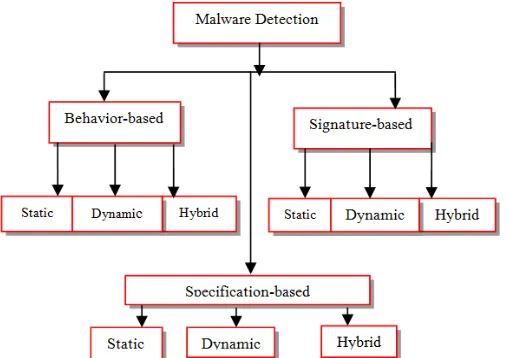
Static analysis of software is performed without actually executing the program. Examples of the information we can obtain from the static analysis include Opcode sequences (extracted by disassembling the binary file), control flow graphs and so on. Dynamic analysis requires that we execute the program, often in a virtual environment. Examples of information that can be obtained by dynamic analysis include API calls, system calls, instruction traces, registry changes, memory writes and so on. Hybrid techniques combine aspects of both static and dynamic analysis (Damodaran et al., 2015; Elhadi et al., 2015). The below Fig. 4 shows the various methods of malware detection techniques which is basically divided into three categories i.e. static, dynamic and hybrid.
In the below Table 4, the analysis types with their main purpose and the corresponding tools that could be used in association with each analysis type are clearly shown and explained. For instance, if we look into the static one we clearly find that it uses as many antivirus detection engines as possible to assist classification which corresponds to using the virus total as the main tool to implement the same. It also uses strings tool when it wants to search the body of the malware for the string. The dynamic uses various tools for various purposes of malware analysis (Verma et al., 2013). Its purposes shown in the Table 4 could be further discussed as with respect to file integration it checks to record baseline configuration. In the case of File monitoring it finds which tools are opening, reading and writing files. Whereas Process monitoring determines resources that are being used such as DLL’s and registry keys. Network monitoring uncovers which ports are open, collect network traffic and find vulnerabilities. Last but not least, Registry monitoring monitors registry activities as they occur. In the case of this dynamic analysis certain tools are been used such as: Analysis, Filemon and Process explorer. Analysis type based on coding its main purpose is to perform disassembly and debugging (Verma et al., 2013).
Malware Detection Techniques
It’s obviously well known fact that malware writers or cyber offenders, otherwise known as hackers, applying some certain sophisticated techniques to evade detection. They follow methods that modify or morphing the malware by means of using several packing and/or program obfuscation techniques. Here comes the concept of malware detector as a system attempts to identify malware using both signatures and other heuristics
techniques. The antivirus scanner, for example, is a good example of a malware detector (You and Yim, 2010). The way of detecting a malware may take different approach as in the case of commercial malware detectors such as virus scanners for example which uses a simple pattern matching approach to detect the malware whereby a program is declared as malware if it contains a sequence of instructions that matched by a regular expression (Idika and Mathur, 2007). This has been discovered by a recent study that such malware detectors can be easily defeated using simple program obfuscations that are already known and been used by hackers. One important point that forces the database of commercial virus scanner to be updated frequently is related to the fact that the pattern-matching algorithm is not very resilient to slight variations, these malware detectors have to use different patterns for detecting two malware that is slight variations of each other(Christodorescu and Jha, 2004).
refers to the similarity between system call sequences and their relations. There is a main limitation been observed in the case of specification-based detection which is related to its difficulty to completely specify the entire set of those behaviors which could be marked as valid, whereas in the case of signature-based since it cannot detect zero-day attack, for which there is no corresponding signature stored in the database which has been treated as one of the major drawbacks of it (Moser et al., 2007).In the case of specification-based techniques, it leverages some specification to decide the maliciousness of a program been under inspection and that by deciding what is the valid behavior is and how it looks like from the behavior point of view. Signature based detection uses its characterization of what is known to be malicious to decide the maliciousness of a program under inspection (Ellis et al., 2004; Han et al., 2014; Shabtai et al., 2009). The procedure of helping protect the system by detecting malicious behavior consider the fact that the malware detector may or may not reside on the system it is trying to protect, in fact the malware detectors takes two inputs which could are related to the signature or behavior of malware to be identified and known as well as the program that currently under inspection (Riesen et al., 2010). Each of them can be applied using any of the methods either static analysis which is implanting signature/behavior/specification-based detection technique without executing the suspected file and it was the first try to detect malware or dynamic analysis, it is applying all of them i.e., signature/behavior/specification-based detection technique during suspected file execution or even hybrid analysis (Idika and Mathur, 2007).
Hence to further explain these techniques and their nature we can say they have and could be categorized as anomaly-based detection, specification-based detection and signature-based detection (Bergroth et al., 2000), (Skormin et al., 2003; Summerville et al., 2005). Anomaly-based detection techniques use the knowledge of what constitutes normal behavior to decide the maliciousness of a program under inspection. Specification-based techniques leverage some specification of what is a valid behavior to decide the maliciousness of a program under inspection. Signature based detection uses its characterization of what is known to be malicious to decide the maliciousness of a program under inspection (Ellis et al., 2004; Han et al., 2014; Shabtai et al., 2009). The fundamental limitation of anomaly-based detection is its high false-positive rate and the time complexity in the training phase. The main limitation of specification-based detection is that it is difficult to specify completely and accurately the entire set of valid behaviors. One of the major drawbacks of signature-based detection is that it cannot detect the zero-day attack, for which there is no corresponding signature stored in the database (Rieck et al., 2011).
We can then conclude to the fact that those techniques used for detecting malware can be categorized broadly into three categories: Anomaly-based detection,
specification-based detection and signature-specification-based detection. Anomaly-based detection techniques use the knowledge of what constitutes normal behavior to decide the maliciousness of a program under inspection. Specification-based techniques leverage some specification of what is a valid behavior to decide the maliciousness of a program under inspection. Signature-based detection uses its characterization of what is known to be malicious to decide the maliciousness of a program under inspection.
The fundamental limitation of anomaly-based detection is its high false-positive rate and the time complexity in the training phase. The main limitation of specification-based detection is that it is difficult to specify completely and accurately the entire set of valid behaviors. One of the major drawbacks of signature-based detection is that it cannot detect the zero-day attack, for which there is no corresponding signature stored in the database (Zhang and Xia, 2012).
Research Techniques for Malware Detection System
The static analysis which is implementing signature based detection without executing the suspected file was the first attempt to detect malware. Some of the researchers who used this approach applied Objective-Oriented Association (OOA) mining based classification (Ye et al., 2008). The proposed model has three major modules, namely, Portable Executable (PE) parser, OOA rule generator and rule-based classifier. This model was taken to a next level by adopting associative classification method based on the analysis of Application Programming Interface (API) execution calls (Ye et al., 2010).
Other researchers combined signature-based technique and genetic algorithm technique and their study focused on three types of malware which are; Viruses, Worms and Trojan Horses (Zolkipli and Jantan, 2010). Signature based detection was also applied during suspected file execution (i.e., dynamic analysis) in which the researchers traced API calls and then built the suspected file signature (Nair et al., 2010).
These researchers generated a signature for an entire malware class instead of individual malware samples. This approach has the advantage that all the metamorphic viruses that are created from a metamorphic generator can be easily detected once a base signature for that metamorphic generator is obtained. A considerable portion of the existing studies relies on using behavior-based detection, whereas some researchers apply static analysis others apply dynamic analysis. Some of the studies adopt the mapping of kernel memory as a way to develop a monitor for malware behavior. The monitor utilizes time-based view of kernel objects to analyze traces of kernel execution (Rhee et al., 2011).
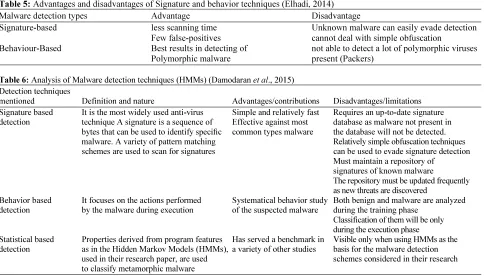
common subgraph detection (Park et al., 2010). We have observed that some of the current researchers have gone for the idea of combining static and dynamic analysis so as to overcome the drawbacks or limitations on each of them. It is a fact that some limitations can be found and observed in approaches been developed following the concepts of signature or behavior-based. It’s then found that the signature-based approaches can be overcome by obfuscation and require prior knowledge of malware samples, whereas in behavior-based not able to detect a lot of polymorphic viruses present (Packers), (Elhadi, 2014). Also it is found that a higher rates of false positive are been generated and incur expensive runtime overheads (Hu et al., 2009). This is been clearly explained as in the Table 5 shown below.
In their research paper (Damodaran et al., 2015) they compare malware detection techniques based on the methods of detection i.e., static, dynamic and hybrid analysis. They have specifically done a training for the Hidden Markov Models (HMMs) on both static and dynamic feature sets and then they have done some comparison for the resulting detection rates over a substantial number of malware families and also they have considered hybrid cases in the situation where dynamic analysis is used in the training phase with the static techniques used in the detection phase and vice versa which enables them to include the hybrid analysis as well (Damodaran et al., 2015). Referring to their work
we can conclude a discussion or findings in such a way that as the three methods of detection which are based on static, dynamic or hybrid one, each has its own advantages or contribution over the models that has been designed based on them and also their own disadvantages or limitations on the same. In the above Table 6 we discussed the various types of detection techniques and our focus will be on projecting these advantages/contributions as well as the common disadvantages/limitations of these three types of malware detection techniques in a form of analytical comparison between three of them which will result in an overall scenario that will shape their real existence in malware detection process and this will certainly help the researcher in looking into the concept of malware detection from a deep and different angles. It is clearly observed that the model, however, has some advantages but it requires a lot of effort as an up to date signature dataset is required since the malware will be expected to be present in the database so as to get detected otherwise it will not. Hence repository of signature of known malware should be maintained and this repository should be up to date as well. It is also observed that with this technique been used simple obfuscation technique can be used to evade it. The behavior based passed through phases of analyzing and then classification since first both benign and malware are analyzed during the training phase. The statistical one is mainly considered as a benchmarking process.
Fig. 4: Organization of malware detection techniques (Elhadi et al., 2015)
Table 4: Summary of some malware analysis tools (Verma et al., 2013)
Analysis type Purpose Tools
Static Use as many antivirus detection engines as possible to assist classification Virus Total (Virus Total, 2008) Search the body of the malware for the string Strings (Microsoft, 2008c) Dynamic File integrity checks to record baseline configuration Analysis (Winalysis.com, 2008)
File monitoring finds which tools are opening, reading and writing files Filemon (Microsoft, 2008c) Process monitoring. Determine resources that are Process explorer (Microsoft, 2008c) being used such as DLL’s and registry keys
Network monitoring. Uncover which ports are open, Fport (Foundstone, 2008), tcpview Collect network traffic and find vulnerabilities (Microsoft, 2008c), nessus Registry monitoring. Monitor registry activities as they occur Regmon (Microsoft, 2008c)
Table 5: Advantages and disadvantages of Signature and behavior techniques (Elhadi, 2014) Malware detection types Advantage Disadvantage
Signature-based less scanning time Unknown malware can easily evade detection Few false-positives cannot deal with simple obfuscation Behaviour-Based Best results in detecting of not able to detect a lot of polymorphic viruses
Polymorphic malware present (Packers)
Table 6: Analysis of Malware detection techniques (HMMs) (Damodaran et al., 2015)
Detection techniques
mentioned Definition and nature Advantages/contributions Disadvantages/limitations Signature based It is the most widely used anti-virus Simple and relatively fast Requires an up-to-date signature detection technique A signature is a sequence of Effective against most database as malware not present in
bytes that can be used to identify specific common types malware the database will not be detected. malware. A variety of pattern matching Relatively simple obfuscation techniques schemes are used to scan for signatures can be used to evade signature detection
Must maintain a repository of signatures of known malware
The repository must be updated frequently as new threats are discovered
Behavior based It focuses on the actions performed Systematical behavior study Both benign and malware are analyzed detection by the malware during execution of the suspected malware during the training phase
Classification of them will be only during the execution phase
Statistical based Properties derived from program features Has served a benchmark in Visible only when using HMMs as the detection as in the Hidden Markov Models (HMMs), a variety of other studies basis for the malware detection
used in their research paper, are used schemes considered in their research to classify metamorphic malware
The main techniques that are used In Malware Detection Systems (MDS) are related to a technique which is based on machine learning or data mining or call graph or string representation. Each of them is explained and discussed below.
Malware Detection Based on Machine Learning
It is observed that there are machine learning techniques of different nature have been proposed for the sake of malware detection, it is found that the boosted decision trees based on n-grams are been observed to produce better results than both the Naïve Bayes classifier and Support Vector Machines. In order to distinguish between malware and clean program files, some researchers have used automatic extraction of association rules on Windows API execution sequences. To figure out whether a given program file is/not a variant of a previous program file a model like Hidden Markov is used so as to detect that file.
In this regards and in order to reach the similar goal, different researchers in this field have gone for applying Hidden Markov Models, which have been previously used with great success for sequence analysis in bioinformatics. In the case of polymorphic malware, we can find that neural networks have been used for the sake of detecting the malware. Also to identify patterns of behavior for viruses in Windows executable files Self-organizing maps have been used. (Kolter and Maloof, 2006) mentioned in their research that, it has been
analysis and a classifier specialized in distinguishing between malicious or benign code (Perdisci et al., 2008). On the same line, some others have proposed analyzing the content of the file for detection of malware samples been embedded within files and that is done basically by making use of similar techniques (Li et al., 2007). Hence in this regards it is very much relevant to mention that for malware behavior the first application of classification has been introduced by researchers who have to generate evidence and classify the samples with several machine-learning algorithms (Devesa et al., 2010). Then a research of the same field has been extended and gone in another line as the focus was on the clustering of malware behavior for the sake of discovering the novel malware and reduction of manual analysis effort, in this regard the first clustering system for observed behavior was introduced, this was then later got extended by another research for the main reason to make it more scalable, where the system devised provides an excellent performance in when it comes to run-time while it is in the practice stage (Bayer et al., 2010). However, both approaches require a single batch of malware samples and thus are limited in the overall capacity.
Malware Detection Based on Data Mining
Detecting unknown viruses researchers have also pay a great attention to the representation of malware detection based on data mining. It is observed that a high accuracy rate is found when a number of classifiers have been built; furthermore it’s been extended to the research level where it become so common to apply data mining techniques for malware detection as it depends on generating a feature set which includes hexadecimal byte sequence which is otherwise termed as N-grams. It also includes instruction sequences, API/system call sequences etc. (Siddiqui et al., 2008). Practically speaking, in the case of features methodology the number of features been extracted from the targeted files is usually very high this has directly/indirectly made several techniques from text classification have been employed to select the best features whereas in other hand features that may include printable strings extracted from the files and some operating system dependent features such as DLL information. When collecting the data the activity monitoring methods may be used, but still, data mining remains the principal detection method. Here we discuss the concept of N-grams which is basically a sequence of bytes of fixed or variable length, extracted from the hexadecimal dump of an executable program. They are used as a general term for both overlapping and non-overlapping byte sequences. They have been defined to remain at a syntactic level of analysis. The first major work that used data mining techniques for malware research was an
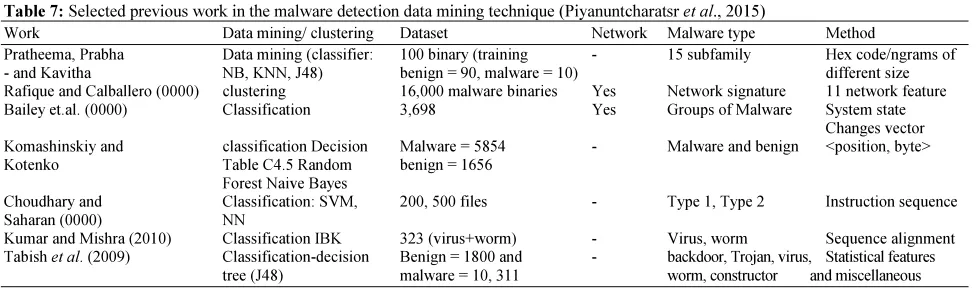
automation of signature extraction for viruses so it is a clear fact that the signature extraction is a major step in data mining technique and with respect to the N-grams technology here comes the concept of Dynamic Misuse Detection, Dynamic Hybrid Detection, Static Hybrid Detection and Static Misuse Detection (Siddiqui et al., 2008).Table 7 summarizes malware detection using data mining which differs in techniques, models, features and data set used. From the below table representation for malware detections work which is mainly related to data mining as a representation technique been used, we can observe that researchers have used different methods which have got a direct relation with the nature of the platform or the system nature that it has been used in for example clustering has been used in Network whereas classification has been used when it comes to detecting various types of malware. More (Norouzi et al., 2016) gave a detailed review from different researches related to some works for malware detection in data mining methods. Some researchers leverage standard data mining algorithms to classify the file content of every block as normal or potentially malicious (Tabish et al., 2009).
Malware Detection Based on API Call Graph
Table 7: Selected previous work in the malware detection data mining technique (Piyanuntcharatsr et al., 2015)
Work Data mining/ clustering Dataset Network Malware type Method
Pratheema, Prabha Data mining (classifier: 100 binary (training - 15 subfamily Hex code/ngrams of - and Kavitha NB, KNN, J48) benign = 90, malware = 10) different size Rafique and Calballero (0000) clustering 16,000 malware binaries Yes Network signature 11 network feature Bailey et.al. (0000) Classification 3,698 Yes Groups of Malware System state
Changes vector Komashinskiy and classification Decision Malware = 5854 - Malware and benign <position, byte> Kotenko Table C4.5 Random benign = 1656
Forest Naive Bayes
Choudhary and Classification: SVM, 200, 500 files - Type 1, Type 2 Instruction sequence Saharan (0000) NN
Kumar and Mishra (2010) Classification IBK 323 (virus+worm) - Virus, worm Sequence alignment Tabish et al. (2009) Classification-decision Benign = 1800 and - backdoor, Trojan, virus, Statistical features
tree (J48) malware = 10, 311 worm, constructor and miscellaneous
The fact is that in the case of API call graph construction algorithms there is a major issue of building a precise call graph from the information collected about malware samples. Also in the case of API call graph matching algorithms it is found that they have NP-complete problems and suffer from being slow because of their computational complexity (Anderson et al., 2011; Han et al., 2012; Lee et al., 2010b). In malware detection, some researchers have paid attention to building their detection systems or architectures based on API call graphs because they have shown some sufficient expressiveness to model complicated structures and their use is gaining momentum in representing structural information. We will be showing in the following paragraphs some of the related work in this area. There are several approaches that the researchers have gone for so as to build the graph, as most of them present graph nodes as system calls. This is very clear as in the case of; Lee et al. (2010a) who have created their graph by transforming a Portable Executable (PE) file into a call graph with nodes and edges which represent system calls and system call sequence, respectively. After that, minimization is applied to the call graph turning it into a code graph to speed up the analysis and comparison process (Lee et al., 2010b). Whereas it is observed that some researchers use the same approach by using 4-tuple nodes to denote a system call, edges, the dependencies between two system calls and a label for nodes and edges, (Park et al., 2010) it is also observed as in the case of Park and Reeves 2011 some other studies use graph nodes to denote kernel objects instead of system calls. It is also seen that the graph was built from subroutines where the nodes and their corresponding call references as edges (Kostakis et al., 2011).On the other hand, some others researchers have used a dependency graph whose vertex represents a line in the semantic code and the dependency between two lines is represented by a directed edge (Kim and Moon, 2010). In some research, we have found that researchers have proposed an algorithm to construct a dependence call graph, where graph nodes represent system calls and two types of dependencies exist between system calls to present the edges (Christodorescu et al., 2008).
Furthermore a researcher has proposed a graphs which are related and based on behavior with the proficiency that they share similarities with graphs of other researchers i.e., Christodorescu in their research paper which is focusing on mining specification of malware behavior, with the clear difference that the edges of their graph have been produced in a way which is totally different with the point that there is no constraint with respect to API call parameters been used. The idea of that usage of both types of research is depends on the fact that an edge is connecting node a to node when there is data dependency between API call nodes a and b, the data dependency represents when the return value of first API call has taint label that is used in one of the input parameter lists for the second API call (Christodorescu et al., 2008; Kolbitsch et al., 2009).This idea is been used later as a researcher has enhanced the dependence graphs proposed by the above two researchers following the methodology of assigning labels to particular files, directories, registry keys and devices based on their significance to the system (e.g., system startup list, firewall settings, system executable) (Christodorescu et al., 2008; Kolbitsch et al., 2009; Fredrikson et al., 2010). It is true and valid to come out from all the above with the fact that all the above studies have used different graph matching techniques while doing the graphs comparison process, these techniques ranges from formula building using intersection and union of graphs, weighted common behavioral graph generation based on an approximate algorithm and maximal common subgraph (Park et al., 2010; Lee et al., 2010a; Kim and Moon, 2010). One important point that forces the database of commercial virus scanner to be updated frequently is related to the fact that the pattern-matching algorithm is not very resilient to slight variations, these malware detectors have to use different patterns for detecting two malware that is slight variations of each other(Christodorescu and Jha, 2004).
Table 8: A review of MDS using data maiming (Norouzi et al., 2016)
Paper title, author, Year of publication Findings with relation to data mining methods
Schultz et al. (2001). Data mining methods Proposed a data mining method to Recognise the new malicious files in run-time for detection of new malicious executable execution. Their method was based on three types of DLL calls such as the list of
DLL issued by the binary; the list of DLL function calls and a number of different systems calls used within each DLL. Also, they examine byte orders extracted from the hex-dump (a hexadecimal scheme of computer data) of an executable file using signature methods. The main structure of this method is based on Naive-Bayes (NB) algorithm. They compared the experimental results by traditional signature-based methods
Kolter and Maloof (2004). Learning to Presented a data mining approach and ݊-gram analysis to identify malicious executable
detect malicious executable sin the wild files based on signature approach. They presented a hex-dump utility for translating each executable file to hexadecimal code in an ASCII format. Their main data set consisted of the clean programs and the malicious programs. They analyzed the proposed approach by some popular classification method such as instance-based learner, TFIDF, Naive-Bayes, support vector machines, decision tree, boosted Naive-Bayes and boosted decision tree. In the other research
Siddiqui et al. (2008). Detecting internet Proposed data mining techniques for recognition some malware programs such as worms using data mining techniques Worms. They considered variable length instruction sequence for their approach.
Their main data set includes some Windows files and Worms. As experimental results sequence reduction was executed, 97% of the sequences were removed and random forest decision tree model was performed slightly better than the others. Also, some research work presented the data mining methodologies for a different approach Yang and Yi-Ping (2015). Data mining in The researchers presented various data mining methods that have been developed for lung cancer pathologic staging diagnosis: cancer diagnosis. Consequently, this research focused on captivating the clinical Correlation between clinical and information which can be found without surgery to exchange the pathology report. pathology information They used to discover the association between the clinical information and the
pathology report in order to maintain lung cancer pathologic staging diagnosis using data mining techniques.
Gandotra et al. (2014). Malware The authors proposed a data mining approach to analyzing the students’ careers. analysis and classification: A survey. Their approach is based on clustering and sequential methods with the aim of Campagni et al. (2015). Data mining categorizing strategies for refining the performance of the exams scheduling and students. models for student careers They analyzed a real case study using ܭ-mean cluster techniques in WEKA tool
Bayer et al. (2006). Dynamic analysis Presented a new data mining method for the problem of detecting the phishing of malicious code websites using a developed associative classification method called multilabel classifier that generates multiple labels rules. They analyzed the experimental results by various patterns in WEKA software
Rahman and Hasan (2011). Using and Analyzed the several decision tree models to classify patients of the hospital comparing different decision tree surveillance data as a real case study. The experimental results of their analysis classification techniques for mining showed that their approach improved identical dissemination of instances in ICDDR,B Hospital Surveillance data. each class
Ghosh et al. (2014). A novel Neuro-fuzzy Used a neuro-fuzzy data mining approach for classification of generalized bell- classification technique for data mining shaped membership functions. They applied the proposed technique to ten real
standard datasets from the UCI machine learning repository for classification using Kappa statistic. They simulated proposed technique in MATLAB.
Moskovitch and Shahar (2015). Presented a novel managed discretization technique for analyzing multivariate time Classification-driven temporal series which uses frequent temporal patterns as features for classification of time discretization of multivariate time series chain for geared near improvement of classification correctness. This paper used
temporal abstraction classification approach and time intervals mining for the presented multivariate time series
Stopel et al. (2006). Application of artificial Presented novel Artificial Neural Networks (ANN) based mechanism for discovering neural networks techniques to computer the computer Worms based on the behavioral computer events. According to the worm detection estimation of different parameters of the infected computers, the ANN, decision tree
and ܭ-nearest neighbors’ classification techniques are compared
Nissim et al. (2012). Detecting unknown Where the author's presented computer measurement extracted mechanism for computer worm activity via support identifying unknown computer Worm activity in the operating system using support vector machines and active learning vector approaches. This paper separates a series of trials to check the new technique
Malware Detection Based on String Representation
This technique as we proposed it, we will address it showing how our proposed model works. Our model has three phases, the first one will basically represent the various known malware in text into string format and hence identify the various functions and their related parameters, phase two will make use of the redundancy there to identify which parameters are repeatedly been called by same functions and hence once this occurrence exists, it will be checked and if it is greater than the threshold then that area will be identified as risky zone which represents the actual malware part of the whole malware file. Phase three will work with unknown malware samples and detecting them only against the risky zone or red area identified in phase two so as to perform a fast detection system which will give a high detection accuracy and be fast so no computational complexity will be experienced with it and as a result of that less memory space will be used. All of these are in fact drawbacks been noted in many of other malware representation techniques. The model we propose is a hybrid one as it makes use of signature and behavior based techniques. Another model is related to Hancock is the first string signature generation system that takes on this challenge on a large scale, Hancock is able to automatically generate string signatures with a false positive rate below 0.1%., it also proven to be given a set of malware samples, Hancock is designed to create a minimal set of N-byte sequences, each of which has a sufficiently low false positive rate, that collectively cover as large a portion of the malware set as possible this has been mentioned in their research. Griffin et al. (2009) published by Symantec Research Laboratories about automatic generation of string signature for malware detection, they have claimed that Hancock differs from previous work by focusing on automatically generating high-coverage string signatures with extremely low false positives (Griffin et al., 2009). Kreibich and Crowcroft (2004) developed Honeycomb a system that uses honeypots to gather inherently suspicious traffic and generates signature by applying the Longest Common Substring (LCS) algorithm to search for similarities in the packet payloads. As they mentioned in their research paper (Lin and Stamp, 2011) that their system is unique in that it generates signatures. In contrast to NIDSs, it cannot read a database of signatures upon startup to match them against live traffic to spot matches thus, the commonly employed pattern-matching algorithms in NIDSs which are of no use to the researchers. Instead, the system tries to spot patterns in traffic previously seen on the honey pot as the researchers have overlay parts of flows in the traffic and use a Longest Common Substring (LCS) algorithm to spot similarities in packet payloads. Like pattern matching, LCS algorithms have
been thoroughly studied in the past. Their LCS implementation is based on suffix trees, which are used as building blocks for a variety of string algorithms. Using suffix trees, the longest common substring of two strings is straightforward to find in linear time (Kreibich and Crowcroft, 2004).
The Importance of Malware Detection
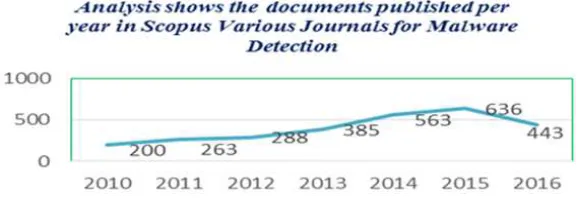
The topic of malware detection has taken a high level of importance in many types of research in recent years and in different types of study fields. According to the analytical data from Scopus, the study of the malware detection has a significantly increased in the last six years (St'astna and Tomasek, 2015) this is shown in the below Fig. 5.
Dynamic Programming Representation Tools
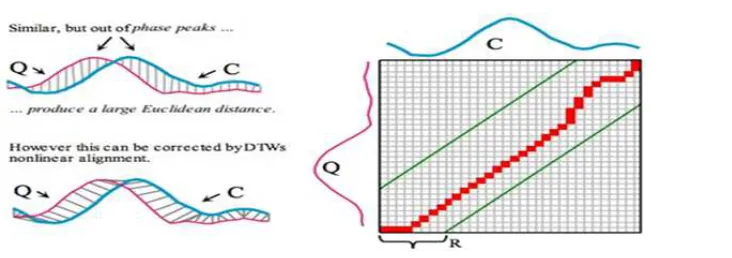
Here some dynamic programming-based tools that are currently been used in most of the representation techniques will be briefly discussed such as Basic Local Alignment Search Tool (BLAST), Longest Common Sequence (LCS) and Dynamic Time Warping (DTW) as in certain representation techniques specially those based on comparison between any two or more inputs/functions/parameters they could be used to generate the desired results based on the final algorithm that will ensure better improvement of malware detection accuracy.