Bayesian ROC curve estimation under binormality using a partial
likelihood based on ranks
By
Jiezhun Gu
ANDSubhashis Ghosal
Department of Statistics, North Carolina State University, Raleigh, North Carolina
27695-8203, U.S.A.
[email protected]
[email protected]
Institute of Statistics Mimeo Series # 2598
Summary
There are various methods to estimate the parameters in the binormal model for the
ROC curve. In this paper, we propose a conceptually simple and computationally accessible
Bayesian estimation method using a partial likelihood based on ranks. Posterior consistency
is also established. We compare the new method with other estimation methods and
con-clude that our estimator generally performs better than its competitors.
Some key words: Binormal model; MCMC; Rank-based partial likelihood; ROC curve; Posterior consistency.
1. Introduction
First introduced in the context of medical diagnostic test by Lusted (1960), Receiver Operating
Characteristic (ROC) analysis has become a unique tool in measuring the accuracy of diagnostic
tests due to its ability to show two alternatives (true positive and false positive) simultaneously
(Swets, 1973). In the general diagnostic setting, with the gold standard for the truth, each patient is
known from either non-diseased or diseased population. Diagnostic result is obtained by comparing
the diagnostic test value with the subjective decision threshold value. For example, Let X and
Y denote two diagnostic test variables from non-diseased and diseased populations, respectively. Based on a decision threshold value ct ∈ R, a patient from X (or Y) is diagnosed as positive if
scales of false positive fraction and true positive fraction. The ROC curve is increasing, invariant
under any monotone increasing transformation on diagnostic variablesX andY and the area under the curve can be interpreted as Pr(Y > X) (Bamber, 1975). This may be used to quantify the accuracy of different diagnostic tests if the curves do not cross. These inherited features has made
ROC analysis flourishing; see the reviews by Swets & Pickett (1982), Hanley (1989), Zhou et al.
(2002) and Pepe (2003).
Throughout the literature of the estimation methods of ROC curves for continuous diagnostic
variables based on independent observations, the most popular assumption is the binormality, which
assumes that the diagnostic test variables of the non-diseased and diseased groups are normally
distributed after some monotone increasing transformationH. That is (without loss of generality),
H(X) ∼ Normal(0,1) and H(Y) ∼ Normal(µ, σ2), with the convention that µ > 0. Then the
binormal ROC curve is given by R(t) = Φ(a+bΦ−1(t)), where a = µ/σ and b = 1/σ. The
corresponding AUC has a closed expression Φ(a/√1 +b2) (McClish, 1989).
The existing estimation methods for continuous diagnostic variables based on independent
ob-servations under binormality assumption is abundant. Metz et al. (1998) treat the continuous
diagnostic test data as an extension of ordinal data by grouping the rank-ordered data into some
fixed I categories conditional on the truth state runs. Hence, both binormal parameters and the nuisance parameters of I−1 category boundary points can be estimated by maximum likelihood method (Dorfman & Alf, 1969) at the same time. Zou & Hall (2000) directly construct a
rank-based likelihoodL(µ, σ2|ranks of Y
1, . . . , Yn among the data) and obtain maximum likelihood (ML)
estimates ofµ, σ2 approximated by using a Monte Carlo procedure. Based on the observation that
R(t) = Pr( ¯F(Y)≤t) = E(1( ¯F(Y)≤t)), Pepe (2000) and Alonzo & Pepe (2002) present a general-ized linear model using probit link. Cai & Moskowitz (2004) propose a maximum profile likelihood
and pseudo-maximum likelihood method which are more efficient than Metz et al. (1998)’s LABROC
and Alonzo & Pepe (2002)’s GLM when the sample size is large. These estimators are invariant
under monotone increasing transformations on the diagnostic variables. The estimators based on
the methods of modeling distribution function do not satisfy the invariant property in general, such
as a generalized least squared procedure (Hsieh & Turnbull, 1996), Box-Cox transformation method
(Zou & Hall, 2000); see reviews by Zhou et al. (2002), Pepe (2003), Cai & Moskowitz (2004) for
more details.
Here, we will propose a Bayesian curve estimation method under binormality using a partial
treat the transformation as latent and to construct a Bayes estimator given the maximal invariant,
namely, the ranks. A similar situation arises in Gaussian copula model (Hoff, 2006). We also show
the posterior consistency conditional on the ranks of the samples except possibly for a collection
of true parameter values of Lebesgue measure zero by applying Doob’s Theorem (cf. Ghosh &
Ramamoorthi, 2003).
The paper is arranged as follows. Our method is proposed in Section 2. Posterior consistency
is studied in Section 3. Simulation studies and real data analysis are shown in Section 4 and 5,
respectively.
2. BAYESIAN RANK-BASED PARTIAL LIKELIHOOD ESTIMATION
METHOD
2
·
1. Notation of truncated normal distribution
Two-sided-truncated normal with non-truncated normal mean µ, variance σ2 and corresponding
truncation region (e1, e2) is denoted as TN(µ, σ2,(e1, e2)); its density can be expressed asfT N(x) =
φ(x)/Re2
e1 φ(x)dx, whene1 < x < e2; fT N(x) = 0, otherwise. Hereafterφand Φ denote the
proba-bility density function (pdf) and cumulative density function (CDF) of the standard normal
distri-bution, respectively; Φµ,σ denotes the CDF of the normal distribution with mean µ and standard
deviationσ, that is Φµ,σ(x) = Φ((x−µ)/σ).
2
·
2.
A partial likelihood and the corresponding Bayesian procedure
A Binormal model assumes thatX1, . . . , Xm∼independently and identically distributed (i.i.d.) F,
Y1, . . . , Yn ∼i.i.d. G, X and Y are continuous and independent, without loss of generality, there
exists monotone increasing transformationH, such that
Zi=H(Xi)∼i.i.d. Normal(0,1), Wj =H(Yj)∼i.i.d. Normal(µ, σ2), (2·1)
S=SN = (X,Y),X= (X1, . . . , Xm), similar notations forY,Z,W,
combined ranksRN =R(SN) = (R1N, . . . , RN N), N=m+n,
labelsL=L(S) = (L1N, . . . , LN N), whereLiN = 0 (respectively, 1) ifSi from X(respectively,Y).
we can define a setDobs invariant underH as follows:
Dobs ={(z,w)∈Rm+n:R(z,w) =R(S), L(z,w) =L(S)},
={(z,w)∈Rm+n:Zk < zk < Zk, Wl< wl< Wl, L(z, w) =L(S)}, (2·2)
where z = (z1, . . . , zm),w = (w1, . . . , wn), Zk = maxi{Zi : Xi < Xk} ∨maxj{Zj : Yj < Xk}, Zk = mini{Zi :Xk < Xi} ∧minj{Zj :Xk < Yj},Wl= maxi{Wi :Xi< Yl} ∨maxj{Wj:Yj< Yl}, Wl = mini{Wi : Yl < Xi} ∧minj{Wi : Yl < Yj}, for all k = 1, . . . , m, l = 1, . . . , n. Hence, a
rank-based partial likelihood can be defined based on this invariant set (2·2) as
Pr((z,w)∈Rm+n :R(z,w) =R(S), L(z,w) =L(S)|µ, σ)
= Pr((z,w)∈ Dobs|µ, σ, R(z,w) =R(S), L(z,w) =L(S)). (2·3)
However, evaluation of (2·3) involves high dimensional integrations, and hence direct
computa-tion of the maximum partial likelihood estimates will be computacomputa-tionally extremely challenging. An
alternative is to adopt the Bayesian approach. The Bayes partial likelihood estimator (BPL) may
be defined as the posterior mean of (µ, σ), where the posterior distribution is given by
π(µ, σ|R(S), L(S)). (2·4)
We shall use a data augmentation technique and implement Gibbs sampling to compute the
posterior in (2·4). More specifically, letting (Z,W) be the augmented variables, we shall de-scribe a procedure to sample from the conditional distribution of ((µ, σ)|Z,W, R(S), L(S)) and ((Z,W)|µ, σ, R(S), L(S)); see Section 4 for details.
3. CONSISTENCY OF THE POSTERIOR
Let (µ0, σ0) be the true value of (µ, σ). It is important to know if the consistency of the
poste-rior at (µ0, σ0) holds, i.e., whether the posterior distribution concentrates around (µ0, σ0) (Ghosh
& Ramamoorthi, 2003). Assume that the disease prevalence is asymptotically stable, i.e. when
Theorem 1. Suppose thatS∼(1−λ)F+λG, and assume that binormality (2·1) holds conditional on the labels,(µ, σ)has joint prior densityπ(µ, σ)>0a.e. overR×R+with respect to the Lebesgue measureν. Then for(µ0, σ0)a.e. [ν], and for any neighborhoodU0 of(µ0, σ0), we have that
lim
N→∞
π((µ, σ)∈ U0|R(S), L(S)) = 1 a.s. [P
∞
µ0,σ0,H], (3·1)
whereP∞
µ0,σ0,H denotes the joint distribution of allX’s andY’s under the binormal model (2·1) with
(µ0, σ0) as the true value of(µ, σ).
Proof. BecauseSi∼i.i.d. (1−λ)F+λG, thenUi= ((1−λ)F+λG)(Si) are i.i.d. Uniform(0,1). Hence, we have
Uk = lim
N→∞ RkN
N+ 1 for all fixed k, (3·2)
whereRkN is the rank of thekth element among the totalN observations. This result is contained
in the proof of Theoremaon page 157 of H´ajek & ˇSid´ak (1967).
Notice unconditionally,Ui= ((1−λ)Φ +λΦµ,σ)(Ni) are i.i.d. Uniform(0,1), whereNi=H(Si).
Based on the sample size N, we denote a subsequence labeling the observations conditionally from
F as (i1, . . . , im). Hence, conditionally onLijN = 0, j = 1, . . . , m, Nij ∼Normal(0,1) and Uij = ((1−λ)Φ +λΦµ,σ)(Nij)∼i.i.d. gµ,σ(say), which belongs to a regular parametric family indexed by parameters (µ, σ). More specifically, Cram´er type regularity conditions can be verified by applying the inverse function theorem. Thus some consistent estimator for (µ, σ) can be easily obtained, such as the MLE, a Bayes estimator or the method of moment estimator. Hence, there exist a series of
functionshN andh, such that (µ, σ) = lim
N→∞
hN(Ui1, . . . , Uim) =h(Ui1, Ui2, . . .), say.
Therefore, there exist functions ˜h,f1, f2, . . ., conditional on observations fromF,
(µ, σ) =h(Ui1, Ui2. . .)
=h( lim
N→∞
f1(RN), lim N→∞
f2(RN), . . .)
= ˜h(R(SN) : N ≥1) a.s. [P∞ µ0,σ0,H],
where RN = R(SN) is defined in (2·1). By Doob’s Theorem (cf. Ghosh & Ramamoorthi, 2003,
page 22 Theorem 1.3.2.), the consistency of posterior (3·1) at (µ0, σ0) holds a.e. [π], and hence at
(µ0, σ0) a.e. [ν].
of an analog of the Lebesgue measure implies that the exceptional set of points where the posterior
may be inconsistent is null when measured with respect to the prior only. This severely dilutes the
importance of the conclusion since what is null with respect to a given prior may be quite large when
measured with respect to another prior. In the present case, existence of a dominating Lebesgue
measure removes this arbitrariness.
4. SIMULATION STUDIES
We compare the BPL estimator of binormal model for ROC curve obtained by (2·4) with other
methods, such as maximum profile likelihood estimator (MLE) and pseudo maximum likelihood
estimator (PMLE) proposed by Cai & Moskowitz (2004), binary regression approach (GLM) by
Alonzo & Pepe (2002), and LABROC by Metz et al. (1998) through the same data generating
scheme in Cai & Moskowitz (2004). We choose the commonly used improper priorπ(µ, σ2)∝1/σ2
and define the same initial values of µ = 3, σ = 2 for each simulated data set. Gibbs sampling procedure from the posterior (2·4) is described as follows using the same denotation in (2·1):
1. Generate (X1, . . . , Xm) ∼ i.i.d. Normal(0,1), (Y1, . . . , Yn) ∼ i.i.d. Normal(µ, σ2), order
the combined vector (X,Y) denoted as OS(X,Y) and record the corresponding labels as
L(OS(X,Y));
2. Generate the initial values (Z,W) satisfying L(OS(Z,W)) =L(OS(X,Y));
3. Start the iterations:
(1) Conditional onµ, σ, updateQ=OS(Z,W) = (Q[1], . . . , Q[N]) with constraint ((Z,W)∈ Dobs|µ, σ), equivalently, satisfying L(Q) = L(OS(X,Y)) through the following sequential
truncated normal componentwise simulations (i= 1, . . . , N):
Q(new)[i]∼
TN(0,1,(Q[i−1], Q[i+ 1])), whenLiN = 0; TN(µ, σ2,(Q[i−1], Q[i+ 1])), whenLiN = 1,
whereQ[0] =−∞,Q[N+ 1] =∞.
(2) Update Z (or W) values based on Q(new) and L(OS(X,Y)), i.e., every component of
vectorZbelongs to the set
similarly, every component of vectorWbelongs to the set
{Q(new)[i] :LiN = 1, i= 1, . . . , N},
(3) Updateµandσby their posterior distributions as
σ2|rest∼ inverse gamma ((n−1)/2,(n−1)s2w/2),
µ|rest∼Normal( ¯Wn, σ2/n),
wheres2
w= Pn
j=1(Wj−Wn¯ )2/(n−1), ¯Wn =
Pn
j=1Wj/n.
4. After burn-in, by averaging out the Gibbs samples, we can calculate ˆµ,ˆσ2, and record ˆa=
ˆ
µ/σ,ˆ ˆb= 1/σˆfor the given dataX,Y. In the mean time, we can calculate 100(1−α)% credible intervals for ˆa and ˆb as (qa,α/2, qa,1−α/2) and (qb,α/2, qb,1−α/2), where qa,α/2 and qa,1−α/2)
denote α/2 and 1−α/2 quantiles of Gibbs samples of a, respectively; similar definition of
qb,α/2,qb,1−α/2forb.
We calculate the bias and the MSE of the estimates using methods BPL, MLE, PMLE, GLM
and LABROC. The true values of parameters are defined asa= 1.245 andb= 0.667, equivalently,
µ = 1.868, σ = 1.5. Simulation results in Table 1 also includes the information contained in Cai & Moskowitz (2004). For limited simulation results not shown in Table 1, when the sample size
exceeds one thousand, mean square errors obtained by BPL tend to be much smaller than those by
MLE, PMLE, GLM and LABROC methods.
Table 1: Estimates of binormal ROC’s parameter
a
and
b
using methods BPL, MLE, PMLE,
GLM and LABROC where we abbreviate it as LAB inside the table. Our BPL estimate is
based on 100 simulated data sets, 95000 Gibbs samples with 100000 iterations and burn-in
at 5000. The other estimates are based on 1000 simulated data sets.
m Bias Mean square error
n BPL MLE PMLE GLM LAB BPL MLE PMLE GLM LAB 50 a .071 .079 .064 .034 .032 .051 .063 .064 .059 .059 50 b -.004 .043 .062 -.009 .002 .020 .022 .022 .022 .022 200 a -.007 .026 .018 .013 .002 .010 .125 .138 .126 .128 200 b -.006 .014 .017 -.004 .001 .004 .048 .051 .052 .049
In order to check whether the frequentist variability of the estimate can be asymptotically
average of the estimated standard error estimator and MCMC standard error obtained by PMLE
and BPL respectively denoted as Ave( ˆSE) in Table 2, coverage probabilities of the 95% confidence interval for the estimatesaandb. Simulation results in Table 2 also contains the information in Cai & Moskowitz (2004).
Table 2: Sampling properties of BPL and PMLE. Our BPL estimate is based on 100
simulated data sets, 95000 Gibbs samples with 100000 iterations and burn-in at 5000. The
PMLE estimate is based on 1000 simulated data sets.
m Sampling SE Ave( ˆSE) Coverage n BPL PMLE BPL PMLE BPL PMLE 50 a .215 .245 .234 .248 .98 .974 50 b .141 .135 .143 .193 .97 .968 200 a .098 .116 .112 .113 .96 .945 200 b .066 .070 .064 .073 .95 .949
Besides considering the performance of the estimators in the binormal model, we also compare
the accuracy of the estimators of ROC functional AUC obtained by our BPL with BN-G (ROC
GLM method by Pepe, 2000), BN-T Box-Cox (Zou & Hall, 2000). Coverage probabilities of AUC
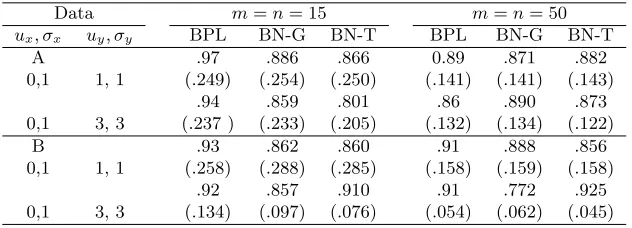
and corresponding average lengths of the 90% CI (shown beneath in the parathesis ) are displayed
in Table 3.
Based on the limited simulation results shown above, we conclude that BPL estimator of (a, b) has considerably smaller MSE than the estimators given by MLE, PML, GLM, LABROC methods
in this simulation setting. When the sample size increases, although BPL estimator tends to have
slightly larger bias, its mean square error is much smaller than the others in Table 1. Compared
to PMLE, our BPL estimates have smaller sampling variation in most cases and similar coverage
probabilities in Table 2. Also, because the simulation results of Ave( ˆSE) which shows the sampling variability and asymptotic variability using BPL and PMLE method, respectively, are not far from
those of Sampling SE which reflects the frequentist variability using BPL and PMLE methods, we can
use the sampling variability to estimate the frequentist variability. Moreover, compared to PMLE,
our BPL estimator performs better when estimatingbbased on sample sizem=n= 50. Compared to BN-G and BN-T, our BPL estimator tends to have larger average length of CI for AUC but with
much higher coverage probability when the simulated data sets are from location-scale exponential
distributions. When the data are from lognormal which means the binormality assumption holds
Table 3: Coverage probabilities of AUC and corresponding average lengths of the 90% CI
shown beneath in the parathesis obtained by BPL, BN-G and BN-T methods. Our BPL
estimate is based on 100 simulated data sets and corresponding 100000 iterations burn-in
at 5000, BN-G and BN-T’s estimates are based on 1000 simulated data sets and
corre-sponding 1000 resamples. Simulated data sets are generated by lognormal, location-scale
exponential distributions (abbreviated as
A, B
, respectively) with different combinations of
the parameters (A:
X
and
Y
datesets are generated from the lognormal with corresponding
normal parameters (
u
x, σ
x) and (
u
y, σ
y), respectively; B:
X
and
Y
are generated from the
exponential distribution with rate=0.5 and the location and scale parameters (
u
x, σ
x) and
(
u
y, σ
y), respectively). The grid points on [0,1] is chosen with equal interval length 0.05.
Data m=n= 15 m=n= 50 ux, σx uy, σy BPL BN-G BN-T BPL BN-G BN-T
A .97 .886 .866 0.89 .871 .882 0,1 1, 1 (.249) (.254) (.250) (.141) (.141) (.143)
.94 .859 .801 .86 .890 .873 0,1 3, 3 (.237 ) (.233) (.205) (.132) (.134) (.122)
B .93 .862 .860 .91 .888 .856 0,1 1, 1 (.258) (.288) (.285) (.158) (.159) (.158)
.92 .857 .910 .91 .772 .925 0,1 3, 3 (.134) (.097) (.076) (.054) (.062) (.045)
5. REAL DATA ANALYSIS
We will use the data set published by Wieand et al. (1989). This study was based on 51 patients
as control group diagnosed as pancreatitis and 90 patients as cases group diagnosed as pancreatic
cancer by two biomarkers, which were a cancer antigen (CA 125) and a carbohydrate antigen (CA
19-9). The purpose was to decide which marker would better distinguish case group from control
group. We will compare our BPL estimator with MLE and PMLE by Cai & Moskowitz (2004), Zou
& Hall (2000), GLM (Alonzo & Pepe, 2002) and LABROC (Metz, et al. 1998) using biomarker CA
125 for illustration. Our BPL estimate is based on 95000 Gibbs samples with 100000 iterations and
burn-in at 5000. We use the same priors as described in Section 4. Both of the initial values ofaand
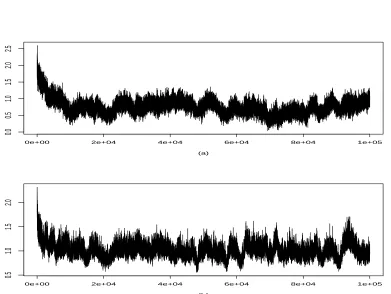
b are chosen to be equal to 2. Simulation results in Table 4 also reflect the information contained in Cai & Moskowitz (2004). Convergence of MCMC is examined by trace plot of MCMC samples
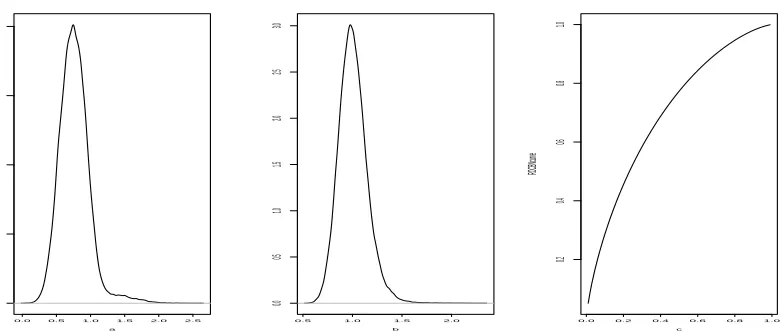
in Figure 1. The density plots of MCMC samples ofa, b and our BPL estimate of ROC curve are shown in Figure 2, respectively. Compared to the other estimates, our BPL estimate tends to have
Table 4: Real data analysis CA-125: comparison of estimates (standard errors) of binormal
parameters obtained by our BPL and other semiparametric methods.
BPL MLE PMLE Zou & Hall GLM (2002) LABROC a .748(.188) .76(.191) .719(.198) .727(.190) .778(.197) .720(.185) b 1.024(.139) 1.065(.140) 1.020(.148) 1.007(.142) 1.017(.167) 1.002(.137)
0e+00 2e+04 4e+04 6e+04 8e+04 1e+05
0.0
0.5
1.0
1.5
2.0
2.5
(a)
0e+00 2e+04 4e+04 6e+04 8e+04 1e+05
0.5
1.0
1.5
2.0
(b)
0.0 0.5 1.0 1.5 2.0 2.5
0.0
0.5
1.0
1.5
2.0
a
0.5 1.0 1.5 2.0
0.0
0.5
1.0
1.5
2.0
2.5
3.0
b
0.0 0.2 0.4 0.6 0.8 1.0
0.2
0.4
0.6
0.8
1.0
c
ROCBNcurve
Figure 2: Density plot of intercept (a) and slope (b) and ROC estimate (c) by BPL method
ACKNOWLEDGEMENTS
Research of the authors is partially supported by NSF grant number DMS-0349111.
APPENDIX
Matlab codes for BPL method
% Given information x m observations from nondiseased group
% y, n observations from disease group
% grid, the length of even interval of false positive fraction
% NSCAN, an integer of MCMC iterations
% burnin, an integer of burn-in
% gap, an integer of lag
% a0=a(1), initial value ofµ
% b0=b(1), initial value ofσ
% Help function–generate size=nsample random variables from truncated normal with
non-truncated normal meanµ, varianceσ2 and corresponding truncation region (e 1, e2)
function [TN2] =TN2(nsample,µ,σ,e1,e2)
xq=ones(nsample,1);
din= normcdf(e2,µ,σ)- normcdf(e1,µ,σ);
u=rand(1,1);
xq(i)=norminv(din*u+normcdf(e1,µ,σ),µ,σ);
end;
TN2=xq;
% start the main codes
z=[x;y];%(m+n)*1 matrix
idd=[zeros(m,1);ones(n,1)];
[temp, index]=sortrows(z);
id=idd(index); %configuration of combined ordered statistics denoted as id
orid=1:(m+n);
% start to get the iniatial values R=order(Z,W)
Rtemp=zeros(m+n,1);
Rtemp(id==1)=sort(normrnd(a0,b0,n,1));%fill in W initial values
indexy=orid(id==1);%get the corresponding indices of W’s initial denoted as indexy
if (indexy(1)>1) %fill in Z initial values
Rtemp(1:(indexy(1)-1))=sort(TN2((indexy(1)-1),0,1,-100,Rtemp(indexy(1))));
end;
gum=ones(size(indexy,2),2);
gum(:,2)= [diff(indexy) -1]-1;
gum(:,1)=indexy;
for i=1:n
if (gum(i,2)>0)
Rtemp((gum(i,1)+1):(gum(i+1,1)-1))=sort(TN2(gum(i,2),0,1, Rtemp(gum(i,1)), Rtemp(gum(i+1,1))));
end;
end;
R=Rtemp;
% start Gibbs sampling
for j=1:NSCAN
% update R based on current values a(j) and b(j)
if (id(i)==0)
R(i)=TN2(1,0,1,-100,R(2));
else
R(i)=TN2(1,a(j),b(j),-100,R(2));
end;
for i=2:(m+n-1)
if (id(i)==0)
R(i)=TN2(1,0,1,R(i-1),R(i+1));
else
R(i)=TN2(1,a(j),b(j),R(i-1),R(i+1));
end;
end;
i=(m+n);
if (id(i)==0)
R(i)=TN2(1,0,1,R(m+n-1),100);
else
R(i)=TN2(1,a(j),b(j),R(m+n-1),100);
end;
% update Z, W values based on R
Z=R(id==0);
W=R(id==1);
vrate=var(W)*(n-1)/2;
% update a and b by (Z,W)
b(j+1)=sqrt(1/gamrnd((n-1)/2, 1/vrate));
a(j+1)=normrnd(mean(W), b(j+1)/sqrt(n),1,1);
end;
% end of Gibbs sampling
% BPL estimate of intercept and slope in the binormal model for ROC
BPLintercept=mean(a(gib)./b(gib));
BPLslope=mean(1./b(gib));
R
EFERENCES
Alonzo, T. A. and Pepe, M. S. (2002). Distribution-free ROC analysis using binary regression
techniques. Biostatistics 3, 421-432.
Bamber, D. (1975). The area above the ordinal dominance graph and the area below the receiver
operating graph. Journal of Mathematical Psychology 12, 387–415.
Cai, T. & Moskowitz C. (2004). Semiparametric estimation of the binormal ROC curve. Biostatis-tics 5(4), 573–586.
Dorfman D. D. & Alf, E. (1969). Maximum likelihood estimation of parameters of signal-detection
theory and determination of confidence intervals–rating method data. Journal of Mathemat-ical Psychology 6, 487–496.
Ghosh, J. K. & Ramamoorthi, R. V. (2003). Bayesian Nonparametrics. Springer-Verlag, New York.
Hanley, J. A. (1989). Receiver operating characteristic (ROC) methodology: the state of the art.
Critical Reviews Diagnostics Imaging 29, 307–335.
Hoff, P. D. (2006). Extending the rank likelihood for semiparametric copula estimation. (http :
//arxiv.org/abs/math/0610413).
H´ajek, J. & ˇSid´ak, Z. (1967). Theory of Rank Tests. Academic press, New York.
Hsieh, F. S. & Turnbull, B. W. (1996). Nonparametric and semiparametric estimation of the
receiver operating characteristic curve. The Annals of Statistics 24, 25-40.
Lusted, L. B. (1960). Logical analysis in roentgen diagnosis. Radiology 74, 178-193.
Metz, C. E., Herman, B. A. & Shen, J. (1998). Maximum likelihood estimation of receiver operating
characteristic (ROC) curves from continuously-distributed data. Statistics in Medicine 17, 1033–1053.
McClish, D. K. (1989). Analyzing a portion of the ROC curve. Medical Decision Making 9, 190–195.
Pepe, M. S. (2000). An interpretation for the ROC curve and inference using GLM procedures.
Pepe, M. S. (2003). The Statistical Evaluation of Medical Tests for Classification and Prediction.
Oxford Statistical Science Series, Oxford University Press.
Swets, J. A. (1973). The relative operating characteristic in psychology. Science 182, 990–1000.
Swets, J. A. & Pickett, R. M. (1982). Evaluation of Diagnostic Systems: Methods from Signal Detection Theory. Academic Press, New York.
Zhou, X. H., McClish, D. K. & Obuchowski, N. A. (2002). Statistical Methods in Diagnostic Medicine. John Wiley & Sons, Inc., New York.
Zou, K. H. & Hall, W. J. (2000). Two transformation models for estimating an ROC curve derived