Approximate Analysis of a .
.
Multi-Class Open Queueing Network
with Class Blocking and Push-Out
r,TUlin
Atmaca
~~~}!
.HarryG. Perros
Yves
Dallery
Center for Communications
and
Signal Processing
Department Electrical
and
Computer Ellgineering
North Carolina State University.
TR-91/2
Approximate Analysis of a
Multi-Class Open Queueing Network with
Class Blocking and Push-out'
by
Tiilin Atmaca Laboratoire MASI, Universite Pierre et Marie Curie
4Place Jussieu
75252 Paris Cedex 05,France
Harry G.
Perros-Computer Science Department, and Center for Communication and Signal Processing
North Carolina State University
Raleigh, NC 27695-8206, USA
Yves Dallery Laboratoire MASI, Universite Pierre et Marie Curie
4 PlaceJussieu
75252 ParisCedex 05, France
January1991
ISupported in part byNATO under grant noeRG900580.
Abstract:
We study a multi-class queueing network which consists of a finite capacity node (node 0) linked
to M parallel finite capacity nodes (nodes 1 to M). M classes of customers are assumed. All
customers first join node
O.
A class i customer after completion of its service at node°
always joins the ith node. All service times and inter-arrival times are assumed to be exponentiallydistributed. The service priority at node 0 is head-of-line with pre-emption. When node i
(i= 1,2,...,M) is full, node0cannot process class i customers. In addition to the service priorirty at
node 0, push-out is employed. That is, a customer that arrives at node 0 when the node is full,
takes the space of a customer which has the lowest priority among the customers already in the
node. If all customers in the node have a higher or equal priority, then the arriving customer is
lost. This queueing network is analyzed approximately by decomposing it into individual nodes,
and then analyzing each node separately. Node0 is analyzed using a class by class decomposition.
The approximation algorithm has been validated using simulation, and the approximate results
have a good error.
1. Introduction
Queueing networks with blocking have recently received a lot of attention (see
r
I]. and (8I).
Blocking arises as a consequence of the finiteness of the buffers. In many real systems, and
especially in computer networks and in manufacturing systems, the finiteness of buffers has a
significant effect on the performance. Thus, it is important to be able to analyze queueing network models with fmite capacity queues.
So far, most of the work on queueing networks with blocking has been devoted to single-class
queueing networks. Exact solutions of queueing networks with blocking are in general not
obtainable. As a result, much effort has been devoted to obtaining approximate solutions. Several
approximation methods have been proposed for the analysis of open tandem queueing networks
with finite buffers. These approximation algorithms are based on the notion of decomposing the
original system into a set of smaller subsystems. These methods are efficient and usually provide a
fairly accurate estimation of the performance measures, such as throughput and queue-length
distributions. Some of these methods have been extended to handle open queueing networks with
a general topology. A survey of these approximation algorithms is given in [6]. Approximation
methods for analyzing closed queueing networks with finite buffers have also been proposed. For
a survey of relevant results see [5].
Despite the numerous contributions in the area of single-class queueing networks with blocking,
very few papers have addressed the problem of analyzing open multi-class queueing networks
with blocking (see [5]). One of the main difficulties encountered when analyzing approximately
such networks, is the analysis of a single node. Due to multiple classes and blocking, this is not a
simple task as it was in the case of single-class open queueing networks with blocking.
In this paper, we consider an open multi-class queueing network consisting of a finite capacity
node (node0) linked to M parallel finite capacity nodes (nodes 1 to M). M classes of customers are assumed. This queueing network is analyzed approximately using single-node decomposition. Of
interest in this paper, is the analysis of node
0
for which we have assumed M classes ofcustomers, head-of-line with pre-emption service priority, blocking, and a mechanism for
managing the space in node 0 known as
push-out.
The computational complexity of analyzingproblem, we propose a class aggregation technique which avoids the complexities of the numerical
technique.
The paper is organized as follows. The multi-class queueing network with blocking is described in
section 2. In section 3" we describe the approximation method for analyzing this queueing
network, and in section 4, we present the class aggregation technique. Comparisons between
approximate and simulation results are given in section 5. Finally, the conclusions are given in
section 6.
2. The multi-class queueing network under study
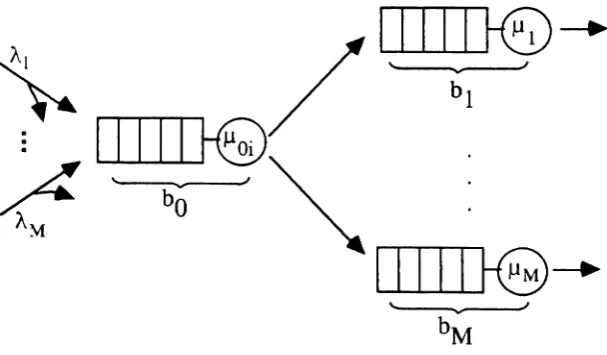
The multi-class queueing network under study is a tree-like configuration consisting of a node
linked to M parallel nodes as shown in figure 1. We shall refer to the first node as node0, and the
M parallel nodes are numbered from 1 to M. Each node is represented by a single server queue
with a finite capacity b, (i=O,I, ...,M) including the space in front of the server. There are M
classes of customers. Class i customers arrive at node
0
in a Poisson fashion at a rate Ai and theyreceive an exponentially distributed service with parameter Jloi (i= 1,...,M). Each class of
customers has a unique destination node. That is, upon service completion at node 0, class i
customers always join node i (i=l,...,M). In view of this, node
°
is shared by all classes, while nodes 1 to M is used only by a single class. The service times at node i (i=l,...,M) areexponentially distributed with parameter
Jli-Figure 1: The multi-class queueing network under study
We assume that class i (i=1,2, ....M-l) has a higher priority than class i+1. The service discipline
at node 0 is head-of-line with pre-emption. Note that since the service times are exponentially
distributed and because of the memoryless property of the exponential distribution, it is not
important to specify whether the discipline is pre-emptive resume or pre-emptive repeat.
Due to the fact that the destination nodes I to M are finite, the flow of customers through node0
may be blocked. Blocking-before-service is assumed (see [6]). That is, a customer cannot begin
his service unless there is space in the destination node. Ifnode i becomes full upon service
completion at node 0, the whole class i of customers becomes blocked. However, the server at
node 0 is not blocked, and it can proceed to serve customers from lower classes that may be
present at node
O.
The server will become blocked if all classes present at node0
are blocked.Class i becomes unblocked at the moment when a departure takes place from node i (i=1,2,...,M).
Due to service pre-emption, a class i customer can start service immediately, if the server is busy
serving a lower class customer. We shall refer to thistype of blocking as class blocking. We note that in view of this type of blocking, it is possible to have a lower class customer in service while higher class customers are present at node
0
despite the service pre-emption discipline. Thishappens when all the higher class customers are blocked.
Blocking-before-service has been used extensively in single-elass queueing networks with finite
capacity queues. The difference between this blocking mechanism and the class blocking
mechanism described above, is that in the former case the server gets blocked each time a customer
becomes blocked. Intuitively speaking, one can easily see that under the class blocking
mechanism, the utilization of the server at node
0
is higher than in the case of blocking beforeservice, and therefore the system's throughput is also higher.
The overall capacity of node 0, b
o,
is shared by all classes of customers. Unlike other finitecapacity nodes, a customer that arrives to node 0 when the node is full, is not always lost. In
particular, let us assume that a class i customer arrives when node
0
is full. Then, the customer islost if the node at that moment only contains customers of class i or higher. However, if the node
contains lower class customers, then a customer of the lowest class currently present at node0is
forced out of the node so that the arriving customer may enter the node. As an example, let us
consider the case where we have four classes (i.e. M
=
4). Let us assume that node 0is full and that a class2 customer arrives. The customer will get lost if node 0 at that moment only containsor class 4 customer present. In particular, the arriving customer will frrst attempt to force out a
class 4 customer. If there is no class 4 customer present, then he will force out a class 3 customer.
In general, when the arriving class i customer forces a class j customer out of node 0 (where
j > i), the forced out customer within class j is the one that arrived last. Due to the service
pre-emption discipline, this customer will be forced out even if at that moment it so happens that he is
receiving service. This mechanism for managing the space in a finite capacity queue is known as
push-out.
This mechanism and other similar mechanisms have been proposed within the context of high-speed computer networks. However, only two classes have been considered (see [3]).3.
The approximation algorithmIn this section, we present an approximation algorithm for analyzing the multi-class queueing
network with blocking described above. We analyze this queueing network using a single-node
decomposition algorithm. The principle of this algorithm is similar to that proposed in [7] for
single-class queueing networks with blocking-after-service. The multiclass queueing network
described in section 2 is analyzed by decomposing it to its individual nodes. In particular, each
node i is analyzed by approximating it by another node, hereafter referred to as Qi (i=O,l ....,M).
Q
i (i=l,...,M) is a single-class node with the same buffer capacity and service rate as node i butwith a revised arrival process. This arrival process approximates the actual arrival process to node i
from node
0
in the original network. This arrival process is assumed to be Poisson with rate Ai.Thus,
Q
i is simply an MIM/l/N queue with arrival rate ~i' service rate ~i' and buffer capacity b.. Let Pi(~) to be the steady-state probability that there are k,customers in Qi(~=O,l ,....b.) and let Xi be the throughput of Qi. For a given arrival rate Ai, these quantities can be easily calculated.Qo is a multiclass node that is identical to node
0
except that the blocking effect due to thedownstream nodes (nodes 1 to M) is taken into account in an approximate way. The blocking
effect is modelled as follows. Upon service completion of a class i customer at Qo, class i is
blocked with a probability ri and is not blocked with a probability I-ri. If it is blocked, the server is
prevented from servicing class i customers. This blocking condition will last for a period of time
that is exponentially distributed with rate Jli. As soon as this period of time ends, the server is again allowed to serve customers of class i. Due to service pre-emption, a class i customer can start
otherwise identical to that of node 0, i.e. it has the same service priority and space priority
mechanisms. Let PO(nOi) denote the probability that there are nOi class i customersin Qo. Also, let
Xoi
be the throughput of class i customers at Qo.Note that XOi is less than Ai due to the finite capacity ofQo
and also due to push-out.The behavior of
Q
o
can be described by a continuous-time Markov chain (CTMC). The state ofthis CTMC is defined by the vector s = (n1,jl, ... ,ni,ji, ...,nM,jM). ni is the number of class i
customers currently present at
Q
o
(ni=O,1,...,bo)
and ji is a parameter that indicates whether class i is blocked or not. ji=
°
if class i is not blocked and ji=
1 if class i is blocked. Let Q be the infinitesimal generator of the CTMC ofQo.
Let P be the stationary probability vector of all probabilities of state. Then, p can be obtained by solving numerically the system of linearequations
pQ
= 0 andpe
= 1.In order to analyze
Qo
we need to know the completion instant blocking probabilities ri(i=l,...,M). Each probability ri is approximated by the probability that a customer arriving to Qi
will occupy the last position (see[2]). Let 1Tibe this probability. Then, we have
Also, the analysis of Qi (i=I,...,M) requires knowledge of the arrival rate
~i'
This arrival rate isdetermined in such a way that the throughput ofQiis equal to the throughput of classi customers
in Qo, that is
Xi
=
X
Oi•The following iterative algorithm can beused to determine the unknown parameters:
Algorithm 1.
Step
O.
Initialization.Set XOi
=
Ai' for all i=
1,2,...,M.Step 1.
Analysis of each single-class queue Q,For i
=
1,2,...,M :Step l.a. Determine ~i such that Xi=X Oi'
Step
2. Analysis of the multi-class queue Qo. Step 2.a. For i=
I, ...~ M, set ri=
ITi' .Step 2.b. Calculate the steady-state probability vector p. Step 2.c. For i
=
1...., M, deri ve the throughputs XOi•Step 3.
Go to Step I until convergence of the unknown parameters.Step
4. Calculate all performance measures of interest.Algorithm I is an iterative procedure that analyzes the set of single-class nodes Qi (i=1,2....,M)
and the multi-class node Qo in tum. On the one hand, for given values of the throughputs, Step 1
calculates new values of the blocking probabilities1Tio In Step l.a, the value ofAiis obtained as the
solution of the fixed-point iteration: ~i
=
Xi I(l-Pi(bi)) (see [2], and [7] for details). On the otherhand, for given values of the blocking probabilities, Step 2 calculates new values of the throughputs
Xoi.
In Step 2.b, the vector p is the solution of the system of equations pQ=0
andpe= 1. In our implementation of this algorithm, we used the power method to solve the above system of equations. Obviously, more efficient methods can be used (see [10]). In Step 3, the iterative procedure is stopped as soon as (1Ti(k)-1Ti(k-l»)I1Ti(k) < e, for all i=l,...,M, where JTi(k)is
the k-th estimate ofITi. In our implementation of this algorithm, we used e
=
10-5•In terms of complexity, the main difficulty of algorithm 1 lies in the numerical solution of the CTMC associated with Qo. The cpu and memory complexity of the solution depends on the size of
the state space of the CTMC. The number of states of the CTMC is a function of the buffer
capacity bo of Qo and the number of classes of customers M. Thus, the size of the CTMC is very large when bo and M are large. Moreover, the CTMC has to be solved as many times as the
number of iterations required for the convergence of algorithm 1. Thus, this numerical solution can
only be used when the CTMC associated with Qo is of moderate size. In the next section. we
present an approximation method for analyzing Qo which avoids the complexity issues of the
above numerical solution.
4.
Class aggregation
As stated above, the size of the CTMC associated with Qo can be very large for networks with an arbitrary number of classes. However, for networks with only two classes, the number of states
solution of the CTMC associated with a network consisting of only two classes is obtainable in a reasonable amount of time.
Based on this observation, we propose a
class aggregaiion
technique which reduces the analysis ofQo to analyzing this node M-l times, but each time with two classes of customers. Due to the
head-of-line pre-emptive service priority and the push-out mechanism, the behaviour of classi is
not affected by the lower priority classes. Thus, it can be analyzed without considering the lower
priority classes. The behavior of class i, however, is affected by the higher priority classes. In
view of this, we analyze the behavior of classi by ignoring classes i+ 1 to M, and representing all
higher priority classes i-I to 1 by a single aggregate class. Let Al.i-1denote this aggregate class.
The class aggregation technique works as follows. We first consider classes 1 and 2. Using
algorithm 1, we analyze nodes Qo, QI and
en
assuming that Qo consists of only two classes, i.e.classes 1 and 2.Based on the results obtained, we aggregate classes 1 and2 into the single class
Al.~. We then use algorithm 1 to analyze nodes Qo and Q3, assuming that
Qo
consists of classesAI,:!and 3.Class AI:! and class 3are then aggregated into the single class A1.3.Using algorithm 1
we analyze class nodes Qo and Q4, assuming that Qo consists of classes A1.3and 4. We continue
in this fashion until we analyze all classes.
We now proceed to describe how two classes are aggregated into one. We first consider the
aggregation of classes 1 and 2. After algorithm 1 has been applied to nodes Qo, Ql and
en,
the quantities rl and r:! as well as the steady-state probabilities of the CTMC associated withQ
o
areknown. Let E be the set of states of the CTMC, where each state is given by the vector (n.,jl' n:!,
j:!). E is partitioned into several subsets of states. Let E(nA' jA) be a subset of E, where
nA=O, l,...,b
o,
and jA=O, 1. The set of states that belong to E(n A, jA) is defined as follows:That is, a state belongs to E(nA' 0) if the total number of customers of classes I and2is equal to
n and one class of customers (either class 1 or 2) is currently receiving service. On the other
hand, a state belongs to E(nA' 1) if the total number of customers of classes 1 and 2 is equal to nA
and neither class 1 nor class 2 is receiving service. This happens when for each class of
customers, either there is no customer (n, = 0) or the class is blocked
Ui
= 1).It is easy to check. that the total numberofsubsets is equal to 2bo
+1(subsetE(O, 0) is empty).The reason we partition the states of the CfMCin this way is because the behavior of class3 in
Q
o
with respect to higher priority classes 1and 2, is only affected by two factors: 1) the totalnumber of class 1and 2 customers currently present in Qo, and 2) whether the server is busy
working on aclass I or2customer. The former factor is represented by variable nA and the latter
by jA.
According to this partition, we can define
an
aggregate CTMC. Each state of this aggregate CTMCis given by the vector (nA ,jA), and the total number of states is equal to the number of subsets of
states of the original CTMC. The transitions rates are obtained using standard Markov chain
aggregation. Let us briefly recall how this works. Consider a CTMC partitionned into several subsets of states
{E1,...
,E;.,...
,ER } . Letj be any state of the CTMC and let pU) be the probability of being in state j. LetYU,
k) be the transition rate between states j and k.Then, the transition rate between statesE,and E,in the aggregate CTMC, say ~(r, s), is as follows~(r, s) =
L
(p(j)L
y(j,k))
jE~ kE~
The aggregate CTMC describes the behaviour of the aggregate class AI.:!. We note however that
the behaviour of the aggregate CTMC is only an approximation to the behavior of the original
CTMC. This is because the transitions between subsets of states in the original CTMC are not
Markovian.
Having aggregated classes 1 and 2 to class A1,2, we can proceed to analyze class 3. This is achieved by analyzing nodes Qo and Q3 using algorithm 1 and assuming that Qo has two classes,
namely, aggregate class Al,2 and class 3. The unknown parameters are the completion instant
blocking probabilitiesf3 of class3 customers at Qo,and the arrival rate ~3atQ3. For a given value
of r3'
Q
o
can again be analyzed by constructing a CTMC describing its behavior in a similar wayas what was done in section 3. The state of this CTMC is defined by the vector
S
=
(nA, jA' n3' j3)· The transition rates of this CTMC are obtained as follows. For any transition related to the aggregate class, i.e. any transition that involves a modification of either nAorjAor both, the transition rate is obtained from the aggregate CTMC described above. For any transition related to class 3 customers, the transition rate is simply obtained according to the
Markovian behavior of class
3.
The unknown parameters, f3 and A3' can then be determined using a fixed-point procedure similar to that described in algorithm 1. Having analyzed class 3,classes Al,:! and 3can be aggregated
into the single class At 3in a similar way as describe above for classes 1 and 2. The behaviour of class AI .3 is thus described by an aggregate CTMC whose transition rates are obtained from the
steady-state probabilities ofQo. Class 4 can be analyzed using algorithm 1 for the nodes Qoand
Q4'and assuming that Qohas two classes, namely, class At,3and 4. This procedure is repeated
until all classes have been analyzed.
The main steps of this approximation algorithm are summarized below.
Algorithm 2.
Set i
=
1.Step O. Initialization
Set XOi
=
Ai·Step 1. Analysis of Qi.
Step l.a. Determine~i such that Xi
=
XOi•Step l.b. Calculate the probabilityITi·
Step 2. Analysis of
Q
o
consisting of class A1,i-l and class i,Step 2.a. Set ri
=
Tri·Step 2.b. Calculate the steady-state probability vector p. Step 2.c. Derive the throughput XOi•
Step 3. Go to Step I until convergence of the unknown parameters.
Step 4. Derive the transition rates of the aggregate class Al.i ·
5. Validation
The approximation algorithm described above, including the class aggregation approach, was.
implemented on a vax workstation. Different configurations were analyzed and the approximate
results were compared against simulation data. The simulation model was developed using
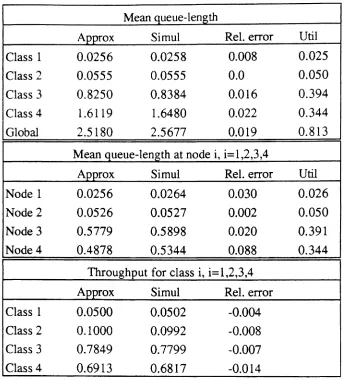
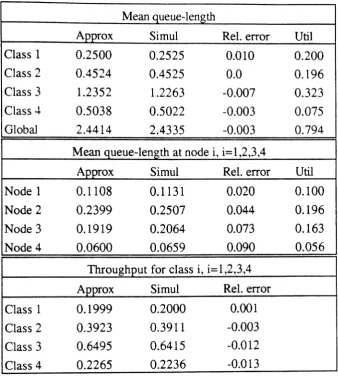
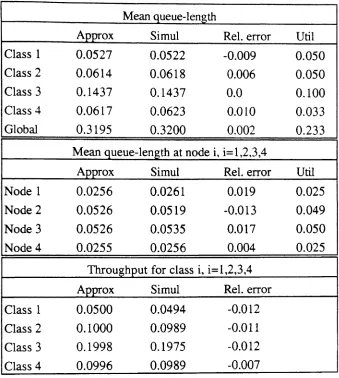
QNAP2 [9].Six representative comparisons between the approximate and the simulation dataare
presented in tables2to7assuming4classes of customers. Each table gives the mean queue length
for each class in node 0, the global mean queue length for node 0, the mean queue length for
nodes 1 to 4, and the throughput of each class (departure rate from queue 1, 2, 3, and 4). The
relative error calculated as (simul-approx)/ simul is also given. In general, the accuracy of this type
of approximation algorithm depends upon the amount of traffic carried by the network. Therefore,
in order to put the results in perspective, each table gives the utilization, as measured by
simulation, of the server at node
°
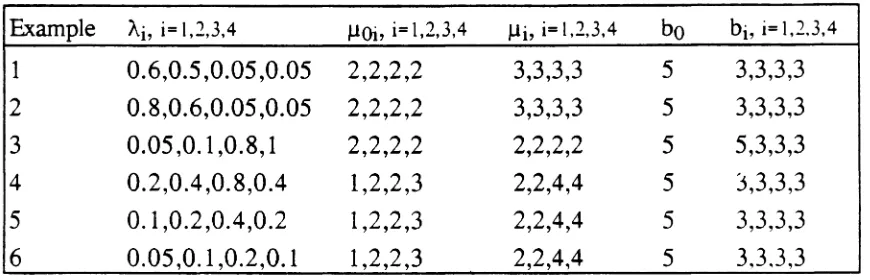
(per class and global), and the utilization of the servers at nodes 1 to 4. The parametersof the six examples are given in table 1.Example Ai, i=1,1,3,4 J..L0i, i=1,2,3,4 Ili, i=1,1,3,4
bo
bi, i=1,2~3,41 0.6,0.5,0.05,0.05 2,2,2,2 3,3,3,3 5 3,3,3,3
2 0.8,0.6,0.05,0.05 2,2,2,2 3,3,3,3 5 3,3,3,3
3 0.05,0.1,0.8,1 2,2,2,2 2,2,2,2 5 5,3,3,3
4 0.2,0.4,0.8,0.4 1,2,2,3 2,2,4,4 5 J,3,3,3
5 0.1,0.2,0.4,0.2 1,2,2,3 2,2,4,4 5 3,3,3,3
6 0.05,0.1,0.2,0.1 1,2,2,3 2,2,4,4 5 3,3~3,3
Table 1: Parameters of the examples given in tables 2 to 7
Tables 2 and 3 give results where the server at node
°
is utilized considerably more by classes 1and 2than by classes3and 4. The utilization of the server at node
°
is about58% in table 2and about 70% in table 3. Table 4 gives an example where the utilization of classes 3 and 4 is higherthan the utilization of classes 1 and 2, and in the example given in table5 the utilization of class3
is higher. The server's utilization at node 0 is about 81
%
in table 4 and 79% in table 5. Theexamples given in tables 6and 7 are for two cases where the utilization of the server at node0 is
lower than in the four previous examples, i.e. about 45% and 23% respectively. We note that the
approximation algorithm performs well and, in general, the relative errors are quite low.
6. Conclusions
One of the main difficulties encountered when analyzing approximately open queueing networks
with blocking, is the analysis of a single node. Due to multiple classes and blocking, this is not a
simple task as it was in the case of single-class open queueing networks with blocking. In this
paper, we considered an open multi-class queueing network consisting of a finite capacity node
(node0) linked to M parallel finite capacity nodes (nodes 1 to M). Of interest in this paper, was the analysis of node
0
for which we assumed M classes of customers, head-of-line withpre-emption service priority, blocking, and a mechanism for managing the space in node 0 known as
push-out. This queueing network is analyzed approximately using single-node decomposition. The
computational complexity of analyzing node
0
numerically increases rapidly as the number ofclasses increases.
In
order to avoid this problem, we proposed a class aggregation technique whichavoids the complexities of the numerical technique. The approximation algorithm has been
Mean queue-length at node0
Approx Simul ReI. error Dtil
Class 1 0.4298 0.4160 -0.033 0.304
Class 2 0.6292 0.6049 -0.040 0.236
Class 3 0.0764 0.0753 -0.015 0.022
Class4 0.0781 0.0803 0.027 0.022
Global 1.2135 1.1765 -0.031 0.584
Mean queue-length atnode i, i=1,2,3,4
Approx Simul ReI. error Util
Node 1 0.2450 0.2464 0.006 0.200
Node2 0.1864 0.1954 0.046 0.159
Node 3 0.0148 0.0149 0.007 0.015
Node4 0.0144 0.0142 -0.014 0.014
Throughput for class i, i=1,2,3,4
Approx Simul ReI. error
Class 1 0.5989 0.5982 -0.001
Class 2 0.4751 0.4696 -0.012
Class 3 0.0437 0.0425 -0.028
Class 4 0.0427 0.0422 -0.012
Table2: Example 1.
Mean queue-length
Approx Simul ReI. error Util
Class 1 0.6611 0.5958 -0.109 0.398
Class 2 0.8900 0.8470 -0.051 0.262
Class 3 0.0826 0.0824 -0.002 0.018
Class 4 0.0829 0.0806 -0.028 0.017
Global 1.7166 1.6058 -0.070 0.695
Mean queue-length at node i, i=I,2,3,4
Approx Simul Rei. error Uill
Node 1 0.3465 0.3486 0.006 0.265
Node 2 0.2089 0.2244 0.069 0.176
Node 3 0.0123 0.0121 0.017 0.012
Node 4 0.0119 0.0119 0.0 0.012
Throughput for class i, i=1,2,3,4
Approx Simul Rei. error
Class 1 0.7946 0.7888 -0.008
Class 2 0.5238 0.5222 -0.003
Class 3 0.0365 0.0362 -0.028
Class 4 0.0351 0.0351 -0.023
Mean queue-length
Approx Simul ReI. error UtiI
Class
1
0.0256
0.0258
0.008
0.025
Class 2
0.0555
0.0555
0.0
0.050
Class
3
0.8250
0.8384
0.016
0.394
Class
4
1.6119
1.6480
0.022
0.344
Global
2.5180
2.5677
0.019
0.813
Mean Queue-length at node i,
i=1,2,3,4
Approx Simul ReI. error Util
Node
1
0.0256
0.0264
0.030
0.026
Node
2
0.0526
0.0527
0.002
0.050
Node
3
0.5779
0.5898
0.020
0.391
Node
4
0.4878
0.5344
0.088
0.344
Throughput for class i,
i=I,2,3,4
Approx Simul ReI. error
Class
1
0.0500
0.0502
-0.004
Class 2
0.1000
0.0992
-0.008
Class
3
0.7849
0.7799
-0.007
Class
4
0.6913
0.6817
-0.014
Table 4: Example
3.
Mean queue-length
Approx Sirnul ReI. error Util
Class I 0.2500 0.2525 0.010 0.200
Class 2 0.4524 0.4525 0.0 0.196
Class 3 1.2352 1.2263 -0.007 0.323
Class 4 0.5038 0.5022 -0.003 0.075
Global 2.4414 2.4335 -0.003 0.794
Mean queue-length at node i, i=I,2,3,4
Approx Simul ReI. error Util
Node 1 0.1108 0.1131 0.020 0.100
Node 2 0.2399 0.2507 0.044 0.196
Node 3 0.1919 0.2064 0.073 0.163
Node 4 0.0600 0.0659 0.090 0.056
Throughput for class i, i= 1,2,3,4
Approx Simul ReI. error
Class I 0.1999 0.2000 0.001
Class 2 0.3923 0.3911 -0.003
Class 3 0.6495 0.6415 -0.012
Class 4 0.2265 0.2236 -0.013
Mean queue-length
Approx Simul ReI. error UtiI
Class 1 0.1111 0.1071 -0.037 0.097
Class 2 0.1520 0.1481 -0.026 0.098
Class 3 0.4124 0.3939 -0.048 0.195
Class 4 0.2032 0.1972 -0.030 0.063
Global 0.8787 0.8463 -0.038 0.453
Mean queue-length at node i, i=1,2,3,4
Approx Simul ReI. error Util
Node 1 0.0526 0.0510 -0.031 0.048
Node 2 0.1107 0.1112 0.004 0.099
Node 3 0.1086 0.1098 0.011 0.097
Node 4 0.0493 0.0516 0.045 0.048
Throughput for class i, i=1,2,3,4
Approx Simul ReI. error
Class 1 0.1999 0.2000 -0.032
Class 2 0.3923 0.3911 -0.017
Class
3
0.6495 0.6415 -0.016Class 4 0.2265 0.2236 0.001
Table
6:
Example 5.Mean queue-length
Approx Simul ReI. error Uti1
Class 1 0.0527 0.0522 -0.009 0.050
Class 2 0.0614 0.0618 0.006 0.050
Class 3 0.1437 0.1437 0.0 0.100
Class 4 0.0617 0.0623 0.010 0.033
Global 0.3195 0.3200 0.002 0.233
Mean queue-length at node i,i=1,2'l3,4
Approx Simul ReI. error Util
Node 1 0.0256 0.0261 0.019 0.025
Node 2 0.0526 0.0519 -0.013 0.049
Node 3 0.0526 0.0535 0.017 0.050
Node 4 0.0255 0.0256 0.004 0.025
Throughput for class i, i=1,2,3,4
Approx Simul ReI. error
Class 1 0.0500 0.0494 -0.012
Class 2 0.1000 0.0989 -0.011
Class 3 0.1998 0.1975 -0.012
Class 4 0.0996 0.0989 -0.007
References
[IJ
[2]
[3]
[4]
I. Akyildiz and H. G. Perros (Eds.),
Special Issue on Queueing Networks
withFinite
Buffers,
PerformanceEvaluation,
Vol. 10, pp. 197-210, 1989. .Y.D~llery and Y.Frein,On decomposition methods for tandem queueing networks with
blocking, Tech. Rep. MASI No. 293, Universite Pierre et Marie Curie, July 1989.
A.A. Nilsson, F. Lai, and H.G. Perros, Aqueueing model of a bufferless synchronous Clos ATM switch with head-of-line priority and push-out, Tech. Rep. 90-18, Computer Science Dept., North Carolina State University, 1990.
R. O. Onvural, A survey of closed queueing networks with finite buffers, ACM
Computing Surveys,
Vol. 22. No 2, pp. 83-121, 1990.[5] R. O. Onvural and H. G. Perros, Approximate analysis of multi-class tandem open
queueing networks with Coxian parameters and finite buffers, King, Mitrani, Pooley (Eds.) Performance '90(North-Holland, 1990) 131-141.
[7]
[8]
[9]
[6]
H. G. Perros, Open queueing networks with blocking, Stochastic Analysis of Computerand Communication Systems, Takagi (Ed.), North Holland, 1989.
H. G. Perros and T. Altiok, Approximate analysis of open queueing networks with blocking: tandemconfigurations,
IEEE Transactions on Software Engineering,
VolSE-12, N°3, pp. 450-461, 1986.
H. G. Perros and T. Altiok (Eds.), Proc. of the First Int. Workshop on Queueing
Networks with Blocking, North Holland, 1989.
QNAP2, Reference manual, version 4.0, Simulog, Av. du Centre, 78182 St. Quentin en
Yvelines, France.
[10] W. J. Stewart, A comparison of numerical techniques in Markov modeling,
Communications ofthe ACM, Vol. 21, N°2, pp. 144-152, 1978.