A Study On Microteaching As Perceived By UTM TESL Undergraduates
Wan Zarina Bt. Wan Zakaria & Nik Azraini Bt. Ah’hyat Faculty Of Education
University Teknologi Malaysia
Abstract: Microteaching is a compulsory subject to be taken before a student is allowed to go for the practical teaching. This indicates the importance of microteaching to prepare the future teacher trainees to teach in school. However, there are some students who take the subject for granted. Therefore, this research had been carried out to investigate the perception of Teaching English as Second Language (TESL) students in UTM regarding their microteaching course. 78 students from the third year and fourth year were chosen to become the respondents of this study. These respondents had completed their microteaching course and had done their teaching practice in the previous semesters. Each respondent was asked to answer a set of questionnaire consisted of 41 items regarding the microteaching experience. For ease of reference, the researcher divided the items in the questionnaire into four different sections which are demographic information of the respondents, opinion towards microteaching, factors affecting perception towards microteaching and application of the skills learnt in microteaching during teaching practice. The findings of the study indicated that the students have high level of perception towards microteaching.
Abstrak: Pengajaran mikro merupakan satu subjek yang wajib di ambil oleh setiap pelajar sebelum mereka di benarkan untuk menjalani latihan mengajar. Ini menunjukkan bahawa subjek ini merupakan subjek yang penting sebagai menyediakan bakal guru pelatih untuk menghadapi pelajar-pelajar sewaktu latihan mengajar. Namun begitu, terdapat segelintir pelajar yang tidak mengambil berat terhadap subek ini. Oleh itu, kajian ini telah dijalankan untuk melihat tahap persepsi pelajar-pelajar Teaching English as Second Language (TESL) di UTM terhadap subjek pengajaran mikro yang telah di ambil. Seramai 78 orang responden daripada tahun tiga dan tahun empat kursus tersebut telah dipilih sebagai responden kajian. Kesemua responden yang dipilih telah mengambil subjek pengajaran mikro dan menjalani latihan mengajar. Setiap responden diberi satu set soal selidik yang mengandungi 41 item untuk melihat tahap persepsi mereka terhadap subjek pengajaran mikro. Untuk bahagian analisis data, penyelidik telah membahagikan item-item tesebut kepada empat bahagian iaitu latar belakang responden, pendapat terhadap subjek pengajaran mikro, faktor-faktor yang mempengaruhi persepsi terhadap subjek pengajaran mikro dan aplikasi kemahiran yang dipelajari dalam subjek pengajaran mikro semasa latihan mengajar. Hasil kajian menunjukkan bahawa tahap persepsi pelajar-pelajar TESL terhadap subjek pengajaran mikro berada pada tahap tinggi.
Keywords: Microteaching, Teaching English as Second Language (TESL)
Introduction
Statement of problems
Unlike other students majoring in other courses for example mathematics, science or physics, TESL undergraduates have more advantages since their microteaching class consists of 7-8 students only. This means, the supervisor will be able to pay more attention to each teacher trainee especially the ones who are doing his or her teaching in that meeting. The supervisor will be able to provide detailed feedback and give consultation to each trainee under his or her supervision to make these trainees aware of their teaching performance.
However, there is one disadvantage of having a small number of students in a class which is one person’s attitude will easily affect other classmates. This is because there are only seven or eight persons in the class. If one student does not turn up for the class or does not care to participate by being the “students”, the teaching-learning process will be rather difficult. Every person in the classroom is needed to enable teacher trainee to practice their skills and teaching techniques during the class. Furthermore, a person’s concern and sensitivity is needed for the peers’ feedback. If he or she does not bother to contribute his or her idea and generous opinion on their friends’ teaching, the peer will not be able to see the strength and weaknesses of his or her teaching.
Another common problem among TESL students undertaking microteaching subject is the lack of effort and responsibility towards the subject. Many of the students are not really prepared for their teaching. When they are doing their teaching, they will usually do it for the sake of completing it. They do not show much effort and initiative to make their teaching lively and interesting. This is such a waste since they are supposed to manipulate this microteaching session to gain as much knowledge as possible for their practical teaching. One of the possible reasons for this scenario would be the credit allocated for this subject. As mentioned before, microteaching is only one credit subject. Therefore, some trainees might regard this subject as less important if compared to other subjects. Furthermore, some students do not really see the significance of microteaching classes for their teaching practice since they could not really see the link between these two subjects. This will somehow leave them feel unmotivated to give full commitment towards microteaching.
Objectives of the study
The objectives of the study are as follows:
(1) To gather the teacher trainees opinion towards their microteaching class.
(2) To determine whether there are any differences between the third year and fourth year TESL students on how they perceived microteaching.
(3) To identify factors affecting their motivation and perception towards microteaching subjects.
(4) To determine whether the skills and knowledge learnt in microteaching class are applied during their practical teaching.
Significance of the study
Based on the findings, the researcher hopes to be able to suggest some ways to help future teacher trainees to make the best out of their microteaching course so that they will not face too much problems while doing their practical teaching. With proper preparation, teacher trainees will be able to experience useful and meaningful teaching experience. Hopefully, this study will be able to help them see that microteaching class is the best platform for them to enhance their teaching skills.
The findings of the study will also help the faculty to re-consider on factors related to microteaching subject such as the credit hour given, supervisor-trainee ratio and number of students in one class. Some changes can be done in the future as to meet the needs of teacher trainees according to suitability especially on the credit hour allocated and students-supervisor ratio since these are amongst the important factors to determine the effectiveness of a microteaching course.
Scope of the study
This study is carried out to identify teacher trainees’ perception towards microteaching course and the factors affecting their perception and motivation towards the course. The researcher has limited the scope of the study only to third year (2007/08) and fourth year (2007/08) students of TESL in Faculty of Education in UTM. This is because the numbers of students in each class are different between TESL program and other programs. Furthermore, there is a slight difference in terms of command of English between TESL students and students from other program. So, the variables will not be the same if researcher decides to include other courses in this research.
Methodology
Research sample
This research involved the third (2007/08) and fourth year (2007/08) TESL students in Faculty of Education, UTM. The numbers of the respondents involved in this research were 77 students whereby 40 respondents are from fourth year and another 37 students are third year students. The researcher was able to get all respondents to answer the questionnaire.
All these TESL students have completed their microteaching course and teaching practice in the previous semesters. Their microteaching format is quite different from other courses in terms of the number of students in one class and chances they get to teach throughout the whole semester.
Research instruments
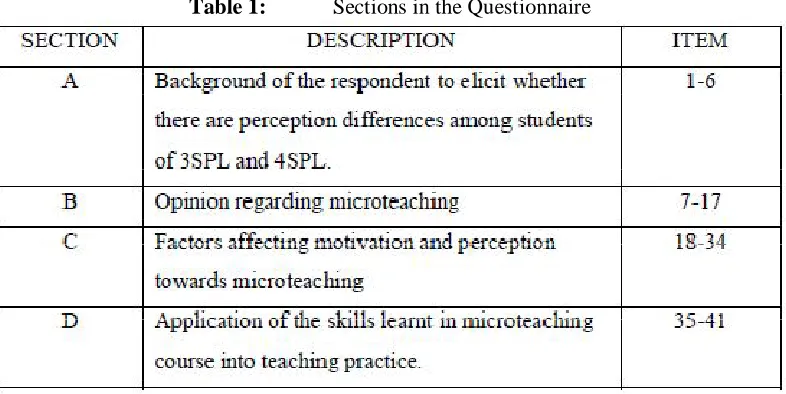
In order to collect the data for the research, the researcher opt to use questionnaire. The questionnaire had been developed by the researcher herself, referring to previous research done on microteaching by Noorazalia (2002). Five items were adapted from her research which are item 20, 21, 24, 25 and 32. All these items can be found in section C in the questionnaire.
Questionnaire
Table 1: Sections in the Questionnaire
For items 7-14 in section A, the questions asked were in the form of Likert scale. As for item 15, respondents were asked to rank from five choices given by giving 1 to the most challenging task and 5 to the least challenging task. As for item 16 and 17, respondents were asked to choose one answer that they think is the most appropriate to represent their opinion regarding microteaching. In section C and D all items were stated in the form of Likert scale. According to McDonough & McDonough, 1997, “the Likert scale questionnaire was used because they are commonly used to elicit opinion rather than facts.
Pilot study
The questionnaire was piloted to 10 respondents majoring in Bachelor of Technology with Education (Electrical Engineering). The pilot study was carried out to find the Cronbach’s Alpha to see how reliable items in the questionnaire were. The Cronbach’s Alpha for reliability test was 0.844. According to Mohd. Najib (1999), “value near to 0 shows that test items are not reliable whereby value which is close to 1 shows that the test items are highly reliable”. Therefore, test items in the questionnaire that had been developed by the researcher are reliable.
Result
Interest towards microteaching
Table 3 (a): attitude towards microteaching among students of 3 SPL
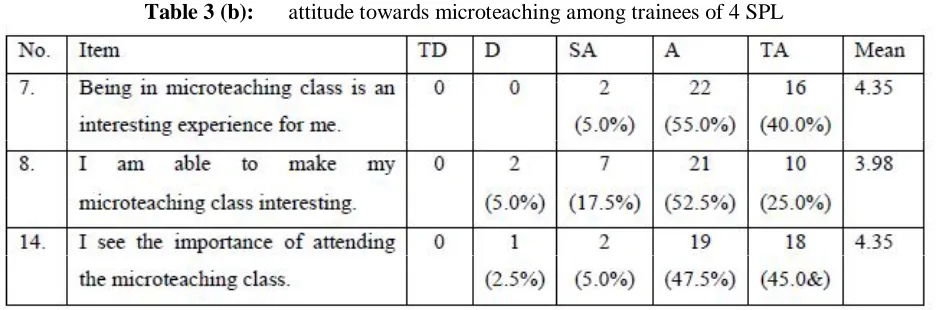
Items 7, 8 and 14 in the table 3 (a) above show the attitude of 3 SPL students towards their microteaching course. In general, the mean values indicated that the respondents showed a high level of perception towards microteaching. For item 14, the students acknowledged the importance of attending microteaching course. 100% of the respondents agreed and totally agreed that they see the importance of attending microteaching class. As for item 7, 35 (82.15%) students agreed and totally agreed that they had interesting experiences in microteaching class while two (5.3%) students somewhat agreed to the statement. These students probably observed their microteaching class as a compulsory class to attend to enable them to go for their practical teaching. Therefore, they do not care much about whether they had interesting experience or not microteaching class.
Table 3 (b): attitude towards microteaching among trainees of 4 SPL
Discussion
How do the students perceived their microteaching classes?
This research question is meant to collect the students’ opinion on their microteaching course. In the questionnaire that had been distributed, the respondents were asked to respond to 11 items related to interest towards microteaching, supervisor, benefits gained from microteaching, the tasks assigned and general view on microteaching. The cumulative mean value for this research question is 3.75. It shows that the level of perception of these students is high. The researcher assumed that these trainees regarded microteaching as important. However, they cannot give full commitment towards the subject since they have about six to seven other subjects to attend to. That is why the level of their perception towards microteaching is moderate.
The findings is related to a research done by Noor Haziah (2003) whereby most of the respondents agreed that their attitude towards teaching changed after taking microteaching course. The respondents agreed that after taking microteaching course, they are more interested in teaching and became more confident. Her research clearly indicated that microteaching prepared the students for their teaching practice especially in building self-confidence when teaching. This is especially true since a teacher needs to appear confident and comfortable to attract the students to learn and participate in classroom. Given a suitable time and chances, these skills can successfully be learned in microteaching class. Jensen (1974) stated that microteaching provides the students with the elements of “preparation, application, feedback, evaluation, modification and reapplication”. All these are important parts of microteaching which enable the students to improve their teaching skills.
Conclusion
The findings of the research showed that the students perceived microteaching as important and they possesed positive attitude towards their microteaching course. Therefore, microteaching can be considered as an important subject to prepare these students for their teaching practice. By going through a certain period of microteaching session, students will be able to learn how to plan a lesson properly, deliver their lesson more effectively and able to attract the students’ attention in class.
References
Abdul Latif Ahmad. Persepsi Guru dan Pelajar Terhadap Perlakuan Buli di Kalangan Pelajar Sekolah Menengah Daerah Batu Pahat. Master thesis. Universiti Teknologi Malaysia; 2005.
Allen, D & Ryan, K. (1969). Microteaching. In Brown, George A. Microteaching: A Program of Teaching Skills. Massachusetts: Addison Wesley. 1975.
Allen, D & Wang Weiping (1996). Microteaching. Beijing: Xinhua Press.
Ameena Ebraheem Al-Methan (2003). Merits of Micro-teaching as Perceived by Student Teachers at Kuwait University. Jurnal Pendidikan. 78, 65-75. Available online at www.penerbit.ukm.my. Retrieved on 25th October 2007.
Benton-Kupper & Jodi (2001). The Microteaching Experience: Student Perspective. Available online at www.findarticles.com. Retrieved on 31st December 2007.
Buku Panduan Akademik Ijazah Sarjana Muda sesi 2003/2004 (2004). Fakulti Pendidikan, UTM.
Derek Bok Center for Teaching and Learning, Harvard University. Teaching Fellows Talk about Microteaching. Available online at http://bokcenter.harvard.edu. Retrieved on 7th February 2008.
Dornyei, Z. (2001). Motivational Strategies in the Language Classroom. Cambridge: Cambridge University Press.
Duthie, J & McIntyre, D. (1977). Students’ reaction to microteaching. Ed McIntyre, D, MacLeod, G, et al. Investigation of Microteaching. London: Croom Helm.
Faire, M. Improving the Practicum: The Professional Development Needs of Lecturers, Associate Teachers and Students Teacher. Australian Teachers Education 2004. 11-15.