i
COMMUNITY BASED TOURISM SERVICE SCORECARD
MOHD AZLAN AB JALIL
v
COMMUNITY BASED TOURISM PERFORMANCE SCORECARD
MOHD AZLAN AB JALIL
A thesis submitted in fulfilment of the requirements for the award of the degree of
Doctor of Philosophy (Computer Science)
Faculty of Computing Universiti Teknologi Malaysia
vii
To My Beloved
Luqman, Iskandar and Amira
viii
ACKNOWLEDGEMENT
Alhamdulillah, thank you to Allah the All Mighty for his blessings that gave me strength to completion this thesis. I would like to express my deepest
appreciation and millions of thank to my supervisor and life time mentor, Prof. Dr. Ahmad Zaki bin Abu Bakar for his excellent guidance, understanding, co-operation and toleration in assisting me throughout the study.
My highest appreciation goes to my parents Haji Ab. Jalil bin Haji Abu Hassan and Hajjah Zaini Johari, my brother Mohd Azrul Hadi bin Ab Jalil and my sister Suraya Azlin binti Ab Jalil. Thank you for all your support, understanding and patience along the time.
Millions of thanks to Tuan Haji A. Jabar bin Md Tahir, former director of the Johor Tourism Department, for all the support and understanding, my respectful leader Tuan Haji Ya’acob bin Abdul Karim, Johor State Scout Commissioner for the motivations and trust given and my respectful Teacher Mr. Muhammad Zaini bin Ismail, for guiding me to the whole new world of exciting lifelong learning.
Last but not least, my gratitude to all tourism industry players, academicians, friends, Universiti Teknologi Malaysia (UTM), Universiti Malaysia Sarawak
(UNIMAS) and related agencies for their input, suggestions and all the support given that enable me to complete this research. Thank you too to all those not mentioned but contributed their support in making this thesis a reality. May Allah bless all of you.
ix
ABSTRAK
Pelancongan Berasaskan Komuniti (CBT) ialah apabila komuniti setempat terlibat secara aktif dalam penyampaian barangan dan khidmat pelancongan bagi kepentingan ekonomi. Komuniti untuk projek CBT mesti dipilih dengan teliti serta perlu dipantau secara berterusan untuk kelestarian. Permasalahannya, sorotan kajian menunjukkan bahawa pada ketika ini masih belum ada alatan Teknologi Maklumat dan Komunikasi (ICT) yang sesuai untuk membantu agensi pemberi dana seperti Kementerian Pelancongan membuat penilaian prestasi CBT. Tujuan penyelidikan ini ialah untuk mengisi keperluan tersebut dengan mencadangkan sebuah kad laporan prestasi untuk penilaian projek CBT. Soalan utama di sini ialah apakah penunjuk untuk kad laporan tersebut? Paradigma interpretif dan konstruktivis telah dipilih untuk menjawab persoalan-persoalan penyelidikan dengan kaedah bercampur terbenam telah dipilih sebagai pendekatan penyelidikan ini. Balanced Scorecard (BSC) berupaya untuk menggambarkan pelbagai perspektif sesuatu organisasi tetapi aplikasinya dalam industri pelancongan terhad dan belum pernah digunakan pada CBT Malaysia. Tujuan utama kajian ini ialah untuk menggunakan perspektif BSC untuk menguji sebuah BSC Khidmat Pelancongan yang boleh meramal pelbagai pembolehubah yang mempengaruhi prestasi sesuatu CBT, manakala tujuan kedua ialah untuk mengumpul data kualitatif prestasi CBT. Penyelidikan tindakan telah digunakan sebagai kaedah penyelidikan utama. Tiga kitaran penyelidikan tindakan telah dijalankan pada industri CBT Malaysia dengan menggunakan sebuah alatan BSC Khidmat yang diubah suai yang dibangunkan oleh kajian ini. Kitaran pertama dijalankan pada program penilaian dan pemantauan prestasi inap desa Johor. Kitaran kedua pula pada penilaian prestasi industri pelancongan Johor melalui Anugerah Pelancongan Johor. Akhirnya, kitaran ketiga dilakukan pada telecentres CBT di Sabah dan Sarawak. Berdasarkan penyelidikan ini dan alatan yang telah dibangunkan, perspektif yang lebih jelas dan berpetunjuk bagi CBT sudah boleh dirancang, dilaksana dan dipantau dengan lebih strategik melalui penggunaan BSC Khidmat Pelancongan.
x
ABSTRACT
Community-Based Tourism (CBT) is when a local community is involved actively in the provision of tourism goods and services to visitors for economic gains. Communities for CBT projects must be chosen carefully and require constant monitoring for sustainability. Here then lies the problem; the literature review shows that currently there is no proper Information and Communication Technology (ICT) tool to assist a funding agency like the Ministry of Tourism to evaluate the performance of a CBT. The goal of this research is to fill in the gap by proposing a performance scorecard for the evaluation of a CBT project. A main research question here is what are the indicators for the scorecard? The interpretive and constructivist paradigms were chosen to answer the research questions with an embedded mixed method chosen as its research approach. Balanced Scorecard (BSC) is able to reflect the multiple perspectives of an organization but its application in the tourism industry is limited and has never been applied to Malaysian CBT. The primary purpose of the study is to use the BSC perspectives to test Tourism Service BSC that predicts various variables that can influence the performance of a CBT while the secondary purpose is to gather qualitative data on CBT performance. Action research was used as the main research methodology. Three action research cycles were conducted on the Malaysian CBT industry using a modified Service BSC tool developed in this research. The first cycle was on the Johor Homestay quality evaluation and monitoring programme. The second cycle was on the performance of the Johor tourism industry through the Johor Tourism Award. Finally, the third cycle was carried out on actual CBT telecentres in Sabah and Sarawak. Based on this research and the tools developed, a clearer and more indicative perspective of the CBT can now be strategically planned, applied and monitored through a Tourism Service BSC.
xi
TABLE OF CONTENTS
CHAPTER TITLE PAGE
DECLARATION ii
DEDICATION iii
ACKNOWLEDGEMENTS iv
ABSTRAK v
ABSTRACT vi
TABLE OF CONTENTS vii
LIST OF TABLES xi
LIST OF FIGURES xiii
LIST OF ABBREVIATIONS xv
1 INTRODUCTION 1
1.1 Overview 1
1.2 Research Background 1
1.3 Problem Statement 3
1.5 Research Question 3
1.6 Objectives of the Research 4
1.7 Significance of the Research 5
1.8 Structure of the Research 5
2 LITERATURE REVIEW 7
2.1 Overview 7
2.2 Performance Measurement 7
2.2.1 The Performance Prism 10
xii
2.3 Balanced Scorecard 12
2.3.1 Need of Balanced Scorecard for CBT’s Performance Measurement. 16
2.3.2 Implementing the Balanced Scorecard in CBT 21 2.3.3 Disadvantages and Limitations of the Balanced Scorecard 22
2.4 Service Scorecard and GLACIER Model 24
2.5 Stakeholder Theory 26
2.6 Community Based Tourism 31
2.6.1 CBT in Malaysia 36
2.6.2 CBT Issues and Challenges 42
2.7 Chapter Summary 44
3 METHODOLOGY AND DESIGN 46
3.1 Overview 46
3.2 Research Paradigm 46
3.3 Research Approach 49
3.4 Research Strategy 51
3.5 Research Design 55
3.5.1 Phase 1 : Planning the Overall Conceptual Framework (Plan) 57
3.5.1.1 Planning 59
3.5.1.2 Implementation 60
3.5.1.3 Reflection 61
3.5.1.4 Re-Planning 61
3.5.2 Phase 2 : Implementing the Action Research Cycle 1, 2 and 3 (Implement) 62
3.5.2.1 Participant Observation 63
3.5.2.2 Individual & In-depth Group Interviews 65
3.5.2.3 Product Auditing 66
3.5.2.4 Field Notes and Self Documentation 68
xiii
3.5.2.5 ICT, Published Information and
Media Content Analysis 68
3.5.3 Phase 3 : Data Analysis and Re-Planning (Reflections) 69
3.5.3.1 Homestay Audit Indicator Weightage 69
3.5.3.2 Stakeholder Analysis 71
3.6 Chapter Summary 74
4 DATA COLLECTION & ANALYSIS 75
4.1 Overview 75
4.2 Action Research Cycle 01 76
4.2.1 Planning 76
4.2.2 Implementation 79
4.2.2.1 Data on the CBT Performance Evaluation in Malaysia 80
4.2.2.2 Implementation of the Johor Homestay Evaluation Framework based on the BSC Approach 84
4.2.3 Reflection 91
4.2.4 Pre-Planning 93
4.3 Action Research Cycle 02 94
4.3.1 Planning Phase 94
4.3.2 Implementation 96
4.3.2.1 Stakeholders Analysis 96
4.3.3 Reflection 102
4.3.4 Pre-Planning 103
4.4 Chapter Summary 104
5 COMMUNITY BASED TOURISM PERFORMANCE SCORECARD DESIGN AND TESTING 105
5.1 Overview 105
5.2 Action Research Cycle 03 105
xiv
5.2.2 Implementation 108
5.2.3 Reflection 121
5.3 Chapter Summary 122
6 DISCUSSION AND CONCLUSION 123
6.1 Overview 123
6.2 Discussion of Action Research Cycle 1, 2 and 3 123
6.2.1. Action Research Cycle 1 : Johor’s Homestay Performance Framework 124
6.2.1. Action Research Cycle 2 : New Johor’s Homestay Performance Framework 125 6.2.1. Action Research Cycle 3 : CoERI’s CBT Performance Framework 126
6.3 Analysis of Action Research Components 127
6.4 New CBT Performance Framework 130
6.5 Conclusion 134
6.6 Research Recommendations 138
6.7 Future Works 139
REFERENCES 140 Appendices A - F 147-164
xv
LIST OF TABLES
TABLE NO.
TITLE PAGE
2.1 Service and Non Service Business 8
2.2 Evolution of Performance Measurements 9
2.3 Evolution of Performance Models 10
2.4 Variants of Homestay Concept 38
2.5 Number of Homestay in Malaysia (by state) 42
3.1 The Research Paradigm Categories 47
3.2 The Research Method in the Action Research Cycle 1, 2 and 3 63 3.3 List of Stakeholders and Agencies Interviewed During Research 66
3.4 List of Components used for the inventory 67
3.5 Weightage given according to importance of components 70
4.1 List of Homestay in the State of Johor, Malaysia 77
4.2 Assessment of Malaysian Homestay Performance Evaluation 81 4.3 BSC Framework Key Areas for the Johor Homestay
Performance Evaluation
85
4.4 BSC Performance Evaluation of Johor Homestay 88
4.5 Table of Triangulation Analysis for Johor Homestay 89 4.6 The BSC Framework Key Areas for the Johor Homestay
Performance Evaluation with GLACIER
97
4.7 New Performance Framework Evaluation of Johor Homestay 100 4.8 Table of Triangulation Analysis with GLACIER for Johor
Homestay
101
5.1 List of CBT of CoERI’s E-Centre Project 107
xvi
5.2 BSC Framework Key Areas for the CoERI’s CBT Performance Evaluation
109
5.3 The Performance Evaluation Sheet for CoERI’s CBT 116
5.4 The Table of Triangulation Analysis for CoERI’s CBT 119 6.1 Analysis of Action Research Cycle 1, 2 and 3 based on BSC
Perspectives
128
6.2 The BSC Framework Key Areas for the CBT Performance Evaluation with GLACIER Model & CBT Principle
xvii
LIST OF FIGURES
FIGURE NO.
TITLE PAGE
1.1 Thesis Organization 6
2.1 The Original Balanced Scorecard Framework 13
2.2 The Balanced Scorecard for Non-Profit Sector 15
2.3 The Generic BSC Model of Environmental Performance 20
2.4 The Seven Criteria for BSC for Start-up Point 21
2.5 Service Scorecard Architecture 25
2.6 The Input – Output Model 27
2.7 The Stakeholders Model 27
2.8 The CBT Variants in Malaysia 40
2.9 The Total Number of Homestay Providers 1997-2008 41
2.10 The Distribution of Homestay in Malaysia 2008 41
3.1 The Typical Scenarios of Research Process 50
3.2 The Action Research process 53
3.3 The Overall Operational Framework 58
3.4 The Basic Action Research Process 59
4.1 The Johor Homestay Performance Framework 86
4.2 The New Johor Homestay Performance Framework 98
5.1 The CoERI’s CBT Performance Evaluation Strategy Map 110 5.2 The Use Case Diagram for CBT Performance Management
System
111
5.3 The Performance Measurement of CoERI’s CBT Kg. Bario 112 5.4 The Performance Measurement of CoERI’s CBT Kg.
Larapan
xviii
5.5 The Performance Measurement of CoERI’s CBT Kg. Buayan
114
5.6 The Performance Measurement Report of CBT in Sabah and Sarawak
115
5.7 The Result Chart of Performance Evaluation of CBT Kg. Bario
117
5.8 The Result Chart of Performance Evaluation of CBT Kg. Larapan
117
5.9 The Result Chart of Performance Evaluation of CBT Kg. Buayan
118
5.10 The Result Chart of Overall Performance Evaluation of CoERI’s CBT
118
6.1 The CBT Performance Evaluation Framework 132
6.2 The CBT Performance Scorecard 133
6.3 The CBT STARS 138
xix
LIST OF ABBREVIATIONS
3BL - Three Bottom Line
ABC - Activity Based Costing
APEC - Asia-Pacific Economic Cooperation ARC1 - Action Research Cycle 1
ARC2 - Action Research Cycle 2 ARC3 - Action Research Cycle 3
BSC - Balanced Scorecard
CBST - Community Based Sustainability Tourism CBT - Community Based Tourism
CoERI - Centre of Excellence for Rural Informatics ECER - East Coast Economic Region
EVA - Economic Value Added
FELDA - Federal Land Development Agency
GLACIER - Growth, Leaderships, Acceleration, Collaboration, Innovation, Environment & Retention
ICT - Information, Communication and Technology
IS - Information System
ISITI - Institute of Social Informatics
JHA - Johor Homestay Association
JTA - Johor Tourism Award
JTAC - Johor Tourism Action Council
JTD - Johor Tourism Department
KKLW - Ministry of Rural & Regional Development MOCAT - Ministry of Culture and Tourism
MOTOUR - Ministry of Tourism, Malaysia
NOSS - National Occupational Skills & Standard
PPT - Pro-poor Tourism
xx
PRA - Participatory Rural Appraisal
SBU - Small Business Unit
SSU - Shared Service Unit
TPRG - Tourism Planning Research Group, UTM TIM - School of Travel Industry Management
UN - United Nation
UNDP - United Nation Development Program UNIMAS - Universiti Malaysia Sarawak
UNWTO - United Nation World Tourism Organization
US - United States of America
UTM - Universiti Teknologi Malaysia WTO - World Tourism Organization
1
CHAPTER 1
INTRODUCTION
1.1 Overview
This chapter provides an overview of the study conducted. Firstly, it
deliberate the research background and the set-up of the research. The key research questions asked and objectives of the research is outlined. Next is the scope of the research discussed to guide the study and then followed by the significance of the study in terms of theory, practice and methodology. This chapter is concluded with an outline of the structure adopted for the remaining sections of the study.
1.2 Research Background
6
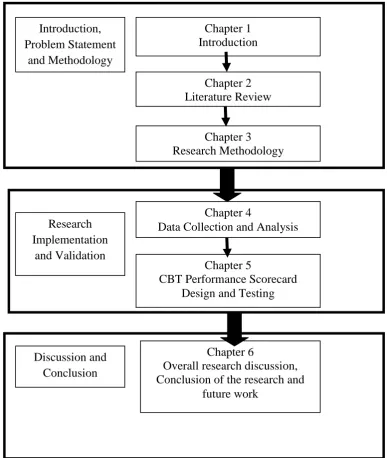
objectives and its scope. Chapter 2 is the deliberation of the related literature review while Chapter 3 is the description of the methodology and planning in conducting the research. Chapter 4 relates to the data collection and analysis while Chapter 5 describes CBT Performance Scorecard Design and testing phase. Chapter 6 presents the overall discussion on the work of the research, the conclusions and recommendation of the future work.
Figure 1.1 Thesis organization
Chapter 1 Introduction
Introduction Chapter 2 Literature Review
Chapter 3
Research Methodology
Chapter 4
Data Collection and Analysis
Chapter 5
CBT Performance Scorecard Design and Testing
Chapter 6
Overall research discussion, Conclusion of the research and
future work Discussion and
Conclusion Research Implementation
and Validation Introduction, Problem Statement
5
1.6 Significance of the Research
This research is in-line with the national planning especially under the New Malaysia Blue Ocean Strategy. The proposed ICT framework has many benefits and will give an impact on the various CBT stakeholders and areas of concern in terms of socio-economic development especially to local governments that are interested to develop the community based tourism industry.
Funding and implementation agencies related to CBT like the Johor Tourism Department, the Malaysian Ministry of Tourism, the Asia–Pacific Economic
Cooperation (APEC) Tourism Working Group and World Tourism Organization (WTO) as well as research institutions like the Institute of Social Informatics and Technological Innovations (ISITI), and its affiliated Centre of Excellence for Rural Informatics (CoERI), Community-Based Tourism Institute that are interested in the development of CBT will benefit from this research by having an ICT Framework and tools to effectively evaluate performance of a CBT.
A consistent evaluation to evaluate the performance of CBT was assist these organizations to plan its actions and allocate necessary resources to assist ailing as well as progressive CBT projects. The framework also was assist the CBT operators themselves to know their current situation in the form of a report card and hence take any necessary actions to improve their situation. The use of Action research in deriving the ICT framework for the toolkit was provide more information on the use and effectiveness of Action research in Malaysia.
1.7 Structure of the research
4
In order to answer this question, the following issues or sub-questions were identified:
1. What is the framework for collecting information and then evaluating the performance of a community-based tourism project?
2. What are the indicators for evaluating a community-based project at its various life cycles?
3. How to facilitate the effective gathering, storing and planning of information to produce the performance evaluation?
4. How to visualize the result of the valuation in a simple but yet balanced and holistic manner and then recommend any action to be taken?
1.5 Research Objectives
Based on the main research question, the primary objective of this research is to investigate and create a suitable framework that can be used to assist a monitoring agency to evaluate the performance of community-based tourism projects.
To achieve this goal, the secondary objectives for this research are as follow: 1. To study and review the current community-based tourism
performance evaluation systems.
2. To propose a framework to facilitate the effective collection of information and then to analyze the performance results for a community-based tourism project.
3. To propose a set of indicators for evaluating a community-based project at its various life cycle.
3
there is a request for funding to improve the CBT, the Ministry of Tourism does not have a proper framework to evaluate effectively CBT current performance.
Further study indicated that similar organizations suffers the same problem due to the non-existence of a proper and effective performance measurement for the CBT.
1.3 Problem Statement
Literature review and initial study conducted shows that currently there is no ICT Framework available to evaluate the performance of a CBT project for a certain community.
Hence there is a need to design and create an ICT framework as a tool to evaluate the performance of an existing CBT project for a certain community so that necessary remedial actions can be taken to improve the CBT.
1.4 Research Questions
In this study, an ICT Framework should assist to facilitate the performance evaluation of CBT project. The research questions is:
2
In this research, a community represent individuals from a demographic group comprised of indigenous people and rural villagers with collective
responsibility and ability to make decision on their tourism business. The level of participation in the tourism activities can vary i.e. either the whole community being fully involved, partially with only certain families or selected members or in joint-partnership with commercial tourism operators and even with the involvement of government agencies.
Once a CBT project has been launched and is in operation, its implementation status like other business projects require constant monitoring and control. Here, lies the problem; according to this research, there is no proper tool to assist a funding agency like the Ministry of Tourism to assess the various stages of a CBT project life cycle. Since there was many CBT projects to be assessed, an effective tool that can provide a consistent assessment through all the phases is required as compared to the ad hoc manual method currently being employed.
According to the report by Project Management Institute (2001) a CBT type of project normally was go through the cycle of conceptualization or initialization phase, planning phase, implementation or execution phase and finally closing phase. Monitoring and control mechanisms are deployed in all the four phases to ensure the integrity and good management of the project. For this reason, various ICT tools have been devised to monitor and evaluate the projects.
Due to the different nature and activities in each phase, using a single tool is not feasible to evaluate the four phases of the project. Hence, there is certainly a need to have a tool to assess the feasibility of the project during the conceptualization phase, another tool to capture the preparation in the planning stage, another tool to monitor the project performance during its implementation phase and finally a tool to audit the final outcome of the project in the closing stage.
140
REFERENCES
Ackermann, F. and Eden, C. (2001). Stakeholders Matter: Techniques for Their Identification and Management. Department of Management Science
Research Paper No 2001/20. Strathclyde Business School, Glasgow. Atkinson, A. A. and McGrindell, J. Q. (1997). Strategic Performance Measurement in government. CMA Magazine, 71:3.
Atkinson, A.A., Waterhouse, J.H. and Well, R.B. (1997). A Stakeholder Approach to Strategic Performance Measurement. Sloan Management Review.Spring. p p 25 – 37.
Avison, D.E., Lau, F., Myers, M.D. and Nielsen P.A. (1999). Action Research. Communications of the ACM. Vol. 42 No. 1, pp 94-97
Bazeley, P. (2007). Qualitative Data Analysis with NVivo. London: Sage. Bennet M. and James P. (1998). The Green Bottom Line. Environmental Accounting for Management. Current Practice and Future Trends Sheffield. Greenleaf Publishing.
Bergman, M. M. (Ed.) (2008). Advances in Mixed Methods Research: Theories and Applications. Thousand Oaks, CA: Sage Publications.
Brown, M.G. (1996). Keeping Score. New York: Quality Resources
Checkland, P. and S. Holwell (1998). Action Research: Its Nature and Validity. Systemic Practice and Action Research Journal. Vol 11, No 1, pp. 9-21. Chevalier, J. M. (2008). Stakeholder Identification: A Guide to Collaborative Inquiry and Social Engagement. SAGE Publication and International Development Research Centre, Ottawa, Canada, pp 165 - 171.
Colfer, C. (1985). Sustainable forest management. Center for International Forestry Research, Bogor, Indonesia.
141
Creswell, J. W. (2003). Research Design: Qualitative, Quantitative and Mixed Methods Approaches. Second Edition. University of Nebraska, Lincoln. Sage Publications, Inc.
Creswell, J. W., Shope, R., Plano Clark, V. L., and Green, D. O. (2008). How Interpretive Qualitative Research Extends Mixed methods Research. Research in the Schools,. 13, 1–11
Daake, D. and Anthony, W.P. (2000). Understanding Stakeholder Power and Influence Gaps in a Health Care Organization; An Empirical Study. Health Care Management Review. Vol 25, No. 3, pp 94 – 107
Donaldson, T. and Preston, L. E. (1995). The Stakeholder Theory of the
Corporation: Concepts, Evidence and Implications. Academy of Management Review. Vol 20, No 1, pp 65 – 91.
Dubois, O. (1998). Capacity to Manage Role Changes in Forestry: Introducing the “4Rs” Framework. Forest Participation Series 11. International Institute for Environment and Development, London, UK.
Eisenhardt, K. M. (1989). Building Theories from Case Study Research
Academy of Management. The Academy of Management Review. Oct 1989; 14, 4; ABI/INFORM Global, pg. 532
Elliot, J. (1987). Educational Theory, Practical Philosophy and Action Research. British Journal of Educational Studies. Volume 35, Issue 2, 1987.
Freeman, R. E. (1984). Strategic Management: A Stakeholder Approach. Pitman Publishing Company, p. 276
Freeman, R. E., and Gilbert, D. R. (1987). Managing stakeholder interests. Business and Society. Dimensions of Conflict and Cooperation (pp. 379-422). Lexington, MA: Lexington Books.
Flak, W., Leif, S. and Will, D. (2005): Stakeholder Theory and Balanced Scorecard to Improve IS Strategy Development and Management in the Public Sector. Presentation held at the IRIS’28 in Kristiansand, Norway, August 6-9, 2005.
Friedman, A. L. and Miles, S. (2002). Developing Stakeholder Theory. Journal of Management Studies 39 (1): 1–21.
142
Gibbs, J. L., and Kraemer, K. L. (2004). A Cross-Country Investigation of the Determinants of Scope of E-Commerce Use: An institutional
Approach.Electronic Markets, 14(2), 124-137.
Greene, J.D. (2007). Why are VMPFC Patients More Utilitarian? Trends Cog. Sci. 11:322-323;
Grimble, R. and Wellard, K. (1997). Stakeholder Methodologies in Natural Resources Management. A Review of Principles, Contexts, Experiences and Opportunities. Agricultural Systems Journal 55 (2): 173 – 193, 1997.
Guba, E. G. (1990). The Alternative Paradigm Dialog. In Guba, E. G. (Ed.), The Paradigm Dialog. Newbery Park: CA: Sage.
Gumesson, E. (2000). Qualitative Methods in Management Research (2nd ed.): Sage Publications.
Gupta, A. (1995). A Stakeholder Approach for Inter-organizational Systems. Industrial Management and Data Systems. Vol. 95, No. 6, pp 3 – 7 Halcomb, E.J., Andrew S., Brannen J. (2009) Introduction to Mixed Methods Research for Nursing and the Health Sciences. UK: Wiley-Blackwell, pp3-12. Hall, C. (1999). Rethinking Collaboration and Partnership: A Public Policy Perspective. Journal of Sustainable Tourism 7:274–289.
Hatton, C. (2007). The Mental Health of Children and Adolescents with Learning Disabilities in Britain. Institute for Health Research, Lancaster University. Hobley, M. (1996). Participatory Forestry: the Process of Change in India and Nepal. ODI, London, UK.
Hoff, K. G. and Holving, P. A. (2002). Balansert målstyring.Universitetsforlaget, Oslo, Norge.
Hopkins, D. (1993). A Teacher’s Guide to Classroom Research. Philadelphia: Open University Press.
Johnson, D.W., & Johnson, R. (1999). The three Cs of Classroom and School \ Management. In H. Freiberg (Ed.). Beyond behaviorism: Changing the Classroom Management Paradigm. Bosyon: Allyn & Bacon.
143
Kaplan, R. S. and Norton, D. P. (1996). Using the Balanced Scorecard as a Strategic Management System. Harvard Business Review. January – February, pp 75 – 85.
Kaplan, R. S. and Norton, D. P. (2006). Alignment. Using the Balanced
Scorecard to Create Corporate Synergies. Harvard Business School Press. pp 29 – 77.
Kemmis, S., and McTaggart, R. (Eds.). (1990). The Action Research Reader. Victoria: Deakin University.
Kiss, A. (2004) Trends in Ecology and Evolution. Volume 19 No.5. May Klein, H. K., and Myers, M.D. (1999). A Set of Principles for Conducting and Evaluating Interpretive Field Studies in Information Systems. MIS Quarterly, 23(1), 67-93.
Lai, V.S. and Guynes, J.L. (1997) An Assessment of the Influence of
Organizational Characteristics on IT Adoption Decision: A Discriminative Approach, IEEE Transactions on Engineering Management, 44(2), 146-157. Leif, S.K and Dertz, W. (2006). Stakeholder Theory and Balanced Scorecard to Improve IS Strategy Development in Public Sector. MIS Quarterly,
18(3), 114-121.
Lincoln, Y. S. and Guba, E. A. (1985). Naturalistic Inquiry. Beverly Hills, CA. Sage Publishing.
Lipe, M. and Salterio, S. (2000). The Balanced Scorecard: Judgemental Effects of Common and unique performance measures. The Accounting Reviews. July 2000, 75:3, 283-298.
144
Mooraj, S., Oyon, D. and Hostettler, D. (1999). The Balanced Scorecard: a Necessary Good or Unnecessary Evil? European Management Journal, October 1999, 17:5. Great Britain: Elsevier Science Ltd.
Myers, M. D. (1997). Qualitative Research in Information Systems. MIS Quarterly, 21(2), 241-242.
Neely, A., Adams, C. and Crowe, P. (2000). The Performance Prism in Practice. Measuring Business Excellence, Vol. 5, No 2., pp 6 – 12
Neuman, L. (2003). Social Research Methods: Qualitative and Quantitative Approaches. Massachusetts: Allyn and Bacon.
Niven, Paul R. (2003). Balanced Scorecard Step-By-Step For Government and Non-Profit Agencies. John Wiley and Sons.
Olve, N. G., Roy, J., and Wetter, M., (1999) Performance Drivers: A Practical Guide to Using the Balanced Scorecard, John Wiley and Sons, New York. Orsatto, R. and Clegg, S. (1999). The Political Ecology of Organizations: Towards a framework for analyzing business environment relationships. Organisation and Environment. 12:3, 263 – 279.
PATA Gold Awards Open for Submission until April 30, 2008.
Available on-line at http://www.pata.org/patasite/index.php?id=128. Accessed on 1 July2008.
Patton, M. Q. (1990). Qualitative Evaluation Methods (2nd ed..). Thousand Oaks: CA:Sage.
Phillips, R. (2004). Some Key Questions About Stakeholder Theory. Ivey Business Journal Online. Ivey Management Services, March/April, pp 1 - 4. Reprint # 9B04TB03.
Pouloudi, A. and Whitley, E. A. (1997). Stakeholder Identification in Inter- Organizational Systems: Gaining Insights for Drug Use Management Systems. European Journal of Information Systems, Vol 6, pp 1 – 12.
PMI. Project Management Institute (2001). The PMI Project Management Fact Report Book Second Edition. 2001, pp 1 – 8.
Reinhart, C. M. (1999). The American Economic Review, Vol 89, No.3 (Jun. 1999), 473 – 500.
145
Ramírez, R. (1999). Stakeholder Analysis and Conflict Management. In Buckles, D. (Ed.). Cultivating Peace: Conflict and Collaboration in Natural Resource Management. International Development Research Centre, Ottawa, Canada, pp. 101 – 128.
Rikhardsson, P. (2004). Accounting for the Costs of Occupational Accidents. Corporate Social Responsibility and Environmental Management. Vol. 11, No. 4, 63-70.
Schon, D.A. (1983). The reflective practitioners: How professionals think in Action. New York: Basic Books.
Seddon, P. B., Staples, S., Patnayakuni, R. and Bowtell, M. (1999). Dimensions of Information Systems Success. Journal Communications of the AIS. Volume 2, Issue 3es, Nov. 1999. Article No. 5
Senge, P. M. (2007). The Practice of Innovation. Leader to Leader. Volume 1998. Issue 9, pages 16-22, summer 1998.
Silverman, D. (1993). Beginning Research. Interpreting Qualitative Data. Methods for Analyzing Talk, Text and Interaction. Londres: Sage Publications.
SNV Asia Pro-Poor Sustainable Network (2007). A Toolkit for Monitoring and Managing Community-Based Tourism. Pp 8-50.
Spitzer, D. R. (2007) Transforming Performance Measurement: Rethinking the Way We Measure and Drive Organizational Success, pp 3 – 7.
Susskind, Lawrence and Cruikshank, J. (1987). Breaking the Impasse.
Consensual Approaches to Resolving Public Disputes. Basic Books, Inc. USA Tourism Planning Research Group (2009). Final Report Business Strategy and Implementation Plan for the Proposed Homestay and Kampungstay Tourism Development for East Coast Economic Region. April 2009.
Tyagi, Rajesh K. and Gupta, P. (2008). A Complete and Balanced Service Scorecard. Creating Value through Sustained Performance Improvement. Pearson Education. Inc.
Varvarovszky, Z. and Brugha, R. (2000). Stakeholder Analysis: A Review. Health Policy and Planning. Vol 15, No 3, pp 239 – 246.
146
Walker, P.A., Greiner, R., McDonald, D. and Lyne, V. (1999) the Tourism
Futures Simulator: A systems thinking approach. Environmental Modelling
and Software 14 (1), p.p 59–67.
Walsham, G. (1995) The Emergence of Inter-Pretivism in IS Research, Information Systems Research, 6(4): 376-394
Weaver, D. B., and Fennell, D. A. (1997). The Vacation Farm Sector in Saskatchewan. A Profile of Operations. Tourism Management 18, 357–365 WWF. World Wildlife Foundation International (2005). Guidelines for Community Based Eco-Tourism Development. Pp. 4-24
Yee-Chin, L. C. (2004). Performance Measurement and Adoption of Balanced Scorecards. A Survey of Municipal Governments in the USA and Canada. The International Journal of Public Sector Management. Vol 17, No 3, pp 204-221.
Yin, R. K. (2004). Case Study Research: Design and Methods. Second Edition. Applied Social Research Methods Series. Volume 5. Sage Publications. Zingales, F., O’Rourke, A., Hockerts, K. (2002). Balanced Scorecard and Sustainability State of the Art Review. The Centre for the Management of Environmental Resources. Journal of Management Studies. 49 : 3–11. Zhu, X., Ghahramani, Z., and Lafferty, J. (2003). Semi Supervised Learning Using Gaussian Fields and Harmonic Functions. ICML-03, 20th
International Conference on Machine Learning.