DEHYDRATION PROCESS
HAFIZAH FARHAH BINTI SAIPAN @ SAIPOL
DEHYDRATION PROCESS
HAFIZAH FARHAH BINTI SAIPAN @ SAIPOL
A thesis submitted in fulfilment of the requirements for the award of the degree of
Doctor of Philosophy (Mathematics)
Faculty of Science Universiti Teknologi Malaysia
ACKNOWLEDGEMENT
All the praises and thanks to Allah the Almighty for giving me the strength to complete and submit this thesis. I would like to express my sincere gratitude to my beloved supervisor, Assoc. Prof. Dr. Norma binti Alias for her sincere and valuable guidance and encouragement. I am extremely grateful and indebted to her for sharing her knowledge and ideas, giving continuous support, and advice throughout this journey.
I sincerely thank Ibnu Sina Institute and the staff members for providing help and guidance and the necessary facilities I need. I also would like to thank all my friends, and to one and all who has been involved directly or indirectly in completing this thesis.
ABSTRACT
ABSTRAK
TABLE OF CONTENTS
CHAPTER TITLE PAGE
DECLARATION ii
DEDICATION iii
ACKNOWLEDGEMENTS iv
ABSTRACT v
ABSTRAK vi
TABLE OF CONTENTS vii
LIST OF TABLES xii
LIST OF FIGURES xv
LIST OF ABBREVIATIONS xxi
LIST OF SYMBOLS xxiii
LIST OF APPENDICES xxiv
1 INTRODUCTION 1
1.1 Background of Research 1
1.2 DIC Technique 3
1.2.1 Mathematical Model in DIC Technique 6
1.3 Statement of Problem 10
1.4 Objectives of Research 11
1.5 Scope of Research 12
1.6 Significance of Research 14
1.7 Thesis Organization 14
2.1 Finite Difference Method 17
2.1.1 Finite Difference Grid 18
2.1.2 Taylor’s Theorem 18
2.2 Basic Scheme for PDE 20
2.2.1 Classical Explicit Method 20
2.2.2 Fully Implicit Method 21
2.3 Numerical Methods for Solving SLE 22
2.3.1 Classical JB Method 23
2.3.2 Classical RBGS Method 25
2.3.3 AGE Method 26
2.3.3.1 Convergence Analysis for AGE Method 28
2.3.4 AGED Method 32
2.3.5 AGEB Method 35
2.4 Numerical Analysis 36
2.4.1 Consistency 37
2.4.2 Convergence 38
2.4.3 Stability 38
2.4.4 Measurements of Numerical Errors 39
2.4.5 Computational Complexity Cost 40
2.5 Distributed Memory Parallel Computing System 41
2.5.1 Designing Parallel Programming 42
2.5.2 Distributed Parallel Computing Architecture 45 2.5.3 Matlab Distributed Computing Server 48
2.5.3.1 Development of MDCS 51
2.5.4 Parallel Performance Evaluations 53
2.5.4.1 Speedup 53
2.5.4.1.1 Amdahl’s Law 54
2.5.4.1.2 Gustafson-Barsis Law 55
2.5.4.2 Efficiency 55
2.5.4.3 Effectiveness 57
2.5.4.4 Temporal Performance 57
2.5.4.5 Granularity 57
3 FORMULATION OF REGRESSION MODEL TO PDE 60
3.1 Introduction 60
3.2 Formulating the Statistical Regression Analysis to
Parabolic PDE 61
3.3 1D Parabolic PDE Model 64
3.3.1 2D Parabolic PDE Model 67
3.4 Formulation from Parabolic to Hyperbolic Equation 72
3.4.1 1D HPDE Model 76
3.4.2 2D HPDE Model 79
3.4.3 3D HPDE Model 81
3.5 Chapter Summary 83
4 SEQUENTIAL AND PARALLEL ALGORITHMS FOR 1D
MODEL 88
4.1 Introduction 88
4.2 Discretization using Weighted Average Method 89
4.3 Numerical Methods 90
4.3.1 1D_SJB Method 91
4.3.2 1D_SRBGS Method 92
4.3.3 1D_SAGED Method 94
4.3.4 1D_SAGEB Method 98
4.4 Parallelization of Numerical Methods 102
4.4.1 1D_PJB Method 109
4.4.2 1D_PRBGS Method 110
4.4.3 1D_PAGED Method 112
4.4.4 1D_PAGEB Method 115
4.5 Computational Complexity 124
4.5.1 Computational Complexity for Sequential
Algorithm 124
4.5.2 Computational Complexity for Parallel
Algorithm 125
4.6 Results and Discussion 127 4.6.1 Numerical Results for Sequential Algorithm 127 4.6.2 Parallel Performance Evaluations for Parallel
Algorithm 130
4.7 Chapter Summary 137
5 SEQUENTIAL AND PARALLEL ALGORITHMS FOR 2D
MODEL 139
5.1 Introduction 139
5.2 Discretization using Weighted Average Method 140
5.3 Numerical Methods 142
5.3.1 2D_SJB Method 142
5.3.2 2D_SRBGS Method 144
5.3.3 2D_SAGED Method 145
5.3.4 2D_SAGEB Method 155
5.4 Parallelization of Numerical Methods 163
5.4.1 2D_PJB Method 164
5.4.2 2D_PRBGS Method 166
5.4.3 2D_PAGED Method 168
5.4.4 2D_PAGEB Method 171
5.5 Computational Complexity and Communication Cost 173 5.5.1 Computational Complexity for Sequential
Algorithm 174
5.5.2 Computational Complexity for Parallel
Algorithm 175
5.5.3 Communication Cost for Parallel Algorithm 176
5.6 Results and Discussion 176
5.6.1 Numerical Results for Sequential Algorithm 177 5.6.2 Parallel Performance Evaluations for Parallel
Algorithm 179
6 SEQUENTIAL AND PARALLEL ALGORITHMS FOR 3D
MODEL 188
6.1 Introduction 188
6.2 Discretization using Weighted Average Method 189
6.3 Numerical Methods 192
6.3.1 3D_SJB Method 192
6.3.2 3D_SRBGS Method 194
6.3.3 3D_SAGED Method 196
6.3.4 3D_SAGEB Method 215
6.4 Parallelization of Numerical Methods 229
6.4.1 3D_PJB Method 231
6.4.2 3D_PRBGS Method 233
6.4.3 3D_PAGED Method 236
6.4.4 3D_PAGEB Method 239
6.5 Computational Complexity and Communication Cost 241 6.5.1 Computational Complexity for Sequential
Algorithm 242
6.5.2 Computational Complexity for Parallel
Algorithm 242
6.5.3 Communication Cost for Parallel Algorithm 244
6.6 Results and Discussion 244
6.6.1 Numerical Results for Sequential Algorithm 245 6.6.2 Parallel Performance Evaluations for Parallel
Algorithm 247
6.7 Chapter Summary 255
7 CONCLUSION AND RECOMMENDATION 256
7.1 Introduction 256
7.2 Conclusion 256
7.3 Recommendation for Future Research 261
REFERENCES 262
LIST OF TABLES
TABLE NO. TITLE PAGE
1.1 Summary of the conventional dehydration techniques 2 1.2 Value of parameters for pressure, water content and processing
time 4
2.1 The comparison between sequential and parallel computing 41
2.2 Command for communication activities in MDCS 50
3.1 Input parameters involved to simulate the 1D parabolic PDE
model 66
3.2 The absolute and relative errors from Haddad et al. (2007) and
1D parabolic PDE model (Equation 3.4) 66
3.3 Input parameters for 1D parabolic PDE for heat and mass
equation 70
3.4 The absolute and relative errors from Haddad et al. (2007) and
1D hyperbolic PDE model (Equation 3.14) 74
3.5 Value of parameters of HPDE model for heat and mass transfer 76 3.6 The chronology to enhance the mathematical model in
dehydration using DIC technique 84
4.1 Arithmetic operations per iteration in sequential algorithm for
1D heat and mass equations (m = problem size) 124 4.2 Arithmetic operations per iteration in parallel algorithm for 1D
heat and mass equations 125
4.3 Communication cost in parallel algorithm for 1D heat and mass
equations 126
4.5 The numerical results of heat and mass equations when 1
and 105 129
4.6 The numerical results of heat and mass equations when 1
and 1010 129
4.7 Execution time for heat and mass equations for 5 10
and
10 10
and its percentage 135
4.8 Granularity for heat and mass equations using 1D_PAGEB
method 135
4.9 Granularity for heat and mass equations using 1D_PAGED
method 136
4.10 Granularity for heat and mass equations using 1D_PRBGS
method 136
4.11 Granularity for heat and mass equations using 1D_PJB method 137 5.1 Arithmetic operations per iteration in sequential algorithm for
2D heat and mass equations 174
5.2 Arithmetic operations per iteration in parallel algorithm for 2D
heat and mass equations 175
5.3 Communication cost in parallel algorithm for 2D heat and mass
equations where m401401 and m901901 175 5.4 Value of parameters for 2D heat and mass equations 177 5.5 The numerical results for 2D heat and mass equations when
1
,NiNj401,xy1.25e05andt 2.025e-06 177
5.6 The numerical results for 2D heat and mass equations when 1
,NiNj901,xy5.556e06and
07 -e 0001 . 9 t 178
5.7 Execution time for heat and mass equation for size of matrix 401
401 and 901901 and its percentage 180 5.8 Granularity for size of matrix 401401 and 901901 using
2D_PAGEB method 185
5.9 Granularity for size of matrix 401401 and 901901 using
2D_PAGED method 185
2D_PRBGS method 186 5.11 Granularity for size of matrix 401401 and 901901 using
2D_PJB method 186
6.1 Arithmetic operations per iteration for sequential algorithm of
3D heat and mass equations (m = problem size) 243 6.2 Arithmetic operations per iteration for parallel algorithm of 3D
heat and mass equations 243
6.3 Communication cost in parallel algorithm for 3D heat and mass
equations 243
6.4 Value of parameters for 3D heat and mass equations 245 6.5 The numerical results for 3D heat and mass equations when
1
, NiNjNk21, xyz2.38e04 and05 -2.38e
t 245
6.6 The numerical results for 3D heat and mass equations when
1
, NiNjNk41, xyz1.22e04 and05 -1.22e
t 246
6.7 Execution time for heat and mass equations for size of matrix, 21
21
21 and 414141and its percentage 247 6.8 Granularity for size of matrix 212121 and 414141
using 3D_PAGEB method 253
6.9 Granularity for size of matrix 212121 and 414141
using 3D_PAGED method 253
6.10 Granularity for size of matrix 212121 and 414141
using 3D_PRBGS method 254
6.11 Granularity for size of matrix 212121 and 414141
LIST OF FIGURES
FIGURE NO. TITLE PAGE
1.1 Schematic diagram of the DIC reactor 4
1.2 Temperature and pressure changes during DIC treatment 5
1.3 Parallel algorithm design 9
2.1 Computational grid points 18
2.2 The computational molecules for explicit method 21 2.3 The computational molecules for fully implicit method 22
2.4 The computational molecules for RBGS method 25
2.5 Problem solving using sequential computing 42
2.6 Problem solving using parallel computing 42
2.7 The computing systems according to a) SISD, b) SIMD,
c) MISD, and d) MIMD 44
2.8 Phases of designing the parallel algorithm 45
2.9 Communication activities involved in JB method 47
2.10 Parallel Command Window 49
2.11 Example code for pmode command and its output 50 2.12 MDCS cluster workstation in Ibnu Sina Insitute, UTM 51
2.13 Parallel architecture of MDCS cluster 52
2.14 Parallel process using MDCS 53
2.15 Speedup versus number of processors 55
3.1 The phytate content during dehydration process using DIC
technique 63
model (Equation 3.4) 65 3.3 The phytate content with a) respect to x-axis and with
b) increasing of time 65
3.4 2D drying material 67
3.5 The phytate content with respect to x- and y- axis 68 3.6 Mass transfer after a) 1, 5 and 10 seconds and b) after 10
seconds 71
3.7 Temperature of drying material a) after 1, 5 and 10 seconds
and b) after 10 seconds 71
3.8 The comparison of phytates in L.albus seed by regression model function in Haddad et al. (2007) and 1D hyperbolic
PDE model (Equation 3.14) 73
3.9 The visualization of the (a) 1D, and (b) 2D equations from
Equation (3.14) and (3.16) 75
3.10 The visualization of the mass transfer a) based on x-axis, and
b) time in second 78
3.11 The visualization of the heat transfer a) based on x-axis, and
b) time in second 78
3.12 The visualization of the 2D HPDE of a) mass transfer and
b) heat transfer in x- and y-axis 80
3.13 The visualization of the 3D HPDE of a) mass transfer and b) heat transfer in x-, y- and z-axis 83 3.14 The schematic diagram of the 3D HPDE model using Comsol
Multiphysics software 83
4.1 The computational molecules for 1D_SJB method 91 4.2 The computational molecules of red and black points for
1D_SRBGS method 93
4.3 The computational molecules for 1D_SAGED method at
a)
2 1
n and b)
n1
time level97 4.4 The computational molecule for 1D_SAGEB method at
a)
4 1
n , b)
2 1
n and c)
n1
time level4.5 Non overlapping domain decomposition of 1D problem 103
4.6 Algorithm for Matlab client 103
4.7 Pseudocode for defining the left and right workers 105 4.8 Pseudocode for data decomposition for each worker 105 4.9 The structure of parallel strategy from Matlab client to each
worker 106
4.10 Pseudocode for global convergence test in the Matlab client 106 4.11 Pseudocode for local convergence test in the Matlab worker 107 4.12 Message passing for the communication activities between
client-workers and between neighboring workers 107
4.13 Parallel algorithm for 1D_PJB method 109
4.14 Send and receive points in 1D_PJB method 110
4.15 Parallel algorithm for 1D_PRBGS method 111
4.16 Send and receive points in 1D_PRBGS method 112
4.17 Parallel algorithm for 1D_PAGED method 114
4.18 Send and receive points in 1D_PAGED method 114
4.19 Data partition for matrix a) G1 and b) G2 to a number of
worker 115
4.20 Parallel algorithm for 1D_PAGEB method 117
4.21 Send and receive points in 1D_PAGEB method 118
4.22 Sequential algorithms for a) 1D_SJB, b) 1D_SRBGS,
c) 1D_SAGED, and d) 1D_SAGEB method 119
4.23(a) Parallel algorithm for 1D_PJB method 120
4.23(b) Parallel algorithm for 1D_PRBGS method 121
4.23(c) Parallel algorithm for 1D_PAGED method 122
4.23(d) Parallel algorithm for 1D_PAGEB method 123
4.24 Execution time for tolerance a) 5 10
and b) 1010 on
1D i) mass and ii) heat equations versus number of workers 130 4.25 Speedup for tolerance a) 5
10
and b) 1010 on 1D i) mass and ii) heat equations versus number of workers 131 4.26 Efficiency value for tolerance a) 5
10
and b) 1010 on
1D i) mass and ii) heat equations versus number of workers 132 4.27 Effectiveness value for tolerance a) 5
10
and b) 10
on 1D i) mass and ii) heat equations versus number of workers 133 4.28 Temporal performance for tolerance a) 5
10
and b) 1010 on 1D i) mass and ii) heat equations versus
number of workers 133
4.29 Granularity analysis for tolerance (a) 5 10
and (b) 1010 on 1D (i) mass and (ii) heat equations versus
number of workers 134
5.1 The computational molecules for 2D_SJB method 143 5.2 The computational molecules for 2D_SRBGS method 144 5.3 Column-wise ordering of the mesh points parallel to the y-axis 152 5.4 The computational molecule of 2D_SAGED method at
a)
4 1
n , b)
2 1
n , c)
4 3
n and d)
n1 time level155 5.5 The computational molecule of 2D_SAGEB method at
a)
5 1
n , b)
5 2
n , c)
5 3
n , d)
5 4
n and e)
n1
time level 162
5.6 Domain decomposition technique and message passing
strategy for 2D problem 163
5.7 Parallel algorithm for 2D_PJB method 166
5.8 Send and receive lines in 2D_PJB method 166
5.9 Parallel algorithm for 2D_PRBGS method 168
5.10 Send and receive lines in 2D_PRBGS method 168
5.11 Parallel algorithm for 2D_PAGED method 170
5.12 Send and receive lines in 2D_PAGED method 171
5.13 Parallel algorithm for 2D_PAGEB method 173
5.14 Execution time for size of matrix a) 401401 and b) 901901 on 2D i) mass and ii) heat equation versus
number of workers 180
5.15 Speedup for size of matrix a) 401401 and b) 901901 on
2D i) mass and ii) heat equation versus number of workers 182 5.16 Efficiency for size of matrix a) 401401 and b) 901901 on
5.17 Effectiveness for size of matrix a) 401401 and b) 901901
on 2D i) mass and ii) heat equation versus number of workers 183 5.18 Temporal performance for size of matrix a) 401401 and
b) 901901 on 2D i) mass and ii) heat equation versus
number of workers 183
5.19 Granularity analysis for size of matrix a) 401401 and b) 901901 on 2D i) mass and ii) heat equation versus
number of workers 184
6.1 The computational molecule for 3D_SJB method 193
6.2 The computational molecule for 3D_SRBGS method 195
6.3 Planes parallel to xy-axis 201
6.4 Planes parallel to yz-axis 208
6.5 Planes parallel to xz-axis 211
6.6 The computational molecules for 3D_SAGED method 215 6.7 The computational molecules for 3D_SAGEB method 228 6.8 Domain decomposition technique and message passing
strategy for 3D problem 230
6.9 Parallel algorithm for 3D_PJB method 232
6.10 Send and receive surface in 3D_PJB method 233
6.11 Parallel algorithm for 3D_PRBGS method 235
6.12 Send and receive surface in 3D_PRBGS method 235
6.13 Parallel algorithm for 3D_PAGED method 237
6.14 Send and receive surface in 3D_PAGED method 238
6.15 Parallel algorithm for 3D_PAGEB method 241
6.16 Execution time for size of matrix a) 212121 and b) 414141 on 3D i) mass and ii) heat equation versus
number of workers 248
6.17 Speedup for size of matrix a) 212121 and b) 414141 on 3D i) mass and ii) heat equation versus number of workers
249 6.18 Efficiency for size of matrix a) 212121 and b) 414141
b) 414141 on 3D i) mass and ii) heat equation versus
number of workers 251
6.20 Temporal performance for size of matrix a) 212121 and b) 414141 on 3D i) mass and ii) heat equation versus
number of workers 251
6.21 Granularity analysis for size of matrix a) 212121 and b) 414141 on 3D i) mass and ii) heat equation versus
LIST OF ABBREVIATIONS
1D_PAGEB - 1D Parallel Alternating Group Explicit with Brian variant 1D_PAGED - 1D Parallel Alternating Group Explicit with Douglas-Rachford
variant
1D_PJB - 1D Parallel Jacobi
1D_PRBGS - 1D Parallel Red Black Gauss Seidel
1D_SAGEB - 1D Sequential Alternating Group Explicit with Brian variant 1D_SAGED - 1D Sequential Alternating Group Explicit with
Douglas-Rachford variant 1D_SJB - 1D Sequential Jacobi
1D_SRBGS - 1D Sequential Red Black Gauss Seidel
2D_PAGEB - 2D Parallel Alternating Group Explicit with Brian variant 2D_PAGED - 2D Parallel Alternating Group Explicit with Douglas-Rachford
variant
2D_PJB - 2D Parallel Jacobi
2D_PRBGS - 2D Parallel Red Black Gauss Seidel
2D_SAGEB - 2D Sequential Alternating Group Explicit with Brian variant 2D_SAGED - 2D Sequential Alternating Group Explicit with
Douglas-Rachford variant 2D_SJB - 2D Sequential Jacobi
2D_SRBGS - 2D Sequential Red Black Gauss Seidel
3D_PAGEB - 3D Parallel Alternating Group Explicit with Brian variant 3D_PAGED - 3D Parallel Alternating Group Explicit with Douglas-Rachford
variant
3D_PJB - 3D Parallel Jacobi
3D_SAGEB - 3D Sequential Alternating Group Explicit with Brian variant 3D_SAGED - 3D Sequential Alternating Group Explicit with
Douglas-Rachford variant 3D_SJB - 3D Sequential Jacobi
3D_SRBGS - 3D Sequential Red Black Gauss Seidel AGE - Alternating Group Explicit
AGEB - Alternating Group Explicit with Briant variant
AGED - Alternating Group Explicit with Douglas-Rachford variant API - Application Programming Interface
CPU - Central Processing Unit DIC - Détente Instantanée Contrôlée
DPCS - Distributed Parallel Computing System FDM - Finite Difference Method
FEM - Finite Element Method
FVM - Finite Volume Method
HPDE - Hyperbolic Partial Differential Equation
JB - Jacobi
LAN - Local Area Network
MDCS - Matlab Distributed Computing Server MIMD - Multiple Instruction Multiple Data MISD - Multiple Instruction Single Data MPI - Message Passing Interface PCT - Parallel Computing Toolbox
PCW - Parallel Command Window
PPE - Parallel performance evaluations PVM - Parallel Virtual Machine
RBGS - Red Black Gauss Seidel RMSE - Root Mean Square Error
LIST OF SYMBOLS
Cp - Specific heat capacity
Do - Diffusivity
hm - Mass transfer coefficient
M - Moisture content
Mo - Initial moisture content
Ni - Total grid on the x-axis
Nj - Total grid on the y-axis
Nk - Total grid on the z-axis
P - Pressure
Po - Initial pressure
p - Number of workers
r - Acceleration parameter
t - Time
T - Temperature
To - Initial temperature
V - Velocity
x
- Step size at x-axis
y
- Step size at y-axis
z
- Step size at z-axis
t
- Time step size
- Tolerance
LIST OF APPENDICES
APPENDIX TITLE PAGE
A 1D_SAGED and 1D_SAGEB method for 1D model
problem 276
B 2D_SAGED and 2D_SAGEB method for 2D model
problem 285
C 3D_SAGED and 3D_SAGEB method for 3D model
problem 295
INTRODUCTION
1.1 Background of Research
Food dehydration is one of the most ancient and efficient preservation methods. Numerous food products are routinely preserved using dehydration techniques, which include grains, marine products, meat products, as well as fruits and vegetables. There are several other food preservation techniques such as storing, freezing, pickling, and canning. Some of the storage techniques require low temperatures and are difficult to maintain throughout the distribution chain (Sagar and Suresh Kumar, 2010). Meanwhile, for pickling and canning, chemical preservative is added to extend the shelf life (Silva and Lidon, 2016). On the contrary, the dehydration involves heat, mass transfer phenomena and frequently used in most food processing industries (Cohen and Yang, 1995; Kristiawan et al., 2011). It is a suitable alternative for post-harvest tasks.
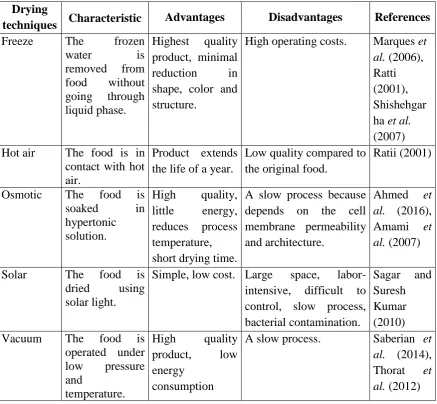
for transportation, enhance storage stability and minimize the packaging requirements. Besides, it is necessary to remove the moisture content to a certain level in order to prevent the growth of bacteria, yeast, and molds thus slowing down or stopping food spoilage (Mujumdar and Law, 2010). The conventional dehydration techniques found in the food processing industry are freeze, hot air, osmotic, solar, and vacuum (George et al. 2004). Unfortunately, these conventional dryers have several limitations such as high operating cost, low quality and slow process. Table 1.1 shows the advantages and disadvantages of these conventional dehydration techniques.
Table 1.1 : Summary of the conventional dehydration techniques Drying
techniques Characteristic Advantages Disadvantages References Freeze The frozen
water is
removed from food without going through liquid phase.
Highest quality product, minimal reduction in shape, color and structure.
High operating costs. Marques et al. (2006), Ratti (2001), Shishehgar ha et al. (2007) Hot air The food is in
contact with hot air.
Product extends the life of a year.
Low quality compared to the original food.
Ratii (2001)
Osmotic The food is
soaked in
hypertonic solution.
High quality, little energy, reduces process temperature, short drying time.
A slow process because depends on the cell membrane permeability and architecture.
Ahmed et al. (2016), Amami et al. (2007) Solar The food is
dried using solar light.
Simple, low cost. Large space, labor-intensive, difficult to control, slow process, bacterial contamination.
Sagar and Suresh Kumar (2010) Vacuum The food is
operated under low pressure and
temperature.
High quality product, low energy
consumption
Based on the limitations from Table 1.1, the conventional dehydration techniques have been improved to enhance the quality of end drying products in terms of color, flavor, nutritional value and texture (Alves-Filho, 2007; Chen and Mujumdar, 2008; Fernandes et al. 2011; Mujumdar, 2006). Some of the novel dehydration techniques are microwave, fluidized-bed, ultrasonic and microwave-augmented freeze (Cohen and Yang, 1995; Falade and Omojola, 2010; Fernandes et al., 2011; Jangam, 2011; Mujumdar and Law, 2010; Sagar and Suresh Kumar, 2010).
1.2 DIC Technique
Figure 1.1 Schematic diagram of the DIC reactor
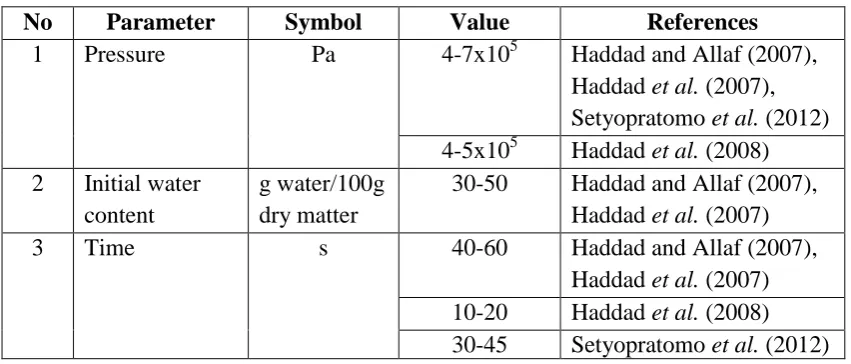
Table 1.2 : Value of parameters for pressure, water content and processing time No Parameter Symbol Value References
1 Pressure Pa 4-7x10⁵ Haddad and Allaf (2007),
Haddad et al. (2007), Setyopratomo et al. (2012) 4-5x10⁵ Haddad et al. (2008) 2 Initial water
content
g water/100g dry matter
30-50 Haddad and Allaf (2007), Haddad et al. (2007)
3 Time s 40-60 Haddad and Allaf (2007),
Haddad et al. (2007) 10-20 Haddad et al. (2008) 30-45 Setyopratomo et al. (2012)
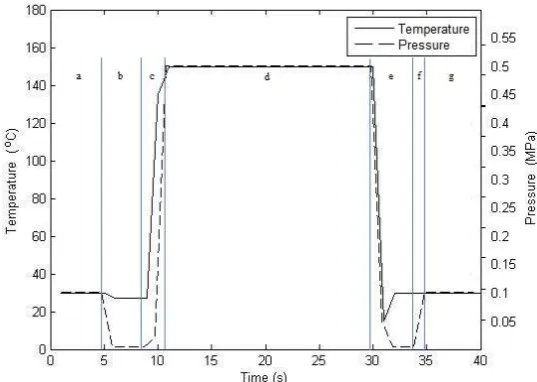
The temperature and pressure changes are presented in Figure 1.2 where stage (a) is at atmospheric pressure. Then, a vacuum condition is created within the reactor to get the greatest contact between steam and materials surface by opening the discharge valve (Figure 1.2(b)). Steam is injected to the materials to create a pressurized atmosphere (Figure 1.2(c)). The materials are left in contact with high pressure for a few seconds (Figure 1.2(d)). Then, a sudden pressure drop in the reactor is created by opening the discharge valve in less than a second (Figure 1.2(e)) which is called as instantaneous pressure drop since the value of ∆𝑃∆𝑡 is higher than
5 10
the moisture from the material and lead to texture change which results in higher porosity. Besides, it also intensifies functional behavior of drying product (Setyopratomo et al., 2009). The material is maintained in vacuum condition (Figure 1.2(f)). The final step is returning the reactor to atmospheric pressure (Figure 1.2(g)). DIC increases the material porosity and surface area and reduces the diffusion resistance of moisture during the final dehydration step.
This technique has been successfully used for various products including: fruit swell drying and vegetables drying (Djilali et al., 2016; Haddad et al., 2008; Louka and Allaf, 2002; Tellez-Perez et al., 2015), texturing and drying various biological products by instant auto vaporization (Haddad and Allaf, 2007; Kristiawan et al., 2011; Louka and Allaf, 2004; Louka et al., 2004; Nouviaire et al., 2008; Setyopratomo et al., 2012), and microbiological decontamination (Setyopratomo et al., 2009), post harvesting or steaming paddy rice (Pilatowski et al., 2010) and essential oil extraction (Amor et al., 2008; Besombes et al., 2010). Besides, some experiments have been done to investigate the effect of the DIC technique on Lupin (Haddad et al., 2007); soybean (Haddad and Allaf, 2007); glucose polymer (Rezzoug et al., 2000); and milk (Mounir et al., 2010).
1.2.1 Mathematical Model in DIC Technique
Researches on the experiment and mathematical model have been done in order to understand the dehydration mechanism since it is a very complex process. The development of mathematical models is to predict, design and control water losses, weight reduction, dehydration rates and temperature behavior. It is also able to perform an optimal strategy for dryer process control. Parameters during dehydration can range from a very simple to complicated parameter in order to upgrade the quality of dehydration technology.
The mathematical model in drying method can be classified as empirical, semi-empirical and theoretical models depending on the different applications (Vijayaraj et al., 2006). The empirical and semi-empirical model take into account the external resistance to moisture transfer meanwhile the theoretical model considers the internal resistance to moisture transfer between the food product and air (Midilli et al., 2002; Panchariya et al., 2002). Theoretical models require assumptions of geometry of food, its mass diffusivity and conductivity (Demirtas et al., 1998; Wang et al., 2007). The fundamental of drying process is not taken into consideration for empirical model and this model presents a direct relationship between average time and drying time using regression analysis (Ozdemir and Devres, 1999).
was in a quadratic form. Besides, it is found that pressure and treatment time gave high impact to the reduction of the trypsin inhibitors. The regression model presented a good fit to the observed data but it is limited to a certain experiment (Kaushal and Sharma, 2014). When the experiment is implemented under different conditions, the model did not provide good simulation of dehydration process. Besides, the regression model neglects the fundamental of dehydration process where the parameters involved have no physical meaning (Simal et al., 2005).
Based on the limitations from the regression model, parabolic PDE is shown to be fit with the regression model. The parabolic PDE or Fick’s law of diffusion equation is proposed to analyze the effect of DIC technique on the drying kinetics of drying materials but neglected the effects of possible shrinkage (Abdulla et al., 2010; Kamal et al., 2012; Mounir et al., 2011; Mounir et al., 2012; Pilatowski et al., 2010; Setyopratomo et al., 2009; Setyopratomo et al., 2012). However, most of the researchers only discussed the fundamental of the dehydration model in DIC technique without solving the equation (Haddad et al., 2008; Mounir et al., 2012). Some of the authors solved the model using Crank (1975) solution according to the geometry of the solid matrix to solve the diffusion equation for mass transport of water within the drying material (Abdulla et al., 2010; Mounir et al., 2011; Mounir et al., 2014; Setyopratomo et al., 2009; Setyopratomo et al., 2012; Tellez-Perez et al., 2012). Meanwhile, other authors (Albitar et al., 2011; Kamal et al., 2012) solved the PDE model with the logarithmic transformation. Zarguili et al. (2009) solved the first order partial differential equation (PDE) of mass transfer equation by using integration method. Only a few researchers in DIC technique solved the model using numerical methods.
(2008) where they stated that hyperbolic heat and mass transfer is an alternative model because the classical parabolic equation is impossible to solve the extreme condition such as high temperature. The HPDE model is able to integrate between the dependent parameters; moisture content, temperature, and pressure, and independent parameters; time and dimension of region in order to simulate, visualize, and predict the heat and mass transfer during the dehydration process using DIC technique. Further details on the formulation of the HPDE model will be discussed in Chapter 3.
Numerical methods are able to solve a complex system of PDE which is almost impossible to be solved analytically. The Finite Element (FEM), Finite Volume (FVM) and Finite Difference methods (FDM) are some alternative numerical methods to solve the PDE (Peiro and Sherwin, 2005). For the other applications of drying, the FDM has been widely used to solve the heat and mass transfer models (Braud et al., 2001; Karim and Hawlader, 2005; Liu et al., 2014; Naghavi et al, 2010; Rovedo et al., 1995; Simal et al., 2000). The FDM scheme is chosen because this method is simple to formulate a set of discretized equations from the transport differential equations in a differential manner (Botte et al., 2000; Chandra and Singh, 1994). Besides, this method is straightforward in determining the unknown values (Incopera and DeWitt, 1996). Thus, due to this reason, the mathematical model in this research will be solved using FDM scheme. Further details of FDM will be discussed in Chapter 2.
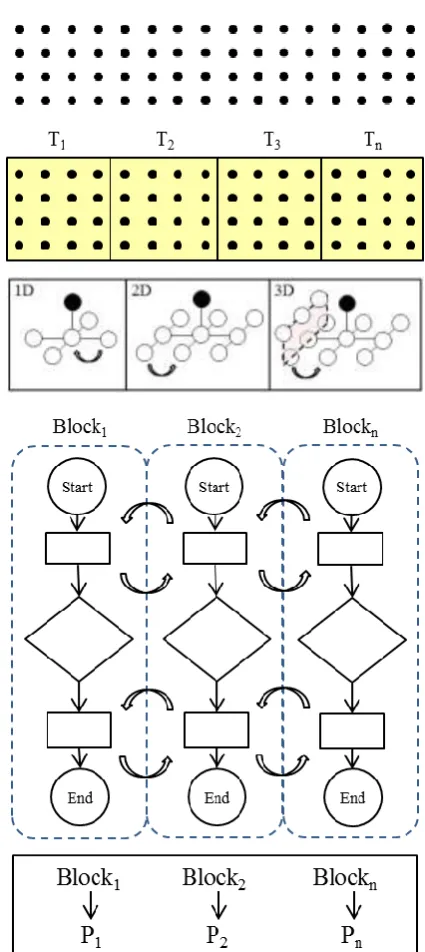
the parallel algorithm before implementing on the DPCS. The strategy to design the parallel algorithm is illustrated in Figure 1.3.
(a) Domain problem
(b) Partitioning
(c) Communication
(d) Agglomeration
(e) Mapping
Figure 1.3 Parallel algorithm design
parallel algorithm (Figure 1.3(b)). Then, the tasks are connected to each other through local and global communication (Figure 1.3(c)). The local communication involves communication by sending and receiving data between the neighboring points where the data is sent by point for 1D, by line for 2D and by surface for 3D. Meanwhile global communication requires communication with other tasks. The number of tasks is combined into a set of tasks; Block1, Block2, …, Blockn to
improve the performance of parallelization. This strategy is called as agglomeration (Figure 1.3(d)). Lastly, each block is assigned to a processor (Figure 1.3(e)). Static mapping is implemented because it is easier to design and implemented on the distributed parallel computing architecture compared to dynamic mapping which is more complicated in message passing program.
The hardware computational tool to support the parallel algorithm is based on distributed parallel computing system (DPCS). The software tool to support DPCS is based on Matlab Distributed Computing Server (MDCS) version 7.12 (R2011a). The MDCS consists of a heterogeneous computing system contains 8 computers with Intel Core Duo CPUs under Fedora 8 featuring a 2.6.23 based Linux kernel operating system, connected with internal network 10/100/1000 NIC. The DPCS and MDCS are discussed further in Chapter 2.
1.3 Statement of Problem
produced any solution to the mathematical model. The third problem is some of them solved the PDE analytically which involves too many parameters. Therefore, it is almost impossible to be solved and it is time consuming.
Based on these limitations, the main aim of this research is to formulate a new modified mathematical model based on HPDE from the regression model obtained from Haddad et al. (2007). The HPDE is able to integrate between the dependent parameters; moisture content, temperature, and pressure, and independent parameters; time and dimension of region in order to simulate, visualize, and predict the heat and mass transfer during the dehydration process using DIC technique. The mathematical model performs in multidimensional problem and FDM is used to discretize the mathematical model. Numerical methods such as Jacobi (JB), Red Black Gauss Seidel (RBGS), Alternating Group Explicit with Douglas-Rachford (AGED), and Brian (AGEB) variances are used to solve the SLE. A large sparse matrix from the SLE is obtained from the discretization, thus, it performs high execution time using a single CPU. Therefore, a DPCS is implemented on MDCS to reduce the computational time and increase the speedup performance.
1.4 Objectives of Research
This section explains the objectives of this research which are:
a) To formulate the regression model from Haddad et al. (2007) to a new modified mathematical model of heat and mass transfer in DIC technique and discretized using FDM to approximate the solution of the mathematical model.
b) To solve the SLE in (a) using some numerical methods such as AGEB, AGED, RBGS, JB methods.
c) To develop sequential and parallel algorithms from (b) using MDCS.
1.5 Scope of Research
Problem Mathematical equations Equations Type Solution Discretization Numerical Method Algorithm Platform Software
Algebraic Equation Polynomial
Equation Li n ea r No n -Li n ea r Tr ig o n o m et ri c Ex p o n en ti al Lo g arit h m ic Differential Equation
Ordinary Partial
1
st o
rd
er
2
nd o
rd
er
1
st d
eg
re
e
1
st d
eg re e E llip tic Par ab o lic Hy p er b o li c
AGEB AGED RBGS JB
Numerical
Solution Exact Solution
FEM FDM FVM
Sequential Parallel
Distributed Memory System Shared
Memory System
MDCS PVM MPI
Matlab Mathematica
1.6 Significance of Research
The first significance of this research is the HPDE is the alternative model to simulate, visualize, predict and control the independent and dependent parameters of dehydration process. The second significance is the implementation of the numerical methods such as AGEB, AGED, RBGS and JB methods are suitable to solve the multidimensional HPDE. The third significance is the parallel implementation to solve the large sparse data for the multidimensional HPDE on DPCS successfully reduces the computational time and increases the performance of speedup. The numerical results and PPE are the indicators to measure the performance of multidimensional HPDE and the large sparse simulation. From the numerical results and PPE, AGEB is the best method to solve the HPDE model followed by AGED, RBGS and JB methods. It is also found that the parallel algorithm is performed better than the sequential algorithm.
1.7 Thesis Organization
In this thesis, there are seven chapters including the introduction and conclusion parts. Chapter 1 comprises a description of the research problem statement on DIC technique. The dehydration process is described based on the previous literature review on mathematical model developed in DIC technique. This chapter also discusses the research objectives, scope and the significance of the research.
and computational complexity. Finally, this chapter will discuss the platform of DPCS to support the MDCS and PPE based on speedup, efficiency, effectiveness, temporal performance, granularity and communication cost to measure the parallel algorithm.
The new modified mathematical model development in DIC technique is covered in Chapter 3. In this chapter, the formulation of the hyperbolic partial differential equation (HPDE) from the regression model from Haddad et al. (2007) is presented. The simulations of the mathematical models are analyzed and shown through graphical representation using Matlab 7.12 (R2011a) software. The HPDE is visualized in multidimensional model which are in 1D, 2D and 3D model.
The contribution of Chapter 4 is the numerical results and parallel performance evaluations of sequential and parallel algorithms for 1D HPDE model. The SLE for 1D model is obtained from FDM and it is solved using some numerical methods such as 1D_SJB, 1D_SRBGS, 1D_SAGED, and 1D_SAGEB. These numerical methods are compared according to execution time, number of iteration, maximum error and root mean square error. Then, these numerical methods are parallelized to improve the performance of the sequential algorithm. The parallel performances for these methods: 1D_PJB, 1D_PRBGS, 1D_PAGED and 1D_PAGEB are measured based on speedup, efficiency, effectiveness, temporal performance and granularity.
methods such as 2D_PJB, 2D_PRBGS, 2D_PAGED, and 2D_PAGEB are analyzed based on speedup, efficiency, effectiveness, temporal performance and granularity.
Furthermore, the contribution of Chapter 6 focuses on the numerical results and parallel performance of the sequential and parallel algorithms for 3D HPDE model. The discretization of the model is based on the FDM. It is then solved by some numerical methods which are 3D_ SJB, 3D_SRBGS, 3D_SAGED, and 3D_SAGEB. The numerical methods are parallelized into 3D_PJB, 3D_PRBGS, 3D_PAGED, and 3D_PAGEB. The PPE of these methods are measured using speedup, efficiency, effectiveness, temporal performance and granularity.
Abdulla, G., Belghit, A., and Allaf, K. (2010). Impact of the Instant Controlled Pressure Drop Treatment on Hot Air Drying of Cork Granules. Drying Technology: An International Journal. 28, 180-185.
Ahmed, I., Qazi, I. M. and Jamal, S. (2016). Developments in Osmotic Dehydration Technique for the Preservation of Fruits and Vegetables. Innovative Food Science and Emerging Technologies. 34, 29-43.
Akhir, M. K. M., Othman, M. Sulaiman, J. Majid, Z. A. and Suleiman, M. (2012) Half-Sweep Iterative Method for Solving Two-Dimensional Helmholtz Equations. International Journal of Applied Mathematics and Statistics. 29(5), 101-109.
Albitar, N., Mounir, S., Besombes, C., and Allaf, K. (2011). Improving the Drying of Onion Using the Instant Controlled Pressure Drop Technology, Drying Technology: An International Journal. 29(9), 993-1001.
Alias, N. (2004). Pembinaan Pelaksanaan Algoritma Selari Bagi Kaedah Kelas TTHS dan TTKS dalam Menyelesaikan Persamaan Parabolik Pada Sistem
Komputer Selari Ingatan Teragih. Doctor Philosophy, Universiti Kebangsaan Malaysia, Bangi.
Alias, N., Saipol, H. F. S., Ghani, A. C. A. and Mustaffa, M. N. (2014). Parallel Performance Comparison of Alternating Group Explicit Method between Parallel Virtual Machine and Matlab Distributed Computing for Solving Large Sparse Partial Differential Equations. Advanced Science Letters. 20(2), 477-482.
Alias, N., Darwis, R., Satam, N., and Othman, M. (2009). Parallelization of Temperature Distribution Simulations for Semiconductor and Polymer Composite Material on Distributed Memory Architecture. In Malyshkin, V. (Ed.). Parallel Computing Technologies. (pp. 392-398). Berlin: Springer-Verlag. Alias, N., Sahimi, M. S. and Abdullah, A. R. (2003). The AGEB Algorithm for
Solving the Heat Equation in Two Space Dimensions and Its Parallelization on a Distributed Memory Machine. In Dongarra, J., Laforenza, D. and Orlando, S. (Ed.) Recent Advances in Parallel Virtual Machine and Message Passing Interface. (pp. 214-221). Berlin: Springer-Verlag.
Allaf, K., Louka, N., Bouvier, J. M., Parent, F. and Forget, M. (1999). Method for Processing Materials to Change Their Texture, Apparatus Therefor, and Resulting Materials. Document Type and Number: United States Patent 5855941. French Patent No. 93 09720.
Alves-Filho, O., Eikevik, T., Mulet, A., Garau, C. and Rossello, C. (2007). Kinetics and Mass Transfer during Atmospheric Freeze Drying of Red Pepper. Drying Technology. 25, 1155-1161.
Amami, E., Fersi, A., Khezami, L., Vorobiev, E. and Kechaou, N. (2007). Centrifugal Osmotic Dehydration and Rehydration of Carrot Tissue Pre-Treated By Pulsed Electric Field. LWT Food Science and Technology. 40, 1156-1166. Amdahl, G. M. (1967). Validity of the Single Processor Approach to Achieving
Large Scale Computer Capabilities. Proceedings AFIPS Spring Joint Comp. Conference. 18-20 April. Atlantic City: New Jersey, 483-485.
Amor, B. B., Lamy, C., Andre, P. and Allaf, K. (2008). Effect of Instant Controlled Pressure Drop Treatments on the Oligosaccharides Extractability and Microstructure of Tephrosia Purpurea Seeds. Journal of Chromatography A. 1213, 118–124.
Arballo, J. R., Campañone, L. A. and Mascheroni, R. H. (2012). Numerical Solution of Coupled Mass and Energy Balances during Osmotic Microwave Dehydration. Computational and Applied Mathematics. 31(3), 539-558.
Banks, H. T., Kapraun, D. F., Thompson, W. C., Peligero, C., Argilaguet, J. and Meyerhans, A. (2013). A Novel Statistical Analysis and Interpretation of Flow Cytometry Data. Journal of Biological Dynamics. 7(1), 96-132.
Banks, H. T., Thompson, W. C., Peligero, C., Giest, S., Argilaguet, J. and Meyerhans, A. (2012). A Division-Dependent Compartmental Model for Computing Cell Numbers in CFSE-Based Lymphocyte Proliferation Assays. Mathematical Bioscience and Engineering. 9(4), 699–736.
Besombes, C., Berka-Zougali, B. and Allaf, K. (2010). Instant Controlled Pressure Drop Extraction of Lavandin Essential Oils: Fundamentals and Experimental Studies. Journal of Chromatography A. 1217, 6807-6815.
Botte, G. G., Ritter, J. A. and White, R. E. (2000). Comparison of Finite Difference and Control Volume Methods for Solving Differential Equations. Computer and Chemical Engineering. 24, 2633-2654.
Braud, L. M., Moreira, R. G. and Castell-Perez, M. E. (2001). Mathematical Modelling of Impingement Drying of Corn Tortillas. Journal of Food Engineering. 50, 121-128.
Byrd, R. H., Dert, C. L., Kan, A. H. G. R. and Schnabel, R. B. (1989). Concurrent Global Optimization on a Network of Computers. In Wouk, A. (Ed.) Parallel Processing and Medium-Scale Multiprocessors. (pp. 76-96). Philadephia: Siam. Chandra, P. K. and Singh, R. P. (1994). Applied Numerical Methods for Food and
Agricultural Engineers. Florida: CRC Press, Inc.
Chartres, B. and Stepleman, R. (1972) A General Theory of Convergence for Numerical Methods. SIAM Journal on Numerical Analysis. 9(3), 476-492.
Chen, G. and Mujumdar, A. S. (2008). Drying Technologies in Food Processing. New York: Blackwell Publishing.
Chien, Y. P., Carpenter, F., Ecer, A. and Akay, H. U. (1995). Load-Balancing for Parallel Computation of Fluid Dynamics Problems. Computer Methods in Applied Mechanics and Engineering. 120, 119-130.
Cohen, J. S. and Yang, T. C. S. (1995). Progress in Food Dehydration. Trends in Food Science and Technology. 6, 20-25.
Crank, J. (1975). The Mathematics of Diffusion. Oxford, England: Clarendon Press. Crank, J. and Nicolson, P. (1947). A Practical Method for Numerical Evaluation of
Cambridge Philos. Soc., 43, 50-67, re-published in: John Crank 80th birthday special issue Advances in Computational Mathematics. 6, 207–226.
De Boland, A. R., Garner, G. B. and O’Dell, B. L. (1975). Identification and Properties of Phytate in Cereal Grains and Oilseed Products. Journal of Agricultural and Food Chemistry. 23(6), 1186-1189.
Demirtas, C., Ayhan, T. and Kaygusuz, K. (1998). Drying Behavior of Hazelnuts. Journal of the Science of Food and Agriculture. 76, 559–564.
Ding, Z., Xiao, A. and Li, M. (2010). Weighted Finite Difference Methods for A Class of Space Fractional Partial Differential Equations with Variable Coefficients.Journal of Computational and Applied Mathematics.233, pp. 1905-1914.
Djilali, A. B., Nabiev, M., Gelicus, A., Benamara, S. and Allaf, K. (2016). Evaluation of Physical-Chemical, Pharmacodynamic and Pharmacological Attributes of Hot Air Dried and Swell Dried Jujube Powders. Journal of Food Process Engineering. Article in Press. doi:10.1111/jfpe.12364
Dolicanin, C. B., Nikolic, V. B. and Dolicanin, D. C. (2010). Application of Finite Difference Method to Study of the Phenomenon in the Theory of Thin Plates. Appl. Math. Inform. and Mech. 2, 29-43.
Eager, D. L., Zahorjan, J., and Lazowska, E. D. (1989). Speedup versus Efficiency in Parallel Systems. IEEE Transactions on Computers. 38(3), 408-423.
Evans, D. J. (1985). Group Explicit Iterative Methods for Solving Large Linear Systems. International Journal Computer Mathematics. 17, 81-108.
Evans, D. J. (1987). The Alternating Group Explicit (AGE) Matrix Iterative Method. Applied Mathematical Modeling. 11(4), 256-263.
Evans, D. J. (1992). Parallel Computer Solution of the Wave Equation. In Donato, A. and Oliveri, F. (Ed.). Nonlinear Hyperbolic Problems: Theoretical, Applied, and Computational Aspects. (pp. 204-216). German: Springer Verlag
Evans, D. J. (1989). Parallel Algorithm Design. Evans. In D. J. and Sutti, C. N. (Ed). Parallel Computing: Methods, Algorithms and Applications. (pp. 1-24). England: CRC Press.
Evans, D. J. and Sahimi, M. S. (1988a). Group Explicit Methods for Hyperbolic Equations. Computers &Mathematics with Applications. 15, 659-697.
Evans, D. J. and Sahimi, M. S. (1988b). The Alternating Group Explicit (AGE) Iterative Method for Solving Parabolic Equations. I: Two-Dimensional Problems. International Journal of Computer Mathematics. 24, 311-341.
Evans, D. J. and Sahimi, M. S. (1990). The Solution of Nonlinear Parabolic Partial Differential Equations by the Alternating Group Explicit (AGE) Method. Computer Methods in Applied Mechanics and Engineering. 84, 15-42.
Fadlallah, G., Lavoie, M. and Dessaint, L. A. (2000). Parallel Computing Environments and Methods. International Conference on Parallel Computing in Electrical Engineering, PARELEC 2000. 27-30 August. Trois-Rivieres: Canada, 2-7.
Falade, K. O. and Omojola, B. S. (2010). Effect of processing methods on physical, chemical, rheological, and sensory properties of okra (Abelmoschus esculentus). Food Bioprocess Technology. 3, 387-394
Feng, Q. (2009). AGE Method for Hyperbolic Equation. Applied Mathematical Sciences. 3, 1381-1385.
Fernandes, F. A. N., Rodrigues, S., Law, C. L. and Mujumdar, A. S. (2011). Drying of Exotic Tropical Fruits: A Comprehensive Review. Food and Bioprocess Technology. 4, 163-185.
Flatt, H. P. and Kennedy, K. (1989). Performance of Parallel Processors. Parallel Computing. 12, 1-20.
George, S. D. S., Cenkowski, S. and Muir, W. E. (2004). A Review of Drying Technologies for the Preservation of Nutritional Compounds in Waxy Skinned Fruit. North Central ASAE/CSAE Conf, Winnipeg. 24-25 September, Manitoba, Canada, MB 04-104.
Haddad, J. and Allaf, K. (2007). A Study of the Impact of Instantaneous Controlled Pressure Drop on the Trypsin Inhibitors of Soybean. Journal of Food Engineering. 79, 353-357.
Haddad, J., Greiner, R. and Allaf, K. (2007). Effect of Instantaneous Controlled Pressure Drop on the Phytate Content of Lupin. LWT. 40, 448-453.
Hamby, D. M. (1994). A Review of Techniques for Parameter Sensitivity Analysis of Environmental Models. Environmental Monitoring and Assessment. 32(2), 135-154.
Hamdi, S., Schiesser, W. E. and Griffiths, G. W. (2007).Methods of Lines. Scholarpedia, 2(7), Art. No. 2859, pp. 1-11.
Harris, K. R. and Woolf, L. A. (1980). Pressure and Temperature Dependence of the Self Diffusion Coefficient of Water and Oxygen-18 Water. Journal of the Chemical Society, Faraday Transactions 1: Physical Chemistry in Condensed
Phases. 76, 377-385.
Ilyas, M. and Mouftah, H. T. (2003). The Handbook of Optical Communication Networks. Boca Raton, Florida: CRC Press.
Incopera, F. P. and DeWitt, D. P. (1996). Fundamentals of Heat and Mass Transfer. New York: Wiley.
Jangam, S. V. (2011). An Overview of Recent Developments and Some R&D Challenges Related to Drying of Foods. Drying Technology: An International Journal, 29(12), 1343-1357.
Jha, N. (2010). The Application of Sixth Order Accurate Parallel Quarter Sweep Alternating Group Explicit Algorithm for Nonlinear Boundary Value Problems with Singularity.
Jin, J. M. (2010). Theory and Computation of Electromagnetic Fields. Hoboken, New Jersey: John Wiley & Sons.
Jin, Y., Jin, G. and Li, J. (2011). A Class of High-Precision Finite Difference Parallel Algorithms for Convection Equations. Journal of Convergence Information Technology. 6, 79-82.
Kai, L. (1988). IVY: A Shared Virtual Memory System for Parallel Computing. Proceedings of the International Conference on Parallel Processing, University Park: USA. 2, 94-101.
Kamal, I., Gelicus, A. and Allaf, K. (2012). Impact of Instant Controlled Pressure Drop (DIC) Treatment on Drying Kinetics and Caffeine Extraction from Green Coffee Beans. Journal of Food Research. 1(1), 24-47.
Kaushal, P. and Sharma, H. K. (2014). Osmo-Convective Dehydration Kinetics of Jackfruit (Artocarpusheterophyllus). Journal of the Saudi Society of Agricultural Sciences. doi:10.1016/j.jssas.2014.08.001
Kiranoudis, C. T., Maroulis, Z. B. and Marinos-Kouris, D. (1995). Design and Production Planning for Multiproduct Dehydration Plants. Computers and Chemical Engineering. 19(5), 581-606.
Kocak, S. and Akay, H. U. (2001). Parallel Schur Complement Method for Large-Scale Systems on Distributed Memory Computers. Applied Mathematical Modelling. 25, 873-886.
Kristiawan, M., Sobolik, V., Klíma, L. and Allaf, K. (2011). Effect of Expansion by Instantaneous Controlled Pressure Drop on Dielectric Properties of Fruits and Vegetables. Journal of Food Engineering. 102(4), 361-368.
Kwiatkowski, J. (2002). Evaluation of Parallel Programs by Measurement of Its Granularity. Lecture Notes in Computer Science (including subseries Lecture Notes in Artificial Intelligence and Lecture Notes in Bioinformatics. 2328, 145-153.
Kwiatkowski, J. (2014). Parallel Applications Performance Evaluation using The Concept of Granularity. Lecture Notes in Computer Science (including subseries Lecture Notes in Artificial Intelligence and Lecture Notes in Bioinformatics).
8385, 215-224.
Li, K. (1988). IVY: A Shared Virtual Memory System for Parallel Computing. Proceedings of the International Conference on Parallel Processing. 2, 94-101. Li, N., Gao, P., Lu, Y. and Yu, W. (2010). The Implementation and Comparison of
Two Kinds of Parallel Genetic Algorithm Using Matlab. Proceedings-9th International Symposium on Distributed Computing and Applications to
Business, Engineering and Science, DCABES 2010, 10-12 August. Hong Kong; Hong Kong, 13-17.
Lin, P. (2004) A Compact Numerical Algorithm for Solving the Time-Dependent Mild Slope Equation. International Journal for Numerical Methods in Fluids. 45 (6), 625-642.
Louka, N. and Allaf, K. (2002). New Process for Texturizing Partially Dehydrated Biological Products Using Controlled Sudden Decompression to the Vacuum: Application on Potatoes. Journal of Food Science. 67, 3033-3038.
Louka, N. and Allaf, K. (2004). Expansion Ratio and Color Improvement of Dried
Vegetables Texturized by a New Process “Controlled Sudden Decomposition to the Vacuum” Application to Potatoes, Carrots and Onions. Journal of Food
Engineering. 65, 233-243.
Louka, N., Juhel, F. and Allaf, K. (2004). Quality Studies on Various Types Of Partially Dried Vegetables Texturized By Controlled Sudden Decompression General Patterns For The Variation Of The Expansion Ration. Journal Food of Engineering. 65, 245–253.
Marques, L. G., Silveira, A. M. and Freire, J. T. (2006). Freeze-Drying Characteristics of Tropical Fruits. Drying Technology. 24, 457-463.
Martinello, M. A., Mattea, M. A. and Crapiste, G. (2003). Superheated Steam Drying of Parsley: A Fixed Bed Model for Predicting Drying Performance. Latin American Applied Research. 33(3), 333-337.
Martinello, M. A., Muñoz, D. J. and Giner, S. A. (2013). Mathematical Modelling of Low Temperature Drying of Maize: Comparison of Numerical Methods for Solving the Differential Equations. Biosystems Engineering. 114(2), 187-194. Midilli, A., Kucuk, H. and Yapar, Z. (2002). A New Model for Single-Layer Drying.
Drying Technology. 20, 1503-1513.
Mounir, S. and Allaf, K. (2008). Three-Stage Spray Drying: New Process Involving Instant Controlled Pressure Drop. Drying Technology: An International Journal. 26(4), 452-463.
Mounir, S., Allaf, T., Berka, B., Hassani, A. and Allaf, K. (2014). Instant Controlled Pressure Drop Technology: From A New Fundamental Approach of Instantaneous Transitory Thermodynamics to Large Industrial Applications on High Performance–High Controlled Quality Unit Operations. Comptes Rendus Chimie. 17, 261-267.
Mounir, S., Besombes, C., Al-Bitar, N. and Allaf, K. (2011). Study of Instant Controlled Pressure Drop DIC Treatment in Manufacturing Snack and Expanded Granule Powder of Apple and Onion. Drying Technology: An International Journal. 29(3), 331-341.
Mounir, S., Schuck, P. and Allaf, K. (2010). Structure and Attribute Modifications of Spray-Dried Skim Milk Powder Treated by DIC (Instant Controlled Pressure Drop) Technology. Dairy Science and Technology. 90, 301-320.
Mujumdar, A. S. (2006). Handbook of Industrial Drying: Third Edition. Boca Raton, Florida: CRC Press.
Mujumdar, A. S. and Law, C. L. (2010). Drying Technology: Trends and Applications in Postharvest Processing. Food Bioprocess Technology. 3, 843-852.
Mulet, A., Berna, A. and Rossello, C. (1989). Drying of Carrots. I. Drying Models. Drying Technology: An International Journal. 7(3), 537-557.
Naghavi, Z., Moheb, A. and Ziaei-rad, S. (2010). Numerical Simulation of Rough Rice Drying in a Deep-Bed Dryer using Non-Equilibrium Model. Energy Conversion and Management. 51, 258-264.
Nouviaire, A. Lancien, R. and Maache-Rezzoug, Z. (2008). Influence of Hydrothermal Treatment on Rheological and Cooking Characteristics of Fresh Egg Pasta. Journal of Cereal Science. 47, 283-291.
Noye, J. (2000). Finite Difference Techniques for Partial Differential Equations. In Noye, J. (Ed.) Computational Techniques for Differential Equations. (pp. 95-354). Amsterdam: Elsevier-Science Publishers B. V.
Noye, B. J. and Hayman, K. J. (1993). Implicit Two-Level Finite-Difference Methods for the Two-Dimensional Diffusion Equation. International Journal of Computer Mathematics. 48(3-4), 219-227.
Oko, C. O. C. and Nnamchi, S. N. (2013). Coupled Heat and Mass Transfer in a Solar Grain Dryer. Drying Technology. 31(1), 82-90.
Olman, V., Mao, F., Wu, H., Xu, Y. (2009). Parallel Clustering Algorithm for Large Data Sets with Applications in Bioinformatics. IEEE/ACM Transactions on Computational Biology and Bioinformatics. 6(2), 344-352.
Panchariya, P. C., Popovic, D. and Sharma, A. L. (2002). Thin-Layer Modeling Of Black Tea Drying Process. Journal of Food Engineering. 52, 349–357.
Peiro, J. and Sherwin, S. (2005). Finite Difference, Finite Element and Finite Volume for Partial Differential Equations. In Yip, S. (Ed.) Handbook of Materials Modeling. (pp. 2415-2446). Netherlands: Springer.
Peishi, C. and Pei, D. C. T. (1989). A Mathematical Model of Drying Processes. International Journal of Heat and Mass Transfer. 32(2), 297-310.
Pilatowski, I., Mounir, S., Haddad, J., Cong, D. T. and Allaf, K. (2010). The Instant Controlled Pressure Drop Process as a New Post Harvesting Treatment of Paddy Rice: Impacts on Drying Kinetics and End Product Attributes. Food Bioprocess Technology. 3, 901–907.
Potter, N. N. and Hotchkiss, J. H. (1998). Food Dehydration and Concentration. In Potter, N. N. and Hotchkiss, J. H. (Ed.) Food Science. (pp. 200–244). New York: Springer.
Ramaswamy, H. S. and Nsonzi, F. (1998). Convective-Air Drying Kinetics of Osmotically Pre-Treated Blueberries. Drying Technology. 16, 743-759.
Ratti, C. (2001). Hot Air and Freeze-Drying of High-Value Foods: A Review. Journal of Food Engineering. 49, 311-319.
Rezzoug, S. A., Maache-Rezzoug, Z., Mazoyer, J., Jeannin, M., Allaf, K. (2000). Effect of Instantaneous Controlled Pressure Drop Process on the Hydration Capacity of Scleroglucan: Optimisation of Operating Conditions by Response Surface Methodology. Carbohydrate Polymers. 42, 73-84.
Rovedo, C. O., Suarez, C., and Viollaz, P. E. (1995). Drying of Foods: Evaluation of A Drying Model. Journal of Food Engineering. 26, 1-12.
Saad, Y. (2003). Iterative Methods for Sparse Linear Systems: Second Edition. Philadelphia, Pennsylvania: SIAM.
Saberian, H., Amooi, M. and Hamidi-Esfahani, Z. (2014). Modeling of Vacuum Drying of Loquat Fruit. Nutrition & Food Science. 44, 24-31.
Sagar, V. R. and Suresh Kumar, P. (2010). Recent Advances in Drying and Dehydration of Fruits and Vegetables: A Review. Journal Food Science Technology. 47(1), 15-26.
Sahimi, M. S., Alias, N. and Sundararajan, E. (2001). The AGEB Algorithm for Solving the Heat Equation in Three Space Dimensions and Its Parallelization using PVM. In Alexandrov, V. N., Dongarra, J. J., Juliano, B. A., Renner, R. S., and Tan, C. J. K. (Eds.). Lecture Notes in Computational Science. (pp. 918-927). Berlin: Springer Verlag.
Sahimi, M. S. and Evans, D. J. (1988). Group Explicit Methods for the Numerical Solution of the Wave Equation. Computers &Mathematics with Applications. 15, 699-709.
Serik, M., Bakiyev, M. N. and Balgozhina, G. B. (2014). Using Cluster Parallel Computing In the Content of Information-Didactic System. Life Science Journal. 11, 537-539.
Setyopratomo, P., Fatmawati, A. and Allaf, K. (2009). Texturing by Instant Controlled Pressure Drop DIC in the Production of Cassava Flour: Impact on Dehydration Kinetics, Product Physical Properties and Microbial Decontamination. World Congress on Engineering and Computer Science. 20-22 October. San Francisco, USA, 112-117.
Setyopratomo, P., Fatmawati, A., Sutrisna, P. D., Savitri, E. and Allaf, K. (2012). The Dehydration Kinetics, Physical Properties and Nutritional Content of Banana Textured By Instantaneous Controlled Pressure Drop. Asia-Pacific Journal of Chemical Engineering. 7, 726-732.
Shishehgarha, F., Makhlouf, J. and Ratti, C. (2002). Freeze-Drying Characteristics of Strawberries. Drying Technology. 20, 131-145.
Silva, M. M. and Lidon, F. C. (2016). Food Preservatives – An Overview on Applications and Side Effects. Emirates Journal of Food and Agriculture. 28(6), 366-373.
Simal, S., Femenia, A., Garau, M. C. and Rossello, C. (2005). Use of Exponential, Page’s and Diffusional Models to Simulate the Drying Kinetics of Kiwi Fruit. Journal of Food Engineering. 66, 323-328.
Simal, S., Femenia, A., Llull, P., and Rossello, C. (2000). Dehydration of Aloe Vera: Simulation of Drying Curves and Evaluation of Functional Properties. Journal of Food Engineering. 43, 109-114.