Alleviating Geometry Levels of Thinking among Indonesian Students Using van Hiele-Based Interactive Visual Tools
Zaid Zainal Abidin, Mohd Salleh Abu
ABSTRACT
There have been serious concerns about students' learning difficulty in geometry worldwide, including Indonesia. Research findings suggest that such phenomenon is best explained by the established van Hiele model of learning of geometry which associates the learning difficulties with the missing of predictable sequence of levels of development of knowledge and understanding geometry concepts. The model has been widely adopted as framework in the design and development of various technology-related applications designed to help learners to learn geometry effectively. However, the suitability and effectiveness of such applications among most of the post-SMP Indonesian school children is very likely to be dampen due to the lack of suitable infrastructure and inappropriate educational emphasis and practices. In addition, most of the applications were designed to help learners to develop knowledge and understanding across the spectrum of geometric topics rather than to help them to progress through their van Hiele geometry thinking on the level-by-level basis. This research paper discusses the needs to develop alternative learning instructions which address these discrepancies. A conceptual framework of the design and development of such instructions would also be discussed. The ultimate goal of the research is to develop interactive learning instructions (called Interactive Visual Tools or IVT) which assist post-SMP students in the region of Parepare to progress through van Hiele levels of geometry thinking via utilization of limited local resources over a minimal technology-oriented educational environment.
Keywords: van Hiele Model, geometry level of thinking, Interactive Visual Tool.
ABSTRAK
Ada keprihatinan serius tentang kesulitan belajar siswa dalam geometri di seluruh dunia, termasuk Indonesia. Keputusan kajian menunjukkan bahawa fenomena tersebut terbaik dijelaskan oleh model pembelajaran geometri menurut van Hiele yang mengembangkan pengetahuan dan pemahaman berdasarkan konsep geometri. Model ini telah banyak digunapakai sebagai rangka kerja dalam rekabentuk dan pembangunan aplikasi teknologi yang berkaitan yang dibangunkan untuk membantu pelajar belajar geometri berkesan. Namun, kesesuaian dan keberkesanan aplikasi teknologi in di kalangan sebahagian besar siswa Indonesia pasca-SMP adalah terhad akibat kurangnya infrastruktur yang sesuai dan amalan penekanan pendidikan yang tidak tepat. Selain itu, sebahagian besar aplikasi yang dirancang untuk membantu peserta didik dalam mengembangkan pengetahuan dan pemahaman seluruh bagian dari topik geometri daripada membantu mereka untuk kemajuan tingkat berpikir geometri van Hiele mereka dari tingkatan awal ke tingkat berikutnya. Laporan kajian membincangkan perlunya membangunkan rekabentuk pembelajaran alternatif bagi tujuan mengatasi masalah ini. Kerangka konseptual rekabentuk dan pembangunan arahan tersebut juga akan dibincang.Tujuan utama dari penelitian ini adalah untuk membangunkan rekabentuk pembelajaran interaktif (disebut Interactive Visual Tools atau IVT) yang boleh membantu pelajar pasca-SMP di wilayah Parepare untuk maju melalui tahap berfikir geometri van Hiele melalui pemanfaatan sumber daya yang terbatas melalui teknologi minimum berorientasi pendidikan alam sekitar.
Kata kunci: Model van Hiele, tahap berfikir geometri, Interactive Visual Tool.
The field of geometry covers a very broad scope and has many applications, such as ability to specify locations and describe spatial relationship (which is used in navigation to shipping or transportation), transformation and symmetry (which is used in a range of projects from packaging to artistic expression and in programming of computer graphics). Battista (1999) and Michelemore (2002) stated that learning geometry was not easy and many of students fail to develop an adequate understanding of geometry concepts, geometry reasoning and geometry problem solving skills.
Research findings suggest that the students‟ learning difficulties in geometry is best explained by the established van Hiele model of learning of geometry which associates the learning difficulties with the missing of predictable sequence of levels of development of knowledge and understanding geometry concepts (van Hiele,1959). Based on the relatively vast experiences as mathematics educators, the researchers strongly believe that the truth, validity and suitability of this specific learning model in geometry should remain applicable among Indonesian school children.
The technological advancement has benefited both mathematics educators and learners in easing various forms of mathematical difficulties, including geometry. The van Hiele model itself has been widely adopted as framework in the design and development of various technology-related applications designed to help learners to learn geometry effectively. However, the suitability and effectiveness of such applications among most of the post-SMP Indonesian school children is very likely to be dampen due to the lack of suitable infrastructure and inappropriate educational emphasis and practices. In addition, most of the applications were designed to help learners to develop knowledge and understanding across the spectrum of geometric topics rather than to help them to progress through their van Hiele geometry thinking on the level-by-level basis.
Parepare to progress through the van Hiele levels of thinking which ultimately help them to ease their learning difficulties. It must be noted that these learning instructions by will be capitalizing the limited local resources over a minimal technology-oriented educational environment.
Background of The Study
Students’ Learning Difficulty in Geometry
A report from Trend in International Mathematics and Science Study (TIMSS) in 2007 showed that students in the United States (U.S.), China, Netherland and Singapore scored at or near the bottom in every geometry task. Usiskin (1987) also stated that from all the students enrolled in U.S. high schools, only 63% can correctly identify different types of triangles and 30% can write proofs. Moreover, the National Assessment of Educational/Progress (NAEP) showed that U.S. fourth- and eighth-grade students performed poorly in basic concepts of geometry. The results from the 2007 NAEP revealed that fourth-grade students performed below the basic level on identifying figures based on descriptions and were close to the basic level in their performance on identifying congruent triangles. Eight-grade students had difficulty identifying the result of combining two shapes and performed at the basic level on modelling a geometrical situation given specific conditions (Lee, Grigg & Dion, 2007).
In Indonesia, many students were found to have encountered difficulty in learning geometry. Data from TIMSS 2007 showed that Indonesia's students for eighth-grade ranked 397 and the score was less than the average achievement, i.e. 500. Furthermore, the average Indonesian students‟ achievement on geometry was the lowest compared than other mathematic contents, i.e. Number 399, Algebra 433, Data and Chance 402, and Geometry 395. In addition, the participation of Indonesia‟s student in International Mathematical Olympiads still ranked among the lowest, i.e. in year 2008 to 2010 ranked 31, 28, and 36 respectively.
of geometry and those require spatial visualization. Later, Sudarman (2000) found that the achievement of elementary school (SD) students' geometry was low. He also found that many students in junior secondary school (SMP) did not understand the basic concepts of geometry. Moreover, Sunardi (2001) found that many students had difficulty in solving problems related to parallel lines.
The Underlying Theory of Students’ Learning Difficulty in Geometry
As mentioned earlier, research findings suggest that the students‟ learning in difficulties in geometry is best explained by the established van Hiele model of learning of geometry which associates the learning difficulties with the missing of predictable sequence of levels of development of knowledge and understanding geometry concepts (van Hiele, 1959). According to van Hiele (1959), there are five levels of thinking in geometry learning, namely,
1. Level 0 (Recognition) 2. Level 1 (Analysis) 3. Level 2 (Order)
4. Level 3 (Formal Deduction) 5. Level 4 (Rigor)
are at level (Hoffer, 1985), and Usiskin (1986) also found that the level “rigor” either does not exist at the high school level.
About the progression from one level to the next, van Hiele was optimistic that cognitive development in geometry can be accelerated by instruction (van Hiele, 1959). Therefore, inherent properties of each level of the theory of van Hiele are sequential and adjacency. Sequantial is students must be taught through the levels in order. To function successfully at a particular level, a learner must have acquired the strategies of the preceding levels and adjacency is at each level of taught what was intrinsic in the preceding level becomes extrinsic in the current level.
Various studies have proved the truth of the van Hiele theory of geometry in influencing learning in school, such as Brown (1991), Baynes (1999), Chong (2001), Tay (2003), and Noraini et al. (2004). Casbari (2007) also said that the use of the van Hiele model for learning mathematics can improve academic achievement and student motivation and provide an atmosphere in mathematics teaching and learning become more fun. Moreover, Mayberry (1981) had recommended that the secondary school geometry teachers need to be trained to understand the van Hiele Levels and also to develop their students‟ van Hiele levels.
In Indonesia, there were few researchs focussing on the van Hiele theory. Purnomo (1999) stated that mastery of the concept of geometry in secondary school will make easier for students to follow lessons in high school. Additionally, Zubedah (1999) found that learning geometry through conceptual change racing on the van Hiele theory improved the understanding level of geometry concept. Recently, Kahfi (2009) investigated that teaching geometry based on the van Hiele theory can alleviate the students to learning geometry at higher levels.
Technology Related Aplications in Learning Geometry
and Cabri 3D provide students with experiences in analyzing properties and in reasoning inductively (Liang & Sedig, 2009).
Those various applications usually have been prepared on a particular subject in accordance with school curriculum. Even there is a software that be prepared for the whole subject of geometry in each level, from elementary to high school. The success of such technology related applications are heavily dependent on the availability of suitable infrastructure, teachers' ability in using the technology available, educational emphasis and practices, educational belief and many other factors.
As mentioned earlier, the van Hiele model itself has been widely adopted as framework in the design and development of various technology-related applications designed to help learners to learn geometry effectively. However, the suitability and effectiveness of such applications among most of the post-SMP Indonesian school children is very likely to be dampen due to the lack of suitable infrastructure and inappropriate educational emphasis and practices. In addition, most of the applications were designed to help learners to develop knowledge and understanding across the spectrum of geometric topics rather than to help them to progress through their van Hiele geometry thinking on the level-by-level basis. These deficiencies are discussed as follows.
A Preliminary Study of the Applications of Technology in the Teaching and Learning among Indonesian High Schools
In general, the use of computer software to facilitate the implementation of geometry learning has not been widely used in Indonesia, especially in local Parepare. There are 14 secondary schools in Parepare including both state and private schools. Based on the survey conducted in July 2010, the results showed that of only 9 schools (60%) which have an internet network and 7 among 9 schools that are using WIFI internet network. Moreover, the comparison between the numbers of students with computer availability at school is approximately 1:50. It means that one computer will be used by 50 students. The complete information about the school, number of teachers, number of students, and information communication technology (ICT) in each school is presented in Table 1.
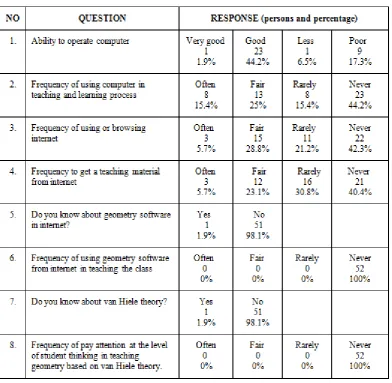
The survey also aimed to know the ability of the mathematics teachers at SMP in local Parepare in using ICT in teaching process and the results could be seen at Table 2. The results showed that 10 or 23.8% of 52 mathematics teachers still cannot use computer. Moreover, 44% of them stated that they never used computer in teaching mathematics in the classroom. In addition, only one teacher knew the existence of geometry software on the internet.
The scenarios mentioned above strongly suggest that the remedial of students‟ learning difficulties in geometry among Indonesian students in the local Parepare could not be eased using the applications of technological advancement designed for the use of school children in the developed nations. The researchers strongly believe that the van Hiele model could be used to provide an underlying theory of the design and development of learning geometry instructions (called van Hiele-Based Interactive Visual Tools or IVT). The IVT is to be designed and built to assist students in local Parepare in easing the learning difficulties by means of facilitating the proper progression of van Hiele geometry thinking among the learners as explained in the earlier section. In doing so, the researchers would „adopt and adapt‟ the van Hiele model via the utilization of limited local resources over a minimal technology-oriented educational environment in order to develop alternative learning instructions which address the problems of learning geometry encountered by Indonesian high school children. The detail of the conceptual framework is presented in the following section.
Table 2. The Practices of Teaching with Technology among Mathematics Teachers at Local Parepare
Conceptual Framework for the Design and Development of van Hiele-Based Interactive Visual Tools
The limited infrastructure and lack of ability of teachers in the mastery of technology are the major barriers in the applications of technology in the teaching and learning of geometry in local Parepare. This condition causes the achievements of the secondary school students in learning mathematics in Parepare were very low from year to year. Consequently, it would be complicate for the students to study mathematics at higher level or in SMA, particularly on the material geometry subject. To overcome this problem, we need to develop a new method to teach geometry to students based on existing conditions.
in the classroom to help students understand geometric concepts (Usiskin, 1987; Kor, 1995; Chong, 2001). Theory of multiple intelligent by Howard Garner suggested that some learners are kinaesthetically inclined (in Campbell, Campbell & Dickinson, 1996), it is means that they learn best actively involved with the objects of their learning. For this type of learners, interactive visualization process-oriented activities are considered to be most beneficial.
As mentioned earlier, the researchers have decided to „adopt and adapt‟ the van Hiele model as to provide an underlying theory of the design and development of IVT. The IVT would be capitalizing the interactive visualization process-oriented activities focusing on level-by-level basis to assist the learners to progress through the van Hiele geometry thinking under a minimal technology-oriented educational environment. The research focuses only on the progression of the first three levels of van Hiele geometry thinking, namely, Level 0 (L0), Level 1 (L1) and Level 2 (L2). The emphasis of the interactive
Figure 1. The Conceptual Framework of the Design and Development of van Hiele-Based Interactive Visual Tools
Conclusion
In Indonesia, many students generally have difficulty in learning geometry. This paper has discussed about the needs to develop alternative learning instructions which address the geometry learning, particularly in local Parepare. A conceptual framework of the design and development of such instructions have also been discussed. The ultimate goal of the research is to develop interactive learning instructions (called Interactive Visual Tools or IVT) which assist post-SMP students in the region of Parepare to progress through van Hiele levels of geometry thinking via utilization of limited local resources over a minimal technology-oriented educational environment. Finally, the proposed method is expected to improve the geometry level of thinking students at Parepare.
References
Abdussakir. (2009). Abdussakir‟s blog.html. copy on line retrivied March 22, 2010 from http://abdussakir.wordpress.com/category/artikel/
Battista, M. (1999). Geometry results from the Third International Mathematics and Science Study. Teaching Children Mathematics, 5(6), 367-373.
Card, S., Mackinlay, J.D., & Shneiderman, B. (Eds.). (1999). Readings in information visualization: Using Vision to Think. San Francisco, CA: Morgan Kaufman.
Campbell, L., Campbell, B., & Dickinson, D. (1996). Teaching and Learning Through Multiple Intelegnces, Massachusetts: Allyn & Bacon.
Chong, L.H. (2001). Pembelajaran geometri menggunakan perisisan Geometer’s Sketchpad (TI-92 Flus) dan kaitannya dengan tahap pemikiran van Hiele dalam geometri.
Clements, D.H. & Battista, M.T. (1992), Geometry and spatial reasoning. In D. A. Grouws (Ed.) Handbook of research on mathematics teaching and learning. NY: Macmillan.
Guttierez, A., Jaime, A., & Fortuny, J.M. (1991). An Alternative Paradigm to Evaluate the Acquisition of the Van Hiele Levels. Journal for Reseach in Mathematic Education, 22(3), 237-251.
Guzman, M. (2008). The Role of Visualization in the Teaching and Learning of Mathematical Analysis. Madrid, Spain: Universidad Complutense de Madrid.
Hauptman, H. (2010). Enhancement of spatial thinking with virtual spaces 1,0. Journal Computer and Education, 54(1), 123-135.
Hershkowitz, R. (1989). Visualization in geometry – two sides of the coin. Focus on Learning Problems in Mathematics, 11(1), 61-76.
Hoffer, A. (1983). Van Hiele-based research. In R. Lesh and M. Landau (eds.) Acquisition of Mathematics Concepts and Processes. Orlando, Florida: Academic Press.
International Mathematics Olympiad (IMO). Copy on line, retrivied August 25, 2010 from http://www.imo2010org
Jacobson, C., & Lehrer, R. (2000). Teacher appropriation and student learning of geometry through design. Journal for Reseach in Mathematics Education, 31(1), 71-88.
Kahfi, M.S. (2009). Analisis geometri dalam buku paket matematika SD ditinjau dari Teori van Hiele. Unpublished thesis. Universitas Negeri Malang, Indonesia.
Kor, A.L. (1995). The development and evaluation of a logobased geometry package. Unpbulished Masters Dissertation, University of Malaya, Malysia
Lee, J., Grigg, W & Dion, G. (2007). The Nation‟s Report Card: Mathematics 2007 (NCES 2007-494). National Center for Education Statistics, Institute of Education Sciences. U.S. Department of Education, Washington, D.C.
Milano, F. (2009). Three dimensional visualization and animation for power system analiysis. Journal Electric Power Sistem Reseach, 79(1), 1638-1647.
Mitchelemore, M. (2002). The role of abstraction and generalisation in Development of Mathematical Knowledge. In 0. Edge & B. H. Yeap (Eds),Proceedings of the second East Asia Regional Coriference on Mathematics Education and Ninth Southeast
Asian Conference on Mathematics Education, Singapore: National Institute of
Education, vol. 1, pp. 157-167.
Noraini, I., Granamalar, E., & Rohaida, S. (2004). Teknologi Dalam Pendidikan Sains dan Matematik, Kuala Lumpur, Universiti Malaya.
Purnomo, D. (1999). Penguasaan Konsep Geometri Dalam Hubungannya dengan Teori Perkembangan Berpikir van Hiele Pada Siswa Kelas II SMP Neg 6 Kodya Malang.
Unpublished thesis, Universitas Negeri Malang, Indonesia.
Schoenfeld, A.H. (1986). On Having and Using Geometric Knowledge. In J. Hiebert (ed.) Conceptual and Procedural Knowledge:the Case of Mathematics. Hillsdale, NJ: LEA,
pp. 225-264.
Sedig, K., & Sumner, M. (2006). Characterizing interaction with visual mathematical representations. International Journal of Computers for Mathematical Learning, 11(1), 1-55.
Senk, S.L. (1989). Van Hiele level and achievement in writing geometry proofs. Journal for Research in Mathematics Education, 20(3), 309-321.
Smith, G.G., Gerretson, H., Olkun, S., Yuan, Y., Dogbey, J., & Erdem, A. (2009). Stills, not full motion, for interactive spatial training: American, Turkish and Taiwanise female pre-service teachers learn spatial visualization. Journal Computer and Education, 52(1), 201-209.
Usiskin, Z. (1982). Van Hiele Levels and Achievement in Secondary School Geometry: School Geometry Project.Department of Education, University of Chicago.
Usiskin, Z. (1987). Resolving the continuing dilemmas in school geometry. In M.M. Lindquist & A.P. Shulte (Eds), Learning and Teaching Geometry, K-12, 1987 yearbook. Reston, VA: National Council Teachers of Mathematics, pp. 17-31.
Van Hiele, P.M. (1959). Development and Learning Process: A Study of Some Aspects of Pieget’s Psycology in Relation with Didactics of Mathematics. Groningen, Nederland:
S. B. Walters.
Van Hiele, P.M. (1999). Developing geometric thinking through activities that begin with play. Journal for Teaching Children Mathematics, 5(6), 310-316.
Zubaidah. (1999). Membangun Konsepsi Geometri Melalui Model Belajar Perubahan
Konseptual Berpedoman pada Teori van Hiele pada Siswa Kelas 5 SD.Unpublished