A
A
B
B
S
S
T
T
R
R
A
A
C
C
T
T
WARREN, HEATHER LYNN. Auditory Cueing Effects on Human Performance with an Adaptive System. (Under the direction of David B. Kaber.)
Adaptive automation (AA) is the dynamic allocation of complex system functions to
a human operator and/or automated controller on the basis of the state of the
human-task-environment and having the objective of optimizing overall system performance. Adaptive
automation has been successfully applied to different types of simulated tasks in laboratory
settings; however, there have been few field applications and problems remain in providing
human operators of adaptive systems with adequate feedback on changing system states and
modes of operation. This may result in poor operator situation awareness (SA). Previous AA
research on system feedback mechanisms has primarily focused on visual cues of system
state changes. Some work has investigated complex auditory icons, but no research has
considered the use of vocal cues on adaptive system state changes.
The current research investigated the potential for multimodal interfaces to
improve adaptively automated system performance by considering multiple resource
theory (MRT) of attention in system interface design. Subjects were provided with
feedback on AA states via their visual and auditory senses in order to improve overall
system performance and human-automation interaction. An experiment was conducted
to compare the use of visual (icons), auditory (earcons) and vocal cues for conveying the
state of an adaptive teleoperator (remote-control robot) in a high- fidelity, virtual reality
simulation of an underwater mine disposal task. Earcons have been found to be
beneficial for cueing operators of automated system states, but there has been no research
interaction or in adaptively automated systems. In this study, modal cues were associated
with task phase changes and teleoperator control mode changes.
The type of cue and level of cue complexity (level of detail) was varied between
and within subjects, respectively. Operator performance was evaluated in terms of
system-state awareness, accurate control commands, and time-to-task completion. The
research sought to discover which cue type was most effective for facilitating overall
system performance and maintaining operator SA.
Results demonstrated the manner in which humans use visual and auditory
sensory cues for feedback when dealing with adaptively automated systems is in
agreement with MRT. Vocal cues were identified as being superior for warning
operators of system-state changes, maintaining SA (attentional resources) and facilitating
overall complex system performance. The results of this study are applicable to the
design of future automated systems and may serve to improve efficiency and
D
D
E
E
D
D
I
I
C
C
A
A
T
T
I
I
O
O
N
N
I dedicate this thesis to Louise “Crump” Crumpler. Crump served as a motivation
not only in my life, but also in the lives of all those she touched. She supported me in
educational endeavors right from the start. She taught me things that simply cannot be
B
B
I
I
O
O
G
G
R
R
A
A
P
P
H
H
Y
Y
Heather L. Warren is originally from Suffolk, VA. She grew up there with her mom,
dad, and brother, Russ. She graduated from Nansemo nd-Suffolk Academy in Suffolk, VA in
1996. She then went on to receive her B.S. in Integrated Science and Technology with
concentrations in energy, environment, and biotechnology from James Madison University in
Harrisonburg, VA. This thesis served as the completion to her M.S. in Industrial Engineering
with a concentration in Ergonomics from N.C. State University in Raleigh, NC. She is
interested in an integrated approach to problem solving involving practical solutions from a
variety of disciplines. In the past, she has worked at U.S. Army Corps of Engineers, N.C.
State University, The International Institute for Energy Technology in Marsaxlokk, Malta,
A
A
C
C
K
K
N
N
O
O
W
W
L
L
E
E
D
D
G
G
E
E
M
M
E
E
N
N
T
T
S
S
I would like to thank my family and friends for support over the past two years. I
would also like to thank Dr. David Kaber, Dr. Gary Mirka, and Dr. Michael Wogalter for
academic advisement. In addition, I would also like to thank Mohamed Sheiknainar for the
development of the virtual environment used in this research. As well, I would also like to
thank the United States Navy, Office of Naval Research for support through a research
assistantship in Industrial Engineering at North Carolina State University, without which my
T
T
A
A
B
B
L
L
E
E
O
O
F
F
C
C
O
O
N
N
T
T
E
E
N
N
T
T
S
S
Page
List of Tables………..…vi
List of Figures………vii
Glossary………viii
1. Literature Review……….1
1.1. Introduction………...1
1.2. Adaptive Automation………2
1.2.1. Adaptive Automation Interfaces………5
1.2.2. Human-Human and Human-Automation Interaction………..……..8
1.2.3. Summary of Adaptive Automation………..10
1.3. Human Information Processing of Auditory Stimuli………..11
1.4. Earcons………..……….……12
1.4.1. Earcon Design………..14
1.4.2. Earcon Training………...16
1.4.3. Comparisons of Earcons and Icons………..16
1.4.4. Comparisons of Earcons and Vocal Information……….…17
1.4.5. Summary on Earcons………...18
1.5. Virtual Reality Systems for Human Factors Research………...19
1.5.1. Virtual Reality Equipment………...20
1.5.1.1. Display Technolo gy……….21
1.5.1.2. Control Technology……….22
1.5.2. Virtual Reality User Considerations………25
1.5.3. Summary of Virtual Reality……….28
2. Problem Statement……….30
3. Methods………..32
3.1. Task……….32
3.2. Subjects………...37
3.3. Equipment…...………38
3.4. Experimental Design………..39
3.5. Independent Variables………42
3.6. Dependent Variables………...42
3.7. Procedures………...44
3.8. Hypotheses………..46
3.9 Data Analysis………..………47
3.9.1 General Statistical Analysis………...………47
4. Results……….51
4.1 Time-to-Task Completion………...51
4.2 Situation Awareness………....55
4.2.1 SART Demand………...56
4.2.2 SART Supply……….57
4.3 Workload……….58
4.3.1 Performance………...58
5.2 General Conclusions………...62
5.3 Design Recommendations………..64
5.4 Future Research………..66
6. Works Cited...…….………...69
Appendix 1: Subject Instructions………...83
Appendix 2: Informed Consent Form………..105
Appendix 3: Anthropometric Data Sheet……….107
Appendix 4: Payment Form……….108
Appendix 5: Simulator Sickness Questionnaire………..109
Appendix 6: SART Rating Form……….110
Appendix 7: NASA-TLX……….111
Appendix 8: Hearing Test………114
Appendix 9: Earcon Comprehension Test………...115
L
L
I
I
S
S
T
T
O
O
F
F
T
T
A
A
B
B
L
L
E
E
S
S
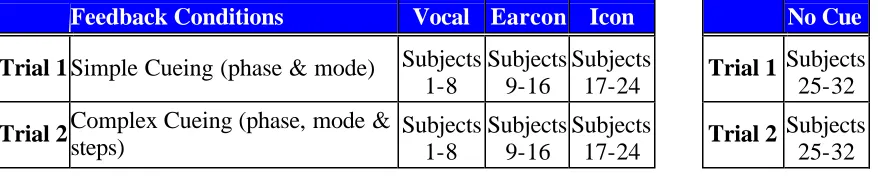
Table 1. Distribution of trials across subject……….39
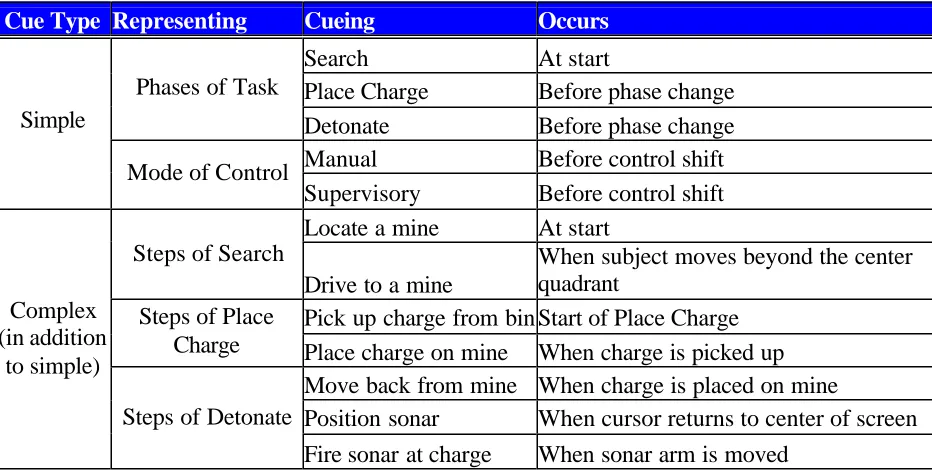
Table 2. Cues………..40
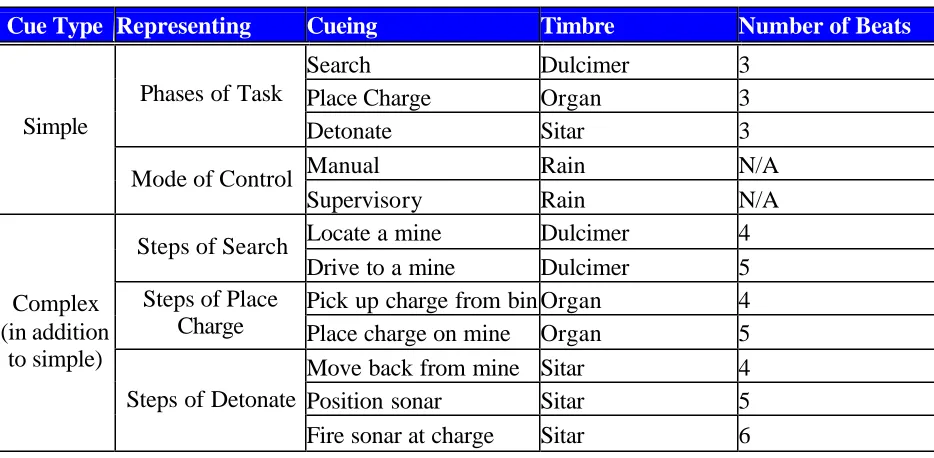
Table 3. Earcon composition………..41
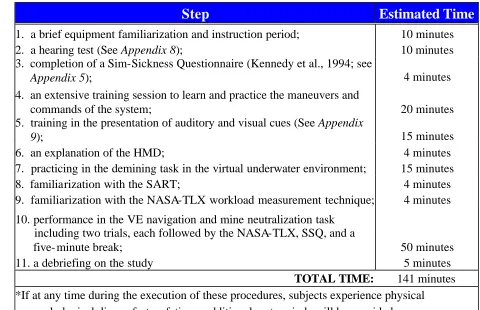
Table 4. Overall Procedures………...46
Table 5. Data points seen as outliers………..50
L
L
I
I
S
S
T
T
O
O
F
F
F
F
I
I
G
G
U
U
R
R
E
E
S
S
Figure 1. Diagram of rover (Kaber et al., 2001)………32
Figure 2. Search phase: Behind rover view………...34
Figure 3. Search phase: On -rover view……….35
Figure 4. Selecting a charge from the bin on the rover: Rover arm view………….35
Figure 5. Place charge phase: Rover arm view………36
Figure 6. Detonate phase: On-rover view……….36
Figure 7. Mine types and associated charges……….37
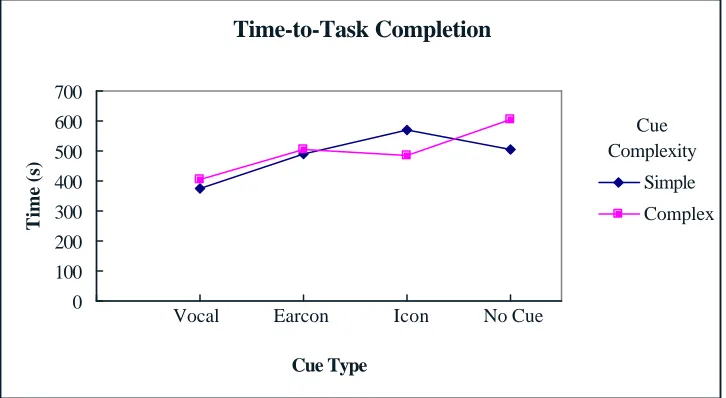
Figure 8. Interaction Plot of cue type and cue complexity on Time-to-Task
Completion………...52
Figure 9. Duncan grouping of time-to-task completion……….53
Figure 10. Average Demand Component Ratings as Part of SART………...57
Figure 11. Standard Means Plot for the Performance component of the TLX……...60
G
G
L
L
O
O
S
S
S
S
A
A
R
R
Y
Y
AA – Adaptive Automation
ATC – Air Traffic Control
BOOM – Binocular Omni-Orientation Monitor
CAVE – Computer Automatic Virtual Environment
CRT – Cathode Ray Tube
DOF – Degree-of-Freedom
HDVD – High Definition Volumetric Display
HMD – Head-Mounted Display
HSD – Honestly Significant Difference
IPD – Inter-Pupillary Distance
LOA – Level of Automation
MR – (Duncan’s) Multiple Range
MRT – Multiple Resource Theory
SA – Situation Awareness
SART – Situation Awareness Rating Technique
TLX – Task Load Index
VE – Virtual Environment
1
1
.
.
L
L
I
I
T
T
E
E
R
R
A
A
T
T
U
U
R
R
E
E
R
R
E
E
V
V
I
I
E
E
W
W
1
1
.
.
1
1
IN
I
NTTRROODDUUCCTTIIOONNAdaptive automation (AA) is considered to provide the capability to improve
complex systems control over traditional, conventional automation; however, there are many
problems currently associated with its implementation (Scerbo, 1996, Kaber, Riley, Tan, &
Endsley, 2000). One proposed approach to effective implementation of AA is to incorporate
multimodal interfaces into the design of systems to improve human-automation interaction.
Kaber et al. (in preparation) investigated the effectiveness of multimodal interface cueing on
automation-state changes in adaptive system operation. Specifically, auditory and visual
cues of adaptive system state changes were evaluated in terms of operator situation
awareness (SA) and performance in an underwater teleoperated virtual reality (VR) demining
task. The goal of their experiment was to reduce decrements in system performance that are
typically associated with AA, as a result of poor human-automation communication. This
problem is generally associated with reduced operator mode awareness and longer duration
recovery times in the event of system errors. Both modal and bimodal cues were evaluated.
They included musical earcons, semi-abstract icons, and both earcons and icons presented
simultaneously. Cues were provided to operators to indicate impending changes in the level
of system automation (manual control or supervisory control) and the phase of the task
(search for mines, place depth charges, or detonate mines). Kaber et al. (in preparation)
found bimodal cues to be superior to modal cues (particularly visual stimuli). As well,
cueing with earcons produced significantly fewer errors than cueing with icons. Operator
bimodal cues produced shorter trial times. Although these results are promising for interface
design for effective implementation of AA, Kaber et al.’s (in preparation) research did not
investigate the use of vocal cues. Vocal cues have the potential advantage of reducing the
translation that may be associated with interpreting the meanings of earcons. Also, the
meanings of vocal cues may be easier for subjects to learn than earcons or icons because
vocal cues require natural language processing. As a result, vocal cues may produce shorter
trial times and better performance.
The following literature review covers AA and research on interface design for
effective implementation of AA. It also covers earcons, their design, and potential benefits
as advanced warning cues in complex systems, as compared to other modal cues. Finally,
virtual reality systems are reviewed as test-beds for human factors research, and AA studies
in particular, and a suitable experimental setup is identified for this research. The review is
intended to serve as a basis for work involving assessment of vocal messages, earcons, and
icons for operator cueing in adaptively automated systems.
1
1
.
.
2
2
AD
A
DAAPPTTIIVVEEA
A
UUTTOOMMAATTIIOONNThe purposes of automation include performing tasks that humans do not want to do,
do poorly, or are not well suited to do (Scerbo, 1996). Traditional automation is defined as
the outsourcing of tasks to a machine to perform (Parsons, 1985). Traditional automation can
result in performance problems such as reduced operator SA, which may occur when humans
are removed from complex system control loops (Kaber, Riley, Tan, & Endsley, 2001).
Other problems include an increased monitoring load on operators. Automation often
Unfortunately, humans are not effective monitors of information sources for extended
periods of time, and this situation often results in vigilance decrements (Parasuraman, 1986).
Scerbo (1996) has noted that introducing automation into a system that was previously
non-automated may actually increase operator workload due to monitoring requirements. Over
the long term, skill decrements can also result from traditional automation because the human
adapts to a supervisory control role in the process and does not exercise active
decision-making or manual control (Shiff, 1983). If a situation develops that requires the human to
intervene in the control loop, he or she may not remember how to perform tasks manually as
a result of the automation (Scerbo, 1996).
Adaptive automation is defined as “the dynamic allocation of tasks or control
functions between human operators and automated control systems over time based on the
state of the human-task-environment” with the objectives of moderating operator workload,
yet maintaining situation awareness at the same time (Kaber, 1999). Adaptive automation,
by nature, incorporates multiple levels of automation (LOAs) into a single system. Adaptive
automation may be beneficial to complex system performance because it considers the
human in the design cycle and ensures the human is retained in the control loop during
normal operations in order to deal with potential automation errors and failures.
Adaptive automation is a new and evolving technology that is not thoroughly
understood. Optimal AA strategies for human-computer- interaction, team scenarios, and
operator performance have not yet been realized (Kaber, Riley, Endsley, & Tan, 2001).
Several strategies have been presented to create an effective adaptively automated system.
The first strategy is to alter the level of automation based upon the human’s interactions with
the optimum interactions. If the operator is not interacting with the system in the most
effective manner, the system may switch to a higher LOA (Morris & Gluckman, 1994). The
main problems associated with this strategy are the complexity of building the database and
the retroactive response (Scerbo, 1996). A more proactive strategy involves modeling human
performance against actual operator performance. The modeled behaviors are compared to
the actual behaviors. Like the previous approach, the system would be capable of switching
LOAs when needed (Scerbo, 1996). Hancock and Chignell (1987, 1988) proposed a slightly
different strategy, in that they used current and future workload of the operator as a means
for allocating tasks to the operator or the machine. Another proposed strategy to AA is using
biopsychometrics, such as heart rate variability, eye movements, and event-related brain
potentials to trigger a change in the LOA (Morris & Gluckman, 1994, Byrne & Parasuraman,
1996). Morris and Gluckman (1994) also advocated monitoring the task and looking for
critical events that might serve as a basis for altering the LOA. However, this strategy has
proved to be ineffective for complex systems because the event driven change is not directly
correlated with performance or workload (Parasuraman, Bahri, Deaton, Morrison, & Barnes,
1992).
The ultimate goal of AA is to determine dynamic function allocation strategies that
optimize human operator performance, situation awareness and workload (Kaber & Riley,
1999). Many solutions have been proposed to alleviate the problems created by various AA
strategies. Among these solutions is the creation of more effective interfaces. Providing
feedback on mode changes, such as cues may improve the effectiveness of AA strategies
performance and SA may increase (Kaber, Hughes, Wright, Sheiknaniar, & Warren, in
preparation).
1
1
.
.
2
2
.
.
1
1
AD
A
DAAPPTTIIVVEEA
A
UUTTOOMMAATTIIOONNIN
I
NTTEERRFFAACCEESSThe main problem that occurs as a result of AA in complex systems is a lack of
operator knowledge concerning the state of the system at any given point in time because of
often inadequate system feedback. One potential solution to this problem is the development
of more effective interfaces for AA systems. There are three types of interface solutions that
have been proposed in the literature. They include dynamic displays, multimodal displays,
and direct manipulation displays.
Weiner (1988) introduced the concept of dynamic displa ys into the cockpit setting
with the objective of improving pilot situation awareness. Specific interfaces are introduced
over time based on the LOA to be employed. Displays can also be selected or deselected
based on the operator’s task requirements. In order to support human operator performance
in interacting with AA, these displays must be consistently designed to allow users to
smoothly switch among different LOAs without getting lost due to complex changes within
the interface. The interface design must ensure that users remain aware of what functions
they are controlling and what functions the automation is controlling (Norman, 1990).
It is possible that interfaces displaying the level of information required for operating
some AA systems may actually increase the complexity of the system (Kaber, 2001).
Consequently, dynamic interfaces have been designed and evaluated for supporting human
performance and situation awareness, but constantly changing interface features may confuse
displays into the system (Kaber, 2001). Such displays may capitalize on MRT by allowing
for presentation of all critical system information without overwhelming the human with
information along a single modality (Scerbo, 1996). Multimodal sensory cues can be an
effective means of notifying the human of LOA changes or other changes within a system
(Kaber, Hughes, Wright, Sheiknainar, & Warren, in preparation). In theory, multimodal
displays may increase situation awareness and performance, while reducing cognitive load.
Ballas et al. (1991) hypothesized that information processing required to resolve user
intentions and adaptive machine states would be reduced when using a direct manipulation
interface because the user’s mental model is more accurately matched by the interface
functions and controls. A benefit of direct manipulation, as stated by Ballas et al. (1991), is
that such interfaces maintain a consistent style and may offset the disadvantages of changing
controls and displays as part of AA implementations in complex systems. In terms of human
performance, the consistency in the interface style may result in increased SA.
Ballas et al (1991) used a dual- task paradigm, including a target confirmation and
classification task along with a tracking task, to investigate the effectiveness of direct
manipulation interface design over conventional interface design for reducing AA- induced
deficits in SA and performance. Deficits were expected as a result of drastic changes in
display content as system automation changed from one mode to another. They speculated
the direct manipulation interface would increase the users sense of task engagement; thereby,
making the transition from one mode of system automation to another easier for operators.
The target classification task was either fully automated or performed manually by a human
depending upon the level of difficulty of the tracking task. Multiple modalities were used to
beep and a graphical border placed around the task window when manual control was
required. The border served to highlight the task interface. Ballas et al. (1991) found that
performance (or “SA”) decrements occurred during manual system control due to advanced
automation of the target classification task. They observed that the direct manipulation
interface was superior to a conventional interface for ameliorating adverse performance
consequences due to system state changes. The relative effectiveness of the beep or
graphical border around the target task window for cueing subjects on system state changes
was not assessed. However, based on subjective query of subjects, Ballas et al. observedthat
the more intuitive direct manipulation interface allowed subjects to better anticipate state
changes than the conventional interface.
Ballas et al. even though subjects were cued to the complex system state changes as
part of AA, automatio n- induced SA deficits were still observed during periods of manual
system control. This suggests that the type of cueing may not have been entirely effective for
informing operators of state changes or the interface design did not allow subjects to easily
infer how to modify control actions based on a system state change. In general, the study
supports the need to examine explicit cueing of operators to complex system state changes to
promote SA and performance subsequent to a state or behavior change (Kaber, Hughes,
Wright, Sheiknainar, & Warren, in preparation).
Dynamic displays, multimodal displays, and direct manipulation displays are all
proposed solutions to problems incurred as a result of AA; however, more empirical research
is needed in order to determine which display type produces the best results under various
1
1
.
.
2
2
.
.
2
2
HU
H
UMMAANN-
-
H
H
UUMMAANNAANNDDH
H
UUMMAANN-
-
AU
A
UTTOOMMAATTIIOONNI
IN
NTTEERRAACCTTIIOONNThe issues in implementation of AA become more complex when considering team
operations or control of complex systems. When AA is utilized in team scenarios, it may
drastically alter the team environment (Kaber, Riley, Endsley, & Tan, 2001). Teams are
created to exploit individual abilities of members. One team member may be stronger in a
certain area of a task than another member. Team member interaction and communication is
crucial for a system to function correctly (Kanki, 1993). In order for the team to be an
effective entity, the members must be able to share their knowledge via an effective means of
communication, be it vocal or non-vocal. Different situations are more conducive to
different forms of communication. For example, in a loud factory, production team members
would most likely not be able to hear one another speak, so they may use other forms of
non-vocal communication, such as hand gestures or written language (Bowers, 1996). Since
automation, in effect, may function like a member of the team, it also must be capable of
communicating with other team members. It should also be designed not to compromise
critical vocal and non- vocal communication among human operators. Scerbo (1999)
suggested that AA should be designed so that multiple forms of communication are possible
across multiple modalities allowing more natural communication to result and possibly
reduced team member (human, computer controller) workload.
Sklar and Sarter (1999) previously hypothesized that auditory and haptic cues may
promote improved interaction between humans and automation in coordinated complex
system control; however, they did not investigate an adaptive system. Specifically, they
unexpected mode transitions in a cockpit simulation. Sklar and Sarter (1999) found the use
of tactile, and a combination of tactile and visual cues, to result in higher rates of detection of
mode transitions. The rates of detection with tactile cues were particularly pronounced in
trials that involved visually intensive displays. It is possible that human and
human-automation team interaction in the cockpit may benefit from cueing across multiple
modalities to facilitate team member comprehension of system states.
As reported earlier, Kaber et al. (in preparation) examined the use of earcons, icons,
and a combination of both earcons and icons in an adaptive teleoperation system involving
human and computer coordinated control. Auditory cueing produced significantly fewer
errors than visual cueing. Time-to-task completion was also greater with visual cues. Kaber
et al’s (in preparation) study expands upon the previous research by Sklar and Sarter (1999)
by providing further evidence of the benefits of multiple modality cueing under AA and
improvements in human-automation interaction.
With respect to these results, the auditory modality may be especially beneficial for
cueing information because it has the advantage of alerting people when a sound is heard,
which can result in faster reaction times (Bly, 1982). Graham (1999) compared earcons to
traditional warnings in an automobile to evaluate emergency warnings in vehicle collision
avoidance applications. Graham (1999) found in the context of emergency warnings,
“Auditory icons have considerable potential advantages over conventional sounds in terms of
response time and subjective ratings.” In this instance, automobile electronic systems act
like a team member to the human operator. The context requires effective communication
communicates by providing cues that a collision is about to occur. The human responds to
the automobile’s cues by re-directing the vehicle, towards collision avoidance.
In general, all of these studies provide evidence to support the use of multimodal
cueing in human-human and human-automation coordinated (team) control of complex
systems. Advanced warning of operators (team members) of system state changes with
complex auditory, tactile, and bi- modal cues has been proven to be successful in various
contexts. Such cueing mechanisms may serve to reduce the number of serious AA
implementation issues in complex system design.
1
1
.
.
2
2
.
.
3
3
S
S
UUMMMMAARRYYOOFFAD
A
DAAPPTTIIVVEEAU
A
UTTOOMMAATTIIOONNAdaptive automation is likely to be an effective means for implementing automation
and improving human performance in the near future; however, optimum methods had not
been developed to employ AA over a broad range of disciplines (Kaber, Hughes, Wright,
Sheiknainar, & Warren, in preparation). This research evaluated what cue types are most
effective in reducing a lack of operator mode awareness problems associated with AA.
Scerbo (1999) cited Weiner (1989), who stated, “Automation is neither inherently good nor
bad. It does, however, change the nature of the work, and, in doing so, solves some problems
while creating others.” These problems need to be known, so designers can create ways to
improve upon and solve them (Scerbo, 1999). Different interfaces are one proposed method
of solving problems with AA. This research evaluated the effectiveness of an interface
utilizing different sensory modalities (visual icons, vocal cues, and earcons) in an AA
1
1
.
.
3
3
HU
H
UMMAANNI
I
NNFFOORRMMAATTIIOONNP
P
RROOCCEESSSSIINNGGOOFFA
A
UUDDIITTOORRYYS
S
TTIIMMUULLIIMountford and Gaver (1990) said, “Sound exists in time and over space, vision exists
in space and over time.” Humans have omnidirectional hearing capability, but only have a
small field of view; therefore, sending information to the auditory modality makes sense
particularly for system-state warnings. Sound can be provided in a way so as not to distract
the user from the visual display, but rather to complement it and to effectively use human
cognitive resources.
According to Wickens and Hollands (2000), “Multiple-resource theory would predict
relative independence between the perception of music and the involvement with tasks that
are manual or vocal.” Likewise, Martin et al. (1988) found that reading comprehension and
instrumental music could be simultaneously processed without any decrement in
understanding; however, reading comprehension did suffer when lyrics were added.
Multiple messages can be conveyed simultaneously by different parameters of
auditory cues. King and Oldfield (1997) said broadband signals should be used, so the user
can successfully hear all of the parameters of sounds. Albers (1996) found that when he
shifted a portion of information to the auditory channel as opposed to the visual channel in an
Audible Web application, users were able to gather more information than they did with a
traditional web application. Albers (1996) shifted information concerning data transfer,
feedback on user’s actions and navigational aids through content feedback to the auditory
modality because the visual modality was already busy gathering all of the information that is
incurred in an internet application. In addition, the users could more accurately describe the
status of the system as far as data transfer and activities.
focuses attention on one channel. However, channels of auditory information that are not
paid focused attention may remain in the echoic short-term sensory store for 3-6 seconds
(Wickens & Hollands, 2000). If the previously unattended information becomes attended to,
then it may be recognized and the information may be sent to working memory and
long-term memory (Wickens & Hollands, 2000). According to Banks et al. (1995), “Information
presented in an unattended channel is temporarily inhibited for several seconds following
presentation, demonstrating ‘negative priming’.” If the information first presented in the
unattended channel is then presented in the attended channel, then there is usually a slower
reaction time than if the information had originally been presented in the attended channel.
As humans age, degenerative effects decrease the ability to distinguish sounds, just
like other types of stimuli (Barr & Giambra, 1990). Therefore, if auditory cues are designed
for older users, care needs to be taken to create earcons that are significantly different from
one another.
1
1
.
.
4
4
E
E
AARRCCOONNSSIn general, the benefits of the auditory modality may be capitalized upon by the use of
earcons. Earcons are messages that are created from auditory tones. The properties of
earcons are generally pitch, amplitude, frequency, duration, tone, and special effects that may
be delivered to musical tones. Earcons can be hierarchical, meaning that one earcon’s
information may build off of another earcon’s meaning. Earcons are useful because they can
be internationally understandable. In addition, earcons may prove to be beneficial for people
who are blind or have low vision, users of displays that are already visually cluttered, and for
Mynatt (1994) described basic rules for incorporating usability into earcons. First,
the sound must be identifiable; that it is common enough that the user is familiar with it, but
also distinguishable from other sounds. Second, the sound should map well to the action
being portrayed. In a study previously conducted by Brewster (1998), many subjects
reported attaching meaning to the earcons, so they could better remember them. Third, the
parameters of the sound should be appropriate. That is the earcon should be constructed in
the normal hearing range of humans, should not be excessively long, and should not create
negative emotions upon sensation.
Blattner et al. (1989) described how motives, which are musical fragments consisting
of a few notes, can be transformed into complex earcons. Motives form hierarchies by using
repetition, variation, or contrast (Brewster, 1998). If repetition is used, a motive is repeated a
specific number of times to denote the level at which the user is at within the hierarchy.
When using earcons as a mechanism of communication, an important point to remember is
not to annoy the user with a particular tune. According to Blattner et al. (1989), "hearing a
simple tune ten or more times a day irritates users, and can cause audio fatigue."
With variation, motives can be altered in rhythm, pitch, timbre, register, or dynamics.
If contrast is used, the motive changes in pitch, rhythmic content, or both. Brewster (1998)
suggests that a change in pitch alone will not provide enough information to the user for them
to recall the correct level within the hierarchy. The ideal number of pitches within a single
motive is two to four (Gaver, 1986).
There are three basic types of comp lex earcons according to Blattner et al. (1989).
They are combined, transformed, and inherited. Each type has specific properties that
motives are used in conjunction with one another, a message is generated. Transformed
earcons alter the sequence of the motives. For example, a transformed earcon may involve a
crescendo as the motives are played. Inherited earcons involve hierarchies. Each hierarchy
is defined to have specific properties. As new motives are added to increase the hierarchy,
new properties must also be added. Blattner et al. (1989) suggests that timbre be used as the
distinguishing factor for the root earcon of the hierarchy because it is an important element of
sounds.
1
1
.
.
4
4
.
.
1
1
E
E
AARRCCOONNDE
D
ESSIIGGNNThere are a few general rules that Brewster suggests using when creating earcons. A
specific family is composed of sounds from one instrument or voice alone. The same types
of earcons share the same rhythm. Kerman (1980) proved that the majority of listeners
respond more readily to rhythm than to any other property of music. If an earcon exists
within the same family and type as another earcon, then the register can be altered to denote
the difference (Brewster, 1998).
Brewster et al. (2001) later generalized his previous guidelines by saying; many
different parameters must be considered, such as timbre, register, rhythm, pitch, duration,
intensity, and spatial location. Families of earcons share one or more of the above
parameters. Families can be further divided into subgroups by sharing additional features as
the families of earcons move down the hierarchy (Brewster, Edwards & Wright, 2001).
Blattner et al. (1989) defined a slightly different method of creating clear, concise
earcons. A family of earcons is assigned a single, distinct rhythm. The second tier of the
the second tier be composed in a sine wave because it is a more basic form of sound. The
third tier consists of a copy of the second tier; however a different timbre and a higher pitch
are used. For the creation of further hierarchies, a change in the register or dynamics can be
used as differentiating parameters.
When designing earcons, care should be taken in using synthesized sounds because
the qualities of the actual instrument may or may not be realized within the synthesizer. It is
also important to consider the pitch when selecting timbres because not all instruments are
capable of all pitches. Rhythm and duration of tones within earcons allow users to
distinguish and process cues. Similar rhythms can be easily confused, thus the wrong
information could be conveyed to the user. In order to distinguish earcons with the same
rhythm, it is suggested that a different number of notes be used within different sub-groups of
earcons.
It is possible that a user can understand two earcons played simultaneously. An
earcon can consist of up to six notes played within 1 second and still be considered an
effective method for information transfer. According to Brewster et al. (2001), the first note
of the earcon should be louder, and the last note should be longer. In order for an earcon to
be successful, it must first grab the attention of the user. Intensity is the most common
means for involving the user in earcon perception; however, rhythm, pitch, rapid onset and
offset times, irregular harmonics, atonal sounds, or arrhythmic sounds can also be used to
attract the user. Compound earcons need to allow at least a 0.1 second gap between different
earcons, so the user will clearly understand the starting and ending point of the respective
earcons (Brewster, Edwards & Wright, 2001).
be effective (Blattner, Greenberg, & Sumikawa 1989). Gaver (1986) suggested using a
change in register to delineate vertical location or direction; a change in dynamics to indicate
horizontal direction; and a crescendo or decrescendo to relate direction to the user.
1
1
.
.
4
4
.
.
2
2
E
E
AARRCCOONNTR
T
RAAIINNIINNGGComplex system operators can be trained to recognize the distinct features of specific
earcons, and therefore understand their meaning (Brewster, 1998). Blattner et al. (1989)
state, “If the basic rules of combination are understood, listeners can infer the meanings of
earcons they haven’t heard.” Also, Blattner et al. (1989) said, “Untrained subjects quickly
recognize musical timbres.” Brewster (1998) found that musical training does not affect a
subject’s ability to respond to earcons. However, similar rhythms did cause problems for
non- musicians. According to a previous study by Blattner et al. (1989), musical motives are
better than flat tones for earcon learning. Dowling (1986) proved that performance involving
earcons was increased if the sequence of notes was familiar to the user (i.e., familiar motives
were used).
1
1
.
.
4
4
.
.
3
3
CO
C
OMMPPAARRIISSOONNSSOOFFE
E
AARRCCOONNSSAANNDDI
I
CCOONNSSEarcons and icons have similar composition and anticipated effects; however, there
are differences that may cause one form of communication to be more desirable than the
other (Blattner, Greenberg & Sumikawa, 1989). Deese and Grindley (1947) related melodies
to visual shapes, stating they were similar in purpose and effect. Buxton et al. (1987)
demonstrated the importance of auditory cues in human-computer interaction applications
scores decreased. Both icons and earcons convey information; however, only icons are
selectable. Earcons are more transient than icons. Earcons presented simultaneously are
more complex for a user to interpret than simultaneously presented icons. However, studies
by both Elliot (1937) and Sticht (1969) have shown that vocal messages are more easily
understood than textual messages.
Icons and earcons can be classified as representational, abstract, or semi-abstract
(Blattner, Greenberg & Sumikawa, 1989). Representational icons are basic pictures of
objects, whereas representational earcons are digitized sounds that mimic actual events.
Abstract icons combine geometrical shapes and marks to invoke the desired effect on the
user. Abstract earcons involve motives that do not directly relate to the meaning initially, but
rather meaning is attached to them through training. Meaning may be in the form of vocal or
visual and even spatial memory codes. Semi- abstract icons are constructed using a
combination of geometrical shapes and marks, as well as pictures of objects. Semi-abstract
icons can also be simplified pictures of objects, whereas semi-abstract earcons combine a
naturally occurring sound with learned motives. Semi-abstract icons and earcons seem to be
the more “internationally- friendly” choice. According to the American Institute of Graphic
Arts (1981), most international signs are constructed using semi-abstract icons.
1
1
.
.
4
4
.
.
4
4
CO
C
OMMPPAARRIISSOONNOOFFE
E
AARRCCOONNSSAANNDDV
V
OOCCAALLIN
I
NFFOORRMMAATTIIOONNEarcons are not language dependent, so unlike vocal cues, earcons are understood by
people of all cultures, regardless of their spoken language (Tannen, 1998). Brewster (1998)
contended that earcons also have an advantage over vocal cues in that they communicate
convey the information necessary to understand a situation than if the meaning is understood
by a single earcon. However, it is possible that the human may be capable of understanding
the meaning of the vocal information more quickly than the information presented in the
earcon because earcons require an additional translational stage within human information
processing. According to Rabiner et al. (1997), “Speech is the most intuitive and most
natural communicative modality for most of the user population.” Beyond this comparison,
only one vocal message can be understood at any given time; however, multiple earcons
messages can be understood simultaneously. Buxton (1995) said, “In cases where we need to
control more than one process simultaneously, speech (alone) is generally not an effective
mode of communication.”
1
1
.
.
4
4
.
.
5
5
S
S
UUMMMMAARRYYOONNE
E
AARRCCOONNSSEarcons have proved to be an effective feedback mechanism compared to visual cues;
however, current studies have failed to compare the effectiveness of earcons as a feedback
with vocal messages. Multiple experiments have proven earcons can be successful in
delivering complex messages to users in cognitively taxing situations. For instance, in
telepho ne-based interfaces, Brewster (1998) used earcons for navigation within a menu
hierarchy. He found earcons could be recalled well over time. He proved that using earcons
is a viable method of navigating through menu hierarchies. When analyzing non-visua l
interfaces for wearable computers, Walker and Brewster (2000) found, “Workload was
significantly reduced when sound was present…users do not have to devote so many of their
cognitive resources to perform the task.” Earcons may be successful because they reallocate
modality. Multiple resource theory provides justification for the division of information into
different modalities for maximum simultaneous human information processing. Earcons that
are trained and have meanings associated with them may also allow for more efficient and
effective information processing than vocal messages.
1
1
.
.
5
5
VI
V
IRRTTUUAALLRE
R
EAALLIITTYYS
S
YYSSTTEEMMSSFFOORRHU
H
UMMAANNF
F
AACCTTOORRSSRE
R
ESSEEAARRCCHHUnfortunately, the majority of historical AA studies presented in the literature have
been conducted using low-fidelity laboratory simulations of flight tasks (e.g., the
Multi-Attribute Task Battery (Parasuraman et al., 1996; Parasuraman, 1993; Scallen, Hancock &
Duley, 1995)). Only recent AA research has developed and employed high- fidelity synthetic
representations of, for example, air traffic control (ATC) tasks (Hilburn, Jorna, Byrne, &
Parasuraman, 1997), aircraft piloting tasks (Scallen & Hancock, 2001), and teleoperation
tasks (Kaber, Hughes, Wright, Sheiknainar, & Warren, in preparation). In some of this work,
VR systems have been used to present simulations to promote task realism and
generalizability of results to real-world applications. The work has provided important
insight into implementation issues associated with adaptive automation.
This research followed this current trend and made use of a VR system to simulate a
complex system and to assess the effects of AA applied to that system on human
performance. With this in mind, this section presents a detailed review of VR technology as
a basis for equipment selection for the experiment as part of this study.
Aukstakalnis et al. (1992) said, "Virtual reality is a way for humans to visualize,
manipulate and interact with computers and extremely complex data." Virtual reality allows
addition of depth to the field creates an environment that is a closer representation of reality.
Virtual reality may be successful because it provides a more accurate and easier mode of
decision analysis than is currently available through traditional 2-D simulation (Kaber,
1999).
There are many benefits for using VR for simulation and training as opposed to more
conventional methods. Virtual Reality is relatively inexpensive in comparison to the cost of
actual field tests. Virtual reality is also capable of producing an extremely high- fidelity
representation of reality. Another benefit is VR serve s as an excellent medium for training in
task-critical situations because real resources are not lost. In addition, VR can be used when
there are limited available resources.
1
1
.
.
5
5
.
.
1
1
VI
V
IRRTTUUAALLRE
R
EAALLIITTYYEQ
E
QUUIIPPMMEENNTTResolution, color, freedom of movement, weight, number of views, cost, speed, and
contrast are all factors that go into the selection of equipment for VR applications. Virtual
reality equipment can broadly be divided into two categories, including displays and controls.
Displays include items like head- mounted displays (HMDs), active and passive glasses,
binocular omni-orientation monitor (BOOM) displays, and autostereoscopic displays.
Controls include items such as mice, joysticks, wands, data gloves and exoskeleton master
controllers (Youngblut et al., 1996). Within each of these categories, there are different
brands and models. Since VR is a relatively new concept, the technology and equipment
1
1
.
.
5
5
.
.
1
1
.
.
1
1
DI
D
ISSPPLLAAYYTE
T
ECCHHNNOOLLOOGGYYHead- mounted displays are primarily used because they allow users a relatively high
degree-of- freedom of movement. Depending on the model, HMDs can also offer high
resolution (1280 x 1024) and high contrast (100:1). However, HMDs limit the field-of- view
of the user, and are often cumbersome.
Certain HMDs are better suited to specific applications. For example, Liquid Image
Corporation claims that the MRG 4 is one of the best selling HMDs for gaming. Virtual
Reality, Inc., offers the VRI HMD 133 for surgical applications. Kaiser Electro-Optics, Inc.
offers the Vision Immersion Module, which can be used by multiple users, allowing more
than one person to be immersed in the same environment simultaneously. Head-mounted
displays, in general, are beneficial for decision analysis because they allow for multiple
viewpoints of the same data. Youngblut et al., (1996) said that they might also focus user
attention and promote performance as they isolate the user in the virtual environment, so they
have an increased sense of presence.
Active glasses work on the principle of switching the image seen by the viewer from
one lens of a pair of lightweight glasses to the other (Belleman et al., 2001). When one lens
is working, the other is blocked, and vice-versa. The switching “on” and “off” of the lenses,
or flicker rate, is so fast that the human eye cannot readily detect the blocked lens, causing
the image to appear both seamless and three-dimensional (Youngblut et al., 1996). Two
slightly different views are shown to each eye. An infrared beam controls switching of the
lens and allows multiple users to use multiple glasses simultaneously with a single beam
emitter (Belleman et al., 2001). Therefore, this technology is well suited to large audiences
cumbersome than Head- mounted displays. However, like HMDs, they only provide a
narrow field-of- view for the users.
Passive glasses are similar to active glasses in tha t they are well suited for large
audiences, but they are also used commonly in CAVE systems. Passive glasses operate by
creating a checkerboard image in each of the alternately polarized lenses. Half of the pixels
resulting are then disregarded and the remaining pixels are used to form an image for the
viewer. The flicker rate in passive glasses is lower than in active glasses, and the resolution
is reduced as a result of the discounted pixels (Youngblut et al., 1996).
Fakespace, Inc. makes the BOOM 3C, which is a visual display that is mounted on a
boom to alleviate viewer discomfort associated with usual HMD weight. A cathode ray tube
(CRT) display system equipped with an optical tracker is then used for each eye. The boom
is equipped with a six degree-of- freedom motion tracker (Youngblut et al., 1996). The
motion tracker assigns floating point angles to specific regions in space. The data is then
transferred to the workstation, which in turn simulates the image to be projected in the visual
displa y (Belleman et al., 2001). The main advantage of the BOOM is that it is not
cumbersome like an HMD.
1
1
.
.
5
5
.
.
1
1
.
.
2
2
CO
C
ONNTTRROOLLTE
T
ECCHHNNOOLLOOGGYYMice are often used in VR applications because they are familiar to most users.
Humans typically interact with conventional PCs using a mouse, so it is logical that they
have been used to facilitate human-virtual environment interaction. Joysticks are used with
VR for this same reason. Wands are another type of controller that may be used with VR
represent different objects of control within the VR simulation. However mice, joysticks,
and wands all may not be the best types of control for VR applications because they tend to
steal user attention away from virtual scenes (Davies, 1996). Another downfall for these
controllers is users may need to see the controller in order to operate it; however, some of the
display technologies, such as HMDs, do not allow users to see anything outside of the virtual
environment.
An alternative to joysticks and wands are data gloves and exoskeleton master
controllers. These devices fit onto your hands and body. Depending on the particular glove
or exoskeleton control, there are varying numbers of flex sensors. Flex sensors relay to the
VE exactly how a person moves at a particular joint, therefore, increasing the intuitiveness
and ease of control as well as the realism of the VE experience, as if the person were actually
in it (Gabbard & Hix, 1997).
A suggestion of Gabbard and Hix (1997) is to incorporate VE input devices into
real-world objects that would be used if the task were to actually occur. An example they give is
the use of a device incorporated into a fire hose to train firefighters. This was initially used
in a VE for the Naval Research Laboratory, but similar technology can now be found in
common video games (e.g.), suggesting the fast pace of development of VE technology
(Gabbard & Hix, 1997).
Gabbard and Hix (1997) also describe speech recognition systems as a means of input
in VR applications. Incorporation of speech into a VR system may increase the reality of the
system to the user. Also, it provides a method of selecting objects that does not divide the
voice recognition technology may not yet be refined enough to use in complex VE systems.
Voice input is likely to be a viable input mechanism in the future, but as of now, it is not.
A specific task may involve fewer movements than another task. For that reason, not
all VE interfaces need to incorporate six degree of freedom (DOF) motion (Hinckley et al.,
1994). More DOF translates into more information that must be processed, therefore,
occupying a more significant portion of the bandwidth and possibly introducing or extending
lag in the system. Lag creates a sense of disjointedness between the user’s movements with
the input device and the results within the VE, in fact Richard et al. (1996) state, “delays of
more than 300 milliseconds may decrease user presence and immersion”.
Although these technologies may facilitate innovative and exciting applications,
researchers are striving to improve many facets of them; so future work can enable more
realistic displays. Current VR technology research focuses primarily of new 3-D displays
and how these devices can be more effectively designed from a human factors perspective.
ATR Communications Systems Research Laboratories is working on correcting the depth
error that can result from an incorrect inter-pupillary distance (IPD) and fuzziness of a
display, which could drastically improve clarity in HMDs (Youngblut et al., 1996).
Dimension Media Associates is manufacturing a High Definition Volumetric Display
(HDVD) intended to provide an autostereoscopic 3-D display using concave mirrors and
specific frequencies to adjust the index of refraction, which diffracts the beam of light.
Anticipated applications of HDVD include VE, gaming, surgical applications, and general
public information platforms. Other researchers are studying improvements in virtual depth
perception, autostereoscopic visual advancements, CAVE, and higher resolution displays
1
1
.
.
5
5
.
.
2
2
VI
V
IRRTTUUAALLRE
R
EAALLIITTYYU
U
SSEERRC
C
OONNSSIIDDEERRAATTIIOONNSSIn addition to recognizing the limitations of certain VR hardware, one must recognize
the constraints of the VR user in order to design effective applications. Gabbard and Hix
(1997) developed a taxonomy that lists certain features that they believe should be
considered when designing a virtual environment. The first item on their list emphasizes that
the user is stressed. Stress can result in decreased attention spans, reduced situation
awareness, tunnel vision, and a variety of other cognitive problems.
In general, the taxonomy supports the notion that the technology should be designed around
user’s characteristics, rather than the user adapting to already existing technology. Individual
differences stem from user experience levels both in the field and with similar technology
(Egan, 1988). User capabilities will likely play a large role in the overall effectiveness of a
VE, such as the user’s vision, hearing, and size. The system should be designed so that it
will be viable for both left and right-handed people. This could be done either by creating
the controls and interfaces so that they are symmetrical, or can be switched to the users
preference (Gabbard & Hix, 1997). The size of users impacts not only the equipment, but
also the role that the users see themselves playing within the VE. One suggestion made by
Boeing, was to incorporate different virtual body sizes into the VE, so that the users could
wear the size body that would be most beneficial to their task (Gabbard & Hix, 1997).
Object selection is another category in Gabbard and Hix’s taxonomy, and it highlights
topics such as feedback, frame rates, and selection of multiple objects in Virtual reality. One
of the basic points that Gabbard and Hix (1997) make is that users need to be aware that
whatever they desire to select is actually selected. Various methods of feedback were listed,
Acoustic feedback is another division in the Gabbard and Hix’s taxonomy. From a
presence perspective, VEs should make users feel like they are actually there. In order for
this to occur, a VE should sound, as well as look, real (Gabbard & Hix, 1997). Virtual
environments should capitalize on user’s capabilities to perceive audio signals. If a situation
is difficult to judge based on appearance alone, the sounds accompanying the event may help
a user understand the Virtual environment. For sound presentation, Gabbard and Hix (1997)
suggest using speakers over headsets, particularly if multiple users are involved. This
recommendation stemmed from the fact that if headphones were used, multiple users would
not be able to communicate in a natural manner. Kinesthetic, tactile, and olfactory cues
could also be used to make the VE feel more real to a user. However, in adding all of these
sensory cues, it is important not to overwhelm the user, so their attention is not drawn away
from the virtual task at hand. With this in mind, one would suggest tha t the sensory cues
only be placed in areas that appear to be problematic. Extra sensory data in areas away from
the problems would only distract the user. Since one of the purposes of this research is to
evaluate multimodal cueing, different sensory mechanisms utilizing a combination of
auditory and visual stimuli will be used.
The ability to select multiple objects at once is a feature that can be used through
“rubber band- like” grouping mechanisms (Mapes & Moshell, 1995). The frame rate needs to
be high enough that it allows the user to have a seamless display, but not so fast that it
disorients the user (Gabbard & Hix, 1997). Ware and Balakrishnan (1994) suggested that
certain tasks such as target acquisition are not heavily affected by low frame rates. This
suggestion once again stresses the importance of developing a VE specific to the individual
Another important issue that Gabbard and Hix (1997) discuss is the number of users
and their mode of evaluating their location in a Virtual environment. The virtual task will
normally determine the number and location of the users, but design specifications must be
made, so that these characteristics are integrated into the Virtual environment. If the VE
focused on only one task, then typically a single-user VE is designed; however, if there is
more than one task in question, designs should include a method for interaction between
multiple users. Designing for multiple users allows all users to be aware of not only their
presence, but that of the other users, as well. Typically, VE equipment is designed with the
single user in mind; however, there are many situations that would benefit from multiple user
capability. The Responsive Workbench, or similar technology is suggested for multiple- user
environments. With respect to user interaction in using the workbench, if it is important for
the operators’ positions within a multiple-user VE to be known, then it is essential to have
some representation of each individual within the overall environment, in order for the users
to see their position relative to the other operators.
The perspective of the user in the VE is also an important consideration in application
design. In VE’s, the perspective can be anything, ranging from that of a human walking
through an environment to that of a bird flying. The perspective is critical because it aids in
the user’s sense of presence, and allows the user a mechanism to investigate their
surroundings. Gabbard and Hix (1997) suggest using an egocentric perspective to
accentuate presence and an exocentric perspective to obtain a more “detailed relative position
information”. An aid to users would be an option that would allow them to switch from an
egocentric to an exocentric perspective. The task to be used in this research provided
Another dilemma that must be combated in VE design is field of view versus pixel
allocation. If a larger field of view is used, then lower resolution may be necessary in order
to maintain high frame rates. Likewise, if a smaller field of view is used, a higher resolution
may be possible. Once again, this is related back to the problem of bandwidth (Yoshida,
Rolland, & Reif, 1995).
1
1
.
.
5
5
.
.
3
3
S
S
UUMMMMAARRYYOOFFV
V
IIRRTTUUAALLR
R
EEAALLIITTYYBased on the review of literature, this experiment used a Virtual Research V8™
HMD integrated with a Silicon Graphics Zx10™ workstation to present to subjects the
underwater virtual demining simulation used by Kaber et al. (in preparation). The Virtual
Research V8™ HMD isolated user vision to only the VE. Test trials were short in duration
and the weight of the HMD was not expected to be a factor in user performance. In addition,
subjects used vocal commands as well as a mouse to control the simulation, which do not
require visual attention or that the subject remove the helmet to perform interface control
actions. The SGI was chosen because it provides the necessary computational power to run
the simulation at relatively high frame rates.
Virtual reality is a highly effective tool that can be successfully used for a variety of
applications, including experimental simulations for research purposes. It is also important
to recognize that not all tasks are well suited for virtual reality (Stanney, 1995). For those
tasks that could be improved upon with the use of VR, the VE should be clearly presented,
relevant, and consistent. It should be clear, so the users understand exactly what they are
seeing, and are required to accomplish. It should be relevant so the VR is actually useful for
specific information (Stanney, 1995). The perspective should be adjustable, so egocentric
and exocentric views are possible. Common sensory cues should tell the user exactly what
problems exist. These and the other user considerations and design principles reviewed
above have been considered in the design of the VR system and task for the current AA