PRODUCTION INFORMATION TRACKING SYSTEM
TIOH KEAT SOON
ABSTRACT
Production Information Tracking System is a multipurpose system that consists of yield rejects report generation, tester frequency error retrieval, to generate emergency response template, visual graphical of rejected IC, and data retention issue management. Yield reject report is extracted from the data warehouse. Previously, it was hard for the engineer to analyze the history of tester frequency error. Engineer needs to utilize multi-system to generate the emergency response template. The system provides the solution for these problems. Besides that, operator can use the system to translate the number of the rejected pin of IC into graphical visual. Managing the data retention is a daunting task. By providing the lot number, the related information will be retrieved from database and exported to excel file. Lot protocol can also be searched easily. This system can be run on any platform and it does not require installation as long as the platform has a virtual machine.
v
ABSTRAK
TABLE OF CONTENTS
NO TITLE PAGE
DECLARATION ii
ACKNOWLEDGEMNET iii
ABSTRACT iv
ABSTRAK v
TABLE OF CONTENS vi-ix
LIST OF TABLES x
LIST OF FIGURES xi-xii
LIST OF ABBREVIATIONS xiii
1 INTRODUCTION 1
1.1 Organization Background 1-3 1.2 Mission & Vision 4
1.2.1 Vision 4
1.2.2 Mission 4
1.2.3 Values 5
1.3 Core Business 5-10
1.4 Project Background 10-11
2. SCOPES & OBJECTIVES 12
2.1 Vision 12
vii
2.3 Project Scope 13
2.4 Project Deliverables 14
3. LITERATURE STUDY 15
3.1 Data Analysis 15
3.1.1 Lot 15
3.1.2 Generic Yield Calculation 16 3.1.3 Data Retention 16 3.1.4 Emergency Response Template 17 3.1.5 IC Pin Detection 17
3.1.6 Chip ID 17
3.1.7 Lot Protocol 18 3.1.8 Facility Flow 18-19 3.1.9 Assembly Process Flow 20-21 3.1.10 Data Relationship 21-22 3.1.11 Generated Lot Protocol 23
3.2 Technology 24
3.2.1 Visual Basic .NET 24
3.2.2 C Programming 25
3.2.3 C++ Programming 26
3.2.4 Java Programming 27-28 3.3 Software Methodologies 29 3.3.1 Waterfall Model 29-31
3.3.1.1 Advantage of Waterfall Model 31 3.3.1.2 Disadvantage of Waterfall Model 31-32 3.3.1.3 Where to Use the Waterfall Model 32
3.3.2 Spiral model 32-34
3.3.2.1 Spiral model may apply where 35 3.3.2.2 Advantage of Spiral Model 35 3.3.2.3 Disadvantage of Spiral Model 35-36 3.3.3 Incremental Model 36
3.3.3.3 Disadvantage of Incremental Model 38 3.3.4 Reason Waterfall model is chosen because 39
4. SYSTEM DEVELOPMENT METHODOLOGY 40
4.1 Analysis 40-41
4.2 Design 41-45
4.3 Implementation 46
4.4 Testing 46
4.5 Maintenance 47
4.6 Tools 47
4.6.1 Oracle SQL Developer 47-48 4.6.2 MySQL Query Browser 49-50
4.6.3 Macro 49-50
4.6.4 Eclipse 51
5. PROJECT DISCUSSION 52
5.1 Overall Production Information Tracking System
Architecture 52
5.2 User Interface Development 53 5.2.1 Identifying Data Retention 53 5.2.2 Retrieve Tester Frequency Error 54 5.2.3 Retrieve Emergency Response information 55 5.2.4 Identifying IC’s pin failure 56 5.3 Coding Implementation 57-59
6. CONCLUSION 60
6.1 Project Outcome 60-61
6.2 Future Work 61-62
6.3 Conclusion 62
REFERENCES 63-65
CHAPTER 1
INTRODUCTION
1.1 Organization Background
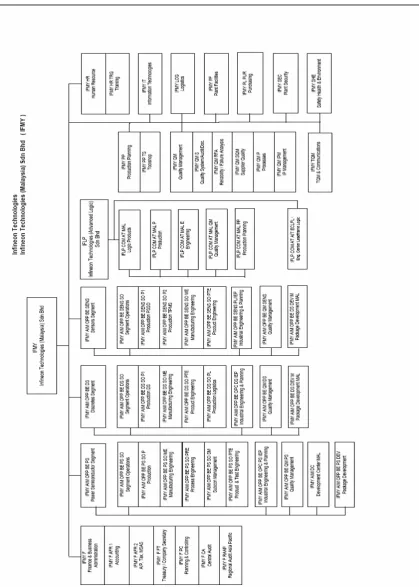
Infineon consists of two main companies which are:
IFMY (Infineon Technologies Malaysia Sdn.Bhd) IFLP (Infineon (Advanced Logic) Sdn.Bhd)
3
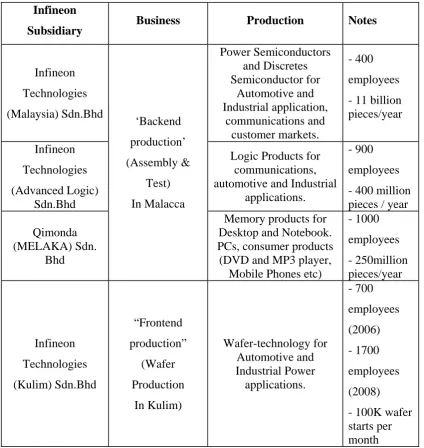
Table 1.1: Infineon Technologies in Malaysia
Infineon
Subsidiary Business Production Notes
Infineon Technologies (Malaysia) Sdn.Bhd Power Semiconductors and Discretes Semiconductor for Automotive and Industrial application, communications and customer markets. - 400 employees - 11 billion pieces/year
Infineon Technologies (Advanced Logic)
Sdn.Bhd
Logic Products for communications, automotive and Industrial
applications.
- 900 employees - 400 million pieces / year
Qimonda (MELAKA) Sdn. Bhd ‘Backend production’ (Assembly & Test) In Malacca
Memory products for Desktop and Notebook. PCs, consumer products (DVD and MP3 player,
Mobile Phones etc)
1.2 Mission & Vision:
1.2.1 Vision
To shape microelectronics by creating innovative products, leading edge
solutions and services for the benefit of our customers and shareholders.
1.2.2 Missions:
To create, manufacture and market the industry’s most advanced
microelectronics product.
To build upon our technological strengths to offer our customer a wade
range of leading edge solutions emphasizing communications, computer. Chip cards and automotive applications.
To attract the best talent worldwide and translate advanced technologies
5
1.2.3 Values:
Never stop thinking
To strive for excellence in people and leadership To act entrepreneurially for the sake of our customer To win together
1.3 Core Business
For business unit, Infineon Technologies is divided into five departments which are:
i) Automotive and Industrial
Produce power semiconductor, opto components, microcontrollers, sensors and discrete semiconductor for automotive applications such as power train management, dynamics systems and safety, body and convenience systems and driver information and in-car entertainment systems. Moreover, it has a wide range of products for industrial applications such as drivers, controls, system for white gods, power supplies and components.
ii) Communication and Peripherals
Produce semiconductors and systems for wired communication applications based on television, PC or wired telephony technologies. This is including communication ICs, computer peripheral components, image and video devices, fiber optic components and infrared
7
iii) Wireless Products
Produce semiconductors and complete system solutions for a range or wireless application including cellular and cordless telephone system and devices used in connection with GPS. Products include standardized base-band ICs(logic and analog) and standardized and customized radio frequency ICs.
iv) Memory Products
Produce the first working DRAM made on 300mm (120) wafer, to our revolutionary new generation of 1 Gigabyte DRAM modules. The memory products are setting the standard for smaller, more powerful, more readily available memory technology.
v) Security & Chip Card ICs
In order to maintain a constant products output to fulfill the market demand and to increase the customer’s satisfaction, Infineon Malacca always seek for a better way to improve the company operation in terms of Human Resource (HR), Financial Controlling (FC), Information Technology (IT), Total quality Management (TQM), Logistic (LOG) and Safety, Health & Environment (SHE).
i) Human Resource (HR)
This department consists of five sections which are the recruitment, payroll, welfare, training and employee relations. All these sections have their own responsibilities and play an important role in Infineon.
ii) Financial Planning (FC)
Also known as the PA, this department is responsible towards the financial part of Infineon. It preserves customer satisfaction by
9
iii) Information Technologies (IT)
The purpose of this department is to provide continuous improvement to business process with IT capabilities. Besides, it is also responsible to provide future IT landscape with central team to construct an IT platform for future business needs.
iv) Total Quality Management (TQM)
This department will ensure the quality of the incoming materials and give services to maintain the very best quality of the products produced by the Infineon’s Business Unit before sending to the valued customers.
v) Logistic(LOG)
vi) Safety, Health &Environment (SHE)
This department is responsible to help to protect all the employees in Infineon Technologies from the accidents and conserving the
environment. Their mission is to create and sustain a culture that produces world-class safety, health and environmental performance in ways that lead to continual improvement in productivity, quality, cost, delivery and morale.
1.4 Project Background
In order for the engineer to identify data retention information and generate data retention report, they need to gather the information from machine’s user interface located in the production and search the lot protocol information in the server. In the same time, to monitor the machine problems, the operators need to manually keep track of the machine problems and then report it to the engineer. This may cause incorrect result due to human error such as forgetting to keep track, writing wrong information, and etc.
For the current practice if the production lot has any problems caused during the process, the engineer need to get the information from various type of system tools in order to complete the Emergency Response Template (ERT) which
summarizes information required for further investigation. Such processes are very time consuming.
11
There might have possibility of wrong calculation by the operator. Therefore engineer might receive wrong information.
In addition, engineer needs to create a report for yield reject every week by using multiple applications. This may causes engineer consume a lot of time to use the applications to create a report.
To overcome the problem, Production Information Tracking System is proposed with the capability to identify data retention information, retrieve machine’s frequency of error, create an Emergency Response Template, visual graphical IC with calculation and yield reject extraction report. This is a new system. The system extracts data from relational database and datawarehouse from
REFERENCES
1. Paquest. Waterfall Model - Paquet
http://newton.cs.concordia.ca/~paquet/wiki/index.php/Waterfall_Model
2. System Development Life Cycle
www.startvbdotnet.com/sdlc/sdlc.aspx
3. Adrian Als & Charles Greenidge. Waterfall Model
http:// scitec.uwichill.edu.bb/cmp/online/cs22l/waterfall_model.htm
4. Reed Sorensen. Comparison of Software Development Methodologies - January 1995
http://www.stsc.hill.af.mil/crosstalk/1995/01/Comparis.asp
5. Paquet. Spiral model - Paquet
http://newton.cs.concordia.ca/~paquet/wiki/index.php/Spiral_model
6. Onine CS Modules: The Spiral Model
http://courses.cs.vt.edu/~csonline/SE/Lessons/Spiral/index.html
7. STSC CrossTalk - The Spiral Model as a Tool for Evolutionary ...
64
8. Paquet. Incremental models - Paquet
http://newton.cs.concordia.ca/~paquet/wiki/index.php/Incremental_models
9. Incremental lifecycle model
http://www.softdevteam.com/Incremental-lifecycle.asp
10. Software Development Lifecycle Models The Basic Types
http://www.idt.mdh.se/~rld/doc/Software%20Development%20Lifecycle%20 Models%20The%20Basic%20Types.pdf
11. vb.net advantage
http://www.kudos-india.com/technology/vb_dot_net1.htm
12 vb.net advantage
http://www.kudos-india.com/technology/vb_dot_net2.htm
13. The C Programming Language
http://www.engin.umd.umich.edu/CIS/course.des/cis400/c/c.html
14. Pooja Bembey, Kuljit Kaur. Microsoft Visual Basic .NET Professional Projects. Premier Press. 2002
15. Herbert Schildt, The CompleteReference, Java 2. McGraw-HIll Companies, Inc. 2002
16. David Flanagan, Java in a Nutshell, 5th Edition. O'Reilly. 2002
17. Jonathan Knudsen, Patrick Niemeyer. Learning Java, 3rd Edition. O'Reilly. 2005
18. MySQL :: MySQL Query Browser
19. David Gallardo. Getting started with the Eclipse Platform
http://www-128.ibm.com/developerworks/opensource/library/os-ecov/?Open&ca=daw-ec-dr
20. Oracle SQL Developer Tutorial