PARALLEL COM PUTING SYSTEM
SAKINAH BINTI ABDUL HANAN
PARALLEL ALGORITHM OF NAVIER-STOKES MODEL FOR MAGNETIC NANOPARTICLES DRUG DELIVERY SYSTEM ON DISTRIBUTED
PARALLEL COMPUTING SYSTEM
SAKINAH ABDUL HANAN
A thesis submitted in fulfillment of the requirements for the award of the degree of
Master of Philosophy
Faculty of Science Universiti Teknologi Malaysia
To
my beloved husband, mother, father,
and brothers
who have always given me love, care and cheer
and whose prayers have always been a source o f great inspiration fo r me.
iv
ACKNOW LEDGEMENT
All praises and thanks are due to Allah for making the completion of this thesis possible. Peace and blessing of Allah be upon Prophet Muhammad (peace be upon him).
First of all, I would like to express my deepest gratitude and thanks to my supervisor, PM Dr Norma Alias for their generous contribution in term of knowledge, expertise and advice that help bring this work to completion. I am especially indebted to PM Dr Norma Alias, for providing me with many years of continuous coaching, guidance, motivation and support. Without her understanding, time and patience, I may not have made it this far. Not to forget she the one who building up my interest and inspired me to develop confidence in this research.
Next, I am grateful to the individuals who have kindly offered their assistance in my time of needs. My special thanks go to Nadia Nofri Yeni, Hazidatul Akma, Siti Hafilah, Masyitah, Maizatul Nadhirah, Nur Hafizah, Akhtar and Imran for their wonderful deeds in sharing with me their knowledge and skills that are relevant to the development of this research. I am also thankful for the valuable friendship that I have obtained from my friends and colleagues who have given me constant advice, help, and encouragement throughout the years of my studies.
vi
ABSTRACT
ABSTRAK
Navier-Stokes pemodelan matematik bersepadu bagi pengangkutan ubat melalui aliran darah dengan menggunakan persamaan pembezaan separa (PDE) dengan satu dimensi (1D) dan dua dimensi (2D), berjenis parabola dalam sistem koordinat silinder dipertimbangkan. Proses nanopartikel magnet melalui sistem peredaran ubat dalam aliran darah diukur dengan mengenal pasti beberapa parameter seperti penghantaran nanopartikel magnet sasaran, aliran darah, pengangkutan momentum, ketumpatan dan kelikatan bagi perlepasan ubat melalui pengantaraan darah, keamatan medan magnet, jejari kapilari dan juga ungkapan pengawalan yang mengawal kelikatan darah. Kaedah beza terhingga (FDM) dengan formula pembezaan tengah telah digunakan untuk mendiskretasikan model matematik tersebut. Kajian ini tertumpu kepada dua jenis pendiskretan yang dikawal oleh parameter pemberat 9 = 1
1
viii
CH APTER TITLE PAGE
DECLARATION ii
DEDICATION iii
ACKNOW LEDGEMENTS iv
ABSTRACT vi
ABSTRAK vii
TABLE OF CONTENTS viii
LIST OF TABLES xiii
LIST OF FIGURES xvi
LIST OF SYMBOLS xxii
LIST OF ABBREVIATIONS xxiv
LIST OF APPENDICES xxv
1 INTRODUCTION
1.1 Research Background 1
1.2 Problem Statement 5
1.3 Objectives 5
1.4 Scope of Study 6
1.5 Significance of Study 8
1.6 Thesis Outline 8
2 LITERATURE REVIEW
2.1 Introduction 12
2.2 Cancer and Tumour Growth Problem 13
2.3 Drug Delivery System 14
2.4 Blood as a Medium of Transportation 15
2.5 Magnetic Nanoparticles 16
2.6 Mathematical Modelling on Magnetic Nanoparticles Drug 18 Delivery System
2.6.1 Partial Differential Equation with Parabolic Type 19
2.6.2 Navier-Stoke Model 21
2.6.3 Optimal Control of Navier-Stokes Model 24
2.7 Finite Difference Method 25
2.7.1 Taylor’s Series Expansion 25
2.7.2 Numerical Schemes 28
2.8 Numerical Iterative Methods 31
2.9 Sequential Algorithm 33
2.9.1 Numerical analysis 34
2.9.1.1 Time execution 34
2.9.1.2 Number of iteration 34
2.9.1.3 Convergence and Maximum error 34
2.9.1.4 Stability 35
2.9.1.5 Consistency 36
2.9.1.6 Root mean square error (RMSE) and 36 Accuracy
2.9.1.7 Computational complexity 36
2.10 Parallel Algorithms 37
2.11 Mathematical Software 42
2.12 Parallel Virtual Machines (PVM) 43
2.12.1 An Overview of PVM 43
2.12.2 Distributed Parallel Computing System (DPCS) 45 Platform
2.12.3 Beowulf Cluster 46
2.13.1 Execution time 49
2.13.2 Speedup 49
2.13.2.1 Amdahl’s law 49
2.13.2.2 Gustafson-Barsis law 50
2.13.3 Efficiency 51
2.13.3 Effectiveness 52
2.13.4 Temporal Performance 52
2.13.5 Granularity 5 3
2.13.6 Communication Cost 54
2.14 Summary of Literature Review 5 5
3 M ATHEM ATICAL M ODELLING OF NAVIER-STOKES MODEL
3.1 Introduction 57
3.2 Formulation of the Mathematical Navier-Stokes Model on 58 Magnetic Nanoparticles Drug Delivery System
3.2.1 The Governing Navier-Stokes Model 59 3.2.2 Non-Dimensionalization the Navier-Stokes 61
Model
3.2.3 Controllability of the 1D Navier-Stokes Model 62 3.3 Discretization of the Navier-Stokes Model 64 3.3.1 Discretization of 1D Navier-Stokes Model 64 3.3.2 Discretization of 2D Navier- Stokes Model 68 3.4 Linear System Equation (LSE) of Navier-Stokes Model 74 3.4.1 Linear System Equation (LSE) for 1D Navier- 75
Stokes Model
3.4.2 Linear System Equation (LSE) for 2D Navier- 76 Stokes Model
3.5 Properties of Parameter 79
3.5 Conclusion 80
x
4 SEQUENTIAL ALGORITHM
4.2 Iterative Methods for Solving 1D Navier-Stokes Model 82 4.2.1 Alternating Group Explicit Method 84
4.2.2 Red Black Gauss Seidel Method 93
4.2.3 Jacobi Method 95
4.3 Iterative Methods for Solving 2D Navier-Stokes Model 98 4.3.1 Alternating Group Explicit Method 100
4.3.2 Red Black Gauss Seidel Method 120
4.3.3 Jacobi Method 122
4.4 Result and Discussion 123
4.4.1 Numerical Result for 1D Iterative Method 124 4.4.2 Numerical Result for 2D Iterative Method 127
4.5 Conclusion 131
5 PARALLEL ALGORITHM
5.1 Introduction 133
5.2 Parallelization of 1D Iterative Methods 135 5.2.1 Parallel Alternating Group Explicit Method 145 5.2.2 Parallel Red Black Gauss Seidel Method 147
5.2.3 Parallel Jacobi Method 150
5.3 Parallelization of 2D Iterative Methods 152 5.3.1 Parallel Alternating Group Explicit Method 158 5.3.2 Parallel Red Black Gauss Seidel Method 160
5.3.3 Parallel Jacobi Method 163
5.4 Result and Discussion 165
5.4.1 Parallel Performance Evaluation for 1D 167 Iterative Methods
5.4.2 Parallel Performance Evaluation for 2D 181 Iterative Methods
5.5 Conclusion 195
6 RESULT AND DISCUSSION
6.1 Introduction 196
6.2.1 Visualization of Navier-Stokes Model using 197 Comsol Multiphysics
6.2.2 Simulation of Navier-Stokes Model 199
6.3 Discussion on Numerical Result 204
6.4 Discussion on Parallel Performance Evaluation 206
6.5 Conclusion 210
7 CONCLUSION AND FUTURE RESEARCH
7.1 Introduction 213
7.2 Conclusion of the Study 213
7.3 Suggestion on Future Research 216
REFERENCES 218
xii
TABLE NO. 2.1 2.2 3.1 4.1 4.2 (a) 4.2 (b) 4.2 (c) 4.3 4.4 4.5 4.6 (a)
LIST OF TABLES
TITLE
Changing parameter of 6
Classifications of parallel computer architecture Properties of parameter values
The computational molecules for 1D SAGE, SRBGS, and SJB
The computational molecules for 2D SAGE The computational molecules for 2D SRBGS The computational molecules for 2D SJB
Numerical result for 1D SAGE, 1D SRBGS and 1D SJB based on execution time, iteration, maximum error and RMSE for IMP, 0 = 1 and CN 6 = 0.5 with m = 100 Numerical result for 1D SAGE, 1D SRBGS and 1D SJB based on execution time, iteration, maximum error and RMSE for IMP 6 = 1 and CN 6 = 0.5 with m = 1000000
Computational Complexity of 1D SAGE, 1D SRBGS, and 1D SJB per iteration
Computational Complexity of 1D SAGE-IMP, 1D SRBGS-IMP, and 1D SJB-IMP for 0 = 1 with m = 100 and m = 1000000
4.6 (b) 4.7 4.8 4.9 4.10 (a) 4.10 (b)
5.1 (a)
5.1 (b)
5.1 (c) 5.2 (a)
5.2 (b)
5.2 (c) 5.3
5.4
Computational Complexity of 1D SAGE-CN, 1D 127 SRBGS-CN, and 1D SJB-CN for 6 = 0.5 with m = 100
and m = 1000000
Numerical result for 2D SAGE, 2D SRBGS and 2D SJB 128 based on execution time, iteration, maximum error and
RMSE for IMP 6 = 1 and CN 6 = 0.5 with m x m = 10 x 10
Numerical result for 2D SAGE, 2D SRBGS and 2D SJB 128 based on execution time, iteration, maximum error and
RMSE for IMP 6 = 1 and CN 6 = 0.5 with m x m = 1000 x 1000
Computational Complexity of 2D SAGE, 2D SRBGS, 130 and 2D SJB per iteration
Computational Complexity of 2D SAGE-IMP, 2D 130 SRBGS-IMP, and 2D SJB-IMP for 6 = 1 with m x
m = 10 x 10 and m x m = 1000 x 1000
Computational Complexity of 2D SAGE-CN, 2D 130 SRBGS-CN, and 2D SJB-CN for 6 = 0.5 with m x
m = 10 x 10 and m x m = 1000 x 1000
The domain decomposition 1D molecule of PAGE 139 method.
The domain decomposition 1D molecule of PRBGS 140 method.
The domain decomposition 1D molecule of PJB method. 141 The domain decomposition 2D molecule of PAGE 154 method
The domain decomposition 2D molecule of PRBGS 155 method
The domain decomposition 2D molecule of PJB method 156 Computational Complexity of 1D PAGE, 1D PRBGS 168 and 1D PJB
5.5
5.6
5.7
5.8
5.9
5.10
5.11
5.12
5.13
5.14
Parallel performance evaluations of 1D PAGE-IMP, 1D 169 PRBGS-IMP and 1D PJB-IMP based on execution time,
speedup, efficiency, effectiveness and temporal performance for IMP scheme 9 = 1
Granularity of 1D PAGE-IMP, 1D PRBGS-IMP and 1D 173 PJB-IMP for IMP scheme 6 = 1
Parallel performance evaluations of 1D PAGE-CN, 1D 175 PRBGS-CN and 1D PJB-CN based on execution time,
speedup, efficiency, effectiveness and temporal performance for CN scheme 0 = 0.5
Granularity of 1D PAGE-CN, 1D PRBGS-CN and 1D 180 PJB-CN for CN scheme 6 = 0.5
Computational Complexity of 2D PAGE, 2D PRBGS 181 and 2D PJB
Communication cost of 2D PAGE, 2D PRBGS and 2D 181 PJB for IMP, 0 = 1 and CN, 6 = 0.5
Parallel performance evaluations of 2D PAGE-IMP, 2D 182 PRBGS-IMP and 2D PJB-IMP based on execution time,
speedup, efficiency, effectiveness and temporal performance for IMP scheme 6 = 1
Granularity of 2D PAGE-IMP, 2D PRBGS-IMP and 2D 187 PJB-IMP for IMP scheme 6 = 1
Parallel performance evaluations of 2D PAGE-CN, 2D 188 PRBGS-CN and 2D PJB-CN based on execution time,
speedup, efficiency, effectiveness and temporal performance for Crank Nicolson scheme 6 = 0.5.
xvi
FIGURE NO. TITLE PAGE
1.1 Structure of Nanoparticle 1
1.2 Structure of nanoparticle platforms for drug delivery 2
1.3 The scope of research 7
1.4 An overview of the thesis research 11
2.1 Tumour grows on beginning cancer to diffusion- 13 limited maximal size.
2.2 Magnetic nanoparticles-based drug delivery due to the 18 x direction of magnetization oriented perpendicular to
the direction of blood vessel feeding the target cells.
2.3 Illustrate infinitesimally small 22
2.4 Finite Difference Grid Point Representation 26 2.5 Basic Sequential Algorithm of Numerical Iterative 33
Methods
2.6 Four stages in designing the parallel algorithms 40 2.7 Basic Parallel Algorithm of Numerical Iterative 41
Methods
2.8 Communication procedure for sending and receiving 44 message between adjacent processors
2.9 (a) Schematic diagram Beowulf cluster of PVM by star 47 network topology at the Ibnu Rush Lab, UTM.
2.9 (b) The facilities Beowulf cluster of PVM by star network 48 topology at the Ibnu Rush Lab, UTM.
2.10 Speedup versus number of processors 51
4.1 The sequential algorithms 82
4.2 The Calculation of AGE Method 84
4.3 The algorithm of 1D SAGE 93
4.4 The grid of red and black points 94
4.5 The algorithm of 1D SRBGS 95
4.6 The algorithm of 1D SJB 98
4.7 The algorithm of 2D SAGE 120
4.8 The algorithm of 2D SRBGS 121
4.9 The algorithm of 2D SJB 123
5.1 Communication for master - slave Model for PVM 134
5.2 The parallel algorithms 135
5.3 Regular memory space allocated for 1D problem 136 5.4 (a) Domain decomposition technique for 1D and
(b) Communication between slaves
137
5.4 (c) Domain decomposition of 1D problem with neighbour subdomain
138
5.5 Data distribution algorithm for 1D 141
5.6 Communication activities for sending and receiving process by slaves for 1D
142
5.7 Master algorithm for global convergence test for 1D 143 5.8 Slave algorithm for local convergence test for 1D 144 5.9 Data partitioning by number of processors 145 5.10 Communication activities in sending and receiving
points for 1D PAGE
146
5.11 The parallel algorithms of 1D PAGE 146
5.12 1D PRBGS ordering 147
.13 (a) Communication activities in sending and receiving red points for 1D PRBGS
148
5.14 The parallel algorithms of 1D PRBGS 149 5.15 Communication activities in sending and receiving 150
points for 1D PJB
5.16 The parallel algorithms of 1D PJB 151
5.17 Regular memory space allocated for 2D problem 152 5.18 (a) Domain decomposition technique for 2D and 153
(b) Communication between slaves
5.19 Communication activities for sending and receiving 156 process by slaves for 2D
5.20 Master algorithm for global convergence test for 2D 157 5.21 Slave algorithm for local convergence test for 2D 158 5.22 Communication activities in sending and receiving 159
lines for 2D PAGE
5.23 The parallel algorithms of 2D PAGE 160
5.24 (a) Communication activities in sending and receiving red 161 points for 2D PRBGS
5.24 (b) Communication activities in sending and receiving 162 black points for 2D PRBGS
5.25 The parallel algorithms of 2D PRBGS 162
5.26 Communication activities in sending and receiving 164 lines for 2D PJB
5.27 The parallel algorithms of 2D PJB 164
5.28 (a) Speedup versus number of processors at different 166 value matrix m for 1D problem
5.28 (b) Speedup versus number of processors at different 166 value matrix m x m for 2D problem
5.29 (a) Time execution versus number of processors for 1D 170 IMP, 0 = 1
5.29 (b) Speedup versus number of processors for 1D IMP, 170 6 = 1
5.29 (c) Efficiency versus number of processors for 1D IMP, 171 6 = 1
5.29 (e) 5.29 (f) 5.30 (a) 5.30 (b) 5.30 (c) 5.30 (d) 5.30 (e) 5.30 (f)
5.31 (a)
5.31 (b)
5.31 (c)
5.31 (d)
5.31 (e)
5.31 (f)
5.32 (a)
Temporal performance versus number of processors 172 1D IMP, for 0 = 1
Granularity versus number of processors for 1D IMP, 174 0 = 1
Time execution versus number of processors for 1D 176 CN, e = 0.5
Speedup versus number of processors for 1D CN, 177 6 = 0.5
Efficiency versus number of processors for1D CN, 177 6 = 0.5
Effectiveness versus number of processors for 1D CN, 178 6 = 0.5
Temporal performance versus number of processors 178 for 1D CN, 6 = 0.5
Granularity versus number of processors for 1D CN, 179 6 = 0.5
Time execution versus number of processors for 2D 183 IMP, 0 = 1
Speedup versus number of processors for 2D IMP, 183 6 = 1
Efficiency versus number of processors for 2D IMP, 184 6 = 1
Effectiveness versus number of processors for 2D 185 IMP, 6 = 1
Temporal performance versus number of processors 185 for 2D IMP, 6 = 1
Granularity versus number of processors for 2D IMP, 186 6 = 1
5.32 (b) Speedup versus number of processors for 2D CN, 190 6 = 0.5
5.32 (c) Efficiency versus number of processors for 2D CN, 191 6 = 0.5
5.32 (d) Effectiveness versus number of processors for 2D CN, 191 6 = 0.5
5.32 (e) Temporal performance versus number of processors 192 for 2D CN, 6 = 0.5
5.32 (f) Granularity versus number of processors for 2D CN, 193 6 = 0.5
6.1 A diagram shows the operating principle of the drug 198 delivery device. The colour in the droplet represents
drug concentration, with red indicating a higher concentration and blue indicating zero concentration. Note that the membrane length is not shown to scale.
6.2 The movement and the total displacement of 198 nanoparticle encapsulated drug at the peak load of (a)
t = 0 sec, (b) t = 0.2 sec, (c) t = 0.4 sec, (d) t = 0.6 sec, (e) t = 0.8 sec and (f) t = 1.0 sec.
6.3 (a) Velocity profile for blood for different time 200 6.3 (b) Velocity profile for magnetic nanoparticles for 200
different time
6.4 Velocity distribution of magnetic nanoparticles for 201 different distances (y) between the capillary wall and
magnet
6.5 Velocity profile for blood and magnetic nanoparticles 202 with t = 0.4 sec and y = 8 cm
6.6 (a) Velocity profile for blood with t = 0.4 sec and y = 203 8 cm
6.6 (b) Velocity profile for magnetic nanoparticles with t = 203 0.4 sec and y = 8 cm
6.7 The visualization of different function of 204 controllability expression
6.8 (a) Time execution versus number of processors 207
6.8 (b) Speedup versus number of processors 207
xxii
u - Velocity of blood (m/s)
v - Velocity of magnetic nanoparticles (m/s) P - Pressure (Pa)
^ - Viscosity of blood (kg/ms)
Rm - Radius of magnetic nanoparticles (m)
v - Kinematic viscosity R - Radius of capillary (m) H - Magnetic intensity
M - Magnetization of particles (A/ m-1) B - Magnetic induction
X - Magnetic susceptibility of the particle - Permeability of free space
VM - Volume of MNP (m3)
m - Mass of MNP (kg)
p - Density of blood (kg/m3) pp - Density of MNP (kg/m3)
N - Number density of suspended nanoparticles A - Stokes’ coefficient
t - Time (s)
r - Grid in r direction (m) x - Grid in x direction (m)
z - Grid in z direction (m) Tp - Execution time
Sp - Speedup
Ep - Efficiency Fp - Effectiveness
Lp - Temporal performance
G - Granularity
Tcomp - Computational time Tcomm - Communication time
Tidie - Idle time
xxiv
1D - One Dimension
2D - Two Dimension
AGE - Alternating Group Explicit
DPCS - Distributed Parallel Computing System FDM - Finite Difference Method
JB - Jacobi
LSE - Linear System Equation
MDCS - MATLAB Distributed Computing Server MNPs - Magnetic Nanoparticles
MPI - Message Passing Interface ODE - Ordinary Differential Equation PAGE - Parallel Alternating Group Explicit PDE - Partial Differential Equation PJB - Parallel Jacobi
PRBGS - Parallel Red Black Gauss Seidel PVM - Parallel Virtual Machines RBGS - Red Black Gauss Seidel
SAGE - Sequential Alternating Group Explicit SJB - Sequential Jacobi
LIST OF APPENDICES
APPENDIX TITLE PAGE
A Some common PVM routines 229
B Table of Literature Review 230
C.1 Discretization of Controllability 1D Navier-Stokes 240 Model
CHAPTER 1
INTRODUCTION
1.1 Research Background
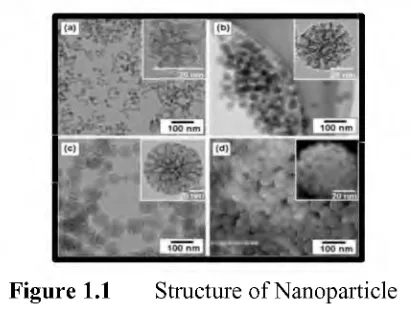
Nanotechnology is a general purpose technology because of its important effects that are related to most of the industries and people. Nanotechnology can be applied to many areas of research and development such as medicine, manufacturing, computing, textiles and cosmetics (Dutta, 2015). Nanotechnology is defined as ‘engineering at a very small scale’ which is shown through a nanoparticle range from 1 to 100 nanometers (nm) (Gupta, 2014). In others description, Figure 1.1 shows structure of nanoparticles with a range of structure size starting from 1 to 100 nm (Taylor et al, 2013).
Figure 1.1 Structure of Nanoparticle
development in the context of nanomedicine should be viewed as science and technology of nanometer scale complex systems. The nanoparticles that are created for drug delivery purposes are defined as small particles (< 100nm). This definition includes nanospheres which the drug is absorbed, dissolved or dispersed throughout the matrix; and nanocapsules in which the drugs are limited to an oily core that surrounded by the shell-like wall (Kreuter, 2004).
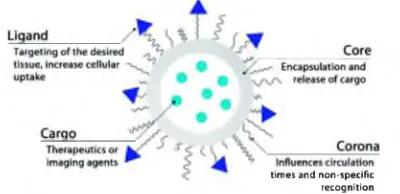
The nanoscale devices allow the chemotherapeutic drug to be discharged into the blood vessels, spreading out through the tissue and gaining access to the tumour cells location. Nowadays, drug delivery system is notable for its capabilities when compared to traditional delivery via bolus injection (Allen and Cullis, 2004). The structure of nanoparticle platforms for drug delivery is shown in Figure 1.2 (Schoonen and van Hest, 2014).
The potential of nanoparticles delivery systems provides chances to diversify the drug delivery approaches or therapeutic options in cancer disease treatment (Gabathuler, 2010). However, Timchack (2008) said that the drug delivery system is being designed to ensure an efficient therapy which meant that no harmful side effects for the body cells and therefore improving the patient life quality. In other words, there should be minimal damage inflicted to the healthy cells within the body while ensuring a good recovery progress.
Lifelong diseases such as cancers or tumour growths are common among people nowadays. Hence, more studies and researches are needed to be carried out so that the crucial effects of nanoparticles drug delivery systems can be understood more thoroughly. Drug delivery systems are recommended particularly as the alternatives
tim es a n d non-specific recognition
3
in the form of nanoparticles in order to maintain the effectiveness of the new drugs that been developed which are more potent and more complex ever before. Magnetic nanoparticles platform has the ability to let the physicians detect and treat diseases such as cancer and cardiovascular disease more effectively than before (Baptista et al, 2013).
The unique advantages of an external magnetic field control have achieved the purpose of targeted delivery because they can be remotely navigated to the intended site via application of an external magnetic field gradient. Magnetic therapy is widely used to assist in curing various diseases. The drug that possessed magnetic nanoparticles properties will be easier to be controlled by external magnetic field and it has potential therapeutic usage in the cancer cells as well as helps in controlling the blood pressure in the blood medium (Kumar and Mohammad, 2011). At stationary position, the transverse magnetic field is applied externally to a moving electrically conducting fluid where electrical currents are induced in the fluid. The interaction between these induced currents and the applied magnetic field produces body forces with a tendency to move slowly along with the movement of blood and bring the drug to the targeted cells (Sun et al, 2008).
Mathematical models have been developed in order to understand the process of magnetic nanoparticle drug delivery system. The development of mathematical model is to predict, design and control the movement of drug delivery through blood medium controlling by external magnetic fields. Parameters during the process can be range from very simple to complex in order to upgrade the quality of the system. Some authors in the area of blood flow feel that blood can be assumed as Newtonion in nature especially in large blood vessels. In Wang et al. (2014), the flow treatment of blood has been assumed to be Newtonian fluid and flow as laminar, incompressible, unsteady and the flow field is simulated by solving the Navier-Stokes equation.
widely used to solve the models (Siepmann, 2008; Palazzo et al, 2005; Dev et al, 2003). However, the FDM scheme is chosen because this method is simple to formulate a set of discretized equations from the transport differential equations in a differential manner (Mitchell and Griffiths, 1980). Besides, this method is straightforward in determining the unknown values. Only a few researchers in magnetic nanoparticles drug delivery system solved the model using numerical methods. Thus, due to this reason, the mathematical Navier-Stokes model magnetic nanoparticles drug delivery system in this research is solved using FDM. Further details of FDM will be discussed in Chapter 2.
A large scale of system linear of equations is discretized from the FDM for simulation and visualization. However, one central processing unit (CPU) is not enough to compute the large computation. Therefore, the parallelization in solving the large scale of system linear of equations is great importance. The objective is to speed up the computation and increase the efficiency by using massively parallel computers. The domain problem is partitioned into subdomain or equal sized tasks. Then, the tasks are connected to each other local and global communication. Static mapping strategy is implemented because this research focuses on the distributed parallel computing architecture. Further detail to describe the parallel algorithm design methodology is discussed in Chapter 2.
5
analysed in reference to the numerical result and parallel performances evaluation (PPE).
1.2 Problem Statement
Magnetic nanoparticle drug delivery system is closely related with biomechanical researchers due to its relationship with cancerous cell or tumour. Some problem statements will be explored and discussed through this research. Firstly, on how to model the mathematical modelling and illustrating the visualization of magnetic nanoparticles drug within its delivery to the specific targeted cell. The integrated mathematical modelling that uses Navier-Stokes model with continuity and momentum equations that are related to parameter changes is developed. Thereafter, the 1D and 2D model with parabolic type equations are solved by the weighted parameter central FDM in order to obtain the results. The discretized computational is conducted for 6 = 1 and 6 = -, which represent Implicit (IMP) and Crank Nicolson (CN) schemes respectively. Dealing with nanoscale phenomena system with large sparse matrices. By applying some iterative numerical methods, the impact of domain decomposition techniques, message passing model and grid generation technique can be stimulated. Furthermore, the implementation of sequential and parallel algorithms on the PDE is generated by some numerical iterative methods such as Alternating Group Explicit (AGE), Red Black Gauss Seidel (RBGS) and Jacobi (JB). PPE will be conducted to measure the superiority of generate FDM schemes in solving the PDEs.
1.3 Objectives
The objectives of the study are:
2. To discretize the mathematical models using weighted parameter central FDM involving a number of parameter changes for the large sparse data set.
3. To develop the sequential and parallel algorithms for the Navier-Stokes model based on three different numerical iterative methods; AGE, RBGS and JB.
4. To analyze the results of 1D and 2D based on the numerical results and PPE in solving the Navier-Stokes model.
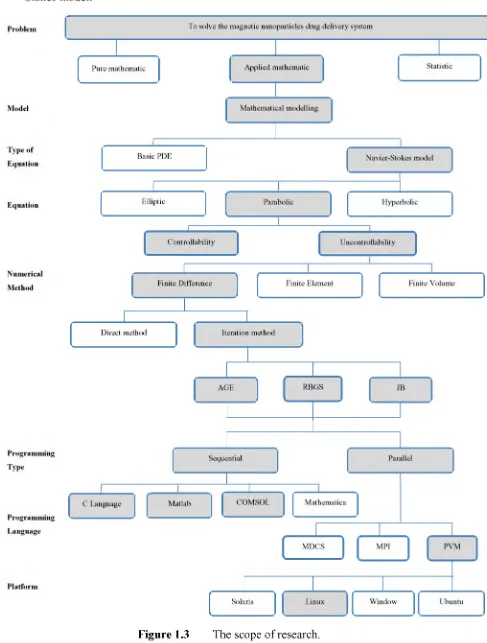
1.4 Scope of Study
7
method of FDM is being observed and utilized in the solution process of the Navier- Stokes model.
1.5 Significance of Study
The magnetic nanoparticles for the drug delivery model are significant in the process of developing the alternative numerical simulation for the treatment of the cancer cell growth. The application of nanoparticles is assumed to be the solution for early detection of tumour cell growth. The importance of the Navier-Stokes model in predicting and visualizing the parameters involved to deliver the magnetic nanoparticles towards the targeted cells. The implementation of the numerical iterative methods such as AGE, RBGS and JB methods are suitable to solve the 1D and 2D model. Besides, the simulation of large sparse matrix for the multidimensional models on DPCS will help reduce the execution time and increases the performance of speedup. In addition, the approximation result uses parallel computing which is a fast prediction of the movement of the magnetic nanoparticles through the blood medium. This medical practice is related to the evolution of biological systems in cancer cells treatment. Furthermore, this research is beneficial to the cancer patients and doctors who are working on the cancer diagnostics and cancer treatments through efficient stimulation and coordination.
1.6 Thesis Outline
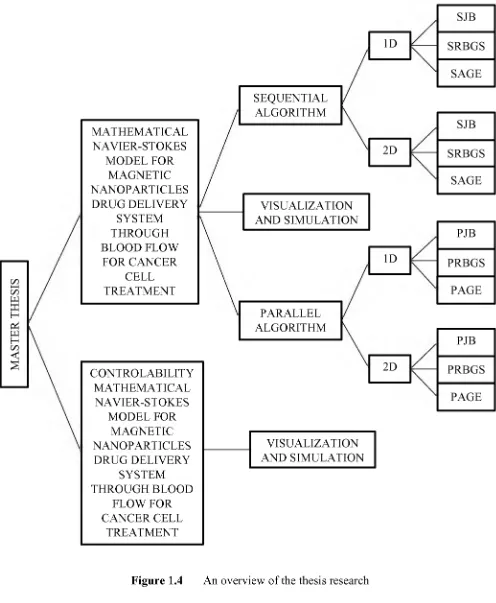
The contents of this research can be divided into seven chapters which includes an introduction, literature review, mathematical modelling, implementation of the sequential algorithm, implementation of the parallel algorithm, result, discussion, and conclusion. Chapter 1 starts with a brief discussion on the introduction, problem formulating, research objectives, the scope of research, significance of study and the thesis outlines.
9
drug delivery is portrayed as the solution to the problem. The mathematical modelling is used to deal with PDE with parabolic type. Some common methods that are used to solve this mathematical modelling are the formulation of FDM and weighted average parameter. The classical and advanced iterative methods are also being highlighted. Besides, the computational solution of the sequential and parallel algorithm with the use of common mathematical software and DPCS are also being studied. This chapter also includes the importance and purpose of mathematical modelling in predicting the magnetic nanoparticle drug delivery within the cancer cell treatment. Some important terms that are related to numerical analysis and PPE such as convergence, consistency, stability, speedup, efficiency, effectiveness, temporal performance and granularity are also discussed in the chapter.
The scope in Chapter 3 is focused on the integrated mathematical modelling that is based on the theory of Navier-Stokes model in the fluid dynamic for blood flow which are the mass (continuity) and momentum conservation equation for 1D and 2D model. The flow is expected to take place under the influence of externally applied magnetic field in the axial direction. The equation of continuity is integrated into each other together with the equation of momentum equation. The governing equations for 1D and 2D are written in the cylindrical coordinate system (r, z, 0). Discretization by weighted parameter with the usage of the central FDM as well as LSE is also being discussed in this chapter. Finally, the presence of controllability expression is injected to 1D Navier-Stokes model due to control of the concentration of blood in capillary that influenced the magnetic nanoparticle drug delivery system will be developed.
The contribution of Chapter 4 is the development of sequential algorithms of the magnetic nanoparticle drug delivery model for 1D and 2D. The continuity and momentum equation will be solved using some numerical iterative methods. The numerical iterative methods mentioned are AGE (1D SAGE and 2D SAGE), RBGS (1D SRBGS and 2D SRBGS) and JB (1D SJB and 2D SJB) method. These numerical method are compared according to the execution times, number of iterations, maximum errors and root mean square errors (RMSE).
large sparse matrix and nanoscale problem. The parallelization of the multidimensional equation will use the same numerical methods discussed in Chapter 4. The parallel algorithm is implemented on PVM with distributed memory within the message passing environment. The numerical methods are parallelized into 1D PAGE, 2D PAGE, 1D PRBGS, 2D PRBGS, 1D PJB and 2D PJB. The performances are measured based on speedup, efficiency, effectiveness, temporal performance and granularity.
The numerical results and the PPE obtained from Chapter 4 and Chapter 5 are then discussed in Chapter 6. The visualization of the mathematical model is simulated by using Comsol Multiphysic in 3D simulation and Matlab R2013a stimulation for 1D and 2D mathematical model. To validate the results obtained, a comparison of the velocity of the blood and velocity of drug magnetic nanoparticle is made with Mishra et al. (2008) as a limiting case where it involved 1D model. Simulation of controllability expression in 1D mathematical modelling is simulated by using Matlab R2013a. The mathematical modelling which are related to Navier-Stokes magnetic nanoparticle drug delivery model of 1D and 2D model are analysed based on the numerical analysis and PPE by comparing between two type of schemes and three types of numerical iterative method.
M A S T E R TH ESI S 11 MATHEMATICAL NAVIER-STOKES MODEL FOR MAGNETIC NANOPARTICLES DRUG DELIVERY SYSTEM THROUGH BLOOD FLOW FOR CANCER CELL TREATMENT CONTROLABILITY MATHEMATICAL NAVIER-STOKES MODEL FOR MAGNETIC NANOPARTICLES DRUG DELIVERY SYSTEM THROUGH BLOOD FLOW FOR CANCER CELL TREATMENT SEQUENTIAL ALGORITHM SJB 1D SRBGS SAGE SJB 2D SRBGS SAGE VISUALIZATION AND SIMULATION PARALLEL ALGORITHM PJB 1D PRBGS PAGE PJB 2D PRBGS PAGE VISUALIZATION AND SIMULATION
R EFE R E N C E S
Ab Rahman, A. (2005). Kaedah Berangka Permulaan (3rd ed). Singapore: McGrawHill.
Abdullah, A. R. (1991). The four point Explicit Decoupled Group (EDG) method:
A fast Poisson solver. International Journal o f Computer Mathematics, 38(1-2): 61-70.
Acheson, D. J. (1990). Elementary fluid dynamics. Oxford University Press. Aggarwal, A ., Chhajer, P., and Maheshwari, S. (2012). Magnetic drug delivery in
therapeutics. International Journal o f Pharmaceutical Sciences and Research,3(12): 46-70.
Akbarzadeh, A ., Samiei, M., and Davaran, S. (2012). Magnetic nanoparticles:
preparation, physical properties, and applications in biomedicine.
Nanoscale research letters. 7(1): 1-13.
Alexiou, C., Tietze, R., Schreiber, E., Jurgons, R., Richter, H., Trahms, L., and
Lyer, S. (2011). Cancer therapy with drug loaded magnetic
nanoparticles— magnetic drug targeting. Journal o f Magnetism and Magnetic Materials. 323(10): 1404-1407.
A lexis F, Rhee J.W, Richie J.P, Radovic-Moreno A.F, Langer R, Farokhzad O.C
(2008). N ew frontiers in nanotechnology for cancer treatment. Urol Oncol. 26:74-85.
Alias N, Anwar R, Che The C.R, Satam N, Hamzah N, Abd. Ghaffar Z.A, Darwis
R, Islam M.R (2011). Performance evaluation o f Multidimensional
Parabolic Type Problems on distributed computing systems. IEEE explorer. 978-1-4577-0681-3/11.
Alias N, Farhah H ,Mustaffa, Nadirah M (2014) Parallel performance comparison
o f alternating group explicit method between parallel virtual machine and
matlab distributed computing for solving large sparse partial differential
equations. Advanced Science Letters,20: 477-482.
Alias, N. and M. R. Islam,. (2010) A Review o f the Parallel Algorithms for Solving
219
Alias, N., and Islam, M. R. (2013). Parallel AGE solver o f multidimensional PDE
modelling for Thermal Control o f Laser Beam on Cylindrical Glass. 9th
International Conference on Fracture & Strength o f Solids June 9-13,
2013, Jeju, Korea.
Alias, N ., Berahim, M., Ghaffar, A ., Safiza, Z., Islam, M., & Hamzah, H. (2009a).
Some numerical methods on temperature and mass transfer on dehydration
o f tropical fruits. Simposium Kebangsaan Sains M atem atik ke-17 (SKSM
17), H otel Mahkota, Melaka.
Alias, N ., Darwis, R., Satam, N ., and Othman, M. (2009b). Parallelization o f
temperature distribution simulations for semiconductor and polymer
composite material on distributed memory architecture. Parallel
Computing Technologies. 10(1): 392-398.
Alias, N ., Islam, M. R., Ahmad, T., & Razzaque, M. A ., (2013). Sequential
Analysis o f Drug Encapsulated Nanoparticle Transport and Drug Release
Using Multicore Shared-memory Environment. 4th ICOWOBAS-RAFSS
2013, Johor Bahru, M alaysia. 3-5 September 2013.
Alias, N., Islam, M. R., Mydin, S., Hamzah, N ., Ghaffar, Z. S. A ., Satam, N ., &
Darwis, R. (2009) Grid Portal Technology For Web Based Education O f
Parallel Computing Courses, Applications and Researches. W eb-based
Education (WBE 2009) March 16 - 12, Phuket, Thailand.
Alias, N ., Masseri, M., Safa, I., Islam, M., and Khalid, S. N. (2009). The
visualization o f three dimensional brain tumours' growth on distributed
parallel computer systems. Journal o f A pplied Sciences. 9(3): 505-512.
Allen, T. M., and Cullis, P. R. (2004). Drug delivery systems: entering the
mainstream. Journal o f Science. 303(5665): 1818-1822.
Amdahl, G. M. (1967). Validity o f the single processor approach to achieving large
scale computing capabilities. Proceedings o f the A pril 18-20,1967, spring
jo in t computer conference. 483-485.
American Cancer Society. (2013) H eredity and Cancer retrieved 22 July 2013
Ames, W. F. (2014). Numerical methods for partial differential equations.
Academ ic press.
Anderson, J. D., and Wendt, J. F. (1995). Computational flu id dynamics (Vol.
Arruebo, M., Fernandez-Pacheco, R., Irusta, S., Arbiol, J., Ibarra, M. R., &
Santamaria, J. (2006). Sustained release o f doxorubicin from zeo
lite-magnetite nanocomposites prepared by mechanical activation.
Nanotechnology, 17(16): 4057.
Babu, A ., Templeton, A. K., Munshi, A., and Ramesh, R. (2013).
Nanoparticle-based drug delivery for therapy o f lung cancer: progress and challenges.
Journal o f Nanomaterials. 14(1): 12-22.
Bader, D. A., Hart, W. E., and Phillips, C. A. (2005). Parallel algorithm design for
branch and bound. In Tutorials on Emerging M ethodologies and
A pplications in Operations Research. 5-1
Balaita, L., and Popa, M. (2009). Polymer Magnetic Particles in Biomedical
Applications. Revue Roumaine de Chimie. 54(3): 185-199.
Baptista, A ., Soares, P., Ferreira, I., and Borges, I. P. (2013). Nanofibers and
nanoparticles in biomedical applications. Bioengineered N anom aterials,
65: 98-100.
Barney, B. (2010). Introduction to parallel computing. Lawrence Livermore
N ational Laboratory. 6(13): 10.
Barrett ,R., Berry, M., Chan, T. F., Demmel, J., Donato, J. M., Dongarra, J.,
Eijkhout ,V., Pozo, R., Romine, C., and Vorst, H. V.,(2000). Templates
f o r the Solution o f Linear Systems:Building Blocks f o r Iterative Methods.
Second Edition.
Becker, D. J., Sterling, T., Savarese, D., Dorband, J. E., Ranawak, U. A ., and
Packer, C. V. (1995). BEOWULF: A parallel workstation for scientific
computation. In Proceedings, International Conference on Parallel
Processing, 95: 11-14.
Bellomo, N ., Elaiw, A., Althiabi, A. M., and Alghamdi, M. A. (2015). On the
interplay between mathematics and biology: Hallmarks toward a new
systems biology. Physics o f life review s, 12: 44-64.
Benard, N ., Coisne, D., Donal, E., and Perrault, R. (2003). Experimental study o f
laminar blood flow through an artery treated by a stent implantation:
characterization o f intra-stent wall shear stress. Journal o f biom echanics,
36(7): 991-99.
Boudreau, B. P. (1997). Diagenetic models and their implementation. Berlin:
221
Brannon-Peppas, L., and Blanchette, J. O. (2012). Nanoparticle and targeted
systems for cancer therapy. A dvanced drug delivery reviews. 64: 206-212.
Chauhan, V. P., Martin, J. D., Liu, H., Lacorre, D. A ., Jain, S. R., Kozin, S. V, and
Popovic, Z. (2013). Angiotensin inhibition enhances drug delivery and
potentiates chemotherapy by decompressing tumour blood vessels. Nature
communications, 4.
Che Rahim, C. T. (2005). Persamaan Pembeza Separa. Kaedah Berangka:
Matematik untuk Sains dan Kejuruteraan menggunakan MAPLE. Johor
Bharu: Universiti Teknologi M alaysia. 239-284.
Chien, A. A ., Jan, J. K., and Kim, J. H. (1995). Planar-adaptive routing: low-cost
adaptive networks for multiprocessors. Journal o f the ACM. 42(1): 91
123.
Che Rahim, C. T. (2009). Numerical Method: Algorithm and Matlab
Programming. Third Edition. Johor: Universiti Teknologi Malaysia.
Christian G., Hans-G., Roos and Martin S. (2007). Numerical Treatment o f Partial
Differential Equations. Springer Science & Business M edia. 23.
Chu, K. F., and Dupuy, D. E. (2014). Thermal ablation o f tumours: biological
mechanisms and advances in therapy. Nature Reviews Cancer. 14(3): 199
208.
Chung, Y. L. (1994). Applied Numerical Methods For Partial Differential
Equations. F irst Edition. Singapore: Prentice Hall.
Cohen, H., (2011). Numerical Approximation Methods, London: Springer.
Cornelis, F., Saut, O., Cumsille, P., Lombardi, D., Iollo, A., Palussiere, J., and
Colin, T. (2013). In vivo mathematical modelling o f tumour growth from
imaging data: Soon to come in the future?. D iagnostic and interventional
imaging. 94(6): 593-600.
Couvreur, P. (2013). Nanoparticles in drug delivery: past, present and future.
Advanced drug delivery reviews. 65(1): 21-23.
Crank, J., and N icolson, P. (1947). A practical method for numerical evaluation o f
solutions o f partial differential equations o f the heat-conduction type.
M athematical Proceedings o f the Cambridge Philosophical Society.
43(1): 50-67.
D ev S. B., Dhar D., and Krassowska W. (2003). Electric field o f a six-needle array
numerical solution. IEEE transactions on biom edical engineering. 50(11):
1296-1300.
Di, L., and Kerns, E. H. (2015). Drug-like properties: concepts, structure design
and methods from ADM E to toxicity optimization. Academic Press is an
imprint o f Elsevier.
Diaz-Viera, M.A., Lopez, D.A, Bertchier, A.M., Tapia, O. A, (2008). COMSOL
Implementation o f a Multiphase Fluid Flow Model in Porous Media.
Proceedings o f the COMSOL Conference 2008 B oston.
Dutta, J. (2015). Nanotechnology in the developing world. A sia Nano Forum. 41
50
Eftimie, R., Bramson, J. L., and Earn, D. J. (2011). Interactions between the
immune system and cancer: a brief review o f non-spatial mathematical
models. Bulletin o f M athematical Biology. 73(1): 2-32.
Elfying, T., (1980), Block -Iterative Methods for Consisntent and Inconsistent
Linear Equations, Numerische Mathematik, 35:1-12.
Evans, D., and Abdullah, A. (1983). Group explicit methods for parabolic
equations. International jo u rn al o f computer mathematics, 14(1), 73-105.
Evans, D. J., & Sahimi, M. S. (1988). The alternating group explicit (AGE)
iterative method for solving parabolic equations I: 2-dimensional
problems. International jo u rn a l o f computer mathematics. 24(3-4): 311
341.
Farokhzad O.C, Langer R (2009). Impact o f nanotechnology on drug delivery.
AC S Nano. 3:16-20.
Feng, Q. (2009). Alternating group iterative method for diffusion equations.
A ppliedM athem atic Sciences, 3:1393-1399.
Flynn, M. (1972). Flynn’s Taxonomy. Encyclopedia o f P arallel Computing. 689
697.
Fornberg, B., and Lehto, E. (2011). Stabilization o f RBF-generated finite
difference methods for convective PDEs. Journal o f Computational
Physics. 230(6): 2270-2285.
Foster, I. (1996). Compositional Parallel Programming Languages, A C M
Transactions on Programming Languages and Systems. 18(4):454-476.
Friedman, A. (2013). Partial differential equations o f parabolic type. Courier
223
Gabathuler, R. (2010). Approaches to transport therapeutic drugs across the
blood-brain barrier to treat brain diseases. N eurobiology o f disease, 37(1):
48-57.
Geist, A. (1994). PVM: Parallel virtual machine: a users' guide and tutorial for
networked parallel computing. MIT press.
Goldsmith, M. E. (2014). The Mode and Meaning of1 Beowulf1. A&C Black.
Grossfeld G.D., Carrol P.R., Lindeman N. (2002). Thrombospondin-1 expression
in patients with pathologic state T3 prostate cancer undergoing radical
prostatectomy: association with p53 alterations, tumour angiogenesis and
tumour progression, Urology. 59: 97-102.
Gummere F. B. (1909). The Oldest English Epic: Beowulf, Finnsburg, Waldere,
Deor, Widsith, and the German Hildebrand. Macmillan.
Gupta, S. R. N. (2014). Advances in Molecular Nanotechnology from Premodern
to Modern Era. International Journal M aterial Sciences Engineering, 2:
2.
Hargrove, W. W. (1999). Cluster computing: Linux taken to the extreme. Linux
Magazine. 1(1): 56-59.
Harwood, A. (2006). An implementation o f the message passing interface over an
adaptive peer-to-peer network. High Performance D istributed Computing,
2 0 0 6 15th IEEE International Symposium. 15(1): 371-372.
Hossain S.S, Hossainy F.A., Bazilevs Y, Victor M.C, Thomas J.R. (2010).
Mathematical M odelling o f Coupled Drug and Drug-Encapsulated
Nanoparticle Transport in Patient Specific Coronary Artery Walls. The
Institute f o r Computational Engineering and Sciences. ICES REPORT 10
41.
Ilyas, M., & Mouftah, H. T. (Eds.). (2003). The Handbook o f optical
communication networks. Chemical Rubber Company Press.
Jin, Y., Jin, G., and Ma, T. (2010). N ew parallel three-level iterative method for
diffusion equation. Information Technology Journal, 9(6), 1184-1189.
Jones A. and Harris A.L. (1998), N ew developments in angiogenesis: a major
mechanism for tumour growth and target for therapy, Cancer Journal from
Scientific American 4: 20 9-217.
Karp, R. M. (1988). A survey o f parallel algorithms for shared-memory machines.
Korfgen, B., and Gutheil, I. Parallel linear algebra methods. Computational Nanoscience: Do it yourself, 31(1): 507.
Kreuter J. (2004) Nanoparticles as drug delivery system. Encyclopedia o f nanoscience and nanotechnology, American Scientific Publishers.7: 161 180.
Kreuter J., (1983). Evaluation o f nanoparticles as drug-delivery systems 1.
Preparation methods, Pharmaceutica Acta Helvetiae. 58: 196-209. Kumar, C. S., and Mohammad, F. (2011). Magnetic nanomaterials for
hyperthermia-based therapy and controlled drug delivery. Advanced drug delivery reviews. 63(9): 789-808.
Kwiatkowski, J. (2002). Evaluation o f Parallel Programs by Measurement o f its
Granularity. International Conference on Parallel Processing and Applied Mathematics. Springer Berlin Heidelberg. 145-153
Lantz, R. B. (1971). Quantitative evaluation o f numerical diffusion (truncation
error). Society o f Petroleum Engineers Journal, 11(03): 315-320.
Lemeire, J. (2007). Learning causal models o f multivariate systems and the value
o f it for the performance modelling o f computer programs. V UB Press.
Li, N ., Steiner, J., and Tang, S. (1994). Convergence and stability analysis o f an
explicit finite difference method for 2-dimensional reaction-diffusion
equations. Australian Mathematical Society Journal, Series B- Applied Mathematics, 36:234-241.
Louren^o, R. (2001). Enteral feeding: Drug/nutrient interaction. Clinical Nutrition, 20(2): 187-193.
Lu, K. P., Zhou, X. Z., and Wulf, G. (2012). Washington, DC: U.S. Patent and
Trademark Office. U.S. Patent No. 8,129,131.
Maggio, R. M., Vignaduzzo, S. E., and Kaufman, T. S. (2013). Practical and
regulatory considerations for stability-indicating methods for the assay o f
bulk drugs and drug formulations. TrAC Trends in Analytical Chemistry. 49: 57-70.
Malik, A. A ., Usman, A ., and Durad, H. (2012). Performance Evaluation o f
Parallel Numerical libraries. Multitopic Conference (INMIC), 2012 15th International. 60-67.
McIntosh, R. (2012). Mathematical modelling and computers in endocrinology.
225
Mishra S, Katiyar V.K, Arora V. and Varshney G (2008). Mathematical model o f
effect o f drug delivery on blood flow in external magnetic field by
magnetic nanoparticles. NSTI-Nanotechnology. 2: 1-4200-8504-4.
Mitchell, A. R., and Griffiths, D. F. (1980). The finite difference method in partial
differential equations. John Wiley.
Mody, V. V., Cox, A ., Shah, S., Singh, A ., Bevins, W., and Parihar, H. (2014).
Magnetic nanoparticle drug delivery systems for targeting tumour.
Applied Nanoscience, 4(4): 385-392.
Morton, K. W., and Mayers, D. F. (2005). Numerical solution o f partial differential
equations: an introduction. Cambridge University Press.
Mykhaylyk O., Dudchenko N ., and Dudchenko A ., (2005). Doxorubicin magnetic
conjugate targeting upon intravenous injection into mice: High gradient
magnetic field inhibits the clearance o f nanoparticles from the blood.
Journal o f Magnetism and Magnetic Materials. 293: 473-482.
Nagaoka T., Watanabe S. (2012), Accelerating three-dimensional FDTD
calculations on GPU clusters for electromagnetic field simulation. 34th International Conference IEEE EMBS San Diego, USA. 5691-5694. Neijonen, E., (2011) On linear parabolic partial differential equations.
N eves, W., V. Priimenko, and M. Vishnevskii, (2014). The Cauchy problem for a
nonlinear magnetoelastic system in 1-D periodically inhomogeneous
media. Nonlinear Analysis: Real World Applications. 15(1): p. 27-37.
Palazzo B., Sidoti M. C., Roveri N., Tampieri A ., Sandri M., Bertolazzi and Contro
R. (2005). Controlled drug delivery from porous hydroxyapatite grafts: An experimental and theoretical approach. Materials Science and Engineering: C. 25(2): 207-213.
Peiro J. and Sherwin S. (2005). Finite difference, finite element and finite volume
methods for partial differential equations. In Handbook o f materials modeling.2415-2446.
Pridgen E.M, Langer R, Farokhzad O.C (2007) Biodegradable, polymeric
nanoparticle delivery systems for cancer therapy. Nanomedical. 2:669 680
Rauber, T., and Runger, G. (2013). Parallel programming: For multicore and
Regezi, J. A., Sciubba, J. J., and Jordan, R. C. (2012). Oral pathology: clinical
pathologic correlations. Elsevier Health Sciences.
Rossi, L. M., Garcia, M. A ., and Vono, L. L. (2012). Recent advances in the
development o f magnetically recoverable metal nanoparticle catalysts.
Journal o f the Brazilian Chemical Society. 23(11): 1959-1971.
Saad, Y. (2003). Iterative Methods for Sparse Linear Systems (2 ed.). SIAM. p.
414. ISBN 0898715342.
Salkuyeh, D.K., (2006). Generalized Jacobi and Gauss-Seidel Methods for Solving
Linear System o f Equations, A Journal o f Chinese U
niversities.16:164-170.
Schoonen, L., and van Hest, J. C. (2014). Functionalization o f protein-based
nanocages for drug delivery applications. Journal o f Nanoscale, 6(13):
7124-7141.
Senger, H., and Geyer, C. (2016). Parallel and Distributed Computing for Big Data
Applications. Concurrency and Computation: P ractice and Experience.
2 8 :2 4 1 2 -2 4 1 5 .
Shaharuddin S., (2009). C Program m ing f o r M athematics. First Edition. Desktop
Publisher.
Siepmann J., and Siepmann F. (2008). Mathematical modeling o f drug delivery.
International jou rn al o f pharm aceutics. 364(2): 328-343.
Sinek J., Friebos H., Zheng X., Cristini V., (2004). Two-dimensional
chemotherapy simulations demonstrate fundamental transport and tumour
response limitations involving nanoparticles, Biomedical Microdevices
6(4): 297-309.
Smith, G. D. (1985). Numerical solution o f partial differential equations: finite
difference methods. Oxford University Press.
Sun, X. H., and Gustafson, J. L. (1991). Toward a better parallel performance
metric. P arallel Computing. 17(10-11): 1093-1109.
Sun, C., Lee, J. S., and Zhang, M. (2008). Magnetic nanoparticles in MR imaging
and drug delivery. A dvanced drug delivery reviews, 60(11): 1252-1265.
Sun, G. F., Liu, G. R., and Li, M. (2015). An Efficient Explicit Finite-Difference
Method for Simulating Coupled Biomass Growth on Nutritive Substrates.
227
Sun, G., and Trueman, C. W. (2006). Efficient implementations o f the
Crank-N icolson scheme for the finite-difference time-domain method. IEEE transactions on microwave theory and techniques, 54(5): 2275-2284. Tan, E. L. (2008). Fundamental schemes for efficient unconditionally stable
Implicit finite-difference time-domain methods. IEEE Transactions on Antennas and Propagation, 56(1): 170-177.
Taylor, R., Coulombe, S., Otanicar, T., Phelan, P., Gunawan, A., Lv, W and Tyagi,
H. (2013). Small particles, big impacts: a review o f the diverse
applications o f nanofluids. Journal o f Applied Physics. 113(1): 011301. Tietze, R., Lyer, S., Durr, S., and Alexiou, C. (2012). Nanoparticles for cancer
therapy using magnetic forces. Nanomedicine, 7(3): 447-457.
Timchack, S. M. (2008). Effects o f Statin Medications on Health Related
Behaviors. Philadelphia College o f Osteopathic Medicine.
Tzirtzilakis, E.E. (2005). A Mathematical Model for Blood Flow in Magnetic
Field. Journal o f Fluids. 17: 1-5.
US Cancer Statistics Working Group. (2014). United States cancer statistics:
1999-2010 incidence and mortality web-based report. Atlanta (GA): Department o f Health and Human Services, Centers fo r Disease Control and Prevention, and National Cancer Institute.
Vatti,V.B.K., and Eneyew,T.K.,(2011). A Refinement o f Gauss-Seidel Method for
Solving o f Linear System o f Equations, International Journal Mathematics and Science. 6:117-121.
Wachsmuth, D. (2005). Regularity and stability o f optimal controls o f
nonstationary Navier-Stokes equations. Control and Cybernetics, 34(2), 387.
Wang S., Zhou Y., Tan J., Xu J., Yang J., and Liu Y. (2014). Computational
modeling o f magnetic nanoparticle targeting to stent surface under high
gradient field. Computational mechanics. 53(3): 403-412.
Welch, J. E., Harlow, F. H., Shannon, J. P., and Daly, B. J. (2009). The MAC
(Marker-and-Cell) Method: A computing technique for solving viscous,
incompressible, transient fluid-flow problems involving free surfaces.
Wilkinson, B. and A llen M. (2004). Parallel Programming: Techniques and
Applications Using Networked workstations and Parallel Computers. New
Jersey: Prentice Hall, 2004.
Wilkinson, B., and Allen, M. (1999). Parallel programming. New Jersey: Prentice
hall. 999.
World Health Organization. (2014). Global status report on cancer and health
2014. World Health Organization.
Wu, X. (1999). Performance Evaluation, Prediction and Visualization o f Parallel
System. K luw er Academ ic Publisher, USA.
Wu, Y., Zhang, L., Tao, F., Shen, Y., Liu, D., and Mu, L. (2012). Modelling and
High Performance Computing Analysis o f Three-Dimensional
Electromagnetic Environment. System Simulation and Scientific
Computing. 1: 25-33.
Xu H, Song T., Bao X., Hu L., (2005). Site -directed research o f magnetic
nanoparticle in magnetic drug targeting. Journal M agnetic M aterial. 293:
514-519.
Yanenko, N. N., (1971). The method o f fractional steps. Springer Berlin.
Zheng X., W ise S.M., and Cristini V., (2005). Nonlinear simulation o f tumour
necrosis, neo-vascularization and tissue invasion via an adaptive