HOLMeS: eHealth in the Big Data and Deep Learning
Era
Flora Amato1, , Stefano Marrone1, , Vincenzo Moscato1, , Gabriele Piantadosi1, , Antonio Picariello1, , Carlo Sansone1,
1 Department of Electrical Engineering and Information Technology (DIETI), University of Naples Federico II,
via Claudio 21, 80125, Naples, Italy.; [email protected] * Correspondence: [email protected]; Tel.: +39-081-7683-640
Version November 15, 2018 submitted to Preprints
Abstract: Data collection and analysis are becoming more and more important in a variety of 1
application domains as long as the novel technologies advance. At the same time, we are experiencing 2
a growing need for human-machine interaction with expert systems pushing research through 3
new knowledge representation models and interaction paradigms. In particular, in the last years 4
eHealth- that indicates all the health-care practices supported by electronic elaboration and remote 5
communications - calls for the availability of smart environment and big computational resources. 6
The aim of this paper is to introduce theHOLMeS (Health On-Line Medical Suggestions)framework. 7
The introduced system proposes to change the eHealth paradigm where a trained machine learning 8
algorithm, deployed on a cluster-computing environment, provides medical suggestion via both 9
chat-bot and web-app modules. The chat-bot, based on deep learning approaches, is able to overcome 10
the limitation of biased interaction between users and software, exhibiting a human-like behavior. 11
Results demonstrate the effectiveness of the machine learning algorithms showing 74.65% of Area 12
Under ROC Curve (AUC) when first-level features are used to assess the occurrence of different 13
prevention pathways. When disease-specific features are added, HOLMeS shows 86.78% of AUC 14
achieving a more specific prevention pathway evaluation. 15
Keywords: eHealth; big data; deep learning; watson; spark; decision support system; prevention 16
pathways 17
1. Introduction
18
Data collection and analysis are becoming more and more important in a variety of application 19
domains as long as the novel technologies advance. At the same time, we are experiencing a growing 20
need for human-machine interaction with expert systems, pushing research trough new knowledge 21
representation models and interaction paradigms [1]. 22
This can be observed in many fields, from commercial to medical diagnostics. For example, the 23
world-famous retail business company Wal-Mart Stores Inc. produces more than one million customer 24
transactions per hour, representing the record of every single purchase by their point-of-sale terminals 25
in each of their 6000 stores worldwide. A traditional data warehouse able to contain such amount 26
of information should be sized more than 3 Petabytes. This implies that suitable data models and 27
cluster-computing framework are mandatory in order to use machine learning algorithms tailored to 28
this kind and amount of data. As well known, such approaches aim to extract patterns indicating the 29
effectiveness of the business strategies, improving the inventory and supply chain management [2]. 30
Similar problems could arise in medical image processing applications that require elaborating 31
huge amount of data burdened from strong temporal constraints, computationally heavy tasks and 32
privacy issues. For example, a common-size clinical centre equipped with Magnetic Resonance Imaging 33
(MRI) appliances, can provide up to 20-30 MRI scans per day producing about 6 Gigabytes of raw 34
data. This amount can easily tenfold when machine learning and pattern recognition are applied, 35
growing up to 30GB per day requiring a suitable storage system, a dedicated computing architecture 36
and specific store-and-retrieve procedures [3,4]. 37
As for medical imaging, patient records should be treated with the same carefulness. A clinical 38
centre may want to store all its patient records within a digital database in order to have historical 39
information, thus strongly improving further diagnosis. A reliable digital knowledge-base should 40
include all the details about personal data (age, height and weight), anamnesis (family history, patient 41
lifestyle and personal health status), clinical investigations (examination results and diagnostic images) 42
[5], the applied treatments and the resulting diagnosis [6]. It is worth noticing that it is very important 43
to store both positive and negative responses in order to have a reliable and complete knowledge-base 44
who referring to. Moreover, each single case may have a specific data structure that may strongly differ 45
from that of other ones. It follows that traditional relational databases may not be able to properly 46
handle suchvarietyof data. Therefore, unstructured data storage mechanisms should be used to avoid 47
data boundaries or constraints and guarantee modularity and upgradability of the system. 48
As preliminary study we analyzed the data-grow models, showing how clinical data can easily 49
increase in terms of bothvelocityandvolume. 50
Q1 2011Q2 2011Q3 2011Q4 2011Q1 2012Q2 2012Q3 2012Q4 2012Q1 2013Q2 2013Q3 2013Q4 2013Q1 2014Q2 2014Q3 2014Q4 2014Q1 2015Q2 2015Q3 2015Q4 2015Q1 2016Q2 2016Q3 2016Q4 2016Q1 2017Q2 2017Q3 2017Q4 2017 Q4 2018 Q4 2019
Year (Quarters)
0 2000 4000 6000 8000
Number of Patient
Actual Trend Future Trend #Patient
Figure 1.Data production in a medium-size medical centre (see Section4.4). Growing collection rate of patient data is pretty evident. Tendency curve (in red) shows estimation for future years.
The Figure1shows real data collected from a medical examination centre, used in this work to 51
validate the proposed system (see Section4.4). During the observed period from 2011 to 2017, the 52
collection rate of clinical data shows a rapidly increasing rate. At the end of the observed period, the 53
clinical has a production of about 2000 patient records per quarter. An easy estimation of the growing 54
factor indicates a production of about 5200 records per quarter at the end of the 2018 and of 7500 55
records in the late 2019. These numbers give an indication of how the data grow quickly promising 56
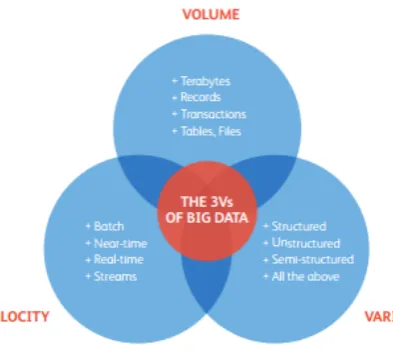
to reach big volume data in few years. These three features: variety in the data structure, growing 57
velocity of data production and big volumes of data represent the three ‘V’ of the Big Data paradigm 58
[7] as shown in Figure2. 59
The medical context includes up to 10,000 known human diseases, however, a physician is able to 60
recall only a small fraction of these diseases at the diagnosis moment. Even if the medical diagnosis 61
are driven by clinical trials and patient anamnesis, diseases misclassification in the diagnosis phase is 62
frequent. According to a study performed in 2012 in an Intensive Care Unit (ICU) of the USA as many 63
as 40,500 patients die annually due to misdiagnosis [8]. 64
In addition, some additional problems must be taken into account: 65
• Data sensitivityof medical records (privacy must be guaranteed) [3,4] 66
• Operational timecomparable with clinical environment time [9,10]. 67
• Patient trustiness, meaning that the system should represent a clinician. Therefore, human-like 68
Figure 2.The 3 Vs of Big Data – Volume, Variety and Velocity
• Massive data handling, since diagnostic by images produces huge amounts of data (not only 70
structured as 3D volumes) [11]. 71
• Context scalability, in order to take into account some sort of distributed computing [3,4]. 72
Those requirements determine to study and realize systems/infrastructure/architecture able to operate 73
on big data analysis, managing at same time computational complexity, scalability, upgradeability and 74
costs [1]. 75
The described need of a smart environment and big computational resources thus push to search 76
proper solutions in the eHealth paradigm. The termeHealth(also written e-health) indicates all the 77
health-care practice supported by electronic elaboration and remote communications [12]. Several 78
different definitions of eHealth has been proposed [13]: some authors consider the term as an extension 79
of health informatics or digital processing of health data [14]; another point of view consider under the 80
eHealth paradigm all the health-care procedures delivered via the Internet [15,16]; the term can be also 81
be referred to health-care services delivered via mobile devices (mHealth) [17] and, finally, in a more 82
general meaning, they can also be considered under the eHealth paradigm all the services or systems 83
laying on the edge of health-care and information technology. 84
In the social network era, communication over the Internet has a strong influence from chat-like 85
conversation model. This new communication approach influenced the social interactions, the business 86
services and the customer care philosophy. health-care and eHealth should benefit from this new 87
communication paradigm performing an human-like interaction that can remove any biasing due to 88
the interaction with an informative system, giving the patient the feeling of a natural conversation 89
and exploiting the possibility of a schema-free conversation interaction. Artificial intelligence, 90
nowadays even more reliable thanks to deep learning approaches, provides automatic and adaptive 91
human-like conversation behaviour via chat-bot applications, enabling user-system interaction able to 92
simulate human behaviour. A chat-bot (also known as a talkbot, chatterbot, Bot, chatterbox, Artificial 93
Conversational Entity) is a software that holds a conversation via message exchange. The final 94
goal of such programs is to convincingly simulate human behaviours to pass the Turing test. Today, 95
chat-bots are used in dialogue systems for several practical purposes including customer service or data 96
collection. The most performing bots use sophisticated Natural Language Processing (NLP) systems 97
and are trained with a deep neural network to better emulate the human behaviours. Many simpler 98
systems scan for keywords within the input, then pull a reply with the most matching keywords, or 99
(ASPs) deploys chat-bot services to be trained on a specific task via example databases and able to 101
interact with the most spread social network and instant messaging application. 102
The aim of this paper is to propose a novel eHealth interaction paradigm where a trained machine 103
learning algorithm, deployed on a cluster-computing framework, provides medical suggestion via 104
a chat-bot module. The chat-bot, trained with deep learning approaches, is able to overcome the 105
limitation of biased interaction between the user and the software providing human behaviour. The 106
whole system is called HOLMeS: Health On-Line Medical Suggestions. 107
The cluster-computing facility is provided by Databricks1, where a cluster of servers allows 108
computing over a Spark framework. The chat-bot application is provided by the Watson Conversation 109
Service, designed and trained via the Bluemix platform. 110
The paper is organised as follows: in Section2we briefly describe the evolution of Decision 111
Support Systems for eHealth applications, while in Section 3we show the tools used to design, 112
to implement and to provide the HOLMeS service. In Section4, we present the proposed system, 113
explaining each module and providing an overview of the complete architecture. Finally, the obtained 114
results are presented in Section5and discussed in Section6, where we also draw some conclusions. 115
2. State of Art
116
The eHealth paradigm is not a new approach in supporting physician in the hard task of giving the 117
right diagnosis. For many years, in this context, the Clinical decision support systems[18] (CDSSs) had 118
a fundamental role in assisting physicians and other health professionals with decision-making tasks, 119
such as determining diagnosis from the patient data. The early CDSSs were designed as two-stage 120
interaction system where the physician put the patient data, the symptoms and few outcomes from 121
clinical tests, receiving the diagnosis. The more advanced CDSSs are able to interact with the physicians 122
and guide them in a progressive process of successive refinement till to the final diagnosis. 123
There are two main types of CDSS: 124
• TheKnowledge-Based CDSSconsist of three parts: a mechanism to communicate (GUI), that 125
allow the system to show the results to the user as well as have to input into the system; a 126
knowledge-base (KB), that contains the rules and associations of compiled data; the inference 127
engine (IE) combines the rules from the knowledge-base with the patient’s data. 128
• The The NonKnowledge-Based CDSS, based on machine learning system which allows
129
learning from past experiences (Ground Truth) and/or finds patterns in clinical data; Two types 130
of non-knowledge-based systems are artificial neural networks (as for developing Computer 131
Aided Diagnosis Systems [19,20]) and genetic algorithms. 132
The first CDSS (in early 1975) was MYCIN [21], an expert system that operated using a fairly 133
simple inference engine and a knowledge base of about 600 rules to identify bacteria causing severe 134
infections, such as bacteremia and meningitis, and to recommend antibiotics, with the dosage adjusted 135
for patient’s body weight. At the same time (in the years 1970-1986) was developed CADUCEUS that 136
worked using an inference engine similar to MYCIN’s; it made a number of changes (like incorporating 137
abductive reasoning) to deal with problems such as the additional complexity of internal diseases, a 138
number of simultaneous diseases and generally flawed and scarce data. With DXplain (1984-1986) the 139
CDSS systems began to be web-oriented providing access through the World Wide Web and, in the 90s 140
(precisely with RODIA in 1997), they began to be used in medical imaging, diagnostics, orthopaedic 141
and other more complex medical disciplines. RODIA provides two major functionality areas: image 142
(x-ray and ultrasonography) quantitative evaluation and fractures healing monitoring [22]. 143
Modern CDSS, such as DiagnosisPro [23], developed in the 2000s is also a web-oriented medical 144
expert system that provides exhaustive diagnostic possibilities for 11,000 diseases and 30,000 findings 145
providing the most appropriate differential diagnosis. The actual web-oriented trend is still growing, 146
both in order to facilitate the diffusion and to exploit greater computing capabilities of servers not 147
always available on conventional workstations. Moreover, this allowed to greatly increase the number 148
of diseases and to engage more complex tasks such as the analysis of biomedical images: It has been 149
claimed that decision support will begin to replace clinicians in common tasks in the future [24]. 150
Among the major services nowadays provided under the eHealth paradigm there are: 151
• Electronic health record: enabling the communication of patient data between different 152
health-care professionals (GPs, specialists etc.); 153
• Computerized physician order entry: a means of requesting diagnostic tests and treatments 154
electronically and receiving the results 155
• ePrescribing: access to prescribing options, printing prescriptions to patients and sometimes 156
electronic transmission of prescriptions from doctors to pharmacists 157
• Clinical decision support system: providing information electronically about protocols and 158
standards for health-care professionals to use in diagnosing and treating patients 159
• Telemedicine: physical and psychological diagnosis and treatments at a distance, including 160
telemonitoring of patients functions; 161
• Consumer health informatics: use of electronic resources on medical topics by healthy individuals 162
or patients; 163
• Health knowledge management: e.g. in an overview of latest medical journals, best practice 164
guidelines or epidemiological tracking (examples include physician resources such as Medscape 165
and MDLinx); 166
• Virtual health-care teams: consisting of health-care professionals who collaborate and share 167
information on patients through digital equipment (for transmural care); 168
• mHealth or m-Health: includes the use of mobile devices in collecting aggregate and patient 169
level health data, providing health-care information to practitioners, researchers, and patients, 170
real-time monitoring of patient vitals, and direct provision of care (via mobile telemedicine); 171
• Medical research using grids: powerful computing and data management capabilities to handle 172
large amounts of heterogeneous data [25]. 173
• Health informatics/health-care information systems: also often refer to software solutions for 174
appointment scheduling, patient data management, work schedule management and other 175
administrative tasks surrounding health 176
To the best of our knowledge, our proposal, HOLMeS: Health On-Line Medical Suggestions is a 177
novelty in the eHealth field. In fact, it offers most of the services required by the eHealth paradigm in 178
an innovative way. 179
3. Big Data tools supporting eHealth applications
180
In recent years the growing amount of data and the need of extrapolating useful information 181
from them, motivated many big players to develop their own deep learning and big data application 182
frameworks. Most common service-oriented architecture are deployed using different service models 183
such as: Software as a Service (SaaS), Platform as a Service (PaaS) and Infrastructure as a Service (IaaS) 184
[26]. In order to understand the techniques, methods and approaches proposed in this work, it is 185
necessary to describe some of such framework. 186
3.1. Apache Spark Cluster 187
Apache Spark is the general-purpose system for cluster computing developed by the Apache 188
foundation [27]. It is designed to provides its services trough high-level APIs available for Java, Scala, 189
Python and R, also supporting different higher-level tools among which it is worth to mention SQL 190
support, Structured Data Processing and MLlib (a machine learning library) [28]. Spark is able to run 191
Standalone, using the included simple cluster manager. 193
Apache Mesos[29], a more general cluster manager able to run Hadoop MapReduce and service 194
applications. 195
Hadoop YARN[30], the standard resource manager for Hadoop 2. 196
3.1.1. Hadoop HDSF 197
The Hadoop Distributed File System (HDFS) is a distributed file system designed to run on 198
commodity hardware [31]. It inherits some characteristics from the others distributed file system, but, 199
by design, it is high fault-tolerant and well suited to work on commodity hardware. It also provides 200
high throughput access to application that use large dataset, even if it is not fully compliant to the 201
POSIX standard in order to provide data streaming. HDFS was originally intended to meet some 202
specific goals: 203
Hardware Failure, since it has to run over hundreds or thousands of commodity server machines. 204
Streaming Data Access, since application that use HDFS usually need batch processing and thus 205
hight throughput is preferred over low access latency. 206
Large Data, supporting ten of millions of files each of size in gigabytes to terabytes. 207
Simple Coherency Model, in order to simplify application access policies, since many applications 208
usually need a write-once-read-many access model for files. 209
Portabilityboth across heterogeneous hardware and software, in order to sustain its usage and 210
diffusion. 211
3.1.2. MapReduce 212
MapReduce is a software framework originally introduced by Google to support computing on 213
big data set with parallel, distributed algorithm on a cluster [32]. A typical MapReduce application is 214
made by two steps: 215
• Map step, that filters and sorts data (for example sorting patient by age, arranging a different 216
queue for each possible age value). 217
• Reduce step, that summarizes the data (for example, counting the number of patients in each 218
queue, producing the age frequencies). 219
The core application manages all operations, primarily by distributing data over different servers, 220
executing all tasks in parallel, managing communication and fault tolerance schemas. One of the most 221
popular open-source implementation of MapReduce is Apache Hadoop [33]. 222
3.1.3. Spark.ML and ML Pipelines 223
Spark.ml, introduced starting from Spark 1.2, is a package that collects the inheritance of the 224
old Spark MLlib, standardizing the Spark API for machine learning application. ML Pipelines is a 225
set of high-level API designed to provide a uniform development strategy to help users creating or 226
combining multiple machine learning algorithms into a single Pipeline (also called work-flow) [34]. 227
A Pipeline is a set of subsequent stages, each of which can be either a Transformer (an abstraction 228
including both feature transformers and trained models) or an Estimator (an abstraction of any king 229
of learning concept or algorithm that trains on data). Stages within a pipeline are executed in order, 230
where the output of a given stage represents the input for the subsequent one. Apache Spark ML 231
support several high-level programming languages, including java, python and scala. 232
3.2. Databricks 233
Databricks refers both to the company founded by the creators of Apache Spark and to the 234
relative cluster infrastructure [35]. It aims to assist users in developing cloud-based big data processing 235
and courses. Databricks provides, in a IaaS model, a virtual analytic platform based on a web-based 237
platform for working with Spark, that provides automated cluster management and IPython-style 238
notebooks. 239
3.3. Watson 240
Watson is an advanced question answering infrastructure, developed by IBM, able to interact 241
in natural language processing. It was developed, in 2011, to answer questions on the quiz show 242
‘Jeopardy!’ [36] winning the final prize. To achieve such task, the Watson inference engine was able to 243
process structured and unstructured contents producing and elaborating up to four TeraBytes of data. 244
In 2013, IBM devotes Watson to commercial applications involving the supercomputer in a decision 245
support task for lung cancer treatment at Memorial Sloan Kettering Cancer Center, in New York City. 246
From that application, several winning strategy leads IBM in successful customer services application. 247
In health-care, the natural language skills, the inference engine and the evidence-based learning 248
capabilities are been applied to contribute to clinical decision support systems for use by several 249
medical professionals. Moreover, Watson Cognitive services are able to draw from 600,000 medical 250
evidence reports, 1.5 million patient records and clinical trials, and two million pages of text from 251
medical journals to help doctors develop treatment plans tailored to patients’ individual symptoms, 252
genetics, and histories. 253
To provide advanced services deployed over the Watson supercomputer, IBM releases Bluemix, a 254
cloud platform as a service (PaaS) supporting several programming languages and cognitive services. 255
Among the newer services provided via the Bluemix platform there is Watson Conversation service. 256
IBM Watson Conversation service, can create, via API interfaces, an application that understands 257
natural-language inputs and uses machine learning to respond to customers in a way that simulates a 258
conversation between humans. 259
4. Methods
260
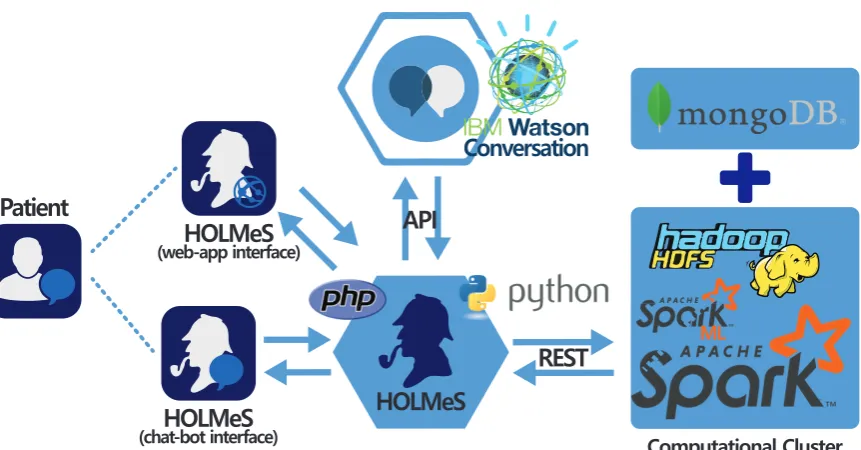
In this work we introduce HOLMeS: Health On-Line Medical Suggestions. It is composed of 261
different modules that collaborate each other to provide an advanced eHealth service through an 262
intuitive chat application (Figure3). 263
The HOLMeS system general architecture is composed as follows: 264
HOLMeS Application is the HOLMeS system core. Written in Python, it implements the main logic 265
and orchestrates modules communications and functions. In particular, it communicates with 266
the user trough the chat-bot, interpreting his requests using the functionalities provided by the 267
Watson Conversation API, managing requests and responses between the patient and application 268
modules in order to provide the disease prevention results. 269
HOLMeS Chat-Bot is the module dedicated to interact with the user, in order to let him feel more 270
conformable. The bot is designed to understand different kinds of chat interactions, from formal 271
writing to more handy ones. It is one of the HOLMeS System entry points and interacts with the 272
user to let him chose the required service. It is also intended to kindly ask the user for required 273
information (such as age, height, weight, smoking status, and so on) just as a human physician 274
would behave. 275
HOLMeS Web-App is the interface dedicated to performing the medical interview via dynamics web 276
forms. The forms change the question fields according to the previous answers, minimizing the 277
interaction while maximizing the quality of the information. The results are provided by bar 278
plots and gauges. Although the web-form interfaces are not as comfortable as a chat-bot, they 279
offer a suitable modality for internet browsers and mobile devices (via mobile-ready interfaces). 280
IBM Watson provides the service needed to establish a written conversation, simulating human 281
interactions, trough its Conversation APIs. Main features include natural language processing 282
*1./G5
EJCVDQVKPVGTHCEG
%QPXGTUCVKQP
*1./G5
/.
%QORWVCVKQPCN%NWUVGT
#2+
4'56
2CVKGPV
*1./G5
YGDCRRKPVGTHCEG
Figure 3.HOLMeS System main modules with interaction paradigm: On bottom-centre the HOLMeS Application core; On the left the HOLMeS Chat-Bot (bottom) and the patient (top) interacting with HOLMeS; On top-centre the IBM Watson Conversation logic adopted by HOLMeS trough its API; On the right the Computational Cluster providing storage, computing and machine learning services used by HOLMeS.
Computational Cluster Implements the decision making logic. It uses the Apache Spark cluster 284
executed over the Databricks infrastructures, in order to be enough fast and scalable to be 285
effectively used in a very big clinical scenario, where many requests from different patients come 286
together, ensuring response time comparable to that of a human physician. It uses machine 287
learning algorithms from Spark ML library, previously trained on many clinical features, in order 288
to predict the expected occurrence probability for different diseases. Finally, the storage service 289
is delegated to Hadoop HDFS and to Mongo DB for storing patient clinical records. 290
HOLMeS is able to handle four possible use-case scenarios: 291
1. Provide general information about itself or the affiliated medical centre. 292
2. Collecting general patient information in order to provide general prevention pathways 293
indications among different disease. 294
3. Collecting detailed patient information (clinical, examination results and so on) in order to 295
evaluate the probability of needing a specific disease prevention partway. 296
4. Book ade-visuexamination with the affiliated medical centre. 297
As described, HOLMeS was designed to be modular, where each concern is associated with a 298
given module. This allows designing and developing each piece separately, in order to better fit specific 299
requirements such as scalability, speed, availability, and so on. In the following we will describe the 300
HOLMeS main functionalities. Finally, the used dataset will be introduced, laying the foundation for 301
results showed in the section5. 302
4.1. The Chat-Bot Interaction Skills 303
HOLMeS Chat-Bot module mimics humans behaviour in order to let him feel more conformable, 304
overcoming the biasing of a ‘machine interaction’. It relies on the IBM Watson Conversation APIs that 305
is able to hold a complete automatic chat with the user. Applying natural language processing and 306
Watson provides high-level dialogue flow design allowing to write down the entire conversation 308
example-by-example. These examples and the interaction model, composed of intents and entities, is 309
used to fine-tune a pre-trained deep neural network. 310
In order to fulfill the four possible uses cases (described above) Watson conversation service has 311
been designed to recognize the following intents: 312
1. #greetings: to handle the initial conversation preamble. 313
2. #book: to describe actions as reserving ade-visuexamination. 314
3. #get: to ask for receive something such as prevention pathways indications or information about 315
the centre. 316
4. #put: to catch the intent of giving the required information to the system. 317
Moreover, several entities useful to contextualize the above intents has been described. The 318
entities are formalized by synonyms. More equivalent formulations of an entity are provided, the 319
more precise will be the subject recognition. Some of the used entities are in the following list: 320
1. @HOLMeS 321
2. @HOLMeS_functionalities 322
3. @clinical_centre 323
4. @address 324
5. @de_visu_examination 325
6. @specific_patway_examination 326
7. @general_patways_examination 327
8. @age 328
9. @sex 329
10. @birthday 330
11. @height 331
Intents and entities are then combined to achieve a fully automated conversation flow by using the 332
‘dialog design toolbox’ of the Bluemix platform. For example, to achieve the initial greeting preamble 333
the application can catch the#greetingintent and, thus, will answer with random greeting sentences. 334
Only after the greeting step is passed, the user can ask for more intents such as#getreferring to a 335
specific entity, for example, the@HOLMeS_functionalities. In this case, HOLMeS will answer with the 336
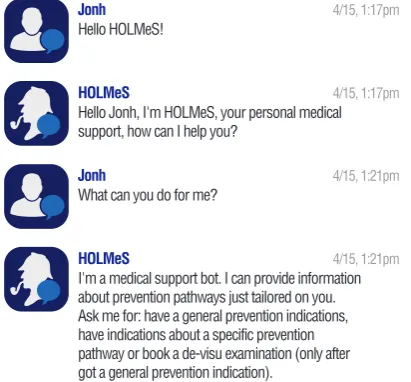
list of all the available functionality the user can ask for. An example of the functionalities described 337
above is depicted in the Figure4. 338
Jonh
Hello HOLMeS!
4/15, 1:17pm
HOLMeS 4/15, 1:17pm
Hello Jonh, I'm HOLMeS, your personal medical support, how can I help you?
Jonh
What can you do for me?
4/15, 1:21pm
HOLMeS 4/15, 1:21pm
I'm a medical support bot. I can provide information about prevention pathways just tailored on you. Ask me for: have a general prevention indications, have indications about a specific prevention pathway or book a de-visu examination (only after got a general prevention indication).
4.2. The Machine Learning algorithm 339
Even if able to understand natural language, the chat-bot alone is not able to provide any kind of 340
medical advice. The simpler way to add this feature is to define a static database and let the bot match 341
user clinical information with those stored in the database, returning all the results obtained by this 342
query. This approach has many limitations, among which it is worth to mention: 343
• A reduced set of possible matches, since the bot can only query the database, without to be able 344
to make inferences on provided data. 345
• A huge work is required by system designers and medical domain experts that have to code all 346
desired diseases causes, aspects and user clinical matching. 347
• A very reduced upgradeability, since if a designer wants the bot to be able to recognize a new 348
disease, he has to re-code all the knowledge-base. 349
The machine learning core aims to overcome all these limitations, sincea)it is able to derive inferences 350
based on uses clinical data,b)autonomously learn the best representation of diseases after a proper 351
training stage and thusc)automatically generates the knowledge-base if new diseases have to be 352
introduced to the system. In particular, to enhance HOLMeS upgradeability, we propose to implement 353
a different classifier for each disease the system has to be able to predict. Finally, in order to combine 354
all classifiers results and to return simple and clear information to the user, a suitable combiner is 355
required. 356
The main advantages of the multi-classifier architecture are: 357
Improved scalability, since classifiers can be easily distributed over a cluster to accommodate 358
growing amount of user request; 359
Reduced computational time, since the schema is high parallelizable because different classifier 360
predictions can be evaluated in parallel; 361
High manutenibility, since any single classifier can be adapted, corrected or improved without any 362
impact on any other system components; 363
High upgradability, since a new classifier can be easily added to make HOLMeS able to deals with 364
any new desired diseases; 365
To deploy our machine learning algorithms, we chose to use Spark as cluster-computing 366
framework deployed over the Databricks infrastructures. Spark provides data storage, implicit 367
data parallelism and fault-tolerance features. The Spark.ML library provides all the data-preparation 368
functionalities and the machine learning algorithms to train the Random Forest models using the 369
collected training data. The same Spark.ML library is, then, used to achieve the final classification for 370
each diseases prevention pathway. Moreover, via the ‘ML pipeline’ paradigm, Spark allows to easily 371
deploy and generate the knowledge-base (represented by the trained model) every time a re-training 372
is required (such as when new diseases or new patients are stored in the database). 373
To be more specific, the HOLMeS machine learning core provides two different working 374
modalities: 375
General-level prevention evaluation, in which the user can query the HOLMeS System, trough the 376
chat bot, in order to have first medical prevention advice submitting some simple clinical features 377
such as age, height, weight, living place, smoking status, some diseases familiarity, and so on. 378
Specific disease prevention evaluation, in which a user can query the HOLMeS System, trough 379
the chat bot, in order to have a more detailed prevention advice about a specific disease by 380
submitting more specific features such as results examination, blood pressure, respiratory and 381
heart rate, oxygen saturation, body temperature, and so on. 382
The output of the machine learning algorithm, deployed in spark, is different according to the 383
required working modality. When a general-level evaluation is required, the algorithm will produce a 384
dataset. This result will be stored in the database and can be retrieved by the physician, when ade-visu 386
examination will occur or can be used by the patient to chose the specific disease to be evaluated in 387
the second working modality. In this last working modality, the user will receive a probability of be 388
affected by the requested disease. 389
4.3. General functionalities 390
The core of the system has in charge to orchestrate the several data flows. Data from and to 391
the patient, through the chat-bot (Fig. 6) or web-app (Fig. 5) interactions, has to be routed to the 392
computational cluster to achieve the final diagnosis. Only the chat-bot skills require the Watson 393
services using Conversation API. The interaction between the user and the application occurs without 394
any further elaboration by the HOLMeS Application that observes the data flow memorizing the 395
information of interest. When interaction requires elaborating machine learning algorithms or accessing 396
to the data storage, the core system contacts the cluster for accomplishing the specific task. 397
Figure 5.Layout of the deployed web application: interface asking for the preliminary in formations.
In order to fulfill the four possible uses cases (as described above) core application needs to catch 398
the following intents: 399
• The user wants information about the affiliated medical centre. 400
• The user asks for general information about the system and its functionalities. 401
• The patient desires to obtain general-level evaluation about the available prevention pathways. 402
• The patient desires to obtain detailed indications about a specific disease prevention pathway 403
(only after a general survey has been carried out). 404
• The patient wants ade-visuexamination (only after a general survey has been carried out). 405
For example, to meet the 2nduse-case scenario, after the greeting preamble, HOLMeS recognize 406
the#getuser intent combined with the@general_patways_examinationentity. Such interaction yield to 407
the data collecting chat flows with the aim of achieving a general-level prevention pathway evaluation. 408
The result of a general-level evaluation conversation should be similar to the graph in Figure7. 409
4.4. Dataset 410
In this paper we focus on the preventive health-care for 13 different diseases. A total of 411
16733 patients prevention records has been collected. Each patient contains a positive or negative 412
ground-truth indicating whether its prevention pathway leads to a positive diagnosis. For each disease, 413
Jonh
Can you give me a general indication for all the prevention patways?
4/15, 1:23pm
HOLMeS 4/15, 1:23pm
You are welcome. I need some general information about you.
I want to ensure you that all your personal data will be treated to the best of the privacy standards and never discloused to other unauthorised people.
Let start! When are you born?
Jonh I’m 42
4/15, 1:25pm
HOLMeS 4/15, 1:25pm
Where do you live? (give me your complete address including city, address, cap, etc...)
Jonh
Via Claudio, 21 Napoli, 80125
4/15, 1:28pm
HOLMeS 4/15, 1:42pm
Jonh, we have finished our preliminary medical survey. I'm sending you an image showing the probability to need a specific disease prevention pathway.
You can open the image by clicking on it.
Now you can choose to have a more specific prevention indication by asking me for a new specific medical survey or you can ask me to book a de-visu visit to our medical centre.
Figure 6.Conversing with HOLMeS via the chat-bot interface: Asking for general indications about the available prevention pathways.
Figure 7.General-level evaluation response (both for chat-bot and web-app interface).
5. Results
415
In this section we report the results obtained by applying the HOLMeS System to the uses case 416
scenario introduced in the previous section. Given the nature of the problem under consideration, it is 417
crucial to validate the results reliability. For this reason, we performed a 10-fold cross validation for 418
each disease prevention pathway, separately for both working modalities. It is worth noticing that 419
the system has to correctly identify all risky patients, while minimising false alarms. To this aim, we 420
chose to compare classifier results in term of Area Under the ROC Curve (AUC-ROC). For both the 421
working modalities, Table2reports the mean values of the 10-fold cross validation evaluated for each 422
disease by means of a Random Forest classifier made of 200 trees and without any limitation on the 423
trees depth; the table also reports the 95% confidence interval and the median value for both working 424
modalities, evaluated over all diseases. 425
Moreover, it is worth noticing that the chat-bot service can successful held a full conversation 426
#Records Age (AVG)
Alzheimer 176 68
Cardiovascular 299 55
Large Bowel 513 53
Diabetes 3955 60
Geriatrics 89 70
Gynecology 1344 46
Obesity 629 50
Diabetic Foot 1075 65
Lung 225 56
Prostate 1045 60
Psychological Obesity 388 50
Breast 5867 47
Thyroid 1128 46
Total 16733 56
Table 1.Dataset size and stats per each prevention pathway.
General Pathway Specific Pathway
(First Level) (Second Level)
Alzheimer 67.08% (±0.06%) 90.60% (±0.06%)
Cardiovascular 71.35% (±0.06%) 83.58% (±0.06%)
Large Bowel 58.07% (±0.04%) 90.16% (±0.04%)
Diabetes 78.94% (±0.03%) 81.21% (±0.03%)
Geriatrics 69.53% (±0.09%) 97.79% (±0.09%)
Gynecology 75.15% (±0.03%) 79.17% (±0.03%)
Obesity 81.80% (±0.04%) 80.20% (±0.04%)
Diabetic Foot 83.00% (±0.03%) 90.88% (±0.03%)
Lung 75.91% (±0.06%) 96.93% (±0.06%)
Prostate 83.68% (±0.03%) 98.82% (±0.03%)
Psychological Obesity 74.65% (±0.06%) 80.30% (±0.06%)
Breast 60.65% (±0.03%) 62.56% (±0.03%)
Thyroid 68.27% (±0.03%) 96.00% (±0.03%)
Median 74.65% 86.78%
Table 2. Classification performance of the general and specific pathway evaluation (first level) per each disease in the dataset. The performances are in terms of Area Under the ROC Curve (AUC-ROC) obtained from a 10-fold cross validation. 95% confidence intervals and median value are reported.
6. Conclusion
428
The aim of this paper was to propose HOLMeS (Health On-Line Medical Suggestions). The 429
proposed approach suggests changing the eHealth paradigm by using a trained machine learning 430
algorithm, deployed on a cluster-computing framework, that provides medical suggestion via a 431
chat-bot module. The chat-bot, trained with deep learning approaches, is able to overcome the 432
limitation of biased interaction between the user and the software simulating human behavior. 433
The results presented in the Section5validates the machine learning algorithms both for the 434
general-level prevention indications and for the disease specific prevention evaluation. It is worth 435
noticing that the second-level evaluation leads to better results (improving the AUC of about 12%) 436
because it exploits more specific features provided by physicians or obtained via further examination. 437
The choice of using a Random Forest classifier was made because when using machine learning 438
in a clinical scenario, it is very important to be able to understand the processes that lead classifier 439
to make its predictions. A Random Forest is an ensemble classifier made of different trees, thus, it is 440
We are currently working on a GUI that allows using knowledge-base and the machine-learning 442
algorithms, deployed in the cluster infrastructure, without conversate with the chat-bot. That will 443
turn HOLMeS into a classical Clinical decision support systems giving to a physician the possibility of 444
continuing the disease prevention evaluation starting from the second-level, when the patient ask for a 445
de-visuexamination. 446
Future works will also focus on improving the trustiness of the chat-bot providing more 447
human-like behaviours and improving the so far implemented uses-case scenarios. Moreover, 448
additional prevention pathways should be added and more patient will be recruited in order to 449
have a complete prevention and a more reliable result. Finally, Watson provides support for different 450
natural languages (such as Brazilian Portuguese, English, French, Italian, Spanish, German, Traditional 451
Chinese, Simplified Chinese, Dutch and Arabic). This multi-language feature could be added to our 452
system pushing the spread of HOLMeS in different countries and helping in the medical knowledge 453
sharing. 454
Author Contributions:All authors read and approved the final manuscript. 455
Acknowledgments: The authors would like to thank CMO - one of the partner of the DATALIFE research
456
consortium - for the availability of the dataset that allowed us to perform the experimentation of such paper. 457
The authors would also like to thank all anonymous reviewers and editors for their helpful suggestions for the 458
improvement of this paper. 459
Conflicts of Interest:The authors declare no conflict of interest. 460
References
461
1. Buyya, R.; Yeo, C.S.; Venugopal, S. Market-oriented cloud computing: Vision, hype, and reality for 462
delivering it services as computing utilities. High Performance Computing and Communications, 2008. 463
HPCC’08. 10th IEEE International Conference on. Ieee, 2008, pp. 5–13. 464
2. Bryant, R.; Katz, R.H.; Lazowska, E.D. Big-Data Computing: Creating Revolutionary Breakthroughs in 465
Commerce, Science and Society, 2008. 466
3. Piantadosi, G.; Marrone, S.; Sansone, M.; Sansone, C. A Secure OsiriX Plug-In for Detecting Suspicious 467
Lesions in Breast DCE-MRI. InAlgorithms and Architectures for Parallel Processing; Springer International 468
Publishing, 2013; pp. 217–224. 469
4. Piantadosi, G.; Marrone, S.; Sansone, M.; Sansone, C. A secure, scalable and versatile multi-layer 470
client–server architecture for remote intelligent data processing. Journal of Reliable Intelligent Environments 471
2015,1, 173–187. 472
5. Pérez, A.; Gojenola, K.; Casillas, A.; Oronoz, M.; de Ilarraza, A.D. Computer aided classification of 473
diagnostic terms in spanish. Expert Systems With Applications2015,42, 2949–2958. 474
6. Arsene, O.; Dumitrache, I.; Mihu, I. Expert system for medicine diagnosis using software agents. Expert 475
Systems with Applications2015,42, 1825–1834. 476
7. Ongenae, F.; Claeys, M.; Dupont, T.; Kerckhove, W.; Verhoeve, P.; Dhaene, T.; De Turck, F. A probabilistic 477
ontology-based platform for self-learning context-aware healthcare applications. Expert Systems with 478
Applications2013,40, 7629–7646. 479
8. Winters, B.; Custer, J.; Galvagno, S.M.; Colantuoni, E.; Kapoor, S.G.; Lee, H.; Goode, V.; Robinson, K.; 480
Nakhasi, A.; Pronovost, P.; others. Diagnostic errors in the intensive care unit: a systematic review of 481
autopsy studies. BMJ quality & safety2012,21, 894–902. 482
9. Marrone, S.; Piantadosi, G.; Fusco, R.; Petrillo, A.; Sansone, M.; Sansone, C. A Novel Model-Based Measure 483
for Quality Evaluation of Image Registration Techniques in DCE-MRI. 2014 IEEE 27th International 484
Symposium on Computer-Based Medical Systems. IEEE, IEEE, 2014, pp. 209–214. 485
10. Piantadosi, G.; Marrone, S.; Fusco, R.; Petrillo, A.; Sansone, M.; Sansone, C. Data-driven selection of motion 486
correction techniques in breast DCE-MRI. 2015 IEEE International Symposium on Medical Measurements 487
and Applications (MeMeA) Proceedings; IEEE: Torino, Italy, 2015; pp. 273–278. 488
11. Marrone, S.; Piantadosi, G.; Fusco, R.; Petrillo, A.; Sansone, M.; Sansone, C. Breast segmentation using 489
Fuzzy C-Means and anatomical priors in DCE-MRI. Pattern Recognition (ICPR), 2016 23rd International 490
12. Della Mea, V. What is e-Health: The death of telemedicine? Journal of Medical Internet Research2001,3, e22. 492
13. Oh, H.; Rizo, C.; Enkin, M.; Jadad, A. What is eHealth?: a systematic review of published definitions. J 493
Med Internet Res2005,7, e1. 494
14. Healy, J. Implementing e-Health in developing countries: Guidance and principles. ICT Applications 495
and Cyber security Division (CYB). Policies and Strategies Department.[monografía en Internet]. Bureau for 496
Telecommunication Development International Telecommunication Union2008. 497
15. Ball, M.J.; Lillis, J. E-health: transforming the physician/patient relationship. International journal of medical 498
informatics2001,61, 1–10. 499
16. Eysenbach, G.; Diepgen, T.L. The role of e-health and consumer health informatics for evidence-based 500
patient choice in the 21st century. Clinics in dermatology2001,19, 11–17. 501
17. O’donoghue, J.; Herbert, J. Data management within mHealth environments: Patient sensors, mobile 502
devices, and databases.Journal of Data and Information Quality (JDIQ)2012,4, 5. 503
18. Berner, E.S.Clinical Decision Support Systems; Springer, 2007. 504
19. Marrone, S.; Piantadosi, G.; Fusco, R.; Petrillo, A.; Sansone, M.; Sansone, C. Automatic Lesion Detection in 505
Breast DCE-MRI. InImage Analysis and Processing (ICIAP); Springer Berlin Heidelberg, 2013; pp. 359–368. 506
20. Piantadosi, G.; Fusco, R.; Petrillo, A.; Sansone, M.; Sansone, C. LBP-TOP for Volume Lesion Classification in 507
Breast DCE-MRI. InLecture Notes in Computer Science (including subseries Lecture Notes in Artificial Intelligence 508
and Lecture Notes in Bioinformatics); 2015; Vol. 9279, pp. 647–657. 509
21. Buchanan, B. Rule based expert systems. The MYCIN Experiments of the Stanford Heuristic Programming 510
Project1984. 511
22. Musen, M.A.; Middleton, B.; Greenes, R.A. Clinical decision-support systems. InBiomedical informatics; 512
Springer, 2014; pp. 643–674. 513
23. Aronson, A.R. DiagnosisPro: the ultimate differential diagnosis assistant. JAMA1997,277, 426–426. 514
24. Khosla, V. Technology will replace 80% of what doctors do. Retrieved April 25, 2013, from 515
http://tech.fortune.cnn.com/2012/12/04/technology-doctors-khosla/, 2012. 516
25. Fingberg, J.; Hansen, M.; Hansen, M.; Krasemann, H.; Iacono, L.L.; Probst, T.; Wright, J. Integrating Data 517
Custodians in eHealth Grids–Security and Privacy Aspects. NEC Lab Report2006. 518
26. Papazoglou, M.P.; Traverso, P.; Dustdar, S.; Leymann, F. Service-oriented computing: State of the art and 519
research challenges. Computer2007,40. 520
27. Spark, A. Apache Spark: Lightning-fast cluster computing, 2015. 521
28. Meng, X.; Bradley, J.; Yavuz, B.; Sparks, E.; Venkataraman, S.; Liu, D.; Freeman, J.; Tsai, D.; Amde, M.; 522
Owen, S.; others. Mllib: Machine learning in apache spark. Journal of Machine Learning Research2016, 523
17, 1–7. 524
29. Kakadia, D.Apache Mesos Essentials; Packt Publishing Ltd, 2015. 525
30. Vavilapalli, V.K.; Murthy, A.C.; Douglas, C.; Agarwal, S.; Konar, M.; Evans, R.; Graves, T.; Lowe, J.; Shah, 526
H.; Seth, S.; others. Apache hadoop yarn: Yet another resource negotiator. Proceedings of the 4th annual 527
Symposium on Cloud Computing. ACM, 2013, p. 5. 528
31. Shvachko, K.; Kuang, H.; Radia, S.; Chansler, R. The hadoop distributed file system. Mass storage systems 529
and technologies (MSST), 2010 IEEE 26th symposium on. IEEE, 2010, pp. 1–10. 530
32. Dean, J.; Ghemawat, S. MapReduce: simplified data processing on large clusters.Communications of the 531
ACM2008,51, 107–113. 532
33. Hadoop, A. Apache hadoop, 2011. 533
34. Meng, X.; Bradley, J.; Sparks, E.; Venkataraman, S. ML pipelines: a new high-level API for MLlib. Databricks 534
blog, https://databricks. com/blog/2015/01/07/ml-pipelines-a-new-high-level-api-for-mllib. html2015. 535
35. Databricks.com. databricks. https://databricks.com/. 536
36. Ferrucci, D.; Levas, A.; Bagchi, S.; Gondek, D.; Mueller, E.T. Watson: beyond jeopardy! Artificial Intelligence 537