International Journal of Asian Social Science, 2014, 4(2): 187-194
† Corresponding author
UNDERSTANDING OF THE CONCEPT OF SUSTAINABILITY VIA SHORT
WRITTEN ASSIGNMENT IN THERMODYNAMICS 1
Nur Irmawati Om
†Department of Mechanical Engineering, College of Engineering, Universiti Tenaga Nasional,
Jalan IKRAM-UNITEN, Kajang, Selangor, Malaysia
Hasril Hasini
Department of Mechanical Engineering, College of Engineering, Universiti Tenaga Nasional,
Jalan IKRAM-UNITEN, Kajang, Selangor, Malaysia
Siti Sarah Ain Fadhil
Department of Mechanical Engineering, College of Engineering, Universiti Tenaga Nasional,
Jalan IKRAM-UNITEN, Kajang, Malaysia
ABSTRACT
The subject of Thermodynamics is important for undergraduate students taking the engineering
degree, in particular mechanical engineering. It has become the core subject for junior
undergraduate engineering students in all universities offering the Mechanical Engineering
programme. The subject deals with the fundamental and principle of the energy conservation and
emphasizes on the foundation of the thermal science and its related concepts. With the current
energy scenario in the world, together with an alarming situation related to environmental issues,
young engineers are expected to be sensible in balancing future development and various
environmental concerns. Thus many institutions have embarked on the introduction of the
sustainability concept to graduating engineers. Different methods were introduced in order to
ensure that graduating engineers are well-equipped with the knowledge and understanding of
sustainability related issues. One method is to slowly integrates the concept during the early years
in the engineering program. This paper describes the investigation of the effectiveness of such
introduction of the sustainability concept through one of the most important subject in earlier years
of engineering program. In this subject, the concept of sustainability is introduced through
lectures, tutorials and assignment. In general, the assessments were distributed through written
mode such as tutorial assignment, homework assignment, midterm examination and final
examination.
© 2014 AESS Publications. All Rights Reserved.
International Journal of Asian Social Science
ISSN(e): 2224-4441/ISSN(p): 2226-5139
Special Issue:
International Conference on Teaching and
Learning in Education, 2013
Keywords:
Sustainability, Thermodynamics, Written assignment, Student, Engineering, Grade.1.
INTRODUCTION
Sustainable development is one of the most important aspects that need to be taken into consideration in the world of engineering where critical elements such as social, economic and environmental are carefully integrated. This is crucial to reduce global imbalance and at the same time enhancing the needs of present and future generations. The past decade has witnessed international interesting incorporation of the skills, attitudes and concepts of sustainability into undergraduate university courses across a wide range of disciplines (Wright, 2002). Awareness of sustainability among young engineer is very important as many of the sustainability issues are related to the engineering discipline. This awareness needs to be applied at early university level to enable good understanding and affection of the concept. In addition, the culminating experience students learned from the junior towards the senior year will further enhanced the understanding of the concept by the time they graduate. The introduction of the sustainability concept at early university year is intended to give an initial exposure on the concept of sustainability. It is envisaged that this understanding will sustain as they progress towards the senior years. Thus, taking into account on the cumulative experience in various teaching and learning activities throughout the university years, it is hoped that graduates are able to master the understanding of the sustainability when they start their working career.
In 2000, Engineers Australia implemented an accreditation process that mandated that academics must ensure that students understand sustainability by the time of graduation (Engineers Australia, 2005). This is one of the efforts made in Australia in implementing sustainability development to graduate students in their country. As the main medium in transferring knowledge and skills to students, lecturer plays an important role to ensure that the engineering graduates are aware of what and how to implement sustainability in engineering professional practice. Various methods can be utilized that includes the introduction of sustainability concept in several courses according to the respected engineering disciplines. This has been comprehensively discussed by Waas et al. (Waas et al., 2010).
Methods to understand sustainability can be considered limitless. There are many other ways to implements sustainability in the context of engineering. For example, Wells conducted course that focusing on design of sustainable plant (Wells, 2002). Lemkowitz et al. explained the characteristics in raising students’ moral and intellectual criticality towards to sustainability development (Lemkowitz et al., 2002). Tilbury et al. elaborated that awareness of sustainability is a fundamental element to implement the concept of sustainable development in higher education (Tilbury et al., 2005). Velázquez et al. emphasized that the lack of sustainability awareness and knowledge will cause the unsustainable behaviour among students and communities (Velazquez et al., 2006). Based on Dahle and Neumayer, the misunderstanding of the meaning of sustainable development can affect the environmental interest among students and intensive costs associated with implementing green initiatives could incur (Dahle and Neumayer, 2001).
© 2014 AESS Publications. All Rights Reserved.
graduates are well-versed with the concept, elements of sustainability were introduced into selected courses at different levels starting from junior undergraduate to senior years. One of the most effective efforts is to introduce specific course in sustainability, called Sustainability Engineering which is taught during the final year of the bachelor program. However, it is thought that the effectiveness towards understanding of sustainability can be further enhanced by introducing the awareness of the concept during the junior level. Thus, the element of sustainability was made compulsory in selected courses which spread over different level of study. In this case, simple task was given to students in compulsory course, Thermodynamics 1 which is taught to second year, first semester students. The element of sustainability is most suited to be integrated in this Thermodynamics 1 course due to the nature of the course itself which emphasize the study of energy. With the analysis of energy, the concept of sustainability could be easily integrated in any chapters within the course.
This paper presents the study on the effectiveness of the introduction of the concept of sustainability in Thermodynamics 1 subject. In this course, the assessment on the element of sustainability is done through written assignment on a given topic. The analysis of the effectiveness of understanding sustainability is done based on students’ performance in the assignments, tests and also final examination.
2.
ASSESSMENTS METHODOLOGY
In Universiti Tenaga Nasional (UNITEN), the mechanical and electrical engineering students are required to take Thermodynamics 1 in the first or second year of their bachelor program. In this subject, students are introduced with the study of energy that include, conservation of mass and energy, first and second law of thermodynamics, steam power cycle and refrigeration cycle. It was found that the concept of sustainability engineering could be easily integrated into Thermodynamics 1 due to the nature of the subject which deals with energy-related processes. Thus, a wide variety of energy-related processes could be tailored to the applications of sustainability simply by using the concept of minimum loss and impact to the surrounding environment.
In the last few semesters, a new approach was implemented to instill the concept of sustainability to the students. This is done by assigning ‘information-searching’ concept of assignment as part of the assessment in Thermodynamics 1. The main objective of the assignment is to instill the concept of sustainability to the student by assigning ‘scenario based’ questions to where student is required to answer by searching information from variety of sources.
Figure-1. Example of Sustainability Assignment
3.
RESULTS AND DISCUSSIONS
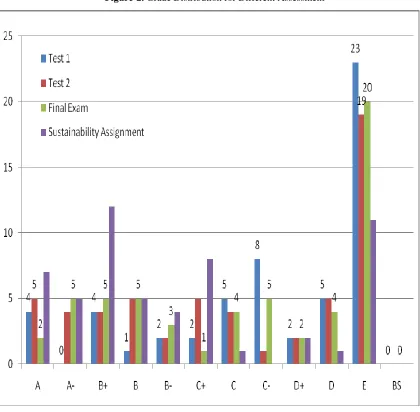
3.1.Comparison of Grade Distribution for Different Assessments
© 2014 AESS Publications. All Rights Reserved.
Figure-2. Grade Distribution for Different Assessment
3.3. Comparison of Sustainability Assignment Grade Distribution in Different Sections Large class size was divided into several sections. Ideally, each section consists of the maximum of 60 students to ensure good teaching and learning environment. For courses which consist of more than one section, ideally, they are taught by the same lecturer to ensure consistency. However, when the class size is very large, different lecturers have to teach different sections. Due to different approaches of teaching and different entry level for different section, it is difficult to determine the factor that influences the performance of students in understanding sustainability for different sections. Figure 4 shows the comparison of grade distribution for sustainability assignment for Section 1 and 2. Both sections are conducted by different lecturer, with different student background. Based on the figure, it is clear that student in Section 2 earned higher marks as compared to the student in Section 1. The difference between the performances shown by the two sections is difficult to determined and needs detail investigations. Nevertheless, the difference could be attributed to different entry background of the students. On top of that it could also be attributed by different skill of teachers teaching the two sections.
© 2014 AESS Publications. All Rights Reserved.
Figure-4. Grade Distribution for Sustainability Assignment in Different Section
4.
CONCLUSION
This study investigates the effectiveness of the introduction of sustainability concepts at the early stage in a bachelor degree program for engineering student in UNITEN. Thermodynamics 1 course is chosen for analysis due to the fact that the subject deals with the fundamental concepts of energy conservation and therefore make it easy to integrate the element of sustainability into one of the chapter application. It was found that awareness of the concept could be done by assigning a small percentage of the total marks for the course to an assessment that contain elements of sustainability. In this case, 5% weightage is reasonable for junior level course and the weightage could be increased should the need to raise the awareness on sustainability increases. The contribution of this assessment towards the final grade of the course was found to be insignificant but sufficient enough to impart knowledge and understanding of the sustainability concept to the students.
5. ACKNOWLEDGEMENTS
The author would like to acknowledge all the lecturers teaching the subject Thermodynamic 1 for providing the data and invaluable discussion on the subject.
REFERENCES
Dahle, M. and E. Neumayer, 2001. Overcoming barriers to campus greening: A survey among higher
educational institutions in London, UK. Int. J. of Sustainability in Higher Education, 2(2): 139-160.
Engineers Australia, 2005. Accreditation criteria summary, accreditation management system education
programs at the level of professional engineer. Doc No. S02.
Lemkowitz, S.M., G. Korevaar, J. Bonnet and G.H. Lameris, 2002. Intellectually responsible teaching of
Engineering Education in Sustainable Development Conference. The Netherland: Delft University.
pp: 55-62.
Tilbury, D., A. Keogh, A. Leighton and J. Kent, 2005. A national review of environmental education and its
contribution to sustainability in Australia: Further and higher education. Canberra: Australian
Government Department of the Environment and Heritage and Australian Research Institute in
Education for Sustainability (ARIES).
Velazquez, L., N. Munguia, A. Platt and J. Taddei, 2006. Sustainable university: What can be matter? J.
Clean. Prod, 14: 810-819.
Waas, T., A. Verbruggen and T. Wright, 2010. University research for sustainable development: Definition
and characteristics explored. J. Clean. Prod, 18(7): 629-636.
Wells, P., 2002. Towards a philosophy of sustainable engineering, in: Proceedings of Engineering Education
in Sustainable Development Conference. The Nertherlands: Delft University. pp: 48-56.
Wright, T.S.A., 2002. Definition and frameworks for environment sustainability in higher education.
International Journal of Sustainability in Higher Education, 3(3): 203-209.